Title
Mark, for whom this Gospel is named, was a close companion of the apostle Peter and a recurring character in the Book of Acts, where he is known as “John whose surname was Mark” (Acts 12:12, 25; cf. 15:37, 39). It was to John Mark’s mother’s home in Jerusalem that Peter went when released from prison (Acts 12:12).
John Mark was a cousin of Barnabas (Col. 4:10), and he accompanied Paul and Barnabas on Paul’s first missionary journey (Acts 12:25; 13:5). But he deserted them along the way in Perga and returned to Jerusalem (Acts 13:13). When Barnabas wanted Paul to take John Mark on the second missionary journey, Paul refused. The friction that resulted between Paul and Barnabas led to their separation (Acts 15:38–40).
But John Mark’s earlier vacillation evidently gave way to great strength and maturity, and, in time, he proved himself even to the apostle Paul. When Paul wrote the Colossians, he instructed them that, if John Mark came, they were to welcome him (Col. 4:10). Paul even listed Mark as a fellow worker (Philem. 24). Later, Paul told Timothy to “get Mark and bring him with you, for he is useful to me for ministry” (2 Tim. 4:11).
John Mark’s restoration to useful ministry may have been due, in part, due to the ministry of Peter. Peter’s close relationship with Mark is evident from his description of him as “Mark my son” (1 Pet. 5:13). Peter, of course, was no stranger to failure himself, and his influence on the younger man was no doubt instrumental in helping Mark out of the instability of his youth and into the strength and maturity he would need for the work to which God had called him.
Author and Date
Unlike the Epistles, the Gospels do not name their authors. The early church fathers, however, unanimously affirmed that Mark wrote this second Gospel. Papias, bishop of Hieropolis,writing about A.D. 140, noted: “The presbyter [the apostle John] said this: Mark having become the interpreter of Peter, wrote down accurately whatsoever he remembered. It was not, however, in exact order that he related the sayings or deeds of Christ. For he neither heard the Lord nor accompanied Him. But afterwards, as I said, he accompanied Peter, who accommodated his instructions to the necessities [of his hearers], but with no intention of giving a regular narrative of the Lord’s sayings. Wherefore Mark made no mistake in thus writing some things as he remembered them. For of one thing he took especial care, not to omit anything he had heard, and not to put anything fictitious into the statements” (from the Exposition of the Oracles of the Lord, 6).
Justin Martyr, writing about A.D. 150, referred to the Gospel of Mark as “the memoirs of Peter,” and suggested that Mark committed his Gospel to writing while in Italy. This agrees with the uniform voice of early tradition, which regarded this Gospel as having been written in Rome, for the benefit of Roman Christians. Irenaeus, writing about A.D. 185, called Mark “the disciple and interpreter of Peter,” and recorded that the second Gospel consisted of what Peter preached about Christ. The testimony of the church fathers differs as to whether this Gospel was written before or after Peter’s death (C. A.D. 67–68).
Evangelical scholars have suggested dates for the writing of Mark’s Gospel ranging from A.D. 50 to 70. A date before the destruction of Jerusalem and the temple in A.D. 70 is required by the comment of Jesus in 13:2. Luke’s Gospel was clearly written before Acts (Acts 1:1–3). The date of the writing of Acts can probably be fixed at about A.D. 63, because that is shortly after the narrative ends (see Introduction to Acts: Author and Date). It is therefore likely, though not certain, that Mark was written at an early date, probably some time in the 50s.
Background and Setting
Whereas Matthew was written to a Jewish audience, Mark seems to have targeted Roman believers, particularly Gentiles. When using Aramaic terms, Mark translates them for his readers (3:17; 5:41; 7:11, 34; 10:46; 14:36; 15:22, 34). On the other hand, in some places he uses Latin expressions instead of their Greek equivalents (5:9; 6:27; 12:15, 42; 15:16, 39). He also reckons time according to the Roman system (6:48; 13:35) and carefully explains Jewish customs (7:3, 4; 14:12; 15:42). Mark omits Jewish elements, such as the genealogies found in Matthew and Luke. This Gospel also makes fewer references to the OT, and includes less material that would be of particular interest to Jewish readers—such as that which is critical of Jesus’ critiques of the Pharisees and Sadducees (Sadducees are mentioned only once, in 12:18). When mentioning Simon of Cyrene (15:21), Mark identifies him as the father of Rufus, a prominent member of the church at Rome (Rom. 16:13). All of this evidence supports the traditional view that Mark was written for a Gentile audience initially at Rome.
Historical and Theological Themes
Mark presents Jesus as the suffering Servant of the Lord (10:45). His focuses is on the deeds of Jesus more than on His teaching, particularly emphasizing His service and sacrifice. Mark omits the lengthy discourses found in the other Gospels, often relating only brief excerpts to give the gist of Jesus’ teaching. Mark also omits any account of Jesus’ ancestry and birth and begins instead where Jesus’ public ministry began—with His baptism by John the Baptist in the wilderness.
Mark demonstrates the humanity of Christ more clearly than any of the other evangelists, emphasizing Christ’s human emotions (1:41; 3:5; 6:34; 8:12; 9:36), His human limitations (4:38; 11:12; 13:32), and other small details that highlight the human side of the Son of God (e.g., 7:33, 34; 8:12; 9:36; 10:13–16).
Interpretive Challenges
Three significant questions confront the interpreter of Mark: (1) What is the relationship of Mark to Luke and Matthew? (see below, “The Synoptic Problem” ); (2) how should one interpret the eschatological passages? (see notes on chs. 4; 13 ); and (3) were the last twelve verses of chapter 16 originally part of Mark’s Gospel? (see note on 16:9–20 ).
The Synoptic Problem
Even a cursory reading of Matthew, Mark, and Luke reveals both striking similarities (cf. 2:3–12; Matt. 9:2–8; Luke 5:18–26) and significant differences, as each portrays the life, ministry, and teaching of Jesus. The issue of how to explain those similarities and differences is known as the Synoptic Problem (syn means “together”; optic means “seeing”).
The modern solution—even among evangelicals—has been to assume that some form of literary dependence exists between the synoptic Gospels. The most commonly accepted theory to explain such an alleged literary dependence is known as the “Two-Source” theory. According to that hypothesis, Mark was the first Gospel written, and Matthew and Luke then used Mark as a source in writing their Gospels. Proponents of this view imagine a non-existent, second source labeled Q (from the German word Quelle, “source”), and argue that this allegedly is the source of the material in Matthew and Luke that does not appear in Mark. They advance several lines of evidence to support their scenario.
First, most of Mark is paralleled in Matthew and Luke. Since Mark is much shorter than Matthew and Luke, the latter must be expansions of Mark. Second, the three Gospels follow the same general chronological outline, but when either Matthew or Luke departs from Mark’s chronology, the other agrees with Mark. Put another way, Matthew and Luke do not both depart from Mark’s chronology in the same places. That, it is argued, shows that Matthew and Luke used Mark for their historical framework. Third, in passages common to all three Gospels, Matthew’s and Luke’s wording seldom agrees when it differs from Mark’s. Proponents of the “Two-Source” theory see that as confirmation that Matthew and Luke used Mark’s Gospel as a source.
But those arguments do not prove that Matthew and Luke used Mark’s Gospel as a source. In fact, the weight of evidence is strongly against such a theory:
1. The nearly unanimous testimony of the church until the nineteenth century was that Matthew was the first Gospel written. Such an impressive body of evidence cannot be ignored.
2. Why would Matthew, an apostle and eyewitness to the events of Christ’s life, depend on Mark (who was not an eyewitness)—even for the account of his own conversion?
3. A significant statistical analysis of the synoptic Gospels has demonstrated that the parallels between them are far less extensive and the differences more significant than is commonly acknowledged. The differences, in particular, argue against literary dependence between the Gospel writers.
4. Since the Gospels record actual historical events, it would be surprising if they did not follow the same general historical sequence. For example, the fact that three books on American history all had the Revolutionary War, the Civil War, World War I, World War II, the Vietnam War, and the Gulf War in the same chronological order would not prove that the authors had read one another’s books. General agreement in content does not prove literary dependency.
5. The passages in which Matthew and Luke agree against Mark (see the third argument in favor of the “Two-Source” theory) amount to about one-sixth of Matthew and one-sixth of Luke. If they used Mark’s Gospel as a source, there is no satisfactory explanation for why Matthew and Luke would so often both change Mark’s wording in the same way.
6. The “Two-Source” theory cannot account for the important section in Mark’s Gospel (6:45–8:26) which Luke omits. That omission suggests that Luke had not seen Mark’s Gospel when he wrote.
7. There is no historical or manuscript evidence to indicate that the Q document ever existed; it is purely a fabrication of modern skepticism and possibly a way to deny the verbal inspiration of the Gospels.
8. Any theory of literary dependence between the Gospel writers overlooks the significance of their personal contacts with one another. Mark and Luke were both companions of Paul (cf. Philem. 24); the early church (including Matthew) met for a time in the home of Mark’s mother (Acts 12:12); and Luke could easily have met Matthew during Paul’s two-year imprisonment at Caesarea (see note on Acts 27:1 ). Such contacts make theories of mutual literary dependence unnecessary.
The simplest solution to the Synoptic Problem is that no such problem exists! Because critics cannot prove literary dependence between the Gospel writers, there is no need to explain it. The traditional view that the Gospel writers were inspired by God and wrote independently of one another—except that all three were moved by the same Holy Spirit (2 Pet. 1:21)—remains the only plausible view.
As the reader compares the various viewpoints in the Gospels, it becomes clear how well they harmonize and lead to a more complete picture of the whole event or message. The accounts are not contradictory, but complementary, yielding a fuller understanding when brought together. Apparent difficulties are dealt with in the notes of each Gospel.
I. PROLOGUE: IN THE WILDERNESS (1:1–13)
1:1 The beginning . . . the Son of God. This is best viewed as Mark’s title for his Gospel. The historical record of the gospel message began with John the Baptist (cf. Matt. 11:12; Luke 16:16; Acts 1:22; 10:37; 13:24). gospel. The Good News about the life, death, and resurrection of Jesus Christ, of which the four Gospels are written records (see Introduction to the Gospels). Jesus Christ. “Jesus” is the Greek form of the Hebrew name Joshua (“the LORD is salvation”); “Christ” (“anointed one”) is the Greek equivalent of the Hebrew word “Messiah.” “Jesus” is the Lord’s human name (cf. Matt. 1:21; Luke 1:31); “Christ” signifies His office as ruler of God’s coming kingdom (Dan. 9:25, 26). Son of God. An affirmation of Jesus’ deity, stressing His unique relationship to the Father (cf. 3:11; 5:7; 9:7; 13:32; 15:39; see note on John 1:34 ).
1:2 it is written. A phrase commonly used in the NT to introduce OT quotes (cf. 7:6; 9:13; 14:21, 27; Matt. 2:5; 4:4, 6, 7; Luke 2:23; 3:4; John 6:45; 12:14; Acts 1:20; 7:42; Rom. 3:4; 8:36; 1 Cor. 1:31; 9:9; 2 Cor. 8:15; 9:9; Gal. 3:10; 4:22; Heb. 10:7; 1 Pet. 1:16). in the Prophets. The better Greek manuscripts read “Isaiah the prophet.” Mark’s quote is actually from two OT passages (Is. 40:3; and Mal. 3:1), which probably explains the reading “the Prophets” found in some manuscripts. The Gospels all introduce John the Baptist’s ministry by quoting Isaiah 40:3 (cf. Matt. 3:3; Luke 3:4; John 1:23). My messenger. John was the divinely-promised messenger, sent to prepare the way for the Messiah. In ancient times, a king’s envoys would travel ahead of him, making sure the roads were safe and fit for him to travel on, as well as announcing his arrival.
1:4 John. A common Jewish name in NT times, it is the Greek equivalent of the Hebrew name Johanan (cf. 2 Kin. 25:23; 1 Chr. 3:15; Jer. 40:8), meaning “the Lord is gracious.” John’s name was given by the angel Gabriel to his father Zacharias, during his time of priestly service in the temple (Luke 1:13). His mother, Elizabeth, also a descendant of Aaron (Luke 1:5), was a relative of Mary the mother of Jesus (Luke 1:36). As the last OT prophet and the divinely ordained forerunner of the Messiah (see note on v. 2 ), John was the culmination of OT history and prophecy (Luke 16:16) as well as the beginning of the historical record of the gospel of Jesus Christ. Not surprisingly, Jesus designated John as the greatest man who had lived until his time (Matt. 11:11). baptizing. Being the distinctive mark of John’s ministry, his baptism differed from the ritual Jewish washings in that it was a one-time act. The Jews performed a similar one-time washing of Gentile proselytes, symbolizing their embracing of the true faith. That Jews would participate in such a rite was a startling admission that they, although members of God’s covenant people, needed to come to God through repentance and faith just as Gentiles did. in the wilderness. The desolate, arid region between Jerusalem and the Dead Sea (see note on Matt. 3:1 ). baptism of repentance. A baptism resulting from true repentance. John’s ministry was to call Israel to repentance in preparation for the coming of Messiah. Baptism did not produce repentance, but was its result (cf. Matt. 3:7, 8). Far more than a mere change of mind or remorse, repentance involves a turning from sin to God (cf. 1 Thess. 1:9), which results in righteous living. Genuine repentance is a work of God in the human heart (Acts 11:18). For a discussion of the nature of repentance, see notes on 2 Corinthians 7:9–12. for the remission of sins. John’s rite of baptism did not produce forgiveness of sin (see notes on Acts 2:38; 22:16 ); it was only confessed outwardly and illustrated the true repentance that results in forgiveness (cf. Luke 24:47; Acts 3:19; 5:31; 2 Cor. 7:10).
1:5 all the land of Judea, and those from Jerusalem. After centuries without a prophetic voice in Israel (Malachi had prophesied more than four hundred years earlier), John’s ministry generated an intense amount of interest. Judea. The southernmost division of Palestine (Samaria and Galilee being the others) in Jesus’ day. It extended from about Bethel in the north to Beersheba in the south, and from the Mediterranean Sea in the west to the Dead Sea and the Jordan River in the east. Included within Judea was the city of Jerusalem. Jordan River. Palestine’s major river flows through the Jordan Rift Valley from Lake Hula (drained in modern times), north of the Sea of Galilee, south to the Dead Sea. According to tradition, John began his baptizing ministry at the fords near Jericho. confessing. To confess one’s sins, as one is being baptized, is to agree with God about them. John baptized no person who did not confess and repent of his sins.
1:6 camel’s hair . . . leather belt. These traditional clothes of a wilderness dweller were sturdy, but they were not fashionable or comfortable. John’s clothing would have reminded his audience of the prophet Elijah (cf. 2 Kin. 1:8), whom they expected to come before Messiah (Mal. 4:5; cf. Matt. 17:10–13). locusts and wild honey. The OT dietary regulations permitted the eating of locusts (Lev. 11:21, 22). Wild honey could often be found in the wilderness (Deut. 32:13; 1 Sam. 14:25–27). John’s austere diet was in keeping with his status as a lifelong Nazirite (cf. Luke 1:15; see notes on Num. 6:2–13 ).
1:7 preached Better translated “proclaimed.” John was Jesus’ herald, sent to announce His Coming (see note on v. 4 ). whose sandal strap I am not worthy to stoop down and loose. The most menial task a slave could perform. John vividly expresses his humility.
1:8 baptize you with the Holy Spirit. This baptism takes place when a person comes to faith in Christ (see notes on Acts 1:5; 8:16, 17; 1 Cor. 12:13 ).
1:9 in those days. At some unspecified time during John’s baptizing ministry at the Jordan River. Nazareth. An obscure village (not mentioned in the OT, or by Josephus, or in the Talmud) about seventy miles north of Jerusalem, that did not enjoy a favorable reputation (cf. John 1:46). Jesus had apparently been living there before His public appearance to Israel. baptized by John. This was done over John’s objections (cf. Matt. 3:14) because he saw no need for the sinless Lamb of God (John 1:29) to participate in a baptism of repentance (see notes on vv. 4, 5; for an explanation of why Jesus was baptized, see note on Matt. 3:15 ).
1:10 immediately. In keeping with his fast-paced narrative style (see Introduction to the Gospels), Mark uses this adverb more than the other three Gospel writers combined. This first occurrence sets the stage for the audible and visible signs that followed Jesus’ baptism. the Spirit descending upon Him like a dove. This was most likely symbolic of Jesus’ empowerment for ministry (Is. 61:1). See note on Matthew 3:16, 17.
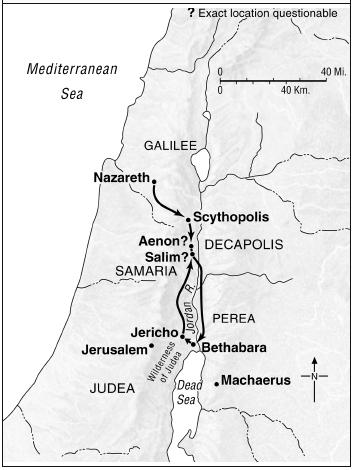
The MacArthur Bible Handbook, by John MacArthur (Nashville: Thomas Nelson Publishers, 2003) 316. © 2003 by Thomas Nelson, Inc.
1:11 The Father’s pronouncement would have reminded the audience of the messianic prophecies of Psalm 2:7 and Isaiah 42:1.
C. Jesus’ Temptation (1:12, 13)
1:12 Immediately. See note on verse 10. Jesus’ temptation came right after His baptism. the Spirit drove Him. Compelled by the Spirit, Jesus confronted Satan and took the first step toward overthrowing his evil kingdom (cf. 1 John 3:8). Though God tempts no one (James 1:13), He sometimes sovereignly permits Satan to tempt His people (e.g., Job; Luke 22:31, 32). the wilderness. The exact location of Jesus’ encounter with Satan is unknown. It most likely would have been the same wilderness where John lived and ministered (see note on v. 4 ), the desolate region farther south, or the arid Arabian desert across the Jordan River.
1:13 forty days. Perhaps this was reminiscent of Israel’s forty years of wandering in the wilderness (Num. 14:33; 32:13). Matthew and Luke add that Jesus went without food during this time. Moses (twice, Deut. 9:9, 18) and Elijah (1 Kin. 19:8) also fasted for that length of time. Satan. This name comes from a Hebrew word meaning “adversary.” Since He had no fallen nature, Jesus’ temptation was not an internal emotional or psychological struggle, but an external attack by a personal being. wild beasts. A detail unique to Mark’s account, emphasizing Jesus’ loneliness and complete isolation from other people. angels ministered to Him. Cf. Psalm 91:11, 12. The tense of this Greek verb, “to minister,” suggests the angels ministered to Jesus throughout His temptation.
II. BEGINNING HIS MINISTRY: IN GALILEE AND THE SURROUNDING REGIONS (1:14–7:23)
A. He Announces His Message (1:14, 15)
1:14 John was put in prison. He was incarcerated for rebuking Herod Antipas over his incestuous marriage to his niece, Herodias (see notes on 6:17–27 ). Jesus came to Galilee. From Judea (Matt. 4:12; Luke 4:13; John 4:3). Mark, along with Matthew and Luke, passes directly from the temptation to the beginning of the Galilean ministry, skipping Jesus’ intervening ministry in Judea (John 2:13–4:4). Galilee was the northernmost region of Palestine, and the most heavily populated. the gospel . . . of God. The Good News of salvation both about God and from Him (see note on Rom. 1:1; cf. Rom. 15:16; 1 Thess. 2:2, 8, 9; 1 Tim. 1:11; 1 Pet. 4:17).