Study Notes
 1:1 word of the LORD. See Hos 1:1 and note. Micah. Means “Who is like the LORD?” (cf. 7:18 and note). Moresheth. See Introduction: Author; see also photo. Jotham, Ahaz and Hezekiah. See Introduction: Date. For background on these kings and the book of Micah, see Introduction: Historical Background. Isaiah, Hosea and Micah prophesied at roughly the same time (Isa 1:1; Hos 1:1). vision. See Pr 29:18; Isa 1:1 and notes. Samaria and Jerusalem. The capitals of Israel and Judah, respectively. The judgment predicted by Micah involved these nations and not just their capital cities.
1:2—2:13 The first cycle of judgment (1:2—2:11) and salvation/restoration (2:12–13; see Introduction: Outline).
1:2–7 A divine covenant lawsuit, including a theophany (appearance of God, vv. 3–4). The Divine Warrior comes to judge Samaria and Israel (through Assyria).
1:2 Hear. The Hebrew for this word introduces prophetic addresses also in 3:1 and 6:1, where it is translated “Listen” (see also 3:9; 6:2). peoples . . . earth. All nations—an announcement that the day of the Lord is at hand (see Am 5:18 and note), when God will call the nations to account. In view of that day Micah speaks in his prophecy of the impending judgments on Israel and Judah. holy temple. Heaven (v. 3), as in Ps 11:4; Jnh 2:7; Hab 2:20.
1:3 The LORD is coming. An OT expression describing the Lord’s intervention in history (see Ps 18:9; 96:13 and note; 144:5; Isa 26:21; 31:4; 64:1–3). heights of the earth. May refer to mountains as well as to pagan shrines, since both are cited here (vv. 4–5). Cf. Am 4:13; see Dt 33:29.
1:4 mountains melt . . . like wax. See Ps 18:6–7; 97:5; Na 1:5; Hab 3:3 and note.
1:5 All this. The Lord’s coming in judgment (vv. 3–4). Jacob’s. Jacob was an alternate name for Israel (see Ge 32:28 and note; 35:10). Israel. Here (and in v. 13) specifically the northern kingdom, but Micah uses the name also for the southern kingdom (3:1,8–9; 5:1,3; 6:2) and for the whole covenant people (vv. 14–15; 2:12; 5:2). high place. Pagan center of idolatry (see note on 1Ki 3:2).
1:6–7 God is the speaker. This prophecy was fulfilled during Micah’s lifetime when Assyria destroyed Samaria in 722–721 bc (see 2Ki 17:6 and note).
1:6 heap of rubble. Cf. 3:12 and note. into the valley. Samaria was built on a hill (see 1Ki 16:24 and note).
 1:7 prostitutes. Prostitution is often an OT symbol for idolatry or spiritual unfaithfulness (see Ex 34:15 and note; Jdg 2:17; Eze 23:29–30). wages. The wealth that Samaria had gained from its idolatry will be taken by the Assyrians and placed in their own temples, to be used again in the worship of idols.
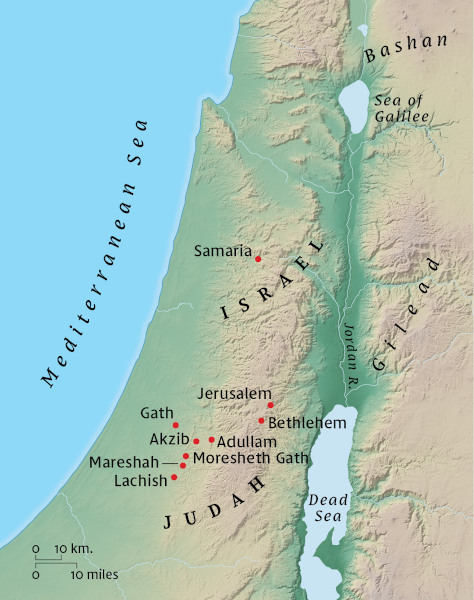
1:8–16 Micah laments not only the imminent destruction of Samaria but also the coming invasion of Judah, fulfilled by Sennacherib of Assyria in 701 bc (see map).
1:8 this. The coming destruction of Samaria. barefoot. A sign of mourning (see 2Sa 15:30 and note). It is possible that Micah actually walked stripped and barefoot through Jerusalem (cf. Isa 20:2). The concept of mourning frames this section (v. 16). naked. Perhaps clothed only in a loincloth.
1:9 plague. The judgment about to overtake Samaria. incurable. See Isa 1:6; see also Isa 17:11; Jer 30:12 and notes. gate. The Assyrian destruction of the northern kingdom will spread like a malignant disease to “the gate of Jerusalem” (v. 12; see note on vv. 8–16). The gate was where the process of town government was carried on (see Ge 19:1 and note; Ru 4:1–4 and note on 4:1).
1:10–15 Several wordplays are explained in the NIV text notes. The towns mentioned lie in the Shephelah, i.e., the foothills (500–1,500 feet high) between the Mediterranean coastal plain and the mountains of Judah.
1:10 Tell it not in Gath. These words introduce a funeral lament over Judah. Micah did not want the pagan people in Gath to gloat over the downfall of God’s people (see 2Sa 1:20 and note). roll in the dust. As a sign of grief over the coming catastrophe. See Isa 47:1 and note.
1:11 naked and in shame. A reference to their future humiliation as prisoners (Isa 20:4). will not come out. Because of the invasion, the people will not dare to go outside their houses.
1:12 has come. Micah foresees the future so clearly that to him it seems as though it has already come (see v. 3 and note).
 1:13 Lachish. One of the largest towns in Judah (see Isa 36:2 and note). Later, Sennacherib was so proud of capturing it that he decorated his palace at Nineveh with reliefs picturing his exploits (see photos here and here). harness fast horses. In order to escape. Daughter Zion. A personification of Jerusalem (see note on 2Ki 19:21). Israel. See note on v. 5.
1:14 parting gifts. The Hebrew for these words is translated “wedding gift” in 1Ki 9:16. Jerusalem must give up Moresheth Gath to Assyria, as a father gives a “wedding gift” to his daughter when she marries. Akzib. See NIV text note. The word “deceptive” is used in Jer 15:18 (see note there) to describe a brook that has dried up in summer. Like such a brook, the city of Akzib will cease to exist. Israel. See note on v. 5.
1:15 Micah again represents God as speaking, as in vv. 6–7.
1:16 Shave your head in mourning. See note on Jer 16:6. exile. Israel was taken into exile by the Assyrians in 722–721 bc and Judah by the Assyrians in 701 and by the Babylonians in 605, 597 and 586.
2:1–5 A judgment woe is pronounced on wealthy and oppressive land-grabbers. Their slogan is “Might makes right.”
2:1 plot evil. Cf. Pr 6:14, 18; Zec 7:10. power to do it. The rich, oppressing classes continued to get rich at the expense of the poor because they controlled the power structures of their society.
2:2 They covet. In violation of the tenth commandment (see Ex 20:17 and note; Dt 5:21). inheritance. Land that was to be the permanent possession of a particular family. See notes on Lev 25:13 (Year of Jubilee); Nu 27:1–11; 36:1–12 (Zelophehad’s daughters); 1Ki 21:3 (Naboth’s vineyard).
2:3 Therefore. Because of the sins of Israel’s influential classes, calamity will strike. disaster. The impending exile.
2:4 We . . . me. The rich landowners, on whom God’s judgment will fall. He. God. traitors. The treacherous Assyrians (see Isa 33:1 and note), who will capture the land.
2:5 you. The oppressing classes—the rich landowners. no one . . . to divide the land. They will be cut off from all the promises of the covenant people.
2:6–11 A disputation: Micah and his God versus the wealthy wicked and their false prophets. The unit is framed by “prophesy” (vv. 6,11).
2:6 their prophets. The false prophets whose words were addressed to Micah.
2:7 Verses 6–7a are spoken by Micah, vv. 7b–13 by God.
2:10 resting place. A place that could be regarded as one’s own possession, where a people could settle in security (see Dt 3:20 and note; Jos 21:43–44; 22:4).
2:11 Anyone who promised greater affluence would gain a hearing (see 3:5,11; cf. 2Co 2:17; 2Ti 4:3–4).
2:12–13 A salvation message of deliverance. Although Israel will be carried into exile, a remnant will return (see note on Isa 1:9).
2:12 Jacob . . . Israel. Here perhaps a remnant of the entire nation, north and south. Contrast 1:5 (see note there).
2:13 One who breaks open . . . Their King . . . the LORD. Rabbinic interpretation refers all three to the Messiah.
3:1—5:15 The second cycle of judgment (ch. 3) and salvation/restoration (chs. 4–5; see Introduction: Outline).
3:1–12 Verses 1–4 deal with the sins of the leaders of Israel, vv. 5–7 with the false prophets and vv. 9–12 with the leaders, priests and prophets.
3:1–4 Probably another divine covenant lawsuit (see 1:2–7), in which God charges the civil leaders with acting like cannibals.
3:1 Listen. See note on 1:2; see also 6:1. Jacob . . . Israel. Both names refer here to Judah (see vv. 9–10; 1:5 and note). embrace justice. Micah’s call for Israel to embrace justice (also 6:8) answers Israel’s callous injustice toward those less fortunate (2:1–2; 3:9; 6:10–12; 7:2–3).
3:2–3 tear the skin . . . like flesh for the pot. A series of figures of speech describing the cruel way the leaders treat the people.
3:2 hate good and love evil. Contrast Am 5:14–15; Ro 12:9,21.
3:4 they. The leaders. he will not answer. See v. 7. hide his face. See Dt 31:17; Isa 1:15 and note. Disobedience leads to separation from God (cf. Ps 21:13 and note).
3:5–8 Another disputation (see note on 2:6–11): Micah and the false prophets of peace.
3:5 proclaim ‘peace.’ The false prophets predicted peace for Judah, while Micah rightly predicted destruction and captivity (v. 12; 4:10). See also Jer 6:13–14 and note on 6:14; 8:10–11.
3:6–7 without visions . . . no answer from God. See Jer 18:18 and note; Am 8:11–12 and note on 8:11.
3:7 seers. An older term for “prophets” (see note on 1Sa 9:9). cover their faces. In shame and humiliation.
3:8 filled . . . with the Spirit. The true prophets were Spirit-filled messengers (see Isa 48:16; 61:1 and note; cf. Lk 1:15; 3:22; 4:1,14,18). to declare . . . his sin. One of the chief purposes of Micah and all true prophets was to declare to Israel its sin.
3:9–12 A message of indictment and of judgment on corrupt leaders, resulting in Zion’s fall.
3:9 Hear. See note on 1:2. Jacob . . . Israel. See v. 1 and note.
3:10 who build Zion with bloodshed. See Eze 7:23 and note.
3:11 for a bribe. See 1Sa 8:3 and note; Isa 1:23; 5:23. teach for a price. God does not oppose receiving money for ministry, but warns against making that the primary motive.
3:12 The destruction of Jerusalem occurred in 586 bc. This verse was quoted a century later in Jer 26:18 (see note there). Jer 26:19 indicates that Micah’s preaching may have been instrumental in the reformation under King Hezekiah (2Ki 18:1–6; 2Ch 29–31). Jerusalem . . . heap of rubble. Just like Samaria (1:6).
4:1–5 An eschatological (“In the last days,” v. 1) salvation message: Zion’s future exaltation. Although the temple will be destroyed (3:12), in the Zion of the future it will be restored in even grander style to become the worship and learning center for all nations.
4:1–3 See notes on Isa 2:2–4, a passage that is almost the same as these verses.
4:3 plowshares. A vivid image of the peace that will characterize the final day of the Lord (see 5:5; see also note on Isa 2:4).
4:4 vine and . . . fig tree. A reference to the peaceful security of the kingdom of God. See 1Ki 4:25; 2Ki 18:31; Zec 3:10. no one will make them afraid. Quoted in Zep 3:13. Fear will be a thing of the past.
4:5 walk in the name of the LORD. Confess, love, obey and rely on the Lord. Cf. Zec 10:12.
4:6–8 Another eschatological (“In that day,” v. 6) salvation message: restoration of a remnant and Zion.
4:6 In that day. The Messianic period (see v. 1; see also notes on Isa 2:11, 17,20; Joel 1:15).
4:7 remnant. The people of God, restored after exile—an important motif in Micah (see 2:12; 5:7–8; 7:18; see also note on Isa 1:9). The LORD will rule. God’s kingship as well as the restored Davidic monarchy.
4:8 watchtower of the flock. Jerusalem, the capital city of David, the shepherd-king. Daughter Zion . . . Daughter Jerusalem. See vv. 10,13; a personification of Jerusalem (see note on 2Ki 19:21). former dominion. The kingdom of David will be restored under the Messiah.
4:9–13 In vv. 9–10 Micah foresees the collapse of the monarchy and the impending exile in 586 bc, as well as the restoration beginning in 538. Verses 11–13 are a prophecy of judgment against the gloating enemies of Jerusalem.
4:9–10 A prophecy of judgment and salvation. The next three units (vv. 9–10,11–13; 5:1–4) all begin with the Hebrew word for “now” and end with an assertion that the present or anticipated bad situation will be changed for the better (here: from distress to deliverance).
4:11–13 A prophecy of judgment and salvation: from siege to victory (see note on vv. 9–10).
5:1–4 A prophecy of judgment and salvation: from helpless ruler to ideal King (see note on 4:9–10), who will be born in Bethlehem and whose “greatness will reach to the ends of the earth” (v. 4).
5:1 Jerusalem will be besieged (588–586 bc), and its kings will be seized and taken to Babylon (the last king, Zedekiah, was blinded; see 2Ki 25:7 and note).

5:2 Quoted in part in Mt 2:6. In contrast to the dire prediction of v. 1, Micah shifts to a positive note. Bethlehem. See photo. It was the hometown of David, the ancestor of the Messiah. Ephrathah. The region in which Bethlehem was located (see Ru 1:2 and note). ruler. Ultimately Christ, who will rule (see note on 4:8) for God the Father. origins are from of old, from ancient times. These phrases most likely refer to ancient times within history (see 2Sa 7:12–16; Isa 9:6–7 and notes; Am 9:11). A Hebrew expression equivalent to “from of old” here occurs in 7:20 (“in days long ago”). An almost identical Hebrew expression to “from ancient times” occurs in 7:14 (“as in days long ago”) and in Am 9:11 (“as it used to be”) of the time of David. These phrases could also mean from eternity. The eternality of the Messiah is clearly taught elsewhere in Scripture (see Jn 1:1, 14,18; 8:58; 17:5; Php 2:5–11; Col 1:15–20; Heb 1:1–3 and notes).
5:3 Israel will be abandoned. Until the Messiah is born and begins his rule. Israel. See note on 1:5.
5:4 The Messiah will shepherd and rule in the “strength” and “majesty” of God the Father.
5:5–6 A salvation message of deliverance: The ideal King will “deliver” (v. 6) his people.
5:5 our peace. Jesus the Messiah is “our peace” (Eph 2:14). In addition to freedom from war, the Hebrew word for “peace” also connotes wholeness in the OT. See notes on Isa 9:6 (“Prince of Peace”); Lk 2:14. Assyrians. Both a real threat to Israel when Micah prophesies and a symbol for all the enemies of God’s people in every age. See Isa 11:11; Zec 10:10 and notes. We. The people of God. seven . . . eight. A figurative way of saying “many” (see note on Job 5:19).
5:6 land of Nimrod. Assyria. See Ge 10:8–12. He. The ruler of v. 2.
5:7–9 A salvation message of deliverance: the remnant among the nations.
5:7–8 remnant. See note on 4:7.
5:7 like dew from the LORD. See Isa 26:19; Hos 14:5 and notes.
5:8 lion. Like the previous simile (v. 7), this pictures the inevitable progress of the people of God toward triumph over their enemies (v. 9). God’s kingdom will be victorious.
5:9 Your. The remnant’s (vv. 7–8).
5:10–15 An eschatological (“In that day,” v. 10) salvation message: obliteration of military power and pagan worship. In the Messianic era the people of God will not depend on weapons of war or pagan idols (cf. 4:3 and note on Isa 2:4). The successes of his people are always achieved by dependence on him.
5:10 In that day. See note on 4:6.
5:13 sacred stones. See photo.
5:14 Asherah poles. See Ex 34:13 and note.
6:1—7:20 The third cycle of judgment (6:1—7:7) and salvation/restoration (7:8–20; see Introduction: Literary Analysis; Outline).
6:1–16 This chapter depicts a courtroom scene in which the Lord lodges a legal complaint against Israel.
6:1–8 A divine covenant lawsuit. In v. 1 the Lord instructs his prophet to present his (i.e., the Lord’s; see v. 2) case; in v. 2 he summons the mountains to listen as witnesses to his accusation. Then the Lord speaks to his people in vv. 3–5, poignantly reminding them of his gracious acts in their behalf. In vv. 6–7 Israel speaks, and in v. 8 Micah responds directly to the nation, answering the questions of vv. 6–7.
6:1–2 mountains . . . foundations of the earth. Inanimate objects were called on as third-party witnesses because of their enduring nature and because they were witnesses to the Lord’s covenant (see Dt 32:1; Jos 24:27; Isa 1:2 and note).
6:1 Listen. See note on 1:2; see also 3:1.
6:2 Israel. Primarily Judah here (see note on 1:5).
6:3–5 A rehearsal of Israel’s covenant history with an exhortation to remember what God has done for them.
6:3,5 My people. Covenant language (see note on v. 8).
6:4 brought you up out of Egypt. See Ex 20:2 and note. Moses . . . Aaron and Miriam. See Nu 12:1–2 and note on 12:2.
6:5 Balak . . . Balaam. See Nu 22–24 and note on 22:8. Shittim to Gilgal. See Nu 25:1; Jos 2:1; 3:1—4:25; 4:19 and notes. righteous acts of the LORD. See 1Sa 12:7 and note.
6:6 The same thought is expressed in 1Sa 15:22; Ps 51:17; Isa 1:11–15; Hos 6:6 (see notes on these verses). Micah does not deny the desirability of sacrifices but shows that it does no good to offer them without obedience.
6:7 These rhetorical questions, charged with hyperbole, demand a resoundingly negative answer.
6:8 One of the most memorable statements in the OT defining a proper relationship to God (see Jer 22:16; Hos 6:6 and notes; cf. Jas 1:27). Micah here summarizes major themes found in the prophecies of his near contemporaries: Amos (“act justly”; cf. Am 5:24), Hosea (“love mercy”; cf. Hos 6:6) and Isaiah (“walk humbly with your God”; cf. Isa 29:19). Cf. also Mt 23:23. O mortal. Micah is speaking to all Israel as a collective entity (see also Dt 10:12–13). act justly . . . love mercy. The kind of obedience God expects from his covenant people. act justly. See note on Zec 8:16. humbly. Or “prudently” (see NIV text note), “carefully” or “wisely.” your God. Covenant language in accordance with “My people” in vv. 3,5 (see note on Zec 8:8).
6:9–16 A divine covenant lawsuit containing further indictments and the sentence (a life of futility, frustration, scorn and destruction, vv. 13–15). Its outline: (1) opening statement (v. 9), (2) a list of commercial and social sins (vv. 10–12), (3) announcement of divine punishment (vv. 13–15) and (4) summary statement (v. 16).
6:9 city. Jerusalem.
6:10 ephah. About half a bushel.
6:11 See Lev 19:35; Pr 11:1 and notes; Hos 12:7; Am 8:5.
6:12 Your. Jerusalem’s.
6:13 Therefore. See note on 2:3. because of your sins. Sin brings suffering (cf. Gal 6:7–8).
6:16 Omri . . . Ahab’s. 1Ki 16:25,30 says that they did more evil than all the kings who preceded them. ruin. Disobedience brings disaster.
7:1–20 The speakers in this chapter are Micah (vv. 1–7), Zion (vv. 8–10), Micah (vv. 11–13), either Micah or Zion (v. 14), God (v. 15) and Micah (vv. 16–20). The chapter begins on a note of gloom but ends with a statement of hope.
7:1–7 Micah’s lament over a decadent society.
7:1–2 Looking for the godly is like looking for summer fruit when the harvest has ended (see also Jer 5:1; 8:20 and notes).
7:3 Power often corrupts. accepts bribes. See 1Sa 8:3 and note; 12:3.
7:4 visits you. For punishment. the day your watchmen sound the alarm. The day of judgment that the prophets warned about (see Eze 3:17–21 and note on 3:17).
7:5–6 Loyalty between friends and neighbors, and even one’s own family, was disintegrating (cf. Mt 10:21,34–36).
7:7 Micah’s complaint (vv. 1–6) is followed by his expression of confidence. Such a hopeful element is actually quite common in laments (see, e.g., Ps 55:16–17).
7:8–20 This completes the final salvation section in the three cycles of judgment and salvation. The unit is a prophetic liturgy made up of four subunits: (1) an expression of trust (vv. 8–10); (2) a promise of restoration (vv. 11–13); (3) a prayer, the Lord’s answer and the response (vv. 14–17); and (4) a hymn of praise (vv. 18–20).
7:8 me. Zion. my enemy. Other nations (v. 10). Though I have fallen. Micah foresees the destruction of Jerusalem in 586 bc.
7:10 Where is the LORD . . . ? See notes on Ps 3:2; 10:11; 115:2; Joel 2:17; see also Ps 42:3, 10; 79:10.
7:12 In that day. See Isa 2:11, 17,20; 10:20,27; Joel 1:15 and notes. people will come. See 4:1–3; Isa 2:2–4 and notes; Zec 14:16–19.
7:14–17 These verses constitute a prayer that God will show his wonders again as in the exodus, that the nations will see and be ashamed and that they will turn to the Lord in fear.
7:14 Shepherd. Rule over (see 5:4; Ps 23:1; Jer 2:8; Eze 34:2 and notes). inheritance. The land and people of Israel (see v. 18; Ps 94:14; see also Ps 127:3; Jer 2:7 and notes). Bashan and Gilead. Fertile areas with rich pasturelands (see Ge 31:21; Ps 22:12; Eze 39:18; Am 4:1 and notes).
7:16 When the nations see the awesome display of God’s power (v. 15), they will be amazed.
7:17 lick dust like a snake. A picture of defeat and death (see Ge 3:14 and note).
7:18–20 As the conclusion to the whole book, not just to ch. 7, these verses rehearse Micah’s themes of God’s faithfulness to his covenant and the future restoration of his remnant people.
7:18–19a See Ex 34:6–7a.
7:18 Who is a God like you . . . ? Perhaps a wordplay on Micah’s name (see note on 1:1). See Ex 15:11 and note.
7:19 tread . . . underfoot. Or “subdue.” When God takes away sin’s guilt so that it does not condemn us (v. 18), he also takes away its power so that it does not rule over us (see Ps 19:13; cf. Ro 6:14). iniquities into the depths of the sea. See note on Isa 38:17; see also Jer 50:20.
7:20 Jacob . . . Abraham. God had sworn to Abraham (see Ge 13:16; 15:5; 22:17 and notes) and Jacob (Ge 28:14) that their descendants would be as numerous as the stars in the sky, the dust of the earth and the sand on the seashore, and he had promised Abraham that he would be the father of many nations (Ge 17:5; cf. Lk 1:54–55). All believers are ultimately included in this promise (Ro 4; Gal 3:6–29; Heb 11:12).