Study Notes
 1 servant. See note on Ro 1:1. brother of James. See Introduction: Author. called. See note on Ro 8:28. loved in God. See Jn 3:16; Ro 8:28–39. kept for Jesus Christ. He who holds the whole universe together (Col 1:17; Heb 1:3) will see that God’s children are kept in the faith and that they reach their eternal inheritance (Jn 6:37–40; 17:11–12; 1Pe 1:3–5).
2 Mercy. See Ge 19:16; Ro 9:22–23; Titus 3:5 and notes. peace. See note on Ro 1:7.
3 Dear friends. See vv. 17,20; see also note on 2Pe 3:1. the salvation we share. Jude’s original intention was to write a more general treatment of the doctrine of salvation in Christ, perhaps dealing with such subjects as human sin and guilt, God’s love and grace, the forgiveness of sins and the changed lifestyle that follows new birth. the faith. Here used of the body of truth held by believers everywhere—the gospel and all its implications (see Introduction: Date; see also 1Ti 4:6). This truth was under attack and had to be defended. once for all entrusted. The truth has finality and is not subject to change. God’s holy people. See notes on Ro 1:7; Eph 1:1; Col 1:4.
4 For. Introduces the reason Jude felt impelled to change the subject of his letter (see Introduction: Occasion and Purpose). whose condemnation was written about. The reference may be to OT denunciations of ungodly people or to Enoch’s prophecy (vv. 14–15). Or Jude may mean that judgment has long been about to fall on them because of their sin (see 2Pe 2:3 and note—which may be a clarification of this clause). ungodly people. See vv. 15,18. pervert the grace of our God into a license for immorality. They assume that salvation by grace gives them the right to sin without restraint, either because God in his grace will freely forgive all their sins or because sin, by contrast, magnifies the grace of God (cf. Ro 5:20; 6:1 and note). our only Sovereign and Lord. The Greek term translated “Sovereign” describes power without limit, or absolute domination. The Greek construction indicates that both “Sovereign” and “Lord” refer to the same person, and this verse, as well as the parallel passage (2Pe 2:1), clearly states that that person is Christ.
5–7 Three examples of divine judgment (see Introduction: Outline).
5 destroyed those who did not believe. They did not believe that God would give them the land of Canaan; consequently all unbelieving adults died in the wilderness without entering the promised land (see Nu 14:29–30; Dt 1:32–36; 2:15; 1Co 10:1–5 and note on 10:5; Heb 3:16–19 and note).
6 angels. See note on 2Pe 2:4. positions of authority. See note on 2Pe 2:4. God had assigned differing areas of responsibility and authority to each of the angels (see Da 10:20–21, where the various princes may be angels assigned to various nations). Some of these angels, including Satan, refused to maintain their assignments and thus became the devil and his angels (cf. Mt 25:41). their proper dwelling. Angels apparently were assigned specific locations, as well as responsibilities. Some assume that they left the heavenly realm and came to earth for evil reasons (see note on 2Pe 2:4). kept . . . bound . . . for judgment. See note on 2Pe 2:4. the great Day. The final judgment.
7 In a similar way. Does not mean that the sin of Sodom and Gomorrah was the same as that of the angels or vice versa. This phrase is used to introduce the third illustration of the fact that God will see to it that the unrighteous will be consigned to eternal punishment on judgment day. perversion. Or, more formally, “went after other flesh”; more specifically, homosexual practices (see Ge 19:5 and note). serve as an example of . . . punishment of eternal fire. God destroyed Sodom and Gomorrah by pouring out “burning sulfur” (Ge 19:24)—a foretaste of the eternal fire that is to come.
8 their dreams. The godless people were referred to as having “dreams” either (1) because they claimed to receive revelations or, more likely, (2) because in their passion they were out of touch with truth and reality (they were “dreamers”). pollute their own bodies. Probably a reference to the homosexual practices in Sodom and Gomorrah (see vv. 4,7; 1Co 6:9,18 and note on 6:9). reject authority. See note on 2Pe 2:10. heap abuse on celestial beings. See note on 2Pe 2:10.
9 According to several church fathers, this verse is based on a noncanonical work called The Testament of Moses (approximately the first century ad). Other NT quotations from, or allusions to, non-biblical works include Paul’s quotations of Aratus (see Ac 17:28 and note), Menander (see 1Co 15:33 and note) and Epimenides (see Titus 1:12 and note). Such usage in no way suggests that the quotations, or the books from which they were taken, are divinely inspired. It only means that the biblical author found the quotations to be a helpful confirmation, clarification or illustration.
10 whatever they do not understand. See note on 2Pe 2:12; cf. 1Co 2:14. irrational animals. See note on 2Pe 2:12.
 11 Three OT examples of the kind of persons Jude warns his readers about. Woe to them! A warning that judgment is coming (Mt 23:13, 15–16,23,25,27,29). way of Cain. The way of selfishness and greed (see note on Ge 4:3–4) and the way of hatred and murder (1Jn 3:12). Balaam’s error. The error of consuming greed (see note on 2Pe 2:15). Korah’s rebellion. Korah rose up against God’s appointed leadership (Nu 16). Jude may be suggesting that the false teachers of his day were rebelling against church leadership (cf. 3Jn 9–10).
12–13 These verses contain six graphic metaphors: (1) blemishes at your love feasts. See note on 1Co 11:21. (2) shepherds who feed only themselves. Instead of feeding the sheep for whom they are responsible (Eze 34:8–10). (3) clouds without rain. Like clouds promising moisture for the parched land, the false teachers promise soul-satisfying truth, but in reality they have nothing to offer. (4) autumn trees, without fruit and uprooted—twice dead. Though the trees ought to be well-rooted and heavy with fruit. (5) wild waves of the sea. As wind-tossed waves constantly churn up muck, so these apostates continually stir up moral filth (see Isa 57:20; see also photo). (6) wandering stars. As shooting stars appear in the sky only to fly off into eternal oblivion, so these false teachers are destined for the darkness of eternal hell.
14 Enoch, the seventh from Adam. Not the Enoch in the line of Cain (Ge 4:17) but the one in the line of Seth (Ge 5:18–24; 1Ch 1:1–3). He was seventh if Adam is counted as the first. The quotation is from the book of 1 Enoch 1:9, which purports to have been written by the Enoch of Ge 5 but actually did not appear until the first century bc. First Enoch was a well-respected writing in NT times (see photo). That it was not canonical does not mean that it contained no truth; nor does Jude’s quotation of the book mean that he considered it inspired (see Introduction: Author; see also note on v. 9). the Lord is coming. Jude uses the quotation to refer to Christ’s second coming and to his judgment of the wicked (2Th 1:6–10). holy ones. Probably angels (Da 4:13–17; 2Th 1:7; Rev 19:14 and note; but see 1Th 3:13 and note).

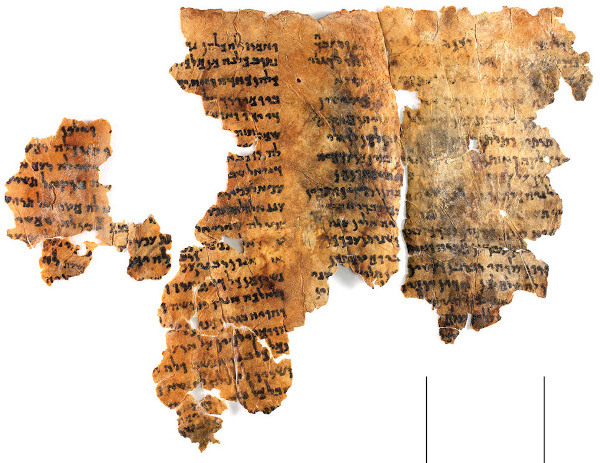
Dead Sea Scroll of 1 Enoch. Jude 14–15 quotes this book.
Courtesy of The Leon Levy Dead Sea Scrolls Digital Library; Israel Antiquities Authority, photo: Shai Halevi
Return to the main text.
15 ungodly . . . ungodliness . . . ungodly. The repetition and the awesome judgment scene that is depicted emphasize the condemnation of the false teachers in v. 4 (see note there).
16 These people. The ungodly people first mentioned in v. 4 and subsequently referred to repeatedly as “these people” (vv. 10,12,19; cf. v. 8). They are the libertine false teachers who pervert the grace of God.
17 remember what the apostles . . . foretold. The coming of these godless people should not take believers by surprise, for it had been predicted by the apostles (Ac 20:29; 1Ti 4:1; 2Ti 3:1–5; 2Pe 2:1–3; 3:2–3).
18 They said. The Greek for this phrase indicates that the apostles repeatedly warned that such godless apostates would come. last times. See note on Jas 5:3. scoffers. In both 2Pe 3:3 and Jude the scoffers are said to be characterized by selfish lusts (“desires”).
19 people who divide you. At the very least this phrase means that they were divisive, creating factions in the church—the usual practice of heretics. Or Jude may be referring to the later Gnostics’ division of people into the spiritual (the Gnostics) and the sensual (those for whom there is no hope). follow mere natural instincts. An ironic description of the false teachers, who labeled others as sensual (see 1Co 2:14 and note). do not have the Spirit. Rather than being the spiritual ones—the privileged elite class the Gnostics claimed to be—Jude denies that they even possess the Spirit. A person who does not have the Spirit is clearly not saved (Ro 8:9).
20 But you, dear friends. In contrast to the ungodly false teachers, about whom this letter speaks at length. most holy faith. See note on v. 3. in the Holy Spirit. According to the Spirit’s promptings and with the power of the Spirit (see Ro 8:26–27; Gal 4:6; Eph 6:17–18 and notes).
21 keep yourselves in God’s love. God both keeps believers in his love (v. 24; see Ro 8:35–39 and notes) and enables them to keep themselves in his love. eternal life. See Jn 3:15 and note.
22–23 those who doubt . . . others. Perhaps those who have come under the influence of the apostates.
23 save others by snatching them from the fire. Rescuing them from the verge of destruction (see Am 4:11; Zec 3:2; 1Co 3:15 and notes). mercy, mixed with fear. Even in showing mercy one may be trapped by the allurement of sin. clothing stained by corrupted flesh. The wicked are pictured as being so corrupt that even their garments are polluted by their sinful flesh.
24–25 After all the attention necessarily given in this letter to the ungodly and their works of darkness, Jude concludes by focusing attention on God, who is fully able to keep those who put their trust in him.