Study Notes
 1:1 word of the LORD. See 3:1; Hos 1:1 and note. Jonah. See Introduction: Title; Authorship and Date. In his account of Jonah’s mission to Nineveh written for Israel’s instruction, the author probably presents Jonah as a cameo representation of Israel, the people called out from the nations by God to be the channel of his redemptive purposes for the peoples of the world. In this narrative, the people of Israel are to see themselves as in a mirror: their unique position of privilege as the people to whom God had revealed himself in a special way, their particular vocation as God’s chosen kingdom people, their stubborn resistance to fulfilling that vocation and the reason Israel must die as a nation (the judgment the prophets were announcing) and be raised up again, refined and renewed (the more distant future the prophets were envisioning). Cf. note on Jdg 13:1—16:31.

 Nineveh and Tarshish represented opposite ends of the Mediterranean commercial sphere in ancient times. The story of Jonah extends to the boundaries of OT geographic knowledge and provides a rare glimpse of seafaring life in the Iron Age. Inscriptions and pottery from Spain demonstrate that Phoenician trade linked the far distant ends of the Mediterranean, perhaps as early as the twelfth century bc.
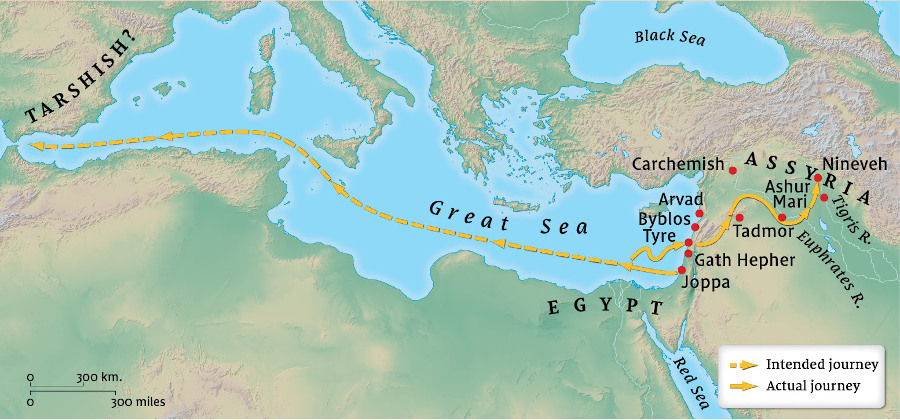
Go to the Maps Index.
1:2–3 Go . . . But Jonah ran away. Contrast Isaiah: “Here am I. Send me!” (Isa 6:8).
 1:2 great city. See 3:2; 4:11; see also note on 3:3. According to Ge 10:11, Nineveh was first built by Nimrod and was traditionally known as the “great city” (see Ge 10:12 and note). About 700 bc Sennacherib made it the capital of Assyria, which it remained until its fall in 612 (see Introduction to Nahum: Background). Nineveh is over 500 miles from Gath Hepher, Jonah’s hometown (see 2Ki 14:25 and note). Nineveh is also over 500 miles from Joppa (see v. 3 and note; see also chart). its wickedness has come up. Cf. Sodom and Gomorrah (see Ge 18:20–21 and note on 18:20). Except for the “violence” (3:8) of Nineveh, its “evil ways” (3:8,10) are not described in Jonah. Nahum later states that Nineveh’s sins included plotting evil against the Lord, cruelty and plundering in war, prostitution, witchcraft and commercial exploitation (see Na 1:11; 2:12–13; 3:1,4,16,19 and notes on 3:3,10).
1:3 ran away. Jonah gives his reason in 4:2. The futility of trying to run away from the Lord is acknowledged in Ps 139:7–12 (see note there). Tarshish. Perhaps the city of Tartessus in southern Spain, a Phoenician mining colony near Gibraltar. By heading in the opposite direction from Nineveh (see map) to what seemed like the end of the world, Jonah intended to escape his divinely appointed task. Joppa. See note on Ac 9:36.
1:4–16 This account of the storm at sea is a graphic depiction, in miniature, of the pagan world of many nations threatened by the judgments of God, with Israel in their midst. Ironically, it is the sailors who call out to their gods while Jonah does not call out to his. See note on 1:1; cf. note on Ac 27:13–44.
1:4–5 Although Jonah’s mission was to bring God’s warning of impending judgment to the pagan world, his refusal to go to Nineveh brings these pagan sailors into peril.
1:4 the LORD sent a great wind. God’s sovereign working in Jonah’s mission is evident at several other points also: the fish (v. 17), the release of Jonah (2:10), the leafy plant (4:6), the worm (4:7) and the “scorching east wind” (4:8).
1:5 his own god. Apparently the sailors, who may have come from various ports, worshiped several different pagan gods (see note on Ge 28:15).
1:6 The captain went to him. The pagan captain’s concern for everyone on board contrasts with the believing prophet’s refusal to carry God’s warning to Nineveh.
1:7 let us cast lots. The casting of lots was a custom widely practiced in the ancient Near East. The precise method is unclear, though it appears that, for the most part, sticks or marked pebbles were drawn from a receptacle into which they had been “cast” (see notes on Ex 28:30; Ne 11:1; Pr 16:33; Eze 21:21; Ac 1:26). lot fell on Jonah. By the lot of judgment the Lord exposed the guilty one (see Jos 7:14–26 and note on 7:14; 1Sa 14:37–44 and note on 14:37).
1:9 Hebrew. See note on Ge 14:13. I worship . . . the God of heaven, who made the sea and the dry land. See note on Ezr 1:2. The sailors would have understood Jonah’s words as being descriptive of the highest deity. Their present experiences confirmed this truth, since, in the religions of the ancient Near East generally, the supreme god was master of the seas (see note on Jos 3:10). This is Jonah’s first confessional statement, and, like those that follow (2:9c; 4:2), it is thoroughly orthodox. Though these are orthodox statements, Jonah refuses to fulfill his divine mission to Nineveh.
1:10 What have you done? This rhetorical question is really an accusation.
1:12 throw me into the sea. Jonah’s readiness to die to save the terrified sailors contrasts with his later callous departure from Nineveh to watch from a safe distance while the city perishes—at least he still hoped it would perish (see 4:5 and note). See photos here and here.
1:13 did their best to row. The Hebrew uses the word meaning “to dig” (with oars) to indicate strenuous effort. The ship could be driven by sails, oars, or both. The reluctance of the sailors to throw Jonah into the sea stands in sharp contrast to Jonah’s reluctance to warn Nineveh of impending judgment.
1:14 cried out to the LORD. Earlier the sailors had cried out to their own gods (see v. 5 and note), but now in their desperation they plead for help from Jonah’s God, the Sovereign of the Sea.
1:16 greatly feared the LORD. There is no evidence that the sailors renounced all other gods (contrast Naaman; see 2Ki 5:15 and note). Ancient pagans were ready to recognize the existence and power of many gods. At the least, however, the sailors acknowledged that the God of Israel was in control of the present events, that he was the one who both stirred up and calmed the storm and that at this moment he was the one to be recognized and worshiped.
1:17 the LORD provided. This characteristic phrase occurs also in 4:6–8. huge fish. The Hebrew here (and the Greek of Mt 12:40) is a general term for a large fish, not necessarily a whale. This great fish is carefully distinguished from the sinister “serpent” of the sea (Am 9:3)—otherwise called “Leviathan” (Isa 27:1), the “monster of the deep” (Job 7:12; see Ps 74:13; Eze 32:2). three days and three nights. The phrase used here may, as in Mt 12:40, refer to a period of time including one full day and parts of two others (see notes on Mt 12:40; 1Co 15:4). In any case, the NT clearly uses Jonah’s experience as a type (foreshadowing) of the burial and resurrection of Jesus, who was entombed for “three days and three nights” (Mt 12:40; see Mt 16:4; Lk 11:29–30 and note on 11:30).
2:1 prayed. For this use of “prayed” elsewhere, see 1Sa 2:1 and note.
2:2–9 A psalm of thanksgiving for deliverance from drowning in the Mediterranean Sea. Jonah recalls his prayer for help as he was sinking into the depths. His gratitude is heightened by his knowledge that he deserved death but that God had shown him extraordinary mercy. The language of this song indicates that Jonah was familiar with the praise literature of the Psalms.
2:2 I called . . . he answered. See note on Ps 118:5. realm of the dead. Figurative (hyperbole) for Jonah’s near-death experience in the sea (see Ps 30:3 and note). See also note on Ge 37:35.
2:3 You hurled me . . . your waves. Jonah recognizes that the sailors (1:15) were agents of God’s judgment.
2:4 yet I will look again toward your holy temple. See v. 7; the same note of hopeful expectation found in the prayers of the Psalms (e.g., Ps 5:7; 27:4–6; cf. 1Ki 8:38–39).
2:6 pit. The grave (see note on v. 2; see also Ps 28:1; 30:1–3 and note on 30:1).
2:9 sacrifice . . . vowed. Cf. the “sacrifice” and “vows” of the sailors (1:16). What I have vowed. In the book of Psalms prayers were commonly accompanied by vows, usually involving thank offerings (see, e.g., Ps 50:14 and note; 56:12; 61:8; 65:1; 66:13–15; 116:12–19). make good. See Ps 76:11; Ecc 5:1–7. Salvation comes from the LORD. The climax of Jonah’s thanksgiving prayer and his second confessional statement (see note on 1:9). It stands aptly at the literary midpoint since it is the theological foundation of the whole book.
3:1 word of the LORD. See 1:1 and note.
3:2–3 Go . . . Jonah obeyed. Contrast 1:2–3.
3:2 great city. See 1:2 and note. proclaim to it the message I give you. A prophet was the bearer of a message from God, not primarily a foreteller of coming events.
3:3 obeyed. But reluctantly, still wanting the Ninevites to be destroyed (see 4:1–5 and notes). very large city. See 4:11, which says the city had more than 120,000 inhabitants. Archaeological excavations indicate that the later imperial city of Nineveh was about eight miles around. The fact, however, that “it took three days to go through it” may suggest a larger area, such as the four-city complex of Nineveh, Rehoboth Ir, Calah and Resen mentioned in Ge 10:11–12. Greater Nineveh covered an area of some 60 miles in circumference. On the other hand, “three days” may have been a conventional way of describing a medium-length distance (see Ge 30:36; Ex 3:18 and note; Jos 9:16–17). Alternatively, “three days” may not refer to the time required to travel the distance but rather to the amount of time it would take for Jonah to complete his task.
3:4 Forty more days. A grace period.
3:5–6 fast . . . sackcloth . . . dust. Customary signs of humbling oneself in repentance (see 1Ki 21:27; Ne 9:1 and note).
3:5 believed God. This may mean that the Ninevites genuinely turned to the Lord (cf. Mt 12:41). On the other hand, their belief in God may have gone no deeper than had the sailors’ fear of God (see note on 1:16). At least they took the prophet’s warning seriously and acted accordingly—something Israel was not doing.
3:6 king of Nineveh. King of Assyria (see note on 1:2).
3:8 animals. Inclusion of the domestic animals (see 4:11) was unusual and expressed the urgency with which the Ninevites sought mercy.
3:9 relent. Also in v. 10. God often responds in mercy to human repentance by canceling threatened punishment (v. 10). See note on Jer 18:7–10.
3:10 did not bring on them the destruction . . . threatened. See 1Ki 21:28–29 and note on 21:29; see also Introduction to Nahum: Background; Na 3:19 and note.
4:1 seemed very wrong . . . he became angry. Jonah was angry that God would have compassion on an enemy of Israel. He thought that God’s goodness should be shown only to Israelites, not to Gentiles.
4:2 prayed to the LORD. Now in anger, not in distress (see 2:1–2 and note on 2:2). That is what I tried to forestall by fleeing to Tarshish. See 1:3 and note. gracious . . . love. Drawn from God’s self-revelation in Ex 34:6–7 (see note there), this is the third and last of Jonah’s confessional statements (see notes on 1:9; 2:9). slow to anger. In contrast to God, Jonah became angry quickly (vv. 1,9).
4:3 take away my life. See 1Ki 19:4 and note (Elijah). To Jonah, God’s mercy to the Ninevites meant an end to Israel’s favored standing with him. Jonah shortly before had rejoiced in his deliverance from death (2:2–9), but now that Nineveh lives, he prefers to die.
4:5 shelter. Apparently this shelter did not provide enough shade since the next verse indicates that God provided a “leafy plant” (v. 6) to give more shade. waited to see. Jonah still hoped that Nineveh would be destroyed.
4:6 the LORD God provided. This characteristic phrase occurs also in vv. 7–8; 1:17. leafy plant. See NIV text note. It may have been a castor oil plant, a shrub growing over 12 feet high with large, shady leaves. God graciously increased the comfort of his stubbornly defiant prophet.
4:8 better for me to die. See note on v. 3.
4:9 Is it right for you to be angry . . . ? This is the second time God asks Jonah this question (also v. 4). Jonah is angry about God’s mercy on Nineveh and is deeply concerned about the fate of the plant—a potent contrast to God’s deep concern for the people of Nineveh, who are much more important than the plant (v. 11).
4:10 sprang up overnight and died overnight. Indicative of fleeting value.
4:11 should I not have concern . . . ? According to God’s own character as compassionate (v. 2), the answer is yes. God had the first word (1:1–2), and he now has the last. The commission he gave Jonah displayed his mercy and compassion to the Ninevites, and his last word to Jonah emphatically proclaimed that concern for every creature, both people and animals. Not only does the Lord “preserve both people and animals” (Ps 36:6; see Ne 9:6; Ps 145:16), but he also takes “no pleasure in the death of the wicked, but [desires] rather that they turn from their ways and live” (Eze 33:11; see Eze 16:6; 18:23; 33:11 and notes; cf. 2Pe 3:9 and note). Jonah and his fellow Israelites traditionally rejoiced in God’s special mercies to Israel but wished only his wrath on their enemies. God here rebukes such hardness and proclaims his own gracious benevolence. great city. See 1:2 and note. The book begins and ends by referring to Nineveh, the unlikely and unexpected scene of a remarkable display of divine compassion. cannot tell their right hand from their left. Like small children (see Dt 1:39 and note), the Ninevites needed God’s fatherly compassion. also many animals. God’s compassion extended even to their domestic animals (cf. 3:8 and chart [item 16]).