Study Notes
1:1–18 The Lord initiates the action by commanding Joshua, his chosen replacement for Moses (Dt 31:1–8), to lead Israel across the Jordan and take possession of the promised land. He urges courage and promises success—but only if Israel obeys the law of God that Moses has given them. The chapter consists of speeches significant in their content and order: The Lord commands Joshua as his appointed leader over his people (vv. 1–9); Joshua, as the Lord’s representative, addresses Israel (vv. 10–15); Israel responds to Joshua as the Lord’s representative and successor to Moses (vv. 16–18). Thus the events of the book are set in motion and the roles of the main actors indicated (see Introduction: Title and Theological Theme).
1:1 After the death of Moses. The story continues where Deuteronomy ended. Cf. “After the death of Joshua” (Jdg 1:1). servant of the LORD. See notes on Ex 14:31; Dt 34:5; Ps 18 title; Isa 41:8–9; 42:1. Moses’ aide. The title by which Joshua served for many years as second-in-command (see Nu 11:28; see also Ex 24:13; 33:11; Dt 1:38).
 1:2 Jordan River. The flow of the Jordan near Jericho was not large during most of the year (less than 100 feet wide), but at flood stage in the spring it filled its wider bed, which at places was a mile wide and far more treacherous to cross (see 3:15 and note). land I am about to give to them. A central theme of the Pentateuch (Ge 12:1; 50:24; Ex 3:8; 23:31; Dt 1:8). The book of Joshua relates the fulfillment of this promise of God.
1:3–5 See Dt 11:24–25.
1:4 The dimensions of the land promised to Israel vary (compare this text and Ge 15:18 with Dt 34:1–4), but these are the farthest limits—conquered and held only by David and Solomon. Joshua was to take all he set out to conquer; wherever he set his foot was his (v. 3). His victories gave the 12 tribes control over most of the central hill country and much of the Negev. Hittite country. Canaan was still called “Hatti-land” centuries after the Hittites had withdrawn to the north.
1:5 I will be with you. To direct, sustain and assure success (see notes on Ge 26:3; Jer 1:8). never . . . forsake you. See Dt 31:6 and note.
1:6 land I swore to their ancestors. The long-awaited inheritance pledged to the descendants of Abraham (Ge 15:7,8–21) and of Jacob (Ge 28:13).
1:7 Be careful to obey. Success was not guaranteed unconditionally (Dt 8:1; 11:8–9,22–25).
1:8 Book of the Law. See Dt 28:58, 61; 29:17,20–21; 30:10; 31:24. lips; meditate. See Ps 1:2. In the ancient world, reading written texts and even meditating on them were usually done aloud (Ex 13:9; Dt 30:14; Ps 19:14; 119:13; Ac 8:30). day and night. All the time, continually.
1:9 Have I not commanded you? A rhetorical question that emphasizes the authority of the speaker.
 1:10 Joshua ordered. At this point Joshua assumes full command. officers. May refer to those whom Moses had appointed over the divisions within the tribes (Ex 18:21; Dt 1:15).
1:11 provisions. Food needed for the next several days’ march.
1:12–15 The threat from Sihon and Og (Nu 21:21–35) was overcome by military victory and the occupation of the lands north of Moab and east of the Jordan River. The two and a half tribes who asked to remain had been commanded by Moses to send their fighting men across with the rest to conquer Canaan (Nu 21:21–35; 32:1–27). The conquest of the promised land must be an undertaking by all Israel.
1:13,15 rest. An important OT concept (see notes on Dt 3:20; 2Sa 7:1,11), implying secure borders, peace with neighboring countries and absence of threat to life and well-being within the land (see 1Ki 5:4; 8:56 and notes). In the NT it becomes a symbol for eternal salvation (Heb 4).
1:14 your fighting men. Those 20 years old or more (Nu 1:3,18–45) who were fit for the rigors of war.
1:18 Whoever rebels. Having just taken the oath of allegiance to Joshua, they now agree to the death penalty for any rebellious act (e.g., the sin of Achan, 7:15). be strong and courageous. The people’s words of encouragement to Joshua echo and reinforce those from the Lord (vv. 6–7,9).
2:1–24 The mission of the two spies and the account of Rahab. The practice of reconnaissance and espionage is as old as war itself (cf. Jdg 7:10–11; 1Sa 26:6–12). Rahab became a convert to the God of Israel and a famous woman among the Hebrews. She is honored in the NT for her faith (Heb 11:31) and good works (Jas 2:25).
In this first encounter of the Israelites (represented by the two spies) and the Canaanites (represented by Rahab and the men pursuing the spies), the outcome of the mission on which God had sent his army under Joshua (ch. 1) is foreshadowed, and God’s assurances of success (see 1:5 and note) are confirmed.
2:1 sent . . . from Shittim. The invasion point was in the plains of Moab facing toward the Jordan and Jericho (Nu 33:48–49). The Hebrew word Shittim means “acacia trees,” which flourish in the semi-arid conditions of the wilderness. especially Jericho. The primary focus of the spies. It was a fortified city, was well supplied with water by strong springs and was located just five miles west of the Jordan (see note on 6:1). prostitute. Josephus and other early sources refer to Rahab as an “innkeeper,” but see Heb 11:31; Jas 2:25; see also Mt 1:5 and notes on 1:3 and 1:5.
 2:2 king of Jericho. The major cities of Canaan were in reality small kingdoms, each ruled by a local king (attested also in the Amarna letters of the fourteenth century bc; see chart).
2:6 hidden . . . under the stalks of flax. Rooftops in the Near East are still used for drying grain or stalks. Rahab’s cunning saved the lives of the two Israelites but put her own life in jeopardy. Siding with Israel’s God was more important than obeying her king. The Bible consistently supports obeying God rather than people when the two conflict.
2:7 fords of the Jordan. Shallow crossings of the Jordan, where the depth of normal flow averages only three feet.
2:9–11 a great fear . . . melting in fear . . . melted in fear. News of the Lord’s power had reached the Canaanites; this was vital information for the spies. Rahab’s confession is the decisive turning point in the narrator’s account of this event. The whole outcome of the spies’ venture into Jericho hinges on her words and actions. Rahab’s confession also shows that anyone in Canaan could have followed the God of Israel and been spared.
2:10 completely destroyed. See NIV text note.
2:12 show kindness to my family. The Hebrew word for “kindness” (ḥesed; see article) is frequently translated “love” or “unfailing love” and signifies behavior that is appropriate to a relationship. God always acts toward his people with “kindness,” that is, with benevolent behavior appropriate to the covenant relationship he has with them. Rahab had entered into a relationship with Israel by virtue of her protection of the spies. Now she asks that Israel treat her and her family as they should because of that relationship. sure sign. They gave her their oath to spare her whole family (v. 14).
2:14 kindly and faithfully. The terms of the pledge made by the spies echo Rahab’s request (v. 12). when the LORD gives us the land. Rahab’s words had added to their assurance of the inevitable victory of the Israelites over Jericho.
2:15 the house . . . was part of the city wall. There is archaeological evidence that the people of Jericho would occasionally integrate living quarters into the city wall. Although this evidence predates the time of Joshua, it may still serve to illumine this verse. The Late Bronze fortifications at Jericho may have included a casemate wall (a hollow wall with partitions), and Rahab may have occupied one or more rooms inside it (see photo).
2:16 Go to the hills. The opposite direction from the fords of the Jordan where the spies’ pursuers had gone (v. 7).
2:18 scarlet cord in the window. The function of the red marker was similar to that of the blood of the Passover lamb when the Lord struck down the firstborn of Egypt (Ex 12:13,22–23).
2:19 their blood will be on our head. A vow that accepted responsibility for the death of another, with its related guilt and the retribution meted out by either relatives or the state.
2:22 into the hills. Directly west of ancient Jericho were the high, rugged hills of the central mountain ridge in Canaan. They are honeycombed with caves, making the concealment and escape of the two spies relatively easy (see photo).
2:24 The spies’ mission (v. 1) concludes with a reassuring word to Joshua (cf. Nu 13:26–33).
3:1—4:24 Details of the river crossing and the memorial of 12 stones set up in the camp at Gilgal. The significance of this account can hardly be overemphasized, since it marks the crossing of the boundary into the promised land and parallels the miracle of the Red Sea crossing in the exodus (Ex 14–15). The Israelites’ faith in the God of their ancestors was renewed and strengthened when it was about to be most severely challenged, while at the same time the Canaanites’ fear was greatly increased (5:1). In this account the author uses an overlay technique in which, having narrated the crossing to its conclusion (ch. 3), he returns to various points in the event to enlarge on several details: the stones for a memorial (4:1–9); the successful crossing by all Israel (4:10–14); the renewed flow of the river after the crossing was completed (4:15–18). The final paragraph of ch. 4 (vv. 19–24) picks up the story again from 3:17 and completes the account by noting Israel’s encampment at Gilgal and the erecting of the stone memorial there.
3:3 ark of the covenant. The most sacred of the tabernacle furnishings (Ex 25:10–22). Since it signified the Lord’s throne, the Lord himself went into the Jordan ahead of his people as he led them into the land of rest (Nu 10:33–36; Dt 31:7).
3:4 distance of about two thousand cubits. See NIV text note. There was evidently a line of march, with the priests and ark leading the way. Respect for the sacred symbol of the Lord’s holy presence accounts for this gap between the people and the priests bearing the ark.
3:5 Consecrate yourselves. Before their meeting with God at Sinai this had involved washing all their garments, as well as their bodies, and also abstinence from sexual intercourse (Ex 19:10,14–15).
3:7 I will begin to exalt you. A prime objective for the divine intervention at the Jordan was to validate the leadership of Joshua. With a miraculous event so much like that of the Red Sea crossing, Joshua’s position as the Lord’s servant would be shown to be comparable to that of Moses.
3:10 This is how you will know. The manner by which God is about to bring the Israelites across the Jordan River, the watery boundary of the promised land, will bring assurance that the one true God is with them and that he will surely dislodge the present inhabitants of Canaan. By passing through the Jordan at the head of his army, the Lord is staking his claim on the land and assuring victory over their gods. Canaanites . . . Jebusites. See notes on Ge 9:25; 10:6,15–16; 13:7; 15:16; 23:3; Ex 3:8; Jdg 3:3; 6:10.
3:12 choose twelve men. Joshua seems to anticipate the Lord’s instructions (4:2–3).
3:13 cut off. Blocked, stopped in its flow. stand up in a heap. The Hebrew for “heap” is found here, in v. 16 and also in the poetic accounts of the Red Sea crossing (Ex 15:8; Ps 78:13). It is possible that God used a physical means (such as a landslide) to dam up the Jordan at the place called Adam (v. 16), near the entrance of the Jabbok River. (As recently as 1927 a blockage of the water in this area was recorded that lasted over 20 hours.) But, even if so, the miraculous element is not diminished (Ex 14:21).
3:15 at flood stage. Because of the spring rains and the melting of snow on Mount Hermon. harvest. Grain harvest took place in April and May. as soon as. The stoppage nearly 20 miles upstream (v. 16) would have happened several hours earlier to make the events coincide.
3:17 The priests who carried the ark . . . stood on dry ground. Signifying that the Lord himself remained in the place of danger—under the threat of the waters of judgment—until all Israel had crossed the Jordan.

➊ Entry Into Canaan
When the Israelite tribes approached Canaan after four decades of wilderness existence, they had to overcome two Amorite kingdoms on the Medeba plateau and in Bashan (Nu 2:21–35). Under Moses’ leadership, they also subdued the Midianites in order to consolidate their control over the Transjordanian region (Nu 31).
The conquest of Canaan followed a course that in retrospect appears as though it had been planned by a brilliant military strategist. Taking Jericho gave Israel control of its strategic plains, fords and roads as a base of operations. When Israel next gained control of the Bethel, Gibeon and Upper Beth Horon regions, it dominated the center of the north-south Palestinian ridge. Subsequently, Israel was able to break the power of the allied urban centers in separate campaigns south and north (for the northern campaign, see map).
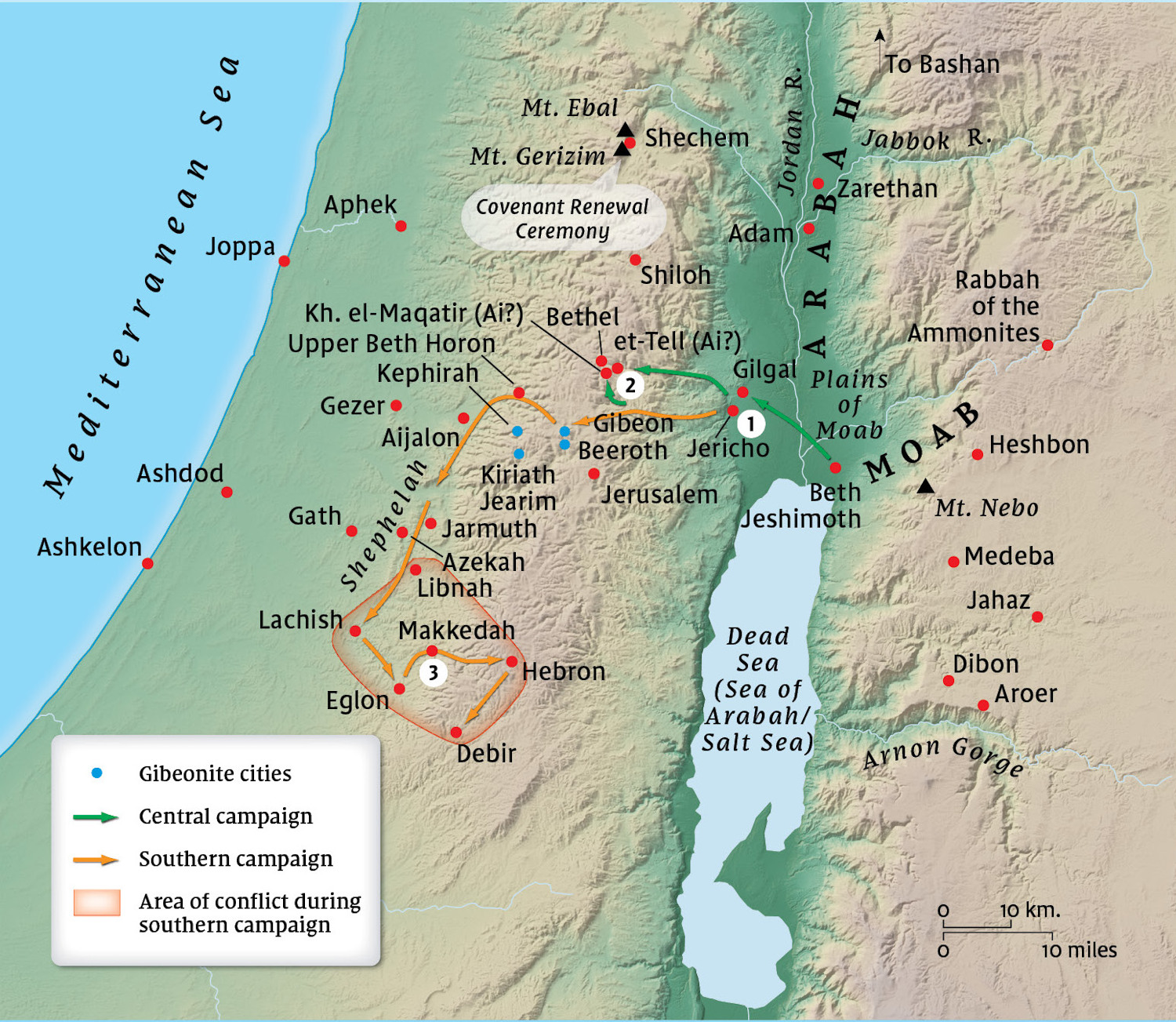
➋ The Central Campaign
The destruction of both Jericho and Ai led to a major victory against the Canaanites in the Valley of Aijalon—the battle of the long day (Jos 10:12–14)—which then allowed Joshua to proceed against the cities of the western foothills.
Archaeological evidence for the conquest is mixed, in part because the chronological problems are unsolved. On the one hand, clay tablets containing cuneiform letters to the Egyptian court have been found at Tell el-Amarna in Egypt from c. 1375 bc. These mention bands of Hapiru that threaten many of the cities of Canaan and create fear among the Canaanite inhabitants.
On the other hand, numerous towns were destroyed c. 1230 bc by unknown assailants, presumably the “Sea Peoples,” but possibly including the Israelites as well. The biblical chronology based on 1Ki 6:1 seems to indicate an even earlier dating, near the end of the fifteenth century (see Introduction to Joshua: Historical Setting) unless the numbers are symbolic.
➌ The Southern Campaign
Azekah, Libnah, Lachish, Eglon and Debir were all captured by Joshua in his campaign against the southern coalition of Canaanite cities that was led by the king of Jerusalem (Jos 10).
Several of these towns, most notably Lachish, contain destruction evidence that might possibly be correlated with the Israelite conquest, but with Jericho and Ai the historical evidence is not clear.
Go to the Maps Index.
4:6 What do these stones mean? A stone monument was commonly used as a memorial to remind future generations of what had happened at a particular place (24:26; 1Sa 7:12).
4:9 Joshua set up the twelve stones. Each tribe brought a stone for the monument from the riverbed to the new campsite at Gilgal, and Joshua constructed the monument there (v. 20). An alternative translation suggests that Joshua set up a second pile in the middle of the river (see NIV text note, but see also note on 3:1—4:24).
4:13 About forty thousand. Seems too few for the number of men listed in Nu 26 for Reuben, Gad and half of Manasseh; the contingents were very likely representative since it would have been imprudent to leave the people undefended who settled in Transjordan (cf. 22:8, “your fellow Israelites”; Nu 32:17).
4:19 tenth day of the first month. The day the Passover lamb was to be selected (Ex 12:3). The Israelites would shortly celebrate the Passover (5:10). Gilgal. Usually identified with the ruins at Khirbet el-Mafjer, two miles northeast of Jericho (see map).
4:22 Israel crossed the Jordan. Earlier Joshua had instructed Israel to answer that the waters of the Jordan were “cut off” so that “the ark of the covenant of the LORD” could cross the Jordan (vv. 6–7). That was the primary fact to be remembered: God (represented by his ark) leads his people across the Jordan to take possession of Canaan as the place in his creation where he would begin to establish his kingdom.
4:23 God dried up the Jordan. Still another descriptive phrase for the miracle, along with “the water . . . cut off,” “piled up in a heap” and “stopped flowing” (3:16).
4:24 so that all . . . might know. The Lord’s revelation of his power to the Israelites was a public event that all the Canaanites heard about (5:1), just as they had heard of the crossing of the Red Sea and the defeat of Sihon and Og (2:10). fear the LORD. Worship and serve him according to his commandments.
5:1 Amorite . . . Canaanite. Sometimes interchangeable (but see 10:5 and note), these general names included the many smaller nations in the land. Amorite meant “westerner,” and Canaanite referred to the people living even farther west along the Mediterranean coast. This verse perhaps concludes the account of the crossing since it notes the effect of that event on the peoples of Canaan (see note on 3:10).
5:2–12 Circumcision and the celebration of the Passover, the two basic covenant rites, were resumed at Gilgal. Both were significant spiritual preparations for the conquest of the promised land. Only as a people who had consecrated themselves to God (circumcision; see note on Ge 17:10) and who remembered that God had set them free from Egyptian bondage to be his people (Passover; Ex 12:11,17) could Israel expect to be given possession of Canaan.
5:2 flint knives. Metal knives were available, but flint made a more efficient surgical tool, as modern demonstrations have shown. circumcise. Circumcision marked every male as a descendant of Abraham (Ge 17:10–11), bound to the service of the Lord, and it was a prerequisite for the Passover (Ex 12:48). again. Explained in vv. 4–8.
5:3 Gibeath Haaraloth. See NIV text note.
5:6 forty years. The time between their departure from Egypt and the crossing of the Jordan. milk and honey. See notes on Ex 3:8; Dt 6:3.
5:9 reproach of Egypt. Although the reference may be to Egypt’s enslavement of Israel, it is much more likely that the author had in mind the reproach the Egyptians would have cast upon them and their God if they had perished in the wilderness (Ex 32:12; Nu 14:13; Dt 9:28). Now that Israel is safely in the promised land, the “reproach of Egypt” is rolled away.
5:10 Passover. The ceremonies took place in the month of Aviv, the first month of the year (Ex 12:2). At twilight on the 14th day of the month the Passover lamb was to be slaughtered, then roasted and eaten that same night (Ex 12:5–8). Before the next season they had rebelled at the border of Canaan, and the generation of the exodus had been condemned to die in the wilderness (Nu 14:21–23,29–35). For that generation the celebration of Passover (deliverance from the judgment that God brought on Egypt; see Ex 12:12–13,23) would have had little meaning.
5:11 unleavened bread. Bread baked without yeast. It was to be eaten during the seven festival days that followed (Ex 12:15; Lev 23:6).
5:12 manna stopped. This transition from eating manna to eating the “produce of the land” (v. 11) ended 40 years of dependence on God’s special provision. Manna was God’s gift for the wilderness journey; from now on he provided Israel with food from the promised land.
5:13–15 The narration of the conquest of Jericho (5:13—6:27) is introduced by the sudden appearance of a heavenly figure who calls himself the “commander of the army of the LORD” (v. 14).
5:13 Joshua was near Jericho. The leader of God’s army went to scout the nearest Canaanite stronghold, but another warrior was already on the scene. a man standing. The experience is taken by many to be an encounter with God in human form (theophany). See Nu 22:23, 31; Jdg 6:11, 13:3; 1Ch 21:16; Da 10:5, 20; 12:1; see also note on Ge 16:7.
5:14 Neither. Joshua and Israel must know their place—it is not that God is on their side; rather, they must fight God’s battles. commander of the army of the LORD. God has sent the commander of his heavenly armies to take charge of the battle on earth. Joshua must take orders from him (6:2–5), and he can also know that the armies of heaven are committed to this war—as later events confirm.
5:15 Joshua is commissioned to undertake the Lord’s battles for Canaan, just as Moses had been commissioned to confront the pharaoh (Ex 3:5). place . . . is holy. See Ex 3:5 and note.
6:1 Jericho. Modern Tell es-Sultan. Archaeological excavations have revealed that Jericho may have been the first site of village settlement in Canaan and one of the oldest cities in the world. (People who moved about and lived by hunting and gathering had been present in the area for thousands of years.) The earliest settled occupation dates from c. 7000 bc. By Joshua’s day, more than two dozen cities had already been built and destroyed on the site, one above the other, over a period of more than 5,000 years. Many of them had powerful double walls. Jericho may have been a center for the worship of the moon god (cf note on Ge 11:31). Jericho probably means “moon city.” If so, God was destroying not only Canaanite cities but also Canaanite religion. See map; see also map and photo.
6:2 the LORD. The Lord’s command no doubt comes to Joshua through the “commander of the army of the LORD” (5:14), who orders the first conquest of a Canaanite city.
6:3 March around the city . . . for six days. A ritual act, signifying a siege of the city.
6:4 trumpets of rams’ horns. Instruments not of music but of signaling, in both religious and military contexts (which appear to come together here). The trumpets were to be sounded (v. 8), as on the seventh day, announcing the presence of the Lord (2Sa 6:15; 1Ch 15:28; Zec 9:14). ark. Signified that the Lord was laying siege to the city. seventh day. No note is taken of the Sabbath during this seven-day siege, but perhaps that was the day the Lord gave the city to Israel as the first pledge of the land of rest. To arrive at the goal of a long march on the seventh day is a motif found also in other ancient Near Eastern literature. In any event, the remarkable constellation of sevens (seven priests with trumpets, seven days, seven encirclements on the seventh day) underscores the sacred significance of the event and is, perhaps, a deliberate evoking of the seven days of creation to signal the beginning of God’s new order in the world.
6:5 long blast . . . loud shout. Signaling the onset of the attack—psychological warfare, intended to create panic and confusion (Jdg 7). In the Dead Sea Scroll of “The War of the Sons of Light against the Sons of Darkness,” the Levites are instructed to blow in unison a great battle fanfare to melt the heart of the enemy. (For Dead Sea Scrolls, see article.) everyone straight in. Not a breach here and there but a general collapse of the walls, giving access to the city from all sides.
6:7 armed guard. The Hebrew for this term differs from that in v. 3 but may be synonymous with it.
6:8–14 Throughout these verses the ark of the Lord is made the center of focus (as it was in the account of the crossing of the Jordan), highlighting the fact that the Lord himself besieged the city.
6:9 rear guard. If the rear guard was made up of the final contingents of the army (Nu 10:25), the armed guard of vv. 7,9 constituted the main body of troops.
6:17 devoted. See NIV text note. The ban placed all of Jericho’s inhabitants under the curse of death and all of the city’s treasures that could not be destroyed under consignment to the tabernacle (v. 19). According to the law of Moses this ban could be applied to animals for sacrifice, to property given to God, or to any person found worthy of death (Lev 27:28–29). At the Lord’s direction, Moses ruled that all the inhabitants of Canaan be executed for their idolatry and all their accompanying moral corruption (Dt 20:16–18). See note on Dt 2:34. Rahab . . . and . . . her house shall be spared. Honoring the pledge made by the two spies (2:14).
6:18 your own destruction. See NIV text note on v. 17. If the Israelites took for themselves anything that was under God’s ban, they themselves would fall under the ban.
6:21 destroyed . . . every living thing. See Dt 20:16–18.
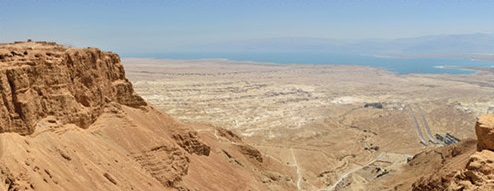
The Conquest, War, and Genocide
Many readers of Joshua (and other OT books) are deeply troubled by the role that warfare plays in Joshua’s account of God’s dealings with his people. Not a few relieve their ethical scruples by ascribing the author’s perspective to a pre-Christian (and sub-Christian) stage of moral development that the Christian, in the light of Christ’s teaching, must repudiate and transcend. Hence the main thread of the narrative line of Joshua is an offense to them.
It must be remembered, however, that the book of Joshua does not address itself to the abstract ethical question of war as a means for gaining human ends. It can only be understood in the context of the history of redemption unfolding in the Pentateuch, with its interplay of divine grace and judgment. Of that story it is the direct continuation.
Joshua is not an epic account of Israel’s heroic generation or the story of Israel’s conquest of Canaan with the aid of their national deity. It is rather the story of how God, to whom the whole world belongs, at one stage in the history of redemption reconquered a portion of the earth from the powers of this world that had claimed it for themselves, defending their claims by force of arms and reliance on their false gods. It tells how God commissioned his people to serve as his army under the leadership of his servant Joshua, to take Canaan in his name out of the hands of the idolatrous and dissolute Canaanites (whose measure of sin was now full; see Ge 15:16 and note). It further tells how he aided them in the enterprise and gave them conditional tenancy in his land in fulfillment of the ancient pledge he had made to Israel’s ancestors—Abraham, Isaac, and Jacob.
Joshua is the story of the kingdom of God breaking into the world of nations at a time when national and political entities were viewed as the creation of the gods and living proofs of their power. Thus the Lord’s triumph over the Canaanites testified to the world that the God of Israel is the one true and living God, whose claim on the world is absolute. It was also a warning to the nations that the irresistible advance of the kingdom of God would ultimately disinherit all those who opposed it, giving place in the earth only to those who acknowledge and serve the Lord. At once an act of redemption and judgment, it gave notice of the outcome of history and anticipated the final destiny of humankind and the creation.
The battles for Canaan were therefore the Lord’s war, undertaken at a particular time in the program of redemption. God gave his people under Joshua no commission or license to conquer the world with the sword but a particular, limited mission. The conquered land itself would not become Israel’s national possession by right of conquest. Instead, it belonged to the Lord. So the land had to be cleansed of all remnants of paganism. Its people and their wealth were not for Israel to seize as the spoils of war from which to enrich themselves (as Achan tried to do, ch. 7) but were placed under God’s ban (were to be devoted to God to dispense with as he pleased). On that land Israel was to establish a commonwealth faithful to the righteous rule of God and thus be a witness (and a blessing) to the nations. If Israel became unfaithful and conformed to Canaanite culture and practice, it would in turn lose its place in the Lord’s land—as Israel almost did in the days of the judges, and as it eventually did in the exile.
No less than twelve factors make it unlikely that the battles in Joshua were part of genocide (the destruction of an entire race or nation of people) or even attempted genocide. (1) Israel did not actually kill a large percentage of the Canaanites. (Jos 13 and all of Judges depict how many were left.) (2) The language of total conquest in Jos 10–12 must therefore be that of hyperbole. Language of total destruction, including men, women and children, and of leaving no survivors was similar to exaggerated claims of other ancient Near Eastern people and should probably not be taken any more literally. (3) Archaeology suggests that several of the cities Joshua attacked were more like armed encampments of soldiers, their families and support personnel, much like military bases today, rather than entire cities (cf. especially Jericho and Ai). (4) The immorality of these cultures, complete with child sacrifice, was arguably as sordid as any in world history. (5) God had already given them over 400 years to repent (Ge 15:13–16). (6) The Gibeonites’ ruse (Jos 9) was presumably available to anyone who wanted to save their lives.
(7) The whole land had already heard of Israel’s exploits and were cowering in fear (Jos 2:9), so that an even better option for them was to turn to the God of Israel, as Rahab did. (8) Another option always available to the Canaanites was to flee the land that God had originally promised to Israel; in fact, 3:10 suggests that the Israelites’ primary task was to “drive out” the people of the land, not exterminate them (cf. 13:6; 14:12; 17:18; 23:5). (9) This makes sense, because their ancestors had likewise covenanted to allow the Israelites to live in the land that they were now denying them (e.g., Ge 20:15; 26:26–31). (10) This is the only war in the Bible that God ever commanded. Later individual battles in Judges and Samuel that Israel initiates are a continuation of “unfinished business” here. All other combat involving Israel was defensive rather than offensive. (11) Progressive revelation suggests that Christ’s full atonement for the world’s sin means that he would never again command his people to initiate a war like Joshua’s. Christians may debate pacifism vs. just war, but they have no right to claim they know God instituted any war they may fight. (12) If, after all these qualifications, we still struggle with the conquest narratives, it is probably because God in his mercy withholds the reality that death is the just punishment for sin the vast majority of the time (Ro 6:23).
War is a terrible curse that the human race brings on itself as it seeks to possess the earth by its own unrighteous ways. But it pales before the curse that awaits all those who do not heed God’s testimony to himself or his warnings—those who oppose the rule of God and reject his offer of grace. The God of the second Joshua (Jesus) is the God of the first Joshua also. Although now for a time he reaches out to the whole world with the gospel (and commissions his people urgently to carry his offer of peace to all nations), the sword of his judgment waits in the wings—and his second Joshua will wield it (Rev 19:11–16; see notes there).
Go to the Articles Index.
6:25 she lives among the Israelites. The faith of Rahab is noted twice in the NT (Heb 11:31; Jas 2:25; cf note on Mt 1:3).
6:26 Cursed . . . is the one. Jericho itself was to be devoted to the Lord as a perpetual sign of God’s judgment on the wicked Canaanites and as a firstfruits offering of the land. This was a way of signifying that the conquered land belonged to the Lord. The curse was fulfilled in the rebellious days of King Ahab (see 1Ki 16:34 and note).
7:1–26 The tragic story of Achan, which stands in sharp contrast to the story of Rahab. In the earlier event a Canaanite prostitute, because of her courageous allegiance to Israel and her acknowledgment of the Lord, was spared and received into Israel. She abandoned Canaan and its gods on account of the Lord and Israel and so received Canaan back. In the present event an Israelite, because of his disloyalty to the Lord and Israel, is executed as the Canaanites were. He stole the riches of Canaan from the Lord and so lost his inheritance in the promised land. This is also a story of how one man’s sin adversely affected the entire nation. Throughout this account (as often in the OT) Israel is considered a corporate unity in covenant with and in the service of the Lord. Thus even in the acts of one (Achan) or a few (the 3,000 defeated at Ai) all Israel is involved (see vv. 1,11; 22:20).
7:2 from Jericho to Ai. An uphill march of some 15 miles through a ravine to the top of the central Canaanite ridge. Strategically, Israel’s advance from Gilgal to Ai would bring them beyond the Jordan Valley and provide a foothold in the central highlands. Ai in Hebrew means “the ruin.” It is usually identified with et-Tell (meaning “the ruin” in Arabic), just two miles east of Bethel. For another possible location of Ai, see map. Beth Aven. In Hebrew, means “house of wickedness,” a derogatory designation of either Bethel itself or a pagan shrine nearby (1Sa 13:5; Hos 4:15; Am 5:5). spy out the region. See note on 2:1–24.
7:6 Joshua tore his clothes. A sign of great distress (see Ge 37:34 and note; 44:13; Jdg 11:35). Joshua’s dismay (and that of the people), as indicated by his prayer, arose from his recognition that the Lord had not been with Israel’s troops in the battle. The Canaanites would now judge that Israel and its God were not invincible. They would pour out of their fortified cities and descend on Israel in the Jordan valley. sprinkled dust on their heads. A sign of mourning (see Job 2:12; La 2:10 and notes).
7:9 your own great name. Joshua pleads, as Moses had (Nu 14:13–16; Dt 9:28–29), that God’s honor in the eyes of all the world was at stake in the fortunes of his people.
7:11 Israel has sinned. One soldier’s theft of the devoted goods brought collective guilt on the entire nation (22:20). violated my covenant. See v. 15. This is the main indictment; what follows is further specification.
7:12 devoted to destruction. See note on 6:18.
7:13 Consecrate yourselves. A series of purifications to be undertaken by every Israelite in preparation for meeting with God, as before a solemn religious festival or a special assembly called by the Lord (see note on 3:5). Here God summons his people before him for his judgment.
7:14 tribe the LORD chooses. One of the tribes is selected by the Lord, perhaps by lot, so that the search is narrowed until the Lord exposes the guilty persons. The lots may have been the Urim and Thummim from the ephod of the high priest (see notes on Ex 28:30; 1Sa 2:28; see also NIV text note on 1Sa 14:41).
7:15 outrageous thing in Israel. An act that brings displeasure to the Lord and disgrace to Israel as his covenant people (see Dt 22:21; Jdg 19:23–24 and notes; 20:6,10; 2Sa 13:12).
7:18 Achan . . . was chosen. “You may be sure . . . your sin will find you out” (Nu 32:23).
7:19 My son. Joshua took a fatherly attitude toward Achan.
7:21 robe from Babylonia. A valuable import. two hundred shekels . . . fifty shekels. See NIV text notes.
7:23 before the LORD. Who is here the Judge.
7:24 Joshua . . . all Israel. Joshua and all Israel were God’s agents for executing his judgment on both the Canaanites and this violator of the covenant. all that he had. As the head of (and example for) his family, Achan involved his whole household in his guilt and punishment. This is in accordance with the principle of corporate solidarity—the whole community is represented in one member (especially the head of that community). Also, it is unlikely that Achan could have done this without the knowledge and perhaps complicity of his family. “The greedy bring ruin to their households” (Pr 15:27; see note there).
7:25 stoned him. Because he had been found guilty of violating the covenant of the holy Lord (Ex 19:13; Lev 24:23; Nu 15:36). Afterward the bodies were burned to purge the land of the evil.
7:26 Achor. See NIV text note. Achor was also another form of Achan’s name (see 1Ch 2:7, “Achar,” and NIV text note there).
8:1–29 Resumption of the conquest and the capture of Ai.
8:1 Do not be afraid. Now that Israel is purged, the Lord reassures Joshua once more (1:3–5; 3:11–13; 6:2–5).
8:2 you may carry off their plunder. Unlike at Jericho, the Lord now allows his people to take plunder. If Achan had obeyed God (ch. 7), he would have received legitimately what he took illegitimately. Set an ambush. Still in command, the Lord directs the attack.
8:12 five thousand. Verse 3 speaks of a contingent of 30,000 assigned to the ambush. Perhaps Joshua assigned two different units to the task to assure success. Or from the original 30,000 a unit of 5,000 may have been designated to attack Ai itself while the remaining 25,000 served as a covering force to block the threat from Bethel (v. 17).
8:13 the main camp to the north. In full visibility Joshua’s main force moved north of the city, then pretended to flee to the east, drawing out the entire army of defenders.
8:14 Arabah. See note on Dt 1:1.
8:17 Ai or Bethel. Their joint action indicates that the two cities were closely allied, though each is said to have had a king (12:9,16).
8:26 he had destroyed all who lived in Ai. For the second time Joshua carried out the Lord’s holy ban on the inhabitants of a Canaanite city (see NIV text note).
8:28 burned Ai. As he had Jericho (6:24) and would later do to Hazor (11:11).
8:29 impaled the body of the king of Ai on a pole. The public display of the dead king and denial of an honorable burial brought even more disgrace on Israel’s enemy. until evening. According to Mosaic instructions (Dt 21:22–23).
8:30–35 The renewal of the covenant with the Lord as Moses had ordered (Dt 11:26–30; 27:1–8) concludes the account of the initial battles (see Introduction: Outline). This final event (see also Joshua’s final official act, ch. 24) underscores the Israelites’ servant relationship to the Lord.
How Israel could assemble peacefully between Mount Ebal and Mount Gerizim without further conquest is uncertain. Perhaps this event is not in strict chronological order and occurred later after further conquests. Or perhaps, by virtue of their alliance with the Gibeonites, the Israelites were at relative peace with the people of Shechem who lived between the two mountains (see photo).
8:30 Mount Ebal. At the foot of this peak was the fortress city of Shechem, where Abraham had built an altar (Ge 12:6–7).
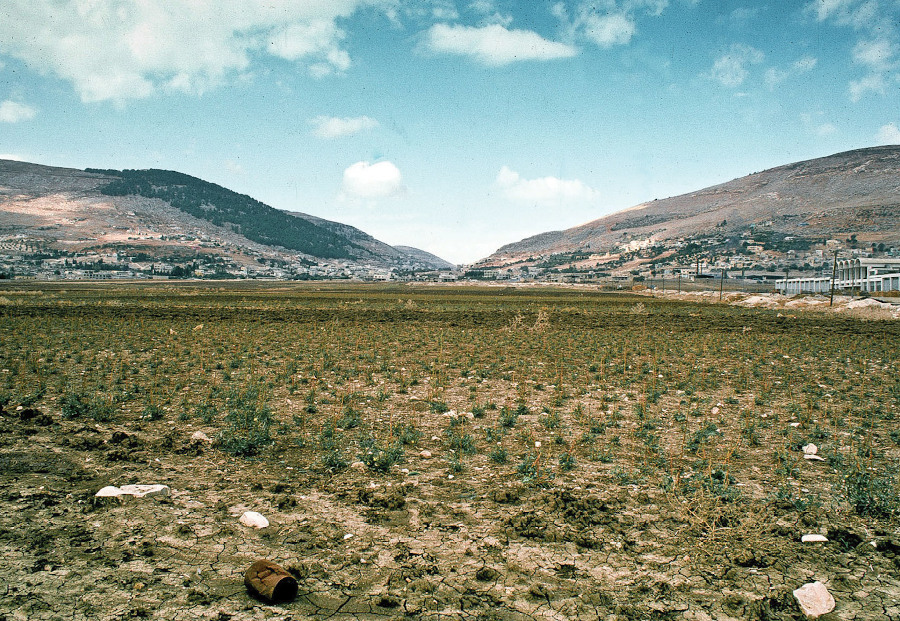
View of Mt. Gerizim (left) and Mt. Ebal (right) looking west. Joshua built an altar to the Lord on Mount Ebal and then recited the blessings on Mount Gerizim and the curses on Mount Ebal, as instructed in Dt 11:29. Shechem lies below.
www.HolyLandPhotos.org
Return to the main text.
8:31 burnt offerings. See Lev 1:1–17. fellowship offerings. See Lev 3:1–17; 7:11–18; see also chart.
8:32 wrote on stones. Moses had ordered the people first to plaster the stones, then to inscribe on them the words of the law (Dt 27:2–4).
8:33 foreigners . . . and the native-born. Israel now included the “other people” (Ex 12:38) who had come out of Egypt, plus those who had joined them during the wilderness wanderings.
8:34 the blessings and the curses. See Dt 27–28 and notes.
9:1–27 The account of how the Gibeonites deceived the leaders of the tribes and obtained a treaty of submission to Israel.
9:1 kings west of the Jordan. Small, independent city-kingdoms were scattered over Canaan, inhabited by a variety of peoples who had come earlier from outside the land (compare vv. 1–2 with Ge 15:19; see also note on Ex 3:8).
9:3 Gibeon. Just north of Jerusalem (see map). A site today called el-Jib shows the remains of a Late Bronze Age city with an excellent water supply. The Gibeonites were in league with a number of neighboring towns (v. 17) but seem to have been dominant in the confederation.
9:4 they resorted to a ruse. Motivated by their fear of Israel’s God, the Gibeonites used pretense to trick Joshua into a treaty that would allow them to live. wineskins. See photo; see also Mt 9:17 and note.
9:6 make a treaty with us. In this request they were offering to submit themselves by treaty to be subjects of the Israelites (see v. 11, where they call themselves “your servants”—unmistakable language in the international diplomacy of that day). They chose submission rather than certain death (v. 24).
9:7 Hivites. Possibly Horites, an ethnic group living in Canaan related to the Hurrians of northern Mesopotamia (see 11:19; Ge 10:17; 34:2; 36:2; Ex 23:23; Jdg 3:3; see also note on Jos 8:30–35).
9:9 heard reports of him. The same reports that had been heard in Jericho (2:10).
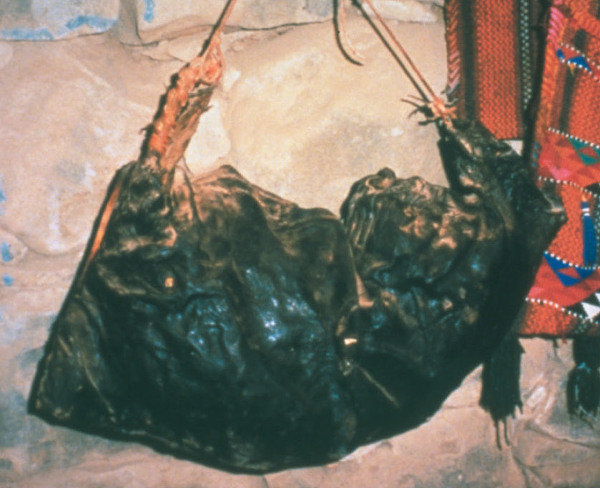
Modern facsimile of a wineskin at Qatzrin, in the Golan Heights. Wineskins were made from the skin of an animal and used to hold wine. Wineskins were among the items brought along when the Gibeonites went to meet Joshua at Gilgal (see Jos 9:4 and note).
Cheryl Dunn
Return to the main text.
9:14 did not inquire of the LORD. Did not consult their King, whose mission they were on.
9:15 treaty of peace. A covenant to let them live was sworn by the heads of the tribes—i.e., an oath was taken in the holy name of God. All such oaths were binding in Israel (Ex 20:7; Lev 19:12; 1Sa 14:24).
9:18 The whole assembly grumbled. Perhaps the people feared the consequences of not following through on the earlier divine order to destroy all the Canaanites, but more likely they grumbled because they could not take over the Gibeonite cities and possessions.
9:21 woodcutters and water carriers. A conventional phrase for household servants (Dt 29:11).
9:23 under a curse. Noah’s prediction that Canaan would someday “be the slave of Shem” (Ge 9:25–26) has part of its fulfillment in this event. for the house of my God. Probably specifies how the Gibeonites were to serve “the whole assembly” (v. 21). Worship at the tabernacle (and later at the temple) required much wood and water (for sacrifices and washing) and consequently a great deal of menial labor. From now on, that labor was to be supplied by the Gibeonites, perhaps on a rotating basis. In this way they entered the Lord’s service. When Solomon became king, the tabernacle and the altar of burnt offering were at Gibeon (2Ch 1:3,5).
9:27 place the LORD would choose. God intended Israel to worship him in a single central location (Dt 12:5). Joshua moved the tabernacle (and its altar) to Shiloh, and there it would reside at least until the days of Samuel (1Sa 4:3). Later God would specify Jerusalem as his chosen place of worship (1Ki 9:3).
10:1–43 The army under Joshua comes to the defense of Gibeon and defeats the coalition of southern kings at Aijalon, then subdues all the southern cities of Judah and the Negev.
10:1 Adoni-Zedek. Means “lord of righteousness” or “My (divine) lord is righteous.” An earlier king of Jerusalem had a similar name (Melchizedek; see Ge 14:18 and note). Jerusalem. City of the Jebusites.
10:2 alarmed. Their concern was that if even Gibeon’s strong army gave in to the Israelites, no one could withstand them. important city. Gibeon was not only larger in size than Bethel or Ai but also closer to Jerusalem. With Bethel and Ai conquered and the Gibeonite league in submission, the Israelites were well established in the central highlands, virtually cutting the land in two. Naturally the king of Jerusalem felt threatened, and he wanted to reunite all the Canaanites against Israel. Perhaps he also held (or claimed) some political dominion over the Gibeonite cities and viewed their submission to Israel as rebellion.
10:5 five kings of the Amorites. Rulers over five of the major cities in the southern hill country. The Amorites of the hills are here distinguished from the Canaanites along the coast.
10:6 Come . . . and save us! An urgent appeal for deliverance to a man whose name means “The LORD saves.” A treaty such as Joshua had made with the Gibeonites usually obliged the ruling nation to come to the aid of the subject peoples if they were attacked (see chart, under “Suzerain-Vassal”).
10:9 all-night march. Gilgal was about 20 miles east of Gibeon, a steep uphill climb for Joshua’s men. by surprise. Joshua attacked early in the morning, perhaps while the moon was still up (v. 12).
10:10 confusion. The Hebrew for this word implies terror or panic.
10:11 down from Beth Horon. A long descent to the plain of Aijalon below, following the main east-west crossroad just north of Jerusalem. large hailstones. For the Lord’s use of the elements of nature as his armaments, see Jdg 5:20; 1Sa 7:10; Job 38:22–23; Ps 18:12–14.
10:12 Sun, stand still. In addressing the Lord in this surprising way, Joshua indicates what he wants the Lord to do.
10:13 sun stood still. Some believe the sun continued to shine for extended hours. Others suggest that the sun and moon were visible in the sky at the same time, an evil omen for the Amorites that would have terrified them. While it is unclear exactly what happened, it is clear that it involved divine intervention, and extended hours of daylight provided the Israelites with an advantage with which they could defeat their enemies (see article). Book of Jashar. An early account of Israel’s wars (perhaps all in poetic form; see 2Sa 1:18; see also note on Jdg 5:1–31), but now lost.
Joshua 10 recounts the military success of Joshua and the Israelites over the Amorites. Midway through the description of the battle, we hear part of the reason for Israel’s victory: “The sun stopped in the middle of the sky and delayed going down about a full day” (10:13b).
There are two primary interpretations of this account. The first line of interpretation reads it as a fairly straightforward statement about celestial activity, with one of the following actions in view: (1) God stopped the earth from rotating for a period of time; (2) the sun appeared to stop shining because of a solar eclipse or another form of visual obstruction; (3) a cosmic phenomenon occurred that produced what looked like an extension of daylight; or (4) in the morning, the sun and moon “aligned” on both sides of the sky, a phenomenon taken as a favorable omen in ancient Near Eastern cultures. In this latter interpretation, Joshua asks God for a favorable sign for their battle.
The second interpretation reads the language about the sun and moon as figurative, especially given the poetic form of Jos 10:12b–13a where reference to the sun and the moon first occurs. The call to the moon to stand still represents Israel’s “all-night march” and its success for defeating the enemy troops (10:9–11). The similar command to the sun expresses in poetic form the events that occurred within the course of a day as the Amorite kings and their troops were completely defeated (10:16–27). An additional interpretive suggestion that often accompanies this view involves identifying Jos 10:13b as poetic along with 10:12b–13a, as in some translations.
Go to the Articles Index.
10:14 What made the day unique in human history was that the Lord responded so dramatically to Joshua—a mere human being—in leading his people to victory.
10:16 Makkedah. A town near Azekah (v. 10) in the western foothills where Joshua’s troops made their camp.
10:19 pursue your enemies. Most of the fighting men defending the southern cities were caught and killed before they could reach the safety of their fortresses.
10:21 no one uttered a word. The thought here appears to be that no one dared even to raise his voice against the Israelites anymore.
10:24 put your feet on the necks. Public humiliation of defeated enemy chieftains was the usual climax of warfare in the ancient Near East.
10:26 exposed their bodies on five poles. See note on Dt 21:22.
10:28 totally destroyed everyone. The holy ban was placed on the people of Makkedah, meaning that they were “devoted to the LORD” because of their wicked deeds (see 6:17 and note; see also NIV text note there). The same fate came to the other major cities of the south (vv. 29–42).
10:33 Horam king of Gezer. An important detail: the defeat of the king of the most powerful city in the area. Gezer was eventually taken over by the Egyptians and given to King Solomon as a wedding gift (1Ki 9:16).
10:38 Debir. Also known as Kiriath Sepher (15:15). This city was at one time identified with Tell Beit Mirsim. More recently, however, it has been equated with Khirbet Rabud, about five miles southwest of Hebron.
10:41 Kadesh Barnea to Gaza. The south-to-north limits in the western part of the region. Goshen. A seldom-used name for the eastern Negev, not to be confused with the Goshen in the delta of Egypt; it is also the name of a town (15:51). Goshen and Gibeon mark the south-to-north limits in the eastern part of the region.
11:1–23 Only the northern cities remained to be conquered. The major battle for the hills of Galilee is fought and won against Hazor and the coalition of other northern city-states. A summary follows of all Joshua’s victories in the southern and central regions as well.
11:1 Jabin king of Hazor. Jabin is perhaps a dynastic name, used again in the days of Deborah (Jdg 4:2).
Late Bronze Age Hazor was burned by Joshua (Jos 11:13). Excavations have revealed three clearly datable destruction layers, one of which may provide the strongest evidence yet for a historically verifiable date for the conquest.
The excavator thought Joshua burned the latest level (c. 1230 bc), but others argue that it must actually have been the earliest of the three levels, c. 1400 bc (see note on Jos 11:10).
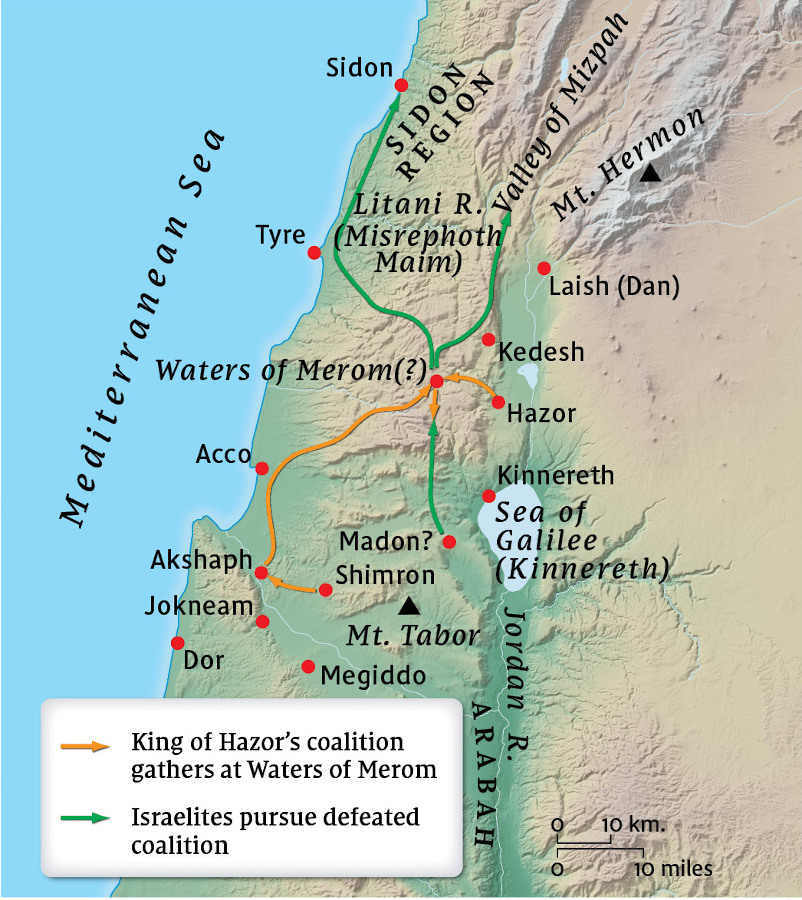
Go to the Maps Index.
11:2 Kinnereth. The Sea of Galilee. This name may be related to the Hebrew word for “harp” (kinnor); see note on Dt 3:17; see also map.
11:4 as numerous as the sand. A widely used figure of speech for indicating large numbers (see note on Ge 22:17).
11:5 All these kings. Jabin’s muster extended as far as the Arabah (v. 2) in the Jordan Valley and Dor on the Mediterranean, south of Mount Carmel. Merom. Probably modern Meirun, about eight miles northwest of the Sea of Galilee.
11:6 hamstring their horses. Done by cutting the tendon above the hock or ankle, preventing the horse’s use in warfare. burn their chariots. These advanced implements of war were not used by the armies of Israel until the time of Solomon (1Ki 9:22; 10:26–29).
11:10 Joshua . . . captured Hazor. Perhaps his greatest victory. Hazor’s armed forces, however, had been defeated earlier at Merom. The archaeological site reveals extensive damage and the burning of the Canaanite city c. 1400 bc (mentioned in the 2001 excavation report), c. 1300 and again c. 1230. Since the destruction level at c. 1300 probably indicates the burning of the city by Pharaoh Horemhab, this leaves the destruction levels at c. 1400 and c. 1230 for Joshua’s conquest. Those who hold to the late date of the conquest opt for the 1230 level; those who hold to the early date opt for 1400 (see Introduction: Historical Setting). Once again the ban of total destruction was applied (v. 11).
11:13 mounds. The Hebrew word is tel (Arabic tall), a hill formed by the accumulated debris of many ancient settlements one on top of another (see notes on 7:2; Jer 30:18).
11:15 he left nothing undone. Joshua’s success should be measured in the light of the specific orders given by God, which he carried out fully, rather than by the total area that eventually would have to be occupied by Israel.
11:16 this entire land. A lesson in the geography of Canaan follows. See map.
11:17 Mount Halak. A wilderness peak to the east of Kadesh Barnea marking Israel’s southern extremity. Baal Gad. The first valley west of Mount Hermon.
11:18 for a long time. An estimation of the duration of Joshua’s conquests can be made from the life span of Caleb: Seven years had elapsed from the beginning of the conquest (age 78; compare 14:7 with Dt 2:14) until he took Hebron (age 85; see 14:10).
11:20 the LORD . . . hardened their hearts. See notes on Ex 4:21; 7:13. exterminating them without mercy. See article.
11:21 Anakites. Had been reported by the 12 spies to be a people “of great size” (Nu 13:32), whom the Israelites had feared so much that they had refused to undertake the conquest. They were related to the Nephilim (see note on Ge 6:4) and were named after their forefather, Anak. Joshua shared with Caleb his victory over the Anakites (14:12–15).
12:1–24 A conclusion to the first section of Joshua, and a summary of the victories of the Israelites and the cities whose kings had been defeated (see maps here, here, and here).
12:1 territory . . . east of the Jordan. The unity of the nation is reaffirmed by the inclusion of these lands in Transjordan. Arnon Gorge. Marked the border with Moab to the south. Mount Hermon. The upper limits of Israel’s land to the north.
12:4 Og king of Bashan. Sihon (v. 2) and Og were defeated by Israel under Moses’ leadership, a long-remembered sign of God’s mighty power (Ne 9:22; Ps 135:11).
12:5 Salekah . . . Geshur . . . Maakah. All of them were east of the Sea of Galilee (Kinnereth): Salekah a town in the far east of Bashan, Geshur a small city kingdom northeast of Bashan, Maakah a city-state southeast of Mount Hermon (see map; see also 13:11).
12:7 the land . . . on the west side. Canaan proper (9:1; 11:16–17; 24:11; Ge 15:18–19).
12:9–24 Lists similar to this have been found elsewhere in the ancient Near East. Repetition of the word “one” is for emphasis and perhaps also distinguishes these places from those that had more than one king.
12:12 king of Gezer. Had been defeated in the siege of Lachish (10:33), but the city itself was not captured by Joshua, nor were the cities of Aphek, Taanach, Megiddo or Dor (vv. 18–23; see Jdg 1:27–31).
13:1–32 The heavenly King, who has conquered the land, begins the administration of his realm by assigning specific territories to the several tribes. Much of chs. 13–21 reads like administrative documents. The account begins by noting the land still to be subdued (but to be allotted) and by recalling the assignments already made by Moses to the two and a half tribes east of the Jordan (see map).
13:1 Joshua had grown old. Between 90 and 100 years of age; Caleb was 85 (14:10). still . . . large areas . . . to be taken over. See note on 18:3.
13:3 Shihor River. Elsewhere Shihor apparently refers to a branch of the Nile (see 1Ch 13:5; Isa 23:3 and notes; see also NIV text note on Jer 2:18). Here, however, it appears to be another name for the Wadi el-Arish below Gaza at the eastern entrance to the Sinai (“on the east of Egypt”). Ekron. See note on 1Sa 5:10. five Philistine rulers. See map.
13:5 Byblos. Just north of modern Beirut. The Phoenicians and the Philistines held most of the territory still to be occupied by Israel.
13:9 Aroer. This town on the Arnon River marked the southern boundary of Israel east of the Jordan. From here the land extended north through Gilead and Bashan to the slopes of Mount Hermon, the territory once dominated by the two kings of the Amorites, Sihon and Og.
13:14 the food offerings . . . are their inheritance. See Dt 18:1–8 and note on 18:1.
13:15 what Moses had given to . . . Reuben. The land east of the Dead Sea between the Arnon River (boundary of Moab) and Heshbon (the old royal city of Sihon).
13:22 Balaam son of Beor. The one who supposedly had influence with the gods (Nu 22–24) was slain when the Lord punished the Midianites for trying to seduce Israel into idolatry and sexual immorality (see Nu 25; 31:8 and notes on Nu 22:5,8).
13:24 what Moses had given to . . . Gad. The central area, beginning near Heshbon on the south and reaching, along the Jordan, to the southern end of the Sea of Galilee. It included most of Gilead, but the exact boundary between Gad and the half-tribe of Manasseh remains somewhat uncertain since not all the places named can now be located.
13:29 what Moses had given to the half-tribe of Manasseh. The lands east and north of the Sea of Galilee, but also including the upper part of Gilead. Makir (v. 31) led in the occupation of these lands (Nu 32:32,39–42).
13:33 the LORD . . . is their inheritance. See v. 14; see also Dt 18:1–8 and note on 18:1.
14:1–5 An introduction to the allotment of territories in Canaan (see map).
14:1 Eleazar the priest. Son of Aaron, Eleazar as high priest was the highest official over the casting of the lots. The Urim and Thummim (see notes on Ex 28:30; 1Sa 2:28) may have been used.
14:4 Manasseh and Ephraim. Sons of Joseph. Since Jacob had adopted them as his own sons (Ge 48:5), they constituted two separate tribes. This made possible the 12-part nation, with the Levites serving as a nonpolitical tribe.
14:6–15 Assignment of Hebron to Caleb—in accordance with Moses’ pledge to him for his faithful service as one of Israel’s spies sent to explore the promised land (see Nu 14:24, 30; 32:12 and note on 14:24). Assignments of cities in Canaan to Caleb (Judah) and Joshua (Ephraim) frame the account of territorial divisions west of the Jordan (see 19:49–50 and note on 19:49).
14:6 what the LORD said. Caleb now recalls the promise from the Lord 45 years earlier at Kadesh Barnea (see note on 11:18) when he brought back a good report of the land (Nu 13:30; 14:6–9; Dt 1:34–36).
14:8 followed . . . wholeheartedly. See Nu 14:24 and note; 32:12.
14:12 this hill country. Hebron is situated high in the Judahite hill country, about 25 miles south of Jerusalem. Anakites. See note on 11:21.
14:15 Kiriath Arba. Means “the town of Arba” and was named for Arba, the father of the Anakites (15:13; 21:11). It can also mean “the town of four,” possibly referring to Anak and his three sons (see 15:14; Nu 13:22 and note; Jdg 1:20). Then the land had rest from war. Since the Judahites and Caleb approached Joshua concerning their territory while he was still headquartered at Gilgal, it may be that they did so shortly before the wars fought under Joshua were ended (11:23).
15:1–63 Judah is the first of the west bank tribes to have its territory delineated. First the outer limits are listed, then the area apportioned to Caleb and Othniel; finally the Canaanite cities allotted to the clans of Judah are named region by region.
15:1 tribe of Judah. Judah’s priority finds support in the blessing of Jacob (Ge 49:8–12) and is upheld in the history of the nation (Jdg 1:1–2; 20:18; 2Ki 17:18; Ps 78:68). See note on 16:1—17:18.
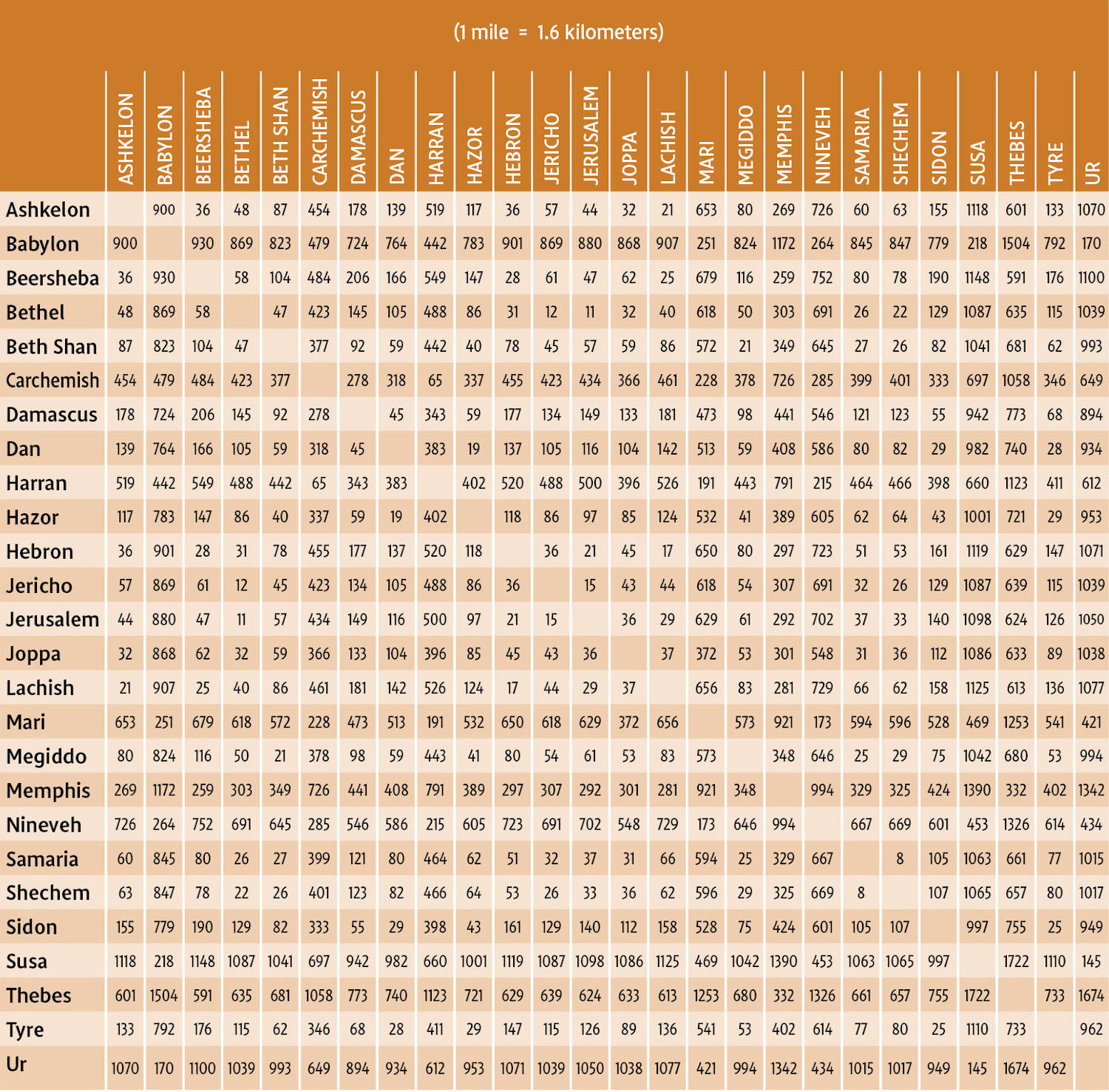
15:4 southern boundary. The points listed formed a curved line beginning at the lower tip of the Dead Sea and moving under Kadesh Barnea to join the Mediterranean coast at the mouth of the Wadi el-Arish (see note on 13:3).
15:5 northern boundary. Judah’s border with Benjamin ran in a westerly line from the mouth of the Jordan through the Hinnom Valley, just south of Jerusalem, over to Timnah, then northwest to the coastal city of Jabneel (later called Jamnia), about ten miles south of Joppa.
15:7 Gilgal. See note on Jdg 3:19.
15:15 he marched against . . . Debir. See note on 10:38.
15:17 Othniel. See Jdg 3:7–11 for his service as judge in Israel.
15:21 southernmost towns. Most of the first 29 villages were assigned to the tribe of Simeon (cf. 19:1–9).
15:33 western foothills. This area between the highlands of central Judah and the Philistine coast was for the most part not occupied by Israel until the victories of King David. Some of the places on this list were reassigned to the tribe of Dan (cf. 19:41–43).
15:48 hill country. The high region south of Jerusalem. The Septuagint (the pre-Christian Greek translation of the OT) adds 11 names, including Tekoa and Bethlehem, to this list.
15:61–62 The “wilderness” is the chalky, dry region east and south of Jerusalem that borders the Dead Sea. Of the places named, only En Gedi can be positively located. However, either Sekakah or the City of Salt may have been the ancient name of the site of Qumran, where the scribes who produced the Dead Sea Scrolls lived.
15:63 Jebusites. A victory over the city of the Jebusites by the men of Judah is recorded in Jdg 1:8 (see note there), but evidently this did not result in its permanent occupation. Both Benjamin and Judah failed to take the Jebusite fortress of Jerusalem (Jdg 1:21).
16:1—17:18 Two chapters are devoted to the lands given to the “descendants of Joseph” (16:4), consisting of Ephraim and the half-tribe of Manasseh that settled west of the Jordan. Following Judah (see note on 15:1), the Joseph tribes were given priority in the allotting of territory.
16:1 allotment for Joseph. The southern border of the Joseph tribes moved west from Jericho past Bethel and down to Gezer and the Mediterranean coast.
16:5 boundary. Ephraim’s northern border began at the edge of the Jordan Valley and ran west near Shiloh, but south of Shechem, then followed the Wadi Kanah down to the Mediterranean Sea.
16:10 Gezer. See note on 10:33. required to do forced labor. On projects undertaken by public officials, usually the king (2Sa 12:13; 1Ki 9:15,20–21).
17:1 Manasseh as Joseph’s firstborn. A reminder that Manasseh was the firstborn, though Jacob had given priority to Ephraim when he adopted Joseph’s two sons (Ge 48:14,19).
17:3 Zelophehad . . . had . . . only daughters. See notes on Nu 27:1–11; 36:1–3.
17:5 ten tracts of land. Manasseh’s territory was second only to Judah’s in size. The ten portions went to the five brothers (minus Hepher) and to the five granddaughters of Hepher.
17:11 Beth Shan . . . Megiddo. These powerfully fortified cities (and others) were not conquered until later. When King Saul died in battle, the victorious Philistines fastened his body to the wall of Beth Shan (1Sa 31:10), which suggests that that city was in league with the Philistines. See photo.
17:13 when the Israelites grew stronger. Possibly referring to the days of David and Solomon (see note on 16:10).
17:14 people of Joseph . . . numerous. The reference is to both Ephraim and Manasseh (v. 17). The allotment to the Joseph tribes is here handled as one (16:1,4)—though the two subdivisions are then described separately (16:5—17:11).
17:15 hill country of Ephraim. The territory of the Joseph tribes—under the name of the legal firstborn (see note on v. 1). clear land for yourselves. This region of Canaan was still heavily forested. It seems that the Israelites viewed their assigned territories primarily in terms of the number of cities that had their land cleared for farming and pasturage, not in terms of the size of the region in which these cities were located. The region assigned to the Joseph tribes was at the time not as heavily populated as others. Perizzites and Rephaites. Here listed as neighboring peoples, though elsewhere the Perizzites are said to have lived on the west bank in Canaan (3:10; 12:8) and the Rephaites in the Transjordan kingdom of Og (12:4; 13:12). See notes on Ge 13:7; Dt 2:11.
17:16 in the plain. Only in the plains were chariots effective. chariots fitted with iron. Wooden chariots with certain parts made of iron (see note on 2Sa 8:7), perhaps the axles. This use of iron was a new development. Israel did not employ chariots until much later (see note on 11:6).
18:1—19:51 Seven tribes remained to be assigned land: Benjamin, Simeon, Zebulun, Issachar, Asher, Naphtali and Dan. Their lots were cast at Shiloh.
18:1 Shiloh. About ten miles northeast of Bethel, a little east of the main road from Bethel to Shechem. tent of meeting. The tabernacle (see note on Ex 27:21) with its sacred ark of the covenant. It would remain at Shiloh until the time of Samuel (1Sa 4:3).
18:3 take possession. Conquest had to be followed by settlement, which required a survey, then a fair distribution, and then a full occupation of the land. A distinction must therefore be made between the national wars of conquest (Joshua) and the tribal wars of occupation (see 21:43–45 and note; Jdg 1–2 and note on 1:1).
18:5 north. Relative to the territory of Judah.
18:6 I will cast lots for you. See note on 14:1.
18:7 priestly service of the LORD is their inheritance. See 13:14; see also Dt 18:1–8 and note on 18:1.
18:9 scroll. Presumed form of the document; the Hebrew for this word is not specific.
18:11 lot . . . for . . . Benjamin. Benjamin’s northern border was the same as Ephraim’s southern border, and Benjamin’s southern border was the same as Judah’s northern border (see note on 15:5). The areas allotted to Benjamin and Dan (19:40–48) constituted a buffer zone between Judah and Ephraim, the two dominant tribes in Israel. The accounts of allotments to Benjamin and Dan frame the account of allotments made at Shiloh. These two tribes and the location of their allotments would play a significant role in the cycles of narratives related in the book of Judges (see Introduction to Judges: Literary Features and notes on Jdg 3:12–36; 13:1—16:31).
19:1 second lot . . . for . . . Simeon. Cities in the Negev within the borders of Judah (15:21; 1Ch 4:24–42; see also Jdg 1:3).
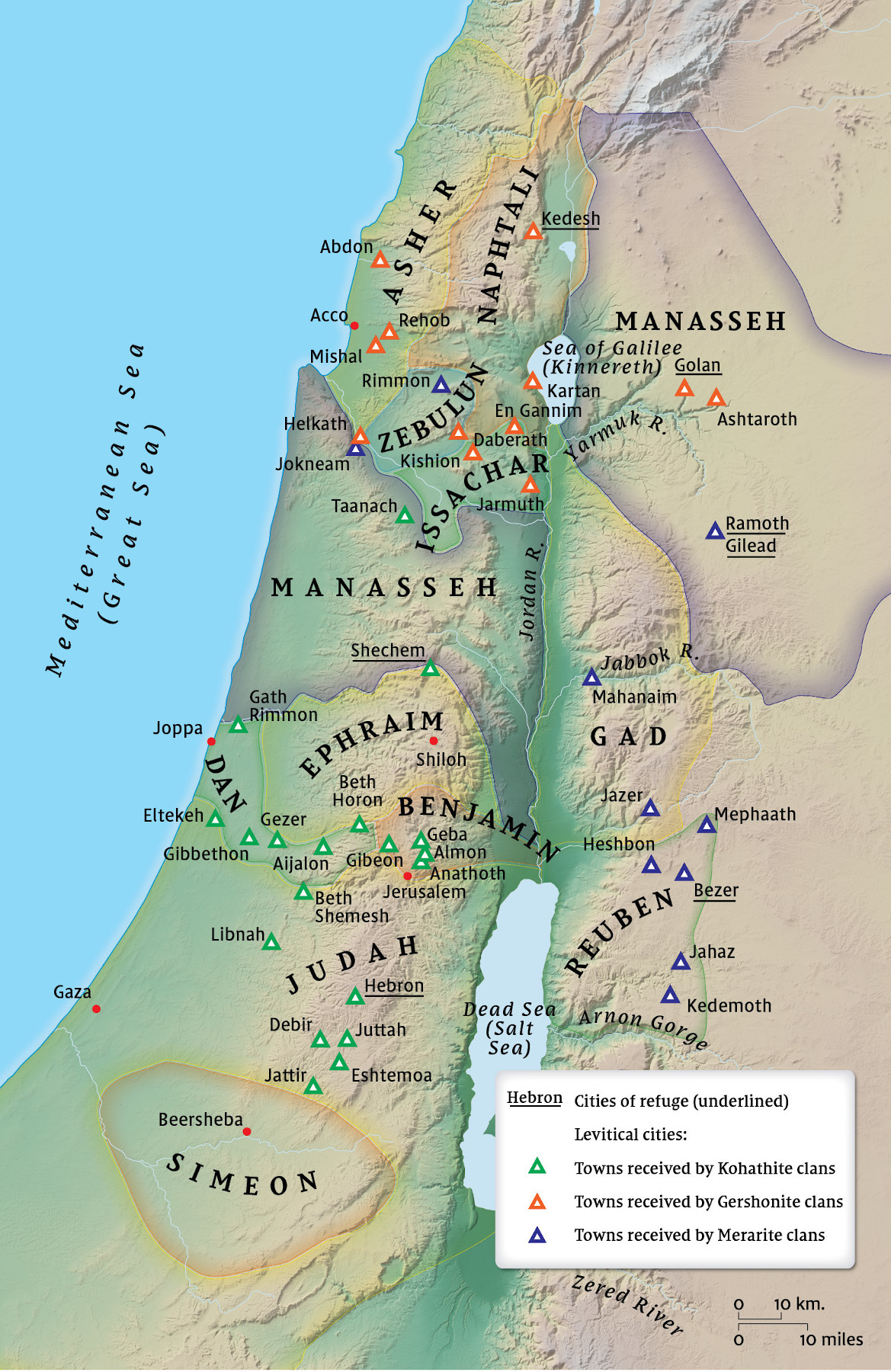
19:10 third lot . . . for Zebulun. To this tribe went a portion of lower Galilee midway between the Sea of Galilee and the Mediterranean.
19:17 fourth lot . . . for Issachar. Southwest of the Sea of Galilee reaching down to the vicinity of Beth Shan and west to the Jezreel Valley. Mount Tabor marked its northern border.
19:24 fifth lot . . . for . . . Asher. Asher was given the coastal area as far north as Sidon in Phoenicia and as far south as Mount Carmel.
19:32 sixth lot . . . for Naphtali. An area mostly to the north of the Sea of Galilee, including the mountains bordering on Asher and Zebulun to the west. Its southernmost point was at the southern end of the Sea of Galilee.
19:40 seventh lot . . . for . . . Dan. An elbow of land squeezed between Ephraim and Judah and west of Benjamin (see note on 18:11). The port of Joppa marked the northwestern corner of Dan.
19:47 territory of the Danites was lost to them. The Amorites of this area “confined the Danites to the hill country” (Jdg 1:34), so most of the tribe migrated to the upper Jordan Valley, where they seized the town of Leshem (or Laish; see Ge 14:14 and note; Jdg 18:2–10,27–29 and notes on 18:1,7,29) and renamed it Dan.
19:49 gave Joshua . . . an inheritance. In the account of the distribution of the promised land (the territory west of the Jordan), the assignment to Caleb is treated first (14:6–15), the assignment to Joshua last. Thus the allotment of an inheritance to these two faithful servants of the Lord from the wilderness generation (Nu 13:30; 14:6,24,30) frames the whole account—and both received the territory they asked for. Appropriately, Joshua’s allotment came last; he was not a king or a warlord but the servant of God commissioned to bring the Lord’s people into the promised land.
19:50 Timnath Serah. Located in the southwestern corner of Ephraim, facing out to the sea. Here Joshua was also buried (24:30).
20:1–9 Having distributed the land to the tribes, the Lord’s next administrative regulation (see note on 13:1–32) provided an elementary system of government, made up of regional courts to deal with capital offenses having to do with manslaughter. A safeguard was thus created against the easy miscarriage of justice (with its potential for endless blood feuds) when retribution for manslaughter was left in the hands of family members. The cities chosen were among those also assigned to the Levites, where ideally the law of Moses would especially be known and honored. See map.
20:2 as I instructed you through Moses. See Nu 35:6–34.
20:3 avenger of blood. The Hebrew word can also be translated “guardian-redeemer” (Ru 2:20; see note and NIV text note there) and “Redeemer” (see Isa 41:14 and note). The avenger was a near relative with the obligation of exacting retribution (see Lev 24:17; Nu 35:16–28).
20:4 city gate. Traditional place for trials, where the elders sat to hold court (see Ru 4:1 and note; see also Job 29:7).
20:6 assembly. Perhaps the assembly in the town where the crime was committed (Nu 35:24–25). death of the high priest. See Nu 35:25–28 and note on 35:24.
20:7 they set apart Kedesh. A wordplay in the Hebrew: “they consecrated (the town of) consecration.” The other two cities west of the Jordan already had sacred associations: For Shechem, see 8:30–35 and note; Ge 12:6–7; for Hebron, see Ge 23:2; 49:29–32. The geographic distribution of the cities was important: one in the north, one in the midlands and one in the south. (See v. 8, where the order of the three cities of refuge that served in Transjordan is reversed: Bezer in the south, Ramoth in the midlands and Golan in the north.) See map.
20:9 or any foreigner. Evidence of the equal protection granted to the foreigners living in Israel (cf. Lev 19:33–34; Dt 10:18–19).
21:1–45 Finally the Levites are allotted their towns and adjoining pasturelands—with the priestly families being given precedence (v. 10).
21:4 Kohathites. The three sons of Levi were Kohath, Gershon and Merari (Ex 6:16; Nu 3:17). Judah, Simeon and Benjamin. Tribal areas close to Jerusalem, which would later be the site of the temple. The remaining Kohathites received cities in adjoining tribes.
21:11 Hebron. Caleb’s city (14:13–15). The priests and Levites were to be given space in their assigned cities along with the other inhabitants.
21:27 Gershonites. Received cities in the northern tribes of Asher, Naphtali and Issachar.
21:32 Kedesh . . . a city of refuge. See map.
21:34 Merarite clans. Their 12 cities were scattered throughout Reuben, Gad and Zebulun.
21:43–45 A concluding summary statement of how the Lord had fulfilled his sworn promise to give Israel this land (Ge 15:18–21). The occupation of the land was not yet complete (23:4–5; Jdg 1–2), but the national campaign was over and Israel was finally established in the promised land. No power was left in Canaan that could threaten to dislodge her.
21:44 rest on every side. See note on 1:13.
21:45 good promises. Refers to the good things God had covenanted to give his people (23:14–15; 1Ki 8:56; Jer 33:14).
22:1–34 The two and a half tribes from east of the Jordan, faithful in battle, are now commended by Joshua and sent to their homes. But their altar of “witness” (vv. 26–27,34) was misunderstood, and disciplinary action against them was narrowly averted.
22:2 all that Moses . . . commanded. Moses had ordered them to join the other tribes in the conquest of Canaan (Nu 32:16–27; Dt 3:18).
22:5 love the LORD . . . serve him with all your heart. Obedience to the laws of God requires love and service from the heart. In the ancient Near East, “love” was also a political term, indicating truehearted loyalty to one’s king (see notes on Dt 6:5; 11:1).
22:8 divide . . . with your fellow Israelites. Moses also had seen the need for a fair sharing of the spoils of war (Nu 31:25–27).
22:10 Geliloth. Understood in the Septuagint (the pre-Christian Greek translation of the OT) to be Gilgal, next to Jericho; more likely it was a site east of Shiloh along the Jordan River (18:17).
22:11 when the Israelites heard. Anxiety about apostasy led to hasty conclusions. They thought the altar had been set up as a rival to the true altar at Shiloh.
22:12 gathered at Shiloh. In the presence of God at the tabernacle. to go to war against them. To take disciplinary action (cf. Dt 13:12–18; Jdg 20).
22:13–14 A prestigious delegation is sent to try to turn the Transjordan tribes from their (supposed) act of rebellion against the Lord.
22:16 How could you . . . ? The accusations were very grave: You have committed apostasy and rebellion.
22:17 Peor. Where some of the Israelites became involved in the Moabite worship of Baal of Peor (Nu 25:1–5).
22:19 is defiled. By pagan worship, corrupting its inhabitants. the LORD’s land. The promised land proper had never included Transjordan territory. Canaan was the land the Lord especially claimed as his own and promised to the descendants of Abraham, Isaac and Jacob.
22:20 Achan . . . the whole community of Israel. See note on 7:1–26.
22:22 The Mighty One, God, the LORD! See note on Ps 50:1. The repetition of the sacred names gives an oath-like quality to this strong denial of any wrongdoing.
22:27 witness. The altar, presumably of uncut stone (8:31; Ex 20:25), was to serve as a testimony to the commitment of the Transjordan tribes to remain loyal to the Lord, and to their continued right to worship the Lord at the tabernacle—even though they lived outside the land of promise.
22:31 you have rescued the Israelites. Their words prevented both the Lord’s punishment on the eastern tribes and the punishment all the tribes would have experienced because of the sin of the 2 1/2 tribes (cf. v. 20).
23:1–16 Joshua, the Lord’s servant, delivers a farewell address recalling the victories the Lord has given, but also reminding the people of areas yet to be possessed and of the need to be loyal to God’s covenant laws. Their mission remains—to be the people of God’s kingdom in the world.
23:1 rest. See note on 1:13,15. very old man. Joshua was approaching the age of 110 (24:29).
23:6 be careful to obey. Echoing the Lord’s instructions at the beginning (1:7–8; see 22:5). Book of the Law. See note on 1:8.
23:10 One of you routs a thousand. See, e.g., Lev 26:8; Dt 32:30; Jdg 15:15–16.
23:11 love the LORD your God. A concluding summation (see note on 22:5).
23:12 But if you turn away. Remaining in the promised land was conditioned on faithfulness to the Lord and separation from the idolaters still around them. Failure to meet these conditions would bring Israel’s banishment from the land (cf. vv. 13,15–16; 2Ki 17:7–8; 2Ch 7:14–20). ally yourselves . . . intermarry. The Lord prohibited alliances, either national or domestic, with the peoples of Canaan because such alliances would tend to compromise Israel’s loyalty to the Lord (see Ex 34:15–16 and note on 34:15; Dt 7:2–4 and notes on 7:1–6; 7:2–5; 7:4; cf. 1Ki 11:1–13).
23:13 snares and traps. Joshua’s warning echoes Ex 23:33; 34:12; Dt 7:16.
23:14 go the way of all the earth. Meaning he was about to die.
24:1–28 Once more Joshua assembled the tribes at Shechem to call Israel to a renewal of the covenant (8:30–35). It was his final official act as the Lord’s servant, mediator of the Lord’s rule over his people. In this he followed the example of Moses, whose final official act was also a call to covenant renewal—of which Deuteronomy is the preserved document.
24:2 This is what the LORD . . . says. Only a divinely appointed mediator would dare to speak for God with direct discourse, as in vv. 2–13. Long ago. In accordance with the common ancient Near Eastern practice of making treaties (covenants), a brief recital of the past history of the relationship precedes the making of covenant commitments.
24:10 I would not listen to Balaam. Not only did the Lord reject Balaam’s prayers, he also turned his curse into a blessing (Nu 23–24; Ne 13:2; Mic 6:5).
24:12 hornet. See note on Ex 23:28. two Amorite kings. Sihon and Og (Nu 21:21–35).
24:14 fear the LORD. Trust, serve and worship him (see note on Ge 20:11). gods your ancestors worshiped beyond the Euphrates River and in Egypt. See v. 2. Joshua appealed to the Israelites to put away the gods their ancestors had worshiped in Mesopotamia and Egypt. In Ur and Harran, Terah’s family would have been exposed to the worship of the moon-god, Nanna(r) or Sin (see 6:1; Ge 11:31 and notes). The golden calf of Ex 32:4 may be an example of their worship of the gods of Egypt. It was probably patterned after Apis, the sacred bull of Egypt; see notes on Ex 9:3; 32:4. (Jeroboam’s golden calves at Bethel and Dan, on the other hand, probably represented mounts or pedestals for a riding or standing deity; see 1Ki 12:28–29 and notes.)
24:15 as for me. Joshua publicly makes his commitment, hoping to elicit the same from Israel.
24:17–18 A confessional statement based on the miraculous events of the exodus.
24:19 You are not able. Strong words to emphasize the danger of overconfidence. He is a holy God. See Lev 11:44 and note. he is a jealous God. See Ex 20:5; Zec 1:14 and notes.
24:22 witnesses. See v. 27; a normal part of treaty/covenant-making (Dt 30:19).
24:23 foreign gods. Such gods were represented by idols of wood and metal, which could be thrown away and destroyed.
24:25 covenant for the people. Consisting of the pledges they had agreed to and the decrees and laws from God.
24:26 Book of the Law of God. Probably a list of decrees and laws Joshua had drawn up for the people at the Lord’s direction (v. 25). large stone. Set up as a witness to the covenant renewal that closed Joshua’s ministry. Thus the promised land itself bore full testimony to God’s people—how they had come into possession of the land and how they would remain in the land only by fulfilling the covenant conditions. oak. See note on Ge 12:6.
24:29–33 Three burials. Since it was a deep desire of the ancients to be buried in their homeland, these notices not only mark the conclusion of the story and the close of an era but also underscore the fact that Israel had indeed been established in the promised homeland. The Lord had kept his covenant promises.
24:29 Joshua . . . died. Just as Deuteronomy ends with the notice of Moses’ death (Dt 34:5), so Joshua ends with a notice of Joshua’s death. a hundred and ten. For the significance of this number see note on Ge 50:26.
24:30 buried him . . . at Timnath Serah. See 19:50 and note.
24:31 The story told in Joshua is a testimony to Israel’s faithfulness in that generation. The author anticipates the quite different story that would follow in Judges.
24:32 Joseph’s bones. Returning his bones to Shechem was significant not only because of the ancient plot of land Jacob bought from Hamor (Ge 33:19) but also because Shechem was to be the center of the tribes of Ephraim and Manasseh, the two sons of Joseph. Also, the return fulfilled an oath sworn to Joseph on his deathbed (Ge 50:25; Ex 13:19).
24:33 Eleazar. The high priest who served Joshua, as Aaron had served Moses. Gibeah. Not the Benjamite city, but a place in Ephraim near Shiloh.