Study Notes
 1:1 Paul. It was customary to put the writer’s name at the beginning of a letter. For more information on Paul, see notes on Ac 13:9; Ro 1:1. apostle . . . by the will of God. See 1Co 1:1 and note. Christ. Paul is very Christ-centered, as seen by this short letter, in which he uses the titles in Greek for “Christ” 25 times and for “Lord” (alone) 9 times. Timothy. Paul indicates the letter comes from Timothy as well in 2 Corinthians, Philippians, 1,2 Thessalonians and Philemon, but Paul is really the sole author, as seen by the constant use of the pronoun “I” (see especially 4:18).
 1:2 holy people. Because of Christ’s substitutionary death for the Colossian believers, they are declared holy in the sight of God, and because of the Holy Spirit’s work they are continuing to be made holy in their lives (see notes on Ro 1:7; 6:22; 1Co 1:2). faithful. See 1:7; 4:7,9. brothers and sisters. See NIV text note. in Christ. Paul mentions the spiritual union with Christ 12 times in Colossians (see note on Eph 1:1). Grace and peace. See note on Ro 1:7.
1:3 We. Paul and Timothy (v. 1). thank God. Every one of Paul’s letters, except Galatians, begins with thanks or praise (see note on Php 1:3–4). In Colossians thanks is an important theme (v. 12; 2:7; 3:15–17; 4:2). In the Bible humans are never thanked for their faith and love, but rather God, who is the source of these virtues, receives thanks. Lord Jesus Christ. See note on 1Th 1:1.
1:4 God’s people. The Greek word for this phrase is sometimes rendered “saints,” meaning “holy people” (v. 2) or “people set apart to God” (see note on Ro 1:7; see also Preface at the front of this study Bible).
1:5 The three great Christian virtues of faith, love and hope appear also in Ro 5:2–5; 1Co 13:13; Gal 5:5–6; 1Th 1:3; 5:8; Heb 10:22–24. hope. Not wishful thinking but a confident expectation (see Ro 5:5 and note). For this unusual thought of faith and love coming from hope, see Titus 1:2. the true message of the gospel. Implies a false message was circulating, that Paul contrasts with the true gospel later (e.g., 1:21–23; 2:4,8,16–23)
1:6 throughout the whole world. Hyperbole, to dramatize the rapid spread of the gospel into every quarter of the Roman Empire within three decades of Pentecost (see v. 23; Ro 1:8 and note; 10:18; 16:19). In refutation of the charge of the false teachers, Paul insists that the Christian faith is not merely local or regional but worldwide.
1:7 Epaphras. A native (4:12) and probably founder of the Colossian church, and an evangelist in nearby Laodicea and Hierapolis (4:13). Paul loved and admired him, calling him a “fellow prisoner” (Phm 23), his “dear fellow servant” and “a faithful minister of Christ.” Epaphras was the one who told Paul at Rome about the Colossian church problem and thereby stimulated him to write this letter (vv. 4,8). His name, a shortened form of Epaphroditus (from “Aphrodite,” the Greek goddess of love), suggests that he was a convert from paganism. He is not the Epaphroditus of Php 2:25; 4:18.
1:8 your love in the Spirit. The Holy Spirit is the source of all Christian love (see Ro 5:5; Gal 5:22–23 and notes).
1:9 knowledge of his will. Knowledge is not merely the possession of facts. Rather, knowledge and wisdom in the Bible are practical, having to do with godly living. This is borne out by vv. 10–12, where knowledge, wisdom and understanding result in a life worthy of the Lord.
1:10 live a life. This phrase is linked to 2:6; 3:7; 4:5 (“act”) by the same Greek verb. bearing fruit . . . growing. Cf. v. 6.
1:12 inheritance. See 1Pe 1:4 and note. light. Often symbolizes holiness (see 1Jn 1:5 and note), truth (Ps 119:105, 130; 2Co 4:6), glory (Isa 60:1–3; 1Ti 6:16) and life (Jn 1:4). Accordingly, God (1Jn 1:5), Christ (Jn 8:12) and the Christian (Eph 5:8) are characterized by light. The “kingdom of light” is the opposite of the “dominion of darkness” (v. 13). See also note on Ps 27:1.
1:13 kingdom. Does not here refer to a territory but to the authority, rule or sovereign power of a king. Here it means that the Christian is no longer under the dominion of evil (darkness) but under the benevolent rule of God’s Son (the “true light,” Jn 1:9).
1:14 redemption. Deliverance and freedom from the penalty of sin by the payment of a ransom—the substitutionary death of Christ (see Ro 3:24; Eph 1:7 and notes).
1:15–20 Perhaps an early Christian hymn (see note on 3:16) on the supremacy of Christ—used here by Paul to counteract the false teaching at Colossae. It is divided into two parts: (1) Christ’s supremacy in creation (vv. 15–17); (2) Christ’s supremacy in redemption (vv. 18–20).
1:15 image. Christ is called the “image of God” here and in 2Co 4:4 (see note there). In Heb 1:3 he is described as the “radiance of God’s glory and the exact representation of his being.” This figure of the image suggests two truths: (1) God is invisible (“No one has ever seen God,” Jn 1:18); and (2) Christ, who is the eternal Son of God and who became the God-man, reflects and reveals him (see also Jn 1:18; 14:9). firstborn over all creation. A metaphor. Just as the firstborn son had certain privileges and rights in the biblical world, so also Christ has certain rights in relation to all creation—priority, preeminence and sovereignty (vv. 16–18). The term does not mean that Christ was God’s first created being.

1:16 thrones or powers or rulers or authorities. Perhaps a reference to an angelic hierarchy that figured so prominently in the Colossian heresy (see Introduction: The Colossian Heresy). Whether or not this is so, Paul asserts that no matter what supernatural powers there may be, Christ is above them because they “have been created through him and for him.” Cf. Eph 6:12 and note. all things have been created through him. See Jn 1:3; 1Co 8:6; Heb 1:2. Seven times in vv. 15–20 Paul mentions “all creation,” “all things” and “everything,” thus stressing that Christ is supreme over all.
1:17 He is before all things. Referring to time, as in Jn 1:1–2; 8:58. in him all things hold together. See Heb 1:3 and note (item 5).
1:18 head. Christ is supreme in the church as the one on whom it is dependent (see notes on 1Co 11:3; Eph 1:22). beginning. Of the new creation. firstborn. Christ was the first to rise from the dead with a resurrection body. Elsewhere Paul calls him the “firstfruits of those who have fallen asleep” (1Co 15:20). Others who were raised from the dead (2Ki 4:35; Lk 7:15; Jn 11:44; Ac 9:36–41; 20:7–12) were raised only to die again.
1:19 fullness. Part of the technical vocabulary of some Gnostic philosophies. In these systems it meant the sum of the supernatural forces controlling the fate of people. For Paul “fullness” meant the totality of God with all his powers and attributes (see 2:9 and note).
1:20 reconcile to himself all things. Does not mean that Christ by his death has saved all people. Scripture speaks of an eternal hell and makes clear that only believers are saved. When Adam and Eve sinned, not only was the harmony between God and human beings destroyed, but also disorder came into creation (Ro 8:19–22). So when Christ died on the cross, he made peace possible between God and humans, and he restored in principle the harmony in the physical world, though the full realization of the latter will come only when Christ returns (see Ro 8:21 and note).
1:22 death. Christ’s death.
1:23 every creature. See note on v. 6.
1:24 what I am suffering. During his mission to the Gentiles Paul experienced all kinds of affliction (2Co 11:23–27), but here he was probably referring especially to his imprisonment. fill up . . . what is still lacking. Does not mean that there was a deficiency in the atoning sacrifice of Christ. Rather, it means that Paul suffered afflictions because he was preaching the good news of Christ’s atonement. Christ suffered on the cross to atone for sin, and Paul filled up Christ’s afflictions by experiencing the added sufferings necessary to carry this good news to a lost world (cf. Mt 5:11–12; Ac 5:41).
1:25 commission. The task with which he was entrusted (1Co 9:17). to present . . . the word of God in its fullness. The meaning seems to be that the word of God, which is the gospel, is brought to completion, i.e., to its intended purpose, only when it is proclaimed (cf. Isa 55:11). Paul’s commission to bring the word to completion, therefore, required him to make the word of God heard in Colossae, as well as elsewhere. See Ro 15:19 for a similar statement.
1:26 mystery. The purpose of God, unknown to humans except by revelation. This word was a popular, pagan religious term used in the mystery religions to refer to secret information available only to an exclusive group of people. Paul changes that meaning radically by always combining it with words such as “disclosed” (here), “made known” (Eph 1:9), “make plain” (Eph 3:9) and “revelation” (Ro 16:25; see note there). The Christian mystery is not secret knowledge for a few. It is a revelation of divine truths—once hidden but now openly proclaimed.
1:27 Gentiles . . . Christ in you. The mystery is the fact that Christ indwells Gentiles, for it had not been previously revealed that the Gentiles would be admitted to the people of God on equal terms with Israel (see note on Eph 3:6). glory. The glorious future prepared by God for his people (see 3:4; Ro 5:2 and note; 8:17–18; 1Co 2:7 and note; 15:42–44 and note; 2Co 4:17 and note; 1Th 2:12; 2Th 2:14; 2Ti 2:10; Heb 2:10; 1Pe 5:1,4 and note on 5:1).
1:28 fully mature. Employed by the mystery religions and the Gnostics to describe those who had become possessors of the secrets or knowledge boasted of by the particular religion (see Introduction to 1 John: Gnosticism). But Christian growth is about becoming “fully mature” in Christ by becoming more like him (Ro 8:29).
1:29 An example of the combination of human effort and divine help (see Php 2:12–13 and notes).
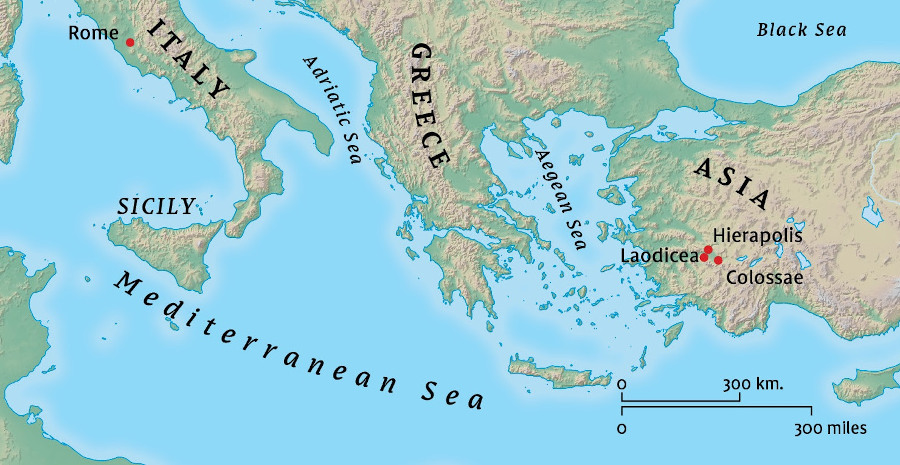
2:1 I am contending. Probably a reference to Paul’s prayers and inner conflicts and concerns for the Colossians. Laodicea. This letter was to be read to the church there too (4:16). Laodicea (near modern Denizli) was only about 11 miles northwest of Colossae (see map).
2:2 mystery. See notes on 1:26; Ro 11:25.
2:3 knowledge. Paul stressed knowledge in this letter (v. 2; 1:9–10) because he was refuting a heresy that emphasized knowledge as the means of salvation (see Introduction to 1 John: Gnosticism). Paul insisted that the Christian, not the Gnostic (or the adherent to any other Greek mystery or folk religion), possessed genuine knowledge.
2:5 absent . . . in body, . . . present . . . in spirit. Cf. 1Co 5:3.
2:6–7 Cf. Eph 3:16–19.
2:6 live . . . in him. The believer’s intimate, spiritual, living union with Christ is mentioned repeatedly in this letter (see, e.g., vv. 7,10–13,20; 1:2,27–28; 3:1,3).
2:7 the faith. See Jude 3 and note. overflowing with thankfulness. See Eph 5:20 and note.
2:8 elemental spiritual forces of this world. If the NIV text note rendering is correct, this phrase (which occurs also in v. 20; Gal 4:3,9) refers to false, worldly, elementary religious teachings. Paul was counteracting the Colossian heresy, which, in part, taught that for salvation one needed to combine faith in Christ with secret knowledge and with human regulations concerning such physical and external practices as circumcision, eating and drinking and observance of religious festivals. On the other hand, if the translation in the main NIV text is correct, it refers to evil spiritual powers (cf. Ro 8:38–39; 1Co 15:24; cf. also Eph 6:10–18; Col 2:15; 1Pe 3:19–20a and notes). These powers, of course, could have been working through the regulations and so-called knowledge just noted.
2:9 fullness of the Deity. See note on 1:19. The declaration that the very essence of deity was present in totality in Jesus’ human body was a direct refutation of Gnostic teaching or other claims that Christ only seemed to be human (Docetism).
2:10–15 Here Paul declares that the Christian is complete in Christ, rather than being deficient as the Gnostics and various other groups claimed. This completeness includes the putting off of the old self ruled by sin (v. 11; cf. 3:9), resurrection from spiritual death (vv. 12–13), forgiveness (v. 13) and deliverance from certain requirements of the law (v. 14) and from evil spirit beings (v. 15).
2:10 head. Cf. 1:18 and note; see Eph 1:19–22 and notes.
2:11–12 circumcision . . . baptism. In the Israelite faith, circumcision was a sign that the individual stood in covenant relation with God. While this is the only reference where circumcision is associated with baptism, some see the passage as implying that, for the Christian, water baptism is the parallel sign of the covenant relationship. On the other hand, Paul describes this “circumcision by Christ” as “not performed by human hands,” whereas baptism is a humanly administered ritual. Paul may be thinking of the believer’s spiritual death and resurrection at conversion (“your faith in the working of God”) as the initiation experience that corresponds spiritually to circumcision.
2:14 the charge of our legal indebtedness. A business term, meaning a certificate of indebtedness in the debtor’s handwriting. Paul uses it as a designation for our burden of guilt incurred by our failure to keep the Mosaic law, with all its regulations, under which everyone is a debtor to God.
2:15 having disarmed. Not only did God cancel out the accusations of the law against the Christian, but he also conquered and disarmed the evil angels (powers and authorities, 1:16; Eph 6:12), who entice people to follow asceticism (v. 21) and false teachings about Christ. The picture is of conquered soldiers stripped of their clothes, as well as their weapons, to symbolize their total defeat. triumphing over them. Or “leading them in a triumphal procession.” The metaphor recalls a Roman general leading his captives through the streets of his city for all the citizens to see as evidence of his complete victory (see 1Co 4:9; 2Co 2:14 and notes). That Christ triumphed over the devil and his cohorts is seen from Mt 12:29; Lk 10:18; Ro 16:20.
2:16 Cf. Paul’s exhortations to the Roman church (Ro 14:1—15:13); cf. also 1Co 8–10.
2:17 shadow . . . reality. The ceremonial laws of the OT are here referred to as shadows (cf. Heb 8:5; 10:1) because they symbolically depicted the coming of Christ; so any insistence on the observance of such ceremonies is a failure to recognize that their fulfillment has already taken place. This element of the Colossian heresy was combined with a rigid asceticism, as vv. 20–21 reveal.
2:18 false humility. Humility in which one delights is of necessity mock humility. worship of angels. Second-century Gnosticism conceived of a list of spirit beings who had emanated from God and through whom God may be approached, and other Hellenistic sects had similar beliefs. Or the phrase may mean “participating in worship together with angels” (see Introduction: The Colossian Heresy). disqualify. This term may picture an umpire or referee who excludes from competition any athlete who fails to follow the rules. The Colossians were not to permit any false teacher to deny the reality of their salvation because they were not delighting in mock humility and in the worship of angelic beings. what they have seen. Probably refers to professed visions by the false teachers.
2:19 lost connection with the head. The central error of the Colossian heresy is a defective view of Christ, in which he is believed to be less than deity (v. 9; 1:19).
2:20 elemental spiritual forces. See note on v. 8.
2:21 Do not handle . . . taste . . . touch! The strict ascetic nature of the heresy is seen here. These prohibitions seem to carry OT ceremonial laws to the extreme (cf. v. 16; 1Ti 4:3).
2:23 A rather detailed analysis of the Colossian heresy: (1) It appeared to set forth an impressive system of religious philosophy. (2) It was, however, a system created by the false teachers themselves (“self-imposed”), rather than being of divine origin. (3) The false teachers attempted to parade their humility. (4) This may have been done by a harsh asceticism that brutally misused the body. Paul’s analysis is that such practices are worthless because they totally fail to control sinful desires. self-imposed worship. The false teachers themselves had created the regulations of their heretical system. They were not from God.
3:1 then. “Then” (or “therefore”) links the doctrinal section of the letter with the practical section, just as it does in Ro 12:1; Eph 4:1; Php 4:1. you have been raised. Verses 1–10 set forth what has been described as the indicative and the imperative (the standing and the mandate) of the Christian. The indicative statements describe believers in Christ: They are dead (v. 3); they have been raised with Christ (v. 1); they are with Christ in heaven (“hidden with Christ,” v. 3); they have “taken off [the] old self” (v. 9); and they have “put on the new self” (v. 10). The imperative statements indicate what believers are to do as a result: set their hearts (or minds) on things above (vv. 1–2); put to death practices that belong to their earthly nature (v. 5); and rid themselves of practices that characterized the unregenerate self (v. 8). In summary, they are called upon to become in daily experience what they are in Christ (cf. Ro 6:1–13).
3:4 appears. Refers to Christ’s second coming (1Jn 3:2).
3:5,8 See note on Ro 1:29–31.
3:6 wrath of God. See notes on Zec 1:2; Ro 1:18. God is unalterably opposed to sin and will invariably make sure that it is justly punished.
3:9–10 taken off . . . put on. As one takes off dirty clothes and puts on clean ones, so Christians, individually and collectively, are called upon to renounce their evil ways and live in accordance with the rules of Christ’s kingdom (see vv. 12–14; cf. Ro 13:12; Gal 3:27; cf. also Eph 4:22–24 and notes).
3:10 renewed. The new self, as it becomes more like its Creator, is advancing in true knowledge—as opposed to the so-called knowledge promoted by the false teachers at Colossae. See 2 Co 5:17. knowledge. See 1:10; 2:2–3 and note on 2:3. image of its Creator. See note on Ge 1:26.
3:11 barbarian. Someone who did not speak Greek and was thought to be uncivilized. Scythian. Scythians were known especially for their brutality and were considered by others as little better than wild beasts. They came originally from what is today south Russia. Christ is all, and is in all. Christ transcends all barriers and unifies people from all cultures, ethnicities and nations. Such distinctions are no longer cause for division. Christ alone matters (see Gal 3:28 and note).
3:12 God’s chosen people. Israel was called this (Dt 4:37), and so is the Christian community (1Pe 2:9; see note there). Divine election is a frequent theme in Paul’s letters (see note on Eph 1:4), but the Bible never teaches that it dulls human responsibility. On the contrary, as this verse shows, it is precisely because Christians have been “chosen” for eternal salvation that they must put forth every effort to live the godly life. For Paul, divine sovereignty and human responsibility go hand in hand. clothe . . . with. See note on Ps 109:29.
3:15 peace of Christ. The attitude of peace that Christ alone gives—in place of the attitude of bitterness and quarrelsomeness (Ro 8:6; Eph 2:14, 17; Php 4:7). This attitude is to “rule” in all human relationships (cf. Mt 10:34 and note). be thankful. See v. 16; 1:3; Eph 5:4,20 and notes.
3:16 message of Christ. Refers especially to Christ’s teaching, but by implication it includes the OT as well as the NT. psalms, hymns, and songs from the Spirit. Some of the most important doctrines were expressed in Christian hymns, preserved for us now only in Paul’s letters (1:15–20; Eph 5:14; Php 2:6–11; 1Ti 3:16). “Psalms” refers to the OT psalms (Lk 20:42; 24:44; Ac 1:20; 13:33), some of which may have been set to music by the church. “Psalm” could also describe a song newly composed for Christian worship (cf. 1Co 14:26, where the Greek word translated as “hymn” is also translated “psalm”). A “hymn” was a song of praise to God, especially used in a celebration (see Mt 26:30 and note; Heb 2:12). A “song” recounted the acts of God and praised him for them (see Rev 5:9 and note; 15:3). See also Eph 5:19 and note.
3:18—4:1 See Eph 5:22—6:9 and notes.
3:20 in everything. In everything not sinful (see Ac 5:29).
3:22—4:1 Paul neither condones slavery nor sanctions revolt against masters. Rather, he calls on both slaves and masters to show Christian principles in their relationship and thus to attempt to change the institution from within (see Phm 16 and note on 1Co 7:21; see also article). The reason Paul writes more about slaves and masters than about wives, husbands, children and fathers may be that the slave Onesimus (4:9) is going along with Tychicus to deliver this Colossian letter and the letter to Philemon, Onesimus’s master, who also lives in Colossae.
3:24 inheritance. See 1Pe 1:4; Heb 9:15 and notes.
3:25 no favoritism. See Ac 10:34 and note.
4:2 Devote yourselves to prayer. See notes on Lk 11:1; Ac 2:42; Ro 12:12; 1Th 5:17. being watchful. Being spiritually alert. being . . . thankful. See Eph 5:20 and note.
4:3 mystery. See notes on 1:26–27; Ro 11:25 and article.
4:5 outsiders. Non-Christians (1Co 5:12–13; 1Th 4:12; 1Ti 3:7). make the most of every opportunity. See Eph 5:16 and note.
4:6 seasoned with salt. Salt is a preservative and is tasty. Similarly, the Christian’s conversation is to be wholesome and helpful (3:8; Eph 4:29). know how to answer everyone. See 1Pe 3:15 and note.
4:7 Tychicus. See note on Eph 6:21.
4:9–17 Onesimus (v. 9), Aristarchus (v. 10), Mark (v. 10), Epaphras (v. 12), Luke (v. 14), Demas (v. 14) and Archippus (v. 17) are mentioned in Philemon. This suggests that the letters to Colossae and Philemon were written at the same time and place.
4:9 Onesimus. See Introduction to Philemon: Recipient, Background and Purpose.
4:10 Aristarchus. A Macedonian who is mentioned three times in Acts: (1) He was with Paul during the Ephesian riot (Ac 19:29) and therefore was known in Colossae. (2) Both he and Tychicus (Ac 20:4) were with Paul in Greece. (3) He accompanied Paul on his trip to Rome (Ac 27:2). Mark. The author of the second Gospel according to early church tradition. Against Barnabas’s advice, Paul refused to take Mark on the second missionary journey because Mark had “deserted” him at Pamphylia (see Ac 15:38 and note). But now—about 12 years later—the difficulties seem to have been resolved, because Paul, both here and in Phm 24 (sent at the same time to Philemon, who was in Colossae), sends Mark’s greetings. About five years later, Paul even writes that Mark “is helpful to me in my ministry” (2Ti 4:11). See note on Ac 15:39.
4:12 Epaphras. See 1:7 and note.
4:13 Hierapolis. A town in Asia Minor (present-day Turkey), about 6 miles from Laodicea (see map) and 14 miles from Colossae. Its church may have been founded during Paul’s three-year stay in Ephesus (Ac 19; see note on Ac 19:10), but probably not by Paul himself (cf. 2:1).
4:14 Luke. Wrote about Paul in the book of Acts, having often accompanied him on his travels (see note on Ac 16:10). He was with Paul in Rome during his imprisonment (Ac 28), where this letter was written. Demas. A Christian worker who would later desert Paul (2Ti 4:10).
4:15 Nympha. An otherwise unknown woman who had the material resources and generosity to host believers in her home. church in her house. For the most part the early church had no buildings, so it usually met for worship and instruction in homes. It often centered around one family, as, e.g., Priscilla and Aquila (Ro 16:5; 1Co 16:19), Philemon (Phm 2) and Mary, the mother of John Mark (Ac 12:12).
4:16 After this letter has been read to you. The practice of the early church was to read Paul’s letters aloud to the assembled congregation. letter from Laodicea. Probably not a letter by the Laodiceans. Rather, it was likely one that the Laodiceans were to lend to the Colossians—a letter that Paul had originally written to the Laodiceans. This may have been a fourth letter (in addition to Ephesians, Colossians and Philemon) that Tychicus carried to this area in what is present-day Turkey. Or it could have been Paul’s letter to the Ephesians—a circular letter making the rounds from Ephesus to Laodicea to Colossae (see Introduction to Ephesians: Author, Date and Place of Writing).
4:17 Archippus. Phm 2 calls him Paul’s “fellow soldier.”
4:18 Paul’s custom was to dictate his letters (Ro 16:22) and pen a few greetings himself (1Co 16:21; Gal 6:11; 2Th 3:17; Phm 19). His personal signature was the guarantee of the genuineness of the letter. Grace. See note on Ro 1:7. with you. See note on 2Co 13:14.