 20:3 walked before you faithfully . . . and have done what is good. Hezekiah’s prayer expresses the realization that the Lord graciously favors those who earnestly serve him (see note on 2Sa 22:21).
20:5 I will heal you. God is the one who sovereignly ordains all that comes to pass (Ps 139:16; Eph 1:11). Hezekiah’s petition and God’s response demonstrate that (1) divine sovereignty does not make prayer inappropriate but, on the contrary, establishes it, and (2) both prayer and the divine response to prayer are to be included in one’s conception of God’s sovereign plan (1Ki 21:29; Eze 33:13–16).
20:6 add fifteen years to your life. Hezekiah died in 686 bc. The beginning of the extension of his life is thus to be placed no later than 701. for my sake and for the sake of my servant David. See 19:34; see also note on 1Ki 11:13.
20:7 poultice of figs. A healing compress applied to a wound or sore. The Lord healed Hezekiah (v. 5), but divine healing does not necessarily exclude the use of known remedies.
20:9 steps. See v. 11 (see also note on Isa 38:8).
20:10 simple matter . . . go forward. Because that was the natural direction of the shadow’s movement. Hezekiah chose the more difficult movement to make sure the sign was from the Lord.
20:11 made the shadow go back. The miracle does not require the earth to have reversed its rotation. God may simply have changed the location of the shadow. stairway of Ahaz. Possibly refers to one leading to his house or to some kind of instrument used to measure time.
20:12 Marduk-Baladan. Means “[The god] Marduk has given me a male heir.” He ruled in Babylon c. 722–710 bc before being forced to submit to Assyrian domination by Sargon II of Assyria. Sometime after Sargon’s death in 705, Marduk-Baladan briefly reestablished Babylonian independence and ruled in Babylon until Sennacherib forced him to flee in 703 (see note on v. 1). sent Hezekiah letters and a gift. It is likely that Marduk-Baladan was attempting to draw Hezekiah into an alliance against Assyria. Although Hezekiah rejected the pro-Assyrian policies of his father, Ahaz (16:7), and rebelled against Assyria (18:7), he erred in seeking to strengthen Israel’s security by friendship with Babylon and Egypt (see 2Ch 32:31; Isa 30–31; see also notes on 1Sa 17:11; 1Ki 15:19).
20:13 received the envoys and showed them all. Hezekiah’s reception of the delegation from Babylon was overly hospitable. Perhaps it was an attempt to bolster Judah’s security by impressing the Babylonians with the wealth and power of his kingdom as a basis for mutual cooperation against the Assyrians. In principle this was a denial of the covenantal nature of the royal office in Israel (see note on 2Sa 24:1). silver . . . olive oil. The presence of these treasures in Jerusalem is evidence that this incident occurred before the payment of tribute to Sennacherib in 701 bc (18:15–16).
20:14 What did those men say . . . ? Hezekiah gave no response to Isaiah’s question concerning the diplomatic purpose of the Babylonian envoys.
20:17 carried off to Babylon. Hezekiah’s reception of the Babylonians would bring the exact opposite of what he desired and expected. Isaiah’s prediction of Babylonian exile at least 115 years before it happened is all the more remarkable because, when he spoke, it appeared that Assyria rather than Babylonia was the world power from whom Judah had the most to fear.
20:18 some of your descendants . . . will be taken away. Hezekiah’s own son Manasseh was taken by the Assyrians and held prisoner for a while in Babylon (2Ch 33:11); later, many more from the house of David were to follow (see 24:15; 25:7; Da 1:3).
20:19 word . . . is good. Hezekiah’s statement may be a selfish expression of relief that he himself would not experience the announced adversity, or it may simply be a humble acceptance of the Lord’s judgment (2Ch 32:26) with gratefulness for the intervening time of peace that the Lord was granting to his people.

 20:20 the pool and the tunnel. See Jn 9:7 and note. Hezekiah built a tunnel from the Gihon spring (1Ki 1:33,38) to a cistern (2Ch 32:30) inside the city’s walls (see map). This greatly reduced Jerusalem’s vulnerability to siege by guaranteeing a continuing water supply. In 1880 an inscription (the Siloam Inscription; see photos) was found in the rock wall near the southern exit of this tunnel, describing the method of its construction. The tunnel, cut through solid rock, is about 1,750 feet long; its height varies from 4 feet to 12 feet and it averages 2 feet in width. annals of the kings of Judah. See note on 1Ki 14:29.

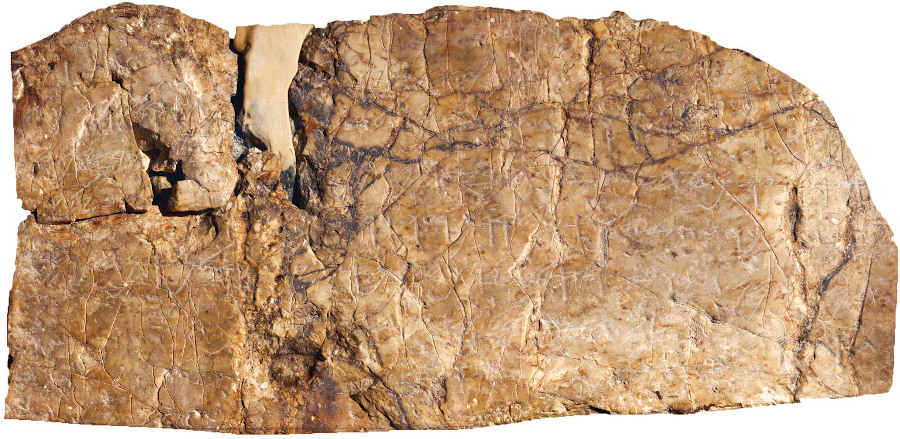
The Siloam Inscription, dated 8th century bc.
Instanbul Archaeological Museums. A.D. Riddle/BiblePlaces.com
Return to the main text.
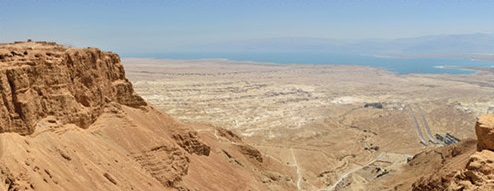
Hezekiah’s Tunnel and Water Projects
Jerusalem’s water supply was vulnerable to enemy attack, since it lay outside the city wall and was limited in scope for an area of its size. Hezekiah sought to secure it from attack and siege. The Gihon spring lay in the valley just east of David’s city. It was joined by aqueducts and a tunnel of about 1,750 feet in length to other locations, including the Pool of Siloam (see 2Ki 20:20 and note).
The tunnel has an inscription near its southern exit that details the arduous digging task. It describes two teams working toward each other, following a somewhat circuitous route. “When there were still 3 cubits to be excavated, there were the sounds of a man calling to his companion. On the day of the (completed) excavation, the stone-hewers struck out, each toward his opposite number, pick toward pick.”
Adapted from Zondervan Illustrated Bible Backgrounds Commentary: OT: Vol. 4 by John H. Walton. Isaiah—Copyright © 2009 by David W. Baker, p. 95. Used by permission of Zondervan.
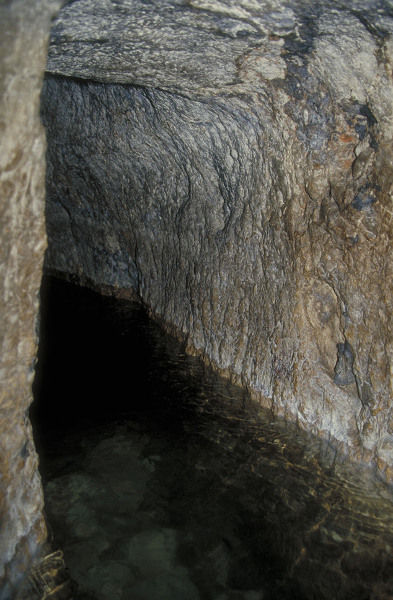
Hezekiah’s Tunnel
© Phoenix Data Systems
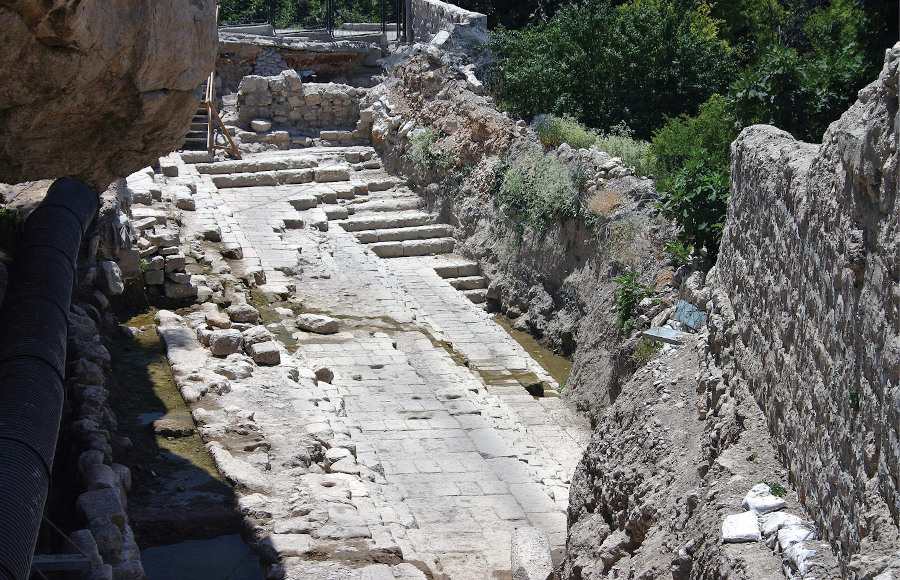
The northeast corner of the Pool of Siloam, which is located at the southern end of the City of David.
www.HolyLandPhotos.org
Go to the Articles Index.
20:21 rested with his ancestors. See note on 1Ki 1:21.
21:1 twelve years old. Thus Manasseh was born c. 709 bc. fifty-five years. 697–642 bc, including a ten-year coregency (697–686) with Hezekiah (see chart). This was the longest reign of any king in either Israel or Judah; he was arguably the most wicked of them all. The name Manasseh has been found on a contemporary seal reading “Belonging to Manasseh Son of the King.” If this is the same Manasseh, the seal was probably used by him during the coregency.
21:2 detestable practices. Manasseh reversed the religious policies of his father, Hezekiah (18:3–5), and reverted to those of Ahaz (16:3).
21:3 high places . . . Hezekiah had destroyed. See note on 18:4; see also 2Ch 31:1. Asherah pole. See 1Ki 14:15, 23; 15:13; 16:33. as Ahab. Manasseh was the Ahab of Judah (1Ki 16:30–33). bowed down to all the starry hosts. See note on 17:16.
21:4 In Jerusalem I will put my Name. See 1Ki 8:16; 9:3 and notes.
21:6 sacrificed his own son. The barbaric Canaanite practice of offering children to the god Molek (see note on 16:3; Lev 18:21; see also 2Ki 17:17; cf. 3:27 and note). practiced divination, sought omens. See notes on 16:15; 17:17. consulted mediums and spiritists. See Lev 19:31; Dt 18:11; 1Sa 28:3,7–9 and notes.
21:7 carved Asherah pole. See note on 1Ki 14:15. David. See 2Sa 7:13. Solomon. See 1Ki 9:3. chosen out of all the tribes. See 1Ki 11:13, 32,36.
21:9 nations the LORD had destroyed. See 1Ki 14:24; Dt 12:29–31; 31:3.
21:10 his servants the prophets. See 2Ch 33:10,18.
21:11 more evil than the Amorites. See note on 1Ki 21:26. idols. See note on Lev 26:30.
21:12 disaster on Jerusalem. Fulfilled in the final destruction of the city by the Babylonians in 586 bc (ch. 25). Because of the later reign of the good and godly King Josiah, the Lord delayed the destruction until then (see 22:2–3 and notes). ears of everyone . . . will tingle. See Jer 19:3 and note.
21:13 measuring line . . . plumb line. Instruments normally associated with construction are used here as symbols of destruction (Isa 34:11; Am 7:7–9, 17).
21:14 I will forsake. In the sense of giving over to judgment (Jer 12:7), not in the sense of abrogation of the covenant (1Sa 12:22; Isa 43:1–7). remnant of my inheritance. Upon the destruction of the northern kingdom, Judah had become the remnant of the Lord’s inheritance (see 1Ki 8:51; Dt 4:20; 1Sa 10:1; Ps 28:9; see also note on 2Ki 19:4).
21:15 The history of Israel was a history of covenant breaking. With the reign of Manasseh the cup of God’s wrath overflowed, and the judgment of exile (see note on 17:7–23) became inevitable (24:1–4).
21:16 innocent blood. A reference to godly people who were martyred for opposition to Manasseh’s evil practices (see vv. 10–11). According to a Jewish tradition (The Ascension of Isaiah—not otherwise substantiated), Isaiah was sawed in two during Manasseh’s reign (see Introduction to Isaiah: Author; cf. Heb 11:37 and note).
21:17 other events of Manasseh’s reign. For the surprising account of his repentance after being exiled by the Assyrians, see 2Ch 33:12–19. annals of the kings of Judah. See note on 1Ki 14:29.
21:18 rested with his ancestors. See note on 1Ki 1:21. Uzza. Probably a shortened form of Uzziah (see NIV text note on 14:21; see also 2Ch 26:1 and note).
21:19 two years. 642–640 bc. Jotbah. Some identify it with the Jotbathah of Nu 33:33–34 and Dt 10:7, near Ezion Geber. Others, including the church father Jerome, have located it in Judah.
21:20 did evil. Amon did not share in the change of heart that characterized his father, Manasseh, in the last days of his life (2Ch 33:12–19). He must have restored the idolatrous practices that Manasseh abolished because these were again in existence in the time of Josiah (23:5–7,12).
21:23 conspired against him. Whether this palace revolt was motivated by religious or political considerations is not known.
21:24 people of the land. The citizenry in general (11:14,18; 14:21; 23:30).
21:25 annals of the kings of Judah. See note on 1Ki 14:29.
21:26 Uzza. See note on v. 18.
22:1 thirty-one years. 640–609 bc (see note on 21:19). Bozkath. Located in Judah in the vicinity of Lachish (Jos 15:39).
22:2 ways of his father David. See note on 18:3. Josiah was the last godly king of the Davidic line prior to the exile. Jeremiah, who prophesied during the reign of Josiah (Jer 1:2), spoke highly of him (Jer 22:15–16). Zephaniah also prophesied in the early days of his reign (Zep 1:1).
22:3 eighteenth year. 622 bc. Josiah was then 26 years old (v. 1). He had begun to serve the Lord faithfully at the age of 16 (the 8th year of his reign, 2Ch 34:3). When he was 20 years old (the 12th year of his reign, 2Ch 34:3), he had already begun to purge the land of its idolatrous practices. secretary, Shaphan. See note on 2Sa 8:17. Two additional individuals are mentioned as accompanying Shaphan in 2Ch 34:8.
22:4 Hilkiah. Father of Azariah and grandfather of Seraiah, the high priest executed at the time of the destruction of Jerusalem by the Babylonians (25:18–21). It is unlikely that this Hilkiah was also the father of Jeremiah (Jer 1:1). money . . . the doorkeepers have collected. Josiah used the method devised by Joash for collecting funds for the restoration of the temple (12:1–16; 2Ch 34:9).
22:5 men appointed to supervise. See 2Ch 34:12–13.
22:8 Book of the Law. Some interpreters hold that this refers to a copy of the entire Pentateuch, while others understand it as a reference to a copy of part or all of Deuteronomy alone (Dt 31:24, 26; 2Ch 34:14).
22:11 tore his robes. See notes on 18:37; Jos 7:6; contrast Josiah’s reaction with that of Jehoiakim to the words of the scroll written by Jeremiah (Jer 36:24). Perhaps the covenant curses of Lev 26 and/or Dt 28, climaxing with the threat of exile, were the statements that especially disturbed Josiah.
22:12 Ahikam son of Shaphan. This official’s name has been found on a seal impression dating to the time of Jeremiah (see photo). Ahikam was the father of Gedaliah, who was later to be appointed governor of Judah by Nebuchadnezzar (25:22; Jer 39:14). He was also the protector of Jeremiah when his life was threatened during the reign of Jehoiakim (Jer 26:24). Akbor. His son Elnathan is mentioned in 24:8; Jer 26:22; 36:12. Shaphan the secretary. See note on v. 3.
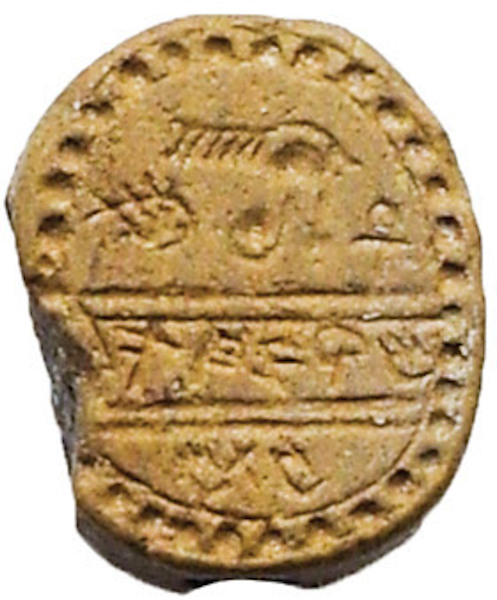
Seal with impression of Ahikam dating to the time of Jeremiah.
A.D. Riddle/BiblePlaces.com
Return to the main text.
22:14 prophet Huldah. Female prophets ministered among the Israelites; for other examples, see notes on Ex 15:20; Jdg 4:4. Shallum . . . keeper of the wardrobe. Perhaps the same Shallum who was the uncle of Jeremiah (Jer 32:7). New Quarter. A section of the city probably located in a newly developed area between the first and second walls in the northwest part of Jerusalem (see 2Ch 33:14; 34:22; Ne 11:9 and note; Zep 1:10).
22:16 this place. Jerusalem.
22:19 your heart was responsive. See v. 11.
22:20 gather you to your ancestors. See note on Ge 25:8. you will be buried in peace. In a time of peace for the nation. This prediction refers to Josiah’s death before God’s judgment on Jerusalem through Nebuchadnezzar and so is not contradicted by his death in battle with Pharaoh Necho of Egypt (23:29–30). Josiah was assured that the final judgment on Judah and Jerusalem would not come in his own days.
23:1 elders. See note on 10:1.
23:2 Book of the Covenant. Although this designation is used in Ex 24:7 with reference to the contents of Ex 20–23, it is here applied to either all or part of the book of Deuteronomy or the entire Mosaic law. Whatever else the scroll contained, it clearly included the covenant curses of Lev 26 and/or Dt 28 (see notes on v. 21; 22:8,11).
23:3 pillar. See note on 11:14. renewed the covenant. Josiah carries out the function of covenant mediator; cf. Moses (Ex 24:3–8; Deuteronomy), Joshua (Jos 24), Samuel (1Sa 11:14—12:25) and Jehoiada (2Ki 11:17). follow the LORD. See notes on 1Sa 12:14,20. pledged themselves to the covenant. A ratification rite in which the people participated and pledged by oath to be loyal to their covenant obligations.
23:4 doorkeepers. See 12:9. Baal and Asherah. See note on 1Ki 14:15. starry hosts. See note on 17:16. Kidron Valley. See note on Isa 22:7 and map; see also 1Ki 15:13 and note. took the ashes to Bethel. See vv. 15–16. Bethel was located just over the border between Judah and the former northern kingdom in territory nominally under Assyrian control. With a decline in Assyrian power, Josiah was able to exert his own influence in the north. He apparently deposited the ashes at Bethel in order to desecrate (see note on v. 14) the very place where golden calf worship had originally polluted the land (see notes on 1Ki 12:28–30).
23:5 idolatrous priests. See Hos 10:5; Zep 1:4. kings of Judah. A reference to Manasseh and Amon, and perhaps to Ahaz before them. high places. See note on 18:4.
23:6 Asherah pole. See note on 1Ki 14:15. The Asherah poles destroyed by Hezekiah (18:4) were reintroduced by Manasseh (21:7). When Manasseh turned to the Lord, it is likely that he too got rid of the Asherah poles (2Ch 33:15) and that they were then again reintroduced by Amon (2Ki 21:21; 2Ch 33:22). scattered the dust over the graves of the common people. Intended as a defilement of the goddess, not as a desecration of the graves of the poor (Jer 26:23).
23:7 male shrine prostitutes. See note on 1Ki 14:24.
23:8 desecrated the high places. See note on 18:4. Geba to Beersheba. Geba was on the northern border of the southern kingdom (1Ki 15:22), and Beersheba was on its southern border (see note on 1Sa 3:20).
23:9 ate unleavened bread with their fellow priests. Although not permitted to serve at the temple altar, these priests were to be sustained by a share of the priestly provisions (Lev 2:10; 6:16–18). They occupied a status similar to that of priests with physical defects (Lev 21:16–23).
23:10 Topheth . . . Molek. See note on 1Ki 11:5. Topheth was an area in the Valley of Hinnom where altars used for child sacrifice were located (see Isa 30:33; Jer 7:31; 19:5–6 and notes). sacrifice their son or daughter. See 17:17; 21:6; see also note on 16:3.
23:11 horses . . . dedicated to the sun. Dedicating horses to the sun appears to have been a distinctively Assyrian practice. However, an Ugaritic liturgy also establishes a connection between horses and the sun. Small images of horses have been found in a pagan shrine just outside one of the ancient walls of Jerusalem. Nathan-Melek. Perhaps the official in charge of the chariots.
23:12 altars . . . on the roof. Altars dedicated to the worship of all the starry hosts (Jer 19:13; Zep 1:5)—erected by Ahaz (2Ki 16:3–4,10–16), Manasseh (21:3) and Amon (21:21–22).
23:13 high places . . . Solomon . . . had built. See note on 1Ki 11:5.
23:14 covered the sites with human bones. The bones would defile these sites and make them unsuitable for pagan use in the future (Nu 19:16).
23:15 altar at Bethel. See 1Ki 12:32–33. Nothing is said of the golden calf, which undoubtedly had been sent to Assyria as tribute at the time of the captivity of the northern kingdom (Hos 10:5–6).
23:16 tombs. Of the priests of the Bethel sanctuary (1Ki 13:2). burned on the altar to defile it. See notes on vv. 6,14. the man of God who foretold these things. See 1Ki 13:1–2,32.
23:18 prophet who had come from Samaria. See 1Ki 13:31–32. Samaria is here not to be understood as the city by that name since the prophet came from Bethel (1Ki 13:11). Rather, it is to be taken as a designation for the entire area of the former northern kingdom (see notes on 17:24,29; 1Ki 13:32).
23:20 slaughtered all the priests of those high places. These were non-Levitical priests of the apostate worship practiced in the area of the former northern kingdom (see notes on 17:27–28,33–34). They were treated like the pagan priests of Judah (v. 5) in contrast to Josiah’s treatment of the priests at the high places in Judah (vv. 8–9). Josiah’s actions in this matter conformed to the requirements of Dt 13; 17:2–7.
23:21 Celebrate the Passover. A more complete description of this observance is found in 2Ch 35:1–19. as it is written in this Book of the Covenant. See note on v. 2. This appears to refer to Dt 16:1–8, where the Passover is described in a communal setting at a sanctuary (Ex 23:15–17; 34:23–24; Lev 23:4–14) rather than in the family setting of Ex 12:1–14,43–49.
23:22 The uniqueness of Josiah’s Passover celebration seems to be in the fact that all the Passover lambs were slaughtered exclusively by the Levites (see 2Ch 35:1–19; cf. 2Ch 30:2–3,17–20 for the Passover observed in the time of Hez-ekiah).
23:23 eighteenth year. See note on 22:3.
23:24 household gods. See note on Ge 31:19. idols. See Lev 26:30. requirements of the law. See notes on v. 2; 22:8.
23:25 was there a king like him. See note on 18:5. with all his heart . . . soul and . . . strength. See Dt 6:5.
23:26 Nevertheless, the LORD did not turn away from the heat of his fierce anger. The judgment against Judah and Jerusalem was postponed but not rescinded because of Josiah’s reformation (see notes on 21:15; 22:20).
23:27 as I removed Israel. See 17:18–23. Jerusalem, the city I chose. See 21:4,7,13. this temple, about which I said, ‘My Name shall be there.’ See note on 1Ki 8:16.
23:28 annals of the kings of Judah. See note on 1Ki 14:29.
23:29 Pharaoh Necho king of Egypt. Ruled 610–595 bc. help the king of Assyria. Pharaoh Necho intended to help Ashur-Uballit II, the last Assyrian king, in his struggle against the rising power of Babylon under Nabopolassar. The Assyrian capital, Nineveh, had already fallen to the Babylonians and Medes in 612 (see the book of Nahum). The remaining Assyrian forces had regrouped at Harran, but in 609 they were forced west of the Euphrates. It appears to be at this time that the Egyptians under Necho were coming to the Assyrians’ aid. King Josiah marched out to meet him in battle. Perhaps Josiah opposed the passage of Necho’s army through the pass at Megiddo (2Ch 35:20–24) because he feared that the growth of either Egyptian or Assyrian power would have adverse results for the continued independence of Judah. Megiddo. See note on Jdg 5:19.
23:30 buried him in his own tomb. See 2Ch 35:24–25. people of the land. See note on 21:24. Jehoahaz son of Josiah. Jehoahaz’s name was originally Shallum (1Ch 3:15; Jer 22:11), which was probably changed to Jehoahaz at the time of his accession to the throne. Perhaps Jehoahaz was chosen by the people over Jehoiakim because it was known that Jehoiakim favored a pro-Egyptian policy instead of the anti-Egyptian policy of Josiah and Jehoahaz. anointed him. See note on 1Sa 9:16.
23:31 three months. In 609 bc. Jeremiah. Not the prophet (see Jer 15:17; 16:2 and notes). Libnah. See note on 8:22.
23:32 evil . . . as his predecessors. See 16:3; 21:2,21; Eze 19:3 and note.
23:33 in chains at Riblah. By either deception or overt force the Egyptians were able to take Jehoahaz captive and impose tribute on Judah (2Ch 36:3). Jehoahaz was imprisoned at Necho’s military headquarters, established at Riblah on the Orontes River. Nebuchadnezzar was later to make his headquarters at the same place (25:6,20).
23:34 Eliakim son of Josiah. Eliakim was an older brother of Jehoahaz (1Ch 3:15). Perhaps he had been bypassed earlier as a successor to Josiah because of a pro-Egyptian political stance. changed Eliakim’s name to Jehoiakim. The meaning of these two names is similar (Eliakim, “God has established”; Jehoiakim, “Yahweh has established”). Perhaps Necho wanted to use the name change to imply that his actions were sanctioned by Yahweh, the God of Judah (18:25; 2Ch 35:21). In any case, the change in name indicated that Jehoiakim was subject to Necho’s authority. took Jehoahaz . . . to Egypt, and there he died. See 2Ch 36:4; Jer 22:10–12.
23:35 from the people of the land. The tribute for Necho was raised by a graduated tax placed on the very people who had supported the kingship of Jehoahaz (see v. 30 and note on 21:24). Menahem of the northern kingdom had used a similar method of raising funds for tribute (15:20).
23:36 eleven years. 609–598 bc.
23:37 did evil in the eyes of the LORD. Jehoiakim was responsible for the murder of the prophet Uriah from Kiriath Jearim (Jer 26:20–24), and his rule was characterized by dishonesty, oppression and injustice (Jer 22:13–19). He reintroduced idolatrous worship in the temple (Eze 8:5–17) and refused to accept the word of the Lord through Jeremiah (Jer 36). his predecessors. Manasseh (21:1–18) and Amon (21:19–26).
24:1 Nebuchadnezzar. See article. three years. Probably 604–602.
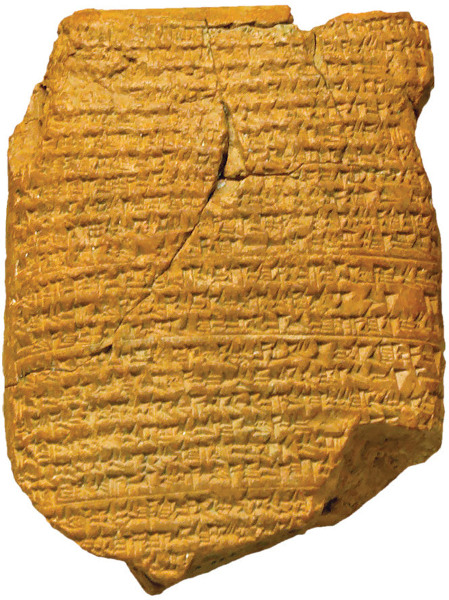
Babylonian Chronicle records the early period of Nebuchadnezzar, including the fall of Carchemish and the attack on Jerusalem.
Todd Bolen/BiblePlaces.com
Return to the main text.
Nebuchadnezzar’s Campaigns Against Judah
605–586 bc
Events in Judah moved swiftly following the death of Josiah. Pharaoh Necho pressed his advantage by deporting Jehoahaz, the new ruler, and appointing a second son of Josiah, Jehoiakim, as king.
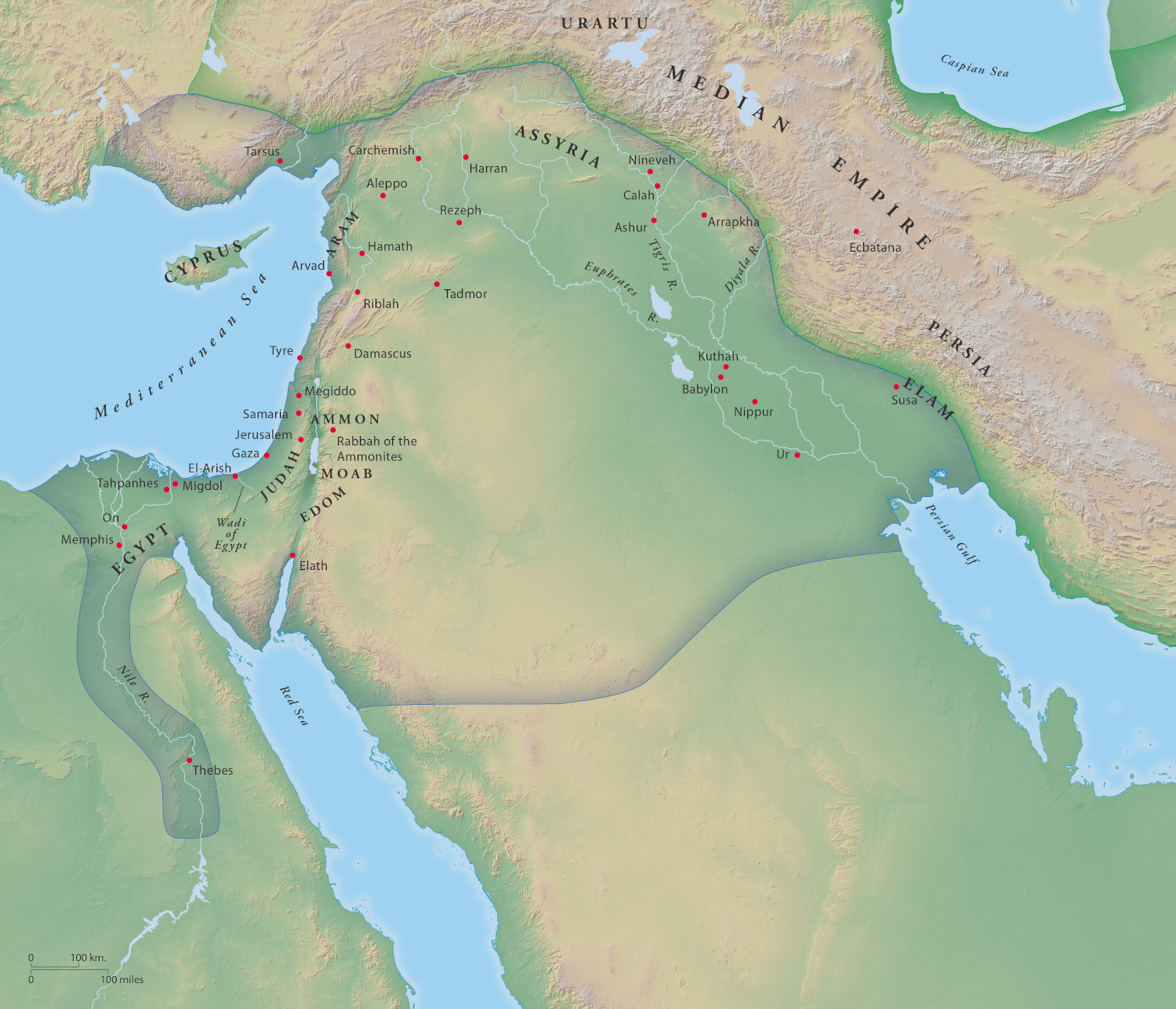
The prophet Jeremiah was taken to Egypt by Judahite refugees fleeing from Babylonian-controlled territory. They brought him to Tahpanhes, where he continued his prophecies.
The Chaldeans (Kaldu), as the Neo-Babylonians were called, had important connections at Ur and Harran, centers of worship of the moon-god Sin. They also developed the trade routes across North Arabia, where Tema was particularly important, becoming the residence of Nabonidus during the last days of the kingdom (see maps here and here).
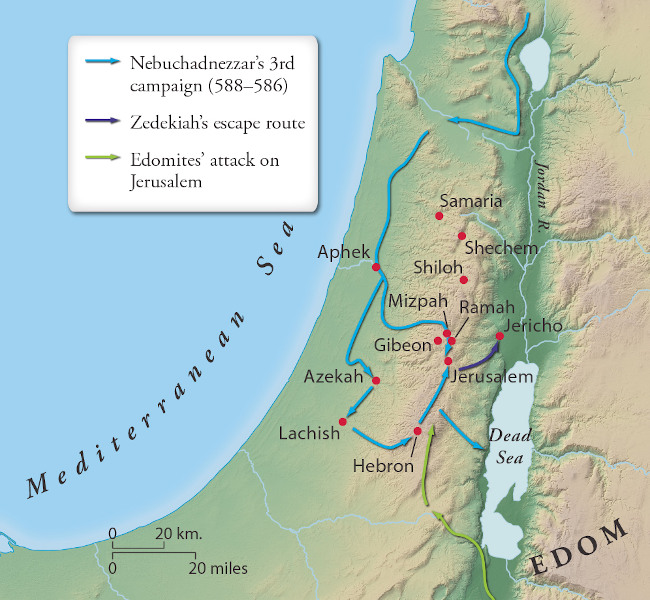
Destruction of Jerusalem 586 bc
Zedekiah, the last king of Judah, was appointed by Nebuchadnezzar, but he rebelled. Jerusalem was attacked and besieged for two and a half years. Lured by the pharaoh’s army, the Babylonians withdrew temporarily. When the Egyptians retreated, however, the Babylonians returned with a vengeance to Jerusalem.
Facing starvation, Zedekiah with his army fled by night “through the gate between the two walls” (2Ki 25:4) toward the Jordan River, but both were overtaken in the plains of Jericho.
Zedekiah was captured and was dragged off in chains to Riblah (see map above), where he saw his sons slaughtered before he was blinded and taken to Babylon. One month later (in 586 bc) Jerusalem was ransacked and burned. Numerous high officials were executed, the temple furnishings were carried off, and the people were exiled.
Dramatic military dispatches found at Lachish warn of the encircling army (see photo).
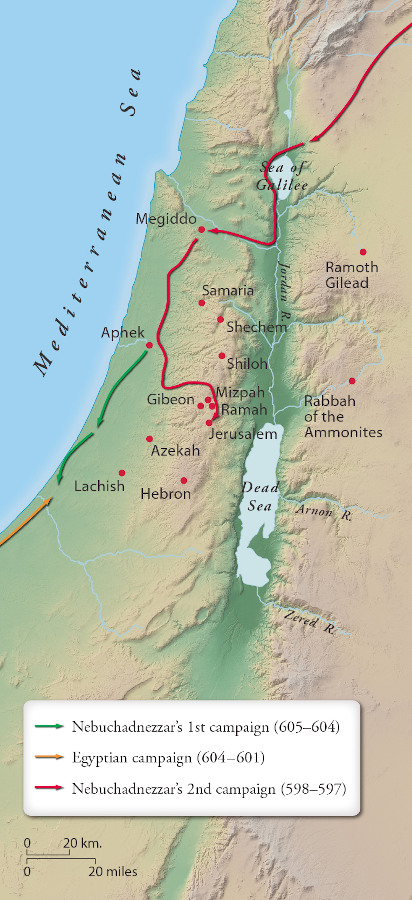
Conquest of Jerusalem c. 597 bc
Soon a stronger power appeared in the north in the person of Nebuchadnezzar, king of the Chaldeans (Neo-Babylonians), who determined to follow the fierce policies of his Assyrian predecessors.
The tribute of Jehoiakim was paid at a distance when he heard of Nebuchadnezzar’s approach. After three years as a Babylonian vassal, he rebelled, bringing a rapid response in the form of small-scale raids from Babylonians, Arameans, Moabites and Ammonites (c. 602 bc). Finally, Nebuchadnezzar’s forces controlled all of the coastal territory north of the Wadi of Egypt (see previous page).
When 18-year-old Jehoiachin had ruled just three months (597 bc), the main Babylonian army struck, capturing Jerusalem and exiling the king as a captive in Babylon. Ten thousand persons were deported.
Go to the Maps Index.
His name means “Nabu [a god], protect (my) son/boundary!” Nebuchadnezzar II inherited the throne from his father, Nabopolassar (see note on 2Ki 23:29) in 605 bc and reigned until 562 bc. He was the most powerful king of the Neo-Babylonian Empire (612–539 bc) and was allied with the Medes by marriage to the daughter of the Median king.
In 605 Nebuchadnezzar defeated Pharaoh Necho and the Egyptians at the battle of Carchemish and again at Hamath (2Ki 23:29; Jer 46:2). These victories had far-reaching implications in the geopolitical power structure of the eastern Mediterranean world. Nebuchadnezzar went on to conquer all of the “Hatti-land,” which, according to Babylonian records, included the “city of Judah.” Daniel was among the Judahite hostages taken at this time (Da 1:1). In 604 Nebuchadnezzar returned to the west and took tribute from “all the kings of Hatti-land.” It is likely that Jehoiakim was included among these kings.
In 601 Nebuchadnezzar again marched west against Egypt and was repulsed by strong Egyptian resistance. This may have encouraged Jehoiakim’s rebellion (2Ki 24:1), even though Jeremiah had warned against it (Jer 27:9–11). Jehoiakim’s rebellion proved disastrous when in 597 bc Nebuchadnezzar returned and captured Jerusalem, taking into exile then-King Jehoiachin (along with about 10,000 other Jews, including Ezekiel) and installing Zedekiah as king over Judah (2Ki 24:10–17).
When Zedekiah, too, subsequently rebelled, Nebuchadnezzar returned and destroyed Jerusalem in 586 bc, burning the city and temple and taking most of the remaining inhabitants into exile in Babylonia (2Ki 24:20–25:12).
Go to the Articles Index.
24:2 Babylonian, Aramean, Moabite and Ammonite raiders against him. Reaction to Jehoiakim’s rebellion was swift. Babylonian troops, perhaps garrisoned in Aram, along with troops of other loyal vassals, were sent to put down the Judahite rebellion.
24:3 sins of Manasseh. See 21:11–12; 23:26–27; Jer 15:3–4.
24:4 innocent blood. See note on 21:16. not willing to forgive. See 22:17.
24:5 annals of the kings of Judah. See note on 1Ki 14:29.
24:6 rested with his ancestors. See note on 1Ki 1:21. Jehoiakim died shortly before Jerusalem fell to the Babylonian siege (vv. 8–12). Whether his death was due to natural causes or political intrigue is not indicated.
24:7 The king of Egypt did not march out from his own country again. This was due to the Egyptian defeat at Carchemish (Jer 46:2) in 605 bc, and it explains why Jehoiakim received no help from Egypt in his rebellion against the Babylonians. Wadi of Egypt. See note on 1Ki 8:65.
24:8 three months. Babylonian records place this capture of Jerusalem by Nebuchadnezzar (vv. 10–17) on Mar. 16, 597 bc. This means that the three-month and ten-day reign (2Ch 36:9–10) of Jehoiachin began in December, 598.
24:9 as his father. See 23:37; Jer 22:20–30.
24:12 eighth year. April, 597 bc (see 2Ch 36:10; see also note on Jer 52:28, where a different system of dating is reflected).
24:13 As the LORD had declared. See 20:13,17.
24:14 ten thousand. This figure may include the 7,000 fighting men and 1,000 craftsmen mentioned in v. 16 (see note on Jer 52:28, where a different number of captives is mentioned).
24:15 Jehoiachin captive to Babylon. Fulfilling Jeremiah’s prophecy (Jer 22:24–27; see 2Ki 25:27–30).
24:17 Mattaniah, Jehoiachin’s uncle. Mattaniah was a son of Josiah (1Ch 3:15; Jer 1:3) and brother of Jehoiachin’s father, Jehoiakim. changed his name to Zedekiah. Mattaniah’s name (meaning “gift of Yahweh”) was changed to Zedekiah (“righteousness of Yahweh”). Perhaps Nebuchadnezzar wanted to imply that his actions against Jerusalem and Jehoiachin were just. In any case, the name change signified subjection to Nebuchadnezzar (see note on 23:34).
24:18 eleven years. 597–586 bc. Jeremiah. See note on 23:31. Libnah. See note on 8:22.
24:19 did evil . . . as Jehoiakim. See note on 23:37. During Zedekiah’s reign idolatrous practices continued to increase in Jerusalem (2Ch 36:14; Eze 8–11). He was a weak and indecisive ruler (Jer 38:5,19) who refused to heed the word of the Lord given through Jeremiah (2Ch 36:12).
24:20 Zedekiah rebelled. Most interpreters link Zedekiah’s revolt with the succession to the Egyptian throne in 589 bc of the ambitious pharaoh Hophra (see Jer 44:30 and note). Zedekiah had sworn allegiance to Nebuchadnezzar (Eze 17:13), had sent envoys to Babylon (Jer 29:3) and had made a personal visit (Jer 51:59). However, he seems to have capitulated to the seductive propaganda of the anti-Babylonian and pro-Egyptian faction in Jerusalem (Jer 37:5; Eze 17:15–16) in a tragically miscalculated effort to gain independence from Babylonia.
25:1 ninth year . . . tenth day . . . tenth month. Jan. 15, 588 bc (Jer 39:1; 52:4; Eze 24:1–2). Nebuchadnezzar . . . marched against Jerusalem. Earlier, Nebuchadnezzar had subdued all the fortified cities in Judah except Lachish and Azekah (Jer 34:7). A number of Hebrew inscriptions on potsherds were found at Lachish in 1935 and 1938. These Lachish ostraca (or letters; see chart; see also photo) describe conditions at Lachish and Azekah during the Babylonian siege.
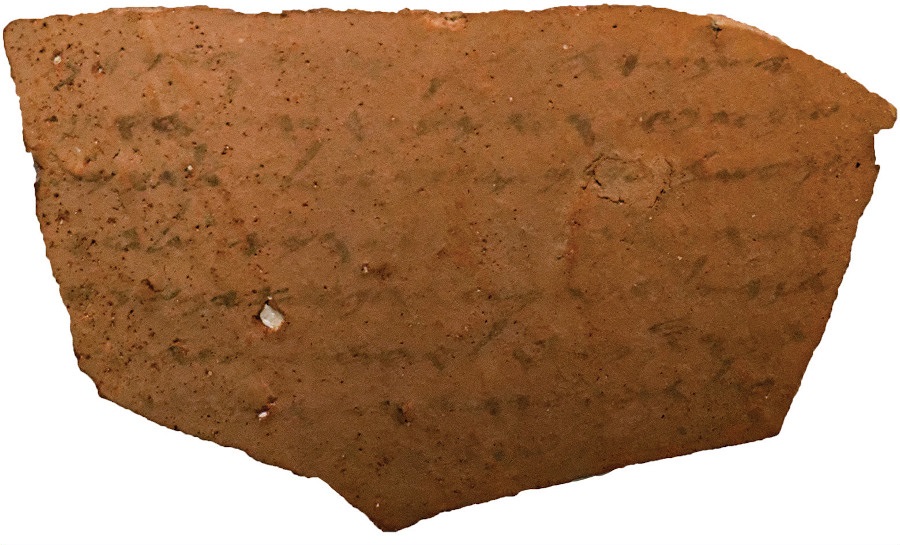
Hebrew inscriptions on potsherds were found in Lachish in 1935 and 1938. The Lachish ostraca describe conditions at Lachish and Azekah during the Babylonian siege.
Todd Bolen/BiblePlaces.com
Return to the main text.
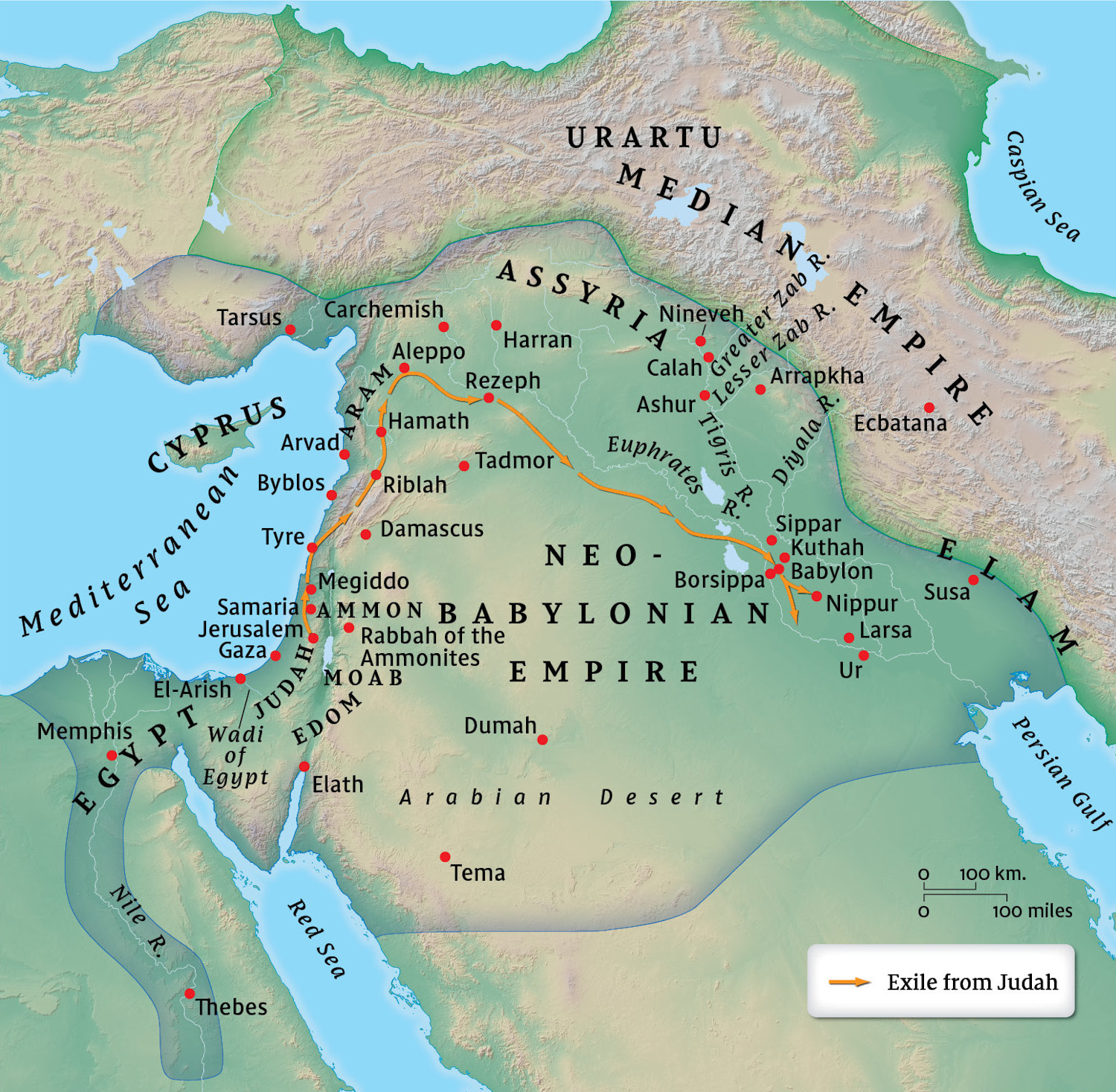
Knowledge about the destiny of the captives from Israel and Judah is sparse in the period following the capture of Samaria and the later destruction of Jerusalem.
Assyrians and Babylonians treated their subject peoples essentially the same: overwhelming military force used in a manner inspiring psychological terror, along with mass deportations and heavy tribute.
Three deportations are mentioned in Jer 52:28–30, the largest one consisting of 10,000 Jews (2Ki 24:14) who were taken to Babylon along with King Jehoiachin in 597 bc.
After the destruction of Jerusalem by Nebuzaradan, the commander of the Babylonian army, hundreds of exiles were taken to Riblah in the land of Hamath, where, in addition to Zedekiah’s sons, at least 61 were executed.
Clay tablets from the fifth century bc called the Murashu archives have been found at Nippur. They document the commercial transactions with Jewish families who remained in Mesopotamia following Ezra’s return to Jerusalem.
Eze 1:1–3 and 3:15 indicate that other captives were placed at Tel Aviv and at the Kebar River, both probably in the locale of Nippur, as were other villages mentioned in Ezr 2:59; 8:15,17; Ne 7:61.
Jehoiachin and his family were kept in Babylon, where clay ration receipts bearing his name and the names of his sons have been found.
Go to the Maps Index.
25:2–3 eleventh year . . . ninth day . . . fourth month. July 18, 586 bc (see NIV text note on v. 3; see also Jer 39:2; 52:5–7). Some scholars follow a different dating system and place the fall of Jerusalem in the summer of 587.
25:3 famine in the city had become so severe. See Jer 38:2–9.
25:6 king of Babylon at Riblah. See note on 23:33; see also Jer 39:5; 52:9.
25:7 killed the sons of Zedekiah . . . put out his eyes . . . took him to Babylon. See Jer 32:4–5; 34:2–3; 38:18; 39:6–7; 52:10–11. Ezekiel (12:13) had predicted that Zedekiah would be brought to Babylon but that he would not see it. Zedekiah could have spared his own life and prevented the destruction of Jerusalem if he had listened to Jeremiah (Jer 38:14–28).
25:8–21 See map and accompanying text.
25:8 seventh day . . . fifth month . . . nineteenth year. Aug. 14, 586 bc (see Jer 52:12 and note).
25:9 set fire to the temple. See 2Ch 36:19; Jer 39:8; 52:13.
25:13 bronze pillars. See 1Ki 7:15–22. movable stands. See 1Ki 7:27–39. bronze Sea. See 1Ki 7:23–26.
25:14 all the bronze articles used in the temple service. See 1Ki 7:40,45.
25:17 bronze capital . . . was three cubits high. See NIV text note. In 1Ki 7:16 and Jer 52:22 the height of the capital is given as seven and a half feet (five cubits). The two-cubit difference may be due to a copyist’s error.
25:18 Seraiah the chief priest. Seraiah was the grandson of Hilkiah (see note on 22:4; see also 22:8; 1Ch 6:13–14). His son Jehozadak was taken captive to Babylon. Ezra was one of Jehozadak’s descendants (Ezr 7:1).
25:19 people of the land. See note on 21:24.
25:20 brought them to the king of Babylon at Riblah. See v. 6 and note.
25:21 Judah went into captivity, away from her land. See maps and accompanying texts, here and here. Judah’s exile from Canaan fulfilled the prediction of judgment given during the reign of Manasseh (23:27). Exile was the direst of the covenant curses (see Lev 26:33; Dt 28:36; see also Jer 25:8–11).
25:22 Gedaliah. See note on 22:12. Gedaliah shared Jeremiah’s nonresistance approach to the Babylonians (v. 24) and won their confidence as a trustworthy governor of Judah (Jer 41:10).
25:23 Mizpah. Had been a town of important political significance in the time just before the establishment of the monarchy (see note on 1Sa 7:5; see also map). Jeremiah found Gedaliah there (Jer 40:1–6). Ishmael son of Nethaniah. Verse 25 gives a fuller genealogy. Elishama, Ishmael’s grandfather, was the royal secretary under Jehoiakim (Jer 36:12). Jaazaniah. In 1932 an agate seal was found at Tell en-Nasbeh (Mizpah) bearing the name of Jaazaniah (perhaps the man mentioned here) with the inscription: “Belonging to Jaazaniah the servant of the king.”
25:24 Gedaliah urged submission to the Babylonians as the judgment of God. He advocated the restoration of the normal pursuits of a peacetime society (Jer 27). A similar message had been given by Jeremiah to the captives taken to Babylon in 597 bc (Jer 29:4–7).
25:25 seventh month. October, 586 bc. assassinated Gedaliah. A more complete account of the assassination of Gedaliah is given in Jer 40:13—41:15. Ishmael appears to have had personal designs on the throne, to have resented Gedaliah’s ready submission to the Babylonians and to have been manipulated by the Ammonites, who also chafed under Babylonian domination (Jer 40:14; 41:10,15).
25:26 fled to Egypt. Pharaoh Hophra was then ruler in Egypt (see note on 24:20).
25:27 thirty-seventh year . . . twenty-seventh day . . . twelfth month. Mar. 22, 561 bc. in the year Awel-Marduk became king of Babylon. In 561 (some scholars place Awel-Marduk’s succession to the throne in October, 562; see note on 24:1). His name means “man of (the god) Marduk.” released Jehoiachin king of Judah from prison. Babylonian administrative tablets (see chart), recording the payment of rations in oil and barley to prisoners held in Babylon, mention Jehoiachin, king of Judah, and five of his sons (cf. 24:15). No reason is given for Jehoiachin’s release. Perhaps it was part of a general amnesty proclaimed at the beginning of Awel-Marduk’s reign. See note on 1Ch 3:17–20.
25:28 spoke kindly to him and gave him a seat of honor. The book of Kings ends on a hopeful note. The judgment of exile will not destroy the people of Israel or the line of David. God’s promise concerning David’s house remains (2Sa 7:14–16).