Study Notes
 1:1 After Ahab’s death. See 1Ki 22:37; see also Jos 1:1; Jdg 1:1; 2Sa 1:1 and notes. Moab rebelled. Moab had been brought into subjection by David (2Sa 8:2), but when the northern and Transjordan tribes rebelled and made Jeroboam their king, political domination of Moab probably also shifted to the northern kingdom. An inscription of Mesha king of Moab (see photo and chart) indicates that during the reign of Omri’s “son” (probably a reference to his grandson Joram, not to Ahab) the Moabites were able to free the area of Medeba from Israelite control (see map).
1:2 Ahaziah. See 1Ki 22:51–53. Baal-Zebub. One of the chief gods of the Philistines (see note on Jdg 10:6). Ekron. The northernmost of the five major Philistine cities (see Jos 13:3; 1Sa 5:10 and notes). if I will recover. Ahaziah appears to have feared that his injury would be fatal. He turned to the pagan deity for a revelatory message, not for healing.
1:3 angel of the LORD. See 1Ki 19:7; see also note on Ge 16:7. The Lord usually spoke directly to the consciousness of the prophet (1Ki 17:2, 8; 18:1; 19:9; 21:17). Perhaps the means of revelation was changed in this instance to heighten the contrast between the messengers of Ahaziah (vv. 2–3,5) and the angel (which means “messenger”) of the Lord. Elijah the Tishbite. See note on 1Ki 17:1. king of Samaria. See note on 1Ki 21:1.
1:4 You will certainly die! Ahaziah will receive the message he sought, but it will come from the Lord through Elijah, not from Baal-Zebub.
1:5 Why have you come back? Ahaziah realized the messengers could not have traveled so quickly to Ekron and back.
1:8 garment of hair. Elijah’s cloak (1Ki 19:19) was probably of sheepskin or camel’s hair, tied with a simple leather strap (cf. Mt 3:4). His dress contrasted sharply with the fine linen clothing (Jer 13:1) of his wealthy contemporaries and constituted a protest against the materialistic attitudes of the king and the upper classes (cf. Mt 11:7–8; Lk 7:24–25). That was Elijah the Tishbite. Ahaziah was familiar with Elijah’s appearance because of the prophet’s many encounters with Ahab, his father. See 1Ki 17:1 and note.
1:9–12 The judgment in these verses may seem harsh, but by this time Elijah was well enough known in Israel that any military captain and his soldiers would have realized they were countering the word of the Lord by going against his prophet.
1:9 he sent to Elijah a captain with his company of fifty men. The pagan people of that time thought that the magical power of curses could be nullified either by forcing the pronouncer of the curse to retract his statement or by killing him so that his curse would go with him to the netherworld. It appears that Ahaziah shared this view and desired to take Elijah prisoner in order to counteract the pronouncement of his death. Man of God, the king says, ‘Come down!’ Ahaziah attempted to place the prophet under the authority of the king. This constituted a violation of the covenant nature of Israelite kingship, in which the king’s actions were always to be placed under the scrutiny and authority of the word of the Lord spoken by his prophets (see notes on 1Sa 10:25; 12:23).
1:10 fire fell from heaven and consumed the captain and his men. Another link between the ministries of Elijah and Moses (Lev 10:2; Nu 16:35). At stake in this incident was the question of who was sovereign in Israel. Would Ahaziah recognize that the king in Israel was only a vice-regent under the authority and kingship of the Lord, or would he exercise despotic power, like pagan kings (see notes on 1Sa 12:14–15)? At Mount Carmel the Lord had revealed himself and authenticated his prophet by fire from heaven (1Ki 18:38–39). Now this previous revelation is confirmed to Ahaziah.
1:11 the king sent to Elijah another captain. Ahaziah refused to submit to the word of the Lord in spite of the dramatic revelation of God’s power.
1:13 fell on his knees before Elijah. The third captain, recognizing that Elijah was the bearer of the word of the Lord, feared for his life and bowed before him with a humble request.
1:15 The angel of the LORD said to Elijah. See note on v. 3.
1:17 died, according to the word of the LORD. In the end Ahaziah was punished for turning away from the God of Israel to a pagan deity, and the word of the Lord was shown to be both reliable and beyond the power of the king to annul. Joram. Ahaziah’s younger brother (3:1; 1Ki 22:51). second year of Jehoram son of Jehoshaphat. Jehoram’s reign overlapped that of his father, Jehoshaphat, from 853 to 848 bc (see note on 8:16; see also chart). The reference here is to the second year of that coregency. The 18th year of Jehoshaphat (3:1) is therefore the same as the second year of Jehoram’s coregency (852).
1:18 annals of the kings of Israel. See note on 1Ki 14:19.
2:1 Gilgal. Probably not the well-known town west of the Jordan River, since they “went down” from it to Bethel (v. 2; see also 4:38); rather, it is more likely the Gilgal located some eight miles north of Bethel.
 2:2 I will not leave you. Elisha was aware that Elijah’s ministry was almost finished and that his departure was near (v. 5). He was determined to accompany him until the moment the Lord took him. His commitment to Elijah and to Elijah’s ministry was unfailing (v. 9; 1Ki 19:21).
2:3 company. See note on 1Ki 20:35. During the days of Elijah and Elisha, companies of prophets were located at Bethel (here), Jericho (v. 5) and Gilgal (4:38). It appears that Elijah journeyed by divine instruction to Gilgal (v. 1), Bethel (v. 2) and Jericho (v. 4) for a last meeting with each of these companies.
2:7 Fifty men. Witnesses of the miracle by which Elijah and Elisha crossed the river.
2:8 Elijah took his cloak . . . and struck the water with it. Elijah used his cloak much as Moses had used his staff at the time of Israel’s passage through the Red Sea (Ex 14:16, 21,26).
2:9 Let me inherit a double portion. Elisha was not expressing a desire for a ministry twice as great as Elijah’s, but he was using terms derived from inheritance law to express his desire to carry on Elijah’s ministry. Inheritance law assigned a double portion of a father’s possessions to the firstborn son (see Dt 21:17 and note).
2:10 difficult thing. Although Elijah had previously been told to anoint Elisha as his successor (1Ki 19:16,19–21), Elijah’s response clearly showed that the issue rested solely with the Lord’s sovereign good pleasure. if you see me . . . it will be yours—otherwise, it will not. Elijah left the answer to Elisha’s request in the Lord’s hands.
2:11 chariot of fire and horses of fire. The Lord’s heavenly host has accompanied and supported Elijah’s ministry (as it had that of Moses; see Ex 15:1–10), and now at his departure Elisha is allowed to see it (cf. 6:17). Elijah went up to heaven in a whirlwind. Elijah, like Enoch before him (see Ge 5:24 and note), was “taken” (vv. 9–10) to heaven bodily without experiencing death; like Moses (Dt 34:4–6), he was outside the promised land when he was taken away.
 2:12 chariots and horsemen of Israel! Elisha depicted Elijah as embodying the true strength of the nation. He, rather than the apostate king, is the Lord’s representative. The same description was later used of Elisha (see 13:14 and note). tore it. See Ge 44:13 and note.
2:13 Elisha . . . picked up Elijah’s cloak. See note on v. 8. Possession of Elijah’s cloak symbolized Elisha’s succession to Elijah’s ministry (1Ki 19:19).
2:14 When he struck the water, it divided. See v. 8. The Lord authenticated Elisha’s succession to Elijah’s ministry and demonstrated that the same divine power that had accompanied Elijah’s ministry was now operative in the ministry of Elisha. In crossing the Jordan as Joshua had before him, Elisha is shown to be Elijah’s “Joshua” (Elisha and Joshua are very similar names, Elisha meaning “God saves” and Joshua “The LORD saves”).
2:15 bowed to the ground before him. Indicated their recognition of Elisha’s succession to Elijah’s position. Elisha was now the Lord’s official representative in this time of royal apostasy.
2:16 Perhaps the Spirit of the LORD has picked him up and set him down. Obadiah expressed the same idea years earlier (1Ki 18:12). do not send them. Elisha knew their search would be fruitless.
2:17 too embarrassed. Under pressure to allow the prophets to send men to look for Elijah, Elisha no longer had the heart to say no. Send them. When the company of prophets refused to be satisfied with Elisha’s answer, he permitted them to go so that the authority and truth of his words would be confirmed to them.
2:19 city. Evidently Jericho (v. 18). the water is bad and the land is unproductive. The inhabitants of Jericho were experiencing the effects of the covenant curse (contrast Dt 28:15–18 with Ex 23:25–26; Lev 26:9; Dt 28:1–4). See 1Ki 16:34; Jos 6:26.
2:20 new bowl. That which was to be used in the service of the Lord was to be undefiled by profane use (Lev 1:3, 10; Nu 19:2; Dt 21:3; 1Sa 6:7). put salt in it. Elisha may have used salt because of its known preservative qualities, but it is more likely that he used it to symbolize the covenant faithfulness of the Lord (see note on Nu 18:19; see also 2Ch 13:5).
2:21 I have healed this water. Any idea of a magical effect of the salt in the purification of the water is excluded by the explicit statement that the Lord himself healed (purified) the water. In this symbolic way Elisha was able, as the first act of his ministry, to proclaim to the people that in spite of their disobedience the Lord was merciful and was still reaching out to them in his grace (13:23).
2:23 Get out of here. Since Bethel was the royal religious center of the northern kings (1Ki 12:29; Am 7:13) and Elijah and Elisha were known to frequent Samaria (perhaps even as their main residence; see note on 5:3), the youths (see 1Ki 11:17 and note) from Bethel no doubt assumed that Elisha was going up to Samaria to continue Elijah’s struggle against royal apostasy. baldy! Baldness was viewed negatively and luxuriant hair seems to have been viewed as a sign of strength and vigor (see note on 2Sa 14:26). By calling Elisha “baldy,” the youths from Bethel expressed that city’s utter disdain for the Lord’s representative, who, they felt, had no power.
2:24 called down a curse on them in the name of the LORD. Elisha pronounced a curse similar to the covenant curse of Lev 26:21–22. This is not a petty act of vindictiveness; it is a warning of the judgment that would come on the entire nation should it persist in disobedience and apostasy (2Ch 36:16). Thus Elisha’s first acts were indicative of his ministry that would follow: God’s covenant blessings would come to those who looked to him (vv. 19–22), but God’s covenant curses would fall on those who turned away from him (cf. 1Ki 19:17 and note).
3:1 Joram son of Ahab became king . . . in the eighteenth year of Jehoshaphat. See note on 1:17. twelve years. 852–841 bc.
3:2 not as his father and mother had done. Not as Ahab (see notes on 1Ki 16:30–34) and Jezebel (1Ki 18:4; 19:1–2; 21:7–15). sacred stone of Baal that his father had made. Apparently a reference to the stone representation of the male deity (see note on 1Ki 14:23) that Ahab placed in the temple he had constructed for Jezebel in Samaria (1Ki 16:32–33). From 10:27 it appears that this stone was later reinstated, perhaps by Jezebel, then destroyed by Jehu.
3:3 sins of Jeroboam . . . he had caused Israel to commit. See note on 1Ki 14:16.
3:4 Mesha king of Moab. See note on 1:1. a hundred thousand lambs and the wool of a hundred thousand rams. The heavy annual tribute (Isa 16:1) that Israel required from the Moabites as a vassal state.
3:5 king of Moab rebelled. See note on 1:1.
3:7 Will you go with me to fight against Moab? Joram wished to attack Moab from the rear (v. 8), but to do that his army had to pass through Judah. I am as you are, my people as your people, my horses as your horses. See 1Ki 22:4. Jehoshaphat had already been condemned by prophets of the Lord for his alliance with the northern kings Ahab (2Ch 18:1; 19:1–2) and Ahaziah (2Ch 20:35–37), yet he agreed to join with Joram against Moab. Perhaps he was disturbed by the potential danger to Judah posed by the growing strength of Moab (2Ch 20), and he may have considered Joram less evil than his predecessors (v. 2).
3:8 Through the Desert of Edom. This route of attack took the armies of Israel and Judah south of the Dead Sea, enabling them to circumvent the fortifications of Moab’s northern frontier and to avoid the possibility of a rearguard action against them by the Arameans of Damascus. The Edomites, who were subject to Judah, were in no position to resist the movement of Israel’s army through their territory.
3:9 king of Edom. Although here designated a king, he was in reality a governor appointed by Jehoshaphat (8:20; 1Ki 22:47).
3:11 Is there no prophet of the LORD here . . . ? See 1Ki 22:7. Only after the apparent failure of their own strategies did the three rulers seek the word of the Lord (v. 12). Elisha son of Shaphat is here. Since Elijah is reported to have sent a letter to Jehoshaphat’s son Jehoram after his father’s death (2Ch 21:12–15), it seems that Elisha accompanied the armies on this campaign as the representative of the aged Elijah. The event is narrated here after the account of Elisha’s initiation as Elijah’s successor and the two events that foreshadowed the character of his ministry. Following this introduction to Elisha’s ministry, the present episode is topically associated with the series of Elisha’s acts that now occupies the narrative.
3:13 Go to the prophets of your father and . . . mother. See 1Ki 22:6.
3:14 if I did not have respect for . . . Jehoshaphat . . . I would not pay any attention to you. Joram will share in the blessing of the word of God only because of his association with Jehoshaphat.
3:15 bring me a harpist. Perhaps to create a disposition conducive to receiving the word of the Lord. hand of the LORD. See note on Eze 1:3.
3:16 this valley. The Israelite armies were encamped in the broad valley (the Arabah) between the highlands of Moab on the east and those of Judah on the west, just south of the Dead Sea.
3:17 will be filled with water. The word of the Lord contained a promise and a directive. The Lord will graciously provide for his people, but they must respond to his word in faith and obedience (v. 16).
3:19 The two armies will devastate the rebellious country.
3:20 time for offering. See Ex 29:38–39; Nu 28:3–4. water flowing from the direction of Edom. Flash floods in the distant mountains of Edom caused water to flow north through the broad, usually dry, valley that sloped toward the Dead Sea (see note on v. 16).
3:23 Those kings must have . . . slaughtered each other. The Moabites would have good reason to suspect that an internal conflict had arisen between the parties of an alliance whose members had previously been mutually hostile.
3:25 Kir Hareseth. The capital city of Moab (Isa 16:7, 11; Jer 48:31,36), usually identified with present-day Kerak, located about 11 miles east of the Dead Sea and 15 miles south of the Arnon River (see map).
3:26 break through to the king of Edom. A desperate attempt by the king of Moab to induce Edom to turn against Israel and Judah.
3:27 offered him as a sacrifice on the city wall. King Mesha offered his oldest son, the crown prince, as a burnt offering (16:3; Jer 7:31) to the Moabite god Chemosh (1Ki 11:7; Nu 21:29; Jer 48:46) in an attempt to induce the deity to come to his aid. The fury against Israel was great. It seems that just when total victory appeared to be in Israel’s grasp, God’s displeasure with the Ahab dynasty showed itself in some way that caused the Israelite kings to give up the campaign.
4:1 company of the prophets. See notes on 2:3; 1Ki 20:35. take my two boys as his slaves. Servitude as a means of debt payment by labor was permitted in the Mosaic law (Ex 21:1–2; Lev 25:39–41; Dt 15:1–11). It appears that the practice was much abused (Ne 5:5, 8; Am 2:6; 8:6), even though the law limited the term of such bondage and required that those so held be treated as hired workers.
4:4 shut the door behind you and your sons. The impending miracle was not intended to be a public sensation but to demonstrate privately God’s mercy and grace to this widow (cf. Ps 68:5). She did not hesitate to respond in faith and obedience to the instructions of the Lord’s prophet.
4:8 Shunem. See note on 1Ki 1:3.
4:9 holy man of God. The woman recognized that Elisha was a person set apart to the Lord’s work in a very special sense (see note on Ex 3:5). Nowhere else in the OT is the term “holy” applied to a prophet.
4:10 he can stay there whenever he comes to us. By her hospitality the woman was able to assist in sustaining the proclamation of God’s word through Elisha.
4:12 Gehazi. Referred to here for the first time; he appears to have served Elisha in some of the same ways as Elisha had served Elijah, though the two men were of drastically different character (5:19–27; 6:15).
4:13 I have a home among my own people. The Shunammite woman felt secure and content in the community of her own family and tribe, and she had no need or desire for favors from high government officials.
4:14 She has no son, and her husband is old. A great disappointment because it meant that the family’s name would cease and its land and possessions would pass on to others. It was also a great threat to this young wife’s future in that she faced the likelihood of many years as a widow with no provider or protector—children were a widow’s only social security in old age (see 8:1–6; see also note on 1Ki 17:22).
4:16 About this time next year. See Ge 17:21; 18:14. man of God, don’t mislead your servant! The woman’s response revealed the depths of her desire for a son and her fear of disappointment.
4:17 just as Elisha had told her. The trustworthiness of Elisha’s word was confirmed, and the birth of the son was shown to be the result of God’s gracious intervention in her behalf.
4:20 he died. The child, given as an evidence of God’s grace and the reliability of his word, was suddenly taken from the woman in a severe test of her faith. Her subsequent actions demonstrate the strength of her faith in the face of great calamity.
4:21 laid him on the bed of the man of God. In this way the woman concealed the child’s death from the rest of the household while she went to seek the prophet at whose word the child had been born.
4:26 Everything is all right. The woman was determined to share her distress with no one but the prophet from whom she had received the promise of the birth of her son.
4:28 Didn’t I tell you, ‘Don’t raise my hopes’? The woman struggled with the question of why the Lord would take from her that which she had been given as a special demonstration of his grace and the trustworthiness of his word.
4:29 Lay my staff on the boy’s face. It appears that Elisha expected the Lord to restore the boy’s life when the staff was placed on him. This does not suggest that Elisha attributed magical power to the staff but that he viewed it as a representation of his own presence and a symbol of divine power (see note on 2:8; cf. Ex 14:16; Ac 19:12).
4:30 I will not leave you. The woman was not convinced that Gehazi’s mission would be successful and insisted that Elisha himself accompany her to Shunem.
4:33 shut the door on the two of them and prayed. Just as Elijah had done in a similar situation years before (1Ki 17:20–22), Elisha first turned to the Lord in earnest prayer for restoration of life to the dead child. His prayer is clear evidence that his subsequent actions were not intended as a magical means of restoring life.
4:34 lay on the boy. See note on 1Ki 17:21. Perhaps Elisha was familiar with the earlier similar action of Elijah.
4:37 fell at his feet and bowed to the ground. The woman gratefully acknowledged the special favor granted to her by the Lord through Elisha, and silently reaffirmed the verbal confession of the widow of Zarephath (1Ki 17:24).
4:38 Gilgal. See note on 2:1. famine in that region. Perhaps the same famine mentioned in 8:1. Famine was a covenant curse (Lev 26:19–20, 26; Dt 28:18,23–24; 1Ki 8:36–37) and evidence of God’s anger with his people’s disobedience to their covenant obligations. company of the prophets. See note on 2:3.
4:41 flour. The flour itself did not make the stew edible (see 2:21 and note). It was simply a means by which the Lord provided for those who were faithful to the covenant, at a time when others suffered under the covenant curse.
4:42–44 The bread was multiplied at the word of the Lord through Elisha, anticipating Jesus’ even greater miracles of feeding the 5000 and the 4000 (Mk 6:30–44, 8:1–10).
4:42 Baal Shalishah. In “the hill country of Ephraim” (1Sa 9:4). twenty loaves of barley bread. Small loaves; about the size of a person’s fist. first ripe grain. Instead of bringing the firstfruits of the new harvest (Lev 2:14; 23:15–17; Dt 18:3–5) to the apostate priests at Bethel and Dan (1Ki 12:28–31), godly people in the northern kingdom may have contributed their offerings for the sustenance of Elisha and those associated with him (see note on v. 23). Thus they looked upon Elisha rather than the apostate king and priests as the true representative of their covenant Lord.
5:1 king of Aram. Probably Ben-Hadad II (see notes on 8:7; 13:3; 1Ki 20:1). the LORD had given victory to Aram. Probably a reference to an otherwise undocumented Aramean victory over the Assyrians in the aftermath of the battle of Qarqar in 853 bc (see note on 1Ki 22:1). In the narrator’s theological perspective, this victory is attributable to the sovereignty of the God of Israel, who is seen as the ruler and controller of the destinies of all nations, not just that of Israel (Eze 30:24; Am 2:1–3; 9:7).
5:2 bands of raiders from Aram. Although Israel had concluded a peace treaty with the Arameans during the reign of Ahab (1Ki 20:34), minor border skirmishes continued between the two states in the aftermath of the battle for control of Ramoth Gilead, in which Ahab had been killed (see note on 1Ki 22:4; see also 1Ki 22:35). young girl from Israel. In sharp contrast to the Israelite king in Samaria, this young girl held captive in Damascus was very much aware of God’s saving presence with his people through his servant Elisha, and she selflessly shared that knowledge with her Aramean captors. The Hebrew phrase for “young girl” allows for a wide latitude in age, from infancy to young adulthood.
5:3 prophet who is in Samaria. Elisha, who maintained a residence in Samaria (v. 9; 2:25; 6:19).
5:5 I will send a letter to the king of Israel. The border skirmishes had not nullified the official peace between the two nations as established by treaty. The king of Israel was Joram (1:17; 3:1; 9:24). ten talents of silver. See NIV text note. An idea of the relative value of this amount of silver can be seen by comparing it with the price Omri paid for the hill of Samaria (1Ki 16:24).
5:6 so that you may cure him of his leprosy. Ben-Hadad (king of Aram) assumed that the prophet described by the Israelite slave girl was subject to the authority of the king and that his services could be bought with a sufficiently large gift. He thought he could buy with worldly wealth one of the chief blessings of God’s saving presence among his people.
5:7 he is trying to pick a quarrel with me! Joram concluded that the entire incident was an attempt by Ben-Hadad to create a pretext for a declaration of war. So blind was the king to God’s saving presence through Elisha that he could think only of international intrigue.
5:8 Why have you torn your robes? Elisha chided Joram for his fear (see note on 1Sa 17:11) and for his failure to consult the Lord’s prophet (see 3:13–14 for evidence of the tension that existed between Joram and Elisha).
5:9 with his horses and chariots. This proud military leader thought he could command the healing by his mighty presence.
5:10 wash yourself seven times in the Jordan. The instruction is designed to demonstrate to Naaman that healing would come by the power of the God of Israel, but only if he obeyed the word of the Lord’s prophet. Ritual washings were practiced among Eastern religions as a purification rite, and the number seven was generally known as a symbol of completeness.
5:11 wave his hand over the spot and cure me of my leprosy. Naaman expected to be healed by the magical technique of the prophet rather than by the power of God operative in connection with his own obedient response to God’s word.
5:12 Abana and Pharpar. The Abana was termed the Golden River by the Greeks. It is usually identified with the Barada River of today, rising in the Anti-Lebanon mountains and flowing through the city of Damascus. The Pharpar River flows east from Mount Hermon just to the south of Damascus (see map).
5:14 his flesh was restored and became clean like that of a young boy. Physically he was reborn (see also v. 15 and note). As he obeyed God’s word, Naaman received the gift of God’s grace. Naaman is here a sign to disobedient Israel that God’s blessing is found only in the path of trustful obedience. When his own people turn away from covenant faithfulness, God will raise up those who will follow his word from outside the covenant nation (see notes on 1Ki 17:9–24; see also Mt 8:10–12; Lk 4:27).
5:15 Now I know. Contrast Naaman’s anger in v. 11. no God in all the world except in Israel. Naaman’s confession put to shame the Israelites who continued to waver in their opinion on whether Baal and the Lord (Yahweh) were both gods or whether Yahweh alone was God (see note on 1Ki 18:21).
5:16 I will not accept a thing. Elisha did not seek monetary gain for proclaiming the word of the Lord (Mt 10:8). Naaman was healed solely by divine grace, not by the power of Elisha.
5:17 let me . . . be given as much earth as a pair of mules can carry. In the ancient world it was commonly thought that a deity could be worshiped only on the soil of the nation to which he was bound (v. 15). For this reason Naaman wanted to take Israelite soil with him in order to have a place in Damascus for the worship of the Lord.
5:18 my master. Ben-Hadad, king of Aram. Rimmon. Also known as Hadad (and in Canaan and Phoenicia as Baal), this Aramean deity was the god of storm (“Rimmon” means “thunderer”) and war. The two names were sometimes combined (see note on Zec 12:11).
5:19 Go in peace. Elisha did not directly address Naaman’s problem of conscience (v. 18), but commended him to the leading and grace of God as he returned to his pagan environment and official responsibilities.
5:20 As surely as the LORD lives. An oath formula (see note on 1Sa 14:39,45).
5:22 company of the prophets. See note on 2:3. Please give them a talent of silver and two sets of clothing. Gehazi deceived Naaman in order to satisfy his desire for material gain. The evil of his lie was compounded in that it obscured the gracious character of the Lord’s work in Naaman’s healing and blurred the distinction between Elisha’s function as a true prophet of the Lord and the self-serving actions of false prophets and pagan soothsayers.
5:24 house. Presumably of Elisha (v. 9).
5:26 Is this the time to take money . . . ? Gehazi sought to use the grace of God granted to another individual for his own material advantage. This was equivalent to making merchandise of God’s grace (see note on 2Co 2:17). “Money” here and elsewhere in 2 Kings refers to gold or silver in various weights, not to coins, which were a later invention. clothes . . . female slaves. Evidently what Gehazi secretly hoped to acquire with the two talents of silver (see note on v. 5).
5:27 leprosy. See NIV text note on v. 1; for leprosy as judgment, see Nu 12:10 (Miriam) and 2Ch 26:16–23 (Uzziah). to you and to your descendants forever. For the extension of punishment to the children of an offender of God’s law, see Ex 20:5 and note; see also note on Jos 7:24. white as snow. See Ex 4:6; cf. Nu 12:10.
6:1 company of the prophets. See note on 2:3.
6:2 a place there for us to meet. Referring to some type of assembly hall. It is implied in 4:1–7 that there were separate dwellings for the members of the prophetic companies to live in (see note on 1Sa 19:18).
6:5 It was borrowed. At that time an iron axhead was a costly tool, too expensive for the members of the prophetic company to purchase. Having lost it, the borrower faced the prospect of having to work off the value as a bondservant.
6:6 Elisha cut a stick and threw it there, and made the iron float. The Lord demonstrated here his concern for the welfare of his faithful ones. Making the axhead float also demonstrated God’s power over Baal, the supposed god of rivers.
6:8 king of Aram. Probably Ben-Hadad II (see note on 5:1). war with Israel. A reference to border clashes rather than full-scale hostility (see v. 23; see also note on 5:2). Some indication of Israelite weakness and Aramean strength is seen in the ability of the Arameans to send forces to Dothan (only about 11 miles north of Samaria) without apparent difficulty (vv. 13–14).
6:9 man of God. Elisha (v. 10). king of Israel. Probably Joram (1:17; 3:1; 9:24).
6:11 Which of us is on the side of the king of Israel? Repeated evidence that Israel possessed advance knowledge of Aramean military plans led the king of Aram to suspect that there was a traitor among his top officials.
6:12 king of Israel. Joram (3:1).
6:13 capture him. The king of Aram thought he could eliminate Elisha’s influence by denying him contact with Israel’s king. Dothan. Located on a hill about halfway between Jezreel and Samaria, where the main royal residences were (1:2; 3:1; 8:29; 9:15; 10:1; 1Ki 21:1; see map).
6:16 Those who are with us are more than those who are with them. Elisha knew that there was greater strength in the unseen reality of the hosts of heaven than in the visible reality of the Aramean forces (2Ch 32:7–8; Ps 34:7; 1Jn 4:4).
6:17 saw the hills full of horses and chariots. In response to Elisha’s prayer, his servant was able to see the protecting might of the heavenly hosts gathered around Elisha (see Ge 32:1–2; Ps 34:7; 91:11–12; Mt 18:10; 26:53; see also note on 2Ki 2:11).
6:18 Strike this army with blindness. Elisha had prayed for the eyes of his servant to be opened to the unseen reality of the heavenly hosts; now he prays for the eyes of the Aramean soldiers to be closed to earthly reality (Ge 19:11).
6:19 This is not the road and this is not the city. Elisha’s statement led the Aramean soldiers to believe that they were being directed to the city where Elisha could be found. Technically this statement was not an untruth, since Elisha accompanied them to Samaria, luring the Aramean soldiers into a trap inside Samaria, the fortress-like capital city of the northern kingdom (see Ex 1:19–20; Jos 2:6; 1Sa 16:1–2 for other instances of deception recorded in the OT).
6:20 there they were, inside Samaria. The power of the Lord operative through Elisha turned the intended captors into captives.
6:21 king of Israel. Joram (see note on v. 9).
6:22 Do not kill them. In reality the Aramean soldiers had been taken captive by the power of the Lord, not by Joram’s military prowess. The Lord’s purpose was to demonstrate to them and their king and to the Israelites and their king that Israel’s national security ultimately was grounded in the Lord, not in military forces or strategies.
6:23 bands from Aram stopped raiding Israel’s territory. See notes on v. 8; 5:2. Temporarily the Arameans recognized the futility of opposition to the power of the God of Israel.
6:24 Ben-Hadad. The same Ben-Hadad II who had besieged Samaria on a previous occasion (see note on 1Ki 20:1). This siege is probably to be dated c. 850 bc.
6:25 donkey’s head. According to Pentateuchal law the donkey was unclean and not to be eaten (Lev 11:2–7; Dt 14:4–8). The severity of the famine caused the inhabitants of Samaria to disregard the laws of uncleanness. Even the less desirable parts of an unclean animal were valuable. eighty shekels of silver. See NIV text note; see also note on 5:5.
6:27 If the LORD does not help you, where can I get help for you? Joram correctly recognized his own inability to assist the woman if the Lord himself did not act in Israel’s behalf.
6:28 tomorrow we’ll eat my son. The sins of the king and people were so great that the covenant curses of Lev 26:29 and Dt 28:53,57 were being inflicted (cf. La 4:10).
6:30 tore his robes. More an expression of anger toward Elisha and the Lord (v. 31) than one of repentance and sorrow for the sins that had provoked the covenant curse. sackcloth. A coarse cloth usually worn as a sign of mourning (see notes on Ge 37:34; Rev 11:3).
6:31 May God deal with me, be it ever so severely. A curse formula (see note on 1Sa 3:17). if the head of Elisha . . . remains on his shoulders today! Joram considered Elisha in some way responsible for the conditions in the city. Cf. Ahab’s attitude toward Elijah (1Ki 18:10, 16–17; 21:20).
6:32 elders. Leaders of the city (see notes on Ex 3:16; 2Sa 3:17). They sit with Elisha rather than with the king.
6:33 Why should I wait for the LORD any longer? Joram felt himself deceived by Elisha and abandoned by the Lord, whom he blamed for the disastrous conditions in the city.
7:1 a seah of the finest flour will sell for a shekel. See NIV text notes. This was about double the normal cost of flour, but a phenomenal improvement over the highly inflated prices the famine had caused.
7:2 floodgates of the heavens. See v. 19; Ge 8:2; Isa 24:18.
7:3 entrance of the city gate. Pentateuchal law excluded persons with defiling skin diseases from residence in the community (Lev 13:46; Nu 5:2–3).
7:6 the Lord had caused the Arameans to hear the sound. See 2Sa 5:24 and note. Hittite . . . kings. Kings of small city-states ruled by dynasties of Hittite origin, which had arisen in northern Aram after the fall of the Hittite Empire c. 1200 bc.
7:12 what the Arameans have done to us. Joram’s unbelief caused him to conclude that the report of the four leprous men was part of an Aramean war strategy rather than an evidence of the fulfillment of Elisha’s prophecy (v. 1).
7:16–20 as the LORD had said . . . as the man of God had foretold . . . as the man of God had said . . . that is exactly what happened to him. Emphasizing the trustworthiness of the prophetic word spoken by Elisha. In the fulfillment of Elisha’s prophecy Israel was reminded that deliverance from their enemies was a gift of God’s grace and that rejection of God’s word provoked the wrath of divine judgment.
8:1 the LORD has decreed a famine. The famine should have been perceived by the people of the northern kingdom as a covenant curse sent on them because of their sin (see note on 4:38). seven years. It is not clear whether this famine began before or after the Aramean siege of Samaria (4:38; 6:24—7:20).
8:3 went to . . . the king. See note on 1Ki 3:16. appeal . . . for her house and land. Either someone had illegally occupied the woman’s property during her absence, or it had fallen to the domain of the king by virtue of its abandonment.
8:4 Tell me about all the great things Elisha has done. The king’s lack of familiarity with Elisha’s ministry is perhaps an indication that this incident occurred in the early days of the reign of Jehu rather than in the time of Joram, who had had numerous contacts with Elisha (3:13–14; 5:7–10; 6:10–23; 6:24—7:20). But see note on 5:7.
8:6 Give back everything that belonged to her. The widow and her son were living examples of the Lord’s provision and blessing for those who were obedient to the word of the Lord through his prophets.
8:7 Elisha went to Damascus. The time had come for Elisha to carry out one of the three tasks originally given to Elijah at Mount Horeb (see notes on 1Ki 19:15–16). The annals of the Assyrian ruler Shalmaneser III record Assyrian victories over Ben-Hadad II (Hadadezer) of Damascus in 846 bc and Hazael of Damascus in 842. Elisha’s visit to Damascus is to be dated c. 843.
8:8 Consult the LORD through him. In a reversal of the situation described in 1:1–4, a pagan king seeks a message from Israel’s God. Will I recover . . . ? The question is the same as that of Ahaziah in 1:2.
8:9 forty camel-loads of all the finest wares of Damascus. Damascus was the center for trade between Egypt, Asia Minor and Mesopotamia. Ben-Hadad evidently thought a generous gift would favorably influence Elisha’s message (cf. Naaman’s gift in 5:5). Your son Ben-Hadad. Use of father-son terminology is a tacit acknowledgment by Ben-Hadad of Elisha’s superiority (6:21; 1Sa 25:8).
8:10 You will certainly recover. An assertion that Ben-Hadad’s illness was not terminal. in fact die. By the hand of Hazael (vv. 14–15).
8:12 harm you will do to the Israelites. The Lord gave Elisha a clear picture of the severity of the judgment he was about to send on Israel by the hand of Hazael (9:14–16; 10:32; 12:17–18; 13:3,22). rip open their pregnant women. This vicious act was often carried out by victorious armies at that time (15:16; Hos 13:16; Am 1:13). Such an atrocity likely was intended to make sure that no male children would be born to provide a remnant of the conquered people, which could rise up again and reclaim the land. Elisha’s prophetic words are accompanied by his grief over the harm Hazael will inflict on Israel, indicating that God in no way sanctions it.
8:13 How could your servant, a mere dog, accomplish such a feat? See 2Sa 9:8 and note. Hazael did not show repulsion at these violent acts but saw no possibility to gain the power necessary to accomplish them. you will become king of Aram. Elisha’s prophecy suggests that Hazael was not a legitimate successor to Ben-Hadad. In an Assyrian inscription Hazael is designated “the son of a nobody” (i.e., a commoner) who usurped the throne.
8:15 died. Elisha’s prophecy of Hazael’s kingship did not legitimize the assassination. Hazael’s murder of Ben-Hadad, as well as his future acts of violence against Israel, were wicked acts arising out of his own sinful heart (Isa 10:5–19). He was followed by a son he named Ben-Hadad III (13:24).
8:16 fifth year of Joram. 848 bc. Jehoram had been coregent with his father since 853 (see note on 1:17), but he now began his reign as sole king (see chart).
8:17 reigned in Jerusalem eight years. Jehoram’s sole reign is to be dated 848–841 bc.
8:18 as the house of Ahab had done. Jehoram introduced Baal worship in Judah, as Ahab had done in the northern kingdom (11:18). Baal worship now spread to the southern kingdom at the same time it was being restricted in the northern kingdom by Ahab’s son Joram (3:1–2). married a daughter of Ahab. Jehoram’s wife was Athaliah, a daughter of Ahab but probably not of Jezebel (v. 26; 2Ch 18:1). Athaliah’s influence on Jehoram paralleled that of Jezebel on Ahab (1Ki 16:31; 18:4; 19:1–2; 2Ch 21:6).
8:19 lamp for David. See note on 1Ki 11:36; see also Ps 132:17. The Lord spared Judah and its royal house the judgment he brought on the house of Ahab because of the covenant he had made with David (2Sa 7:16, 29; 2Ch 21:7).
8:20 set up its own king. Previously Edom had been subject to Judah and had been ruled by a deputy (see note on 3:9; see also 1Ki 22:47).
8:22 To this day. Until the time of the writing of the account of Jehoram’s reign used by the author of 1,2 Kings (see Introduction to 1 Kings: Author, Sources and Date; see also note on 1Ki 8:8). Later, Amaziah of Judah was able to inflict a serious defeat on Edom (14:7), and his successor Azariah regained control of the trade route to Elath through Edomite territory (14:22; 2Ch 26:2). Libnah revolted at the same time. Libnah appears to have been located close to the Philistine border near Lachish (19:8). It is likely that this revolt was connected with that of the Philistines and Arabs described in 2Ch 21:16–17.
8:23 other events of Jehoram’s reign. See 2Ch 21:4–20. annals of the kings of Judah. See note on 1Ki 14:29.
8:24 rested with his ancestors. See notes on 1Ki 1:21; 2Ch 21:20.
8:25 twelfth year of Joram. 841 bc. In 9:29 the first year of Joram’s reign was counted as his accession year and his second year as the first year of his reign, whereas here his accession year was counted as the first year of his reign (see Introduction to 1 Kings: Chronology; see also chart).
8:26 twenty-two years old when he became king. See note on 2Ch 22:2. Athaliah. See note on v. 18.
8:27 ways of the house of Ahab. See 2Ch 22:3–5.
8:28 Ahaziah went with Joram . . . to war against Hazael . . . at Ramoth Gilead. As Jehoshaphat had joined Ahab in battle against the Arameans at Ramoth Gilead (1Ki 22), so now Ahaziah joined his uncle Joram in a similar venture. On the previous occasion Ahab met his death (1Ki 22:37). On this occasion Joram was wounded and, while recuperating in Jezreel (see note on 1Ki 21:1), both he and his nephew Ahaziah were assassinated by Jehu (9:14–28). Hazael. See note on 1Ki 19:15. He reigned 843–796 bc.
9:1 company of the prophets. See note on 2:3.
9:3 I anoint you king. See notes on 1Sa 2:10; 9:16; 1Ki 19:16.
9:7 destroy the house of Ahab. Jehu learned that he was the divinely appointed agent to inflict the judgment Elijah had pronounced many years earlier in his own hearing against the house of Ahab (vv. 25–26; 1Ki 21:21–24). blood of all the LORD’s servants shed by Jezebel. See 1Ki 18:4; 21:13.
9:8 slave or free. See note on 1Ki 14:10.
9:9 like the house of Jeroboam. See 1Ki 14:7–11; 15:27–30. like the house of Baasha. See 1Ki 16:1–4, 8–12. Elijah had spoken the same words to Ahab years before (1Ki 21:21–24).
9:11 this maniac. Prophets often said or did things that seemed crazy to others (cf. 1Sa 21:13–15).
9:15 Jezreel. About 45 miles from Ramoth Gilead. Joram apparently had a summer palace there (see 1Ki 21:1 and note; see also map). don’t let anyone . . . go and tell the news in Jezreel. For the success of Jehu’s revolt and to avoid a civil conflict, it was important to take Joram totally by surprise.
9:16 Ahaziah . . . had gone down to see him. See 8:29.
9:21 plot of ground that had belonged to Naboth. See notes on 1Ki 21:2–3, 13,19.
9:22 idolatry and witchcraft. Both punishable by death (Dt 13; 18:10–12).
9:25 chariot officer. See note on 1Ki 22:34.
9:26 in accordance with the word of the LORD. Jehu saw himself providentially placed in the position of fulfilling the prophecy of Elijah given years before (1Ki 21:18–24). Even though Ahab’s own blood was not shed on Naboth’s field (see 1Ki 21:29 and note), Jehu saw in Joram’s death the fulfillment of Elijah’s prophecy (see note on 1Ki 21:19).
9:27 Kill him too! There is no indication that Jehu was justified in extending the purge of Ahab’s house (see Hos 1:4) to the descendants of the house of David through Ahab’s daughter Athaliah (8:18,26).
9:31 Zimri, you murderer of your master. In bitter sarcasm Jezebel called Jehu by the name Zimri. About 45 years earlier Zimri had seized the throne from Elah by assassination and then had destroyed the whole house of Baasha. He ruled, however, for only seven days before Omri seized power (1Ki 16:8–20).
9:36 the word of the LORD that he spoke through his servant Elijah. In the manner of Jezebel’s death the word of the Lord was confirmed—the word she had defied during her life (1Ki 21:23).
10:1 Samaria. In order to consolidate his coup and establish control of the northern kingdom, Jehu still faced the formidable problems of taking the nearly impregnable fortress of Samaria (see note on 1Ki 16:24) and then of completing the destruction of Ahab’s house. seventy sons of the house of Ahab. The 70 could include both sons and grandsons. officials. Officers appointed by the king (1Ki 4:1–6). elders. Local leaders by virtue of their position in the tribal and family structure (see notes on Ex 3:16; 2Sa 3:17).
10:3 fight for your master’s house. Jehu’s strategy was to induce the leaders of Samaria into submission to his rule by bluffing a military confrontation.
10:4 terrified. The leaders of Samaria were completely intimidated by Jehu’s challenge. two kings. Joram and Ahaziah (9:24,27).
10:5 palace administrator. See note on 1Ki 4:6. city governor. Probably an official, appointed by the king, who served as commander of the militia of the capital city. the elders and the guardians. See notes on these in v. 1.
10:6 take the heads of your master’s sons and come to me. The wording of Jehu’s command contains what appears to be a deliberate ambiguity. The “heads of your master’s sons” could be understood as a reference to the leading figures among the 70 descendants of Ahab, such as the crown prince and several other sons of special ability and standing. On the other hand, the expression could be taken as a reference to the literal heads of all 70 princes.
10:7 slaughtered all seventy. The leaders of the city understood the communique in the literal sense, as Jehu most certainly had hoped they would. put their heads in baskets and sent them to Jehu. The leaders of Samaria did not carry the heads of the princes to Jezreel themselves as they had been ordered to do by Jehu (v. 6). It is likely that they feared for their lives.
10:8 Put them in two piles at the entrance of the city gate. To intimidate and warn others. This gruesome procedure imitated the barbaric practice of the Assyrian rulers Ashurnasirpal and Shalmaneser III, whose reigns were characterized by acts of terror.
10:9 It was I who . . . killed him. Jehu openly confessed his own part in the overthrow of the government of Joram. who killed all these? Because of the ambiguous communique Jehu sent to the leaders of Samaria (see note on v. 6), he can now deny any personal responsibility for the slaughter of the 70 sons of Ahab and can lay the blame for it on the leaders of Samaria.
10:10 what he announced through his servant Elijah. See 1Ki 21:20–24,29. Jehu implies a divine sanction not only for what had already been done but also for his intent to continue the purge of Ahab’s house and associates.
10:11 all his chief men, his close friends and his priests. Jehu went beyond the responsibility given to him (9:7; Hos 1:4) and acted solely on grounds of political self-interest. Not everyone who was in the service of Ahab was killed, only his closest advisers. It was common practice in the ancient Near East to kill any rival to the throne.
10:13 relatives of Ahaziah. See 2Ch 21:17. families of the king and of the queen mother. Members of the royal family from Judah who had not yet heard of the deaths of Joram and Jezebel.
10:15 Jehonadab son of Rekab. Jehonadab was the leader of a conservative movement among the Israelites that was characterized by strong opposition to Baalism, as well as to various practices of a settled agricultural society, including the building of houses, the sowing of crops and the use of wine. His followers still adhered to these principles over 200 years later and were known as Rekabites (Jer 35:6–10).
10:16 had him ride along. Public association with Jehonadab gave Jehu added credentials among the rural populace as a follower of the Lord.
10:18 Ahab served Baal a little; Jehu will serve him much. After settling in Samaria, Jehu gave the appearance of having previously appealed to the word of the Lord as a mere political maneuver.
10:19 will no longer live. Jehu’s reputation made this no idle threat.
10:26 burned it. May refer to the Asherah pole (see note on 1Ki 14:15) that usually accompanied a sacred stone (1Ki 16:32–33).
10:27 sacred stone of Baal. See note on 1Ki 14:23. to this day. See note on 8:22.
10:29 sins of Jeroboam . . . he had caused Israel to commit. See 1Ki 12:26–32; 13:33–34; 14:16.
10:30 Because you have done . . . to the house of Ahab all I had in mind. Jehu was the Lord’s instrument to bring judgment on the house of Ahab, for which he was commended. But he was later condemned by the prophet Hosea for the killing of all Ahab’s associates, as well as Ahaziah of Judah and the 42 Judahite princes—the “massacre at Jezreel” (Hos 1:4). fourth generation. The restriction of this blessing to four generations is reflective of the qualified approval given to Jehu’s reign. Nevertheless, his dynasty survived longer than any other dynasty of the northern kingdom, lasting nearly 100 years. It included the reigns of Jehoahaz, Jehoash, Jeroboam II and Zechariah (see note on 15:12).
10:31 was not careful to keep the law of the LORD . . . with all his heart. Jehu seems to have been driven more by a political desire to secure his own position on the throne of the northern kingdom than by a desire to serve the Lord. In this he was guilty of using God’s judgment on the house of Ahab to serve his self-interest.
10:32 the LORD began to reduce the size of Israel. The climax of the covenant curses enumerated in Lev 26 and Dt 28 was Israel’s expulsion from Canaan. During the rule of Jehu the northern kingdom experienced the beginnings of this curse (see 17:7–18 for its full realization).
10:33 All of Transjordan was lost to Hazael and the Arameans of Damascus.
10:34 other events of Jehu’s reign. The Black Obelisk of the Assyrian ruler Shalmaneser III (see photo) informs us that Jehu paid tribute to the Assyrians shortly after coming to the throne of the northern kingdom in 841 bc. In the Assyrian inscription Jehu is called the “son of Omri,” but this may simply be Shalmaneser’s way of identifying Jehu with Samaria (or Israel). annals of the kings of Israel. See note on 1Ki 14:19.

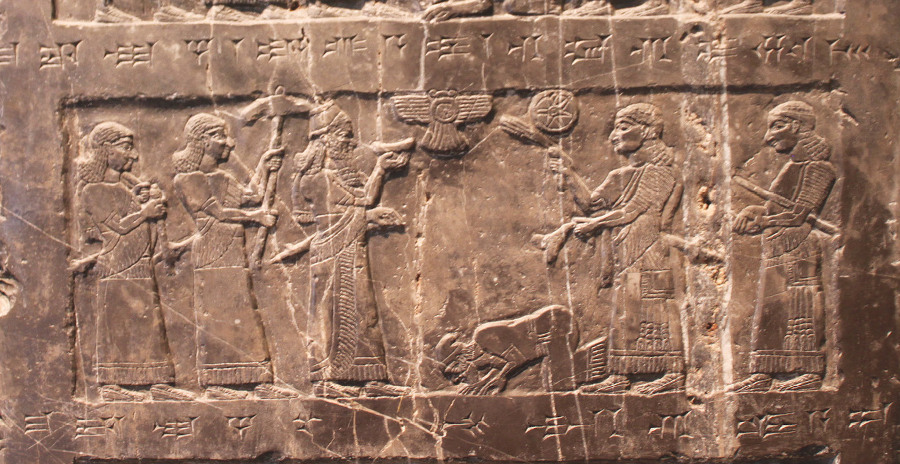
Black obelisk of Assyrian King Shalmaneser III depicting Israelite King Jehu paying tribute (see note on 2Ki 10:34).
© 2013 by Zondervan
Return to the main text.
10:35 rested with his ancestors. See note on 1Ki 1:21. Jehoahaz his son succeeded him. For the reign of Jehoahaz, see 13:1–9.
10:36 twenty-eight years. 841–814 bc.
11:1 Athaliah. See note on 8:18. her son was dead. See 9:27. destroy the whole royal family. To secure the throne in Judah for herself. By this time the royal family in Judah had already been reduced to a mere remnant. Jehoram, the late husband of Athaliah and the father of Ahaziah, had killed all his brothers when he succeeded his father Jehoshaphat on the throne (2Ch 21:4). Jehu had slain another 42 members of the royal house of Judah, perhaps including many of the sons of Jehoram’s brothers (10:12–14; 2Ch 22:8–9), and the brothers of Ahaziah had been killed by marauding Arabs (2Ch 22:1). It is likely that Athaliah’s purge focused primarily on the children of Ahaziah, i.e., her own grandchildren. Ahaziah had died at the young age of 22 (8:26). This attempt to completely destroy the house of David was an attack on God’s redemptive plan—a plan that centered in the Messiah, which the Davidic covenant promised (see notes on 2Sa 7:11, 16; 1Ki 8:25).
11:2 daughter of King Jehoram and sister of Ahaziah. It is likely that Jehosheba was the daughter of Jehoram by a wife other than Athaliah, and thus she was a half sister of Ahaziah. She was married to the high priest Jehoiada (2Ch 22:11). him and his nurse. The child was not more than a year old and had not yet been weaned (vv. 3,21).
11:4 seventh year. Of Athaliah’s rule. commanders of units of a hundred. 2Ch 23:1 lists the names of five commanders, all native Israelites. Carites. Mercenary soldiers from Caria in southwest Asia Minor who served as royal bodyguards. had them brought to him at the temple. 2Ch 23:2 includes the Levites and family leaders of Judah in the conspiracy.
11:10 shields that had belonged to King David and that were in the temple. David had taken gold shields as plunder in his battle with Hadadezer and then dedicated them to the Lord (2Sa 8:7–11). The temple and palace were plundered by Shishak, king of Egypt, during Rehoboam’s reign (1Ki 14:26). Apparently David’s shields had been hidden and were not taken.
11:12 covenant. Either (1) the Ten Commandments or (2) the entire Sinaitic covenant or (3) a document dealing more specifically with the covenant responsibilities of the king (see Dt 17:14–20; see also note on 1Sa 10:25). The third option is most likely. anointed him. See notes on 1Sa 2:10; 9:16; 1Ki 1:39. Long live the king! See note on Ps 62:4.
11:14 pillar. Apparently one of the two bronze pillars of the portico of the temple, named Jakin and Boaz by Solomon (23:3; 1Ki 7:15–22; 2Ch 23:13). all the people of the land. It is likely that Jehoiada had chosen to stage his coup on a Sabbath during one of the major religious festivals, when many from the realm who were loyal to the Lord would be in Jerusalem.
11:15 not be put to death in the temple. So as not to defile God’s holy house (see Ex 21:14 and note).
11:17 covenant between the LORD and the king and people that they would be the LORD’s people. A renewal of the Sinaitic covenant, by which Israel had been constituted as the Lord’s people (Ex 19:5–6; Dt 4:20). The years of apostasy, involving both the royal house and the people of Judah, necessitated a renewal of allegiance to the Lord at the time of an important new beginning for the southern kingdom (see notes on 1Sa 11:14–15; 12:14–15,24–25). covenant between the king and the people. Defined responsibilities and mutual obligations of king and people that were compatible with Israel’s covenant relationship with the Lord (see notes on 1Sa 10:25; 2Sa 5:3).
11:18 idols. Stone pillars (see note on 1Ki 14:23) and Asherah poles (see note on 1Ki 14:15).
11:19 commanders of hundreds, the Carites, the guards. See note on v. 4.
11:21 See v. 3. The Lord had preserved a lamp for David in Jerusalem (1Ki 11:36).
12:1 seventh year of Jehu. 835 bc (see note on 10:36). forty years. 835–796.
12:2 all the years Jehoiada the priest instructed him. After Jehoiada died, Joash turned away from the Lord (2Ch 24:17–27).
12:3 high places . . . were not removed. These were high places where the Lord was worshiped rather than pagan deities (see note on 1Ki 15:14). They were nevertheless potential sources for the entrance of pagan practices into Israel’s worship (see note on 1Ki 3:2).
12:4 money . . . brought as sacred offerings to the temple. The money was derived from three different sources: (1) money collected in the census. At the age of 20, Israelite youths were required to register for military service and to make an offering of half a shekel (see note on 5:26) for use in the service of the central sanctuary (Ex 30:11–16; 38:25–26). (2) money received from personal vows. Various types of vows and their equivalence in monetary assessments are described in Lev 27:1–25. (3) money brought voluntarily to the temple. For voluntary offerings, see Lev 22:18–23; Dt 16:10.
12:5 treasurers. Temple functionaries who handled financial matters for the priests relative to the people’s sacrifices and offerings. whatever damage is found in the temple. Construction of the temple had been completed 124 years before the beginning of the reign of Joash (see notes on v. 1; 1Ki 6:38). In addition to deterioration due to age, it had fallen into disrepair and abuse during the rule of Athaliah (2Ch 24:7).
12:6 twenty-third year of King Joash. Joash may have instituted his plan for restoration of the temple a few years before the 23rd year of his reign. Now at age 30 he asserts his royal authority and takes charge of the temple repairs.
12:7 Take no more money from your treasurers. The proceeds from the sources of revenue mentioned in v. 4 were no longer to be given to the priests.
12:8 priests agreed. Apparently a compromise was reached: The priests would no longer take the money received from the people, but neither would they pay for the temple repairs from the money they had already received.
12:9 priests who guarded the entrance. Three high-ranking priests charged with protecting the temple from unlawful (profane) entry (25:18; Jer 52:24). put into the chest all the money. When the people were assured that all their offerings would be used for the temple restoration, they responded with greater generosity. See 22:3–7 for continuation (or renewal) of this practice in the reign of Josiah.
12:10 royal secretary. See note on 2Sa 8:17. Joash arranges for direct royal supervision of the temple’s monetary affairs.
12:11 men appointed. The whole matter is taken out of the hands of the priests.
12:13 articles of gold or silver for the temple. All the money was initially designated for the restoration of the temple. When the restoration was completed, additional funds were used for the acquisition of silver and gold articles for use in the temple service (2Ch 24:14).
12:16 money from the guilt offerings. See Lev 5:16; 6:5; Nu 5:7–10 for references to priestly income in connection with the bringing of a guilt offering.
12:17 About this time. These events must have taken place toward the end of Joash’s reign. From 2Ch 24:17–24 it is clear that the Aramean attack was occasioned by Joash’s turning away from the Lord after Jehoiada’s death. Joash’s apostasy reached its climax in the stoning of Jehoiada’s son Zechariah (2Ch 24:22). Probably because of Joash’s earlier zeal for the temple, the author of Kings did not choose to relate these matters. Hazael. See 8:7–15; 10:32–33; 13:3,22; see also note on 1Ki 19:15. Gath. One of the major Philistine cities (Jos 13:3) that David had conquered (1Ch 18:1) and that continued to be subject to Judah during the reign of Rehoboam (2Ch 11:8). In the latter years of the reign of Joash of Judah (835–796 bc) and during the reign of Jehoahaz of Israel (814–798; see 13:3,7), the Arameans had virtually overrun the northern kingdom, enabling them to advance against the Philistines and the kingdom of Judah with little resistance. he turned to attack Jerusalem. See 2Ch 24:23–24.
12:18 sacred objects . . . gold . . . he sent them to Hazael. Years earlier, Asa had sought to secure assistance from the Arameans with a similar gift (1Ki 15:18).
12:19 annals of the kings of Judah. See note on 1Ki 14:29. A fuller account of the reign of Joash is also found in 2Ch 22:10—24:27.
12:20 conspired against him. The conspiracy was aroused in response to Joash’s murder of Zechariah, son of Jehoiada (2Ch 24:25). Beth Millo. Beth means “house”; for the meaning of Millo see note on Jdg 9:6. Here the reference may be to a building (perhaps a kind of barracks) built on the “Millo” in the old City of David (see 2Sa 5:9 and note; 1Ki 11:27). Perhaps the king was staying there temporarily with his troops at the time of his assassination; Chronicles says he was killed “in his bed” (2Ch 24:25).
12:21 officials. Sons of Ammonite and Moabite mothers (2Ch 24:26), suggesting that they may have been mercenary military officers whose services could have been bought by others. buried with his ancestors. But see 2Ch 24:25. Amaziah his son succeeded him. For the reign of Amaziah, see 14:1–22.
13:1 twenty-third year of Joash. 814 bc (see note on 12:1; see also Introduction to 1 Kings: Chronology). seventeen years. 814–798.
13:2 sins of Jeroboam. See 1Ki 12:26–32; 13:33–34; 14:16.
13:3 Hazael. See notes on 8:12,13,15; 10:33; 1 Ki 19:15. Ben-Hadad. See v. 24. Ben-Hadad III reigned c. 796–770 bc.
13:4 the LORD listened to him. Although deliverance did not come during the lifetime of Jehoahaz (v. 22), the Lord was merciful to his people in spite of their sin, because of his covenant with Abraham, Isaac and Jacob (v. 23).
13:5 deliverer for Israel. Probably (1) the Assyrian ruler Adadnirari III (810–783 bc), whose attacks on the Arameans of Damascus in 806 and 804 enabled the Israelites to break Aramean control over Israelite territory (v. 25; 14:25); or (2) Jehoash, son of Jehoahaz (vv. 17,19,25); or (3) Jeroboam II, who was able to extend Israel’s boundaries far to the north (14:25,27) after the Assyrians had broken the military power of the Arameans.
13:6 Asherah pole remained standing. This idol had been set up by Ahab (1Ki 16:33) and either had escaped destruction by Jehu when he purged Baal worship from Samaria (10:27–28) or had been reintroduced during the reign of Jehoahaz.
13:7 ten chariots. Cf. the 2,000 chariots that Ahab was able to deploy against the Assyrians at the battle of Qarqar in 853 bc (see note on 1Ki 22:1). ten thousand foot soldiers. At the battle of Qarqar Ahab had supplied 10,000 foot soldiers to the coalition of forces opposing the Assyrians. At that time this would have represented only a contingent of Israel’s army, while now it represented the entire Israelite infantry. In 857 bc Ahab had inflicted 100,000 casualties on the Aramean foot soldiers in one day (1Ki 20:29).
13:8 annals of the kings of Israel. See note on 1Ki 14:19.
13:9 rested with his ancestors. See note on 1Ki 1:21.
13:10 thirty-seventh year of Joash. 798 bc (see note on 12:1). sixteen years. 798–782.
13:11 sins of Jeroboam. Primarily, those leading Israel into idolatry (1Ki 12:26–32; 13:33–34; 14:16).
13:12 war against Amaziah. See 14:8–14; 2Ch 25:17–24. annals of the kings of Israel. See note on 1Ki 14:19.
13:13 rested with his ancestors. See note on 1Ki 1:21. Jeroboam succeeded him. For the reign of Jeroboam II, see 14:23–29.
13:14 Elisha had been suffering. Ch. 9 contains the last previous reference to Elisha. Since Jehu had been anointed in 841 bc (see note on 10:36) and Jehoash began to reign in 798 (see note on v. 10), there is at least a 43-year period in which we are told nothing of Elisha’s activities. Based on Elisha’s relationship with Elijah, he must have been born prior to 880 and have lived to be more than 80 years of age. The chariots and horsemen of Israel! An expression of recognition by Jehoash that Elisha was of greater significance for Israel’s military success than Israel’s military forces were (see notes on 2:12; 6:13,16–23).
13:16 put his hands on the king’s hands. By this symbolic act Elisha indicated that Jehoash was to engage the Arameans in battle with the Lord’s blessing on him.
13:17 east window. Faced Transjordan, which was controlled by the Arameans (10:32–33). Aphek. About 60 years earlier Ahab had won a decisive victory at Aphek over the Arameans and Ben-Hadad II (see 1Ki 20:26–30 and note on 20:26).
13:18 struck it three times and stopped. The moderately enthusiastic response to Elisha’s directive reflected insufficient zeal for accomplishing the announced task.
13:19 defeat it only three times. Jehoash’s moderate enthusiasm in striking the ground with arrows symbolized the moderate success he would have against the Arameans. It would be left for Jeroboam II, son of Jehoash, to gain complete victory over them (14:25,28).
13:21 When the body touched Elisha’s bones, the man came to life. The life-giving power of the God Elisha represented is demonstrated once again in this last OT reference to Elisha (for previous demonstrations of this power, see 4:32–37 and 1Ki 17:17–24; for Elijah’s departure to heaven without dying, see 2:11–12).
13:23 To this day. Until the time of the writing of the source from which the author derived this account (see note on 1Ki 8:8; see also Introduction to 1 Kings: Author, Sources and Date). unwilling to destroy them or banish them. In his mercy and grace the Lord was long-suffering toward his people and refrained from full implementation of the covenant curse of exile from Canaan (see note on 10:32). This postponement of judgment provided Israel with the opportunity to repent and return to covenant faithfulness.
13:24 Ben-Hadad. See note on v. 3.
13:25 towns he had taken . . . from . . . Jehoahaz. Probably towns west of the Jordan, since the area east of the Jordan had been lost already in the time of Jehu (10:32–33). It was not until the time of Jeroboam II that the area east of the Jordan was fully recovered for Israel (14:25). Three times. In fulfillment of Elisha’s prophecy (v. 19).
14:1 second year of Jehoash. 796 bc (see note on 13:10).
14:2 twenty-nine years. 796–767. Amaziah’s 29-year reign included a 24-year coregency with his son Azariah (see notes on v. 21; 15:1–2; see also chart).
14:3 not as his father David. Amaziah did not remain completely free from involvement with the worship of pagan deities (see 2Ch 25:14–16). His loyalty to the Lord fell short of that of Asa and Jehoshaphat before him (see 1Ki 15:11, 14; 22:43; see also 1Ki 9:4; 11:4).
14:4 high places, however, were not removed. See note on 1Ki 15:14.
14:7 defeated ten thousand Edomites. Amaziah was able to regain temporarily (2Ch 28:17) some of Judah’s control over the Edomites, which had been lost during the reign of Jehoram (8:20–22). Valley of Salt. The same battlefield on which David had defeated the Edomites (2Sa 8:13; 1Ch 18:12; Ps 60 title), generally identified with the Arabah directly south of the Dead Sea. Sela. See notes on Isa 16:1; Ob 3. to this day. Until the time of the writing of the account of Amaziah’s reign used by the author (see note on 1Ki 8:8; see also Introduction to 1 Kings: Author, Sources and Date).
14:8 let us face each other in battle. A challenge amounting to a declaration of war. Perhaps it was provoked by the hostile actions of mercenary troops from the northern kingdom after their dismissal from the Judahite army (2Ch 25:10,13) and by the refusal of Jehoash to establish a marriage alliance with Amaziah (v. 9).
14:9 Jehoash . . . replied. For his reply Jehoash used a fable (Jdg 9:8–15) in which he represented himself as a strong cedar and Amaziah as an insignificant thistle that could easily be trampled underfoot.
14:11 would not listen. See 2Ch 25:20. Beth Shemesh. A town about 15 miles west of Jerusalem (see Jos 15:10; 1Sa 6:9 and note).
14:13 Jehoash . . . captured Amaziah. It is likely that Amaziah was taken back to the northern kingdom as a prisoner, where he remained until being released to return to Judah after the death of Jehoash (see vv. 15–16; see also note on v. 21). Ephraim Gate to the Corner Gate. The Corner Gate (Jer 31:38; Zec 14:10) was at the northwest corner of the wall around Jerusalem. The Ephraim Gate was on the north side of Jerusalem (Ne 12:39), 600 feet east of the Corner Gate. This northwestern section of the wall of Jerusalem was the point at which the city was most vulnerable to attack.
14:14 gold and silver and all the articles found in the temple . . . and . . . the royal palace. The value of the plundered articles was probably not great, because Joash had previously stripped the temple and palace to pay tribute to Hazael of Damascus (12:17–18). took hostages. The hostages were probably intended to secure additional payments of tribute in view of the meager plunder taken in battle.
14:15 annals of the kings of Israel. See note on 1Ki 14:19.
14:16 rested with his ancestors. See 13:12–13; see also note on 1Ki 1:21.
14:17 lived for fifteen years after the death of Jehoash. Jehoash died in 782 bc and Amaziah in 767.
14:18 annals of the kings of Judah. See note on 1Ki 14:29.
14:19 conspired against him. 2Ch 25:27 connects the conspiracy against Amaziah with his turning away from the Lord, but it did not serve the purpose of the author of Kings to note this. Lachish. A fortress city in southern Judah 15 miles west of Hebron, presently known as Tell ed-Duweir (see 18:14; 2Ch 11:9; see also photos here, here, here, and here).
14:21 Then all the people of Judah took Azariah, who was. Or “Now all the people of Judah had taken Azariah, when he was.” See NIV text note and 15:13. made him king in place of his father Amaziah. It is likely that this occurred after Amaziah had been taken prisoner by Jehoash (v. 13). Thus Azariah’s reign substantially overlapped that of his father, Amaziah (see notes on v. 2; 15:2).
14:22 rebuilt Elath and restored it to Judah. Azariah extended the subjection of the Edomites begun by his father (v. 7) and reestablished Israelite control over the important port city on the Gulf of Aqaba (1Ki 9:26). rested with his ancestors. See note on 1Ki 1:21.
14:23 fifteenth year of Amaziah. 782 bc (see note on v. 2). This was the beginning of Jeroboam’s sole reign. He had previously served as coregent with his father, Jehoash. forty-one years. 793–753 (including the coregency with his father). See chart.
14:24 sins of Jeroboam. See 1Ki 12:26–32; 13:33–34; 14:16; Am 3:13–14; 4:4–5; 5:4–6; 7:10–17.
14:25 from Lebo Hamath. See note on Eze 47:15. Jeroboam II was able to free the northern kingdom from the oppression it had suffered at the hands of Hazael and Ben-Hadad (10:32; 12:17; 13:3,22,25). He also extended Israelite political control over the Arameans of Damascus, an undertaking that had been begun by his father, Jehoash (13:25). Assyrian pressure on the Arameans, including attacks on Damascus by Shalmaneser IV in 773 bc and Ashur-Dan III in 772, had weakened the Arameans enough to enable Jeroboam II to gain the upper hand over them. Meanwhile, Assyria also became too weak to suppress Jeroboam’s expansion. Dead Sea. See NIV text note. According to Am 6:14 the southern limit of Jeroboam’s kingdom in Transjordan was the “valley of the Arabah”—probably to be connected with the Valley of Salt (see note on v. 7). If so, Jeroboam had also subdued Moab and the Ammonites. word of the LORD . . . spoken through . . . Jonah. Not found in the book of Jonah. However, mention of the prophet here helps to date his ministry to the first half of the eighth century bc (see Introduction to Jonah: Authorship and Date). Gath Hepher. Located in the tribe of Zebulun, northeast of Nazareth (Jos 19:13).
14:26 slave or free. See NIV text note; see also note on 1Ki 14:10. suffering. At the hands of the Arameans (10:32–33; 13:3–7), the Moabites (13:20) and the Ammonites (Am 1:13).
14:27 had not said. The sin of the Israelites had not yet reached its full measure, and the Lord mercifully extended to the nation an additional period of grace in which there was opportunity to repent (see note on 13:23). Persistence in apostasy, however, would bring certain judgment (Am 4:2–3; 6:14). saved them by the hand of Jeroboam. See note on 13:5.
14:28 all he did. During Jeroboam’s reign the northern kingdom enjoyed greater material prosperity than at any time since the rule of David and Solomon. Unfortunately, it was also a time of religious formalism and apostasy, as well as social injustice (see the books of Amos and Hosea, who prophesied during Jeroboam’s reign). Damascus and Hamath. See note on v. 25. annals of the kings of Israel. See note on 1Ki 14:19.
14:29 rested with his ancestors. See note on 1Ki 1:21. Zechariah his son succeeded him. For the reign of Zechariah, see 15:8–12.
15:1 twenty-seventh year of Jeroboam. 767 bc, based on dating the beginning of Jeroboam’s coregency with Jehoash in 793 (see note on 14:23). Azariah . . . began to reign. He began his sole reign, after a 24-year coregency with his father, Amaziah (see notes on v. 2; 14:2,21; see also chart). (His actual years were one less than his official years.)
Assyrian Campaigns Against Israel and Judah
The Assyrian invasions of the eighth century bc were the most traumatic political events in the entire history of Israel.
The brutal Assyrian style of warfare relied on massive armies, superbly equipped with the world’s first great siege machines manipulated by an efficient corps of engineers.
Psychological terror, however, was Assyria’s most effective weapon. It was ruthlessly applied, with corpses impaled on stakes, severed heads stacked in heaps, and captives skinned alive.
The shock of bloody military sieges on both Israel and Judah was profound. The prophets did not fail to speak out against their horror, while at the same time pleading with the people to see God’s hand in history, to recognize spiritual causes in the present punishment.
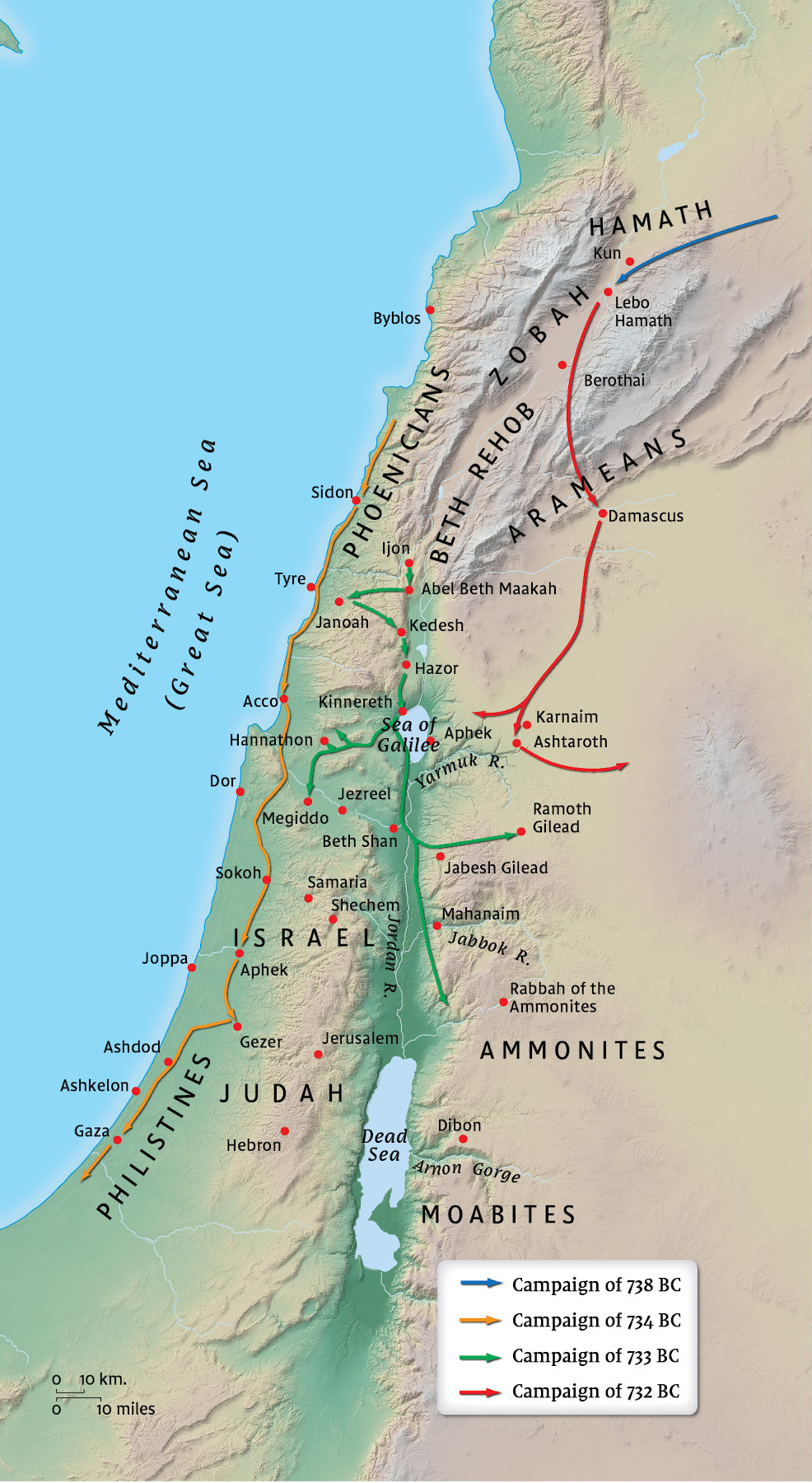
1. CAMPAIGNS OF TIGLATH-PILESER III (738–732 bc)
King Tiglath-Pileser of Assyria (745–727 bc) proved to be a vigorous campaigner, first exacting tribute from Menahem and then annexing Hamath, Philistia, Galilee, Gilead and Damascus (738–732 bc) during the reign of Pekah.
The ferocious onslaught against the northern tribes left only central Israel and the capital city of Samaria intact.
By this time Israel was a tiny nation wracked by pro- and anti-Assyrian factions, multiple assassinations, hypocrisy, arrogance and fear.
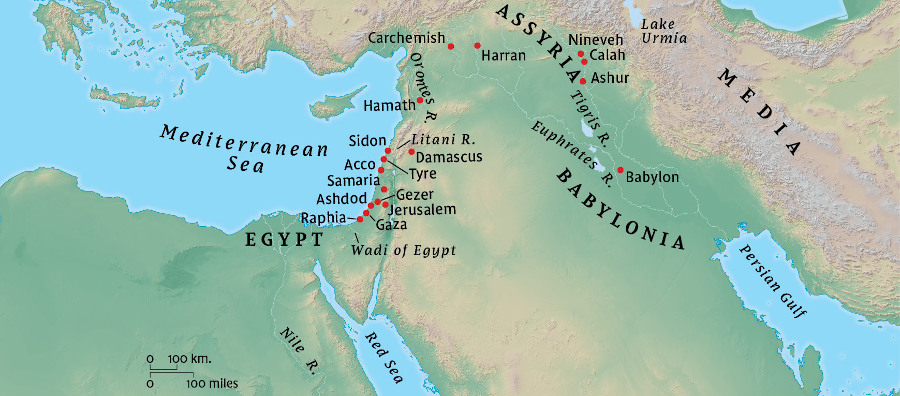
2. CAMPAIGN OF SHALMANESER V (725–722 bc)
The last king of Israel, Hoshea, conspired with Egypt and withheld the annual tribute to the Assyrians.
A protracted three-year siege conducted by Shalmaneser and concluded by Sargon II saw the end of the Israelite kingdom in 722–721 bc.
At that time, according to Assyrian annals, “I [Sargon] besieged and conquered Samaria, led away as plunder 27,290 inhabitants . . . I installed over [those remaining] an officer of mine and imposed upon them the tribute of the former king.”
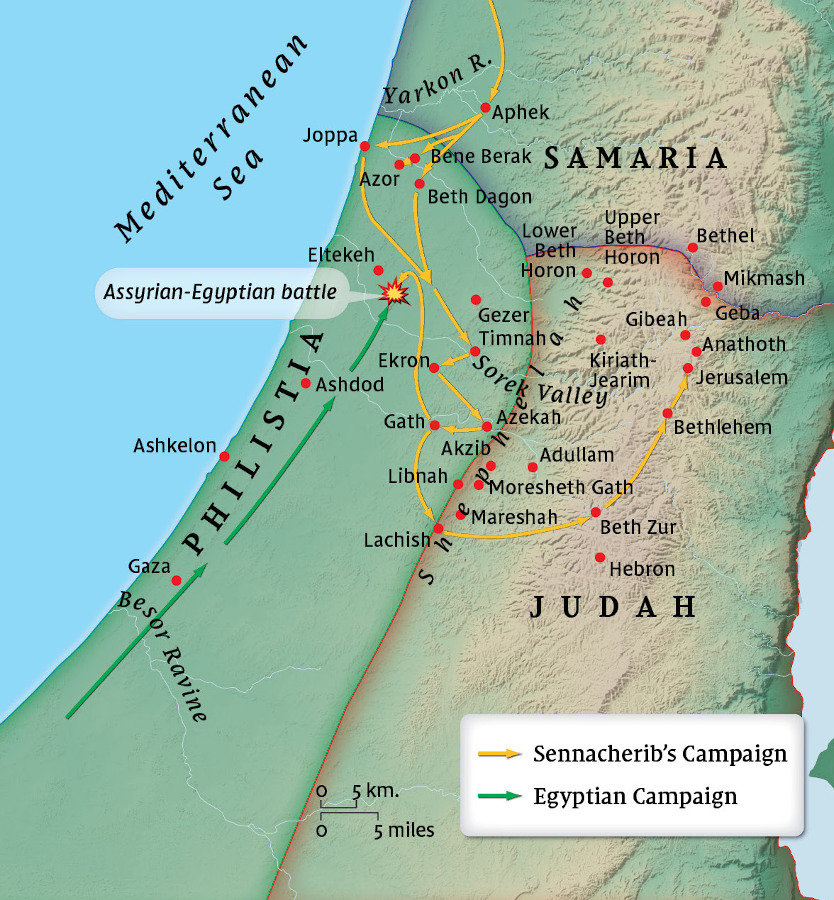
3. SENNACHERIB’S CAMPAIGN AGAINST JUDAH (701 bc)
In the 14th year of Hezekiah, the Assyrians finally attacked Judah. The Prism of Sennacherib (see photo and chart) calls Hezekiah “overbearing and proud,” indicating that he was part of Philistia’s and Egypt’s effort to rebel against Assyria.
A battle in the plain of Eltekeh was won by Assyria; the Egyptian and Cushite charioteers fled. Lachish was besieged and taken. Sennacherib’s annals note: “As for Hezekiah the Jew, he did not submit to my yoke. I laid siege to 46 of his strong cities, walled forts and the countless small villages in their vicinity, and conquered them by means of well-tamped earth ramps and battering-rams brought near to the walls combined with the attack by foot-soldiers, using mines, breaches and sapper work. I drove out 200,150 people, young and old, male and female, horses, mules, donkeys, camels, large and small cattle beyond counting, and considered them plunder. Himself I made a prisoner in Jerusalem, his royal residence, like a bird in a cage.”
Nowhere, however, does the boastful Assyrian king record the disaster mentioned in 2Ki 19:35–36; 2Ch 32:21; Isa 37:36–37.
Go to the Maps Index.
15:2 fifty-two years. 792–740 bc (but he was coregent with his father, Amaziah, 792–767). See note on v. 1.
15:3 as his father Amaziah had done. See note on 14:3.
15:4 high places, however, were not removed. See 14:4; see also note on 1Ki 15:14.
15:5 afflicted the king with leprosy. See NIV text note; a punishment for usurping the priestly function of burning incense on the altar in the temple (see 2Ch 26:16–21; cf. Lev 13:46). had charge of the palace and governed the people of the land. Jotham ruled for his father for the remainder of Azariah’s life (750–740 bc; see note on v. 33).
15:6 all he did. A more detailed account of Azariah’s accomplishments is found in 2Ch 26:1–15. annals of the kings of Judah. See note on 1Ki 14:29.
15:7 rested with his ancestors. See note on 1Ki 1:21. Jotham his son succeeded him. For the reign of Jotham, see vv. 32–38.
15:8 thirty-eighth year of Azariah. 753 bc (see note on v. 2).
15:9 sins of Jeroboam. See 1Ki 12:26–32; 13:33–34; 14:16.
15:11 annals of the kings of Israel. See note on 1Ki 14:19.
15:12 word of the LORD . . . was fulfilled. See NIV text note. With the downfall of Jehu’s dynasty, the northern kingdom entered a period of political instability (Hos 1:4). The remaining five kings of the northern kingdom were all assassinated, with the exception of Menahem, who reigned ten years, and Hoshea, who was imprisoned by the Assyrians. From the strength and wealth of the reign of Jeroboam II, the decline and fall of the northern kingdom was swift.
15:13 thirty-ninth year of Uzziah. 752 bc (see note on v. 2). Uzziah is another name for Azariah (see NIV text note on 14:21).
15:14 Menahem . . . went from Tirzah up to Samaria. It is likely that Menahem was the commander of a military garrison at Tirzah, the former capital of the northern kingdom (1Ki 14:17; 15:21,33). succeeded him. For the reign of Menahem, see vv. 17–22.
15:15 annals of the kings of Israel. See note on 1Ki 14:19.
15:16 Tiphsah. There was a Tiphsah located far to the north of Hamath (14:25) on the Euphrates River (1Ki 4:24). It is unlikely that this was the city intended. Some interpreters prefer the reading “Tappuah” of the Septuagint (the pre-Christian Greek translation of the OT). Tappuah was a city on the border between Ephraim and Manasseh (Jos 16:8; 17:7–8). Perhaps there was a Tiphsah in Israel not otherwise mentioned. ripped open all the pregnant women. This horrific action was a tragic but frequent part of ancient warfare (see 8:12 and note).
15:17 thirty-ninth year of Azariah. 752 bc (see note on v. 2). ten years. 752–742.
15:18 sins of Jeroboam. See 1Ki 12:26–32; 13:33–34; 14:16.
15:19 Pul. The Babylonian name (1Ch 5:26) of the Assyrian ruler Tiglath-Pileser III (745–727 bc; see NIV text note). invaded the land. Assyrian annals of Tiglath-Pileser III (see photo) indicate that he marched west with his army in 743 and took tribute from, among others, Carchemish, Hamath, Tyre, Byblos, Damascus, and Menahem of Samaria (see maps here, here, and here). thousand talents. See NIV text note. This was an enormous sum of money. For the relative value of a talent of silver, see note on 5:5. gain his support and strengthen his own hold. It appears that as a usurper Menahem still felt insecure on the throne. The opposition to his rule may have come from those following the leadership of Pekah, who favored an alliance with the Arameans of Damascus in order to resist the Assyrian threat (see note on v. 27). Hosea denounced the policy of seeking aid from the Assyrians and predicted that it would fail (Hos 5:13–15).
15:20 fifty shekels. See NIV text note. It would require approximately 60,000 men of means to provide the 1,000 talents of tribute. This gives some indication of the prosperity the northern kingdom had enjoyed during the reign of Jeroboam II.
15:21 annals of the kings of Israel. See note on 1Ki 14:19.
15:22 rested with his ancestors. See note on 1Ki 1:21.
15:23 fiftieth year of Azariah. 742 bc (see note on v. 2). two years. 742–740.
15:24 sins of Jeroboam. See 1Ki 12:26–32; 13:33–34; 14:16.
15:25 One of his chief officers. Pekah was probably the ranking official in the Transjordan provinces, but his allegiance to Menahem and Pekahiah may well have been more apparent than real (see note on v. 27). conspired against him. Differences over foreign policy probably played an important role in fomenting Pekah’s revolution. Pekahiah undoubtedly followed the policy of his father Menahem in seeking Assyria’s friendship (v. 20). Pekah advocated friendly relations with the Arameans of Damascus in order to counter potential Assyrian aggression (16:1–9; Isa 7:1–2,4–6).
15:26 annals of the kings of Israel. See note on 1Ki 14:19.
15:27 fifty-second year of Azariah. 740 bc (see note on v. 2). twenty years. 752–732, based on the assumptions (which the data seem to require) that Pekah had established in Transjordan virtually a rival government to that of Menahem when Menahem assassinated Shallum (see notes on vv. 17,19,25) and that the number of regnal years given here includes this period of rival rule.
15:28 sins of Jeroboam. See 1Ki 12:26–32; 13:33–34; 14:16.
15:29 Tiglath-Pileser king of Assyria came. See note on v. 19; see also map. The historical background for this attack is found in 16:5–9; 2Ch 28:16–21; Isa 7:1–17. Ijon . . . Naphtali. Over 150 years earlier Ben-Hadad I of Damascus had taken this same territory from the northern kingdom in response to an appeal by a king of Judah (see notes on 1Ki 15:19–20). deported the people to Assyria. See 1Ch 5:26. The forced exile of Israelites from their homeland was a fulfillment of the covenant curse (see note on 10:32).
15:30 Hoshea . . . conspired against Pekah. Hoshea probably represented the faction in the northern kingdom that favored cooperation with Assyria rather than resistance. In one of his annals Tiglath-Pileser III claims to have placed Hoshea on the throne of the northern kingdom and to have taken ten talents of gold and 1,000 talents of silver as tribute from him. twentieth year of Jotham. 732 bc (see notes on vv. 32–33). Reference is to his 20th official year, which was his 19th actual year.
15:31 annals of the kings of Israel. See note on 1Ki 14:19.
15:32 second year of Pekah. 750 bc (see note on v. 27).
15:33 sixteen years. 750–735 bc. Jotham was coregent with his father 750–740 (see note on v. 5). Jotham’s reign was in some sense terminated in 735, and his son Ahaz took over. However, Jotham continued to live until at least 732 (see notes on vv. 30,37).
15:34 as his father Uzziah had done. See note on v. 3; see also 2Ch 27:2.
15:35 high places, however, were not removed. See v. 4; see also note on 1Ki 15:14. Upper Gate of the temple. See 2Ch 23:20; Jer 20:2; Eze 9:2. Additional information on Jotham’s building activities is given in 2Ch 27:3–4.
15:36 other events of Jotham’s reign. See 2Ch 27:1–6. annals of the kings of Judah. See note on 1Ki 14:29.
15:37 This parenthetical statement concerning Jotham’s reign supports the idea of an overlap between the reigns of Jotham and Ahaz (see note on v. 33), since 16:5–12; 2Ch 28:5–21; Isa 7:1–17 all place the major effort of Rezin and Pekah in the time of Ahaz.
15:38 rested with his ancestors. See note on 1Ki 1:21.
16:1 seventeenth year of Pekah. 735 bc (see note on 15:27). The reign of Ahaz apparently overlapped that of Jotham, with Ahaz serving as a senior partner beginning in 735 (see notes on 15:33,37; see also notes on 16:2; 17:1; cf. chart). Ahaz son of Jotham king of Judah. In 1996 a clay seal impression reading “Belonging to Ahaz (son of) Jotham king of Judah” came to light, although its authenticity is debated.
16:2 twenty years old when he became king. Perhaps the age at which Ahaz became a senior coregent with his father, Jotham, in 735 bc (see note on v. 1). Otherwise, according to the ages and dates provided, Ahaz would have been 11 or 12 instead of 14 or 15 years old when his son Hezekiah was born (cf. 18:1–2). sixteen years. The synchronizations of the reigns of Ahaz and Hezekiah of Judah with those of Pekah and Hoshea of the northern kingdom present some apparent chronological difficulties (see notes on v. 1; 17:1; 18:1,9–10). It seems best to take the 16 years specified here as the number of years Ahaz reigned after the death of Jotham, thus 732–715 (see notes on 15:30,33). The beginning of his reign appears to be dated in a variety of ways in the biblical text: (1) in 744/743, which presupposes a coregency with his grandfather Azariah at the tender age of 11 or 12 (17:1); (2) in 735, when he became senior coregent with Jotham (v. 1); and (3) in 732, when he began his sole reign after the death of Jotham. Unlike David his father. Ahaz does not even receive the qualified approval given to Amaziah (14:3), Azariah (15:3) and Jotham (15:34).
16:3 ways of the kings of Israel. It is unlikely that Ahaz adhered to the calf worship introduced by Jeroboam I at Bethel and Dan (1Ki 12:26–32; 13:33–34; 14:16). The reference here is probably to Baal worship in the spirit of Ahab (see notes on 1Ki 16:31–33; see also 2Ch 28:2). sacrificed his son. Israel had been warned by Moses not to engage in this pagan rite (Lev 18:21; Dt 18:10). In Israel the firstborn son in each household was to be consecrated to the Lord and redeemed by a payment of five shekels to the priests (Ex 13:1, 11–13; Nu 18:16). See 3:27; 17:17; 21:6; 23:10; 2Ch 28:3; Jer 7:31; 32:35.
16:4 high places. See 15:4,35; see also note on 1Ki 15:14. These high places appear to be those assimilated from pagan Baal worship and used by those who worshiped Baal even while also worshiping the Lord. under every spreading tree. Large trees were viewed as symbols of fertility by the pre-Israelite inhabitants of Canaan. Immoral pagan rites were performed at shrines located under such trees. Contrary to the explicit prohibition of the Mosaic covenant, the Israelites adopted this pagan custom (17:10; 1Ki 14:23; Dt 12:2; Jer 2:20; 3:6; 17:2; Eze 6:13; 20:28; Hos 4:13–14).
16:5 Rezin . . . and Pekah . . . marched up to fight against Jerusalem. See notes on 15:25,37. could not overpower. See Isa 7:1–17; 2Ch 28:5–21. Rezin and Pekah desired to replace Ahaz with someone else (see Isa 7:6) on the throne of the southern kingdom in order to gain another ally in their anti-Assyrian political policy (see notes on 15:19,25). The Lord delivered Judah and Ahaz from this threat in spite of their wickedness because of the promises of the Davidic covenant (1Ki 11:36; 2Sa 7:13; Isa 7:3–7,14). This invasion was the context of the famous prophecy about the virgin’s child in Isa 7:14.
16:6 Rezin king of Aram recovered Elath. See note on 14:22. Edomites then moved into Elath. See 2Ch 28:17. The Philistines also took this opportunity to avenge previous defeats (compare 2Ch 26:5–7 with 2Ch 28:18). to this day. See note on 1Ki 8:8.
16:7 Tiglath-Pileser. See notes on 15:19,29. your servant and vassal. Ahaz preferred to seek security for Judah by means of a treaty with Assyria rather than by obedience to the Lord and trust in his promises (Ex 23:22; Isa 7:10–16).
16:8 silver and gold found in the temple. The temple treasure must have been restored to some degree by Jotham (12:18; 14:14). The name “Jehoahaz of Judah” (Ahaz) appears on an inscription of Tiglath-Pileser that contains a list of rulers (including those of the Philistines, Ammonites, Moabites and Edomites) who brought tribute to him in 734 bc.
16:9 attacking Damascus and capturing it. In 732 bc Tiglath-Pileser III moved against Damascus and destroyed it (see the prophecies of Isa 7:16; Am 1:3–5). deported its inhabitants to Kir. The Arameans were sent back to the place from which they had come (Am 9:7) in fulfillment of the prophecy of Amos (Am 1:5). The location of Kir is unknown, though it is mentioned in connection with Elam in Isa 22:6.
16:10 Ahaz went to Damascus to meet Tiglath-Pileser. As a vassal king to express his gratitude and loyalty to the victorious Assyrian ruler. altar in Damascus. Perhaps that of the god Rimmon (5:18; 2Ch 28:23), but more likely a royal altar of Tiglath-Pileser. Ahaz’s reproduction of such an altar would have been a further sign of submission to the Assyrians.
16:13 burnt offering . . . grain offering . . . drink offering . . . fellowship offerings. See chart. With the exception of the drink offering, these same sacrifices were offered at the dedication of the temple (1Ki 8:64).
16:14 north side of the new altar. Ahaz removed the bronze altar of burnt offering from its prominent place in front of the temple and gave it a place alongside the stone altar.
16:15 large new altar. Even though fire from heaven had inaugurated and sanctioned the use of the bronze altar for the worship of the Lord (2Ch 7:1), Ahaz now replaced it with an altar built on the pattern of the pagan altar from Damascus. Although the bronze altar was quite large (2Ch 4:1), the new altar was larger. morning burnt offering. See 3:20; Ex 29:38–39; Nu 28:3–4. evening grain offering. See note on 1Ki 18:29. king’s burnt offering and his grain offering. There is no other reference to these special offerings of the king in the OT, with the possible exception of Ezekiel’s depiction of the offerings of a future prince (Eze 46:12). I will use the bronze altar for seeking guidance. Seeking omens by the examination of the livers and other organ materials of sacrificed animals is well attested in ancient Near Eastern texts. Here Ahaz states his intention to follow an Assyrian divination technique in an attempt to secure the Lord’s guidance.
16:17 side panels and . . . basins from the movable stands. See 1Ki 7:27–39. removed the Sea from the bronze bulls. See 1Ki 7:23–26. Perhaps the bronze was needed for tribute required by Tiglath-Pileser III.
16:18 in deference to the king of Assyria. As a vassal of Tiglath-Pileser, Ahaz was forced to relinquish some of the symbols of his own royal power.
16:19 other events of the reign of Ahaz. See 2Ch 28, where, among other things, it is said that Ahaz went so far as to “shut the doors of the . . . temple” (2Ch 28:24). annals of the kings of Judah. See note on 1Ki 14:29.
16:20 rested with his ancestors. See note on 1Ki 1:21; see also 2Ch 28:27. Hezekiah his son succeeded him. For the reign of Hezekiah, see 18:1—20:21.
17:1 twelfth year of Ahaz. 732 bc (see note on 15:30), on the assumption that Ahaz began a coregency with Azariah in 744/743 (see notes on 16:1–2; see also chart). nine years. 732–722 (see Introduction to 1 Kings: Chronology); cf. note on 15:30.
17:3 Shalmaneser. Hoshea had become a vassal to Assyria under the rule of Tiglath-Pileser III (see note on 15:30). The latter was succeeded on the Assyrian throne by Shalmaneser V, who ruled 727–722 bc (see chart).
17:5 three years. 725–722 bc. Samaria was a strongly fortified city and extremely difficult to subdue (see note on 1Ki 16:24).
17:6 ninth year of Hoshea. 722 bc (see note on v. 1). king of Assyria captured Samaria. In the winter (December) of 722–721 Shalmaneser V died (possibly by assassination), and the Assyrian throne was seized by Sargon II (721–705). In his annals (see photos here and here) Sargon lays claim to the capture of Samaria at the beginning of his reign, but it was hardly more than a mopping-up operation. deported the Israelites. Because the northern kingdom refused to be obedient to its covenant obligations, the Lord brought on its citizens the judgment pronounced already by Ahijah during the reign of the northern kingdom’s first king, Jeroboam I (see note on 1Ki 14:15). In his annals Sargon II claims to have deported 27,290 Israelites. He then settled other captured people in the vacated towns of the northern kingdom (v. 24). Gozan on the Habor River. Gozan was an Assyrian provincial capital located on a tributary (the Habor) of the Euphrates River. towns of the Medes. Towns located in the area south of the Caspian Sea and northeast of the Tigris River.
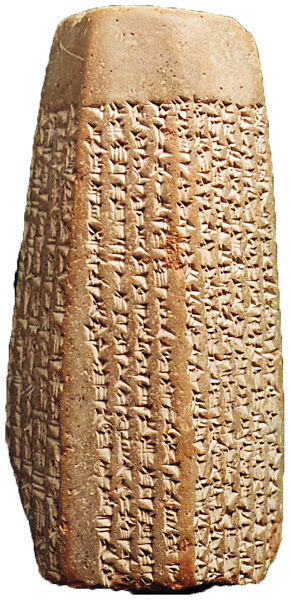
Royal inscription of Sargon II of Assyria with a description of his conquests (722–705 bc).
The Schøyen Collection, MS 2368, Oslo and London
Return to the main text.
17:7–23 A theological explanation for the downfall and exile of the northern kingdom (see map and accompanying text). Israel had repeatedly spurned the Lord’s gracious acts, had refused to heed the prophets’ warnings of impending judgment (vv. 13–14,23) and had failed to keep their covenant obligations (v. 15). The result was the implementation of the covenant curse precisely as it had been presented to the Israelites by Moses before they entered Canaan (Dt 28:49–68; 32:1–47).
17:7 brought them up out of Egypt. The deliverance from Egypt was the fundamental redemptive event in Israel’s history. They owed their very existence as a nation to this gracious and mighty act of the Lord (Ex 20:2; Dt 5:15; 26:8; Jos 24:5–7,17; Jdg 10:11; 1Sa 12:6; Ne 9:9–13; Mic 6:4). worshiped other gods. A violation of the most basic obligation of Israel’s covenant with the Lord (v. 35; Dt 5:7; 6:14; Jos 24:14–16,20; Jer 1:16; 2:5–6; 25:6; 35:15).
The mass deportation policy of the Assyrians was a companion piece to the brutal and calculated terror initiated by Ashurnasirpal and followed by all his successors. It was intended to forestall revolts but, like all draconian measures, it merely spread misery and engendered hatred. In the end, it hastened the disintegration of the Assyrian Empire.
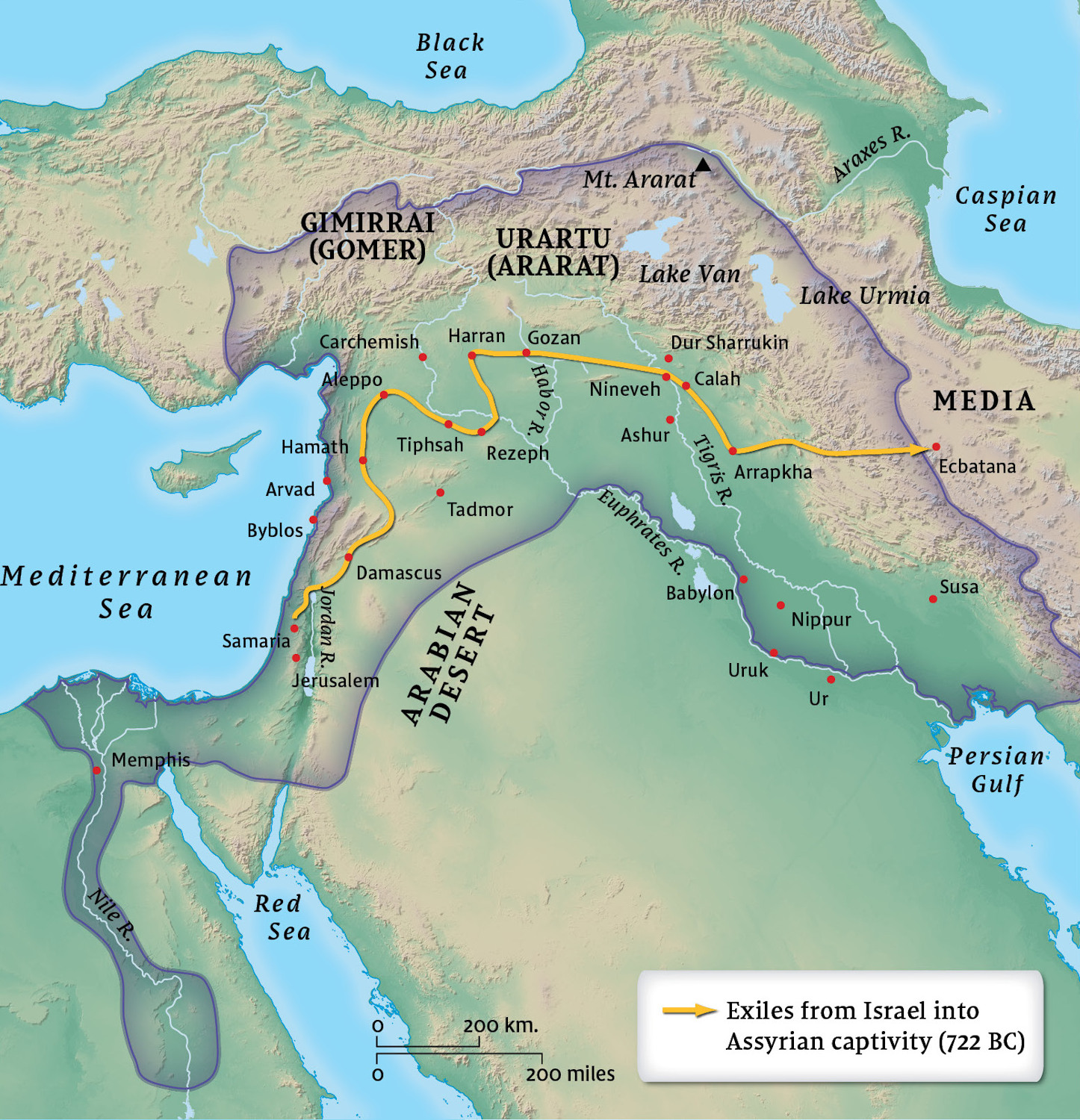
There is some evidence that Israel experienced its first deportations under Tiglath-Pileser III (745–727 bc), a cruelty repeated by Sargon II (721–705) at the time of the fall of Samaria. The latter king’s inscriptions boast of carrying away 27,290 inhabitants of the city “as plunder.” According to 2Ki 17:6, they were sent to Assyria, to Halah, to Gozan on the Habor River, and apparently to the eastern frontiers of the empire (to the towns of the Medes, most probably somewhere in the vicinity of Ecbatana, the modern Hamadan).
The sequel is provided by the inscriptions of Sargon: “The Arabs who live far away in the desert, who know neither overseers nor officials, and who had not yet brought their tribute to any king, I deported . . . and settled them in Samaria.”
Much mythology has developed around the theme of the so-called ten “lost” tribes of Israel. A close examination of Assyrian records reveals that the deportations approximated only a limited percentage of the population, usually consisting of noble families. Agricultural workers, no doubt the majority, were deliberately left to care for the crops (cf. the Babylonian practice, 2Ki 24:14; 25:12).
Go to the Maps Index.
17:8 practices of the nations. See Dt 18:9; Jdg 2:12–13. practices that the kings of Israel had introduced. See, e.g., 10:31 (Jehu); 14:24 (Jeroboam II); 1Ki 12:28–33 (Jeroboam I); 16:25–26 (Omri); 16:30–34 (Ahab).
17:9 high places in all their towns. See 14:4; 15:4,35; see also notes on 16:4; 1Ki 3:2; 15:14.
17:10 sacred stones. See note on 1Ki 14:23. Asherah poles. See note on 1Ki 14:15. on every high hill and under every spreading tree. See 16:4; 1Ki 14:23; Jer 2:20; 3:6,13; 17:2.
17:11 wicked things. Perhaps a reference to ritual prostitution (see note on 1Ki 14:24; see also Hos 4:13–14).
17:12 idols. See note on Lev 26:30. You shall not do this. See NIV text note; see also Ex 23:13; Lev 26:1; Dt 5:6–10.
17:13 warned Israel and Judah through all his prophets. Israel not only violated the requirements of the Sinaitic covenant but also spurned the words of prophets the Lord had graciously sent to call his people back to the covenant (see, e.g., 1Ki 13:1–3; 14:6–16; Jdg 6:8–10; 1Sa 3:19–21, as well as the ministries of Elijah, Elisha, Amos and Hosea). seers. See note on 1Sa 9:9.
17:14 stiff-necked. A figure derived from the obstinate resistance of an ox to being placed under a yoke (Dt 10:16; Jer 2:20; 7:26; 17:23; 19:15; Hos 4:16).
17:15 followed worthless idols. See Dt 32:21; Jer 2:5; 8:19; 10:8; 14:22; 51:18.
17:16 two idols cast in the shape of calves. The golden calves of Bethel and Dan (1Ki 12:28–30). Asherah pole. See note on 1Ki 14:15. all the starry hosts. Israel had been commanded not to worship the stars like their pagan neighbors (Dt 4:19; 17:3). Although this form of idolatry is not mentioned previously in 1,2 Kings, the prophet Amos apparently alludes to its practice in the northern kingdom during the reign of Jeroboam II (see note on Am 5:26). It was later introduced in the southern kingdom during the reign of Manasseh (21:3,5) and abolished during the reformation of Josiah (see 23:4–5,12; see also Eze 8:16).
17:17 sacrificed their sons and daughters. See note on 16:3. practiced divination and sought omens. Such practices were forbidden in the Mosaic covenant (see note on 16:15; see also Lev 19:26; Dt 18:10 and note on 18:9).
17:18 removed them from his presence. The exile of the northern kingdom (see v. 6; 23:27; see also map). Only the tribe of Judah was left. The southern kingdom included elements of the tribes of Simeon and Benjamin, but Judah was the only tribe in the south to retain its complete integrity (see notes on 1Ki 11:31–32; see also note on 2Ki 19:4).
17:20 afflicted them and gave them into the hands of plunderers. See 10:32–33; 13:3,20; 24:2; 2Ch 21:16; 28:18; Am 1:13.
17:21 tore Israel away from the house of David. See 1Ki 11:11, 31; 12:24. It was the Lord’s will for the kingdom to be divided, but the division came to the nation as a punishment for its sins. Jeroboam . . . caused them to commit a great sin. See 1Ki 12:26–32; 13:33–34; see also note on Ge 20:9.
17:23 warned through all his servants the prophets. See 1Ki 14:15–16; Hos 10:1–7; 11:5; Am 5:27. exile in Assyria . . . still there. See maps and accompanying texts here and here. Some started returning c. 538 bc (see map).
17:24 king of Assyria. Primarily Sargon II (721–705 bc; see photo), though later Assyrian rulers, including Esarhaddon (681–669) and Ashurbanipal (669–627), settled additional non-Israelites in Samaria (Ezr 4:2,9–10). Babylon, Kuthah. Babylon and Kuthah (located about eight miles northeast of Babylon) were forced to submit to Assyrian rule by Sargon II in 709. Avva. Probably the same as Ivvah (18:34; 19:13). Its association with Hamath and Arpad suggests a location somewhere in Aram (Syria). Hamath. Located on the Orontes River (see 14:25; 18:34; see also note on Eze 47:15). In 720 Sargon II made the kingdom of Hamath into an Assyrian province. Sepharvaim. See note on Isa 36:19. Samaria. Here a designation for the entire northern kingdom (see note on 1Ki 13:32).
17:25 did not worship the LORD. They worshiped their own national deities. sent lions among them. Lions had always been present in Canaan (1Ki 13:24; 20:36; Jdg 14:5; 1Sa 17:34; Am 3:12). In the aftermath of the disruption and depopulation caused by the conflict with the Assyrians, the lions greatly increased in number (Ex 23:29). This was viewed by the inhabitants of the land and the writer of Kings as a punishment from the Lord (Lev 26:21–22).
17:26 king of Assyria. Sargon II. what the god of that country requires. According to the religious ideas of that time, each regional deity required special ritual observances, which, if ignored or violated, would bring disaster on the land.
17:27 one of the priests. Probably a priest of the religion Jeroboam I established in the northern kingdom (see 1Ki 12:31 and note).
17:28 came to live in Bethel. Bethel continued to be the center for the apostate form of Yahweh worship that had been promoted in the northern kingdom since the time of Jeroboam I (see notes on 1Ki 12:28–30).
17:29 people of Samaria. The mixed population of the former territory of the northern kingdom. These people of mixed ancestry eventually came to be known as Samaritans. In later times the Samaritans rejected the idolatry of their polytheistic origins and followed the teachings of Moses, including monotheism. In NT times Jesus testified to a Samaritan woman (Jn 4:4–26), and many Samaritans were converted under the ministry of Philip (Ac 8:4–25).
17:32 officiate for them as priests. See note on 1Ki 12:31.
17:33 They worshiped the LORD, but they also served their own gods. A classic statement of a syncretistic (mixed) religion.
17:34 To this day. Until the time of the writing of 1,2 Kings. worship the LORD. Here used in the sense of faithful worship. In vv. 32–33 “worship the LORD” refers to a paganized worship.
17:35 Do not worship any other gods. The Mosaic covenant demanded exclusive worship of the Lord (Ex 20:5; Dt 5:9). This was the “first and greatest commandment” (Mt 22:38), and it was to distinguish Israel from all other peoples.
17:36 the LORD, who brought you up out of Egypt . . . you must worship. Here, as in v. 7 (see note there), the deliverance from Egypt is cited as the gracious act of the Lord par excellence that entitled him to exclusive claim on Israel’s loyalty.
17:39 will deliver you from . . . all your enemies. See Ex 23:22; Dt 20:1–4; 23:14.
17:41 To this day. See note on v. 34.
18:1 third year of Hoshea . . . Hezekiah . . . began to reign. 729 bc (17:1). Hezekiah was coregent with his father Ahaz from 729 to 715 (see notes on 16:2; Isa 36:1; see also chart). Hezekiah son of Ahaz king of Judah. In 2015 a clay impression of a royal stamp seal was discovered that reads “Belonging to Hezekiah (son of) Ahaz, king of Judah” (see photo). It is the first such seal impression from a king of Israel or Judah to come to light in a scientific archaeological excavation.
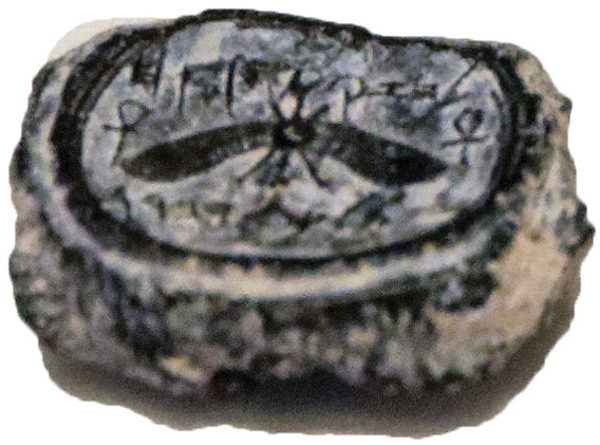
Clay impression with ancient Hebrew script, “Belonging to Hezekiah (son of) Ahaz king of Judah.”
Jerusalem, Israel Museum. Todd Bolen/BiblePlaces.com
Return to the main text.
18:2 became king. Became sole king of Judah. twenty-nine years. 715–686 bc. See also 2Ch 29–32 and Isa 36–39 for a description of the events of his reign, including a more detailed account of the reformation he led (2Ch 29–31). One of his first acts was to reopen the temple, which had been closed by his father, Ahaz (see note on 16:19; see also 2Ch 29:3).
18:3 did what was right . . . as his father David had done. Hezekiah is one of the few kings who is compared favorably with David. The others are Asa (1Ki 15:11), Jehoshaphat (1Ki 22:43) and Josiah (2Ki 22:2). A qualification is introduced, however, with both Asa and Jehoshaphat: They did not remove the high places (1Ki 15:14; 22:43).
18:4 removed the high places. Hezekiah was not the first king to destroy high places (see notes on 1Ki 3:2; 15:14), but he was the first to destroy high places dedicated to the worship of the Lord (12:3; 14:4; 15:4,35; 17:9; 1Ki 22:43). This became known even to the Assyrian king, Sennacherib (v. 22). sacred stones. See 3:2; 10:26–27; 17:10; see also note on 1Ki 14:23. Asherah poles. See 13:6; 17:10,16; 1Ki 16:23; see also note on 1Ki 14:15. Israelites had been burning incense to it. It is unlikely that the “bronze snake” had been an object of worship all through the centuries of Israel’s existence as a nation. Perhaps the idolatrous significance attached to it occurred during the reign of Hezekiah’s father, Ahaz (ch. 16). Snake worship of various types was common among ancient Near Eastern peoples. See note on Nu 21:8–9.
18:5 no one like him . . . either before him or after him. A difference of emphasis is to be seen in this statement when compared to that of 23:25. Hezekiah’s uniqueness is to be found in his trust in the Lord, while Josiah’s uniqueness is to be found in his scrupulous observance of the Mosaic law.
18:7 rebelled against the king of Assyria. Judah had become a vassal to Assyria under Ahaz (16:7)—which required at least formal recognition of Assyrian deities. Hezekiah reversed the policy of his father, Ahaz, and sought independence from Assyrian dominance. It is likely that sometime shortly after 705 bc, when Sennacherib replaced Sargon II on the Assyrian throne, Hezekiah refused to pay the annual tribute due the Assyrians.
18:8 defeated the Philistines. In a reversal of the conditions existing during the time of Ahaz, in which the Philistines captured Judahite cities in the hill country and Negev (2Ch 28:18), Hezekiah was able once again to subdue the Philistines. Probably Hezekiah tried to coerce the Philistines into joining his anti-Assyrian policy. In one of his annals Sennacherib tells of forcing Hezekiah to release Padi, king of the Philistine city of Ekron, whom Hezekiah held prisoner in Jerusalem. This occurred in connection with Sennacherib’s military campaign in 701 bc.
18:9 Hezekiah’s fourth year. 725 bc, the fourth year of Hezekiah’s coregency with Ahaz (see notes on v. 1; 17:1). Shalmaneser. See note on 17:3.
18:10 three years. See note on 17:5. ninth year of Hoshea. See note on 17:6.
18:11 king of Assyria deported Israel. See note on 17:6.
18:12 violated his covenant. A restatement of the reason for the exile (17:7–23) and also a summary of the theme of 1,2 Kings. Disobedience results in judgment, obedience in blessing.
18:13 fourteenth year. Of Hezekiah’s sole reign: 701 bc (see note on v. 2). Sennacherib . . . attacked. See map. Verses 13–16 correspond very closely with Sennacherib’s own account of his 701 campaign against Phoenicia, Judah and Egypt. captured them. In his annals, Sennacherib claims to have captured 46 of Hezekiah’s fortified cities, as well as numerous open villages, and to have taken 200,150 of the people captive. He says he made Hezekiah “a prisoner in Jerusalem his royal residence, like a bird in a cage,” but he does not say he took Jerusalem (19:35–36).
18:14 Lachish. See notes on 14:19; Isa 36:2; see also photos here and here. three hundred talents of silver and thirty talents of gold. See NIV text notes. The Assyrian and biblical reports of the amount of tribute paid by Hezekiah to Sennacherib agree with respect to the 30 talents of gold, but Sennacherib claims to have received 800 talents of silver rather than the 300 specified in the biblical text.
18:15 silver . . . in the temple . . . and in the treasuries of the royal palace. See 12:10,18; 14:14; 16:8; 1Ki 7:51; 14:26; 15:18.
18:17—19:37 See Isa 36–37; cf. 2Ch 32.
18:17 aqueduct . . . Field. See note on Isa 7:3. It is ironic that the Assyrian officials demand Judah’s surrender on the very spot where Isaiah had warned Ahaz to trust in the Lord rather than in an alliance with Assyria for deliverance from the threat against him from Aram and the northern kingdom of Israel (16:5–10; Isa 7:1–17).
18:18 palace administrator. See note on 1Ki 4:6. secretary. See note on 2Sa 8:17. recorder. See note on 2Sa 8:16.
18:19 great king. A frequently used title of the Assyrian rulers—and occasionally of the Lord (Ps 47:2; 48:2; 95:3; Mal 1:14; Mt 5:35). says. The following address is a masterpiece of calculated intimidation and psychological warfare designed to destroy the morale of the inhabitants of Jerusalem (see vv. 26–27; cf. note on Jos 6:5).
18:21 depending on Egypt. See 19:9; Isa 30:1–5; 31:1–3.
18:22 isn’t he the one whose high places and altars Hezekiah removed . . . ? The Assyrians cleverly attempted to drive a wedge between Hezekiah and the people. They attempted to exploit any resentment that may have existed among those who opposed Hezekiah’s reformation and his destruction of the high places (see note on v. 4).
18:23 if you can put riders on them! With this sarcastic taunt, the Assyrians undoubtedly accurately suggest that the Judahites were so weak in military personnel that they could not even take advantage of such a generous offer. In contrast with the Assyrians, the army of Judah at the time consisted largely of foot soldiers. The city under siege would have contained few chariots, and it is not known whether the Israelites ever employed mounted men in combat.
18:26 Aramaic. Had become the international language of the Near East, known and used by those engaged in diplomacy and commerce. It is surprising that an Assyrian official was able to speak the Hebrew dialect of the common people of Judah (2Ch 32:18). It is also a testimony to Assyria’s diplomatic expertise.
18:27 people sitting on the wall. The Assyrian strategy was to negotiate in the hearing of the people in order to demoralize them and turn them against Hezekiah. eat their own excrement and drink their own urine. A vivid portrayal of the potential hardship of a prolonged siege.
18:29 the king says. The Assyrian officials now address their remarks directly to the populace rather than to the officials of Hezekiah, as in vv. 19–27. Do not let Hezekiah deceive you. Here and in vv. 30–31 the people are urged three times to turn against Hezekiah.
18:30 this city will not be given into the hand of the king of Assyria. Hezekiah could say this on the basis of God’s promise to him (see 20:6; see also note on Isa 38:6).
18:31 eat fruit from your own vine and fig tree and drink water from your own cistern. Depicting peaceful and prosperous times (1Ki 4:25; Mic 4:4; Zec 3:10).
18:32 until I come and take you to a land like your own. Ultimately surrender meant deportation, but Sennacherib pictured it as something desirable. Choose life and not death! The alternatives depicted for the people are: (1) Trust in the Lord and Hezekiah and die, or (2) trust in the Assyrians and enjoy prosperity and peace. These words directly contradict the alternatives placed before Israel by Moses in Dt 30:15–20.
18:33–35 Has the god of any nation ever delivered his land from the hand of the king of Assyria? . . . How then can the LORD deliver Jerusalem from my hand? The flaw in the Assyrian reasoning was to equate the one true and living God with the no-gods (Dt 32:21) of the pagan peoples the Assyrians had defeated (19:4,6; 2Ch 32:13–19; Isa 10:9–11).
18:34 Hamath. See notes on 14:25; 17:24. Arpad. A city located near Hamath and taken by the Assyrians in 740 bc (19:13; Isa 10:9; Jer 49:23). Sepharvaim, Hena and Ivvah. Likely all located in Aram (Syria). See note on 17:24, Isa 10:9, 36:19.
18:36 because the king had commanded, “Do not answer him.” The Assyrian attempt to stir up a popular revolt against the leadership and authority of Hezekiah had failed.
18:37 clothes torn. An expression of great emotion (6:30; 1Ki 21:27). Perhaps in this instance it was motivated by the Assyrian blasphemy against the true God (19:4,6; Mt 26:65; Mk 14:63–64).
19:1 sackcloth. See note on 6:30.
19:2 palace administrator. See note on 1Ki 4:6. secretary. See note on 2Sa 8:17. leading priests. Probably the oldest members of various priestly families (Jer 19:1). The crisis involved not only the city of Jerusalem but also the temple. prophet Isaiah. The first reference to Isaiah in the book of Kings, though he had been active in the reigns of Uzziah, Jotham and Ahaz (Isa 1:1).
19:3 as when children come to the moment of birth and there is no strength to deliver them. Depicts the critical nature of the threat facing the city.
19:4 living God. In contrast to the no-gods of 18:33–35. See 1Sa 17:26, 36,45 for another example of ridiculing the living and true God. pray. Intercessory prayer was an important aspect of the ministry of the prophets (see, e.g., the intercession of Moses and Samuel: Ex 32:31–32; 33:12–17; Nu 14:13–19; 1Sa 7:8–9; 12:19,23; Ps 99:6; Jer 15:1). remnant. Those left in Judah after Sennacherib’s capture of many towns and numerous people (see note on 18:13; cf. Isa 10:28–32). Archaeological evidence reveals that many Israelites fled the northern kingdom during the Assyrian assaults and settled in Judah, so that the nation of Judah became the remnant of all Israel.
19:7 report. Some interpreters link this report with the challenge to Sennacherib from Tirhakah of Egypt (v. 9). Others regard it as disturbing information from Sennacherib’s homeland. make him want to return. Because of a spirit of insecurity and fear. cut down with the sword. See v. 37. Here the eventual murder of Sennacherib is connected with his blasphemy against the living God.
19:8 Libnah. See note on 8:22.
19:9 Tirhakah. See note on Isa 37:9. Cush. See NIV text note.
19:12 Gozan. See note on 17:6. Harran. See note on Ge 11:31. It is not known just when Harran was taken by the Assyrians. Rezeph. Located south of the Euphrates River and northeast of Hamath. Eden. A district along the Euphrates River south of Harran (Eze 27:23; Am 1:5), not to be confused with the Garden of Eden. It was incorporated into the Assyrian Empire by Shalmaneser III in 855 bc.
19:13 Hamath . . . Ivvah. See note on 17:24.
19:15 enthroned between the cherubim. See notes on Ex 25:18; 1Sa 4:4. you alone are God. See v. 19; Dt 4:35,39; see also 2Ki 18:33–35; Isa 43:11 and notes.
19:18 fashioned by human hands. For the foolishness and futility of idolatry, see Ps 115:3–8; 135:15–18; Isa 2:20; 40:19–20; 41:7; 44:9–20.
19:19 that all the kingdoms of the earth may know. Hezekiah recognizes that the Lord’s reputation is at stake in the welfare of his covenant people (see 1Sa 12:22; see also Jos 7:9; 2Sa 7:23; Ps 23:3; Eze 5:13; 6:7 and notes).
19:20 heard your prayer. On this occasion Isaiah’s message to Hezekiah was unsolicited by the king (contrast v. 2).
19:21–28 The arrogance of the Assyrians and their ridicule of the Israelites and their God are countered with a derisive pronouncement of judgment (cf. Ps 2) on the misconceived Assyrian pride (Isa 10:5–34).
19:21 Virgin Daughter Zion . . . Daughter Jerusalem. In Hebrew poetry, a conventional way of referring to a royal city, a nation or a people when these are personified as a woman, found often in the prophetic literature, with special concentration in Lamentations.
19:22 Holy One of Israel. A designation of the God of Israel characteristic of the book of Isaiah (see Lev 11:44; Isa 1:4 and notes).
19:23 Lebanon . . . its tallest cedars. See note on 1Ki 5:6.
19:24 dried up all the streams of Egypt. A presumptuous boast for one who had not even conquered Egypt.
19:25 I ordained it . . . now I have brought it to pass. The God of Israel is the ruler of all nations and history. The Assyrians attributed their victories to their own military superiority. However, Isaiah said that God alone ordained these victories (see Isa 10:5–19; cf. Eze 30:24–26).
19:28 hook in your nose. At the top of an Assyrian obelisk an Assyrian king (probably Esarhaddon, 681–669 bc) is pictured holding ropes attached to rings in the noses of four of his enemies (see photo). Here Isaiah portrays the same thing happening to Sennacherib (see note on Isa 37:29; cf. Eze 38:4; Am 4:2).
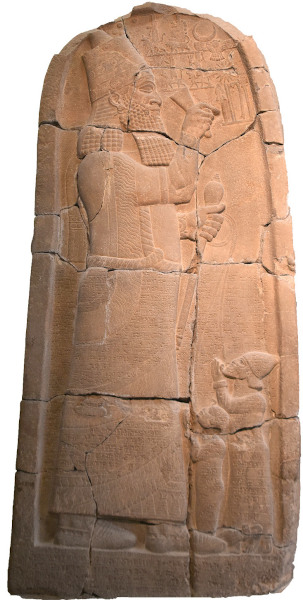
Stele of Assyrian king Esarhaddon holding ropes attached to rings going through the lips of two subjected persons, dated 670 bc.
Pergamon Museum, Berlin. Richard Mortel, CC BY 2.0
Return to the main text.
19:29 This year you will eat what grows by itself. Sennacherib had apparently either destroyed or confiscated the entire harvest that had been sown the previous fall. The people would only have use of the later, second growth that came from seeds dropped from the previous year’s harvest (Lev 25:5). This suggests that Sennacherib came to Judah in March or April, about the time of harvest. the second year what springs from that. Sennacherib’s departure would be too late in the fall for new crops to be planted for the coming year. In the Holy Land, crops are normally sown in September and October. in the third year sow and reap. The routine times for sowing and harvesting could be observed in the following year. The third year is likely a reference to the third year of harvests detrimentally affected by the Assyrian presence.
19:30–31 remnant. See note on v. 4. For use of the term “remnant” as a designation for those who will participate in the future unfolding of God’s redemptive program, see Isa 11:11, 16; 28:5; Mic 4:7; Ro 11:5.
19:32 not enter this city. Sennacherib, who was presently at Libnah (see v. 8; see also note on 8:22), would not be able to carry out his threats against Jerusalem (see note on 18:13).
19:34 for the sake of David my servant. See note on 1Ki 11:13.
19:35 angel of the LORD. See note on Ge 16:7. a hundred and eighty-five thousand. See Isa 37:36 and note.
19:36 Nineveh. The capital of the Assyrian Empire.
19:37 his sons Adrammelek and Sharezer. Ancient records refer to the murder of Sennacherib by an unnamed son in the 23rd year of Sennacherib’s reign. Ararat. See note on Ge 8:4. Esarhaddon his son succeeded him. And reigned 681–669 bc (see chart). Assyrian inscriptions speak of a struggle among Sennacherib’s sons for the right of succession to the Assyrian throne. Sennacherib’s designation of Esarhaddon as heir apparent, even though he was younger than several of his brothers, may have sparked the abortive attempt at a coup by Adrammelek and Sharezer.
20:1 In those days. Hezekiah’s illness (vv. 1–11), as well as his reception of envoys from Babylon (vv. 12–19), must have preceded the Assyrian campaign in 701 bc (see v. 6; see also notes on vv. 12–13). Babylonian records indicate that Marduk-Baladan (v. 12) died in Elam after being expelled from Babylon in 703. Put your house in order. Arrangements of a testamentary nature needed to be made, especially with respect to throne succession. you are going to die. A surprising announcement since Hezekiah was not yet an old man. Assuming that he was 25 years old in 715 when he began his sole reign (18:2) and that his illness occurred a little more than 15 years prior to his death (see note on v. 6), Hezekiah would have been 37 or 38 years old at this time.