Study Notes
 1:1 third year. According to the Babylonian system of computing the years of a king’s reign, the third year of Jehoiakim would have been 605 bc, since his first full year of kingship began on New Year’s Day after his accession in 608. But according to the system in Judah, which counted the year of accession as the first year of reign, this was “the fourth year of Jehoiakim” (Jer 25:1; 46:2; see notes there). Jehoiakim king of Judah. Reigned 609–598 bc. See 2Ki 23:34; 2Ch 36:5–8 and notes. Nebuchadnezzar king of Babylon. 605 bc was also the first year of his reign (see Jer 25:1; 2Ki 24:1 and note; see also chart).
 1:2 carried off. Judah was exiled to Babylonia because they disobeyed God’s word regarding covenant-keeping, the sabbath years and idolatry (see Lev 25:4 and note; 26:27–35; Dt 28:15–68; 2Ki 25:1 and note; 2Ch 36:20–21 and note). The first deportation (605 bc) included Daniel, and the second (597) included Ezekiel. A third deportation took place in 586, when the Babylonians destroyed the city of Jerusalem and Solomon’s temple. his god. Marduk (see note on Isa 45:4).
1:4 language and literature of the Babylonians. Including the classical literature in Sumerian and Akkadian cuneiform, a complicated syllabic writing system. But the language of normal communication in multiracial Babylon was Aramaic, written in an easily learned alphabetic script (see 2:4 and note).
1:6 Daniel. Means “God is (my) Judge.” Hananiah. Means “The LORD shows grace.” Mishael. Means “Who is what God is?” Azariah. Means “The LORD helps.”
1:7 gave them new names. Indicating that they were now subject to Nebuchadnezzar’s authority (see Ge 17:5; 41:45; 2Ki 23:34; 24:17 and notes) and assimilating to the culture. Belteshazzar. Probably means, in Babylonian, “Bel (i.e., Marduk), protect his life!” Shadrach. Probably means “command of Aku (Sumerian moon-god).” Meshach. Probably means “Who is what Aku is?” Abednego. Means “servant of Nego/Nebo (i.e., Nabu).”
1:8 royal food and wine. Israelites perhaps considered food from Nebuchadnezzar’s table to be contaminated because the first portion of it was offered to idols. Likewise, a portion of the wine was poured out on a pagan altar. Ceremonially unclean animals were also used and were neither slaughtered nor prepared according to the regulations of the law. Finally, the acceptance of the king’s rations may have implied absolute allegiance to the king, which Daniel could not give him. he asked . . . not to defile himself. He demonstrated the courage of his convictions.
 1:9 God had caused the official to show favor . . . to Daniel. The careers of Joseph and Daniel were similar in many respects (Ge 39–41).
1:12 test your servants. Daniel used good judgment by offering an alternative instead of rebelling. ten. Often symbolized completeness.
1:17 With God’s help, Daniel and his friends mastered the essential Babylonian literature on astrology and divination by dreams. But in the crucial tests of interpretation and prediction (2:2–11; 4:6–7), all the pagan literature proved worthless. Only by God’s special revelation (2:17–28) was Daniel able to interpret correctly.
1:20 ten. See note on v. 12. magicians. See note on Ge 41:8.
1:21 there. In Babylonia. first year of King Cyrus. Over Babylon (539 bc; see chart). Daniel spent about 70 years in Babylonia and was still living in the year 537 (10:1), so he saw the exiles return to Judah from Babylonian captivity.
2:1 second year of . . . Nebuchadnezzar. 604 bc (see 1:1 and note). he could not sleep. See 6:18; Est 6:1 and note.

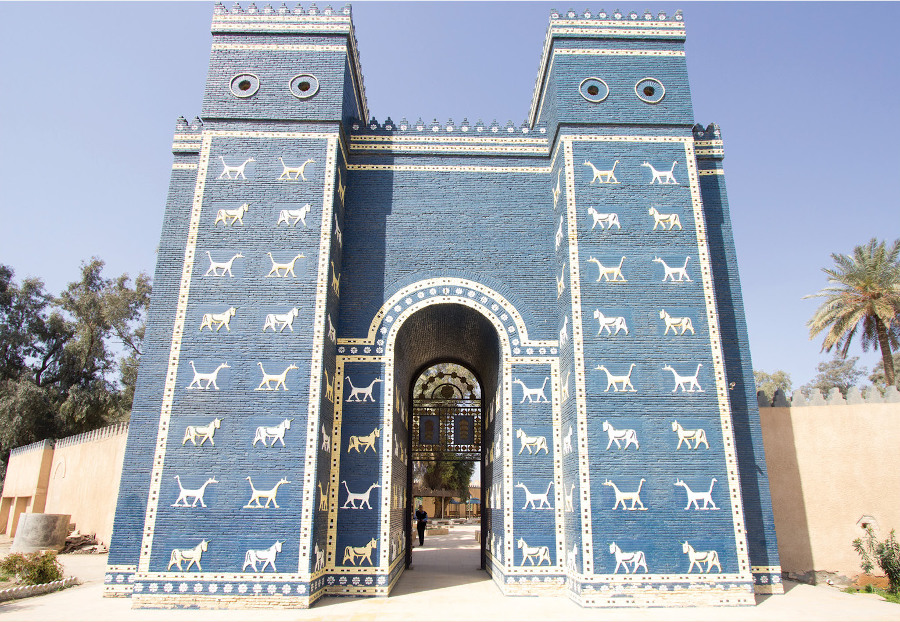
Reconstructed Ishtar Gate at the site of ancient Babylon in modern Iraq.
rasoulali/Shutterstock
Return to the main text.
2:2 magicians, enchanters, sorcerers. See Dt 18:9–14 and note on 18:9.
2:4 See NIV text note. Since the astrologers were of various ethnic and cultural backgrounds, they communicated in Aramaic, the language everyone understood. From here to the end of ch. 7 the entire narrative is in Aramaic. These six chapters deal with matters of importance to the Gentile nations of the Near East and were written in a language understandable to all. But the last five chapters (8–12) revert to Hebrew, since they deal with special concerns of the chosen people. your servants. Us.
2:10 no one on earth who can do what the king asks. But “God in heaven” can (through Daniel; see vv. 27–28).
2:11 do not live among humans. Are not readily accessible.
2:14 Arioch. Also the name of a Mesopotamian king who lived centuries earlier (Ge 14:1,9). wisdom and tact. See 1:12,20 and note on 1:12.
2:18 God of heaven. In this chapter this Persian title for a high god (see note on Ezr 1:2) is used to refer to Yahweh, the God of Israel. mystery. A key word in Daniel (vv. 19,27–30, 47; 4:9). It also appears often in the writings (Dead Sea Scrolls) of the Qumran sect (see article). The Greek equivalent is used in the NT to refer to the secret purposes of God that he reveals only to his chosen prophets and apostles (see notes on Ro 11:25; Rev 10:7).
2:21 He gives wisdom . . . to the discerning. See Pr 1:2–5 and note on 1:2.
2:22 light dwells with him. See Ps 36:9 and note; cf. 1Jn 1:5 and note.
2:29 the revealer of mysteries. God (v. 47).
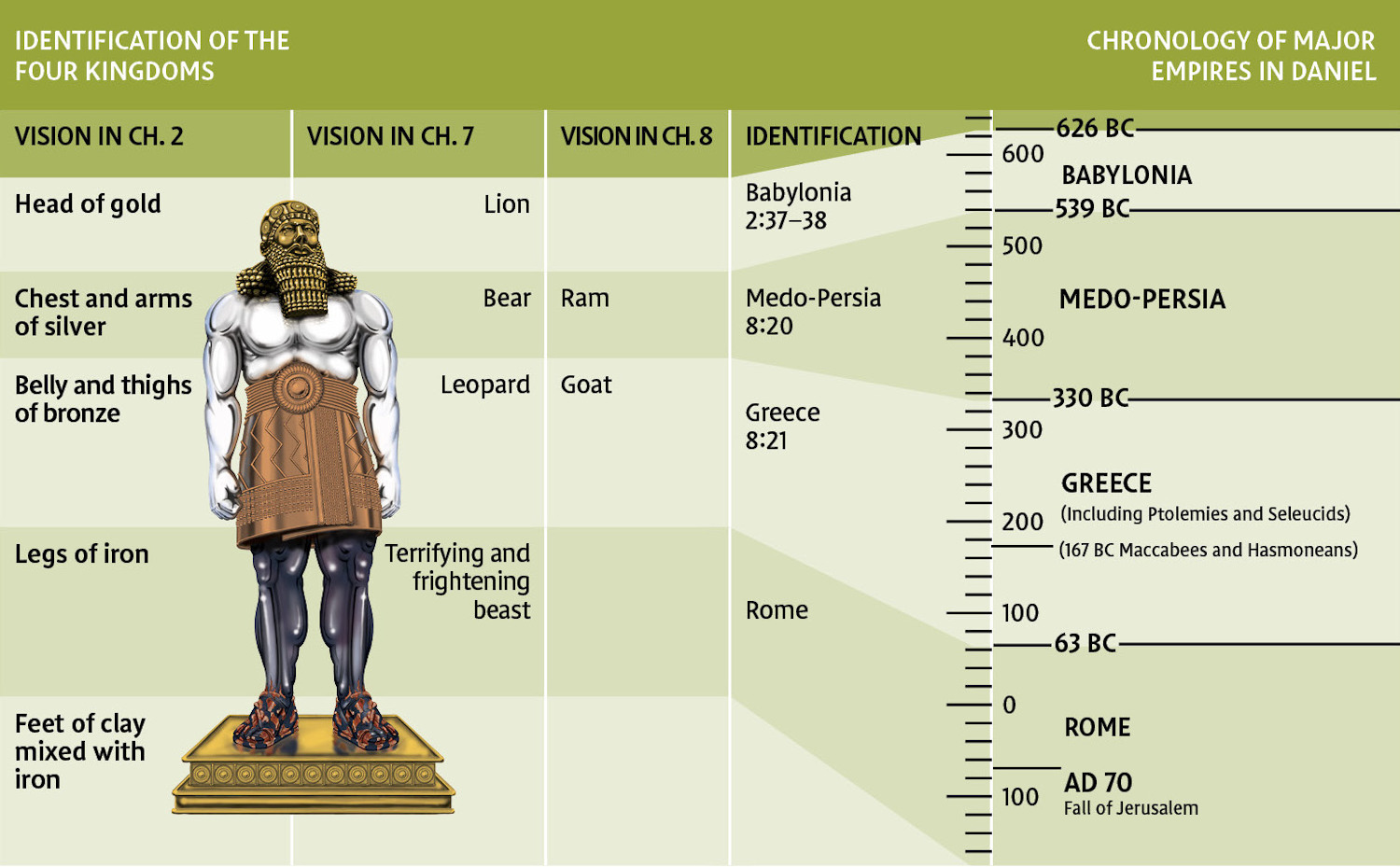
2:32–43 See maps here and here; see also chart. The gold head represents the Neo-Babylonian Empire (v. 38; see Jer 51:7 and note; see also map); the silver chest and arms the Medo-Persian Empire established by Cyrus in 539 bc (the date of the fall of Babylon); the bronze belly and thighs the Greek Empire established by Alexander the Great c. 330; the iron legs and feet the Roman Empire (in the Apocrypha, cf. 2 Esdras 12:11). The toes (v. 41) are understood by some to represent a later confederation of states occupying the territory formerly controlled by the Roman Empire. The diminishing value of the metals from gold to silver to bronze to iron represents the decreasing power and grandeur (v. 39) of the rulers of the successive empires, from the absolute despotism of Nebuchadnezzar to the democratic system of checks and balances that characterized the Roman senates and assemblies. The metals also symbolize a growing degree of toughness and endurance, with each successive empire lasting longer than the preceding one.
2:33 partly of iron and partly of baked clay. “Partly strong and partly brittle” (v. 42).
2:34–35 rock . . . filled the whole earth. See vv. 44–45 and note on v. 44.
2:35 broken to pieces. See Lk 20:18 and note.
2:37 king of kings. That is, the greatest king (cf. v. 47; Ezr 7:12 and note; 1Ti 6:15; Rev 17:14 and note; 19:16).
2:44 The fifth kingdom is the eternal kingdom of God (Rev 11:15), built on the ruins of the sinful empires of the world. Its authority will extend over “the whole earth” (v. 35) and ultimately over “a new heaven and a new earth” (Rev 21:1).
2:46 offering . . . be presented to him. As to a god (cf. Ac 14:12 and note).
2:48 Cf. the story of Joseph (Ge 41:41–43).
2:49 Daniel requests that his administrative authority be shared with his three Jewish friends.
3:1 image of gold. Large statues of this kind usually were not made of solid gold but were plated with gold. sixty cubits high. Including the lofty pedestal on which it no doubt stood (see NIV text note; cf. Est 5:14 and note). Dura. Either the name of a place now marked by a series of mounds (located a few miles south of Babylon) or a common noun meaning “walled enclosure.”
3:2 The seven classifications of government officials were to pledge full allegiance to the newly established empire as they stood before the image. The image perhaps represented the god Nabu, whose name formed the first element in Nebuchadnezzar’s name (see note on 2Ki 24:1).
3:4 every language. Nebuchadnezzar’s Babylon had become a cosmopolitan city whose population included people of many national and ethnic origins (v. 7).
3:5 The words for “zither,” “harp” and “pipe” (or perhaps “small drum”) are Greek loanwords in Daniel. Greek musicians and instruments are mentioned in Assyrian inscriptions written before the time of Nebuchadnezzar. See photos here, here, here, and here. fall down and worship the image. See Ex 20:4–5 and note on 20:4.
3:8 Jews. A shortened form of “Judahites” (see Zec 8:23 and note).
3:12 They neither serve your gods nor worship the image. They obeyed the word of God (Ex 20:3–5) above the word of the king.
3:15 what god will be able to rescue you from my hand? Such boastful taunts were characteristic of proud Mesopotamian rulers (see Isa 36:18–20 and note).
3:17 See vv. 26–27; Heb 11:34 and note. the God we serve is able to deliver us. But see NIV text note. is able. For what God is “able” to do, see, e.g., 4:37; 6:19–22 (cf. Ro 11:23; 2Co 9:8; Eph 3:20; Heb 7:25; Jude 24–25 and notes).
3:18 if he does not. Whether God decides to rescue them (v. 17) or not, their faith is fully resigned to his will.
3:19 seven times hotter than usual. Probably figurative for “as hot as possible” (seven signifies completeness).
3:25 See Ps 91:9–12. son of the gods. Nebuchadnezzar was speaking as a pagan polytheist and conceived of the fourth figure as a lesser heavenly being (“angel,” v. 28) sent by the all-powerful God of the Jews (see 6:22).
3:26 Most High God. Nebuchadnezzar had earlier acknowledged that Daniel’s God is “the God of gods and the Lord of kings” (2:47).
3:28 They trusted in him. See 6:23 and note; Ps 11; 16; 23; 31; 52; Pr 3:5 and note.
3:29 See 2:5. no other god can save. See Isa 40:18–20; 41:24; 44:17 and notes (cf. Jn 14:6 and note).
4:1–3 Nebuchadnezzar reached this conclusion after the experiences of vv. 4–33. The language of his confession may reflect Daniel’s influence.
The Neo-Babylonian Empire 626–539 bc
The Babylonians, while continuing the militaristic tradition of Assyria, created an astonishing renaissance of Sumero-Akkadian civilization. Led by Nebuchadnezzar (605–562 bc), the Neo-Babylonian Empire carried out a building program of canals and monuments that was ambitious in the extreme.
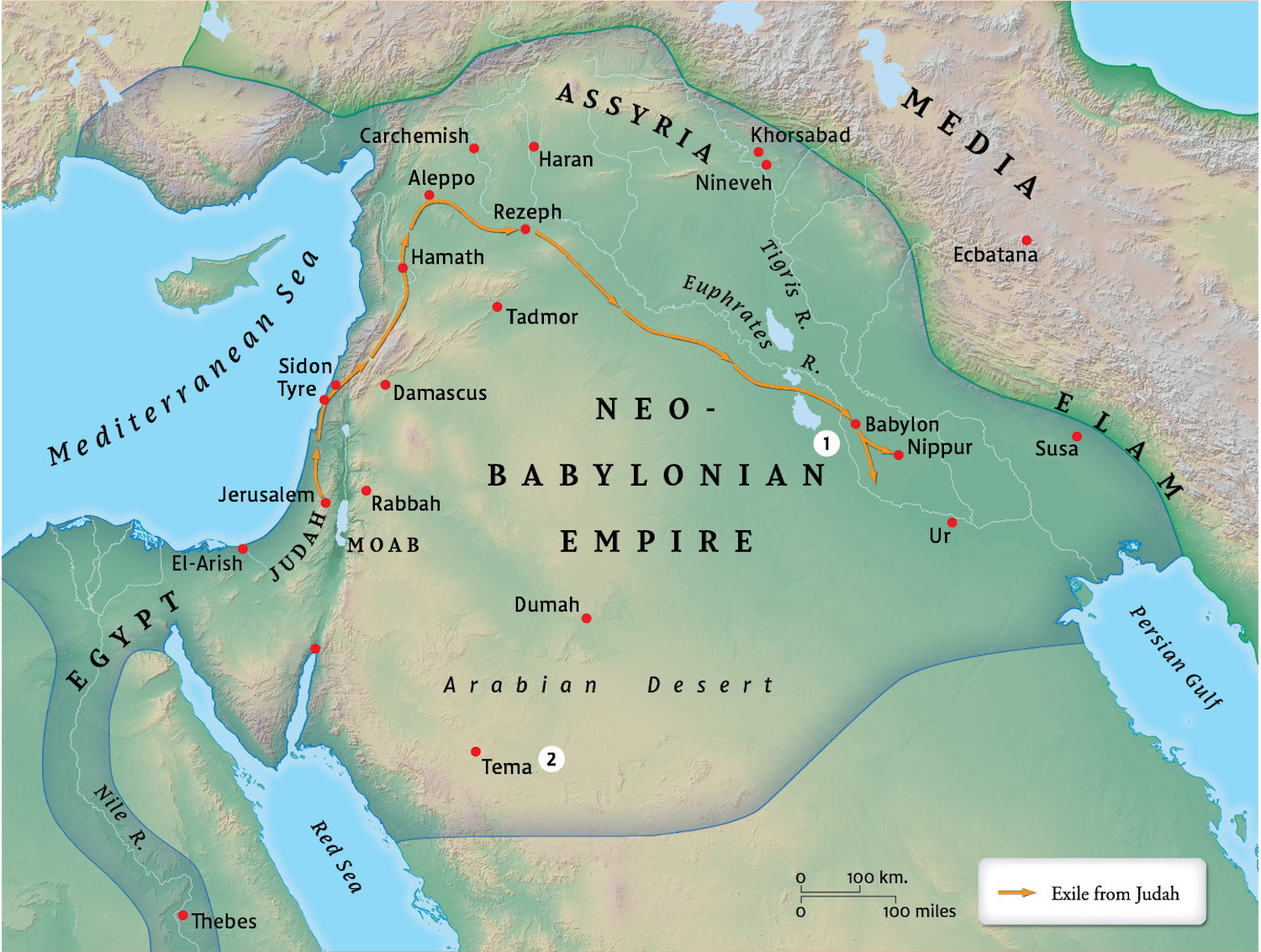
➊ Early Greek and Roman authors rhapsodized about the capital city astride the Euphrates. A four-horse chariot could turn atop the high hundred-gated walls. Babylon also boasted one of the world’s seven wonders, the famed hanging gardens, as well as a stepped temple-tower 295 feet high and, according to Herodotus, several colossal gold statues weighing many tons.
➋ Discoveries of inscriptions in clay have shown that the last king of Babylonia, Nabonidus, absented himself at Tema in Arabia while Belshazzar acted as regent in the capital (ch. 5).
Go to the Maps Index.
4:3 His kingdom . . . from generation to generation. See v. 34 and note.
4:7 magicians . . . diviners. Condemned in Dt 18:9–13 (see note on 18:9).
4:8 after the name of my god. See note on 1:7. Bel (“lord”) was a title for Marduk, chief god of the Babylonian pantheon and Nebuchadnezzar’s personal god and so his favorite god.
4:9 chief of the magicians. See 2:48.
4:10 tree. Interpreted in v. 22.
4:11 grew large and strong. In one of Nebuchadnezzar’s building inscriptions, Babylon is compared to a spreading tree (cf. v. 22). its top touched the sky. Hyperbole; a phrase often used of Mesopotamian temple-towers (see Ge 11:4 and note).
4:13 messenger. Angel (but see NIV text note).
4:15 let the stump . . . remain. Implies that the tree will be revived later (v. 26). him. The tree is here personified and later identified (v. 22).
4:16 seven. Signifies completeness (i.e., a full measure). times. See NIV text note; see also 7:25 and NIV text note. Alternatively, “times” can refer to indefinite periods.
4:17 messengers. The agents of God, who is the ultimate source of the “decision” (v. 24). the Most High is sovereign. See Introduction: Theological Theme.
4:19 Daniel . . . was greatly perplexed. Possibly over how to state the interpretation in an appropriate way, or, more likely, because of the implications of the dream for the king, the Jews in captivity and himself. My lord, if only . . . adversaries! Daniel prepared the king to fear the worst.
4:22 Your Majesty, you are that tree! Cf. 2:37–38. your dominion extends . . . the earth. Nebuchadnezzar’s empire was the largest and most powerful in that part of the world up to that time (see map).
4:25 eat grass like the ox. Nebuchadnezzar was possibly stricken with a rare mental illness (v. 34) known as boanthropy, which causes its victims to assume the appearance, habits and posture of cattle (v. 33). acknowledge that the Most High is sovereign. He will soon learn that lesson (compare v. 30 with v. 37).
4:26 Heaven. A Jewish way of referring to God, later reflected in the NT expression “kingdom of heaven” (compare, e.g., Mt 5:3 with Lk 6:20).
4:28 All this happened. But only because Nebuchadnezzar did not follow Daniel’s “advice” (v. 27).
4:30 great Babylon. Illustrated, e.g., in the city’s ramparts, temples and hanging gardens (see note on Isa 13:19; see also map and photo).
4:31 as the words were on his lips. See Lk 12:19–20.
4:33 what had been said . . . was fulfilled. See Pr 11:2 and note; 16:18. driven away. Possibly into the palace gardens. His counselors, perhaps led by Daniel (2:48–49), could have administered the kingdom efficiently.
4:34 At the end of that time. Perhaps as much as seven years (see v. 16 and note). my sanity was restored. Cf. Lk 15:17. I honored and glorified him. Contrast v. 30. His dominion . . . from generation to generation. Nebuchadnezzar returns to the grand theme with which he began (see v. 3; see also 6:26; 7:14).
4:37 everything he does is right and . . . just. See notes on Ps 119:121; Eze 18:25. those who walk in pride he is able to humble. See Pr 3:34; Jas 4:6, 10; 1Pe 5:5–6. “Pride goes before a fall” (cf. Pr 16:18).
5:1–4 The revelry and blasphemy on such occasions are mentioned also by the ancient Greek historians Herodotus and Xenophon.
5:1 King. Belshazzar (meaning “Bel, protect the king!”) was the son and viceroy of Nabonidus (see chart). He is called the “son” of Nebuchadnezzar (v. 22), but the Aramaic term could also mean “grandson” or “descendant” or even “successor” (see NIV text note on v. 22). See also note on v. 10 and NIV text note on v. 2.
5:2 gold . . . that Nebuchadnezzar . . . had taken from the temple. In the eighth year of his reign (597 bc; see 2Ki 24:12–13 and note on 24:12).
5:5 Suddenly. See 4:31; see also Pr 29:1; 1Th 5:3 and notes; cf. Lk 12:19–20.
5:7 third highest ruler in the kingdom. Nabonidus was first, Belshazzar second (see last notation on map).
5:10 queen. See NIV text note. She could have been (1) the wife of Nebuchadnezzar, (2) the daughter of Nebuchadnezzar and wife of Nabonidus or (3) the wife of Nabonidus but not the daughter of Nebuchadnezzar.
5:11 the time of your father. Nebuchadnezzar had died in 562 bc; the year is now 539.
5:16 third highest ruler. See v. 7 and note.
5:17 keep your gifts for yourself. See Ge 14:23; 2Ki 5:16 and notes.
5:21 He was . . . given the mind of an animal. See 4:25 and note. until he acknowledged. See note on 4:25. the Most High God is sovereign over all kingdoms on earth. See Introduction: Theological Theme.
5:22–23 Three charges were brought against Belshazzar: (1) He sinned through disobedience and pride, not through ignorance (v. 22); (2) he defied God by desecrating the sacred vessels (v. 23a); and (3) he praised idols and so did not honor God (v. 23b).
5:23 The stark contrast between the false gods of the nations and the one true God is a pervasive theme in the Prophets (see, e.g., 3:29 and note; Isa 41:5–10; 44:6–23; Jer 10:1–16; Eze 8–9; Hos 13:1–8; Hab 2:18–20; see also Ps 115:2–8; 135:15–18).
5:24 he sent the hand. Daniel waits until the last moment before informing the king that God himself is the source of the inscription.
5:26–28 See NIV text notes. Three weights (mina, shekel and half mina/shekel) may be intended, symbolizing three rulers (respectively): (1) Nebuchadnezzar, (2) either Awel-Marduk (see 2Ki 25:27 and note) or Nabonidus, and (3) Belshazzar.
5:27 weighed on the scales. Measured in the light of God’s standards (see Job 31:6 and note; Ps 62:9; see also model).
5:28 divided . . . Persians. Daniel employs a telling wordplay (see NIV text note). Medes and Persians. The second kingdom of the series of four predicted in ch. 2 (see Introduction: Author, Date and Authenticity; see also chart).
5:29 gold chain was placed around his neck. As a symbol of authority (see Ge 41:42 and note).
5:30 That very night. See v. 5; Pr 6:15 and notes; Lk 12:20.
5:31 Darius the Mede. A difficulty, since Cyrus conquered the Neo-Babylonian Empire. Perhaps Darius was another name for Gubaru, referred to in Babylonian inscriptions as the governor that Cyrus put in charge of the newly conquered Babylonian territories. Or “Darius the Mede” may have been Cyrus’s throne name in Babylon (see NIV text note on 6:28; see also 1Ch 5:26 and note), since Darius’s age of 62 fits Cyrus’s age at this time and Cyrus’s mother was a Mede. took over the kingdom. In 539 bc. The “head of gold” (2:38) is now no more, as predicted in 2:39.
6:7 The conspirators lied in stating that “all” the royal administrators supported the proposed decree since they knew that Daniel (totally unaware of the proposal) was the foremost of the three administrators. lions’ den. A pit with a relatively small opening at the top (v. 17), making it impossible for a prisoner to escape.
6:8,12 law of the Medes and Persians, which cannot be repealed. See v. 15; see also notes on Est 1:19; 8:8.
6:10 toward Jerusalem. See 2Ch 6:38–39. Three times a day. Cf. Ps 55:17. prayed . . . just as he had done before. Not even the threat of death could keep Daniel from honoring his customary times of prayer to “his God.”
6:13 pays no attention to you. But see vv. 22,24.
6:16 serve continually. See 1Co 15:58 and note.
6:18 he could not sleep. See 2:1; Est 6:1 and note.
6:20 has your God . . . been able to rescue you . . . ? See 3:17 and note.
6:22 shut the mouths of the lions. See Heb 11:33 and note.
6:23 no wound was found on him. See 3:27. he . . . trusted in his God. That the lions were ravenously hungry (v. 24) was no obstacle to the Lord’s rewarding Daniel’s faith by saving his life (see 3:28 and note). See photo.
6:24 thrown into the lions’ den. A good example of the law of retaliation (“eye for eye”; see Ex 21:23–25 and note). along with their wives and children. In accordance with Persian custom (cf. Jos 7:24 and note).
6:28 See NIV text note; see also photo.
7:1 first year of Belshazzar. Probably 553 bc. The events of ch. 7 preceded those of ch. 5.
7:2 the great sea. The world of nations and peoples (see also vv. 3,17; cf. Rev 17:15).
7:4–7 The lion with an eagle’s wings symbolizes the Neo-Babylonian Empire (see Ge 3:24 and note). The rest of v. 4 perhaps reflects the humbling of Nebuchadnezzar, as recorded in ch. 4. The bear (v. 5), “raised up on one of its sides,” refers to the superior status of the Persians in the Medo-Persian alliance. The three ribs may represent its three principal conquests: Lydia (546 bc), Babylon (539) and Egypt (525). The leopard with four wings (v. 6) represents the speedy conquests of Alexander the Great (334–330), and the four heads correspond to the four main divisions into which his empire fell after his untimely death in 323 (8:22): Macedon and Greece (under Antipater and Cassander), Thrace and Asia Minor (under Lysimachus), Syria (under Seleucus I), and Egypt (under Ptolemy I; see chart). The fourth beast (v. 7), with its irresistible power surpassing all its predecessors, points to the Roman Empire (cf. 11:30 and note; in the Apocrypha, see 2 Esdras 12:11). Its ten horns correspond to the ten toes of 2:41–42 (see note on 2:32–43).
7:7 iron. See 2:40–43 and note on 2:32–43. ten horns. Indicative of the comprehensiveness of the beast’s sphere of authority (see note on 1:12).
7:8 another horn, a little one. The antichrist, or a world power sharing in the characteristics of the antichrist. mouth that spoke boastfully. See 11:36; 2Th 2:4 and notes; Rev 13:5–6.
7:9 Ancient of Days. God. hair of his head was white like wool. See Rev 1:14 and note. throne . . . wheels. See Eze 1:15–21,26–27.
7:10 Thousands . . . ten thousand. See 1Sa 18:7 and note. court was seated . . . books were opened. John echoes the language of this judgment scene in Rev 20:12.
7:13 like a son of man. See Mk 8:31 and note; Rev 1:13. son of man. A description of the Messiah. “Son of man” is an idiomatic expression meaning “human being.” But this figure is “like” a human being and yet rides on the clouds, indicating his divinity (cf. Ps 68:4; 104:3–4; Isa 19:1; Nah 1:3), and has unhindered access to the Ancient of Days. Jesus later applies the term to himself (e.g., Mt 24:30; 26:64). The figure here will be enthroned as ruler over the whole earth (previously misruled by the four human kingdoms that oppose God’s kingdom), and his kingdom “will never be destroyed” (v. 14), whether on earth or in heaven (see v. 27 and note). coming with the clouds of heaven. See Mk 14:62 and note; Rev 1:7.
7:16 one of those standing there. An angel.
7:17 four kings. See 2:38–40 and note on 2:32–43. the earth. The world of nations and peoples—referred to as “the (great) sea” in vv. 2–3.
7:18 holy people. Exalted privileges will be enjoyed by Christ’s followers in the Messianic kingdom (see Mt 19:28–29; see also Lk 22:29–30; Rev 1:6; 20:2–6 and notes). will receive the kingdom. Because the holy people share the privileges of the kingdom along with the son of man (v. 14), the son of man appears to be both an individual person and a collective figure for Israel (representing God’s people). This points forward to Jesus, the Son of Man, and the church as the “body of Christ” (see vv. 22,27 and note on v. 27).
7:21 waging war against the holy people. Israel, as the collective son of man, must suffer. So too Jesus, the individual Son of Man, will suffer on behalf of his people.
7:24 ten kings. All the political powers (see note on 1:12; see also Rev 17:12–14) that will arise out of the fourth kingdom—not necessarily simultaneously (but see 2:44 [“In the time of those kings”] and note). three kings. Some of the ten. Three often signified a small, indefinite number (see Ex 3:18 and note).
7:25 He. See v. 8 and note. a time, times and half a time. See NIV text note.
7:27 handed over to the holy people. For their benefit. God and the Messiah will rule, as the last sentence in the verse makes clear (see v. 14 and note on v. 13; see also Rev 19–22).
8:1—12:13 These chapters are written in Hebrew (see note on 2:4).
8:1 third year. About 551 bc. The events of ch. 8 preceded those of ch. 5. after the one that had already appeared to me. Two years earlier (see 7:1 and note).
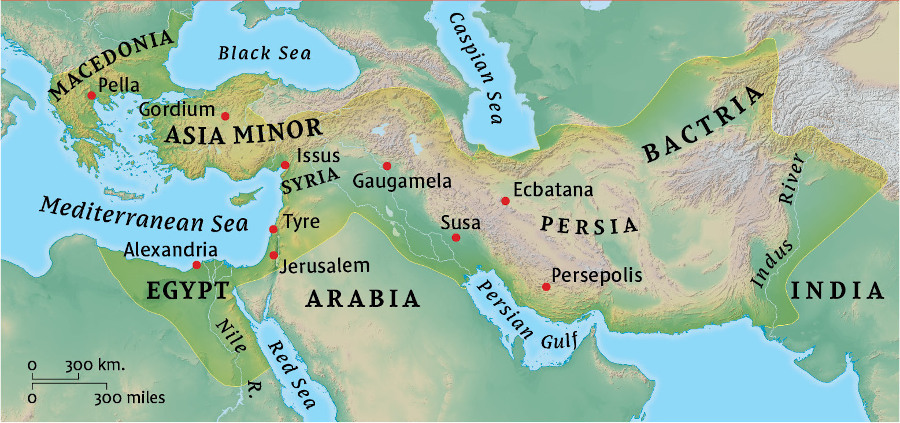
8:2 citadel of Susa . . . Elam. See notes on Ezr 4:9; Est 1:2; see also map.
8:3 The ram represents the Medo-Persian Empire (v. 20). The longer of his two horns reflects the predominant position of Persia (see 7:5 and note on 7:4–7).
8:5 The rapidly charging goat is Greece, and the “prominent horn” is Alexander the Great, “the first king” (v. 21; see chart; see also map).
8:7 shattering its two horns. Greece crushes Medo-Persia.
8:8 large horn was broken off. The death of Alexander the Great at the height of his power (323 bc). four prominent horns. Equivalent to the “four heads” of 7:6 (see note on 7:4–7).
8:9–12 “Another horn” (v. 9) emerges not from the ten horns belonging to the fourth kingdom (as in 7:8) but rather from one of the four horns belonging to the third kingdom. The horn that “started small” is Antiochus IV Epiphanes, who during the last few years of his reign (168–164 bc) made a determined effort to destroy the Jewish faith. He in turn served as a type of the even more ruthless beast of the last days (the antichrist), who is also referred to in 7:8 as a “little” horn (for this pattern [type-antitype], see note on 11:6). Antiochus was to extend his power over Israel, “the Beautiful Land” (v. 9; see Jer 3:19 and note), and defeat the godly believers there (referred to as “the host of the heavens,” v. 10; see also v. 12), many of whom died for their faith. Then he set himself up to be the equal of “the commander of the army of the LORD” (v. 11) and ordered the daily sacrifices to end. Eventually the army of Judas Maccabeus recaptured Jerusalem and rededicated the temple (v. 14) to the Lord (December, 165)—the origin of the Festival of Hanukkah (see Jn 10:22 and note), still celebrated by Jews today (in the Apocrypha, see 1 Maccabees 1–4; see also here).
8:13 a holy one. An angel.
8:14 There were two daily sacrifices for the continual burnt offering (see 9:21; Ex 29:38–39 and note), representing the atonement required for Israel as a whole. The “2,300 evenings and mornings” probably refer to the number of sacrifices consecutively offered on 1,150 days, the approximate interval between the desecration of the Lord’s altar by Antiochus Epiphanes and its reconsecration by Judas Maccabeus on Kislev 25, 165 bc.
8:16 Gabriel. One of two named angels in the Bible (see Lk 1:19 and note); the other is Michael (see note on 12:1).
8:17 Son of man. Referring to Daniel as a mere human being, as also throughout Ezekiel, and not to be confused with the “one like a son of man” in 7:13 (see note there; see also note on Eze 2:1).
8:23–25 A description of Antiochus IV and his rise to power by intrigue and deceit (he was not the rightful successor to the Seleucid throne).
8:25 consider himself superior. Antiochus IV called himself Epiphanes (“God manifest”). Others, however, referred to him as Epimanes (“madman”) because of his erratic behavior (Polybius, Histories, 26.1–14). Prince of princes. God. destroyed, but not by human power. Antiochus died in 164 bc at Tabae in Persia through illness or accident; God “destroyed” him (cf. 9:27; 11:45; Rev 19:20).
8:26 vision of the evenings and mornings. See v. 14 and note.
9:1 first year. 539–538 bc. Darius . . . a Mede. See 5:31 and note. Xerxes. See NIV text note; not the later Xerxes of the book of Esther.
9:2 Jeremiah . . . seventy years. See notes on Jer 25:11–12; 29:10.
9:3–19 Daniel’s prayer contains expressions of humility (v. 3), worship (v. 4), confession (vv. 5–15) and petition (vv. 16–19). See similar prayers in Ezr 9:5–15; Ne 9:5–37 (see note there).
9:3 sackcloth and ashes. See notes on Ge 37:34; Rev 11:3.
9:4 who keeps his covenant of love. See Dt 7:9,12 and note. who love him and keep his commandments. See Ne 1:5; cf. Ex 20:6 and note.
9:6 your servants the prophets. See v. 10; see also Jer 7:25; Zec 1:6 and notes.
9:7 scattered us because of our unfaithfulness. See 2Ki 17:7–23 and note; 2Ch 36:15–20.
9:11 curses . . . written in the Law. See Lev 26:33; Dt 28:64 and note.
9:12 disaster. Disobedience brings disaster (vv. 11,13–14).
9:14 the LORD our God is righteous. See Ps 4:1; Jer 12:1; 1Jn 4:8 and notes.
9:18 city that bears your Name. Jerusalem (1Ki 11:36; cf. Ps 132:13 and note; see Jer 25:29 and note). Name. See Dt 12:5 and note. because of your great mercy. God answers prayer because of his grace, not because of our works.
9:20 While I was speaking. See Isa 65:24. holy hill. Zion (see Ps 2:6 and note).
9:21 Gabriel. See 8:16 and note. evening sacrifice. See note on Ps 141:2.
9:24 ‘sevens.’ Probably seven-year periods of time, making a total of 490 years, but some take the numbers as symbolic of a complete period of time. Of the six purposes mentioned (all to be fulfilled through the Messiah), some believe that the last three were not achieved by the crucifixion and resurrection of Christ but await his further action: the establishment of everlasting righteousness (on earth), the complete fulfillment of vision and prophecy and the anointing of the “Most Holy Place.”
9:27 He will confirm a covenant . . . will put an end to sacrifice. According to some, a reference to the Messiah’s (“the Anointed One,” v. 26) instituting the new covenant and putting “an end” to the OT sacrificial system; according to others, a reference to the antichrist’s (“the [ultimate] ruler who will come,” v. 26) making a treaty with the Jews in the future and then disrupting their system of worship. abomination that causes desolation. See note on 11:31.
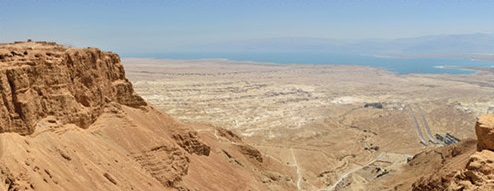
Daniel’s mysterious reference to “70 sevens” (or “70 weeks”) has been a topic of great curiosity and much speculation. According to Da 7:25, the time between the decree authorizing the rebuilding of Jerusalem (v. 25) and the coming of the Messiah (“the Anointed One”) was to be 7 “sevens” plus 62 “sevens,” a total of 69 “sevens.” While some scholars view these “sevens” as merely a symbol representing a complete or perfect period of time, others see them as a code pointing to the number of years before the coming of the Messiah. Most who take this latter view consider these “sevens” to be weeks of years (= 7 years). Sixty-nine of them would be a total of 483 years (see note on Ezr 7:11). The first 7 “sevens’ ” (= 49 years) may refer to the period of the complete restoration of Jerusalem (partially narrated in Ezra and Nehemiah). The 62 “sevens” would then refer to the period between that restoration and the Messiah’s coming to Israel.
There were various decrees under the Medo-Persian kings Cyrus, Darius and Artaxerxes (Ezra 1:1, 2; 4:1–5; 7:11–13,20,27; Neh. 2:1–8) and so various possible starting dates. All bring us close to the time of Christ. For example, the first decree of Artaxerxes was in 457 bc. Adding 483 years takes us to ad 27, viewed by many scholars as the year Jesus’ ministry began—a remarkable prophecy! The cutting off of the Anointed One (v. 26) would then refer to the crucifixion of Christ.
The final (70th) “seven,” not mentioned specifically until v. 27, is the most puzzling. It follows the prophecy of the destruction of Jerusalem by “the people of the ruler who will come,” probably a reference to Titus’s destruction of Jerusalem in ad 70. What is this 70th week? (1) Some claim that the 70th “seven” was fulfilled during Christ’s earthly ministry and the years immediately following. (2) Others conclude that it occurs in the last days of history. According to this view, there is an indeterminate interval between the 69th and the 70th “seven”—a period of “war” and “desolation” (v. 26)—and the 70th “seven” is the final seven-year period of the Tribulation just before the Second Coming of Christ. The little horn or beast of the last days (referred to here as the one who sets up an “abomination that causes desolation”) will establish a covenant for seven years with the Jews (the “many”) but will violate the covenant halfway through that period (but see also note on v. 27). The last half (3 ½ years) of the seven years is known as the Great Tribulation, after which Christ will return to establish his kingdom (cf. Mt 24; Rev 6–18; 12:6,13,14; 13:4–7; 19:1—20:15, cf. 2Th 2:3–12).
Go to the Articles Index.
10:1 third year of Cyrus. 537 bc. This is the third year after his conquest of Babylon in 539 (see note on 1:1).
10:3 See 1:8–16 and note on 1:8.
10:5–6 See 7:9; Rev 1:12–16 and notes.
10:13 prince of the Persian kingdom. Apparently a demon exercising influence over the Persian realm (see also v. 20 and note). His resistance was finally overcome by the archangel Michael, “the great prince who protects” the people of God (12:1). Michael is one of two named angels in the Bible (Jude 9; Rev 12:7); the other is Gabriel (see note on 8:16).
10:14 what will happen to your people in the future. See chs. 11–12.
10:16 touched my lips, and I . . . began to speak. See Isa 6:7; Jer 1:9 and notes.
10:20 prince of Greece. See note on v. 13. This spiritual power will also have to be opposed.
10:21 Book of Truth. See 12:1; perhaps a reference to God’s book of the destinies of all human beings (see Ex 32:32; Ps 69:28 and notes).
11:1 Darius the Mede. See note on 5:31. The Septuagint (the pre-Christian Greek translation of the OT) reads “Cyrus the King” here, attesting to a very old pedigree for this interpretation of Darius the Mede.
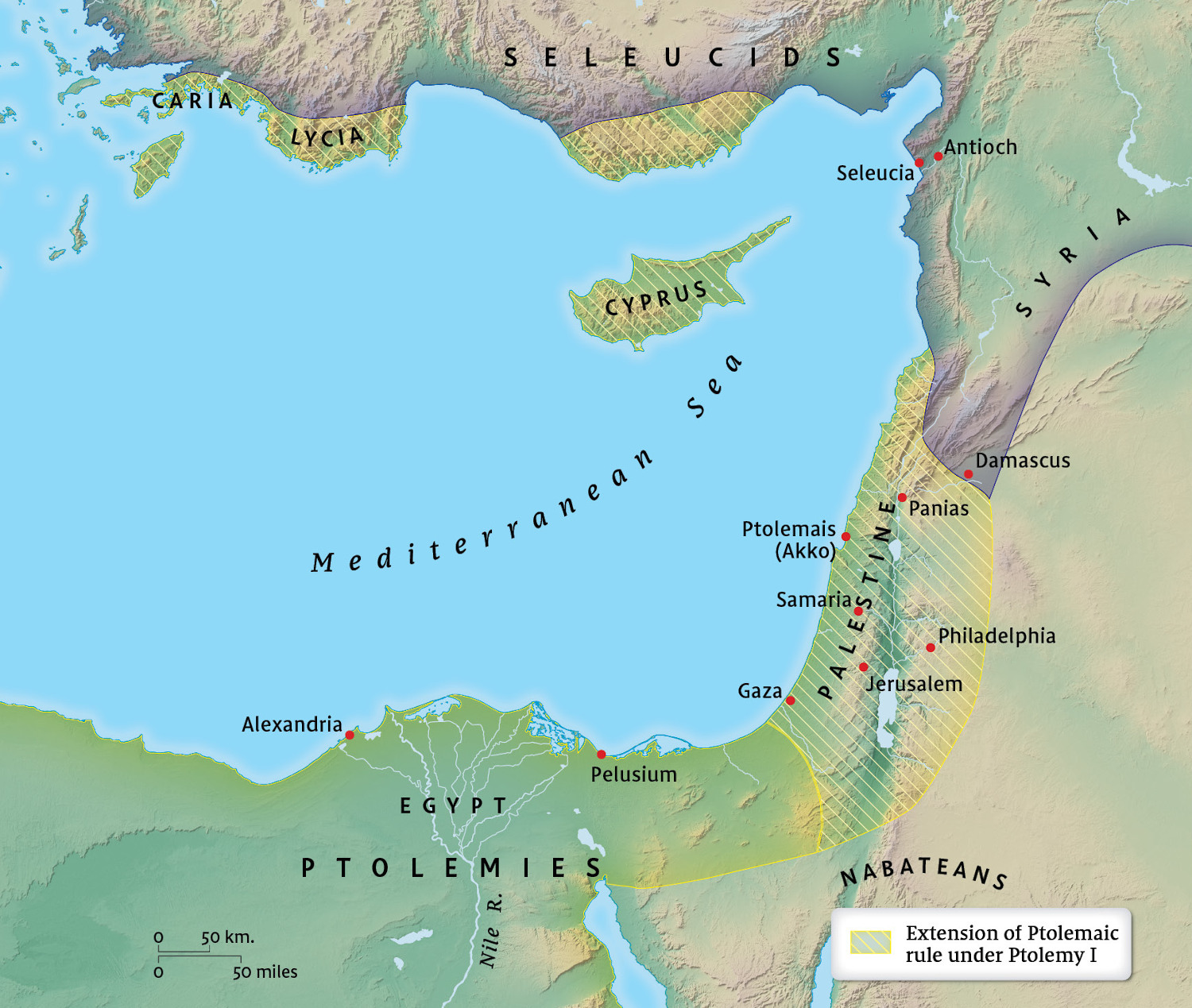
Soon after the death of Alexander the Great in 323 bc, his generals divided his empire into four parts, two of which—Egypt and Syria—were under the rule of the Ptolemies and Seleucids respectively. The Holy Land was controlled from Egypt by the Ptolemaic dynasty from 323 to 198, and was subsequently governed by the Seleucids of Syria from 198 to 142.
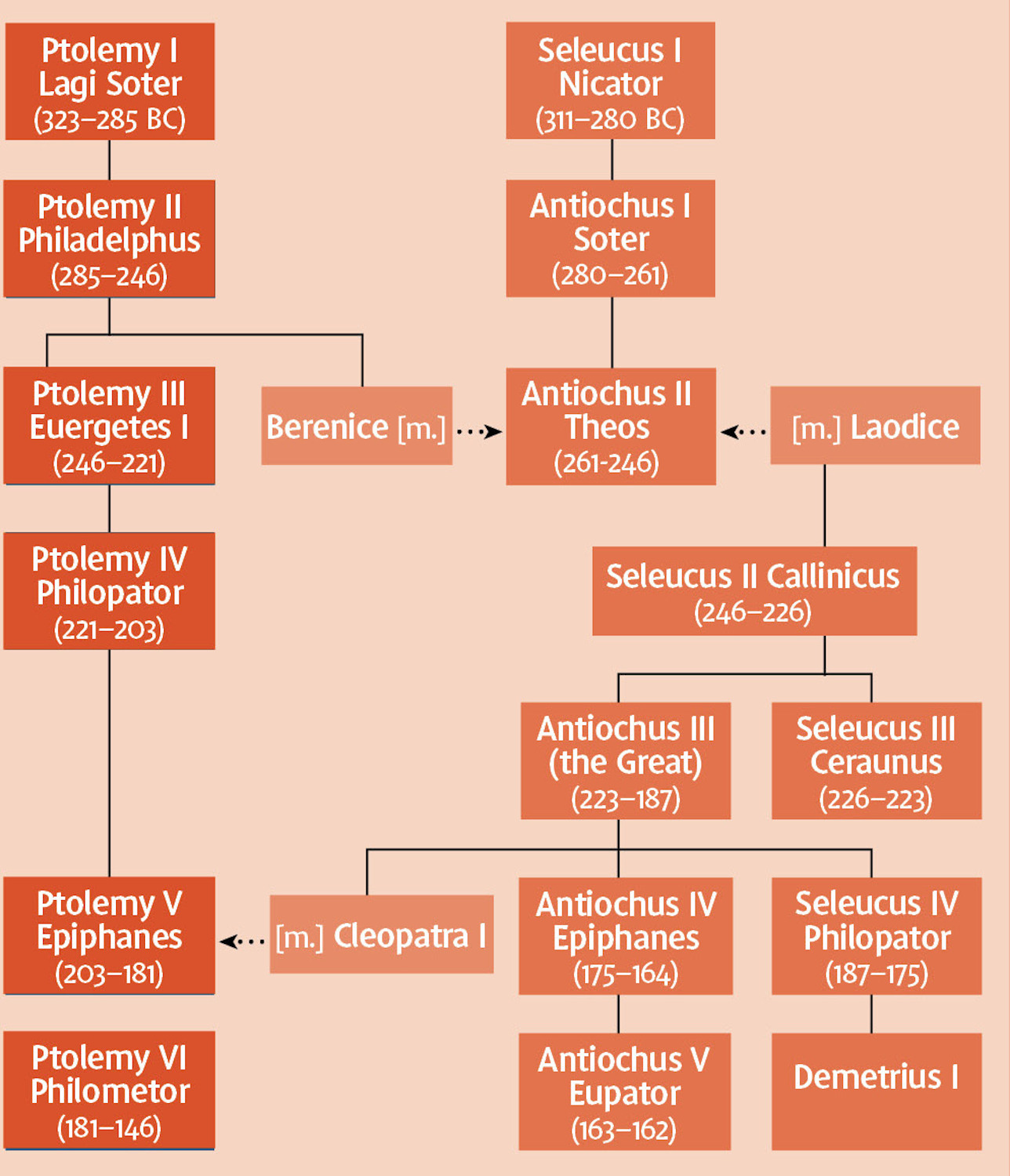
The Diadochi, as the successors of Alexander were called, struggled bitterly for power over his domain. At first Ptolemy I seized his own satrapy, Egypt and North Africa, which had splendid resources and natural defense capabilities. Seleucus gained Syria and Mesopotamia, and by 301 Lysimachus held Thrace and Asia Minor while Cassander ruled Macedon. The situation changed again by 277, when only three major Hellenistic kingdoms stabilized in Egypt, in Syria, and in Macedonia under the Antigonids (277–168). Each continued until the eventual triumph of Rome.
Daniel 11 treats the “king of the South” and the “king of the North,” describing their conflicts, wars and alliances. Their hostility toward the people of God culminated in the “abomination that causes desolation” (11:31), identified historically with the reign of Antiochus IV Epiphanes (175–164). The Maccabean revolt followed, leading eventually to the founding of the Hasmonean dynasty.
Continued political rivalries in Judea brought the intervention of the Roman general Pompey in 63 bc. This event signaled the end of Jewish political independence, except for periods of brief autonomy during the ill-fated revolts of the first and second Christian centuries.
Go to the Maps Index.
11:2 Three more kings. Cambyses (530–522 bc), Pseudo-Smerdis or Gaumata (522) and Darius I (522–486). fourth. Xerxes I (486–465; see note on Est 1:1), who attempted to conquer Greece in 480.
11:3 mighty king. Alexander the Great (336–323).
11:4 four winds. See 7:2–3 and note on 7:4–7 (four heads).
11:5 king of the South. Ptolemy I Soter (323–285 bc) of Egypt (see chart and map). one of his commanders. Seleucus I Nicator (311–280). his own kingdom. Initially Babylonia, to which he then added extensive territories both east and west.
11:6 daughter of the king of the South. Berenice, daughter of Ptolemy II Philadelphus (285–246 bc) of Egypt. king of the North. Antiochus II Theos (261–246) of Syria. alliance. A treaty cemented by the marriage of Berenice to Antiochus. she will not retain her power, and he . . . will not last. Antiochus’s former wife, Laodice, conspired to have Berenice and Antiochus put to death. her father. Berenice’s father, Ptolemy, died at about the same time.
11:7 One from her family line. Berenice’s brother, Ptolemy III Euergetes (246–221 bc) of Egypt, who did away with Laodice. king of the North. Seleucus II Callinicus (246–226) of Syria. his fortress. Either (1) Seleucia (see Ac 13:4 and note), which was the port of Antioch, or (2) Antioch itself.
11:8 their gods. Images of Syrian deities, and also of Egyptian gods that the Persian Cambyses had carried off after conquering Egypt in 525 bc.
11:10 His sons. Seleucus III Ceraunus (226–223 bc) and Antiochus III (the Great) (223–187), sons of Seleucus II. his fortress. Ptolemy’s fortress at Raphia (southwest of Gaza).
11:11 king of the South. Ptolemy IV Philopator (221–203 bc) of Egypt. king of the North. Antiochus III. defeated. At Raphia in 217.
11:12 slaughter many thousands. The Greek historian Polybius records that Antiochus lost nearly 10,000 infantrymen at Raphia.
11:14 king of the South. Ptolemy V Epiphanes (203–181 bc) of Egypt. Those who are violent among your own people. Jews who joined the forces of Antiochus. without success. The Ptolemaic general Scopas crushed the rebellion in 200.
11:15 fortified city. The Mediterranean port of Sidon.
11:16 The invader. Antiochus, who was in control of the Holy Land by 197 bc. Beautiful Land. See note on 8:9–12.
11:17 he will give him a daughter in marriage. Antiochus gave his daughter Cleopatra I in marriage to Ptolemy V in 194 bc.
11:18 he. Antiochus. coastlands. Asia Minor and perhaps also mainland Greece. commander. The Roman consul Lucius Cornelius Scipio Asiaticus, who defeated Antiochus at Magnesia in Asia Minor in 190 bc.
11:19 stumble and fall. Antiochus died in 187 bc while attempting to plunder a temple in the province of Elymais.
11:20 His successor. Seleucus IV Philopator (187–175 bc), son and successor of Antiochus the Great. tax collector. Seleucus’s finance minister, Heliodorus. he will be destroyed. Seleucus was the victim of a conspiracy engineered by Heliodorus.
11:21 contemptible person. Seleucus’s younger brother, Antiochus IV Epiphanes (175–164 bc). not been given the honor of royalty. Antiochus seized power while the rightful heir to the throne, the son of Seleucus (later to become Demetrius I), was still very young. kingdom. Syro-Palestine.
11:22 prince of the covenant. Either the high priest Onias III, who was murdered in 170 bc, or, if the Hebrew for this phrase is translated “confederate prince,” Ptolemy VI Philometor (181–146) of Egypt.
11:23 he. Antiochus.
11:24 richest provinces. Either of the Holy Land or of Egypt. fortresses. In Egypt.
11:25 king of the South. Ptolemy VI.
11:26 his army. Ptolemy’s.
11:27 two kings. Antiochus and Ptolemy, who was living in Antiochus’s custody.
11:28 against the holy covenant. In 169 bc Antiochus plundered the temple in Jerusalem, set up a garrison there and massacred many Jews in the city.
11:30 Ships of the western coastlands. Roman vessels under the command of Popilius Laenas. those who forsake the holy covenant. Apostate Jews (see also v. 32).
11:31 abomination that causes desolation. See 9:27; 12:11; the altar to the pagan god Zeus Olympius, set up in 168 bc by Antiochus Epiphanes and prefiguring a similar abomination that Jesus predicted would be erected in the future (see Mt 24:15; Lk 21:20 and notes).
11:33 Those who are wise. The godly leaders of the Jewish resistance movement, also called the Hasidim. fall by the sword or be burned or captured or plundered. See Heb 11:36–38.
11:34 a little help. The early successes of the guerrilla uprising (167 bc) that originated in Modein, 17 miles northwest of Jerusalem, under the leadership of Mattathias and his son Judas Maccabeus. In December, 165, the altar of the temple was rededicated (see here).
11:35 time of the end. See v. 40; 12:4,9. Daniel concludes his predictions about Antiochus Epiphanes and begins to prophesy concerning the more distant future.
11:36 From here to the end of ch. 11 the antichrist (see notes on 7:8; 8:9–12; 9:27) is in view. The details of this section do not fit what is known of Antiochus Epiphanes. See 2Th 2:3–4 and notes; cf. Rev 13:5–8.
11:37 the one desired by women. Usually interpreted as either Tammuz (see Eze 8:14 and note) or the Messiah (see Hag 2:7 and note).
11:40–45 Many feel that these verses speak of conflicts to be waged between the antichrist and his political enemies. He will meet his end “at the beautiful holy mountain” (v. 45), Jerusalem’s temple mount, perhaps in connection with the battle of Armageddon (cf. note on v. 36; cf. also 9:27b; Rev 16:13–16).
11:41 Beautiful Land. Israel (see note on 8:9–12). Edom, Moab . . . Ammon. “Will be delivered” perhaps because they will cooperate with the antichrist and become his allies.
12:1 Michael. See note on 10:13. time of distress. See Jer 30:7; Mt 24:21–22 and notes; cf. Rev 3:10; 7:14; 16:18. book. See 10:21; Ps 9:5; 51:1; 69:28 and notes.
12:2 Multitudes who sleep in the dust of the earth will awake. They will rise from the dead (see Isa 26:19 and note). some to everlasting life, others to shame. The first clear reference to a resurrection of both the righteous and the wicked. See Jn 5:24–29; Rev 20:4–6, 12–15 and notes. everlasting life. The phrase occurs only here in the OT.
12:5 two others. Two was the minimum number of witnesses to an oath (see v. 7; Dt 17:6 and note; 19:15).
12:7 time, times and half a time. See NIV text note; cf. 7:25.
12:11–12 Apparently representing either (1) further calculations relating to the persecutions by Antiochus Epiphanes (see 8:14; 11:28 and notes) or (2) further end-time calculations. See article.
12:11 daily sacrifice is abolished . . . abomination that causes desolation is set up. See 11:31 and note.
Mysterious Numbers in Daniel and Revelation
In apocalyptic literature numbers often have symbolic significance. A series of mysterious numbers appears in Daniel and Revelation which seem to point to the same period of time—3½ years. In Daniel 7:24–25 an evil king is predicted who will oppress God’s people for “a time, times and half a time” (cf. 12:7).
In the context of Daniel’s prophecies, this king is Antiochus IV “Epiphanes,” who in the second century bc sought to paganize Judaism by abolishing Jewish distinctives like circumcision and Sabbath observance. He ultimately committed the “abomination that causes desolation,” turning the Jerusalem temple into a pagan shrine (Da 9:27; 11:31; 12:11). This event sparked the Maccabean revolt (166 bc), which resulted in victory for the Jews and a period of political independence under a Jewish state.
The reference to “a time [1], times [2] and half a time [1/2]” likely refers to a period of 3½ years, approximately the time it took the Jews to defeat Antiochus and to restore proper temple worship. This interpretation of the “times” as years would appear to be confirmed in Da 12:11, which speaks of a period of 1290 days, which also amounts to about 3½ years.
The plot thickens, however, in the book of Revelation, where similar numbers appear. Revelation 11:2 says that the holy city (Jerusalem) will be trampled by the enemies of God for 42 months, again a period of 3½ years. The next verse (11:3) speaks of God’s two witnesses prophesying for 1260 days, which is also 3½ years (using the traditional 360-day year). In 12:6 the woman (representing either Israel or the church), is protected in the wilderness for 1260 days, which is restated in 12:14 as “a time, times and half a time.” Finally, in 13:5 the “beast” from the sea is allowed to exercise its authority for 42 months.
What is this mysterious 3½ year period? Some consider the number to refer symbolically to a short period of time, deliberately half of seven—the perfect number throughout the Bible. Evil may appear to triumph during this imperfect period, but ultimately it will be defeated. Others consider the 3½ years to be a literal period, referring to the second half of the tribulation period, known as the Great Tribulation. This is then taken as the same as the second half of Daniel’s 70th week (Da 9:27; see article). According to this view, Antiochus Epiphanes was a “type” pointing forward to the ultimate enemy of the people of God: the Antichrist.
If the 3 ½ years are a symbolic period of time, then it is interesting that at least one occurrence of this period (1260 days) seems to begin after Christ’s birth and ascension (Rev 12:5–6). This could suggest that there is a similarity between the entire church age (2Ti 3:12 promises persecution for all who want to live godly lives in Christ) and the final tribulation of the end times. Finally, there are some who, for this reason, interpret all of the uses of 3 ½ years to refer to the entire church age. On any interpretation, the most important promises are those of spiritual protection for all of God’s true people, no matter how tough the times become that they have to live through.
Go to the Articles Index.