Study Notes
1:1–28 Forced into Babylonian exile far from the Lord’s temple with its symbolic evocations of God’s glory (see notes on Ex 26:1; 40:34; Ps 24:2; see also Ps 24:8–10; 26:8; 29:9; 96:6 and notes), Ezekiel is inaugurated into his prophetic mission (see 1:1 and note) with an overwhelming vision of God’s glory (see note on 1:28)—much as Isaiah was granted an awesome vision of God enthroned on high and attended by winged “seraphim” (see Isa 6:1–2 and notes) at the inauguration of his prophetic ministry (cf. 1Ki 22:19 and note).
1:1 my thirtieth year. Ezekiel’s age. According to Nu 4:3, a person entered active priestly ministry in his 30th year. Denied the ministry of the priesthood, Ezekiel received another commission—that of prophet. fourth month . . . fifth day. July 31, 593 bc (see chart). Kebar River. A canal of the Euphrates near the city of Nippur, south of Babylon, and possibly a place of prayer for the exiles (see Ps 137:1; cf. Ac 16:13). visions of God. A term for special revelation, always in the plural and always with the word “God” (not with the more personal “LORD”). The expression precedes this and the two other major visions of the prophet (8:3; 40:2).
1:2 fifth year of the exile. Verses 2–3, written in the third person (the only third-person narrative in the book), clarify the date in v. 1. King Jehoiachin. Was forced to accompany an early group of exiles to Babylon in 597 bc (see Introduction: Background). Ezekiel was among them and received his prophetic call in 593 (see chart).
 1:3 Ezekiel. The prophet’s name occurs elsewhere in the book only in 24:24 (see note there) and thus frames the first major literary unit in his message. His name means “God is strong” (cf. 3:14), “God strengthens” (cf. 30:25; 34:16) or “God makes hard” (cf. 3:8). priest. Member of a priestly family. hand of the LORD. A phrase occurring seven times in the book (see also 3:14,22; 8:1; 33:22; 37:1; 40:1), indicating an overpowering experience of divine revelation.
1:4 I looked. Introduces the first part of the vision: storm and living creatures (vv. 4–14). The “I looked” of v. 15 introduces the second part: wheels and the glory of the Lord. a windstorm. A storm cloud—accompanied by wind, lightning and thunder—often served as a symbol of God’s powerful and active presence (see Ex 19:16–18; Ps 18:7–15; 77:16–19 and notes; cf. Job 38:1).
1:5 four living creatures. “Four,” which stands for completeness (cf. the four directions in Ge 13:14 and the four quarters of the earth in Isa 11:12), is used often in this chapter—and over 40 times in the book. The living creatures, called “cherubim” in ch. 10, are throne attendants (see Ex 25:18 and note). Here (see v. 10 and note) they contribute to the whole complex scenario that symbolically represents God’s creation. These four creatures (cf. the “seraphim” of Isa 6:2–4) appear again in Rev 4:7. They were often depicted in the paintings and sculptures of the Middle Ages, but in this later use they represent the four Gospels. their form . . . human. God’s noblest creature on earth (see v. 10 and note).
1:6 four faces. See v. 10 and note. four wings. Signifying their mobility as throne attendants of the heavenly King, who is ever on the move through history.
1:7 like those of a calf. With rounded hooves, perhaps indicating agility (cf. Ps 29:6; Mal 4:2).
1:10 face of a human being. God’s appointed ruler on earth (see Ge 1:26–28; Ps 8:3–8 and notes). a lion. The most ferocious of wild animals known in Israel and Mesopotamia, and reputedly the strongest of such beasts (Jdg 14:18). an ox. The most powerful of domesticated animals. an eagle. The mightiest of the birds. Cf. Rev 4:7 and note.
1:12 straight ahead . . . without turning. In their mobility they were multidirectional (v. 14). the spirit. The directing presence in the cherubim (v. 20).
1:13 like burning coals. Cf. Ps 18:8. like torches. Cf. Ge 15:17.
1:15 wheel. Also symbolic of mobility (see note on v. 12).
 1:16 topaz. The precise identification of this stone is uncertain. See Ex 28:20 (and NIV text note), where the stone appears in the priestly breastplate. a wheel intersecting a wheel. Probably two wheels intersecting at right angles in order to move in all four directions (v. 17). The imagery symbolizes the omnipresence of God.
1:18 full of eyes. Symbolizes God’s all-seeing nature (cf. notes on Zec 3:9; 4:10).
1:22 vault. The same word occurs in Ge 1:6–8, where its function is to separate the waters above from the waters below. Here it separates the creatures from the glory of the Lord. like crystal . . . awesome. Cf. Rev 4:6 and note; 15:2.
1:25 stood with lowered wings. Awaiting a word from the throne.
1:26 Above the vault . . . on the throne. Cf. Ex 24:10. a figure like that of a man. Ezekiel is reporting his vision of God, but it is clear that he did not see God directly (Ge 16:13; Ex 3:6; Jdg 13:22).
1:28 appearance of the likeness. See note on v. 26. glory of the LORD. See note on 1:1–28. When God’s glory was symbolically revealed, it took the form of brilliant light (see Ex 40:34 and note; Isa 6:3). What is remarkable about Ezekiel’s experience is that God’s glory had for centuries been associated with the temple in Jerusalem (1Ki 8:11; Ps 26:8; 63:2; 96:6; 102:16). Now God had left his temple and was appearing to his exiled people in Babylonia—a major theme in the first half of Ezekiel’s message (10:4; 11:23). In his vision of the restored Jerusalem the prophet saw the glory of the Lord returning (43:2). I fell facedown. See Ge 17:3; Ex 3:6; cf. Isa 6:5.
2:1—3:15 God does not abandon his covenant people even though he banishes them from the promised land because of their long history of rebellion against him. He commissions Ezekiel to bring his word to those in exile, still calling them by their covenant name, “Israel” (see 2:3; 3:4–5,7; cf. Am 8:11 and note). Ezekiel’s mission to the exiles overlapped that of Jeremiah, another member of a priestly family called to the prophetic office, whose mission was to the Israelites still living in and around Jerusalem.
2:1 Son of man. See NIV text note; a term used 93 times in Ezekiel, emphasizing the prophet’s humanity in contrast to the transcendent God (see note on Ps 8:4). Da 7:13 and 8:17 are the only other places where the phrase is used as a title in the OT. Jesus’ frequent use of the phrase in referring to himself revealed not merely his humanity but also that he was the eschatological figure spoken of in Da 7:13 (see, e.g., Mk 8:31 and note).
2:2 the Spirit came into me and raised me to my feet. The Spirit of God governs and empowers the prophet’s entire ministry (see 11:5; 36:27; 37:14; 39:29; see also 3:12 and note).
2:3 to a rebellious nation. A theme that became a keynote of Ezekiel’s preaching.
2:6 briers and thorns . . . scorpions. Vivid images of those who would make life difficult for the prophet.
 2:10 On both sides. Normally, ancient scrolls were written on one side only. See Ex 32:15 and note. lament and mourning and woe. Although Ezekiel was later commanded to preach hope (see note on 33:1—48:35), his initial commission (until the fall of Jerusalem) was to declare God’s displeasure and the certainty of his judgment on Jerusalem and all of Judah.
3:1 eat this scroll. Ezekiel must ingest the Lord’s message that he is commissioned to bring to the exiles, so that it becomes, as it were, a very part of his being (cf. Jer 15:16 and note).
3:3 sweet as honey in my mouth. What Jeremiah experienced emotionally (Jer 15:16) was experienced by Ezekiel in a more sensory way: Words from God are sweet to the taste (Ps 19:10; 119:103)—even when their content is bitter (Rev 10:9–10).
3:6 Surely if I had sent you to them, they would have listened. For the greater readiness of other peoples to hear and heed the word of God, see Jnh 3:5; Mal 1:10–11; Mt 11:20–24; Ro 10:20–21.
3:9 I will make your forehead like the hardest stone. Strength and courage were necessary equipment for a prophet, especially when preaching judgment. Jeremiah was similarly equipped (see Jer 1:18; cf. Isa 50:7).
3:10 listen carefully and take to heart. The prophet is to stand in marked contrast to the people, who do not listen.
3:11 Go now to your people in exile. Ezekiel’s ministry was to the exiled community, most of whom refused to believe that God would abandon Jerusalem and the temple. After the fall of Jerusalem, therefore, they were strongly inclined to despair.
3:12–15 The dramatic conclusion to Ezekiel’s call experience, with echoes of his initial vision.
3:12 the Spirit lifted me up. See v. 14; 8:3; 11:1,24; 37:1; 43:5; cf. 2:2 and note.
3:14 in bitterness and in the anger of my spirit. The prophet, knowing the righteousness of God’s anger, personally identified with the divine emotions. strong hand of the LORD on me. See note on 1:3.
3:15 Tel Aviv. The only mention of the specific place where the exiles lived. In Babylonian the name meant “mound of the deluge” and was used to refer to ancient cities that had been reduced to mere mounds (tells). When used of the modern Israeli city of Tel Aviv, this name is understood to mean “hill of new growth” (cf. Ex 12:2 and note). seven days. The traditional period of mourning (Ge 50:10; 1Sa 31:13). deeply distressed. Because of his horror over Judah’s impending doom (cf. Ezr 9:3–4; Job 2:13 and note; Da 8:27).
3:16–21 Ezekiel’s appointment to serve as a “watchman” for Israel—a metaphor drawn from urban life. His special task as watchman is spelled out here; its urgency is more fully elaborated in ch. 18.
3:17 I have made you a watchman. In ancient Israel, watchmen were stationed on city walls to serve as the eyes of the city (2Sa 18:24–27; 2Ki 9:17–20; SS 3:3; 5:7; Isa 52:8; 62:6), especially to warn of approaching danger (33:2–3,6; Ps 127:1; Isa 21:6; 56:10; Jer 6:17; Hos 9:8).
3:19 Neglecting one’s prophetic responsibilities in this instance is a capital offense.
3:20 I put a stumbling block before them. Those who have abandoned righteousness and embraced what is evil will be put to the test by the Lord himself (see 14:9; cf. Dt 13:3; 2Sa 24:1 and note; 2Ch 32:31; Ps 66:10 and note; see also Mt 6:13).
3:22–27 God places severe limitations on Ezekiel’s freedom to carry out his mission, very likely to signify that the Lord knows that the exiles will not be responsive to his warnings.
3:22 hand of the LORD. See note on 1:3.
3:25 you . . . they will tie with ropes. Reference is to the restraints that God will place on Ezekiel’s movements (cf. 4:8).
3:26 you will be silent. Verses 26–27 indicate that the prophet would be unable to speak except when he had a direct word from the Lord. His enforced silence underscored Israel’s stubborn refusal to take God’s word seriously—and was itself a part of God’s judgment on his rebellious people (see 7:26 and note; 20:3,31). This condition was relieved only after the fall of Jerusalem (24:27; 33:22). From that time on Ezekiel was given messages of hope, which he continually shared with his fellow exiles.
4:1—5:17 By means of a series of symbolic acts, Ezekiel is to portray the siege of Jerusalem and its outcome. In 4:1–3 the siege itself is portrayed; in 4:4–8 Ezekiel symbolically bears the punishment of the people of Israel and Judah; in 4:9–17 Ezekiel’s assigned food symbolizes both the limitations of food that those under siege will suffer and the fact that they and the exiles will be forced to eat food the law specified to be “unclean” and therefore prohibited; in 5:1–4 Ezekiel is instructed to shave off his hair and use it to symbolize that only a small remnant of Israel will be left from God’s unfolding judgment; in 5:5–17 these symbolic acts are explained.
4:1 take a block of clay. The first of several symbolic acts to be performed by the prophet. After inscribing a likeness of the city of Jerusalem on a moist clay block, Ezekiel was to place around it models of siege works to represent the city under attack (v. 2). He was then to place an iron pan (an impenetrable barrier) between himself and the symbolized city (v. 3) to indicate the Lord’s unyielding resolve to bring the siege to pass.

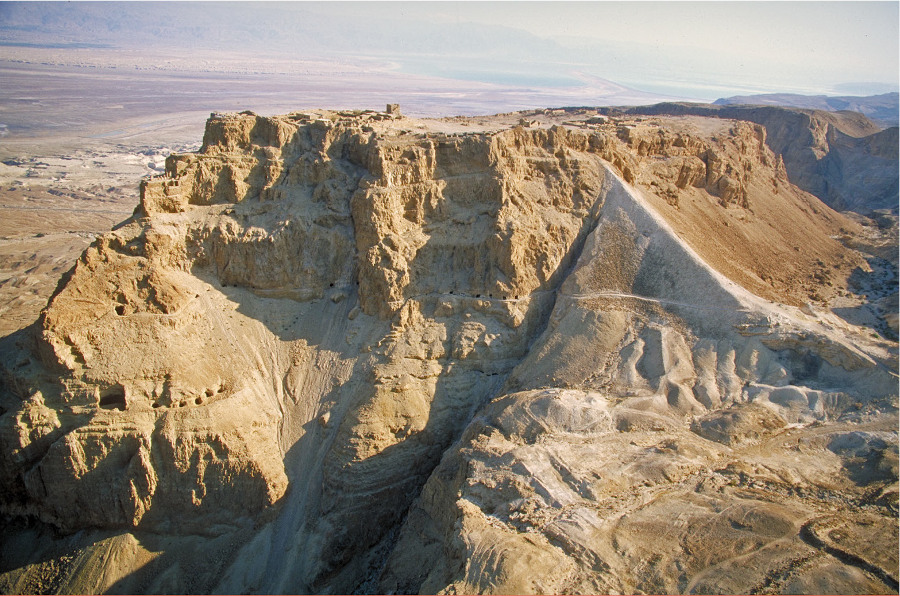
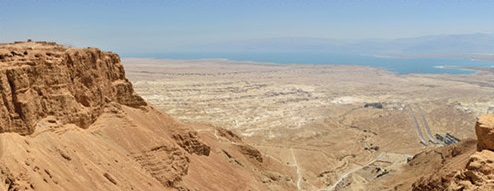
Masada with a siege ramp along the right side of the photo. Enemies would build a ramp up to the top of a city wall to make it easier to attack the city. In Eze 4:1–2, God instructs Ezekiel, “Take a block of clay, put it in front of you and draw the city of Jerusalem on it. Then lay siege to it: Erect siege works against it, build a ramp up to it, set up camps against it and put battering rams around it.”
© Phoenix Data Systems
Return to the main text.
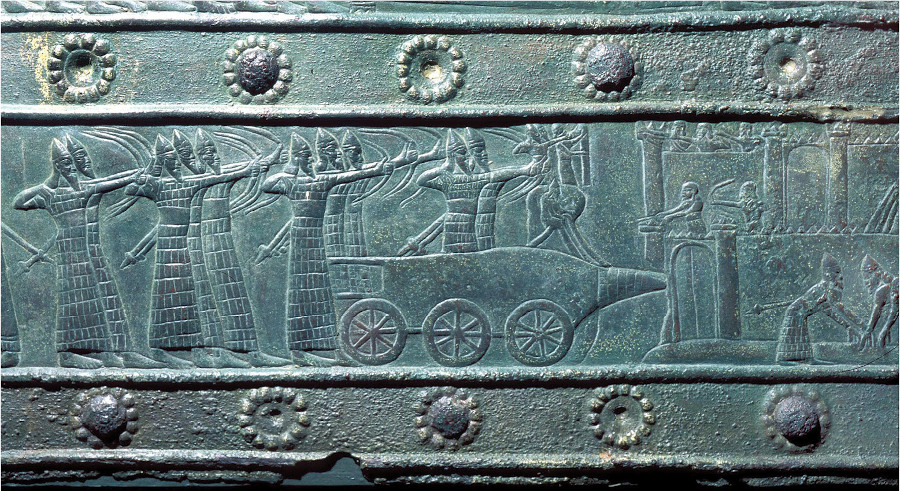
Assyrian soldiers destroying the walls of a city with a battering ram (Nimrud, c. 865 bc).
Z. Radovan/www.BibleLandPictures.com
Return to the main text.
4:2 build a ramp up to it. See photo. battering rams. See photo.
4:3 you shall besiege it. Ezekiel’s own presence in the scene signified that the siege would actually be laid by the Lord himself. sign. For Ezekiel as a “sign,” see also 12:6,11; 24:24,27. These references to “sign” mark off significant literary transitions in the book (see notes on 12:1–28; 24:15–27).
4:4 You are to bear their sin. A representative rather than a substitutionary bearing of sin. The prophet’s action symbolized the punishment Israel would suffer for her sins; it did not remove the sins.
4:5 for 390 days. The 390 years (v. 6) may represent the period from the time of Solomon’s unfaithfulness to the fall of Jerusalem. Correspondingly, the 40 years of v. 6 may represent the long reign of wicked Manasseh before his repentance (2Ki 21:11–15; 23:26–27; 24:3–4; 2Ch 33:12–13). Or It may be a round number for a generation, corresponding to the generation of Babylonian exiles that followed the fall of Jerusalem.
4:6 on your right side. Lying on his left side (v. 4) while facing Jerusalem (v. 7) probably placed Ezekiel to the north of the symbolic city (v. 1); lying on his right side would then have placed him to the south—signifying the northern and southern kingdoms, respectively. Ezekiel may have lain on his side for several hours each day as people passed by, but he probably carried on his other activities the rest of the day or he could not have stayed alive.
4:7 prophesy against her. By means of his words and actions.
4:9 Take wheat and barley, beans and lentils, millet and spelt. A scant, vegetarian diet representing the meager provisions of a besieged city.
4:15 cow dung. When thoroughly dried, it was commonly used in the Near East as a fuel for baking and is still sometimes so used even today. Ezekiel again showed his sensitivity to things ceremonially unclean (see note on 1:3), and God graciously responded to the prophet’s objection by allowing this substitute for human excrement.
5:1–17 The fate of the people of Jerusalem in the judgment that is about to overtake them—only the merest remnant will be left (cf. notes on 2Ki 19:30–31; Isa 1:9; 10:20–22).
5:1 take a sharp sword. What Isaiah had expressed in a metaphor (Isa 7:20) Ezekiel acted out in prophetic symbolism. shave your head and your beard. A sign of humiliation (see 7:18).
5:2 with drawn sword. See 12:14; 21:3–5; 30:25; 32:10; Ps 7:12–13 and note.
5:5 This is Jerusalem. After acting out the symbols (beginning in 4:1), Ezekiel received and probably related the divine explanations (5:12). center of the nations. God had chosen for his people Israel and for his earthly temple a place at the crossroads of the continents of Africa, Asia and Europe so that Israel and what he does for them might be a strong witness to the nations that he is the one and only God with whom all peoples have to do and from whom alone come life and blessing. This made Israel’s responsibility and judgment all the more severe (see also 38:12 and note).
5:6 more than the nations . . . around her. See v. 7; 16:47–48; 2Ki 21:9; Am 3:9 and note.
5:8 I myself am against you. A short and effective phrase of judgment used often by Ezekiel (see 13:8; 21:3; 26:3; 28:22; 29:3,10; 30:22; 34:10; 35:3; 38:3; 39:1; see also Jer 23:30–32; 50:31; 51:25; Na 2:13; 3:5). inflict punishment on you in the sight of the nations. Just as he had acted to bring about Israel’s freedom and privileged position as his people (see Lev 26:45; Jos 2:11; 5:1; cf. Isa 52:10).
5:10 parents will eat their children. Cannibalism, the most gruesome extremity of life under siege (2Ki 6:28), was threatened as a consequence of breaking the covenant (Dt 28:53; see Jer 19:9 and note; La 2:20; Zec 11:9 and note).
5:11 as surely as I live. A divine oath, revealing God’s unalterable intention. It is used often in Ezekiel (see 14:16,18,20; 16:48; 17:16,19; 18:3; 20:3,31,33; 33:11,27; 34:8; 35:6,11; see also Heb 6:13 and note). you have defiled my sanctuary. See ch. 8.
5:13 spent my wrath on. An expression frequently used by the Lord in this book (6:12; 7:8; 13:15; 20:8,21). they will know that I the LORD have spoken. See 17:21; 36:36; 37:14; see also 6:7 and note.
5:15 a reproach and a taunt, a warning and an object of horror. A fourfold list (see note on 1:5).
5:16–17 These verses contain echoes of the threatened forces of judgment for covenant unfaithfulness found in Dt 32:22–25. Note especially that God’s “arrows” of judgment are the four main causes of death among the peoples of the ancient Near East: famine, disease, sword (violent death at human hands) and wild beasts (see 14:12–21; see also 6:11–12; 7:15; 12:16; cf. 34:25–31; see also Jer 14:12 and note; cf. Rev 6:8).
5:16 my . . . arrows. A widely used metaphor for God’s judgments (see note on Ge 9:13).
6:1–14 After announcing judgment on Jerusalem (chs. 4–5), Ezekiel is instructed to pronounce judgment on the whole land; the “mountains of Israel” were the heavily cultivated central highlands (see Ps 104:13–15 and note), which also provided the principal sites for the pagan sanctuaries set up to worship the Baals. The judgment Ezekiel is to pronounce echoes Lev 26:27–39.
6:3 high places. Open-air sanctuaries of Canaanite origin, condemned throughout the OT. The high places, together with the “altars,” “incense altars” and “idols” (v. 4), make up a list of four objects (see note on 1:5).
6:4 incense altars. Made of baked clay, about two feet high, usually inscribed with animal figures and idols of Canaanite gods (see photo). idols. The Hebrew word is a derisive term (see note on Lev 26:30) used especially by Ezekiel (38 times, as opposed to only 9 times elsewhere in the OT).
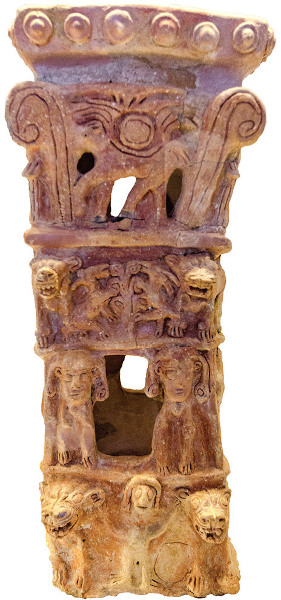
Ezekiel 6:4 refers to the destruction of incense altars. This altar at the Israel Museum dates to the 10th century bc.
© 2018 by Zondervan
Return to the main text.
6:7 you will know that I am the LORD. See 36:11 and note. This assertion that God’s mighty acts in history (his dealings with Israel and the nations in judgment and redemption) will result in his being known and acknowledged by Israel and the nations echoes throughout chs. 6–39 (see 5:13 and note).
6:9 those who escape will remember me. The corrective outcome God intends from the severe judgment to come (v. 10). their adulterous hearts . . . lusted after their idols. See Ex 34:15 and note.
6:11 Strike your hands together and stamp your feet. A command to Ezekiel to punctuate his words of judgment with symbolic acts (21:14,17)—acts of quite different intent from those of Israel’s enemies in 25:6. sword, famine and plague. See 5:16–17 and note.
6:14 I will stretch out my hand against. A common expression in Ezekiel (14:9,13; 16:27; 25:7; 35:3). Diblah. Perhaps the Beth Diblathaim of Jer 48:22, a city in Moab; or Riblah, a city north of Damascus on the Orontes River (see NIV text note).
7:1–27 God’s word of judgment on the “mountains of Israel” (6:2; see ch. 6 and note on 6:1–14) is elaborated in the fateful declaration that God’s patience with Israel’s stubborn rebelliousness has run out: “The end! The end has come” (v. 2; see vv. 3,6,24; see also Jer 51:13; La 4:18; cf. Am 7:8; 8:2).
7:7 The day. The “day of the LORD’s wrath” (v. 19), i.e., the day of reckoning when God brings down his righteous judgments on the wickedness of his people (see also vv. 10,12). Ezekiel’s language may be a deliberate echo of the “day of the LORD” of which many of the prophets spoke (see Am 5:18 and note). panic, not joy. Cf. Am 5:20 (“darkness, not light”).
7:8 pour out my wrath. A common expression in Ezekiel (9:8; 14:19; 20:8,13,21; 22:31; 30:15; 36:18).
7:10–12 The short staccato lines of poetry heighten the intensity of the prophecy and the suddenness and severity of its fulfillment.
7:12 Let not the buyer rejoice. Advice similar to that of Jesus (Mt 24:17–18).
7:15 sword . . . plague and famine. See 5:16–17 and note.
7:16 doves . . . moan. The people’s mourning resembles the plaintive call of these birds.
7:17 Every hand will go limp. See 21:7; 30:25; Isa 13:7 and note; Jer 6:24; 47:3 and note; 50:43; Zep 3:16 and note. every leg will be wet with urine. Because of panic (21:7).
7:18 They will put on sackcloth . . . every head will be shaved. As signs of intense mourning (see Ge 37:34; Job 1:20; Isa 15:2; Rev 11:3 and notes).
7:19 They will throw their silver. See Isa 2:20.
7:20 beautiful jewelry. See Ex 32:2–4.
7:22 the place I treasure. The Jerusalem temple.
7:23 full of bloodshed . . . violence. See 9:9; 11:6; 12:19; see also 2Ki 21:16; 24:4; Jer 19:4; 22:17; La 4:13; Mic 3:10; Hab 1:2–4; cf. Hab 2:8, 12,17.
7:24 pride of the mighty. The Jerusalem temple, described by the word “pride” (as in 24:21; 33:28).
7:26 prophet . . . priestly . . . elders. There would be no guidance from God and no direction from the elders (see 1Sa 28:6; Am 8:11–12 and note on 8:11; Mic 3:6–7; see also Jer 18:18 and note).
7:27 king . . . prince. Here both nouns probably refer to the same person, namely, King Jehoiachin. clothed with. See note on Ps 109:29. people of the land. The full citizens of Judah (those holding inherited family property and subject to military service; see 12:19; 45:16,22; 46:3).
8:1—11:25 The vision has six movements: (1) God shows Ezekiel the idolatry practiced in the temple in Jerusalem (ch. 8); (2) God pronounces his judgment on the idolaters there (ch. 9); (3) Ezekiel is shown God’s glory departing from the temple (ch. 10); (4) God declares that the complacent Jerusalemites will not escape his judgment (11:1–13); (5) God promises that the exiles, whom those still in Jerusalem have written off, will be restored (11:14–21); and (6) the conclusion of the vision (11:22–25).
8:1–8 Ezekiel is shown four examples of idolatrous worship being carried on in the very temple of the Lord: (1) “idol of jealousy” (v. 5), (2) “crawling things and unclean animals” (v. 10), (3) “mourning the god Tammuz” (v. 14), and (4) “bowing down to the sun” (v. 16).
8:1 In the sixth year, in the sixth month on the fifth day. Sept. 17, 592 bc—the second of 13 dates in Ezekiel (see chart). This one, like those in 1:2 and 40:1, introduces a vision. sitting in my house. The exiles were free to build houses (Jer 29:5). elders of Judah were sitting before me. They also had freedom of movement, assembly and worship (14:1; 20:1). A year and two months after his inaugural vision and preaching, the prophet commanded a hearing. Some have seen in such meetings the beginnings of the synagogue form of worship. hand of the Sovereign LORD. See note on 1:3.
8:2 figure like that of a man. A figure, manifesting the brilliance of the divine presence, similar in appearance to the vision of God in 1:26–27. like fire . . . as bright as glowing metal. A way of describing the blinding brightness of the divine messenger (see Mt 28:3; cf. Ac 9:3).
8:3 The Spirit lifted me up. See 3:12 and note. took me to Jerusalem. Ezekiel had been directed to prophesy stern judgments on Jerusalem (chs. 1–7). Now he was transported to Jerusalem in visions of God (11:24) and shown the reason for the judgments. idol that provokes to jealousy. Any idol in the temple provoked the Lord to jealousy (see Ex 20:5 and note), but this one seems to be a statue of Asherah, the Canaanite goddess of fertility, which Josiah had removed some 30 years previously (2Ki 23:6).
8:5 idol of jealousy. See note on v. 3.
8:10 all kinds of crawling things and unclean animals. Probably reflecting Egyptian influence (cf. 2Ki 23:31–35).
8:11 Jaazaniah. Not the same person as in 11:1. Ironically, the name means “The LORD hears,” and the irony is sharpened by the quotation in v. 12.
8:14 Tammuz. The only biblical reference to this Babylonian fertility god. The women of Jerusalem were bewailing his dying (which supposedly happened seasonally at the height of the summer heat), which they thought caused the annual summer die-off of the vegetation. According to some interpreters, he is alluded to in Da 11:37 (“the one desired by women”; see note there).
8:16 twenty-five men. A representative number (11:1). With their backs toward the temple. Almost all ancient temples were oriented toward the east. Worshiping the sun as it rose required people standing at the temple’s entrance to turn their backs to the temple. bowing down to the sun. For other references to sun worship, see Dt 4:19; 17:3; 2Ki 23:5,11; cf. 2Ki 17:16; 21:3,5; Jer 43:13.
8:17 fill the land with violence. See 7:23 and note. putting the branch to their nose. Possibly a ceremonial gesture in pagan worship, not documented elsewhere in the Bible. It could also be a gesture of disrespect for Yahweh, like the modern expression, “to thumb one’s nose at” someone.
9:1 loud voice. The thunderous voice of God (see Ex 19:19 and NIV text note; see also Ps 29).
9:2 six men coming from the direction of the upper gate. These six angels of the city, plus the seventh clothed in linen, came from the place where the idol that provoked to jealousy stood (see 8:3 and note).
9:3 the glory . . . went up. In a dramatic scene, God’s life-giving presence began to vacate the temple, his glory moving to the door (see note on 8:1—11:25), leaving the temple and city exposed to death and destruction.
9:4 mark. A taw, the last letter of the Hebrew alphabet, which originally looked like an “x” (see Rev 7:2–4 and note on 7:2; cf. Rev 13:16 and note). those who grieve and lament. The remnant (1Ki 19:18).
9:5 kill, without showing pity. See La 2:21.
9:6 Begin at my sanctuary. Because that was a primary source of the evil that pervaded Jerusalem (ch. 8), even though it should have been the holiest place. Cf. an echo in 1Pe 4:17.
9:8 crying out. See 11:13. As those who served as intermediaries between God and his people, the prophets frequently interceded on behalf of the people when God’s judgments threatened (Ex 32:31; Nu 14:13–19; 1Sa 12:23; Jer 14:19–21; 15:1; Am 7:2,5).
9:9 land is full of bloodshed. See 7:23 and note.
9:10 bring down on their own heads what they have done. See 16:43; Jer 50:15; Pr 26:27 and note.
10:1–22 See note on 8:1—11:25.
10:1 I looked. Ch. 10 echoes ch. 1, underscoring the identity of what Ezekiel saw at the Kebar River with what he now sees in his vision (8:4). The creatures in ch. 1 are here called cherubim (see note on 1:5 and photo).
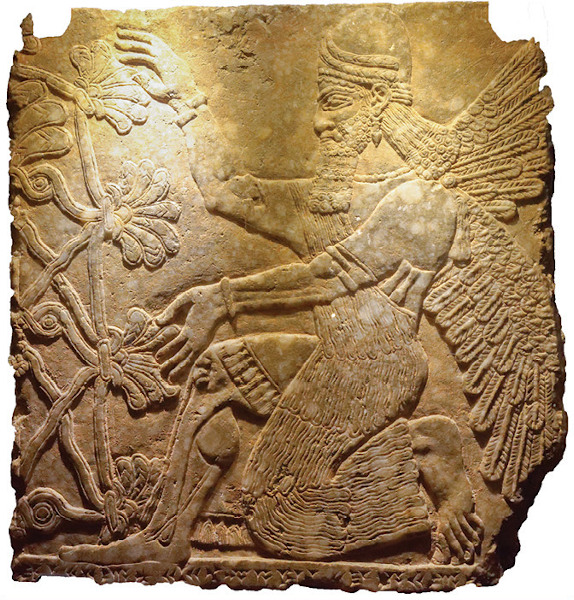
Neo-Assyrian relief of a mythical being called a Winged Genius from the northwest palace of Nimrud (c. 883–859 bc).
Todd Bolen/BiblePlaces.com
Return to the main text.
10:2 burning coals. While in 1:13 the living creatures looked like burning coals, here there are real coals. scatter them over the city. A judgment by fire (Ge 19:24; Am 7:4).
10:3 cloud. The cloud that enclosed the “glory of the LORD” (v. 4), which otherwise would have blinded those who saw it (see 1:4; Ex 16:10; 24:15–17; 40:34–35,38; Nu 9:15–16; 16:42; Dt 5:23; 1Ki 8:10–12; Hag 2:7 and note; cf. Mt 13:5; 24:30; 26:64; Mk 9:7; 13:26; 14:62; Lk 9:34–35; 21:27; Ac 1:9; Rev 1:7; 14:14–16).
10:7 one of the cherubim reached out his hand. Though the “man clothed in linen” was initially commanded to get the coals himself (v. 2), he received them from the hand of one of the creatures (1:8). who took it and went out. No further report is given, but the destructive spreading of the coals over Jerusalem is assumed.
10:14 One face was that of a cherub. While the faces of the human being, lion and eagle are identical with those in 1:10 (see note on 1:5), the ox is here called a cherub (see note on Ge 3:24). Perhaps this distinguished this face from the bull gods of ancient pagan religions.
10:15 Kebar River. See 1:1 and note.
10:19 east gate . . . and the glory of the God of Israel was above them. A second movement of the glory, again in an easterly direction (see 9:3; 10:4; see also note on 8:1—11:25). See ch. 43 for the return of the glory of the Lord to the temple by way of the east gate (see note on 43:1–12).
11:1–13 See note on 8:1—11:25.
11:1 the Spirit lifted me up. See 3:12 and note. twenty-five men. See 8:16 and note. Jaazaniah. See note on 8:11. Pelatiah. Means “The LORD delivers.”
11:3 Haven’t our houses been recently rebuilt? The residents of Jerusalem who were not exiled by the Babylonians in 597 bc felt smugly secure, thinking they had no further Babylonian threat to fear. pot. As in ch. 24, Jerusalem is compared to a cooking pot. Those left behind boasted that they were the “meat,” the choice portions—the inference being that the exiles in Babylon were the discarded bones (v. 15).
11:5 the Spirit of the LORD came on me. See 2:2 and note.
11:6 killed many . . . filled its streets with the dead. See 7:23 and note.
11:7 The bodies you have thrown there are the meat. The meat, redefined by the prophet, is not those in power in Jerusalem (who will be driven out) but the innocent people they killed.
11:11 at the borders of Israel. At Riblah (2Ki 25:20–21).
11:13 Pelatiah. See v. 1. cried out. See note on 9:8.
11:14–21 See note on 8:1—11:25.
11:16 I have been a sanctuary for them. A key verse in Ezekiel. Although the exiles had been driven from Jerusalem and its sanctuary (the symbol of God’s presence among his people), God himself became their sanctuary, i.e., he was present among them to preserve and bless them.
11:19 undivided heart . . . new spirit. Inner spiritual and moral transformation that results in single-minded commitment to the Lord and to his will (36:26). remove . . . heart of stone . . . give . . . heart of flesh. Give Israel a new heart, responsive to God’s will (see 2Co 3:3 and note).
11:20 my people . . . their God. The heart of God’s covenant promise (see Ex 6:7; Jer 7:23; Zec 8:8 and notes).
11:21 bring down on their own heads what they have done. See note on 9:10.
11:22–25 See note on 8:1—11:25.
11:23 The glory of the LORD went up. The final eastward movement of the glory (as the Lord left his temple), which stopped above the Mount of Olives (see 9:3; 10:4,19; see also note on 8:1—11:25). Because God had now withdrawn his life-giving presence from the temple, his people face the consequent coming devastation. God’s glory returns in ch. 43, bringing with it abundant life and restoration.
12:1–28 The first series of messages concludes with Ezekiel being called upon to symbolize by personal actions the coming exile of Jerusalem—just as the second series of messages culminates (24:15–27) in Ezekiel suffering the death of his wife as a symbolic representation of the fall of Jerusalem. Verses 1–2 and v. 28 frame the chapter; two symbolic acts (vv. 3–16,17–20) are followed by the refutation of two sayings with which the Jerusalemites vainly try to reassure themselves (vv. 21–25,26–27).
12:2 eyes to see but do not see. The hardening about which the Lord had spoken to Isaiah (see Isa 6:8–10 and notes). The Israelites in Jerusalem refuse to recognize that the end has come for them (v. 28; 7:2–6).
12:3 pack your belongings. Another symbolic act, which, like those in chs. 4–5, follows a vision. Perhaps they will understand. Some hope remained that they would change.
12:5 dig through the wall. Not the city wall, which was made of stone and was many feet thick, but the sun-dried brick wall of his house.
12:6 cannot see the land. The ground. The language is used to prepare the reader for v. 13 (see note there). sign. Prophets were often instructed to perform symbolic acts (see, e.g., v. 11; 24:24,27; cf. 1Ki 11:29–31; 13:23–32; 20:35–43; Isa 8:18; Jer 13:1–11; 16:1–9; 19:1–15; 27:2—28:14; 32:6–15).
12:8 In the morning. After Ezekiel “did as . . . commanded” (v. 7). Again the divine explanation follows the prophet’s unquestioning obedience (see note on 8:3).
12:9 What are you doing? The book’s first indication of the people’s response to the prophet’s symbolic acts.
12:10 prince in Jerusalem. Zedekiah.
12:13 Chaldeans. See notes on 23:23; Ezr 5:12; Job 1:17. he will not see it. Nebuchadnezzar’s men would put out Zedekiah’s eyes (see 2Ki 25:7 and note).
12:14 with drawn sword. See 5:2 and note.
12:15 know that I am the LORD. See vv. 16,20; see also note on 6:7.
12:16 sword, famine and plague. See 5:16–17 and note.
12:18 tremble as you eat. Another prophetic symbol. The Hebrew word for “tremble” indicates a violent shaking and is used elsewhere to describe earthquakes (1Ki 19:11; Am 1:1), so Ezekiel’s trembling must have been particularly violent.
12:19 people of the land. See note on 7:27. because of the violence. See 7:23 and note.
12:22 For more than 30 years Jeremiah had been prophesying Jerusalem’s fall, but the city still stood. So among its inhabitants, whose ears were deaf to Jeremiah’s warnings (v. 2), a mocking proverb was making the rounds, reinforced by the false prophets (ch. 13; Jer 23:9–40; 28), which said in effect: “The days go by” and none of the visions of coming disaster has come true, so forget them (cf. 2Pe 3:4 and note).
12:23 The Lord refutes the first saying (v. 22) of the Israelites that dismisses his prophet’s announcements of impending judgment.
12:24 no more false visions . . . divinations. Events will silence the false prophets, who were prophesying only peace for Israel when there would be none (13:10).
12:27 Another saying (see note on v. 23) is being passed around among the Israelites, this one apparently among those in exile. It pertains to Ezekiel’s “visions” and dismisses them as having to do only with far-off events that need not concern the present generation.
12:28 None of my words will be delayed any longer. The Lord also refutes this saying (v. 27) circulating among his “rebellious people” (v. 2; see note on 12:1–28).
13:1–23 The Lord’s condemnation of the false prophets, both men and women—as through Jeremiah in Jerusalem (Jer 23:9–40; 28), so through Ezekiel in Babylonia. This begins a series of messages concerning God’s judgment on Judah that concludes with a parable in which Jerusalem is likened to a pot cooking on a fire (24:1–14).
13:2 out of their own imagination. Cf. Jer 23:16, 26–32.
13:3 have seen nothing. No revelation from God was received (cf. Jer 23:18,22 and note on 23:18).
13:4 jackals. Animals that travel in packs and feed on dead flesh—a powerfully negative image (Ps 63:10; La 5:18).
13:5 to repair it for the people of Israel. The function of true prophets is described (cf. 22:30; Ps 106:23). day of the LORD. See note on 7:7.
13:6 Their visions are false. Whether the false prophets had actual visions is unknown, but they claimed to have received revelations from God when in reality their messages only proclaimed what their hearers wanted to hear (see 12:24 and note; Isa 30:10; Jer 23:9–17; 2Ti 4:3).
13:8 I am against you. See 5:8 and note.
13:9 They will not belong . . . land of Israel. A threefold punishment, resulting in total exclusion from the community. council of my people. See Ps 111:1 and note. records of Israel. See Ezr 2:62; cf. Da 12:1; see also Ps 69:28 and note.
13:10 saying, “Peace.” Very likely in echo of the priestly benediction (see Nu 6:24–26 and note on 6:26), ignoring the fact that God’s promise of “peace” to his people was conditional on their faithfulness to him. when there is no peace. See v. 16; Jer 6:14 and note; 8:11. whitewash. See vv. 11,14–15; 22:28; an uncommon word used only by Ezekiel, perhaps chosen by him to evoke the like-sounding word rendered “repulsive thing” in Jer 23:13 and “worthless” in La 2:14, both pertaining to the proclamations of the false prophets.
13:11 Rain will come in torrents. The violent thunderstorm of God’s judgment (imagery frequently used in the OT) was about to sweep them away (Ps 18:7–15; 77:17–18; 83:15; Isa 28:17; 30:30; Jer 23:19; 30:23).
13:18 magic charms. Exactly what the women were doing is not known, but that it was some kind of black magic or witchcraft is clear. The Bible consistently avoids explicit description of occult practices.
13:19 profaned me. See note on Lev 18:21. for a few handfuls of barley. Involvement in religious matters of any kind for mere gain is consistently condemned in the Bible (Jer 6:13; 8:10; Mic 3:5,11; Ac 8:9–24; 2Co 2:17; Titus 1:11). For the proper attitude and motivation, see 2Co 11:7; 2Th 3:8; 1Ti 3:3. you have killed. The women with magic charms had used their evil powers for unjust ends, involving even matters of life and death.
14:1–11 The idolatry among the Israelites that God here condemns took the form of worshiping the gods of neighboring peoples (see notes on Ge 20:9; Ex 34:15) along with the worship of Yahweh—the people thought they should take all the gods seriously—an apostasy that struck at the very heart of Israel’s covenant relationship with Yahweh (see Ex 20:3–5 and notes). And this idolatry was not limited to those still living in Jerusalem; Ezekiel had to confront it also among the exiles.
14:1 elders of Israel. Apparently interchangeable with “elders of Judah” (see note on 8:1).
14:3 idols. See note on 6:4. wicked stumbling blocks. The physical representations of the idols. inquire. A technical term for seeking a message from a prophet (2Ki 1:16; 3:11; 8:8).
14:4 I the LORD will answer them myself. Not through a prophet but by direct action. The punishment for idolatry was death (Dt 13:6–18).
14:6 Repent! First of three calls for repentance from Ezekiel, who elsewhere proclaims inescapable judgment (18:30; 33:11).
14:8 byword. A popular, well-known symbol or representative of something negative or notorious.
14:9 enticed. Related to God’s testing of his people’s loyalty (see 3:20 and note; cf. 1Ki 22:19–23).
14:11 The harsh judgment about to fall on idolatrous Israel has a redemptive purpose: to restore Israel to covenant faithfulness (see 20:32–44; cf. 33:11). my people . . . their God. Covenant terminology (see note on 11:20).
14:12–23 God makes it clear that those who turn away from him are turning away from life. Nothing is left for them but “sword and famine and wild beasts and plague” (14:21). As long as they refuse to turn to the Lord, there is no hope for them. The judgments in view here include the four often mentioned in Ezekiel: famine (v. 13), wild beasts (v. 15), sword (v. 17) and plague (v. 19; see also v. 21 and note on 5:16–17).
14:14,20 Noah, Daniel and Job. Three ancient men of renown, selected because of their proverbial righteousness. As the NIV text note indicates, another Daniel may be referred to (Ugaritic literature speaks of an honored “Danel”; see chart), since the biblical Daniel’s righteousness probably had not become proverbial so soon (Daniel and Ezekiel were contemporaries; see Da 1:1).
14:20 neither son nor daughter. When God comes in judgment against a nation or people, they cannot count on another’s righteousness—not even that of their parents—to deliver them.
14:23 You. Plural; i.e., the exiles in Babylonia. will be consoled. When the exiles see the wickedness of those brought to Babylonia from Jerusalem, they will know that God’s judgment on the city was just.
15:1–8 God compares Jerusalem to a vine (cf. Ps 80:8–16 and note) that yields no grapes and is therefore good for nothing but to be used as fuel.
15:3 Do they make pegs from it to hang things on? See Isa 22:23–25.
15:4 is it then useful for anything? Whereas Isaiah (5:1–7) and Jeremiah (2:21) express divine disappointment over Israel’s failure to produce good fruit, Ezekiel typically laments her total uselessness.
15:7 Although they have come out of the fire. A reference to the siege of Jerusalem in 597 bc, which resulted in the exile of which Ezekiel was a part (1:2; 2Ki 24:10–16). fire will yet consume them. Prophecy threatening another and more devastating siege—Ezekiel’s main message before 586 (5:2,4; 10:2,7).
Jerusalem as an Adulterous Wife
The whole history of God’s dealings with Jerusalem is graphically portrayed in an allegory that highlights the Lord’s great goodness to the city on the one hand and the depth of the city’s unfaithfulness to him on the other. Here Jerusalem as a royal city among the other cities of the world is in focus and serves as an analogue and representative of Israel. It is the city God had chosen to be the site of his temple (1Ki 9:3; 2Ch 7:1–3; Ps 68:16; 78:68–69; 132:13–16), and he had elevated it as “the city of the Great King” (Ps 48:2) to be the earthly center of his kingly rule in human affairs (see 5:5 and note). He had married her (see v. 8 and note) and provided for her richly. But she turned to the false gods to supply her needs and allied herself with the great empires around her (Egypt [v. 26], Assyria [v. 28] and Babylonia [v. 29]) to provide her security. So God accuses her of unfaithfulness to him, like that of an adulterous wife (see Ex 34:15 and note).
Go to the Articles Index.
16:3 Your ancestry and birth. Jerusalem had a centuries-old, pre-Israelite history (see notes on Ge 14:18; Ecc 1:16), and the city had long resisted Israelite conquest (Jos 15:63). It became fully Israelite only after David’s conquest (2Sa 5:6–9). father . . . mother. A reference to Jerusalem’s non-Israelite origin generally, not to any specific individuals. Amorite. Cf. v. 45. Like the Canaanites, the Amorites were pre-Israelite, Semitic inhabitants of Canaan (see Ge 10:16 and note; 48:22; Jos 5:1 and note; 10:5; Jdg 1:34–36). Hittite. The Hittites were non-Semitic residents of Canaan, who had flourished in Asia Minor during the second millennium bc (see Ge 10:15 and note; 23:10–20; 26:34; 1Sa 26:6; 2Sa 11:2–27; 1Ki 11:1).
16:4 rubbed with salt. This practice has been observed among Arab peasants as late as ad 1918. wrapped in cloths. Cf. Lk 2:7.
16:5 thrown out into the open field. Abandoned to die. Exposure of infants, common in ancient pagan societies, was abhorrent to Israel.
16:6 blood. Of childbirth. Live! God’s basic desire for all people, summed up in one word (18:23,32; 1Ti 2:4; 2Pe 3:9).
16:7 hair. Pubic hair.
16:8 spread the corner of my garment. Symbolic of entering a marriage relationship (see notes on Dt 22:30; Ru 3:9). covenant. Since the young woman symbolizes Jerusalem, this does not refer to the Sinaitic covenant but to marriage as a covenant (Mal 2:14).
16:9 blood. Menstrual blood, indicating sexual maturity.
16:10 embroidered dress . . . sandals of fine leather . . . fine linen. Representative of the very best garments. embroidered dress. See 27:16,24; colored, variegated material fit for a queen (Ps 45:14). sandals of fine leather. The same kind of leather was used to cover the tabernacle (Ex 25:5; 26:14).
16:11 bracelets on your arms. See Ge 24:22.
16:12 ring. Not piercing the nose but worn on the outer part of the nose (Ge 24:47). earrings. Circular ear ornaments, also worn by men (Nu 31:50). The Hebrew for this word is not the same as that used in Ge 35:4; Ex 32:2–3. crown. The wedding crown (see SS 3:11, where the groom wears it).
16:13 gold and silver. Cf. Hos 2:8. olive oil. Cf. Hos 2:8. For the combination of honey and oil, see Dt 32:13. finest flour. Used in offerings and therefore of high quality (v. 19; 46:14). You became very beautiful. Cf. Eph 5:27.
16:14 your fame spread. Especially in the time of David and Solomon.
16:15 favors. Sexual favors. Verb and noun forms of the Hebrew for this word occur 23 times in this chapter. anyone who passed by. Cf. Ge 38:14–16.
16:16 garments. All of the Lord’s previous gifts were used by Jerusalem in prostituting herself. Cloths of some kind were needed in the Asherah worship practices (2Ki 23:7). They may have been used as curtains or as bedding (Am 2:7–8).
16:20 sons and daughters . . . sacrificed. See 20:26,31 and note; 23:37; 2Ki 21:6; 23:10; Jer 7:31 and note; 19:5; 32:35. For laws against child sacrifice, see Lev 18:21; Dt 18:10; cf. Lev 20:2–5; Dt 12:31.
16:24 mound . . . lofty shrine. Centers of idol worship were built not only in the countryside but also in Jerusalem itself.
16:26–29 Egyptians . . . Philistines . . . Assyrians . . . Babylonia. The historical sequence of Jerusalem’s political alliances with these four powers.
16:26 neighbors. Nowhere else in the OT are the Egyptians called “neighbors.” Shockingly, the nation that is Israel’s traditional enemy is portrayed as a sexual partner. large genitals. See 23:20. The graphic language reflects both God’s and Ezekiel’s disgust with Jerusalem’s apostasy.
16:27 reduced your territory. After the 701 bc siege of Jerusalem, the Assyrian king, Sennacherib, gave some of Jerusalem’s territory to the Philistines. shocked by your lewd conduct. Cf. Am 3:9,13 and notes.
16:29 Babylonia, a land of merchants. See note on Rev 14:8; see also Rev 18:11–19,23.
16:32 your own husband. The Lord himself (see v. 8 and note; see also Jer 3:14; 31:32; Hos 2:16–17 and notes; cf. Ex 34:15 and note).
16:33 you give gifts to all your lovers. Jerusalem’s perversity is here pictured as worse than adultery and ordinary prostitution (see v. 34).
16:35–42 The graphic imagery of the prostitute’s punishment does not represent sexism or misogyny. The language is metaphorical for Jerusalem’s heinous idolatry and coming exile, and it is the natural continuation of the metaphor that began with Yahweh’s rescue of a helpless baby and his provisions for her throughout her childhood.
16:37 strip you. A reversal of the marriage covering (v. 8) and a return to the state described in v. 7.
16:38 sentence you. The punishment prescribed in the law was death (Lev 20:10; Dt 22:22) by stoning (Dt 22:21–24; Jn 8:5–7). jealous anger. See v. 42; see also notes on Ex 20:5; Zec 1:14.
16:39 your mounds . . . your lofty shrines. See vv. 24–25.
16:43 bring down on your head what you have done. See note on 9:10.
16:44 Like mother, like daughter. Referring to Jerusalem’s continual and seemingly hereditary tendency toward evil (cf. vv. 3,45).
16:45 Hittite . . . Amorite. See note on v. 3.
16:46 Your older sister was Samaria. Historically, Samaria was not founded as a royal city until after 880 bc (see note on 1Ki 16:24), so “older” in this allegory apparently alludes to the fact that Samaria ruled over a significantly larger kingdom than Jerusalem did. daughters. Suburbs or satellite cities.
16:47 more depraved than they. The Bible frequently compares a city or people to Sodom (v. 46) as the epitome of evil and degradation (see Ge 13:10 and note; Dt 29:23; 32:32; Isa 1:9–10 and note; 3:9; Jer 23:14; La 4:6; Mt 10:15; 11:23–24; Jude 7).
16:49 sin of your sister Sodom. Here social injustice rather than sexual perversion (Ge 19) is highlighted. But “detestable” is used in Lev 18:22 for homosexual perversion, so it may be hinted at here too. Cf. Eze 18:5–9, where sexual sin and social injustice are intertwined.
16:51–52 righteous. Relatively innocent.
16:56 day of your pride. Referring to a time long before Ezekiel, when Jerusalem (as an Israelite city) was still relatively uncorrupted—as in the days of David and the early years of Solomon.
16:57 scorned by the daughters of Edom. The OT frequently condemns Edom for this (see 25:12–14; 35:5 and note; Isa 63:1; Introduction to Obadiah: Unity and Theme; Ob 10–14 and notes).
16:59–63 In God’s concluding word concerning Jerusalem’s future reformation and restoration, the city’s role as representative of Israel in the allegory is foregrounded (see note on vv. 1–63), so that his words about remembering the covenant and establishing an everlasting covenant (see v. 60; cf. v. 62) parallel what is elsewhere said of Israel itself (see 37:26; Isa 55:3; Jer 32:40 and notes).
16:59 covenant. See v. 8 and note.
16:60 I will remember the covenant. Though Jerusalem did not (v. 43). everlasting covenant. See note on vv. 59–63.
16:61 will remember . . . be ashamed. Samaria and Sodom will be subordinated to Jerusalem in one kingdom, even though they were not tied to her by the Lord’s covenant with Judah.
16:63 when I make atonement for you. God himself will do for faithless Jerusalem what she cannot do for herself (cf. Ro 3:23; 1Jn 2:2 and notes).
17:1–24 An allegory/parable symbolizing King Zedekiah’s vacillating royal policy that led to his downfall. The allegory is presented in vv. 1–10; its explanation follows in vv. 11–21; and vv. 22–24 append a promise of better times to come, utilizing the imagery of the allegory.
17:3 great eagle. Nebuchadnezzar (v. 12). Lebanon. Jerusalem (v. 12). cedar. David’s dynasty; his royal family.
17:4 topmost shoot. Jehoiachin. land of merchants. The country of Babylonia (see v. 12; 16:29 and note). city of traders. Babylon.
17:5 one of the seedlings. Zedekiah, son of Josiah; he was the brother of Jehoahaz and Jehoiakim and uncle of Jehoiachin (2Ki 23–24). planted it. Made him king (2Ki 24:17).
17:6 low, spreading vine. No longer a tall cedar, because thousands of Judah’s leading citizens had been deported (see 2Ki 24:15–16; see also Jer 52:28). But see note on 15:1–8.
17:7 another great eagle. An Egyptian pharaoh, either Psammetichus II (595–589 bc) or Hophra (589–570). Hophra, mentioned in Jer 44:30, is probably the pharaoh who offered help to Jerusalem in 586 (Jer 37:5). If the fact that ch. 17 is located between ch. 8 (dated 592) and ch. 20 (dated 591) is chronologically meaningful, Psammetichus is meant. sent out its roots toward him. Zedekiah appealed to Egypt for military aid (v. 15), an act of rebellion against Nebuchadnezzar (2Ki 24:20).
17:10 east wind. The hot, dry wind known today as the khamsin, which withers vegetation (19:12). Here it stands for Nebuchadnezzar and his Babylonian forces.
17:12 this rebellious people. See 2:3 and note.
17:15 Will he break the treaty and yet escape? The point of the chapter (vv. 16,18).
17:16 he shall die in Babylon. See 2Ki 25:7.
17:19 my oath . . . my covenant. The king of Judah would have sworn faithfulness to the treaty in the name of the Lord. His oath would have taken some such form as “May the Lord slay me if I do not remain true to this treaty” (a self-maledictory oath; see notes on Ge 9:13; 15:17; 17:10). To swear such an oath and then violate it was to treat the Lord as if he were powerless.
17:22 I myself. A beautiful Messianic promise follows, using the previous imagery in a totally new and unexpected way. shoot. A member of David’s family (cf. Isa 11:1; Zec 3:8; 6:12 and notes). cedar. See note on v. 3. plant it. Make him king (v. 5). high and lofty mountain. Jerusalem (see Isa 2:2–4 and note).
17:23 Birds . . . will nest in it. For similar imagery applied to a mighty king, see Da 4:10–12,20–22; cf. Mk 4:32.
17:24 trees of the forest. Kings and rulers of the world. bring down the tall tree . . . make the dry tree flourish. See 1Sa 2:4–8 and notes; cf. Isa 2:12–18.
18:1–32 A word to silence those who complained that they were being made to suffer for the sins of their ancestors rather than for their own sins. That sin and guilt are not always purely individual but often have a communal and thus also a cumulative dimension is the pervasive testimony of the OT (see, e.g., Ex 20:5; Jdg 7:24; 1Ki 14:14–16 and notes; see also Ex 34:7; 1Ki 22:16–20; 2Ki 21:10–15; 23:26–27; 24:1–4; Isa 5:1–7; Jer 1:15–16; 5:1–17; 17:1–4; Am 2:4–16; 5:12). But when the Jerusalemites charged God with injustice, as if they themselves were not guilty, that called for a sharp corrective word—they had not turned away from the sinful ways of their ancestors after the manner specified in vv. 14–17, 27–28. This justification of God’s way with Israel stands at the center of the series of messages found in 13:1—24:14 (see note on 13:1–23).
18:2 this proverb. Jer 31:29 indicates that the proverb arose first in Jerusalem. Jeremiah predicted the cessation of the proverb, and Ezekiel said that its end had come. about the land of Israel. And about the fate of those who have suffered loss. The parents . . . on edge. The proverb expresses self-pity and mocks the justice of God. set on edge. The Hebrew for this phrase perhaps means “blunted” or “worn” (cf. Ecc 10:10), but it may refer to the sensation in the mouth when eating something bitter or sour. This proverb must be balanced by Dt 24:16: “Each will die for their own sin,” as v. 4 also explains.
18:3 As surely as I live. See note on 5:11.
18:4 The one who sins is the one who will die. Or “Only the one who sins . . . ” Ezekiel spoke out against a false use the people were making of a doctrine of inherited guilt (perhaps based on a false understanding of Ex 20:5; 34:7). What follows is his description of three men, standing for three generations, who break the three/four-generation pattern.
18:5 righteous man. The first generation that keeps the law. The following 15 commandments are partly ceremonial but are mostly moral injunctions. See the Ten Commandments in Ex 20 and Dt 5; cf. Ps 15:2–5; 24:3–6; Isa 33:15; cf. also note on Ps 1:5. just and right. Emphasized by Ezekiel in chs. 18 (see vv. 19,21,27) and 33 (see vv. 14,16,19; see also note on Ps 119:121).
18:6 eat at the mountain shrines. Eating meat sacrificed to idols on the high places (6:3; Hos 4:13). look to. Seek help from (23:27; 33:25; Ps 121:1). idols. See note on 6:4. defile. Adultery (condemned in Ex 20:14; Dt 22:22; Lev 18:20; 20:10) is here associated with a menstrual prohibition (Lev 15:19–24; 18:19; 20:18), which is absent from the two listings that follow (cf. vv. 11,15).
18:7 oppress. The rich taking advantage of the poor. returns what he took in pledge. See Ex 22:26; Dt 24:12–13; Am 2:8. robbery. See the commandment against stealing in Ex 20:15; Dt 5:19. This is violent (armed) robbery rather than secret theft or burglary (Lev 19:13). food to the hungry. See Dt 15:7–11; Mt 25:31–46.
18:8 lend . . . at interest. See 22:12; see also Ex 22:25–27 and note.
18:9 That man is righteous; he will surely live. After the checklist of commandments has been gone over, the verdict is rendered (cf. Ps 15:5; 24:5). live. See note on 16:6. This is life as more than mere existence; it includes communion with God (Ps 63:3; 73:27–28), the source of abundant life.
18:10 violent son. Evil, second generation. About half (eight) of the previous commandments follow, but in a different order.
18:13 his blood will be on his own head. He is held responsible for his own sin (Lev 20:9, 11–12,16,27).
18:14 a son. Righteous, third generation. Twelve commandments follow.
18:20 righteousness . . . credited to them. See Ps 106:31 and note.
18:21 But if a wicked person turns . . . and keeps . . . that person will surely live. Verses 1–20 indicate that the chain of inherited guilt can be broken, and vv. 21–29 teach that the power of guilt accumulated within a person’s life can be overcome. just and right. See note on v. 5.
18:23 Do I take any pleasure in the death of the wicked? In addition to the answer in this verse and in v. 32, see 33:11; Jnh 4:11 and notes; cf. 2Pe 3:9 and note.
18:24 But if a righteous person turns. See Heb 2:3; 2Pe 2:20–22 for warnings against those who knowingly and willfully turn from righteousness.
18:25 Is my way unjust? See 33:17; cf. Ge 18:25 and note; Dt 32:4; Jer 12:1 and note.
18:26 If a righteous person. Verses 26–29 repeat the argument developed in vv. 21–25.
18:30 Therefore. Concluding summary message. Compare the language of this conclusion with the closing words of the last (the fourteenth) message in this series (24:14). each of you. While the house of Israel as a whole was guilty, God’s judgment would be just and individual. Repent! Second call to repentance (see 14:6 and note).
18:31 get a new heart. What had been promised unconditionally (11:19; 36:26) is here portrayed as attainable but not inevitable (cf. the same tension between Php 2:12 and 2:13).
18:32 I take no pleasure. Verse 23 is echoed in this final, grand summary, called by some the most important message in the whole book of Ezekiel (see note on 16:6).
19:1–14 A twofold dirge lamenting the fall of the royal family of Judah, one part employing the imagery of a lioness and her brood of whelps (vv. 1–9), the other utilizing the imagery of a once flourishing vine (vv. 10–14).
19:1 lament. A chant usually composed for funerals of fallen leaders (as in 2Sa 1:17–27), but often used sarcastically by the OT prophets to lament or to ironically predict the death of a nation (see Isa 14:4–21; Am 5:1–3 and note on 5:1). See also 2:10. princes. Kings.
19:2 An allegorical reference to the people of Israel or the nation of Judah.
19:3 one of her cubs. Jehoahaz (2Ki 23:31–34; Jer 22:10–12), who reigned only three months. became a man-eater. A reference to his oppressive policies.
19:5 another of her cubs. Perhaps Jehoiachin (who also reigned only three months, 2Ki 24:8), but probably Zedekiah (of whom v. 7 appears to be a more likely description). Both were taken to Babylon (v. 9). If the reference is to Jehoiachin (2Ki 24:15), this was a true lament; if to Zedekiah, it was a prediction (2Ki 25:7).
19:10 Your mother was like a vine. The one previously pictured as a lioness (v. 2) is here a vine (for other uses of the vine imagery, see 15:1–8; 17:7 and notes).
19:12 east wind. Nebuchadnezzar and his army (see note on 17:10).
19:13 desert. Babylonia—which to Israel seemed like a desert (see 20:35; Isa 21:1 and note).
19:14 Fire. Rebellion (2Ki 24:20). one of its main branches. Zedekiah. to be used as a lament. Indicates repeated use (Ps 137:1).
20:1–44 This word (to be addressed to the elders of Israel) came to Ezekiel on Aug. 14, 591 bc, some 11 months after the preceding dated vision (see 8:1 and note on 8:1—11:25; see also chart). It begins with an overview of Israel’s long history of apostasy (vv. 1–29), which leads into an announcement of the Lord’s purpose to purge and renew his apostate people through the judgment now overtaking them (vv. 30–44).
20:1 seventh year . . . fifth month . . . tenth day. The third date (see previous note) supplied in the book of Ezekiel (1:2; 8:1). elders of Israel. See notes on 8:1; 14:1. inquire. See v. 3 and note on 14:3.
20:3 As surely as I live. See note on 5:11. I will not let you inquire of me. See v. 31; see also 3:26; 7:26 and notes.
20:4 Will you judge them? . . . Then confront them. As the one sent to pronounce God’s judgment on Israel, Ezekiel is instructed to spell out the “detestable practices” for which that judgment comes on them (see also 22:2; 23:36).
20:5–26 These verses present Israel’s history of apostasy in three acts (Act 1: vv. 5–9, Egypt; Act 2: vv. 10–17, Wilderness, Part 1; Act 3: vv. 18–26, Wilderness, Part 2). Each act has four scenes: (1) revelation, (2) rebellion, (3) wrath, (4) reconsideration. But see also note on v. 28.
20:5 With uplifted hand. A symbolic act accompanying the swearing of an oath (see vv. 15,23,42; Ge 14:22 and note; Ex 6:8). I am the LORD your God. See Ex 3:6,14–15 and notes.
20:6 land flowing with milk and honey. See note on Ex 3:8. most beautiful of all lands. Cf. Dt 8:7–10; Jer 3:19 for the land’s natural beauty. Its real beauty lay in being selected as God’s dwelling place (Dt 12:5,11).
20:8 But they rebelled. See vv. 13,21; see also Jos 24:14. So I said I would pour out my wrath on them. An internal refrain (vv. 13,21); see also note on 7:8. spend my anger against. See note on 5:13.
20:9 for the sake of my name. See vv. 14,22,44. Name and person are closely connected in the Bible. God’s name is his identity and reputation—that by which he is known (see note on Ps 5:11). The phrase used here is equivalent to “for my own sake” (cf. Isa 37:35; 43:25). God’s acts of deliverance—past and future—identify him, revealing his true nature (see 36:22; Ps 23:3 and notes; Isa 48:9). profaned. Made light of—as through ridicule (Nu 14:15–16).
20:10 wilderness. Act 2 (see note on vv. 5–26).
20:11 will live. See vv. 13,21; contrast v. 25. See notes on 16:6; 18:9; see also Lev 18:5 and note.
20:12 Sabbaths as a sign. Israel’s observance of the Sabbath was to serve as a sign that they were the Lord’s holy people (see Ex 31:16–17 and note). Ezekiel highlights the Sabbath (22:8,26; 23:38; 44:24; 45:17; 46:3), as did Isaiah (see Isa 56:1–8 and notes) and Jeremiah (Jer 17:19–27; cf. Ne 13:17–18). Legalism later corrupted the Sabbath law in certain Jewish circles (Mt 12:1–14).
20:13 desecrated. By not observing the Sabbath-rest (Jer 17:21–23) or by not observing it in the manner and spirit God intended (Am 8:5).
20:15 land flowing with milk and honey. See note on Ex 3:8.
20:18 I said to their children. Act 3 (see note on vv. 5–26). God began anew with the second generation in the wilderness (Nu 14:26–35).
20:25 So I gave them . . . laws through which they could not live. Just as God’s judgments undo the creation order (see note on Ge 6:9—9:29) and undo human history (see note on Ge 11:1–9), so as an act of judgment he turns the laws he gave as the way to life (see vv. 12–13,21 and note on v. 11) into laws that produced death. This is a hard saying, but it most likely refers to God’s requirement that Israel dedicate to him every firstborn male (Ex 13:2; 22:29)—which kings Ahaz and Manasseh, under the influence of the pagan religions of Israel’s neighbors, radicalized into a law calling for actual sacrifice of the firstborn (v. 26; cf. Ro 1:24–32 and notes).
20:26 sacrifice of every firstborn. See v. 31 and note on 16:20. so they would know that I am the LORD. God will go to any lengths to get his people to acknowledge him (see note on 6:7).
20:28 When I brought them into the land. Apparently Act 4 in Ezekiel’s history (see note on vv. 5–26), but it is not carried through with the same schematic consistency.
20:30–44 See note on vv. 1–44.
20:30 Will you defile yourselves the way your ancestors did . . . ? See note on vv. 5–26.
20:31 inquire. See v. 3 and note.
20:32 like the nations. The temptation to lose its uniqueness was always present for Israel (see 1Sa 8:5 and note). will never happen. As happened to those who were exiled to Egypt (Jer 44:15–19). God will not abandon them to their idolatrous ways but will firmly turn them back to the way of covenant faithfulness to him.
20:33 mighty hand . . . outstretched arm. Terminology of the exodus (cf. Dt 4:34; 5:15; 7:19; 11:2; 26:8).
20:35 wilderness of the nations. Exile among the nations would be for Israel like a return to the wilderness through which they journeyed on the way to the promised land (see Hos 2:14 and note).
20:37 pass under my rod. The way a shepherd counts or separates his flock (see Lev 27:32; Jer 33:13; cf. Mt 25:32–33). I will bring you into the bond of the covenant. As he had in the Sinai Desert (see note on 16:59–63).
20:38 purge. As in the first wilderness experience, many were not allowed to enter the land (see Nu 14:26–35 and notes).
20:39 Go and serve your idols. Irony, as in Am 4:4. profane my holy name. See Lev 18:21 and note.
20:40 my holy mountain. Mentioned only here in Ezekiel, it refers to Jerusalem or Zion (see Ps 2:6; Isa 2:2–4 and notes; 65; Ob 16; Zep 3:11). all the people of Israel. Includes a remnant of the northern kingdom, which fell in 722–721 bc (see 11:15; 36:10 and note). offerings. Possibly refers to a prescribed contribution. The other 19 occurrences in Ezekiel of the Hebrew for this word are confined to chs. 44–48, where the reference is to the land set aside for the temple and priests (see 45:1; 48:8–10, “portion”) or to the special gifts for the priests (44:30). choice gifts. Voluntary contributions (but see NIV text note).
20:41 as fragrant incense. In a metaphorical sense (as in Eph 5:2). bring you out. Cf. v. 34. I will be proved holy. See Lev 10:3 and note.
20:43 you will remember . . . and . . . loathe yourselves. A thorough repentance (see 6:9 and note; 16:63; 36:31; Lk 15:17–19).
20:44 for my name’s sake. Summarizes and concludes the message (see note on v. 9).
20:45—21:32 Babylon will be God’s sword to bring a ruinous destruction as total as that of a forest fire—primarily on Judah and Jerusalem (20:45—21:27), but also on the Ammonites (21:28–29)—and then Babylon, too, will feel God’s wrath (21:30–32).
20:46 set your face. A posture required eight times of Ezekiel (here; 13:17; 21:2; 25:2; 28:21; 29:2; 35:2; 38:2). toward the south. Toward Judah and Jerusalem. Any Babylonian invasion would traverse Israel from north to south (see 26:7 and note).
20:47 set fire. Common figurative language for God’s devastating judgments (Isa 10:16–19), which often took the form of invasion by some world power (see Am 1:4 and note). both green and dry. All trees (cf. 17:24; Lk 23:31). from south to north. Expresses totality, not direction; equivalent to saying, “from the border on the right to that on the left.”
20:49 parables. See note on 17:1–24; for other ridiculing of the prophet, see 12:21–28; 33:32.
21:2 set your face. See note on 20:46. against the sanctuary. See 9:6 and note.
21:3–5 my sword . . . my sword . . . my sword. See 5:2 and note. The threefold repetition is for emphasis (see note on Jer 7:4).
21:3 I am against you. See note on 5:8. my sword. Verses 1–7 present the first of five sword messages (see also vv. 8–17, 18–24,25–27,28–32). Here the sword refers to Babylonia and Nebuchadnezzar (v. 19). both the righteous and the wicked. Indicates the completeness of the judgment that is about to come on Israel. No one will escape its devastating effects, not even the righteous in the land. Contrast God’s deliverance of Noah (Ge 6:7–8) and Lot (Ge 18:23; 19:12–13).
21:4 from south to north. See note on 20:47.
21:5 it will not return. God’s judgment will not end until the people recognize him as the one who is inflicting it.
21:6 groan . . . with broken heart and bitter grief. Ezekiel’s display of intense grief is to serve as another prophetic sign and as an occasion for a new message of impending judgment. This is Ezekiel’s seventh symbolic act (see Introduction: Literary Features).
21:7 every leg will be wet with urine. Because of panic (7:17).
21:9 A sword, a sword. A sword song (see vv. 3–5 and note; see also note on v. 3), possibly accompanied by dancing or symbolic actions. Such songs may have been sung by warriors about to go into battle (see note on 2Sa 1:18).
21:10 Shall we rejoice . . . every such stick. To think that the Babylonians would conquer every other country except Judah was a false hope. scepter. Represents rule, government or kingdom (see photo). my royal son. Referring to the reigning king of the house of David (see vv. 25–27; Ps 2:7 and notes). sword. Babylonia and Nebuchadnezzar (v. 19).
21:11 slayer. Nebuchadnezzar (v. 19).
21:12 Cry out and wail . . . beat your breast. Eighth symbolic act (see Introduction: Literary Features; see also Jer 31:19 and note).
21:13 come. On Judah. what if even the scepter . . . does not continue? See note on v. 10. The question anticipates the final interruption of Davidic kingship, which came in 586 bc (vv. 25–27).
21:14 strike your hands. See 6:11 and note. Let the sword strike twice. Cf. 2Ki 13:18–19.
21:17 strike my hands. As Ezekiel was commanded to do in v. 14.
21:19 king of Babylon. Nebuchadnezzar. same country. Babylonia, or possibly Aram (Syria)—Nebuchadnezzar headquartered at Riblah in northern Aram (2Ki 25:6).
21:20 Rabbah. Capital of Ammon (Jer 49:2); modern Amman (capital of Jordan).
21:21 cast lots with arrows. Divination with arrows, for the purpose of seeking good omens for the coming campaign—a practice not elsewhere mentioned in the Bible. Apparently arrows were labeled (e.g., “Rabbah,” “Jerusalem”), placed into a quiver and drawn out, one with each hand. Right-hand selection was seen as a good omen (v. 22). idols. The Hebrew for this word is translated “household gods” in Ge 31:19 (see note there). Consulting them is referred to in Hos 3:4; Zec 10:2. The household gods of Ge 31:19–35 were small enough to hide in a saddle, but others were life-size (1Sa 19:13–16). examine the liver. Looking at the color and configurations of sheep livers to foretell the future was common in ancient Babylonia and Rome, but the practice is not mentioned elsewhere in the Bible. See photo.
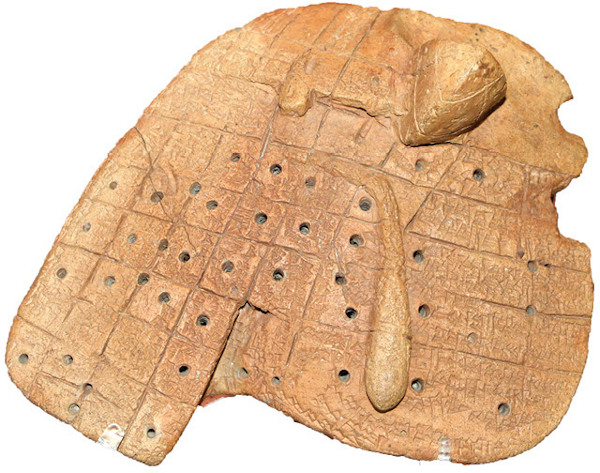
Looking at the color and configurations of sheep livers to foretell the future was was common in ancient Babylonia and Rome (see Eze 21:21 and note). This is a clay model of a liver, inscribed with omens, c. 1830–1530 bc.
©2013 by Zondervan
Return to the main text.
21:23 false omen. The leaders of Jerusalem, once submissive to Nebuchadnezzar but now in rebellion (2Ki 24:20), hoped that the result of the omen-seeking (vv. 21–22) was misleading.
21:25,29 whose day . . . has reached its climax. The same fate that awaits the Ammonites also awaits Judah’s king.
21:25 prince of Israel. Zedekiah (see note on 7:27).
21:26 turban. Only here is it mentioned as royal headwear. Elsewhere it is worn by priests (Ex 28:4, 37,39; 29:6; 39:28,31; Lev 8:9; 16:4) as a setting for the crown (Ex 28:36–37; 29:6; 39:31; Lev 8:9). It was made of fine linen (Ex 28:39; 39:28). lowly . . . exalted . . . exalted . . . brought low. A common biblical expression for the reversal of human conditions because of the intervention of the Lord (see 17:24 and note; 1Sa 2:7–8; Pr 26:27 and note; Lk 1:52–53).
21:27 A ruin! A ruin! . . . a ruin! Threefold repetition for emphasis (see Isa 6:3; Jer 7:4 and notes). The crown. Representing dominion (the kingdom of Judah). until he to whom it rightfully belongs shall come. The Messiah; probably an allusion to Ge 49:10 (see note there).
21:28 Ammonites. See v. 20. After judgment on Jerusalem, they too will be dealt with (see 25:1–7; see also Jer 9:26; 49:1–6; Am 1:13–15; Zep 2:8–11). their insults. See 25:3,6; cf. 36:15. A sword, a sword. Nebuchadnezzar’s (see vv. 9,19 and notes).
21:29 false visions . . . lying divinations. Apparently Ammon also had false prophets of peace (see v. 10 and note; 13:10; Jer 6:14; 8:11–12). it. The sword.
21:30–32 When the Lord has accomplished his purpose through the Babylonians, they too will come under his judgment for all their evil ways (see Jer 50:15, 27,29,31; 51:6,49; Hab 2:4–20; cf. Isa 10:5–19 and note on 10:12).
21:30 Let the sword return. Addressing Nebuchadnezzar (see note on 21:3–5).
21:31 brutal men. The people of the East, as in 25:4.
21:32 fuel for the fire. See 20:47 and note.
22:1–31 Ezekiel is instructed to confront Jerusalem (vv. 1–12) and the land of Judah (vv. 23–29) with all the sins they are guilty of and for which they were about to feel the fiery wrath of Yahweh (vv. 13–22,30–31). Under Manasseh, Amon and Jehoiakim, Jerusalem had become a city of idolatry and pervasive moral corruption (2Ki 21:2–26; Jer 22:13–17). In the land of Judah all who held power cruelly exploited the weak.
22:2 will you judge her? Cf. 20:4 and note. this city. Jerusalem, the usual focal point of Ezekiel’s prophecy (see 5:5 and note).
22:3 shedding blood . . . making idols. Two categories of sins are developed: social injustices and idol worship. idols. See note on 6:4.
22:6 princes of Israel. Leaders generally, not kings; contrast 21:12 with 19:1.
22:7 treated father and mother with contempt. See Mic 7:6 and note. Both passages are the opposite of what God commands in Ex 20:12 (see note there). foreigner . . . fatherless . . . widow. See Ex 22:21–27 and notes; Dt 10:18; 16:11,14; 24:17; 27:19; Ps 68:5–6 and note; 82:3; Isa 1:17 and note; 23; Jer 7:6; 22:3; Jas 1:27.
22:8 Sabbaths. A major concern in Ezekiel (see note on 20:12).
22:9 eat at the mountain shrines. See 18:6 and note. commit lewd acts. In their pagan worship practices (see Hos 4:14 and note).
22:10 violate women. Cf. 18:6 and note. Here the word for “violate” is very harsh, suggesting an abusive practice akin to rape.
22:11 detestable offense. All the sins mentioned in this verse were specifically forbidden in the law (Lev 18:7–20; 20:10–21; Dt 22:22–23, 30; 27:22).
22:12 you take interest and make a profit from the poor. See 18:8 and note.
22:13 strike my hands. In anger (21:14,17).
22:17–22 Jerusalem will become God’s “furnace” in which he melts down all those remaining in and around the city in order to cleanse away the “dross” (see Ps 12:6 and note).
22:25 princes. Ezekiel begins to speak plainly concerning the “dross” of vv. 18–22. All of Jerusalem’s leaders and people were included: princes (here), priests (v. 26), officials (v. 27), prophets (v. 28), people (v. 29). like a roaring lion. Cf. v. 27; 13:4; Zep 3:3.
22:26 distinguish between the holy and the common. One of the main duties of the priests (see 44:23 and note; see also Lev 10:10 and note). Sabbaths. See note on v. 8. I am profaned. See Lev 18:21 and note.
22:28 whitewash. See 13:10 and note.
22:29 people of the land. See 7:27 and note.
22:30 I looked for someone. Cf. Isa 59:16; 63:5 and notes. stand before me in the gap. See 13:5 and note. Some interpret the task here as prophetic intercession with God in behalf of the people (Ge 20:7; 1Sa 12:23; Jer 37:3; 42:2). Others interpret it as teaching, particularly calling the people to repentance. Cf. the task of the prophetic “watchman” (3:17–21; 33:1–6).
22:31 bringing down on their own heads all they have done. See note on Pr 26:27.
23:1–49 This extended allegory depicting in lurid colors the sins of Israel (similar to that found in ch. 16) climaxes the series of messages of judgment on Jerusalem and Judah begun in ch. 13 (see notes on 13:1–23; 18:1–32).
23:4 The older. See 16:46 and note. Oholah. Means “her tent,” probably referring to the fact that Samaria had its own unauthorized sanctuary. Oholibah. Means “My tent is in her,” probably referring to the Lord’s sanctuary in Jerusalem. Cf. the two sisters of Jer 3:6–12 and note on 3:7.
23:5 prostitution. Here represents political alliances with pagan powers—not idolatry as in ch. 16 (see Ex 34:15 and note). The graphic language of the chapter underscores God’s and Ezekiel’s disgust with Israel for playing the worldly game of international politics rather than relying on the Lord for her security—as clear a case of religious prostitution as idolatry. Assyrians. See 2Ki 15:19 and note.
23:8 in Egypt. Cf. 20:5–8. Israel’s entire history was marked by unfaithfulness. For her attachment to Egypt, see Ex 17:3; Nu 11:5, 18,20; 14:2–4; 21:5.
23:10 stripped her naked. A reference to the fall of Samaria to the Assyrians in 722–721 bc.
23:14 Chaldeans portrayed in red. Brightly painted military figures after whom Oholibah lusted. Jeremiah, too, noted red interior decorations with disfavor (Jer 22:14).
23:15 belts. Cf. Isa 5:27 for similar Assyrian military equipment.
23:20 genitals. See note on 16:26.
23:23 Babylonians . . . Chaldeans. Often identified with one another (see 1:3 and NIV text note there; 12:13), here distinguished (as in v. 15), probably because the Chaldeans were relative newcomers. Pekod. Aramaic people located east of Babylon. Shoa and Koa. Babylonian allies of uncertain origin and location.
23:24 their standards. Which were cruel and gruesome (v. 25).
23:25 jealous anger. See 16:38 and note. fire. See notes on 15:7; 20:47.
23:27 in Egypt. See note on v. 8.
23:31 cup. Filled with the anger of the Lord. To drink it was to die. For a development of the imagery, see Ps 16:5 and note; 75:8; Isa 51:17, 22; Jer 25:15 and note; 49:12; La 4:21; Ob 16 and note; Hab 2:16; Mt 20:22; 26:39; Rev 14:10 and note.
23:34 tear your breasts. Beating the breasts—a sign of mourning (see 21:12; see also Jer 31:19; Lk 23:48 and notes)—is here poetically intensified to the point of tearing them in a frantic attempt to find relief from intolerable suffering.
23:35 you have forgotten me. See 22:12; Jer 2:32 and note.
23:37 sacrificed their children. See note on 16:20.
23:38 defiled my sanctuary. See ch. 8. Sabbaths. See note on 22:8.
23:40 They even sent messengers for men. Possibly a reference to the Jerusalem summit meeting in Zedekiah’s time (Jer 27). you. Jerusalem. applied eye makeup. By daubing the eyelids with kohl, a soot-like compound, to draw attention to the eyes.
23:41 couch, with a table spread before it. Ready for a banquet (see Isa 21:5; also Pr 9:2).
23:42 drunkards. Drunkenness is consistently condemned in Scripture (see notes on Pr 20:1; Isa 5:11–13).
24:1–14 The series of messages beginning with ch. 13 (see note on 13:1–23) ends with a depiction of Jerusalem as a pot cooking over an open fire, concluding with words that echo the final words of the seventh message in this series (see 18:30; 24:14 and notes).
24:1 ninth year . . . tenth month . . . tenth day. Of King Zedekiah’s reign (2Ki 25:1): Jan. 15, 588 bc, some two and a half years after the preceding dated message (see 20:1 and chart); Ezekiel’s fourth date (1:2; 8:1; 20:1).
24:2 record this date . . . because. God revealed to Ezekiel what was happening in Jerusalem: the beginning of the siege.
24:3 rebellious people. The last occurrence of this condemning phrase in Ezekiel (2:5,6,8; 3:9,26–27; 12:2–3,9,25; 17:12). Jerusalem’s rebellion would soon be crushed. parable. Cf. 17:2. cooking pot. A reuse of the imagery found in 11:3–12. The cooking pot is Jerusalem (cf. 11:3 and note). In what follows, the imagery shifts from cooking the meat and bones in the pot (vv. 4–5) to burning away the impurities that adhere to the pot (vv. 6–8) and then repeats the cycle (vv. 9–10, cooking the meat and bones; vv. 11–12, burning off the encrusted impurities).
24:4 choice pieces. The people of Jerusalem who thought they were spared the exile in 597 bc because of their goodness (see 11:3 and note).
24:5 wood. Nebuchadnezzar’s siege equipment.
24:6 city of bloodshed. Cf. v. 9; 22:2–3. encrusted. Representing Jerusalem’s irredeemable situation. in whatever order it comes. After the siege of Jerusalem in 597, perhaps the Babylonians had cast lots to see whom they would take away into exile. Now everyone would go.
24:7 blood . . . on the bare rock. Jerusalem had brazenly left on display the blood she unjustly shed (cf. Isa 3:9). For uncovered blood, see Ge 4:10; Job 16:18 and notes; cf. Lev 17:13–14.
24:8 wrath. God’s wrath. What Jerusalem had done would be done to her (see 16:43 and note; see also 1Ki 8:32; Isa 3:1; cf. Ex 4:21; 21:23–25; Lev 24:17–22; Dt 19:21 and notes).
24:11 empty pot. Jerusalem, emptied of inhabitants, would be set to the torch in a vain, final effort at purification.
24:13 lewdness. See 16:1–63; 23:1–49 and notes.
24:14 The time has come. See 7:2–3 and note on 7:1–27. judged according to your conduct and your actions. See notes on Ro 2:1–16; 2:6–8; Rev 20:12.
24:15–27 Following the series of messages concerning God’s judgment on Judah (13:1—24:14), Ezekiel’s action upon the death of his wife serves to symbolize how the exiles would react to the fall of Jerusalem, just as his earlier symbolic actions symbolized the exile of the people of Jerusalem (see 12:1–28 and note). These two symbolic acts thus serve as a literary frame around this second series of messages in Ezekiel.
24:16 blow. Some swiftly fatal disease, one that often reached plague proportions (Ex 9:14; Nu 14:37). delight of your eyes. The object of loving attention (vv. 21,25)—apparently a conventional way of referring to a man’s wife (cf. Jdg 14:3: formally, “She is right in my eyes”; see also SS 8:10).
24:17 Keep your turban fastened. Mourners normally removed turbans and put dust on their heads (see Jos 7:6; 1Sa 4:12 and notes). sandals on your feet. To remove them showed grief (see 2Sa 15:30 and note). cover . . . mustache and beard. A gesture of shame (Mic 3:7). food of mourners. The funeral meal (see Jer 16:7 and note).
24:18 in the evening my wife died. She died the same day the temple was burned (Aug. 14, 586 bc; see vv. 25–27; 2Ki 25:8 and note; see also Introduction: Occasion, Purpose and Summary of Contents).
24:19 Then the people asked me. The third time the people responded to Ezekiel’s behavior (see 12:9; 21:7 and notes).
24:21 desecrate. By letting Nebuchadnezzar burn it down.
24:24 Ezekiel. The Lord speaks of Ezekiel in the third person. Elsewhere the prophet’s name occurs only in 1:3 (see note there). sign. See v. 27 and note on 12:6.
24:26 fugitive. The first of the exiles of 586 bc. news. About the siege—its beginning (verifying the accuracy of vv. 1–2) and its ending (see note on 33:21).
24:27 At that time. When the fugitive arrived from Jerusalem (see 33:21 and note). no longer be silent. The muteness that had been imposed on him at the beginning of his ministry was now lifted (see 3:26 and note).
25:1—32:32 Messages against the nations (see map). Frequently in the Prophets, God’s word of judgment on Israel is accompanied by messages of judgment on the nations (see note on Jer 46:1—51:64). These make clear that, while judgment begins “with God’s household” (1Pe 4:17), the pagan nations would not escape God’s wrath. Often these judgments are implicit messages of salvation for Israel (see 28:25–26 and notes) since the Lord’s victories over hostile powers remove enemies of his people or punish them for their cruel attacks on his people. In the case of Ezekiel, there are seven prophecies (the seventh of which has seven parts, each introduced by the phrase “The word of the LORD came to me”; see Introduction: Outline). The structure of these prophecies follows the pattern “Because [introducing the evil committed] . . . , therefore [introducing the judgment] . . . know that I am the LORD” (e.g., 25:3–7).
25:2 set your face. See note on 20:46. Ammonites. Ammon (part of modern Jordan) was immediately east of Israel (see 21:20 and note; see also Jer 9:26; 49:1–6; Am 1:13–15; Zep 2:8–11). For hostile Ammonite action during this time and later, see 2Ki 24:2; Ne 4:7.
25:3 Aha! A cry of malicious joy (cf. 26:2; 36:2; Ps 35:21–25).
25:4 people of the East. Probably nomadic tribes of the desert east of Ammon, though this could be a reference to Nebuchadnezzar and his army (21:31).
25:5 Rabbah. See note on 21:20. pasture . . . resting place. A common OT description of destroyed cities (Isa 34:13–15; Zep 2:13–15). The sites were returned to the conditions they were in before the cities were built, representing the undoing of human efforts.
25:6 clapped your hands. See 6:11 and note.
25:7 I will stretch out my hand against. See note on 6:14. plunder to the nations. Cf. 26:5; 34:28. wipe you out. Cf. v. 16.
25:8 Moab. Immediately to the south of Ammon, east of the Dead Sea (see Ge 19:36–38 and note; Isa 15–16; Jer 48; Am 2:1–3; Zep 2:8–11). Seir. Edom, a country south of Moab and south of the Dead Sea (see ch. 35, especially v. 15; 36:5; Isa 34:5–17; 63:1–6; Jer 49:7–11; Am 1:11–12). like all the other nations. Israel wanted to be like the other nations (see 20:32 and note).
25:9 flank of Moab. Lower hills rising from the Dead Sea, visible from Jerusalem. Beth Jeshimoth. A town in the plains of Moab. Baal Meon. A major Moabite town mentioned in an inscribed monument of Mesha, king of Moab (see chart). Kiriathaim. A city also mentioned in the Mesha inscription (cf. 2Ki 3:4–5 and note on 2Ki 1:1).
25:12 Edom. See note on v. 8 (“Seir”). took revenge. By not harboring Judah’s refugees after 586 bc (see Ob 11–14 and notes).
25:13 Teman. A district near Petra in central Edom (see Jer 49:7, 20; Am 1:12; Ob 9; Hab 3:3 and notes). Dedan. A tribe and territory in southern Edom (see 27:20; 38:13; Isa 21:13 and note; Jer 49:8).
25:15 Philistines. Inhabitants of the coastal plain along the Mediterranean west of Judah (1Sa 6:17; see note on Ge 10:14) who strove for control of Canaan until subdued by David. Their hostility to Israel continued, however (Isa 14:29–31; Jer 47; Am 1:6–8; Zep 2:4–7), until Nebuchadnezzar deported them.
25:16 Kerethites. Related to, if not identical with, the Philistines (see 1Sa 30:14 and note; 2Sa 8:18; 15:18; 20:7). coast. Of the Mediterranean.
26:1—28:19 A series of prophecies against Tyre, the chief seaport of Phoenicia (present-day Lebanon). Tyre was an island fortress that had an additional harbor on the mainland. After Nebuchadnezzar’s victory at Carchemish in 605 bc, Tyre acknowledged the hegemony of the Babylonian king, but in 594 bc it joined a coalition of states to throw off the Babylonian yoke (Jer 27:3). Ancient historians relate that Nebuchadnezzar laid siege to Tyre for 15 years (cf. 29:18 and note) and may have succeeded in once more establishing some kind of authority over it, but he did not succeed in destroying the city. The island fortress was not overrun until Alexander the Great conquered it after a seven-month siege in 332 bc (see notes on Isa 23:1; Zec 9:3). See photo.
26:1 eleventh month of the twelfth year . . . first day of the month. The fifth date in the book (1:2; 8:1; 20:1; 24:1); see chart. As the NIV text note indicates, the Masoretic Text (the traditional Hebrew text) does not have “month of the twelfth.” Thus it reads “eleventh year,” which dates from Apr. 23, 587, to Apr. 13, 586 bc. If this is the correct text, the prophecy must date from the end of that year, in the 11th (Feb. 13, 586) or the 12th month (Mar. 15, 586). But there is a problem with these dates: This prophecy describes Tyre’s gloating over the destruction of Jerusalem (v. 2), yet Jerusalem did not fall until July 18, 586 (see note on 2Ki 25:2–3), and was not burned until Aug. 14, 586 (see note on 2Ki 25:8)—several months after the date given here for Tyre’s celebration of the fact that Jerusalem “now . . . lies in ruins” (v. 2). To solve the problem, many interpreters believe that the probable reading of the original Hebrew text was “In the eleventh month of the twelfth year, on the first day of the month” and that the words “month of the twelfth” must have been inadvertently omitted by a copyist (hence the NIV reading). The restored reading would yield the date Feb. 3, 585, which would nicely fit the chronology in 33:21 (see note there). If, on the other hand, the Hebrew text that has come down to us is correct, then the Lord (through Ezekiel) is prophesying what Tyre’s response to Jerusalem’s fall will be and how the Lord, in turn, will judge Tyre.
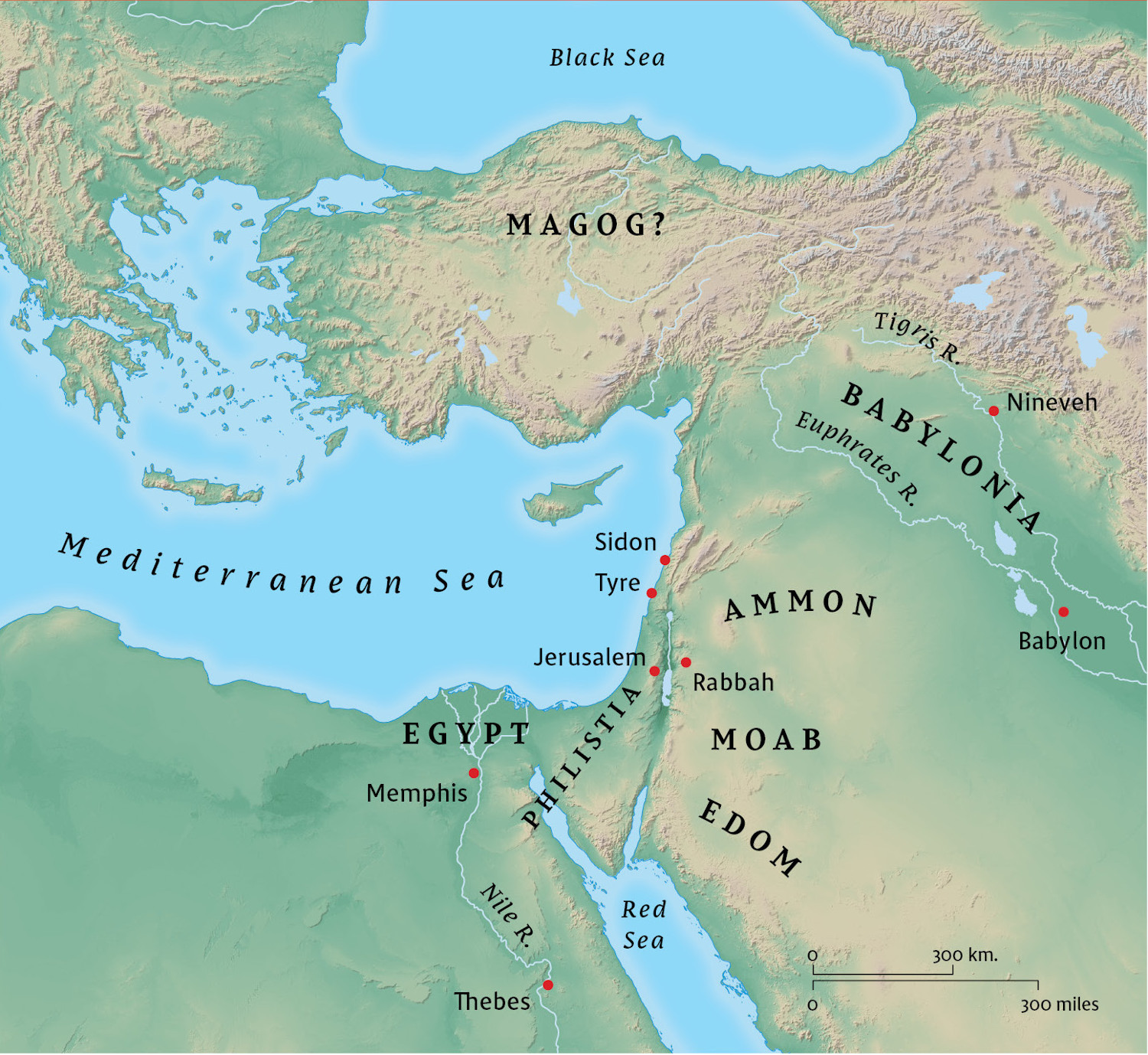
26:2 Tyre. For other prophecies against Tyre, see Isa 23; Jer 25:22; 47:4; Joel 3:4–5; Am 1:9–10; Zec 9:2–4. Aha! See note on 25:3. gate to the nations. Because of its geographic location, its political importance and the central role it played in international trade. The anti-Babylonian summit meeting was held there (Jer 27).
26:3 I am against you. See note on 5:8. like the sea casting up its waves. For invading armies likened to waves of the sea, cf. Isa 17:12–13. Since Tyre was mainly a fortified island, the metaphor is especially appropriate here.
26:4 The Lord did this through Alexander the Great (see note on 26:1—28:19).
26:5 a place to spread fishnets. See photo. plunder for the nations. Cf. 25:7; 34:28.
Fishermen pulling in nets with fish near Haifa, south of Tyre (Eze 26:5).
Library of Congress, LC-matpc-1538/www.LifeintheHolyLand.com
Return to the main text.
26:6 know that I am the LORD. See Introduction: Themes.
26:7 north. The direction from which Nebuchadnezzar would descend on Tyre after first marching his army up the Euphrates River valley rather than across the Arabian Desert (cf. Jer 1:13). I am going to bring. A clear indication of God’s sovereignty over the nations (cf. 28:7; 29:8). Nebuchadnezzar. The first of four references to him in Ezekiel (29:18–19; 30:10). He ruled from 605 to 562 bc, and his name means “O (god) Nabu, protect my son” or “O (god) Nabu, protect my boundary.” Jeremiah and Ezekiel both proclaimed that this pagan king would be used by God to do his work (see Jer 25:9 and note; 27:6).
26:8 siege. See note on 26:1—28:19.
26:14 never be rebuilt. Eventually fulfilled by Alexander’s devastating siege in 332 bc (see 26:1—28:19; Isa 23:1 and notes).
26:16 princes of the coast. Called kings in 27:35, they were probably trading partners with Tyre. lay aside their robes. Usually mourners tore their clothes (Job 2:12) and put on sackcloth, but cf. the king of Nineveh (Jnh 3:6). Clothed with terror. Because of political shock waves from the fall of such a powerful city (cf. 7:27; Ps 35:26; 109:29 and note).
26:17 lament. See note on 19:1.
26:19 ocean depths. The primeval, chaotic mass—the “deep” of Ge 1:2. Tyre’s collapse into the sea is described in almost cosmic terms.
26:20 pit. The grave, “the earth below” (see note on Ps 30:1). people of long ago. Those long dead (Ps 143:3; La 3:6). not return or take your place in the land of the living. As Israel would (37:1–14).
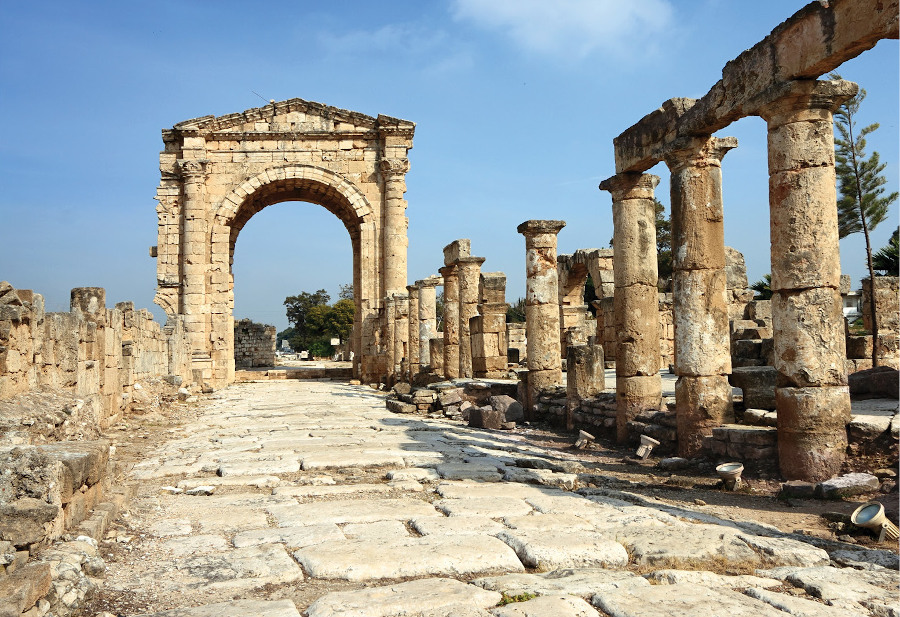
Colonnaded street in Tyre from the Roman period. Ezekiel 27 describes God’s judgment on Tyre.
diak/Shutterstock
Return to the main text.
27:2 lament. See note on 19:1.
27:3 I am perfect in beauty. See 28:12 and note; cf. 28:2 for a similar prideful statement. Since Tyre is described as a stately ship in the following verses, some translate, “You are a ship, perfect in beauty.”
27:4 brought your beauty to perfection. See v. 11.
27:5 Senir. Amorite name for Hermon, the Anti-Lebanon mountain (or range) famed for cedar.
27:6 Bashan. See note on 39:18. Cyprus. Translates Hebrew Kittim, originally the name of a town in southern Cyprus colonized by Phoenicia.
27:7 Elishah. A city on the east side of Cyprus; also the oldest name for Cyprus (but see note on Ge 10:4).
27:8 Sidon. A harbor city 25 miles north of Tyre, which sometimes rivaled her in political and commercial importance (see note on 28:21). Arvad. Another Phoenician island-city, off the Mediterranean coast and north of Sidon.
27:9 Byblos. An important ancient city on the coast between Sidon and Arvad (see 1Ki 5:18; see also map).
27:10 Persia. Or “Paras” (identification uncertain). Lydia. In Asia Minor; the Lydians are known to have served as mercenaries for the Egyptians. Put. Libya, in North Africa, west of Egypt. soldiers. The ship image is abandoned, and Tyre is now described literally—as a city (note references to walls and towers here and in v. 11), complete with a mercenary army gathered from many peoples.
27:11 Arvad. See note on v. 8. Helek. Cilicia, the mountainous region in southeast Asia Minor. Gammad. Either (1) northern Asia Minor or (2) a coastal town near Arvad.
27:12 Tarshish. Traditionally located on the coast of southern Spain, but the island of Sardinia has also been suggested. Passages such as 1Ki 10:22; Jnh 1:3 imply that it was a long distance from the Canaanite coast. The list of places in vv. 12–23 generally follows a west-to-east direction.
27:13 Tubal and Meshek. Both in Asia Minor.
27:14 Beth Togarmah. In eastern Asia Minor, present-day Armenia (38:6). chariot horses. Asia Minor was known for its horses (see 1Ki 10:28 and NIV text note there on “Kue”).
27:15 Rhodes. A large island off the southwest coast of Asia Minor that served as gateway to the Aegean islands. It was an early major trading center (Ac 21:1).
27:16 Aram. Modern Syria. Since Damascus, the capital of Aram, is mentioned in v. 18, perhaps Edom is meant here (see NIV text note; see also 25:12 and note).
27:17 Israel traded with you. In the past. Since 722–721 bc Israel had ceased to exist as a political state. Minnith. An Ammonite town, apparently famous for its wheat; “wheat from Minnith” possibly denoted a superior quality of wheat. balm. Gum or oil from one of several plants; a product of Gilead (see Ge 37:25 and note; Jer 8:22; 46:11).
27:18 Damascus. Capital of Aram (see note on v. 16; see also Isa 7:8). Helbon. A town north of Damascus, still in existence and still a wine-making center. The name occurs only here in the Bible. Zahar. Modern Ṣaḥra, an area northwest of Damascus, where grazing is still common today.
27:19 Izal. Perhaps the area between Harran and the Tigris. cassia. Similar to the cinnamon tree. The only other biblical mention of it is in Ex 30:24, where it appears in a list of aromatic plants. calamus. An aromatic reed.
27:20 Dedan. See note on 25:13.
27:21 Arabia and . . . Kedar. A general expression for the nomadic tribes from Aram to the Arabian Desert. For Kedar, see Isa 21:16 and note; 42:11; 60:7; Jer 49:28.
27:22 Sheba. See note on 23:42. Raamah. A city in southern Arabia.
27:23 Harran. A city east of Carchemish, in present-day eastern Turkey. It was well-known in ancient times as a center both for trade and for the worship of the moon-god, Sin. From here Abram moved to Canaan (see Ge 11:31 and note; 12:4). Kanneh. Of uncertain location, presumably in Mesopotamia. It is often identified with Kalno or Kalneh (Isa 10:9; Am 6:2). Eden. A district south of Harran, mentioned in connection with Harran in 2Ki 19:12 (see note there). Cf. Beth Eden in Am 1:5 (but see note there). Sheba. See note on 23:42. Ashur. Can mean the city, the country (Assyria) or the people (Assyrians). Here it is probably the city south of Nineveh that gave its name to the country. Kilmad. If a town, it is yet unidentified; presumably in Mesopotamia. Some read it as “all Media.”
27:25 Tarshish. See note on v. 12. The ship image is resumed (see notes on vv. 3,10).
27:26 east wind. Disastrous at sea (Ps 48:7) as well as on land (Jer 18:17). It perhaps symbolizes Nebuchadnezzar (as in 17:10; 19:12).
27:27 shipwrights. Carpenters who build and repair ships.
27:30 dust on their heads. See 26:16 for a similar scene. roll in ashes. Cf. Mic 1:10 and note.
27:31 shave their heads. Cf. 7:18; Isa 15:2 and note; 22:12. sackcloth. See notes on Ge 37:34; Rev 11:3.
27:36 horrible end . . . be no more. See 26:21; 28:19; see also note on Isa 23:1. Cf. photo.
28:2,8 in the heart of the seas. Emphasizes Tyre’s location as an island fortress and as a dominant force in maritime commerce.
28:2 ruler of Tyre. May refer to the city of Tyre as ruler, or to Ethbaal III, Tyre’s king (v. 12), not to be confused with Ethbaal I (1Ki 16:31). pride. Cf. 27:3; Pr 11:2 and note; 16:18; Ac 12:21–23. I am a god. Cf. the proud boasts of the king of Babylon in Isa 14:12–15 (see note there).
28:3 Daniel. See note on 14:14.
28:7 foreigners. The Babylonians; see next phrase.
28:8 pit. Cf. Job 33:22,24; see note on 26:20.
28:10 uncircumcised. Used here in the sense of barbarian or uncouth. The Phoenicians, like the Israelites and the Egyptians, practiced circumcision (31:18; 32:19).
28:12 lament. See note on 19:1. king of Tyre. Cf. v. 2, but see note on Isa 14:12–15. seal of perfection. For “seal,” see Hag 2:23, where Zerubbabel is called God’s “signet ring” (see note there). With biting irony Ezekiel depicts the proud king of Tyre as the first man created, radiant with wisdom and beauty. perfect in beauty. See 27:3 and note.
28:13 You were in Eden. Like Adam (Ge 2:15). Ezekiel continues to use imagery of the creation and the fall to picture the career of the king of Tyre (31:9,16,18). every precious stone. Unlike Adam, who was naked (Ge 2:25), the king is pictured as a fully clothed priest, ordained (v. 14) to guard God’s holy place. The 9 stones are among the 12 worn by the priest (Ex 28:17–20). (The Septuagint, the pre-Christian Greek translation of the OT, lists all 12.) settings and mountings. For the precious stones. on the day you were created. Cf. v. 15; Ge 5:2.
The King of Tyre and Similarities to Satan’s Fall
Just as with the depiction of the “morning star” (KJV “Lucifer”) in Isa 14:12 (see note there), some have wondered if Eze 28:11–19 with its address to the “king of Tyre” really has the devil in view behind him. Verses 1–10 speak to the “prince of Tyre,” another way of referring to the ruling king. Perhaps this section contains the prophecies against the human ruler, with the next section turning to the dark, invisible power behind the throne.
The language seems to go well beyond what would be true of a mere earthly king. He was “the seal of perfection, full of wisdom and perfect in beauty” (v. 12), “in Eden,” bedecked with every precious gem (v. 13), placed as a “guardian cherub” (v. 14), initially “blameless” (v. 15), but expelled after sinning (v. 16) and thrown down to earth (v. 17). The last of these declarations resembles NT references to Satan falling from heaven to earth (Lk 10:18; Rev 12:9).
On the other hand, the Hebrew for “king” (melek) everywhere else in Ezekiel refers to a human, earthly king. The structure and themes of Eze 28:1–10 and 11–19 are quite similar, suggesting they may refer to the same person. The Garden of Eden imagery more likely points to the role of Adam (and Eve) as God’s crowning creation, perfectly sinless with all the wisdom and beauty he actually needed. That cherubim were sent to guard Eden after the first human couple sinned and were expelled (Ge 3:24) makes it likely that the first human(s) had a similar guardianship before they fell. And the expulsion in Eze 28:16–17 is not from heaven to earth but from Eden to the rest of the world.
Still other imagery is taken from the king of Tyre’s role as the sovereign ruler and therefore chief trader and merchant in that kingdom (v. 18). The bejeweled garment (v. 13) suggests a priestly role (Ex 39:10–14) for the king, which Satan never had. The violence (v. 16) likewise is more appropriate for the human king than for anything we are told about Adam in the Garden. It would appear that the pride of wanting to be like God, which was Adam’s downfall (Ge 3:5) is that which has turned Tyre’s ruler into the corrupt, greedy tyrant that he has become (Eze 28:17–18) and ensured his awful destiny (v. 19).
Go to the Articles Index.
28:14 as a guardian cherub. Cf. v. 16. The Genesis account has cherubim (plural) stationed at the border of the garden after the expulsion of Adam and Eve (see Ge 3:24 and note). Some read “with” instead of “as.” holy mount of God. Cf. v. 16. This does not reflect the Genesis story. See Isa 14:13 for the figure of God dwelling on a mountain. fiery stones. The precious stones (v. 13; cf. Rev 4:1–6; 21:15–21).
28:15 You were blameless . . . till. The parallel to Ge 2–3 is clear (see Ge 6:9 and note; 17:1).
28:16 widespread trade . . . filled with violence. Tyre’s major crime.
28:17 threw you to the earth. God suddenly brought the proud and arrogant king of Tyre “back down to earth” by appointing Nebuchadnezzar to conquer him (cf. 29:18).
28:19 horrible end . . . be no more. See note on 27:36.
28:21 set your face. See note on 20:46. Sidon. See 27:8 and note.
28:22 I am against you. Possibly because of Sidon’s involvement in the Jerusalem summit conference (Jer 27:3; see note on 5:8). among you I will display my glory. The Lord’s glory would be recognized in Sidon’s punishment. am proved to be holy. See v. 25; Lev 10:3 and note.
28:23 Then you will know that I am the LORD. See note on 6:7.
28:24 painful briers. For references to Israel’s enemies as briers, see Nu 33:55; Jos 23:13.
28:25 When I gather . . . Israel. A frequent promise in Ezekiel and later (11:17; 20:34,41–42; 29:13; 34:13; 36:24; 37:21; 38:8; 39:27; Ne 1:9; Zec 10:8,10). my servant Jacob. Cf. 37:25. For the promise, see Ge 28:13; 35:12; Ps 105:10–11.
28:26 live there in safety. A perennial ideal that had become an especially meaningful promise (cf. 34:28; 38:8,11,14; 39:26; Lev 25:18–19; Jer 23:6; 32:37; 33:16)—closely related to God’s promised “rest” (see Dt 3:20 and note). houses . . . vineyards. Basic necessities of the good life (cf. Isa 65:21; Jer 29:5, 28; Am 9:14).