29:1—32:32 A series of seven prophecies against Egypt (for their dates, see notes below), most of which came during Jerusalem’s last years when the Egyptian pharaoh was offering encouragement to King Zedekiah to rebel against Nebuchadnezzar (17:15; Jer 37:5–8).
29:1 tenth year . . . tenth month . . . twelfth day. Jan. 7, 587 bc; the sixth date in Ezekiel (see 1:2; 8:1; 20:1; 24:1; 26:1); see chart. All the prophecies against Egypt are dated except one (30:1).
29:2 set your face. See note on 20:46. Pharaoh. Hophra, 589–570 bc (Jer 44:30).
 29:3 I am against you. See note on 5:8. great monster. Or “crocodile”; pictured as being in the Nile. See notes on Job 41:1; Ps 74:13–14; Isa 27:1. your streams. Nile delta and canals (cf. Isa 7:18; 19:6; 37:25). You say. Boasts inscribed on Egyptian monuments had become proverbial.
29:4 hooks. Cf. 19:4. fish of your streams. Egypt’s conquered territories or mercenaries.
29:5 food to the beasts. Particularly frustrating to the pharaoh’s great hopes for an afterlife, as symbolized by the pyramids and expressed in the Egyptian “Book of the Dead.”
29:6 You have been a staff of reed. Weak and temporary support. This is a comparison made earlier (see Isa 36:6 and note). Pharaoh Hophra briefly but unsuccessfully diverted the Babylonians from laying siege to Jerusalem (Jer 37:1–10).
29:8 sword. Nebuchadnezzar’s (see 5:2 and note).
29:10 Migdol. Probably in northern Egypt (see Jer 44:1 and note). Aswan. A town in southern Egypt. “From Migdol to Aswan” (30:6) probably indicated all Egypt, just as “from Dan to Beersheba” meant all Israel (see, e.g., Jdg 20:1; 1Sa 3:20 and notes).
29:11 forty years. Sometimes used to signify a long and difficult period (cf. 4:6).
29:14 Upper Egypt. Southern Egypt (see 30:14; Isa 11:11 and note; Jer 44:1,15).
29:17 The second prophecy against Egypt (see note on v. 1). twenty-seventh year . . . first month . . . first day. Apr. 26, 571 bc; the seventh date in Ezekiel (v. 1; 1:2; 8:1; 20:1; 24:1; 26:1); see chart. This is the latest date in Ezekiel; accordingly, this prophecy intrudes in the series of dated prophecies against Egypt, all the rest of which come within the years 587–585.
29:18 hard campaign. Nebuchadnezzar besieged Tyre for 15 years, from 586 to 571 bc (26:7–14). every head was rubbed bare. Probably from the leather helmets.
 29:19 I am going to give. God’s sovereignty over the nations is again proclaimed. See photo.

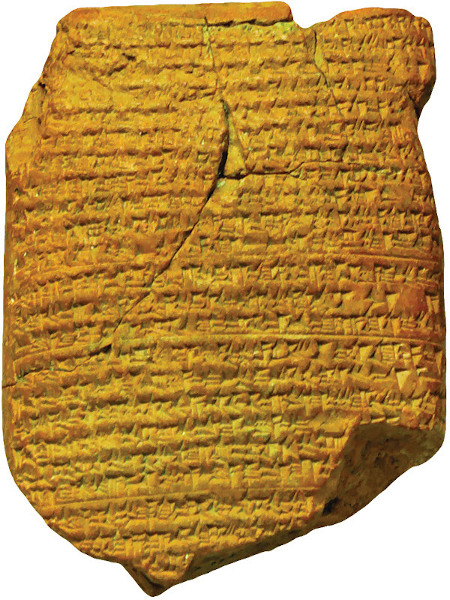
The Babylonian Chronicle describes Nebuchadnezzar’s battles from 605 to 595 bc, which include battles against Carchemish and Egyptian forces and the capture of Jerusalem. Ezekiel predicts Nebuchadnezzar’s victory over Egypt (Eze 29:19–20).
Todd Bolen/BiblePlaces.com
Return to the main text.
29:21 make a horn grow for. Revive the strength of (see NIV text note). open your mouth. Ezekiel’s muteness (3:26; 24:27) would be removed, which anticipates 33:22.
30:1 The third prophecy against Egypt (see note on 29:1). No date is given, but it was probably between January and April of 587 bc. Compare 29:1 with 30:20 (and see note on 30:21). Jerusalem was under siege at this time.
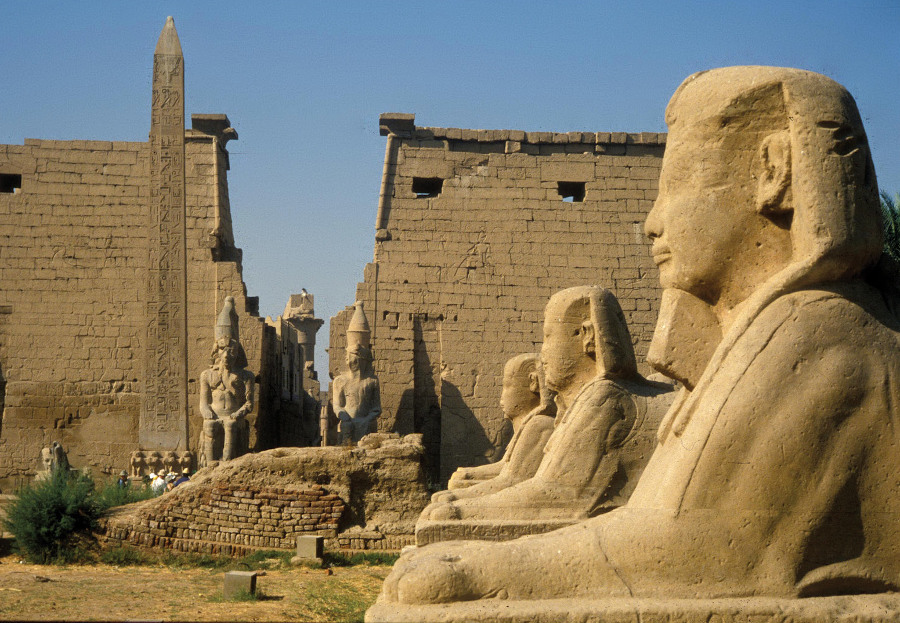
The monumental entrance to the Luxor Temple at Thebes. This temple, built by Pharaohs Amenhotep III (1387–1350 bc) and Rameses II (1279–1212 bc), was later besieged by Nebuchadnezzar.
Z. Radovan/www.BibleLandPictures.com
Return to the main text.
30:2–3 that day . . . the day of the LORD. The day of God’s coming in judgment (see 7:7 and note). Egypt’s judgment is announced.
30:3 the day is near. See 7:2–3,6 and note on 7:1–27; cf. Isa 13:6. day of clouds. Cf. Joel 2:2; Zep 1:15.
30:4 sword. Nebuchadnezzar’s (see 29:8 and note).
30:5 Libya. In North Africa (see note on 27:10). Lydia. See 27:10 and note. people of the covenant land. Apparently Jews living in Egypt (see Jer 44 and note on 44:1).
30:6 From Migdol to Aswan. See note on 29:10.
30:8 set fire to. See note on 20:47.
30:9 messengers . . . in ships. See Isa 18 for a similar prophecy against Cush, involving ships on the Nile.
30:11 most ruthless of nations. A common phrase for the Babylonians, who were known for their cruelty (2Ki 25:7).
30:13 idols. See note on 6:4. Memphis. Located 15 miles south of Cairo, Memphis was a former capital of Egypt and one of her largest cities. The following list of towns shows no discernible geographic pattern but is a literary device used to underscore the scope of the destruction (cf. Isa 10:9–11, 27–32; Mic 1:10–15; Zep 2:4). prince. King.
30:14 Upper Egypt. See 29:14 and note. Zoan. A city in northeast Egypt in the delta region; also called Tanis (see Isa 19:11; 30:4 and notes). Thebes. Capital of Upper Egypt; present-day Luxor and Karnak. See photos here and here.
30:15 Pelusium. A fortress in the eastern delta region of the Nile.
30:17 Heliopolis. Greek name (meaning “city of the sun”) for Hebrew On, located six miles northeast of Cairo (see note on Jer 43:13). Bubastis. At one time the capital of Lower (northern) Egypt; located 40 miles northeast of Cairo.
30:18 Dark. A common biblical metaphor describing ruin, destruction or death. Tahpanhes. In extreme northeast Egypt. Johanan, son of Kareah, and his men fled there after the murder of Gedaliah (Jer 43:4–7). covered with clouds. See v. 3 and note; 32:7.
30:20 The fourth prophecy against Egypt (see note on 29:1). eleventh year . . . first month . . . seventh day. Apr. 29, 587 bc; the eighth date in Ezekiel (1:2; 8:1; 20:1; 24:1; 26:1; 29:1,17); see chart.
30:21 broken the arm. Refers to Pharaoh Hophra’s defeat by Nebuchadnezzar the previous year (see notes on 29:6; Jer 37:10).
30:22 A fighter with a wounded arm would transfer his sword to his good arm. Breaking both of them would ensure he could not continue to fight.
30:24 put my sword in his hand. See note on 21:3.
30:25 my sword. See 5:2 and note.
31:1 The fifth prophecy against Egypt (see note on 29:1). eleventh year . . . third month . . . first day. June 21, 587 bc; the ninth date in Ezekiel (1:2; 8:1; 20:1; 24:1; 26:1; 29:1,17; 30:20); see chart.
31:3 Consider Assyria. A great nation that had fallen. In 609 bc Pharaoh Necho and his army marched north to help the Assyrians, who were reeling from Babylonian attacks. The effort ultimately failed, and Assyria passed from history. once a cedar. The beginning of another allegory (see Ezekiel’s allegorical use of the cedar in ch. 17). Lebanon. Known for its cedars (vv. 15–18; Jdg 9:15; 1Ki 4:33; 5:6; 2Ki 14:9; Ezr 3:7; Ps 29:5; 92:12; 104:16).
31:4 waters. The Tigris and Euphrates. deep springs. Or “the deep” (see note on 26:19).
31:6 birds of the sky. See 17:23 and note.
31:8 garden of God. Cf. 28:13.
31:11 ruler of the nations. Either Nabopolassar or Nebuchadnezzar. its wickedness. Pride (v. 10; Ge 11:1–8).
31:12 most ruthless. Babylonia (see note on 30:11).
31:14 the earth below . . . the realm of the dead. See note on Ps 30:1.
31:15 deep springs. See v. 4 and note. clothed . . . with gloom. See note on Ps 109:29.
31:16 nations tremble. As at Tyre’s fall (27:35; 28:19). were consoled. Because the mightiest of trees had joined them in the “realm of the dead” (Sheol). See note on Ps 30:1.
31:18 you. The Egyptian pharaoh. you, too. What had happened to Assyria would also happen to the pharaoh. uncircumcised. See note on 28:10.
32:1 The sixth prophecy against Egypt (see note on 29:1). twelfth year . . . twelfth month . . . first day. Mar. 3, 585 bc; the tenth date in Ezekiel (1:2; 8:1; 20:1; 24:1; 26:1; 29:1,17; 30:20; 31:1); see chart. If the Septuagint (the pre-Christian Greek translation of the OT) is followed (“eleventh year”), then the chronological order of the Egypt prophecies is preserved (and the date would be Mar. 13, 586). Cf. 29:1; 30:20; 31:1; see v. 17 and note.
32:2 lament. See note on 19:1. lion among the nations. A figure for royalty and grandeur (19:1–9). monster. See 29:3 and note. seas . . . streams. Canals of the Nile (see note on 29:3).
32:3 cast my net. Earlier it was Zedekiah over whom God’s net was thrown (12:13; 17:20; 19:8).
32:4 I will throw. God’s actions here are very similar to those described in 29:3–5.
32:7–8 A piling up of language that evokes the darkness associated with the day of the Lord (see Joel 2:2, 10,31 and note on 2:2; 3:15; Am 5:18 and note; Zep 1:15).
32:9 trouble the hearts. This and the next verse reflect the fear brought about whenever great world powers fall, reminding lesser nations that they are even more vulnerable. Cf. similar feelings aroused by Tyre’s fall (26:16–18; 27:35; 28:19).
32:10 my sword. See 5:2 and note.
32:11 king of Babylon. Nebuchadnezzar (cf. 21:19).
32:12 most ruthless of all nations. Babylonia (see note on 30:11). pride of Egypt . . . her hordes. The army in which Egypt took pride (cf. Am 6:8).
32:14 streams flow like oil. Their surface undisturbed by any form of life.
32:16 daughters of the nations. A world chorus of professional wailers (see Jer 9:17–18 and notes).
32:17 The seventh and last prophecy against Egypt (see note on 29:1). twelfth year . . . fifteenth day. No month is given (as in 26:1; 40:1). The whole year dates from Apr. 13, 586, to Apr. 1, 585 bc. The Septuagint (the pre-Christian Greek translation of the OT) suggests the first month, the 15th day of which would be Apr. 27, 586. See chart.
32:18 earth below. Same as “realm of the dead” (Sheol) in 31:15. daughters of mighty nations. See note on v. 16.
32:19 uncircumcised. See note on 28:10.
32:24 Elam. A country east of Assyria, in present-day Iran (see note on Isa 11:11).
32:26 Meshek and Tubal. Peoples and territories in Asia Minor (see 38:2 and note).
32:29 Edom. See note on Ge 36:1,8; see also Isa 34:5; Am 1:11–12; Introduction to Obadiah: Unity and Theme; map.
32:30 Sidonians. See note on 28:21.
33:1—48:35 A section depicting consolation for Israel (see Introduction: Outline).
33:1—37:28 Sermons and messages of comfort following the fall of Jerusalem. Interspersed are words of warning and judgment (e.g., 33:23–33; 34:1–19; 35).
33:1–20 At this juncture, when his message takes on a radically different theme, Ezekiel’s call to be a “watchman” for Israel is renewed (see 3:16–19 and note on 3:17).
33:2 your people. Fellow Israelites in exile with Ezekiel. sword. The invading army (cf. 5:2 and note). people of the land. See note on 7:27.
33:3 trumpet. An instrument made from a ram’s horn (see notes on Jos 6:4–5), used to warn of approaching danger (Ne 4:18–20; Jer 4:19; Am 3:6).
33:4 their blood will be on their own head. See note on 18:13.
33:6 their blood. Their life, blood being the life principle (see Ge 9:5; 42:22; Lev 17:11 and note).
33:10 Our offenses and sins. The first time the exiles expressed consciousness of sin. Previously they had blamed their fathers (18:2) and even God (18:19,25).
33:11 As surely as I live. See note on 5:11. I take no pleasure. The question of 18:23 (see note there) is now a statement. God’s basic intention for his creation is life, not death (see note on 16:6). Turn! The third call for repentance (14:6; 18:30).
33:12–20 Complete apostasy and thoroughgoing repentance are in view here, not temporary backsliding or temporary interest in the things of God (cf. 18:21–29 and notes).
33:14 what is just and right. See notes on 18:5; Ps 119:121.
33:15 give back what they took in pledge . . . return what they have stolen. See note on 18:7. decrees that give life. The purpose of God’s law was to foster and protect life (see note on 20:11). that person will surely live. The entire section is Ezekiel’s answer to the despairing question of v. 10.
33:17 The way of the Lord is not just. See note on 18:25.
33:21–33 When news of Jerusalem’s fall reaches Ezekiel, he must still reinforce his earlier word that “the end” (7:2) had truly come on the city (see note on 7:1–27); even the remnant eking out an existence in the ruins of the city will be destroyed.
33:21 twelfth year . . . tenth month . . . fifth day. Jan. 8, 585 bc, five months after the Jerusalem temple was burned; see chart. See also date in 2Ki 25:8, which in modern reckoning is Aug. 14, 586. The journey between Jerusalem and Babylon could be made in four months (Ezr 7:9). man who had escaped. The first of the exiles of 586 (see 24:26, “fugitive”; see also note there). He had “escaped” alive from the disaster at Jerusalem. The city has fallen! With this statement, all of Ezekiel’s previous prophecies were fulfilled and vindicated. He was then sent with a new mission: pastoral comfort.
33:22 no longer silent. See 24:27 and note.
33:24 people living in those ruins. The residents of Jerusalem not exiled in 586 bc. Abraham was only one man . . . But we are many. A boast by the unrepentant, similar to that of 11:15 (cf. Lk 3:8).
33:25 eat meat with the blood. Forbidden in Ge 9:4 (see note there; see also note on Lev 17:11). look to your idols. See note on 18:6.
33:26 each . . . defiles his neighbor’s wife. Violating Ex 20:14.
33:27 As surely as I live. See note on 5:11. sword . . . wild animals . . . plague. Cf. the threefold threat in 5:12; 7:15; 12:16 and the fourfold threat in 14:12–21 (see note on 5:16–17).
33:29 know that I am the LORD. See note on 6:7.
33:30–33 Words addressed to Ezekiel, but included here as a rebuke and admonition to the remnant from Jerusalem living in exile.
33:31 sit before you. As the elders had (8:1; 14:1). greedy. The people were waiting for Ezekiel to tell them how they could personally profit from the situation. They were not interested in God’s designs for them (see 22:13,27; cf. 36:26–27; Mt 15:8; 20:20–28).
33:32 one who sings. May indicate that Ezekiel chanted his prophecies (2Ki 3:15; Isa 5:1) and that people came to hear a performance but not to obey God’s message. they hear . . . but do not . . . practice. See 1Sa 15:22; Isa 29:13 and notes; Mt 21:28–32; cf. Jas 1:22–25.
34:1–31 The Lord gives the Israelites in exile the reassuring word that in the future he will himself be their Shepherd. In vv. 1–10 he denounces Israel’s worthless “shepherds” (leaders); in vv. 11–16 he promises to seek out his scattered flock; in vv. 17–22 he declares that he will judge the strong sheep who have oppressed the weak; in vv. 23–24 he promises to set over his flock his servant “David”; in vv. 25–31 he speaks climactically of his “covenant of peace” that will secure Israel’s blessed state.
34:2 shepherds of Israel. Those responsible for providing leadership, especially the kings and their officials (see 2Sa 7:7 and note; Jer 25:18–19), but also the prophets and priests (Isa 56:11; Jer 23:9–11). Ezekiel had earlier singled out the princes, priests and prophets for special rebuke (ch. 22). To call a king a shepherd was common throughout the ancient Near East (see note on Ps 23:1). For David’s rise from shepherd to shepherd-king, see Ps 78:70–71. For condemnation of the shepherds, cf. Jer 23:1–4.
34:3 eat . . . clothe . . . slaughter. Legitimate rewards for shepherds. Their crime was that they did not care for the flock.
34:4 searched for the lost. Cf. Jer 50:6; Zec 11:15–17; Mt 18:12–14; Lk 15:4; 19:10.
34:5 scattered. Often used by Ezekiel to describe Israel’s exile and dispersion (11:16–17; 12:15; 20:23,34,41; 22:15; 28:25). no shepherd. That is, no true shepherd (cf. Mk 6:34).
34:8 wild animals. Hostile foreign nations; but see v. 28, where they are contrasted.
34:10 I am against the shepherds. See note on 5:8.
34:11 I myself will search for my sheep. Having dealt with the faithless shepherds (vv. 1–10), the Lord committed himself to shepherd his flock (Jer 23:3–4).
34:12 from all the places. Babylonia was not the only place where the Israelites had gone (Jer 43:1–7). day of clouds and darkness. The day of the Lord that had come upon Israel when Jerusalem fell in the summer of 586 bc (see 7:7; 32:7 and notes).
34:13 I will bring them out. The promises of restoration—begun in 11:17 and repeated in 20:34,41–42; 28:25—find special emphasis in this part (chs. 33–39) of Ezekiel (see 36:24–32 and notes; 37:21; 38:8 and note; 39:27). mountains of Israel. Compare the tone of 6:3–7 with judgment now past (v. 12). The pasture on the mountains of Israel represents abundant life in a restored relationship with God.
34:14 I will tend them. See Isa 40:11; Jn 10:11.
34:16 the sleek and the strong. Those with power who had fattened themselves by oppressing the other “sheep” (vv. 17–22).
34:17 rams and goats. People of power and influence who were oppressing poorer Israelites. This prophetic word shows the same concern for social justice found elsewhere in the Prophets (see Isa 3:13–15; 5:8; Am 5:12; 6:1–7; see also Mic 2:1–5 and notes). Cf. the treatment of slaves Jeremiah observed (Jer 34:8–11).
34:23–24 my servant David. Referring to the Messiah, who is sometimes portrayed as a new David (here and in Isa 11:1) and sometimes as his descendant (see 37:24 and note; 2Sa 7:11–16; Ps 89:4, 20,29; Isa 9:7; see also Jer 23:5–6 and notes).
34:23 be their shepherd. See Isa 40:10–11 and notes.
34:24 prince. The Lord announced a kingdom where he would be King and the earthly king a “prince” (cf. 37:25; 44:3; 45:7,16–17,22; 46:2–18; 48:21–22).
34:25 covenant of peace. Cf. 37:26. All of God’s covenants aim at peace (Ge 26:28–31; Nu 25:12; Isa 54:10; Mal 2:5). This covenant (the “new covenant” spoken of by Jeremiah, 31:31–34) looks to the final peace, initiated by Christ (Php 4:7) and still awaiting final fulfillment. The “peace” (Hebrew shalom; see article) envisioned here is that of a restored relationship with God and the secure enjoyment of a life made full and rich through his blessings. None of the threats to life experienced under God’s judgments will mar this “peace” (compare vv. 25–29 with 5:16–17 and note). sleep in the forests. Often dangerous (Ps 104:20–21; Jer 5:6).
34:26 showers in season. Autumn rains, which signal the beginning of the rainy season, and spring rains, which come at the end (cf. Jer 5:24). showers of blessing. Blessing, the power of life promised to God’s people through Abraham (Ge 12:1–3), is beautifully symbolized in the life-giving effects of rain.
34:27 bars of their yoke. The bars were wooden pegs inserted down through holes in the yoke and tied below the animal’s neck with cords (Isa 58:6) to form a collar (cf. 30:18; Lev 26:13; Jer 27:2; 28:10–13). The entire picture represents foreign domination.
34:29 scorn of the nations. See 22:4.
34:30 their God . . . my people. Covenant language (see 11:20; Ex 6:7; Hos 1:9; Zec 8:8 and notes).
35:1–15 The counterpart of Israel’s restoration as the Lord’s people is the desolation of her enemies—of which Edom serves here as representative (36:5). Given the historic relationship between Israel and Edom (see notes on vv. 2,5), the spiteful treatment of Judah by the Edomites at the time of Jerusalem’s fall was especially reprehensible (see Isa 63:1–6 and notes; Introduction to Obadiah: Unity and Theme; see also notes on Am 9:12; Ob 8).
35:2 set your face against. See note on 20:46. Mount Seir. Edom (v. 15), Israel’s relative (Jacob and Esau being twins, Ge 25:21–30) and constant enemy, from whom brotherhood was sought but seldom found (cf. Am 1:11). Edom had to be dealt with before Israel could find peace (cf. Ge 32–33). See 25:12 and note.
35:3 I am against you. See note on 5:8.
35:5 ancient hostility. Beginning with Jacob’s deception of Isaac for Esau’s blessing (Ge 27; see especially v. 41) and continuing later (Nu 20:14–21; 2Sa 8:13–14; 1Ki 9:26–28). time of their calamity. Edom looted Jerusalem in 586 bc (see Ob 11–14 and notes).
35:6 as surely as I live. See note on 5:11. bloodshed . . . will pursue you. Retributive justice, in accordance with Ge 9:6 (see note there).
35:9 desolate forever. To experience no restoration like Egypt’s (29:13–16). know that I am the LORD. See Introduction: Themes.
35:10 These two nations. Israel and Judah. I the LORD was there. See 48:35 and note.
35:13 You boasted against me. Cf. Ob 12; Zep 2:8,10; also Ps 35:26; Jer 48:26,42.
35:15 A good example of the so-called law of retaliation (“eye for eye . . . ”; see Ex 21:23–25 and note), but see Jesus’ teaching in Mt 5:38–42.
36:1–38 How God, whose name has been profaned among the nations, will display his holiness in the restoration of his people: Verses 1–15 set forth God’s promise to cause the now desolate land (“mountains”) of Israel to prosper once more so that it is a place of blessing for Israel, thereby removing its disgrace; vv. 16–38 spell out God’s promise to cleanse and restore his now defiled and scattered people, thereby removing the disgrace that Israel has brought on his name and once again showing to all nations his holiness.
36:1–15 The comforting counterpart to ch. 6. Verses 1–7 announce God’s coming judgment on the nations for the scorn they heaped on the land of Israel; vv. 8–15 announce God’s future renewal of the prosperity of the land.
36:2 The enemy said of you. See 25:3; 26:2. Aha! See note on 25:3. ancient heights. The promised land, of which the elevated region between the Jordan River and the Mediterranean coast was the central core.
36:3 rest of the nations. All nations that in the past had conquered parts of Israel—until finally they took full possession.
36:4 mountains . . . hills . . . ravines . . . valleys. See 6:3 and note on 1:5.
36:5 my burning zeal. The Lord was personally offended by the ridicule of the nations because it was his special land they were mocking and plundering (see “my land” later in the verse). Edom. Singled out because of its long-standing hostility to Israel (see ch. 35, especially vv. 2,5 and notes).
36:6 jealous wrath. See 16:38 and note.
36:7 with uplifted hand. See 20:5 and note.
36:8 branches and fruit. Signs of productivity (17:8,23) and the Lord’s restored favor (Lev 26:3–5); to be contrasted with Edom’s desolation in 35:3,7,15. soon. Even as judgment fell, a speedy return of the exiles was announced.
36:9 I . . . will look on you with favor. Cf. Lev 26:9 for the identical clause in a similar context.
36:10 yes, all of Israel. In this chapter (as in 37:15–23) Ezekiel is speaking of the restoration of all Israel.
36:11 be fruitful and become numerous. Identical terminology to the divine blessing at creation (Ge 1:22,28; see Ge 8:17; 9:1,7) and the subsequent covenant blessing (Ge 17:6; 35:11; 48:3–4; Ex 1:7). know that I am the LORD. See note on 6:7. These words of recognition, used throughout the book to express God’s revelation through judgment, here point to God’s self-disclosure in salvation (see 35:9 and note).
36:12 live on you. The mountains of Israel are still being addressed. deprive them of their children. The mountains are poetically pictured as having contributed to the depopulation brought by the exile. This may refer to the fact that the promised land had contained the Canaanites and their religious centers (“high places”) that had led Israel astray and so brought God’s wrath down on his people (see 6:3 and note).
36:16–38 God’s restoration of his defiled and scattered people. Verses 16–23 remind Israel that the nation was exiled from her land because of her uncleanness and that her restoration is for the sake of God’s holy name; vv. 24–27 announce God’s renewal of defiled Israel and its effects on Israel (vv. 28–32) and on the nations (vv. 33–36); vv. 37–38 provide a concluding summary.
36:18 shed blood . . . defiled it with their idols. A summary reference to Israel’s social injustices and idolatrous religious practices (see 22:3 and note). idols. See note on 6:4.
36:20 they profaned my holy name. Because Israel had been removed from her land, it seemed to the nations that her God was unable to protect and preserve his people (see 20:9 and note; cf. Nu 14:15–16; 2Ki 18:32–35; 19:10–12).
36:22 It is not for your sake. Not because God did not care for Israel, but because his people did not deserve what he was about to do (cf. Dt 9:4–6). Statements like these demonstrate God’s pure grace. for the sake of my holy name. The reason given in ch. 20 for the withholding of divine punishment (20:9,14,22) is here given as a reason for divine restoration.
36:23 Then the nations will know that I am the LORD. The ultimate purpose of God’s plans with Israel is that the whole world may know the true God (see v. 11 and note). I am proved holy. See Lev 10:3 and note.
36:24–27 The four elements in the promised restoration: (1) return of the exiles (v. 24), (2) cleansing from sin (v. 25), (3) renewal of heart (v. 26) and (4) enablement by God’s Spirit to live God’s way (v. 27).
36:25 I will sprinkle clean water. For sprinkling with water as a ritual act of cleansing, see Ex 30:19–20; Lev 14:51; Nu 19:18; cf. Zec 13:1; Heb 10:22. I will cleanse. See v. 33; 37:23; Jer 33:8. idols. See note on 6:4.
36:26–27 Contains “new covenant” terminology (see Jer 31:33–34 and notes).
36:26 new heart. See notes on 11:19; 18:31. put a new spirit in you. Transform your mind and heart. Here and in 11:19 God declared that he would bring about the change. In 18:31 (see note there) he called on his people to effect the change. What he requires of his people he always provides. heart of flesh. “Flesh” in the OT is often a symbol for weakness and frailty (Isa 31:3); in the NT it often stands for our propensity toward sin that opposes God (as in Ro 8:5–8). Here it stands (in opposition to stone) for a pliable, teachable heart.
36:27 my Spirit. God bestows his Spirit to enable the human spirit to do his will (see 37:14 and note on 2:2). Verses 25–27 are closely paralleled in Ps 51:7–11 (see notes there).
36:28–32 The results of Israel’s renewal: restoration to prosperity (vv. 28–30) and a deep sense of shame for all her sins (vv. 31–32).
36:28 my people . . . your God. Covenant language (see 11:20 and note).
36:29 from all your uncleanness. From idol worship and moral defilement (v. 25; 37:23).
36:31 Then you will remember. God’s undeserved grace leads to recollection and repentance (cf. 6:9; 16:63; 20:43; Ps 130:4).
36:32 not . . . for your sake. See note on v. 22.
36:33–36 The impact of Israel’s restoration on the nations.
36:33 On the day. Connects the promise of cleansing (vv. 24–32) and the promise of repopulation (vv. 33–36).
36:35 garden of Eden. Cf. 28:13; 31:9. fortified. In contrast to 38:11.
36:36 nations . . . will know. See note on v. 23.
36:37–38 In summary, Israel’s full standing with God will be restored.
36:37 yield to Israel’s plea. Allowing petitions to come to him again, God reversed his earlier refusals to hear (cf. 14:3; 20:3,31).
36:38 as numerous as the flocks for offerings. See 1Ki 8:63; 1Ch 29:21; 2Ch 35:7 for the appropriateness of the comparison.
37:1–28 Although one of Ezekiel’s major visions, it surprisingly bears no date (see chart). However, it must have come to Ezekiel sometime after 586 bc. The symbolic vision given to Ezekiel (vv. 1–15) is immediately followed by a symbolic act that Ezekiel is instructed to perform (vv. 16–28). Both speak of the restoration of Israel, the central theme of chs. 34–36.
37:1 Ezekiel now received a message of hope, whereas previously he had heard God’s word of judgment. hand of the LORD. See note on 1:3. brought me out by the Spirit. See 3:12 and note. bones. Verse 11 interprets them as symbolizing Israel’s apparently hopeless condition in exile.
Dry Bones and Resurrection in Ezekiel
Ezekiel 37:1–14 is one of the most memorable prophetic visions in all of Scripture. The Lord’s Spirit takes Ezekiel to a valley filled with dry human bones. God commands him to prophesy to them that they will live again and, step-by-step, tendons, flesh and skin cover them. Finally, God breathes life into these bodies and they become a vast “army” of people (v. 10). The most natural understanding up to this point in the passage, as countless Jewish and Christian interpreters have recognized over the centuries, is resurrection of the dead.
The Lord continues, however, and explains to Ezekiel that the meaning of what he has seen is the resettlement of the people of Israel in their land (v. 14)—after the Babylonian exile in which they are now languishing. In the OT, explicit teaching about the bodily resurrection of all people is found only in Da 12:1–4, and many parts of the OT seem to know only of Sheol, a shadowy underworld, when they speak of life after death.
At the same time, Israel had neighbors who believed in bodily resurrection and an afterlife from as early a time as their slavery in Egypt (witness all the provisions left behind in the Pharaohs’ tombs). Job 19:26; Ps 16:10; 73:24 and Isa 26:19 all point in a similar direction. Elijah and Elisha had already raised dead people back to the life of this world (1Ki 17:17–24; 2Ki 4:32–37). And the language of Eze 37:12 here (“I am going to open your graves and bring you up from them”) is so vivid that it invites application to more than just the restoration of the people to the land, even if that is undoubtedly the primary meaning of the passage (see 37:14 and note).
Go to the Articles Index.
37:2 a great many bones. Symbolizing the whole community of exiles. very dry. Long dead, far beyond the reach of resuscitation (1Ki 17:17–24; 2Ki 4:18–37; but see 2Ki 13:21).
37:4 Prophesy to these bones. Ezekiel had previously prophesied to inanimate objects (mountains, 6:2; 36:1; forests, 20:47); now he prophesies to lifeless bones and “the breath” (v. 9). Cf. Jn 5:25 and note.
37:6 tendons . . . flesh . . . skin . . . breath. Lists of four items are common in Ezekiel (see note on 1:5).
37:8 but there was no breath. This visionary re-creation of God’s people recalls the two-step creation of Adam in Ge 2:7.
37:9 breath. See NIV text note on v. 5. four. See note on 1:5. slain. What Ezekiel saw was a battlefield strewn with the bones of the fallen (v. 10).
37:11 Our bones . . . cut off. A sense of utter despair, to which the vision offers hope.
37:12 graves. The imagery shifts from a scattering of bones on a battlefield (see note on v. 9) to a cemetery with sealed graves.
37:14 I will put my Spirit in you. See 36:27 and note. I will settle you in your own land. These words make it clear that the Lord is not speaking here of a resurrection from the dead but of the national restoration of Israel.
37:16 take a stick. Ezekiel’s last symbolic act involving a material object (cf. 4:1,3,9; 5:1). write on it. Zec 11:7 seems to be based on this passage in Ezekiel.
37:18 Won’t you tell us . . . ? The symbolic act successfully aroused the people’s curiosity (12:9; 21:7; 24:19).
37:19 they will become one in my hand. God would duplicate Ezekiel’s symbolic act by uniting the two kingdoms separated since Solomon’s death (1Ki 12). For similar prophecies of the reunion of Israel, see 33:23,29; Jer 3:18; 23:5–6; Hos 1:11; Am 9:11.
37:22 mountains of Israel. See 6:2–3; 34:13; 36:1. one king. Only here and in v. 24 is the word “king” used of the future ruler. Usually “prince” is used (see note on 34:24), as in v. 25. See 7:27 and note; see also 44:3; 45:7–9 and frequently in chs. 45–48, where the ruler in the ideal age is always referred to as “prince.”
37:23 idols. The old and basic offense (see note on 6:4). backsliding. Cf. Jer 2:19; 3:22. cleanse. Cf. 36:25 for the same notion. my people . . . their God. See 11:20 and note.
37:24–26 These verses appear to recall the Davidic covenant (v. 24a), the Sinaitic covenant (v. 24b) and the Abrahamic covenant (v. 25)—all of which will be fulfilled in the “covenant of peace” (v. 26).
37:24 My servant David. As in 34:23–24 (see note there) the coming Messianic ruler is called David because he would be a descendant of David and would achieve for Israel what David had—except more fully. king. See note on v. 22. shepherd. As in 34:23 the coming ruler is likened to a shepherd who cares for his flock (cf. Jn 10, especially v. 16).
37:25 my servant Jacob. See 28:25 and note.
37:26 covenant of peace. See vv. 24–26; 34:25 and notes. everlasting covenant. See note on 16:59–63. The phrase occurs 16 times in the OT, referring at times to the Noahic (Ge 9:16), the Abrahamic (Ge 17:7, 13,19), the Davidic (2Sa 23:5) and the “new” (Jer 32:40) covenants. Cf. the covenant with Phinehas (Nu 25:12–13). put my sanctuary among them. As he had done before. This word is further developed in Ezekiel’s vision of the future age, in which the rebuilt sanctuary would have central position (chs. 40–48). See vv. 27–28 and map.
37:27 their God . . . my people. See note on Zec 8:8.
37:28 when my sanctuary is among them forever. Cf. Rev 21:3 and note.
38:1—39:29 The great battle of the ages, when the future restoration of Israel under the reign of the house of David (ch. 37) evokes a massive coalition of world powers to destroy God’s kingdom. The vast host that comes against Jerusalem will end up as dead bodies strewn over the fields of the promised land, which will become the cemetery of all the enemy hordes that invade it (cf. ch. 39). Three prophecies against Gog (38:1–13,14–23; 39:1–16) are followed by the depiction of a great feast in which the enemy warriors are described in terms of sacrificial animals (39:17–20). Two final words put this great battle in the context of God’s ways with Israel in exile and restoration: (1) The nations will then know that Israel was carried into exile not because her God was incapable of protecting his own but because he had punished her for being unfaithful to him (39:21–24), and (2) Israel’s restoration following her punishment will show the nations that her God is truly the Holy One (39:25–29).
Ezekiel’s description of the battle between “Gog, of the land of Magog” (together with the “many nations” allied with him) and God’s people parallels the final, eschatological battle between the enemies of God and his people described in Rev 19:11–21. For this reason, many interpreters understand Eze 38–39 to be referring to a time of “great tribulation” associated with the end of this age, when the Lord will return, achieve complete victory over his enemies and those of his people, and establish his kingdom. Both passages emphasize the fact that no matter how vast and seemingly overwhelming are the forces of evil, the ultimate victory belongs to God.
38:1 This statement, repeated often for receiving God’s word, stands as an introduction to chs. 38–39, which are a unit.
38:2 Son of man. See note on 2:1. set your face. See note on 20:46. Gog. Apparently a leader or king whose name appears only in chs. 38–39; 1Ch 5:4; Rev 20:8. Several identifications have been attempted, notably Gyges, king of Lydia (c. 660 bc). Possibly the name is purposely vague, standing for a mysterious, as yet undisclosed, enemy of God’s people. of the land of Magog. In Ge 10:2; 1Ch 1:5 Magog is one of the sons of Japheth, thus the name of a people. In Eze 39:6 it appears to refer to a people. But since the prefix ma-can mean “place of,” Magog may here simply mean “land of Gog.” Israel had long experienced the hostility of the Hamites and other Semitic peoples; the future coalition here envisioned will include—and in fact be led by—peoples descended from Japheth (cf. Ge 10). chief prince. Military commander-in-chief. The NIV text note gives the possible translation “prince of Rosh,” and if it is correct, Rosh is probably the name of an unknown people or place. Identification with Russia is unlikely and in any case the Hebrew word rosh elsewhere always means “head” or “chief.” Meshek and Tubal. These sons of Japheth (see Ge 10:2 and note; 1Ch 1:5) are probably located in eastern Asia Minor (cf. 27:13; 32:26). They are peoples and territories to the north of Israel (cf. vv. 6,15; 39:2). As in the days of the Assyrians and Babylonians, the major attack will come from the north.
38:3 I am against you. See note on 5:8.
38:4 I will turn you around. Emphasis is on the fact that God is in complete control of all that is to follow. put hooks in your jaws. As with the pharaoh in 29:4, Gog is likened to a beast led around by God.
38:5 Cush. See NIV text note. The invading forces from the north (see v. 2 and note) are joined by armies from the south. Put. Libya.
38:6 Gomer. Another of Gog’s northern allies (see note on v. 2), mentioned in Ge 10:3 and 1Ch 1:6 as one of the sons of Japheth. According to non-biblical sources, these peoples originated north of the Black Sea. Beth Togarmah. See note on 27:14. According to Ge 10:3 and 1Ch 1:6, Togarmah is one of the children of Gomer.
38:8 After many days . . . In future years. After all the events of Israel’s restoration described in chs. 34–37 are completed.
38:9 like a cloud. In Jer 4:13 Jeremiah similarly describes an invasion from the north.
38:10 On that day. A phrase also common to other prophetic writings; here it refers to the day of Gog’s invasion of Israel. thoughts will come into your mind. The divine initiative (v. 4) is paralleled, as it often is in Scripture, by human action (cf. Dt 31:3; Isa 10:6–7). Sudden unprovoked ideas are often from the Lord, though we may not automatically attribute all new thoughts to him. evil scheme. A raiding expedition (v. 12).
38:11 land of unwalled villages. Speaks of a blissfully peaceful, ideal future time when walls will no longer be needed. See Zec 2:4–5 (and notes), which assumes, as does this passage, that the Lord alone is sufficient protection (cf. 36:35–36).
38:12 center of the land. The Hebrew for “center” also means “navel,” a graphic image for the belief that Israel was the vital link between God and the world (the idea occurs also in 5:5). Since the Hebrew for “land” can also mean “earth,” theologically Jerusalem is both the center of the land of Israel and the center of the world.
38:13 Sheba. Southwest corner of the Arabian peninsula (modern Yemen), known for trading (Job 6:19; see 23:42; 27:22; Ge 10:28 and note). Dedan. See note on 25:13. Tarshish. See note on 27:12.
38:16 I am proved holy. See Lev 10:3 and note.
38:17 You are the one I spoke of. Probably a general reference to earlier messages of divine judgment on the nations arrayed against God and his people (see note on v. 2, “Gog”).
38:19 earthquake. Signaling the mighty presence of God, who comes to overwhelm the great army invading his land.
38:20 The fourfold listing of the animal world indicates the totality of nature (see note on 1:5; cf. Ge 9:2; 1Ki 4:33; Job 12:7–8 for similar listings).
38:21 I will summon a sword. God’s sword of judgment (see 5:2 and note). Every man’s sword will be against his brother. The coalition of Israel’s enemies will turn on itself, as did the armies that attacked Judah in the time of Jehoshaphat (2Ch 20:22–23).
38:22 The list of divine weapons suggests that God will intervene directly, without the benefit of an earthly army.
39:1–16 The same basic events as those of ch. 38 are described, though some new details are added.
39:1 Gog, chief prince of Meshek. See note on 38:2.
39:2 from the far north. As in 38:6,15.
39:3 bow. Cf. Jer 6:23. The Lord will disarm Israel’s enemies before they can shoot an arrow.
39:4 food to all kinds of carrion birds. A theme expanded in vv. 17–20.
39:6 I will send fire. See 20:47 and note.
39:7 no longer let my holy name be profaned. See Lev 18:21 and note. the Holy One. See Lev 11:44 and note.
39:9 seven. A symbolic number. The seven years may indicate that the land needs a sabbatical rest to recover for the invader’s devastation, along with suggesting the finality of this great battle against God’s people, though some understand “seven years” literally also.
39:11 valley. Probably that of Jezreel/Megiddo, which runs from the Mediterranean in the west to the Jordan River in the east (see note on Hos 1:5; see also map). the Sea. Probably the Mediterranean. Hamon Gog. See NIV text note.
39:12 seven. Cf. v. 9 and note. cleanse the land. Ritual purity is a basic element in Ezekiel’s theology (22:26; 24:13; 36:25,33; 37:23). Corpses were especially unclean (Lev 5:2; 21:1,11; 22:4; Nu 5:2; 6:6–12; 19:16; 31:19).
39:13 people of the land. See 7:27 and note, though here a special class may not be implied.
39:14 People will be continually employed. After the seven-month burial period observed by all the people, special squads will be hired full-time to ensure total cleansing of the land—by marking for burial any human bones that may have been missed. Total ritual purity is the aim.
39:17–20 These verses involve a restating of vv. 9–16, employing a different figure of speech (see Isa 34:6 and note; Jer 46:10; Zep 1:7). The metaphor of sacrifice suggests a consecration to the Lord in judgment, as with Jericho (see Jos 6:17 and NIV text note there).
39:18 You will eat the flesh of mighty men. A gory description of what birds of prey commonly do (see previous note and Rev 19:17–21). as if they were. The bodies of the victims are compared to animals commonly used for sacrifices. Bashan. Rich pastureland east of the Sea of Galilee, known for its sleek cattle (Dt 32:14; Ps 22:12; Am 4:1) and its oak trees (27:6; Isa 2:13).
39:19 eat fat . . . drink blood. Further indication that this is the Lord’s sacrificial feast, in that fat and blood were normally reserved for God (see 44:15; see also Lev 3:16; 1Sa 2:15; Isa 34:6 and notes).
39:20 my table. Sacrificial altar. See 40:38–43 and 41:22 for description of the tables in the new temple.
39:21 my glory. God’s visible presence in the world (see note on 1:28). Here that visibility is due to divine intervention in history.
39:22–23 the people of Israel will know . . . And the nations will know. As God had made himself known to Israel and the nations through his saving acts in Israel’s behalf (see Ex 6:7; 7:5,17; 10:2; 14:18; 16:6–7,12; Jos 3:10; 4:24; cf. Jos 2:9–11; 5:1), so now Israel and the nations see him at work as he judges his people for their sin (see v. 27; 6:7 and note).
39:23 I hid my face. Expression of divine displeasure (see Ps 13:1 and note; 30:7; Isa 54:8; 57:17).
39:24 their uncleanness and their offenses. Spelled out throughout chs. 6–24, especially in ch. 22 (see note on 22:1–31).
39:25 Jacob. The nation of Israel, as in 20:5. my holy name. See 20:9 and note.
39:26 They will forget their shame. The remembrance of shame previously called for (6:9; 20:43; 36:31) is here erased.
39:27 I will be proved holy through them. God will reveal himself anew in a restored, holy people (see Lev 10:3 and note).
39:28 know that I am the LORD. See note on vv. 22–23.
39:29 I will pour out my Spirit. The gift of God’s enabling and life-giving Spirit (see 36:27; 37:14; see also notes on 2:2; Joel 2:28; Zec 12:10).
40:1—48:35 The restoration of Israel as a purified people calls for a purified land and a new order in the commonwealth of the people of God. This is the subject of Ezekiel’s last vision, which presents an idealized picture of the new order to be put in place. For the basic outline of the vision’s various topics, see Introduction: Outline under “The New Order for Purified Israel,” as well as the summary (overview) notes below.
40:1–47 Restoration of the temple area.
40:1 twenty-fifth year . . . beginning . . . tenth. Apr. 28, 573 bc. of our exile. All the dates in the book of Ezekiel (see chart) are reckoned from the 597 exile, but only here and in 33:21 is the exile specifically mentioned (1:2). the beginning of the year. Hebrew Rosh Hashanah, the Jewish New Year festival. It had long occurred in the fall (in either September or October), but since throughout the book Ezekiel uses a different and older religious calendar, the spring date as given above is correct (see note on Lev 23:24). hand of the LORD was on me. See note on 1:3.
Ezekiel chs. 40–48 depict in elaborate detail a rebuilt temple for Israel in a renewed land and holy city, with the people given meticulous commands for its proper use, especially at festival times. Interpreters have understood this vision in several different ways over the centuries. The main options have been: (1) It remains a picture of what will literally occur in Jerusalem at some future point in this world’s history. (2) It would have been part of Israel’s literal future, but they forfeited it through their disobedience. (3) It will still come about but during a millennial kingdom on earth after Christ returns. (4) It is metaphorically fulfilled in the church of Jesus Christ. (5) It is fulfilled in the picture in Rev chs. 21–22 of a new Jerusalem in the new heavens and new earth of the eternal state.
The more literal interpretations better explain the massive amount of detail these chapters contain. But the primary distinctive of the temple was as the one place God designated for animal sacrifice for the forgiveness of sins, and it is hard to imagine God reinstituting this after Jesus became the once-for-all sacrifice for all humanity’s sins (Heb 9:24–28). Paul describes the church of Jesus Christ as God’s temple (1Co 3:16–17; Eph 2:21), but again the amount of detail here in Ezekiel is difficult to square with that interpretation. Perhaps the best approach is (5), especially in light of numerous parallels between these chapters and Rev chs. 21–22 (a prophet taken by a heavenly guide to a high mountain, seeing a new earth with Jerusalem at its heart, with the glory of the Lord within it, as he lives with his people in perfect shalom). Above all, the city itself is a perfect cube (21:16), just as Ezekiel’s temple was, which explains why there is no literal temple in the new Jerusalem (v. 22).
Go to the Articles Index.
Ezekiel uses a long or “royal” cubit, about 21 inches or 53 centimeters (“cubit and a handbreadth,” Eze 40.5) as opposed to the standard Hebrew cubit of about 18 inches or 46 centimeters.
Scripture describes a floor plan but provides few height dimensions. This artwork shows an upward projection of the temple over the floor plan. This temple existed only in a vision of Ezekiel (Eze 40.2) and was never actually built as were the temples of Solomon, Zerubbabel and Herod, but some premillennial interpreters believe that it will be built in the future (see article).
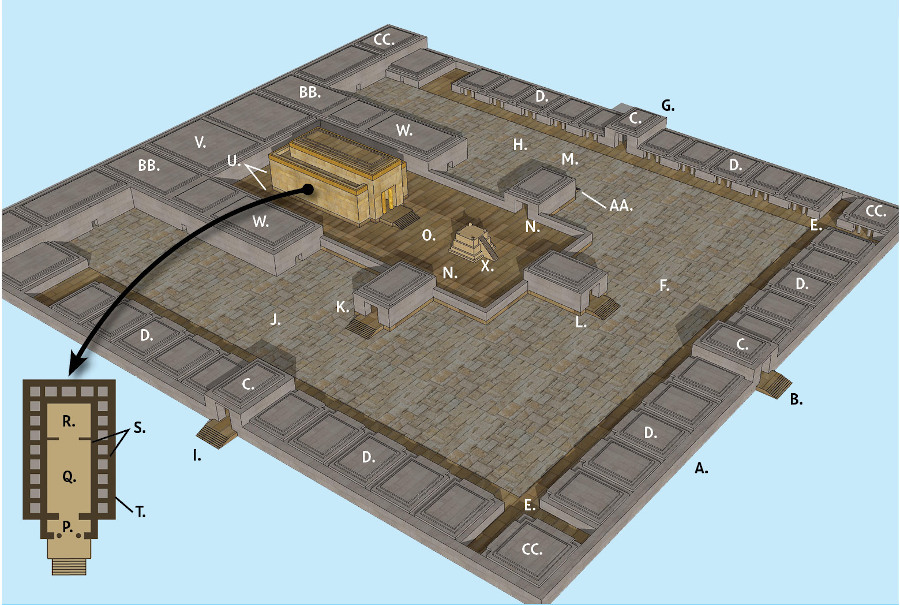
C. Portico (40:8)
D. Outer court (40:17)
E. Pavement (40:17)
F. East inner court (40:19)
G. North gate (40:20–22)
H. North inner court (40:23)
I. South gate (40:24–26)
J. South inner court (40:27)
K. Gateway (40:28–31)
L. Gateway (40:32–34)
M. Gateway (40:35–38)
N. Priests’ rooms (40:44–45)
O. Court (40:47)
P. Temple portico (40:48–49)
Q. Outer sanctuary (41:1–2)
R. Most Holy Place (41:3–4)
T. Base (41:8)
U. Open area (41:10)
V. West building (41:12)
W. Priests’ rooms (42:1–10)
X. Altar (43:13–17)
AA. Rooms for preparing sacrifices (40:39–43)
BB. Ovens (46:19–20)
CC. Kitchens (46:21–24)
© 2011 by Zondervan. All rights reserved.
Go to the Models Index.
40:2 visions of God. Introduces all three of Ezekiel’s major visions (1:1; 8:3). very high mountain. Mount Zion, also seen as extraordinarily high in other prophetic visions (17:22; Isa 2:2; Mic 4:1; Zec 14:10). Height here signifies importance, as the earthly seat of God’s reign. on whose south side. With the city located on its southern slopes, the mountain is to the north (cf. Ps 48; see Ps 48:2 and note).
40:3 like bronze. Indicates that the man was other than human. in the gateway. Presumably of the outer court (vv. 17–19). linen cord. Used for longer measurements, such as those in 47:3. measuring rod. Used for shorter measurements—about ten feet and four inches long.
40:5 wall completely surrounding the temple area. Separating the sacred from the secular. six long cubits. In using the long cubit (seven handbreadths, or about 21 inches), which was older than the shorter cubit (six handbreadths, or about 18 inches), Ezekiel was returning to more ancient standards for the new community (2Ch 3:3).
40:6 east gate. The gate of the outer court. The three gates (east, north, south) of the outer court were similar to the three in the inner court (v. 32), having six alcoves for the guards (three on each side) and a portico (vv. 8–9). Comparable gate plans have been discovered at Megiddo, Gezer and Hazor, all dating from the time of Solomon (see 1Ki 9:15 and note). The guards kept out anyone who might profane the temple area (Ezr 2:62). climbed its steps. The first of three sets of stairs leading to the temple. This one had seven steps (v. 22); the next one (inner court), eight (v. 31); the last (temple), ten (v. 49; see NIV text note there)—possibly indicating increasing degrees of “holiness” (sacredness).
40:9 portico of the gateway faced the temple. The reverse position of the porticoes of the inner court gates, which faced away from the temple (v. 34).
40:10 three alcoves. The alcoves for the guards, mentioned in v. 7.
40:16 palm trees. As in Solomon’s temple (see 1Ki 6:29, 32,35 and note on 6:29).
40:17 thirty rooms. The exact location of these rooms is not given. They were probably intended for the people’s use (see Jer 35:2,4 and note on 35:2).
40:19 hundred cubits. Over 170 feet (see note on v. 5) separated the outer wall from the inner wall and was the width of the outer court.
40:20 north gate. Both it and the south gate (v. 24) were identical to the east gate (see note on v. 6).
40:22 Seven steps. See note on v. 6.
40:28 south gate. Of the inner wall, which is not described but must be assumed. it had the same measurements as the others. In both the outer walls (see note on v. 6).
40:38 portico in each of the inner gateways. The porticoes of the inner gateways were on the side of the outer court, facing away from the temple. washed. The inner parts and the legs were washed (Lev 1:9).
40:39 burnt offerings. Probably one of the oldest kinds of sacrifice. The entire animal was burned in consecration to God (see note on Lev 1:3). sin offerings and guilt offerings. Discussed in Lev 4–7 (see notes there). The fellowship offerings, which were more festive, are notable by their absence from this listing (see 43:27; 45:17; 46:2,12; see also chart).
40:46 sons of Zadok. For the distinction between the sons of Zadok and the Levites, see the fuller discussion in the notes on 44:15–31.
40:47 altar. Described in 43:13–17 (see notes there).
40:48—42:20 Description of the new temple (see diagram).
40:48 portico. Similar to the portico in Solomon’s temple but slightly larger (1Ki 6:3).
40:49 pillars. These pillars also appear in Solomon’s temple, where they are called Jakin and Boaz (see 1Ki 7:21 and NIV text notes).
41:1 main hall. Or nave, the largest of the three rooms comprising the temple (1Ki 6:3–5). This main hall was identical in size to Solomon’s (1Ki 6:17).
41:3 he went into the inner sanctuary. Only the angel, not Ezekiel, entered the Most Holy Place. Lev 16 forbids any but the high priest to enter it, and then only once a year (see Heb 9:7 and note). six cubits wide. Note the progressive narrowing of the door openings as one approaches the inner sanctuary (40:48, 14 cubits; 41:2, 10 cubits; here, 6 cubits).
41:4 Most Holy Place. See notes on Ex 26:31–35; 27:12–13; 1Ki 6:2,23; 2Ch 3:8; Ezr 6:15; Ps 28:2; Mt 27:51; Heb 8:2; 10:19–20.
41:6 thirty on each level. These 90 side rooms were probably storerooms for the priests, possibly for the tithes (see Mal 3:10 and note).
41:13 hundred. The 100-cubit symmetry stood for perfection.
41:16 everything . . . was covered with wood. As in Solomon’s temple (1Ki 6:15).
41:18 cherubim. Who served as guards (cf. Ge 3:24 and note). These, as opposed to those mentioned in ch. 10 (see note on 1:5), have only two faces—a man’s and a lion’s (1Ki 6:29, 32,35).
41:22 wooden altar. As the altar of burnt offering stood outside the temple proper (43:13–17), so a smaller altar (3’5” square by 5’ high) stood outside the Most Holy Place. It served as a table, no doubt to hold the bread of the Presence (see Ex 25:30; Lev 24:5–9; 1Ki 7:48 and notes). Ezekiel makes no mention of an altar of incense or of lampstands, such as were found in Solomon’s temple and in the tabernacle before it. Also not included are the “Sea” (1Ki 7:23) and the ark of the covenant (see notes on Ezr 6:15; Jer 3:16). Because God is fully present and there is no longer any danger, these symbolic foreshadowings are no longer necessary.
41:23 double doors. Folding doors, so that the entry could be made still narrower.
42:1 rooms opposite the temple courtyard. Their function is described in vv. 13–14. They have no parallel in Solomon’s temple as described in 1Ki 6.
42:13 priests who approach the LORD. The sons of Zadok (see 40:6 and note on 44:15). eat the most holy offerings. The priests normally received partial maintenance by being allowed to eat certain sacrifices (Lev 2:3; 5:13; 6:16,26,29; 7:6,10). the place is holy. See note on Lev 11:44; see also Introduction to Leviticus: Theological Themes.
42:20 five hundred cubits long and five hundred cubits wide. Perfect symmetry in the ideal temple’s total area.
43:1–12 God’s glory returns to the new temple, signaling a restoration of life for his people.
43:2 I saw the glory. The high point of chs. 40–48 (see notes on 1:1–28; 1:28). The temple had been prepared for this moment, and all that follows flows from this appearance. coming from the east. The direction from which Ezekiel had seen God leave (see 11:23 and note). In the book of Ezekiel God’s glory is always active (vv. 4–5; 3:23; 9:3; 10:4,18; 44:4). like the roar of rushing waters. Ezekiel experienced an audition as well as a vision. For the comparison, see 1:24; Rev 1:15; 14:2; 19:6. the land was radiant with his glory. God’s visible glory is frequently described as being very bright (10:4; Lk 2:9; Rev 21:11,23).
43:3 like the vision I had seen. But somewhat different, for no creatures or wheels are mentioned here. when he came to destroy the city. See ch. 9. Kebar River. See 1:1 and note. I fell facedown. See 1:28; 3:23; 9:8; 11:13; 44:4.
43:4 through the gate facing east. See note on v. 2.
43:5 Then the Spirit lifted me up. With God being nearer, the function of the guiding angel was taken over by the Spirit of God. Ezekiel was transported into the inner court but not into the temple (cf. 3:12 and note). filled the temple. As at the consecration of Solomon’s temple (1Ki 8:10–11; see notes on Ex 40:34; 1Ki 8:10; cf. Isa 6:4).
43:6 someone. God, but out of reverence not named here, preserving an air of awe and mystery.
43:7 place of my throne. See 1Sa 4:4; Ps 47:8 and notes. place for the soles of my feet. See 1Ch 28:2; Ps 99:5 and note; 132:7; Isa 60:13 and note; La 2:1. I will live among the Israelites forever. Renewing the promise of 37:26–28 (v. 9; 1Ki 6:13; Zec 2:11). defile my holy name. See Lev 18:21 and note. prostitution. See note on Ex 34:15. funeral offerings. As the NIV text note indicates, the reference is either to funeral offerings or to memorial monuments for past kings. Fourteen kings of Judah were buried in Jerusalem, possibly near (too near for Ezekiel) the temple area (2Ki 21:18, 26; 23:30, if this reading is accepted).
43:8 their threshold next to my threshold. Solomon’s temple was surrounded by many of his own private structures (1Ki 7:1–12). The distinction between God’s holy temple and the rest of the world is a central idea in the book of Ezekiel (v. 12; 44:23). So I destroyed them. As elsewhere in Ezekiel, the unstable practices of the people and their kings brought about their destruction (see 5:11; 18:10–12; and especially 22:1–15).
43:12 This is the law. Refers to the contents of chs. 40–42.
43:13–27 Restoration of the altar of burnt offering.
43:13 altar. Alluded to in 40:47 and here described in detail. Although the material is not mentioned, dressed stones were probably to be used. Ex 20:24–26 allowed an altar to be made of earth, but use of dressed stones for those altars was strictly forbidden (see notes on Ex 20:24–25). Solomon’s altar was bronze (1Ki 8:64). Ezekiel’s altar, much larger than Solomon’s, was over 20 feet tall (including the horns, v. 15), made up of three slabs of decreasing size, like an Egyptian pyramid or Babylonian ziggurat: the “lower ledge” (v. 14) two cubits high; the “upper ledge” (v. 14) four cubits high; and the “altar hearth” (v. 15) four cubits high.
43:15 altar hearth. The Hebrew for this term (‘ari’el) appears only here in the OT and may also mean “mountain of God” or “lion of God”; it is a variant of a form that appears in Isa 29:1–2,7 (see note there). four horns. Stone projections from each of the four corners of the altar hearth. On earlier altars they afforded a refuge of last resort for an accused person (Ex 21:12–14; 1Ki 1:50–51; 2:28–29). See photo.
43:17 steps of the altar. Forbidden in Ex 20:26 but here required because of the size (see note on v. 13).
43:18 burnt offerings. See note on 40:39. splashing blood. See Ex 29:16; Lev 4:6; 5:9.
43:19 sin offering. To cleanse the altar from the pollution of human sin (see note on 40:39). of the family of Zadok. See note on 44:15.
43:21 outside the sanctuary. As prescribed in Ex 29:14; Lev 4:12, 21; 8:17; 9:11; 16:27. This action foreshadows one aspect of Christ’s sacrifice (see Heb 13:11–13 and notes).
43:22 purified. By the sprinkling of the blood (v. 20).
43:27 fellowship offerings. After the seven-day consecration by burnt offerings and sin offerings, the altar was ready for the celebration of the more festive fellowship offerings, where the people partook of some of the meat (see note on Lev 3:1).
44:1–31 Restoration of the priesthood.
44:2 It is to remain shut because. The reason given here is that God entered through the east gate (43:1–2), thus making it holy. Related reasons may be that God would never again leave as before (10:19; 11:23) and that sun worship would be made impossible (8:16). Today the east gate (called the Golden Gate) of the sacred Muslim area (Haram esh-Sharif) in Jerusalem is likewise sealed shut due to King Suleiman’s rebuilding of the wall in the mid-sixteenth century. The Muslim sultan was supposed to have wanted to keep the Messiah out of the city when he came, but this may be just a legend.
44:3 prince. The first mention of the prince in chs. 40–48 (see 34:24 and note). to eat. Probably his part of the fellowship offering (see Lev 7:15; Dt 12:7; see also Eze 43:27 and note). While this honor is accorded the prince, it is significant that he is given no other part in the ceremonial functions, reserved now solely for the priests (2Ch 26:16–20). by way of the portico. From the inside of the outer court.
44:7 uncircumcised in heart. Spiritually unfit.
44:9 No foreigner uncircumcised . . . is to enter my sanctuary. Nehemiah enforced this restriction when he dismissed Tobiah (Ne 13:8), an Ammonite (Ne 2:10; see Dt 23:3). Foreigners could, however, be a part of Israel (see 47:22 and note).
44:10 Levites. Some members of the tribe of Levi served as priests (Dt 33:8–11; Jdg 17:13). when Israel went astray. The reference is mainly to the period of the monarchy, especially to the last years, during which Ezekiel so often criticized the people’s idolatry (6:3–6; 14:3–11; 16:18–21; 23:36–49; 36:17–18; 37:23).
44:11 stand before the people. Cf. standing before the Lord (v. 15); the Levites still had an honorable position.
44:12 with uplifted hand. See 20:5 and note.
 44:15 Zadok. Traced his Levitical lineage to Aaron through Aaron’s son Eleazar (1Ch 6:50–53). He served as priest under David, along with Abiathar (see 2Sa 8:17 and note; 15:24–29; 20:25). He supported Solomon (as opposed to Abiathar, who pledged himself to Adonijah) and thus secured for himself and his descendants the privilege of serving in the Jerusalem temple (1Ki 1). Later the Zadokites were removed from office, but the Qumran (Dead Sea Scrolls) community remained loyal to them. who guarded my sanctuary. Contrast 22:26 and the thrust of all of ch. 8. In chs. 40–48 the Zadokites received special consideration because of their faithfulness (cf. Zec 3:7 and note). fat and blood. See 39:19 and note.
44:16 They alone are to enter. This elevation of the Zadokite priests and demotion of the Levites were part of the concern for ritual purity, a major theme of chs. 40–48. Only the fittest were to serve. my table. Either the table that held the bread (see 41:22 and note) or the large altar on which the Lord’s food was presented (v. 7).
44:17 linen. Cooler than wool (v. 18).
44:18 turbans. Ezekiel wore one (24:17).
44:19 take off the clothes. In the interest of ritual purity.
44:20 must not shave their heads. Because it was a mourning ritual (7:18) that rendered the mourner unclean (Lev 21:1–5). or let their hair grow long. Because it implied the taking of a vow that might prevent the priest from serving (Nu 6:5; Ac 21:23–26).
44:23 difference between the holy and the common. One of Ezekiel’s central concerns. The important task of declaring God’s will on matters of clean and unclean food, the fitness of sacrificial animals and ritual purity either had been done for pay (Mic 3:11) or had been neglected altogether (see Jer 2:8; Eze 22:26 and note). See Hag 2:10–13 for a positive example. distinguish between the unclean and the clean. See Lev 11; Dt 14:3–21 and notes.
44:24 priests are to serve as judges. One of their functions from earliest days (see NIV text note on 1Sa 4:18; see also 2Ch 19:8–11).
44:25 dead person. Contact with the dead made a person ceremonially unclean (Lev 21:1–3; Hag 2:13).
44:28 no possession. The statement that priests were not to own land agrees with Nu 18:20, 23–24; Dt 10:9; Jos 13:14, 33; 18:7.
44:31 found dead. This restriction applied to all Israel according to Lev 7:24.
45:1—46:24 An idealized depiction of the restoration of Israel’s theocratic order.
45:1 When you allot the land. Envisioned a new acquisition and redistribution of the land. present to the LORD. The entire square area in the center of the land was to be set aside for the Lord. 20,000 cubits. With the 5,000-cubit city area (v. 6) it was a perfect square. entire area will be holy. Set apart for the Lord and owned by no tribe.
45:2 section 500 cubits square. The temple area discussed in 42:16–20. open land. An unoccupied strip of land that served as a buffer between the more holy and the less holy, though the whole area was holy (42:20).
45:3 measure off a section. The middle strip of the holy square was specifically for the temple (see map).
45:4 land for the priests. Not to own (44:28) but to live on.
45:5 area . . . to the Levites. A section of equal size just to the north was for the Levites to dwell in, even though it was in the holy area. The Levites, as opposed to the Zadokite priests, could hold land as a possession.
45:6 city. The former Jerusalem contained the temple area. The new holy city would not, but would be adjacent to the temple. 5,000 cubits wide. The southernmost section of the city completed the perfectly square area. it will belong to all Israel. Not to any one tribe or person, as in former days.
45:7 The prince will have the land. A considerable portion of territory. In view of the next verse (cf. 46:18), the generous allotment should have kept the prince from greed like that of Ahab (1Ki 21). The prince was also responsible for sizable offerings (v. 17).
45:9 princes of Israel! The language of this verse is reminiscent of the preaching Ezekiel did before 586 bc (22:6). what is just and right. See note on 33:14.
45:10 You are to use accurate scales. Israel was not to repeat the economic injustices of the past. The OT often warns against cheating in weights and measures (see Lev 19:35 and note; Dt 25:13–16; Mic 6:10–12).
45:11 same size. A little more than half a bushel. homer. About six bushels.
45:13 special gift. Given to the prince, as distinct from the gifts given to the priests (44:30). The prince is to use these gifts in part for the offerings to the Lord (v. 16).
45:15 make atonement. See notes on Ex 25:17; Lev 16:20–22; 17:11; Ro 3:25.
45:16 people of the land. See v. 22; 7:27 and note.
45:17 drink offerings. Usually wine is meant (Nu 15:5; Hos 9:4), although olive oil, not wine, is mentioned here (vv. 14,24).
45:18—46:24 This entire section involves so many variations from Pentateuchal law that the rabbis spent a great deal of effort trying to reconcile them. For example, the provision in 45:18 for an annual purification of the temple does not seem to take into consideration the Day of Atonement ritual of Lev 16. The potential for sin and corruption remains even in this new order. Some interpreters thus assign its fulfillment to the millennial kingdom (Rev 19–20).
45:19 priest. High priest.
45:20 sins unintentionally or through ignorance. See Nu 15:22–30 and notes.
45:22 sin offering. See note on 40:39.
45:25 the festival, which begins in the seventh month. In some respects the most important of the festivals (see note on Zec 14:16)—called the Festival of Ingathering (Ex 23:16; 34:22) and the Festival of Tabernacles (Dt 16:16).
46:1 gate of the inner court. While the east gate of the outer court was permanently closed (44:2), the east gate of the inner court could be opened on festival days.
46:2 through the portico of the gateway. The portico of the gate of the inner court faced the outer court. stand by the gatepost. Which had been ritually cleansed (45:19). From there the prince could observe the sacrifices being offered on the altar of burnt offering in the inner court, but he was not allowed into the inner court itself.
46:3 people of the land. See note on 7:27. at the entrance of that gateway. But in the outer court.
46:4 six male lambs and a ram. Another example of a difference from Pentateuchal laws (see note on 45:18—46:24). Nu 28:9 calls for two lambs and no ram on the Sabbath.
46:6 day of the New Moon. The first day of the month. Contrast the requirement of Nu 28:11.
46:7 as a grain offering one ephah. Contrast Nu 28:12.
46:9 whoever enters by the north gate. These appear to be crowd control measures. If so, the new era would see masses of people thronging the sanctuary on the festival day.
46:12 freewill offering. Above and beyond what was required of the prince.
46:13 morning by morning. Contrast Nu 28:3–8, where the daily sacrifice consists of one lamb in the morning and one in the evening (1Ch 16:40; 2Ch 13:11; 31:3). A different custom appears in 2Ki 16:15, where a burnt offering was offered in the mornings, a grain offering in the evenings.
46:14 sixth of an ephah . . . third of a hin. Contrast Nu 28:5.
46:16 his descendants. Ezekiel pictured a hereditary rulership.
46:17 until the year of freedom. The Year of Jubilee—held, theoretically, every 50th year (see Lev 25:8–15, especially v. 13).
46:18 The prince must not take. See note on 45:7.
46:19–24 Fits well after 42:13–14, where other rooms for priests are described. The provisions here are a fitting conclusion to the sacrifice laws. The priests’ area (vv. 19–20) was to be kept separate from the cooking areas of the Levites (vv. 21–24).
47:1–12 The river of life flowing from the temple.
47:1 man. The angelic guide (40:3), who here appears for the last time, concluded Ezekiel’s visionary tour of the new temple. entrance to the temple. Ezekiel was standing in the inner court. water. The rest of this section (vv. 1–12) makes it clear that healing, life-nurturing water is meant (see Ps 36:8; 46:4 and notes; see also Joel 3:18; Zec 13:1; 14:8; Rev 22:1–2). In the larger background was the river flowing from the Garden of Eden (Ge 2:10). Cf. also Jn 7:37–39 and note on 7:39.
47:2 brought me out through the north gate. Because the east gate was closed (44:2).
47:5 measured off another thousand. For a total of four measurings (see note on 1:5). river that no one could cross. Amazing, in that a stream fed by no tributaries is increasing as it flows!
47:7 great number of trees. Reminiscent of Eden (Ge 2:9).
47:8 toward the eastern region. Contrast Zec 14:8. Arabah. Here the waterless region between Jerusalem and the Dead Sea (see NIV text note). becomes fresh. Or “is healed.” That this lowest (1,300 feet below sea level) and saltiest (25 percent) body of water in the world should sustain such an abundance of life indicates the wonderful renewing power of this “river of the water of life” (Rev 22:1).
47:9 Swarms of living creatures. Overtones of Ge 1:20–21 point to a new creation.
47:10 En Gedi. Means “spring of the goat”; a strong spring midway along the western side of the Dead Sea (see note on SS 1:14). En Eglaim. Means “spring of the two calves.” It is possibly Ain Feshkha, at the northwestern corner of the Dead Sea, though some suggest a location on the east bank.
47:11 they will be left for salt. Perhaps to provide the salt needed in the sacrifices (43:24).
47:12 Every month they will bear. A marvelous extension of the promises in 34:27; 36:30 (see Am 9:13; cf. Rev 22:2).
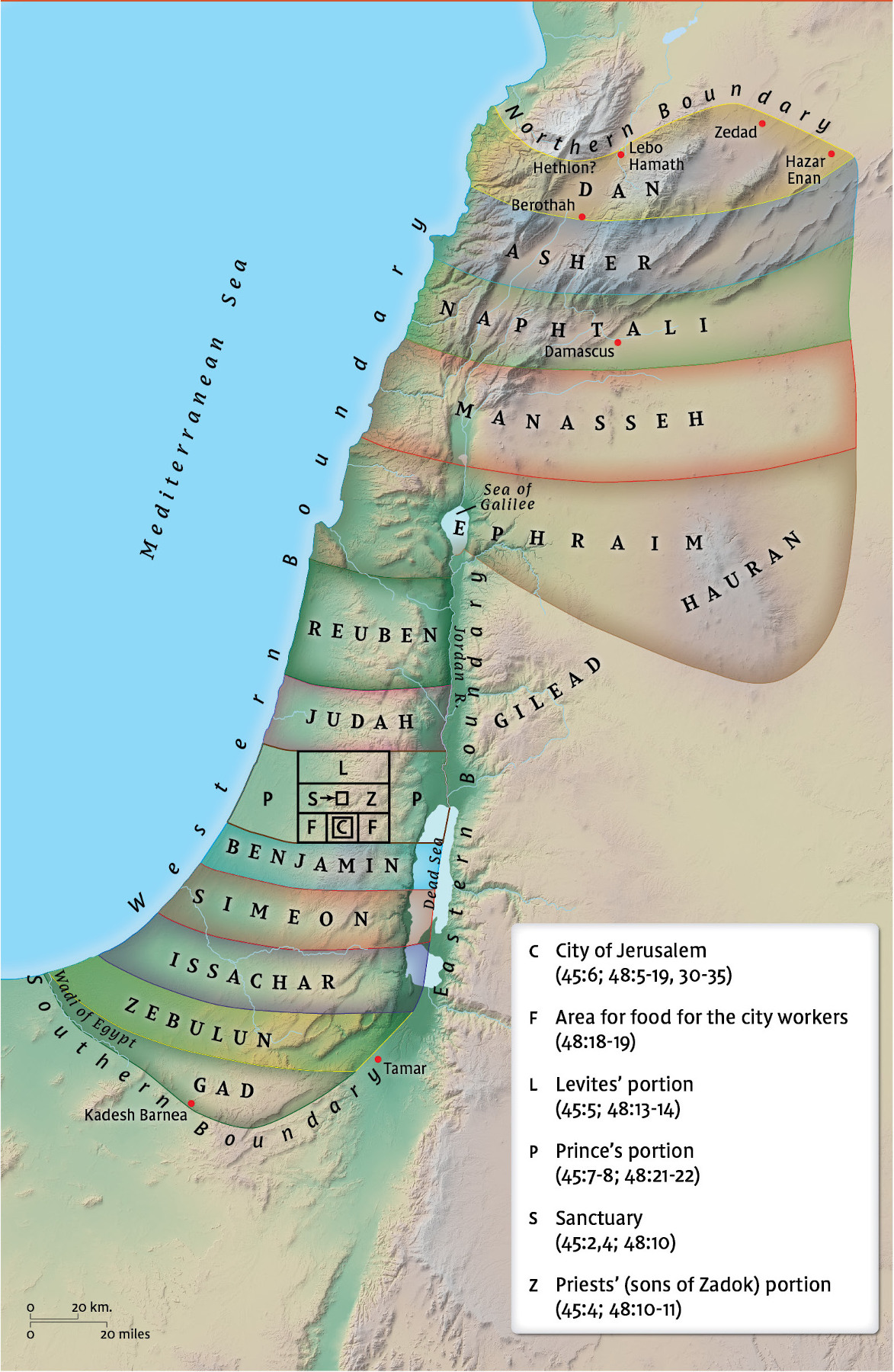
47:13–23 The boundaries of the land in the new order (see map).
47:13 two portions for Joseph. Since the tribe of Levi received none (44:28), Ephraim and Manasseh, Joseph’s two sons adopted by Jacob (Ge 48:5,17–20), each received an allotment (48:4–5).
47:14 Because I swore. A reference to the covenant made with Abram (see Ge 15:9–21 and notes; Eze 20:5; 36:28). with uplifted hand. See 20:5 and note.
47:15 This is to be the boundary. Approximates Israel’s borders at the time of David and Solomon, except that Transjordan is not included (v. 18)—which, in any event, was never within the boundaries of the promised land proper. The following specified boundaries closely resemble those in Nu 34:1–12. Hethlon road. Probably situated on the Mediterranean coast, somewhere in present-day Lebanon. Lebo Hamath. Lebo is now identified with modern Lebweh, about 15 miles northeast of Baalbek. At one time Lebo must have served as a fortress guarding the southern route to Hamath. Perhaps the phrase should be translated “Lebo of Hamath.” It is often referred to in Scripture as the northern limit of Israel (v. 20; 48:1; Nu 13:21; 34:8; Jos 13:5; 1Ki 8:65; 2Ki 14:25; Am 6:14). Lebo. Traditionally rendered “to the entrance of.” Zedad. Mentioned in Nu 34:8 but otherwise unknown.
47:16 Berothah. Probably to be identified with the Berothai of 2Sa 8:8, but otherwise unknown. Sibraim. Probably the Sepharvaim of 2Ki 17:24; 18:34. Damascus. Capital of Aram (Syria); according to v. 17 it was included in Israel. Hamath. A city about 120 miles north of Damascus on the Orontes River. Hazer Hattikon. Means “the middle enclosure.” It is possibly the same as Hazar Enan in v. 17.
47:18 Dead Sea. See Joel 2:20; Zec 14:8. Tamar. Means “(place of) palms” (v. 19; 48:28); mentioned in Ge 14:7 (Hazezon Tamar) and 1Ki 9:18 (see NIV text note there).
47:19 Meribah Kadesh. About 50 miles south of Beersheba, identified with Kadesh Barnea in Nu 34:4. Wadi of Egypt. The Wadi el-Arish, a deeply cut riverbed with seasonal flow that runs from the Sinai north-northwest until it enters the Mediterranean, 50 miles southwest of Gaza. It marked the southernmost extremity of Solomon’s kingdom (1Ki 8:65). See maps here and here.
47:22 You are to consider them as native-born Israelites. A gracious inclusiveness that went beyond the provision of 14:7. It reflects the same universalism that is found in such prophecies as Isa 56:3–8 (see notes there).
48:1–29 The distribution of the land in the new order (see map).
48:1 Dan. Occupies its historical location as the northernmost tribe (see the phrase “from Dan to Beersheba,” giving northern and southern boundaries—e.g., in Jdg 20:1; 1Sa 3:20). Dan was born to Rachel’s maidservant Bilhah (Ge 35:25). Hethlon . . . Lebo Hamath. See note on 47:15. Hazar Enan. See note on 47:16.
48:2 Asher. Born to Leah’s maidservant Zilpah (Ge 35:26). The tribes descended from maidservants were placed farthest from the sanctuary (see Dan, v. 1; Naphtali, v. 3; Gad, v. 27).
48:3 Naphtali. Born to Rachel’s maidservant Bilhah (see note on v. 2).
48:4 Manasseh. See note on 47:13.
48:5 Ephraim. See note on 47:13.
48:6 Reuben. Leah’s firstborn (Ge 29:31).
48:7 Judah. Son of Leah (Ge 35:23). He had the most prestigious place, bordering the central holy portion (v. 8), because his tribe was given the Messianic promise (see Ge 49:8–12 and note on 49:10).
48:8–22 An expansion of 45:1–8 (see notes there).
48:9 10,000 cubits wide. The width of the entire sacred district was 20,000 cubits (45:1). The present verse must refer to the width of either the priests’ or the Levites’ area. The Septuagint (the pre-Christian Greek translation of the OT), however, reads “20,000” here.
48:11 Zadokites, who were faithful. See note on 44:15.
48:14 not sell or exchange. Since it was the Lord’s, it was not to be an object of commerce.
48:19 from all the tribes of Israel. The sacred district was national property, not the prince’s private domain.
48:23 Benjamin. Rachel’s son (Ge 35:24).
48:24 Simeon. Leah’s son (Ge 35:23).
48:25 Issachar. Leah’s son (Ge 35:23).
48:26 Zebulun. Leah’s son (Ge 35:23).
48:27 Gad. Son of Zilpah, Leah’s maid (see note on v. 2).
48:28 Tamar. See note on 47:18. Meribah Kadesh. See note on 47:19. Wadi of Egypt. See note on 47:19.
48:30–35 The 12 gates of the new city of Jerusalem.
48:31 Reuben . . . Judah . . . Levi. Reuben (representing the firstborn), Judah (the Messianic tribe) and Levi (the tribe of the priesthood) had gates together on the north side. Since Levi was included in this list, Joseph (v. 32) represented Ephraim and Manasseh (see note on 47:13) in order to keep the number at 12. For the gates, cf. Rev 21:12–14.
48:35 THE LORD IS THERE. The great decisive word concerning the holy city. The Hebrew for this clause is Yahweh Shammah, which may be a wordplay on Yerushalayim, the Hebrew pronunciation of Jerusalem. For other names of Jerusalem, see 23:4; Isa 1:26; 29:1; 60:14; 62:2–4,12; Jer 3:17; 33:16; Zec 8:3. The book of Joel has a similar ending (see note on Joel 3:21).