Study Notes
1:1 Paul. See note on Ac 13:9. In ancient times writers put their names at the beginning of letters. For the story of Paul’s ministry, see Ac 9:1–30 and note on 9:1; 13:1—28:31; for his autobiographical accounts see 2Co 6:3–10; 11:21—12:10; Gal 1:13–24; Php 3:4–14; 1Ti 1:12–16. servant. Depending on the context, this Greek word (doulos) can emphasize the sense of (1) ownership (“slave”), one who completely belongs to their owner, or (2) loyalty (“servant”), one who seeks to serve and please their master. Both nuances are probably present here. See notes on Ex 14:31; Ps 18 title; Isa 41:8–9; 42:1. apostle. One specially commissioned by Christ (see notes on Mk 6:30; 1Co 1:1; Heb 3:1). set apart. See Gal 1:15 and note. gospel. See note on Mk 1:1.
1:2 prophets. Not just the writers of the prophetic books, for the whole OT story culminates in the coming of Jesus (see Lk 24:27,44–47 and notes). Holy Scriptures. Although later this term would also apply to the NT, at this point in redemptive history only the OT is in view.
1:3–4 These verses are often considered to be part of an early Christian creed or hymn, which Paul cites to show that he and the Roman believers share a common faith.
 1:3 regarding his Son. The central figure of the gospel is Jesus, in and through whom all the promises of the OT are fulfilled (see Lk 24:27,44–47 and notes; cf. 2Co 1:20 and note). descendant of David. See 2Sa 7:11–16; Isa 9:1–7; 11:1–9; Mt 1:1, 16; 9:27; Mk 10:47; Lk 1:32–35; Jn 7:42 and notes.
1:4 Son of God. See Jn 3:16; Lk 1:32 and notes. his resurrection. The authentication of Jesus’ divine nature and the focal point of the apostolic proclamation (see Ac 2:14–40; 4:33 and notes). He had always been God’s Son, but his resurrection had shown that he had been appointed “in power” (see NIV text note).
1:7 his holy people. All Christians are “holy” in that they are positionally “set apart” to God and are experientially being made increasingly “holy” by the Holy Spirit (see note on 1Co 1:2). Grace and peace. The initial greeting used by both Paul and Peter in their letters. It modifies the traditional Greek word for “greetings” (chairein) by changing it to “grace” (charis) and then combines this with the Hebrew word for “greetings” (Hebrew shalom; see article; Greek eirēnē; “peace”). Even Paul’s simple greeting therefore points to God’s great salvation, indicating its source (“grace” in the sense of God’s unmerited favor) and its result (“peace,” the reconciliation and total well-being that only God can provide; see 5:1; Php 4:7 and notes; Gal 1:3; Eph 1:2; see also Jn 14:27; 20:19 and notes). This greeting is echoed in the conclusions of Paul’s and Peter’s letters, so that these letters stand framed in what amounts to an apostolic benediction on those who are addressed. Cf. Ex 34:6–7 and note. Lord Jesus Christ. See note on 1Th 1:1.
1:8 thank. Paul often began his letters with thanks (see 1Co 1:4; Eph 1:16; Php 1:3–4 and note; Col 1:3 and note; 1Th 1:2; 2Th 1:3; 2Ti 1:3; Phm 4). through Jesus Christ. Christ is the center of the Christian’s thanksgiving as well as of their requests to God (Jn 15:16). your faith is being reported all over the world. The church in Rome, probably established shortly after the Day of Pentecost (Ac 2:10), had become one of the largest and most influential churches in the Roman Empire. The “world” here refers to the Roman world and every place where the gospel had been preached.
1:9 gospel of his Son. The same as the “gospel of God” (v. 1).
1:10 way may be opened. See 15:23–29.
1:11 impart . . . some spiritual gift. This probably does not mean that Paul hopes to bestow gifts on the Roman Christians (only the Holy Spirit bestows spiritual gifts), but rather that they will receive spiritual blessings when he exercises his gifts among them.
1:12 mutually. Paul’s genuine humility is seen in his desire to be ministered to by the believers at Rome, as well as to minister to them.
1:13 brothers and sisters. See NIV text note; see also note on Ac 11:1. harvest. New converts, as well as spiritual growth by those already converted. among you . . . among the other Gentiles. Suggests that the church at Rome was predominantly Gentile.
1:14 Greeks. Those Gentiles who spoke Greek or followed the Greek way of life, even though they may have been Latin-speaking citizens of the Roman Empire. non-Greeks. Or “barbarians,” a word that probably imitated the unintelligible sound of their languages to Greek ears. They were the “other Gentiles” (v. 13) to whom Paul ministered. the wise and the foolish. This may be another way of contrasting (cultured) Greeks and (uncultured) barbarians. Or perhaps Paul is referring socio-economically to the educated upper-class elite versus the mass of uneducated peasants.
1:16–17 The theme of the entire book.
1:16 not ashamed. Among the elite leaders and philosophers of the honor/shame culture that was the Greco-Roman world, the Christian message of a rejected and humiliated crucified Messiah seemed foolish and shameful. gospel. See note on Mk 1:1. power. In Romans, Paul defines the gospel as God’s “power” to save “everyone who believes” (see 1Co 1:18,24; cf. 1Pe 1:23 and note). first. Not only in time but also in privilege. Israel received God’s salvation first because they were meant to be God’s light to the nations. “Salvation is from the Jews” (Jn 4:22), and the Messiah was a Jew. The “very words of God” (3:2), the covenants, law, temple worship, revelation of the divine glory and Messianic prophecies came to them (9:3–5; see notes there). These privileges, however, were not extended to the Jews because of their superior merit or because of God’s partiality toward them (cf. Dt 7:7–11 and note on Dt 4:37). It was necessary that the invasion of this world by the gospel begin at a particular point with a particular people, who in turn were responsible to carry that gospel to the other nations (see 2:9 and note).
1:17 righteousness. This is a multi-faceted term that can refer to (1) God’s perfection (he is absolutely righteous in all he does and fulfills all he promises) or (2) the status of perfection bestowed by God on believers on the basis of Christ’s death on the cross (cf. 2Co 5:21), which brings us into (3) a right relationship with God (see notes on 2:13; 3:21,24).
1:18—3:20 The unrighteousness of all people (see outline). In developing the theme of the righteousness of God (1:17; 3:21—5:21), Paul sets the stage by showing that all have sinned and therefore need the righteousness that only God can provide. He shows the sin of the Gentiles (1:18–32) and the sin of the Jews (2:1—3:8) and then summarizes the sin of all—Gentile and Jew alike (3:9–20).
1:18–20 No one—not even one who has not heard of the Bible or of Christ—has an excuse for not honoring God, because the whole created world reveals him.
 1:18 wrath of God. Not a petulant, irrational burst of anger, such as humans often exhibit, but a holy, just revulsion against what is contrary to and opposes his holy nature and will. is being revealed. God’s wrath is not limited to the end-time judgment of the wicked (1Th 1:10; Rev 19:15; 20:11–15). Here the wrath of God is his abandonment of the wicked to their sin and its consequences (vv. 24–32). the truth. The truth about God revealed in creation.
1:21 knew God. From seeing his revelation in creation (vv. 19–20). The fact that these people were idolaters (v. 23) and knew God only through creation indicates that they were Gentiles. gave thanks. For earthly blessings, such as sun, rain and crops (see Mt 5:45 and note; Ac 14:17).
1:23 glory. God’s unique majesty (see Isa 40:5 and note; 48:11; see also Eze 1:28; 43:2 and notes), of which fallen humankind has lost sight and for which people have substituted deities of their own devising, patterned after various creatures (see Ps 106:20 and note).
1:24,26,28 God gave them over. God allowed sin to run its course as an act of judgment (cf. Ps 81:11–12 and note on 81:12). The destroyed are self-destroyed.
1:25 Amen. Can mean either “Yes indeed, it is so” or “So be it” (see 9:5; 11:36; 15:33; 16:27; see also note on Dt 27:15; cf. 1Ki 1:36).
1:26 their women. The one verse in Scripture where lesbian practice is addressed. Some claim that Paul in vv. 26–27 is referring only to abusive, exploitative or oppressive homosexual behavior. But the fact that he refers to lesbian sexual activity here (which was not generally characterized as abusive or oppressive) would suggest otherwise.
1:27 One of the clearest evidences that homosexual practice is sinful in God’s eyes. The OT also condemns the practice (Lev 18:22; 20:13; cf. 1Ti 1:10; 1Co 6:9). But it is the act, rather than the inclination, that is sinful.
1:28 knowledge of God. See vv. 19,21. depraved mind. In time sin distorts the ability to discern good from evil, and right from wrong (v. 21; Mk 7:20–23). so that they do what ought not to be done. What one thinks governs what one does (see v. 21; Mk 7:20–23).
1:29–31 A list of vices similar to those found in 13:13; Mk 7:21–22; 1Co 5:10–11; 6:9–10; 2Co 12:20–21; Gal 5:19–21; Eph 4:31; 5:3–5; Col 3:5,8; 1Ti 1:9–10; 2Ti 3:2–5; Rev 21:8; 22:15.
1:31 no understanding, no fidelity, no love, no mercy. As with many vice (and virtue) lists, the final items are climactic and summative.
1:32 they know. Their outrageous conduct was not due to total ignorance of what God required but to self-will and rebellion. approve. The extreme of sin is applauding, rather than regretting, the sins of others (see Ps 1:1; 1Co 15:33 and notes).
2:1–16 In this section Paul sets forth principles that govern God’s judgment. God judges (1) according to truth (v. 2), (2) according to deeds (vv. 6–11) and (3) according to the light a person has (vv. 12–15). It is debated whether in these verses (vv. 1–16) Paul is referring to a Gentile moralist or whether he is already beginning his argument against the self-righteous Jew (explicitly identified in v. 17). In either case, the principles lay the groundwork for Paul’s discussion of the guilt of the Jews in vv. 17–29.
2:1 no excuse. Cf. 1:20. Paul’s teaching about judging agrees with that of Jesus (see note on Mt 7:1), who did not condemn judging as such, but hypocritical judging. you who pass judgment. A warning that had special relevance for Jews, who were inclined to look down on Gentiles because of their ignorance of God’s revelation in the OT and because of their immoral lives.


The Colosseum in Rome—one of the most impressive reminders of the might of the ancient Roman Empire.
Viacheslav Lopatin/Shutterstock
Return to the main text.
2:2 we know. An expression Paul frequently used, assuming that the persons addressed agreed with the statement that followed (3:19; 6:6,9; 7:14; 8:22,28; 1Co 8:1, 4; 2Co 5:1; 1Ti 1:8).
2:3 Jesus also condemned such judgmental acts (see Mt 7:3 and note; cf. Lk 18:9).
2:4 The purpose of God’s kindness is to give opportunity for repentance (see 2Pe 3:9 and note). The Jews had misconstrued his patience to be a lack of intent to judge.
2:5 day of God’s wrath. See v. 8; judgment in the end times, in contrast to the judgment discussed in 1:18–32.
2:6 according to what they have done. See note on vv. 1–16; see also Rev 20:12 and note. While salvation comes to believers through God’s grace alone and with Christ’s covenant obedience applied to them (see next note), unbelievers are judged based on their own works. This is because God is perfectly just and so will judge “according to what they have done.”
2:7 To those who by persistence in doing good . . . he will give eternal life. Paul is not contradicting his continual emphasis that people are saved by faith rather than works. He is referring to “persistence in doing good” as the proof of genuine faith (see Gal 5:6; Jas 2:14–26 and notes).
2:8 wrath and anger. On the day of final judgment (see note on 1:18).
2:9 first for the Jew. With spiritual privilege comes spiritual responsibility (see Am 3:2 and note; Lk 12:48; cf. Ro 1:16 and note).
2:11 God does not show favoritism. Taught in the OT (Dt 10:17) and even more clearly in the NT (Ac 10:34; see note there).
2:12 law. The Mosaic law. “All who sin apart from the law” refers to Gentiles. God judges according to the light available to people. Gentiles will not be condemned for not obeying a law they did not possess. Their judgment will be on other grounds (see v. 15 and note on vv. 1–16; 1:18–20 and note; cf. Am 1:3—2:3).
2:13 will be declared righteous. At God’s pronouncement of acquittal on judgment day (see note on 3:24).
2:14 by nature. By natural impulse, without the external constraint of the Mosaic law. things required by the law. Does not mean that pagans fulfilled the requirements of the Mosaic law but refers to practices in pagan society that agreed with the law, such as caring for the sick and elderly, honoring parents and condemning adultery. law for themselves. The moral nature of pagans, enlightened by conscience (v. 15), functioned for them as the Mosaic law did for the Jews.
2:16 This verse should be read with v. 13, as the parentheses around vv. 14–15 indicate. See Ecc 12:14 and note. my gospel. See 16:25 and note.
2:17–24 The presentation takes the form of a dialogue with his fellow Jews. Paul knew how a zealous Jew thought, for he had been one himself. He cites one advantage after another that Jews regarded as unqualified assets. But those assets became liabilities when there was no correspondence between profession and practice. Paul applied to the Jew the principles of judgment set forth in vv. 1–16 (see note on those verses).
2:19–20 the blind . . . little children. Gentiles, to whom Jews regarded themselves as superior because they (the Jews) possessed the Mosaic law. a light. Israel was meant to be a guiding light for the nations (Isa 42:6; 49:6; 60:3).
2:22 do you rob temples? See Ac 19:37. This could refer literally to robbing temples (large amounts of wealth were often stored in pagan temples). Or it could refer to sacrilege in general.
2:23 do you dishonor God by breaking the law? See Ps 50:16–20. What God desires is obedience, not rationalization.
2:25 Circumcision. The sign of the covenant that God made with Israel (see Ge 17:11 and note; Lev 12:3) and a pledge of the covenant blessing (see 4:11 and note). Some Jews had come to regard circumcision as a guarantee of God’s favor.
2:27 If a Gentile’s deeds excelled those of a Jew in righteousness, that very fact condemned the Jew, who had an immeasurably better set of standards in the law of Moses.
2:29 by the Spirit. The true sign of belonging to God is not an outward mark on the physical body but the regenerating power of the Holy Spirit within (see Titus 3:5 and note)—what Paul meant by “circumcision of the heart” (see 4:9–12; Dt 30:6 and notes on Ge 17:10; Jer 4:4). praise is not from other people, but from God. Cf. Jn 5:41, 44; 12:43; 1Co 4:3–5 and notes on 4:3,5.
3:2 First of all. Paul does not discuss the other advantages of being a Jew until 9:4–5 (see notes there). entrusted. The advantage of having “the very words of God” leads to a duty to obey them. very words of God. The Hebrew Scriptures (the OT).
3:3 God’s faithfulness. God is faithful to his promises and would both bring about salvation for his people who remained faithful to him and also punish those in Israel who did not (v. 5; see 2Ti 2:13 and note).
3:4 God’s punishment of sin exhibits his faithfulness to his righteous character.
3:5 brings out God’s righteousness. By contrast, in showing it up against the dark background of human sin. human argument. “Human” in the sense of its weakness and absurdity.
3:6 judge. On judgment day. world. All moral creatures (also in v. 19)—a more limited reference than in 1:20.
3:8 Let us do evil that good may result. An accusation against Paul that arose because of his preaching a message of salvation by God’s grace. Paul deals with this issue more fully in ch. 6.
3:9 Do we have any advantage? Are Jews better than Gentiles in the sight of God? Not at all! This does not contradict v. 2, which answers the same question with “Much in every way!” The Jews had the great advantage of God’s special revelation, but their failure to obey it left them with the same culpability as the Gentiles. all under the power of sin. Nine times in four verses (vv. 9–12) Paul mentions the universality of sin (“all,” two times; “no one,” four times; “not even one,” two times; “together,” once). under the power of sin. And its condemnation.
3:10–18 An impressive series of OT citations that underscores Paul’s claim that both Jews and Gentiles are totally under the power of sin. Several factors explain why the citations are not always verbatim: (1) NT citations sometimes gave the general sense and were not meant to be word-for-word. (2) Quotation marks were not used in Greek. (3) The citations were often taken from the pre-Christian Greek translation (the Septuagint) of the Hebrew OT, because Greek readers were not familiar with the Hebrew Bible. (4) Sometimes the NT writer, in order to drive home his point, would purposely (under the inspiration of the Holy Spirit) enlarge, abbreviate or adapt an OT passage or combine two or more passages.
3:11 understands. About God and what is right.
3:12 All have turned away. See Isa 53:6 and note.
3:13 open graves. Expressing the corruption of the heart.
3:18 fear of God. Awesome reverence for God; the source of all godliness (see notes on Ge 20:11; Pr 1:7).
3:19 we know. See note on 2:2. law. The OT (as in Jn 10:34; 15:25; 1Co 14:21). those who are under the law. Jews. every mouth . . . whole world. Jews as well as Gentiles are guilty.
3:20 declared righteous. See notes on v. 24; 2:13. we become conscious of our sin. According to Paul, this is one of the primary purposes of the law (see 7:7 and note).
3:21—5:21 God’s righteousness imputed: Justification (see outline; see also article). Having shown that all (both Gentiles and Jews) are unrighteous (1:18—3:20), Paul now shows that God has provided a righteousness for humankind.
3:21 But now. There are two possible meanings: (1) temporal—all of time is divided into two periods, and in the “now” period the righteousness of God has been made known; (2) logical—the contrast is between the righteousness gained by observing the law (which is impossible, v. 20) and the righteousness provided by God. apart from the law. Apart from keeping the law, because it now comes in the person of the Messiah. the Law and the Prophets testify. A shorthand way to refer to all of Scripture. For OT passages on salvation apart from the law see Ge 15:6; Ps 32:1–2; Hab 2:4; Mt 5:17 and notes.
3:22 through faith in Jesus Christ. Or “through the faithfulness of Jesus Christ” (see NIV text note). If the latter, Paul is saying that God’s righteousness has been revealed in Christ’s faithful and obedient sacrificial death (5:19). In both views, human faith is necessary (“to all who believe”). no difference between Jew and Gentile. See 10:12 and note.
3:23 the glory of God. What God intended humans to be. The glory human beings were intended to have if they had not fallen (see Ge 1:26–28; Ps 8:4–8 and notes; cf. Eph 4:24; Col 3:10), that believers will receive through Christ (see Heb 2:5–9 and notes).
3:24 justified. See article. freely by his grace. The central thought in justification is that, although people clearly and totally deserve to be declared guilty (vv. 9–19), God declares them righteous because of Christ’s atoning work and their trust in him. This is stated in several ways here: (1) “freely” (as a gift, for nothing), (2) “by his grace,” (3) “through the redemption that came by Christ Jesus” and (4) “by faith” (v. 25). redemption. A word taken from the slave market—the purchase of a slave’s freedom or obtaining release by payment of a ransom. Paul uses this word to refer to release from guilt, with its liability for judgment, and to deliverance from slavery to sin, because Christ in his death paid the ransom to set us free (see Eph 1:7 and note; see also article).

Paul uses the Greek verb for “justified” 27 times, mostly in Romans and Galatians. It is translated “justify” in all cases except two (2:13; 3:20, where it is translated “declared righteous”). The term describes what happens when people believe in Christ as their Savior: From the negative viewpoint, God declares them to be not guilty; from the positive viewpoint, he declares them to be righteous. He cancels the guilt of their sin and credits righteousness to them.
Paul emphasizes two points in this regard: (1) No one lives a perfectly good, holy, righteous life. On the contrary, “there is no one righteous” (v. 10), and “all have sinned and fall short of the glory of God” (v. 23). “Therefore no one will be declared righteous in God’s sight by the works of the law” (v. 20). (2) But even though all are sinners, God will declare those who put their trust in Jesus not guilty but righteous. This declaration is valid because Christ died to pay the penalty for our sin and lived a life of perfect righteousness that can in turn be imputed to believers. This happens because believers have been incorporated into Christ and his saving work (they are “in Christ”).
This is one of the central themes of Romans and is stated in a key theme verse, 1:17 (“the righteousness of God . . . by faith”). Christ’s righteousness (his obedience to God’s law and his sacrificial death) will be credited to believers as their own. Paul uses the Greek for “credited” ten times in ch. 4 alone.
Go to the Articles Index.
3:25 sacrifice of atonement. See NIV text note. The blood of a representative sacrificial animal was sprinkled on the atonement cover in the temple to atone for the people’s sins. Jesus has become the place of atonement and the perfect sacrifice for sin. Other interpreters add that the Greek for this phrase could speak of a sacrifice that satisfies the righteous wrath of God (traditionally rendered “propitiation”). Without this appeasement all people are justly destined for eternal punishment. See note on 1Jn 2:2. through . . . his blood . . . received by faith. Saving faith looks to Jesus Christ and his sacrificial death for us.
3:25b–26 The sins of God’s people, punished temporarily and partially in the animal sacrifices of the OT period, were totally punished in the once-for-all sacrifice of Christ on the cross.
3:27 Boasting about keeping the law is excluded because no one can perfectly keep it. the law that requires faith. In a play on words, Paul uses “law” here in the sense of “principle.”
3:28 by faith. When Luther translated this passage, he added the word “alone,” which, though not in the Greek, accurately reflects the meaning (see note on Jas 2:14–26).
3:30 only one God. By appealing to the first article of Jewish faith (“the LORD is one,” Dt 6:4; see note there), Paul argues that there is only one way of salvation for both Jew (“circumcised”) and Gentile (“uncircumcised”), namely, faith in Christ.
3:31 Paul anticipated being charged with antinomianism (antagonism toward the law): If justification comes by faith alone, then is not the law rejected? He gives a more complete answer in chs. 4, 6–7 and reasserts the validity of the law’s central tenet of love in 13:8–10. we uphold the law. The law is upheld by insistence on faith in the only one who has perfectly obeyed the law’s requirements.
4:1 Abraham, our forefather. The great patriarch of the Jewish nation, the true example of a justified person (see Jas 2:21–23 and notes). Some Jews revered Abraham as a model of righteousness and obedience to God. But Paul demonstrates that this righteousness came not by his works, but by faith (see vv. 9,22 and note on v. 22; cf. Gal 3:7–9 and notes).
4:2 If . . . Abraham was justified by works. Paul’s Jewish opponents may have been claiming that Abraham was justified by works (the book of Sirach [44:19] in the Apocrypha says, “no one was found like him in glory”). But the fact is that he was not (v. 3), and therefore all boasting on his part is excluded.
4:3 The reference (see also vv. 9,22) is to Ge 15:6 (see note there), where nothing is mentioned about works (see note on 3:21). credited. Abraham had kept no law, rendered no service and performed no ritual that earned credit to his account before God. His belief in God, who had made promises to him, was credited to him as righteousness.
4:6–8 God does not continue to credit unrighteousness to sinners who repent, but forgives them when they confess (see Ps 32:3–5 and notes; Eze 18:23, 27–28,32 and notes on 18:23 and 18:32; 33:14–16).
4:10 not after, but before! Abraham was declared righteous (Ge 15:6) some 14 years before he was circumcised (Ge 17:24,26). See Gal 3:17 for a similar statement.
4:11 sign. Circumcision was, among other things, the outward sign of the righteousness that God had credited to Abraham for his faith (see Ge 17:11 and note). So then. Abraham is the “father” of believing Gentiles (the uncircumcised), because he believed and was justified before the rite of circumcision (the mark of Jews) was instituted.
4:12 father of the circumcised. Abraham is also the father of believing Jews. Thus his story shows that for Jew and Gentile alike there is only one way of justification—the way of faith.
4:13 not through the law. The promise came before any law was given, so it was not based on keeping the law. his offspring. All those of whom Abraham is said to be father (vv. 11–12). heir of the world. “World” here refers to the creation, as in 1:20. No express mention of this heirship is made in the Genesis account of Abraham. He is promised “offspring like the dust of the earth” (Ge 13:16), possession of the land of Canaan (Ge 12:7; 13:14–15; 15:7,18–21; 17:8) and blessing through him (see Ge 12:2–3 and note; 18:18) or his offspring (Ge 22:18) for all peoples on earth. But since, as Genesis already makes clear, God purposed through Abraham and his offspring to work out the destiny of the whole world, it was implicit in the promises to Abraham that he and his offspring would “inherit the land” (see Ps 37:9, 11,22,29,34 and note on 37:9; Mt 5:5). The full realization of this awaits the consummation of the Messianic kingdom at Christ’s return.
4:14 those who depend on the law. Those whose claim to the inheritance is based on obedience to the law. promise. See note on v. 13.
4:15 the law brings wrath. The law, because it reveals and even stimulates sin (7:7–11), produces wrath, not promise (vv. 13–14). transgression. Overstepping a clearly defined line. Where there is no law there is still sin, but it does not have the character of transgression.
4:16 A summary of the thought of vv. 11–12. For the close correlation between faith and grace, see 3:24–25; Eph 2:8–9 and notes. those who are of the law. Jewish Christians. those who have the faith of Abraham. Gentile Christians who share Abraham’s faith but who, like Abraham, do not possess the law.
4:17 in the sight of God. God considers Abraham the father of Jews and believing Gentiles alike. the God who gives life to the dead. The main reference is to the birth of Isaac through Abraham and Sarah, both of whom were far past the age of childbearing (Ge 18:11). Secondarily Paul alludes also to the resurrection of Christ (see vv. 24–25 and notes). calls into being things that were not. God has the ability to create out of nothing, as he demonstrated at creation and again in the birth of Isaac (see note on v. 19).
4:18 Against all hope . . . in hope believed. When all hope, as a human possibility, failed, Abraham placed his hope in God.
4:19 Without weakening in his faith. Abraham had some anxious and even rebellious moments (Ge 17:17–18), but overall he persevered remarkably well in trusting God’s amazing promises. faced the fact. Faith does not refuse to face reality but looks beyond all difficulties to God and his promises. Sarah’s womb was also dead. Sarah was ten years younger than Abraham (Ge 17:17) but well past the age for bearing children.
4:20 he did not waver. See note on 4:19. gave glory to God. Because Abraham had faith to believe that God would do what he promised. Whereas works are human attempts to establish a claim on God, faith brings glory to him.
4:22 This is why. Abraham’s faith was “credited to him as righteousness” because it was true faith, i.e., complete confidence in God’s promise.
4:23 not for him alone. Abraham’s experience was not merely private or individual but had implications for generations to come. If justification by faith was true for him, it is universally true.
4:24 but also for us. As Abraham was justified because he believed in a God who brought life from the dead, so we will be justified by believing “in him who raised Jesus our Lord from the dead” (see 10:9 and note).
4:25 These words, which reflect the Septuagint (Greek) translation of Isa 53:12, may have been quoted from a Christian confessional formula. justification. See 3:24 and note.
5:1 we have. See NIV text note. In some manuscripts the verb gives an exhortation to live in light of our justification: “Let us have peace with God” (see article). peace with God. Not merely a subjective feeling (peace of mind) but primarily an objective status, a new relationship with God: Once we were his enemies, but now we are his friends (see v. 10 and note; Eph 2:14–16; Col 1:20–22). Jesus is the great Reconciler (see 2Co 5:17–21 and notes on 5:18–21).
5:2 access. Jesus ushers us into the presence of God. The heavy curtain (of the temple) that separated us from God and God from us has been removed (see notes on Mt 27:51; Heb 10:19–22). boast. No longer a boasting in a faulty belief in one’s ability to keep the law (cf. 2:23; 3:27), but a boasting in God’s glorious promises through faith in Jesus Christ (cf. v. 11). hope of the glory of God. Our confidence that the purpose for which God created us will be ultimately realized (see note on 3:23).
5:3 glory in our sufferings. Not “because of” but “in.” Paul does not advocate a morbid view of life but a joyous and triumphant one (see Jas 1:2 and note). To glory in suffering means recognizing that we share in Christ’s sufferings because we share in all that Christ has done (see Php 3:10, Col 1:24).
5:4 Christians can rejoice in suffering because they know that it is not meaningless. Part of God’s purpose is to produce character in his children (Jas 1:3).
5:5 hope. The believer’s hope is not to be equated with unfounded optimism. On the contrary, it is the confident expectation and blessed assurance of our future destiny and is based on God’s love, which is revealed to us by the Holy Spirit and objectively demonstrated to us in the death of Christ. Paul has moved from faith (v. 1) to hope (vv. 2,4–5) to love (here; see 1Co 13:13; 1Th 1:3 and notes). has been poured out. Indicates a present status resulting from a past action. When we first believed in Christ, the Holy Spirit poured out his love in our hearts, and his love for us continues to dwell in us. who has been given to us. All true believers have the gift of the Spirit (see 8:9 and note).
5:6 the right time. The appointed moment in God’s redemptive plan (see Mk 1:15; Gal 4:4 and notes). Christ died for the ungodly. Christ’s love is grounded in God’s free grace and is not the result of any worthiness merited by humanity. In fact, it is lavished on us in spite of our undesirable character.
5:7 righteous person . . . good person. “Righteous” and “good” may be synonymous terms, or “righteous” may refer to moral uprightness while “good” may go beyond this to genuine concern for others. Of course, we were neither righteous nor good, but sinners, when Christ died for us (v. 8; 3:10–12).
5:9 by his blood. By laying down his life as a sacrifice—a reference to Christ’s death for our sins (see 3:25 and note). how much more. A greater to lesser argument. Once God has done the harder work of making us righteous through the sacrificial death of his Son, turning aside God’s wrath is a given (since there is no sin to judge). God’s wrath. At the final judgment when God will judge all people (see note on 1:18; cf. 1Th 1:9–10 and notes).
5:10 God’s enemies. Humans are enemies of God, not the reverse. Thus the hostility must be removed from humans if reconciliation is to be accomplished. God took the initiative in bringing this about through the death of his Son (see v. 11; Col 1:21–22 and note on 1:20). reconciled. To reconcile is “to put an end to hostility,” and is closely related to the term “justify,” as the parallelism in vv. 9–10 indicates:
v. 9 | v. 10 |
justified | reconciled |
by his blood | through the death of his Son |
shall we be saved | shall we be saved |
how much more. Another greater to lesser argument (see v. 9). If God did the harder thing in accomplishing reconciliation with a hostile world, how simple it is to just receive this gift of salvation. saved through his life. A reference to the unending life and ministry of the resurrected Christ for his people (see Heb 7:25 and note). Since we were reconciled when we were God’s enemies, we will be saved because Christ lives to keep us. See notes on 2Co 5:18,21.
5:11 we have now received reconciliation. Reconciliation, like justification (v. 1), is a present reality for Christians and is something to rejoice about (see Col 1:20 and note).
5:12–21 A contrast between Adam and Christ. Adam introduced sin and death into the world; Christ brought righteousness and life. The comparison begun in v. 12 is completed in v. 18; these two verses summarize the whole passage. These two men also sum up the message of the book up to this point. Adam stands for humanity’s condemnation (1:18—3:20); Christ stands for the believer’s justification (3:21—5:11).
5:12 death. Physical death is the penalty for sin. It is also the symbol of spiritual death—ultimate separation from God (Rev 20:15; 21:8). because all sinned. The context suggests that Adam’s sin involved the rest of humankind in condemnation (vv. 18–19) and death (v. 15). We do not start life with even the possibility of living it sinlessly; we begin it as sinners by nature (see Ge 8:21; Ps 51:5; 58:3 and notes; Eph 2:3). Some interpreters claim, by contrast, that while we inherit Adam’s fallen nature, we do not inherit his guilt. Guilt and condemnation result “because all sinned.”
5:13 sin is not charged against anyone’s account. In the period when there was no (Mosaic) law, people were not charged with sin in the sense of “breaking a command” (v. 14).
5:14 pattern. Adam by his sin brought universal ruin on the human race. In this act he is the prototype of Christ, who through one righteous act (v. 18) brought universal blessing. The analogy is one of contrast. Cf. 1Co 15:21–22,45.
5:15 the many. The same as “all people” in v. 12. The contrast is not between “many” and “all,” but between the “one” and the “many.” One man’s sin affected all people (Isa 53:11; Mk 10:45). how much more. A theme that runs through this section. God’s grace is infinitely greater for good than is Adam’s sin for evil.
5:16 gift of God. Salvation and “righteousness” (v. 17). many trespasses. The sins of the succeeding generations.
5:17 will . . . reign in life. This is both a present (8:37; Eph 2:6; Col 3:1–3) and future reality (see 2Ti 2:12 and note; Rev 20:4, 6; 22:5).
5:18 life for all. Contrast v. 12; does not mean that everyone eventually will be saved, but that salvation is available to all (see 1Jn 2:2 and note), both Jew and Gentile. It is sufficient for all. To be effective, God’s gracious gift must be received (v. 17).
5:19 made righteous. A reference to a person’s status before God (see v. 17; 2Co 5:21 and note), not to a change in character. The latter (the doctrine of sanctification) is developed in chs. 6–8.
5:20 law was brought in. Not to bring about redemption but to point out the need for it. The law made sin even more sinful by revealing what sin is in stark contrast to God’s holiness.
6:1—8:39 God’s righteousness imparted: Sanctification (see outline). In 3:21—5:21 Paul explains how God has provided for our redemption and justification. He next explains the doctrine of sanctification—the process by which believers grow to maturity in Christ. He treats this subject in three parts: (1) freedom from sin’s tyranny (ch. 6), (2) freedom from the law’s condemnation (ch. 7) and (3) life in the power of the Holy Spirit (ch. 8).
6:1 Shall we go on sinning so that grace may increase? This question arose out of what Paul had just said in 5:20: “Where sin increased, grace increased all the more.” His answer is “By no means!” (v. 2). Then he explains his answer.
6:2 died to sin. Meaning to die to its power over us. The reference is to an event in the past and is explained in v. 3 (see note on vv. 3–4).
6:3–4 The when and how of the Christian’s death to sin. In NT times baptism so closely followed conversion that the two were considered part of one event (see Ac 2:38 and note). So although baptism is not a means by which we enter into a vital faith relationship with Jesus Christ, it is closely associated with faith (see 1Pe 3:21 and note). Baptism depicts graphically what happens as a result of the Christian’s union with Christ, which comes with faith—through faith we are united with Christ, just as through our natural birth we are united with Adam. As we fell into sin and became subject to death in our participation with Adam, so we now have died and been raised again in our participation with the second Adam, who is Christ. Baptism now symbolizes this death, burial and resurrection. Paul frequently refers to being “in Christ,” shorthand for the believer’s identification with Christ in his death, burial and resurrection. See note on 6:11; see also photo.
6:3 know. Three key words in this chapter are “know” (here and in vv. 6,9), “offer” (vv. 13,16,19) and “obey” (vv. 12,16–17).
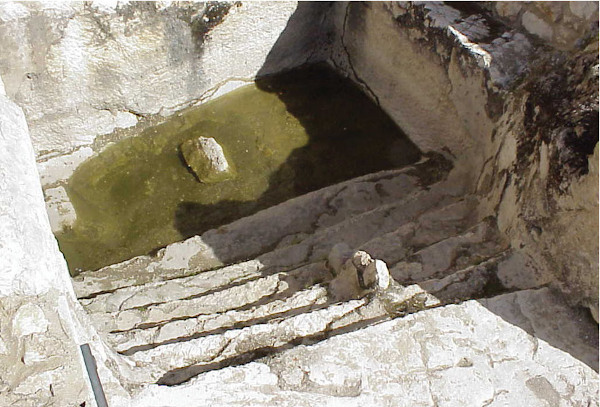
A Jewish mikveh, or ritual bath, south of the temple mount. These baths were used by worshipers to cleanse themselves before entering the temple. “Don’t you know that all of us who were baptized into Christ Jesus were baptized into his death? We were therefore buried with him through baptism into death in order that, just as Christ was raised from the dead through the glory of the Father, we too may live a new life” (Ro 6:3–4). Just as ancient worshipers entered a mikveh unclean and came out clean, so those who are “baptized into Christ” have a new life.
www.HolyLandPhotos.org
Return to the main text.
6:4 buried with him through baptism into death. Amplified in vv. 5–7. through the glory of the Father. By the power of God. God’s glory is his divine excellence, his perfection. Any one of his attributes is a manifestation of his excellence. Thus his power is a manifestation of his glory, as is his righteousness (see 3:23 and note). Glory and power are often closely related in the Bible (Ps 145:11; Col 1:11; 1Pe 4:11; Rev 1:6; 4:11; 5:12–13; 7:12; 19:1). live a new life. Amplified in vv. 8–10. Baptism is a sign of new life in Christ.
6:6 our old self. Our unregenerate self; what we once were in Adam (1Co 15:22; see note there; see also Ro 5:12–21 and note). crucified with him. See vv. 7,8,11,12–13; Gal 2:20 and notes. body ruled by sin. The self in its pre-Christian state, dominated by sin. This is a figurative expression in which the old self is personified. It is a “body” that can be put to death. For the believer, this old self has been “rendered powerless” (see NIV text note) so that it can no longer enslave us to sin—whatever lingering vitality it may yet exert in its death throes. sin. Personified here and elsewhere in Romans. It is a power that rules over people (here and v. 12) and is their slave master (before they come to faith; vv. 14,16–17).
6:7 has died. The believer’s death with Christ to sin’s ruling power (v. 3). set free from sin. Not sinless, but free from sin’s shackles and power.
6:8 As resurrection followed death in the experience of Christ, so the believer who dies with Christ is raised to a new quality of life here and now. Resurrection in the sense of a new birth is already a fact, and it increasingly exerts itself in the believer’s life.
6:10 he died to sin once for all. See Heb 9:12 and note. In his death Christ (for the sake of sinners) submitted to the “reign” of sin (5:21); but his death broke the judicial link between sin and death, and he passed forever from the sphere of sin’s “reign.” Having been raised from the dead, he now lives forever to glorify God. to God. For the glory of God.
6:11 count yourselves . . . alive . . . in Christ. The first step toward victory over sin in the life of believers. They are dead to sin and alive to God, and by faith they are to live in the light of this truth. in Christ. The first occurrence in Romans of this phrase, which is found often in Paul’s writings. True believers are “in Christ” because they have died with Christ and have been raised to new life with him. See note on Eph 1:1.
6:12–13 A call for Christians to become in practice what they already are in their status before God—dead to sin (vv. 5–7) and alive to God (vv. 8–10). The key to victory over sin is refusal to let sin reign in one’s life (v. 12) and offering oneself to God instead (v. 13).
6:13 offer. Put yourselves in the service of, perhaps also echoing the language of sacrifice. every part of yourself. All the separate capacities of your being (also in v. 19).
6:14 sin shall no longer be your master. Paul conceived of sin as a power that enslaves, and so personified it (Ps 19:13). not under the law. The meaning is not that Christians have been freed from all moral authority. They have, however, been freed from the law in the manner in which God’s people were under the law in the OT era. The law provides no power to resist the power of sin; it only condemns the sinner. But grace empowers. under grace. For grace’s role in encouraging godliness, see Titus 2:11–12 and notes.
6:15–23 The question raised here seems to come from those who are afraid that the doctrine of justification by faith alone will remove all moral restraint. Paul rejects such a suggestion and shows that Christians do not throw morality to the winds. To the contrary, they exchange sin for righteousness as their master. Cf. 1Jn 2:15–17.
6:16 The contrast between sin and obedience suggests that sin is by nature disobedience to God.
6:17 have come to obey from your heart. Christian obedience is not forced or legalistic, but willing. pattern of teaching. May refer to a summary of the moral and ethical teachings of Christ that was given to new converts in the early church.
6:18 slaves to righteousness. Christians have changed masters. Whereas they were formerly slaves to sin (vv. 16–17), now they become slaves (willing servants) to righteousness.
6:19 I am using an example from everyday life. Paul apologizes for using an imperfect analogy. The word “slave” when applied to Christians, who are free in Christ, naturally presents problems.
6:22 set free from sin. See note on v. 6. holiness. Slavery to God produces holiness, and the end of the process is eternal life (viewed not in its present sense but in its final, future sense). There is no eternal life without holiness (Heb 12:14). Those who have been justified will surely give evidence of that fact by the presence of holiness in their lives. For other occurrences of the word “holiness,” see v. 19; 1Co 1:30 and note on 1:2; 1Ti 2:15; Heb 12:14. For “holy,” see Lev 11:44 and note; 1Th 4:4,7. For “sanctified,” see 1Th 4:3. For “sanctifying work,” see 2Th 2:13; 1Pe 1:2 and note.
6:23 Two kinds of servitude are contrasted here: Sin brings death as its wages; service to God results in eternal life, not as wages earned or merited but as a gift of God (cf. Eph 2:8–9 and notes). For the contrast between wages and gift, see 4:4. eternal life. See Jn 17:3.
7:2–3 These verses illustrate the principle set down in v. 1. Death decisively changes a person’s relationship to the law.
7:4 So. Paul now draws the conclusion from the principle stated in v. 1 and illustrated in vv. 2–3. died to the law. The law’s power to condemn no longer threatens believers, whose death here is to be understood in terms of 6:2–7. There, however, they die to sin; here they die to the law. The result is that the law has no more hold on them. through the body of Christ. His physical body (self) crucified. belong to another. The resurrected Christ (see 6:5; cf. Titus 2:14; 1Pe 2:9 and note). The purpose of this union is to produce the fruit of holiness.
7:5 in the realm of the flesh. The power of sin and its rule (see NIV text note). Christians have been freed from this realm and now live in the power and the realm of the Spirit. aroused by the law. The law not only reveals sin; it also stimulates it. The natural human tendency is to desire the forbidden thing. death. Physical death and, beyond that, spiritual death—final separation from God (see note on 5:12)—were the fruit of our union with the law (cf. note on v. 4).
7:6 what once bound us. The law (see later in this verse, as well as v. 4). released from the law. In the sense of its condemnation (see note on v. 4). new way of the Spirit. See note on 8:4. old way of the written code. Life under the OT law.
7:7 Is the law sinful? This question was occasioned by the remarks about the law in vv. 4–6. I. Paul seems to be using the first-person pronoun of himself, but also as representative of people in general (vv. 7–12) and of Christians in particular (vv. 13–25). I would not have known what sin was. The law fulfilled the important function of revealing the presence and fact of sin.
7:8 opportunity afforded by the commandment. See note on v. 5. sin was dead. Not nonexistent but not fully perceived (see 5:13 and note).
7:9 Once I was alive. Paul reviews his own experience from the vantage point of his present understanding. Before he realized that the law condemned him to death, he was alive. He could be speaking as a representative human being and referring to how Adam and Eve were spiritually alive before they broke God’s law. He could be reflecting as a representative Israelite before the giving of the law at Mt. Sinai. Or he could be referring to the time before his bar mitzvah (see below). It is not as likely that he is remembering the time just before his conversion, as if the true rigor of the law became clear to him then, because he believed he was doing quite well in his obedience (Gal 1:14; Php 3:6). I died. Paul came to realize he was condemned to death, because law reveals sin, and sin’s wages is death (see 6:23 and note).
7:10 was intended to bring life. See Lev 18:5 and note. As it worked out in Paul’s experience, the law became the avenue through which sin entered generally. Instead of giving life, the law brought condemnation; instead of producing holiness, it stimulated sin.
7:12 the law is holy. Despite the despicable use that sin made of the law, the law was not to blame. The law is God’s and as such is “holy, righteous and good.”
7:13–25 Whether Paul is describing a Christian or non-Christian experience has been hotly debated through the centuries. That he is speaking of the non-Christian life is suggested by: (1) the use of phrases such as “sold as a slave to sin” (v. 14), “I know that good itself does not dwell in me” (v. 18) and “What a wretched man I am!” (v. 24)—which do not seem to describe Christian experience; (2) the contrast between ch. 7 and ch. 8, making it difficult for the other view to be credible; (3) the problem of the value of conversion if one ends up in spiritual misery. In favor of the view that Paul is describing Christian experience are: (1) the use of the present tense throughout the passage; (2) Paul’s humble opinion of himself (v. 18); (3) the location of this passage in the section of Romans where Paul is dealing with sanctification—the growth of the Christian in holiness. No matter which view one adopts, Paul’s point is clear: No one can hope to find salvation by means of obedience to God’s law.
7:13 Sin used a holy thing (law) for an unholy end (death). By this fact the contemptible nature of sin is revealed.
Saul of Tarsus, known to us as Paul the Apostle, had a profound and lasting impact on the Christian faith. We first meet Saul as the church’s greatest enemy, arresting and imprisoning Christians as heretics and enemies of Judaism (Ac 7:58; 8:1–3; 9:1–2; 1Co 15:9; Gal 1:13; Php 3:6). All this changed with his dramatic conversion, when the risen Lord Jesus appeared to him on the road to Damascus (Ac 9:1–9). Recognizing that Jesus was indeed the Messiah, Paul’s extraordinary religious zeal and passion took a 180-degree turn. The church’s greatest enemy became its greatest advocate (Ac 22:6–16; 26:12–18; Gal 1:13–14; Php 3:4–8).
Paul received from Jesus a commission to take the good news of salvation to the Gentiles (Ac 9:15; 22:21; 26:17), and he was uniquely gifted for this role. On the one hand, Paul was raised in a conservative Jewish home and trained in Jerusalem by one of the leading Jewish rabbis of his day (Ac 22:3; Gal 1:14). He developed a passion for God and deep knowledge of his Word. At the same time, being raised in the major Greco-Roman city of Tarsus in Cilicia, Paul was well acquainted with the Greek language and with Gentile ways (Ac 21:39). His Roman citizenship, perhaps acquired by his father, also proved to be a great asset in navigating the Gentile world (Ac 16:37–40; 22:25–29; 23:27; 25:10–12).
Paul faithfully followed the commission he received from Jesus. He traveled throughout the Roman Empire, calling people to faith in Jesus the Messiah. He was the church’s first great theologian, writing thirteen of the New Testament epistles. Paul’s zeal for his Lord and for his mission is seen in the extraordinary suffering he endured, including repeated beatings, stoning, imprisonment, deprivation, shipwreck, snakebite and assassination attempts (Ac 20:3; 23:12–16; 28:3–6; 2Co 11:22–29). Yet when he compared these to the gift of salvation he had received from God, he called them “light and momentary troubles” which were achieving “an eternal glory that far outweighs them all” (2Co 4:17).
Though a man of extraordinary gifts and abilities, Paul repeatedly refers to himself merely as a “slave of Jesus Christ”—a farm hand in God’s field, a simple laborer building the church of God (1Co 3:5–9). From Paul’s perspective, everything he had and did was a gracious gift from the Lord.
Go to the Articles Index.
7:14 spiritual. The law had its origin in God. I am. The personal pronoun and the verb, taken together, suggest that Paul is describing his present (Christian) experience. unspiritual. Even believers have the seeds of rebellion in their hearts. sold as a slave to sin. A phrase so strong that many refuse to accept it as descriptive of a Christian. However, it may graphically point out the failure even of Christians to meet the radical ethical and moral demands of the gospel. It also points out the persistent nature of sin. Cf. Paul’s statement in 1Ti 1:15: “sinners—of whom I am the worst” (see note there).
7:15 I do not understand. The struggle within creates tension, ambivalence and confusion (cf. Gal 5:16–17 and notes).
7:17 no longer I myself who do it. Not an attempt to escape moral responsibility but a statement of the great control sin exerts.
7:18 good itself does not dwell in me. A reference to Paul’s fallen nature, as the last phrase of the sentence indicates.
7:20 sin . . . does it. See note on v. 17.
7:21 law. Here most likely means “principle.”
7:22 I delight in God’s law. The Mosaic law or God’s law generally. If this is Paul the non-Christian speaking, then it has to be from his perspective as a zealous Jew.
7:23 another law. A principle or force at work in Paul, preventing him from giving obedience to God’s law. law of my mind. His desire to obey God’s law. law of sin. Essentially the same as “another law,” mentioned above.
7:24 body that is subject to death. His body not only was aging and dying, but was still influenced by sinful powers. This language is figurative for the inescapable body of sin (see 6:6; 8:10 and notes).
7:25 The first half of this verse is the answer to the question raised in v. 24—deliverance comes, not through obedience to the law, but through Christ (see 8:2 and note). The last half is a summary of vv. 13–24. I myself. The real self—the inner being that delights in God’s law (see v. 22 and note). sinful nature. Or “flesh” (see NIV text note). Paul here references the realm of sin and death that has so infiltrated humanity that sin has become their master. Only in Christ is the yoke of slavery broken. slave to the law of sin. Christians must reckon with the enslaving power of their sinfulness (see note on v. 23) as long as they live—until “the redemption of our bodies” (8:23).
8:1 condemnation. Condemnation here must mean not the passing of a sentence of guilt, but the punishment that follows. Though we stand guilty before a righteous and perfect God, Christ took the punishment (condemnation) for our sin (see v. 3: as “a sin offering . . . he condemned sin in the flesh”). in Christ Jesus. United with him, as explained in 6:1–10 (see note on 6:11; see also Eph 1:1; Php 2:1 and notes).
8:2 law of the Spirit who gives life. The controlling power of the Holy Spirit, who is life-giving (see 1:16 and note). Paul uses the word “law” in several different ways in Romans—to mean, e.g., a controlling power (here); God’s law (2:17–20; 9:31; 10:3–5); the Pentateuch (3:21b); the OT as a whole (see 3:19 and note); and a principle (3:27). law of sin and death. The controlling power of sin, which ultimately produces death (see 7:24 and note).
8:3 powerless to do. The law was not able to overcome sin (cf. Heb 7:18 and note). It could point out, stimulate and pronounce guilt over sin, but it could not remove it, and it could not enable believers to obey that law perfectly (see note on v. 4, “according to the Spirit,” which presents the Holy Spirit as our great empowerer). weakened by the flesh. See NIV text note. in the likeness of sinful flesh. Christ in his incarnation became truly human, but, unlike all other humans, was sinless (see note on Mt 4:1–11). in the flesh. Probably referring to Christ’s human body (on the cross).
8:4 righteous requirement of the law might be fully met. This could mean that the penalty mandated by the law is fully met (or “fulfilled”) through Christ’s death on the cross. Or it could mean that the Spirit empowers believers to live out the righteous requirements of the law in their daily lives. This is the fulfillment of Jer 31:31–34 (a prophecy of the new covenant; see notes there). The law still plays a role in the life of a believer—not, however, as a means of salvation but as a moral and ethical guide, obeyed out of love for God and by the power that the Spirit provides. according to the Spirit. How the law’s “righteous requirement” can be fully met—by no longer letting the flesh hold sway but by yielding to the directing and empowering ministry of the Holy Spirit.
8:5–8 Two mindsets are described here: that of the flesh and that of the Spirit. The former leads to death, the latter to life and peace. The realm of the flesh is bound up with death (v. 6), hostility to God (v. 7), insubordination (v. 7) and unacceptability to God (v. 8).
8:9 Paul makes it unmistakably clear that “the Spirit of God lives in” every believer.
8:10 your body is subject to death because of sin. Even a Christian’s body is subject to physical death, the consequence of sin. the Spirit gives life. See v. 2 and note. On this reading, “body” is understood as in 7:24. For another reading, see NIV text note. because of righteousness. Christians are indwelt by the life-giving Spirit as a result of their justification.
8:11 For the close connection between the resurrection of Christ and that of believers, see 1Co 6:14; 15:20,23; 2Co 4:14; Php 3:21; 1Th 4:14 and notes. give life to your mortal bodies. The resurrection of our bodies is guaranteed to believers by the indwelling presence of the Holy Spirit—whose presence is evidenced by a Spirit-controlled life (vv. 4–9), which in turn provides assurance even now that our resurrection is certain.
8:14 children of God. God is the Father of all in the sense that he created all and his love and providential care are extended to all (see Ac 17:28–29; Mt 5:45 and note). But not all are his children. Jesus said to the unbelieving Jews of his day, “You belong to your father, the devil” (Jn 8:44; see note there). People become children of God through faith in God’s unique Son (see Jn 1:12 and note), and being led by God’s Spirit is the hallmark of this relationship.
8:15 adoption to sonship. See NIV text note. The Greek word for this phrase occurs four other times in the NT (v. 23; 9:4; Gal 4:5 [see note there]; Eph 1:5). Adoption was common among the Greeks and Romans, who granted the adopted son all the privileges of a natural son, including inheritance rights. Christians are adopted sons and daughters by grace; Christ, however, is God’s Son by nature. Abba, Father. The Aramaic term for “father” (see NIV text note) followed by a Greek translation. This was Jesus’ term for addressing God as his Father (see Mark 14:36; cf. Gal 4:6). Though the term does not necessarily mean “Daddy” (adult children would use it to address their fathers), it expresses an especially close relationship to God.
8:16 testifies with our spirit. The inner testimony of the Holy Spirit to our relationship with Christ.
8:17 heirs. Those who have already entered, at least partially, into the possession of their inheritance. co-heirs with Christ. Everything really belongs to Christ, but by grace we share in what is his. if indeed we share in his sufferings. The meaning is not that there is some doubt about sharing Christ’s glory. Rather, despite the fact that Christians presently suffer, they are assured a future entrance into their inheritance.
8:19 creation. Both animate and inanimate, but exclusive of human beings (see vv. 22–23, where “whole creation” and “we ourselves” are contrasted). children of God to be revealed. Christians are already children of God, but the full manifestation of all that this means will not come until the end (1Jn 3:1–2).
8:20 was subjected to frustration. A reference to Ge 3:17–19. in hope. A possible allusion to the promise of Ge 3:15 (see note there).
8:21 will be liberated from its bondage to decay. The physical universe is not destined for destruction (annihilation) but for renewal (cf. John Milton, Paradise Regained; see 2Pe 3:13 and note; Rev 21:1). And living things will no longer be subject to death and decay, as they are today.
8:22 has been groaning. Creation is personified as a woman in labor waiting for the birth of her child.
8:23 firstfruits of the Spirit. Meaning the Spirit is the firstfruits. Believers’ possession of the Holy Spirit is not only evidence of their present salvation (vv. 14,16) but also a pledge of their future inheritance—and not only a pledge but also the down payment on that inheritance (see 2Co 1:22; 5:5 and notes; Eph 1:14). firstfruits. The beginning of the harvest and the assurance of the complete harvest. See Ex 23:19 and note; cf. 1Co 15:20 and note. our adoption to sonship. See note on v. 15. Christians are already God’s children, but this is a reference to the full realization of our inheritance in Christ. redemption of our bodies. The resurrection, as the final stage of our adoption. The first stage was God’s predestination of our adoption. The full process is outlined in vv. 29–30 with the redemption of our bodies corresponding to what Paul calls glorification there.
8:24 in this hope. We are saved by faith (see Eph 2:8 and note), not hope; but hope (confident expectation) accompanies salvation.
8:26 In the same way. As hope sustains believers when they suffer, so the Holy Spirit helps them when they don’t know what to pray. through wordless groans. In v. 22 creation groans; in v. 23 it is the believer who groans; here it is the Holy Spirit. The groans are “wordless” either because they are unuttered, or unutterable in human language. Some interpreters think this refers to speaking in tongues, but this is unlikely since not all believers have the gift of tongues (1Co. 12:30).
8:27 The relationship between the Holy Spirit and God the Father is so close that the Holy Spirit’s prayers need not be audible. God knows his every thought.
8:28 the good. That which conforms us “to the image of his Son” (v. 29).
8:29 foreknew. Some maintain that the knowledge here is not abstract but is couched in love and mixed with purpose. They hold that God not only knew us before we had any knowledge of him but that he also knew us, in the sense of choosing us by his grace, before the foundation of the world (see Eph 1:4; 2Ti 1:9 and notes). Others believe that Paul here refers to the fact that in eternity past God knew those who by faith would become his people. predestined. Predestination here is to moral conformity to the likeness of his Son. that he might be the firstborn among many brothers and sisters. The reason God foreknew, predestined and conformed believers to Christ’s likeness is that the Son might hold the position of highest honor in the great family of God.
8:30 predestined . . . glorified. The sequence by which God carries out his predestination. glorified. Since this final stage is firmly grounded in God’s set purpose, it is as certain as if it had already happened. Furthermore, we are already glorified “in Christ” since he is reigning at the right hand of God (Col 3:1–3).
8:31 If. The “if” here does not imply that there is any uncertainty or conditions attached. It means since God is for us, nothing can stand against us.
8:32 The argument (from the greater to the lesser) here is similar to that in 5:9–10. If God gave the supreme gift of his Son to save us, he will certainly also give whatever is necessary to bring to fulfillment the work begun at the cross. See note on Ge 22:16.
8:33–34 A court of law is in mind. No charge can be brought against Christians because in Christ their penalty has been paid and their sentence has been served.
8:34 Who then is the one who condemns? Echoes the language of Isa 50:9. Paul gives three reasons why no one can condemn God’s people: (1) Christ died for us; (2) Christ is alive and seated at the right hand of God, the position of power; (3) Christ is interceding for us (see Heb 7:25; 1Jn 2:1 and notes).
8:35–39 Paul shows his readers that suffering does not separate believers from Christ but actually carries them along toward their ultimate goal.
8:36 Ps 44:22 (see note there) is quoted to show that suffering has always been part of the experience of God’s people (see Php 1:29 and note).
8:37 who loved us. Referring especially to Christ’s death on the cross (see note on Ge 22:16; see also Gal 2:20; Eph 5:25 and notes).
8:39 neither height nor depth. It is impossible to get beyond God’s loving reach (Eph 3:17–19). nor anything else in all creation. Includes all created things. Only God is not included, and he is the one who has justified us (see note on vv. 33–34).
9:1—11:36 God’s righteousness vindicated (see outline), and God’s way with Israel. Among other matters, Paul addresses three urgent questions occasioned by the rejection of the gospel by many (most?) Jews in Paul’s day: (1) Has the word of God to Israel concerning their salvation come to nothing? (2) Has God completely and finally rejected his people Israel? (3) Is the gospel incapable of saving the Jews? His answer to all three is an emphatic “No!” See Introduction: Contents; Outline; see also 11:1 and note.
9:1 through the Holy Spirit. Conscience is a reliable guide only when enlightened by the Holy Spirit.
9:3 cursed. The Greek for this word is anathema, and it here means delivered over to the wrath of God for destruction (see 1Co 12:3; 16:22; Gal 1:8 and notes). Such was Paul’s great love for his fellow Jews. For a similar expression of love, see Ex 32:32.
9:4 people of Israel. The descendants of Jacob (who was renamed Israel by God; see Ge 32:28 and note). The name was used of the entire nation (see Jdg 5:7), then of the northern kingdom after the nation was divided (1Ki 12), the southern kingdom being called Judah. During the intertestamental period and later in NT times, Jews in the Holy Land used the title to indicate that they were the chosen people of God. Its use here is especially relevant because Paul is about to show that, despite Israel’s unbelief and disobedience, God’s promises to them are still valid (see Lev 26:42–45 and note on 26:44). adoption to sonship. Israel was called to be God’s son (see Ex 4:22; Jer 31:9; Hos 11:1 and notes; see also articles here and here). glory. The evidence of the presence of God among his people (Ex 16:7, 10; Lev 9:6,23; Nu 16:19). covenants. For example, the Abrahamic (Ge 15:17–21; 17:1–8); the Mosaic (Ex 19:5; 24:1–4), renewed on the plains of Moab (Dt 29:1–15), at Mounts Ebal and Gerizim (Jos 8:30–35) and at Shechem (Jos 24); the Phinehas or Levitical (Nu 25:12–13; Jer 33:21; Mal 2:4–5); the Davidic (2Sa 7; 23:5; Ps 89:3–4, 28–29; 132:11–12); and the new (prophesied in Jer 31:31–34). See chart. promises. Especially those made to Abraham and David (see Ge 12:7; 13:14–17; see also 17:5–8; 22:16–18 and notes; 2Sa 7:12, 16; Ps 110; Isa 9:6–7; Jer 23:5; 31:31–34; Eze 34:23–24; 37:24; Mic 5:1–4; Zec 9:9–10 and notes).
9:5 patriarchs. Abraham, Isaac, Jacob and his sons. the Messiah, who is God. A statement affirming the deity of Jesus the Messiah (but see NIV text note for other possibilities). For other passages explicitly or implicitly affirming the deity of Christ, see 1:4; 10:9; Mt 1:23; 28:19; Lk 1:35; 5:20–21; Jn 1:1, 3,10,14,18; 5:18; 8:58; 20:28; 2Co 13:14; Php 2:6; Col 1:15–20; 2:9; Titus 2:13; Heb 1:2–3, 6,8; 2Pe 1:1; Rev 1:13–18; 22:13 and relevant notes.
9:6–29 There are two primary interpretations for this section. The first view understands Paul to be addressing personal rather than national election. He chooses significant examples from the OT (Jacob, Esau, Pharaoh) to illustrate that “not all who are descended from Israel are Israel” (v. 6). This view highlights the clear statements of God’s election that occur across the passage (vv. 15,18,22). The second view understands Paul to be addressing corporate election in an overview of Israel’s history, with key individuals standing in for nations: Jacob for Israel, Esau for Edom, Pharaoh for Egypt. This view highlights Paul’s sequence (1) from God’s choice of Israel as his people (9:6–13); (2) to his renewal of choice of Israel when he redeems them from Egypt (9:14–18); (3) to his warning that he will send them into exile for disobedience, though still retaining a remnant (9:19–29).
9:6 God’s word. His clearly stated purpose, which has not failed, because “not all who are descended from Israel are Israel.” Paul is not denying the election of all Israel (as a nation) but stating that within Israel there is a separation, that of unbelieving Israel and believing Israel. Physical descent is no guarantee of a place in God’s spiritual family (cf. 2:28–29 and note on 2:29).
9:7 descendants. Physical descendants (e.g., Ishmael and his offspring).
9:8 children by physical descent. Those merely biologically descended from Abraham. God’s children. See v. 4. Not all Israelites were God’s children (see Jn 8:44 and note). The reference is to those Israelites who exercise the same faith that characterized their father Abraham.
9:11 done anything good or bad. God’s choice of Jacob (and the family that would come from him, the twelve tribes of Israel) was based on sovereign freedom, not on the fulfillment of any prior conditions. God’s purpose in election. God’s purpose embodied in his election (see note on Eph 1:4).
9:12 not by works but by him who calls. Before Rebekah’s children were even born, God made a choice—a choice obviously not based on works. calls. See 8:28 and note.
9:13 Jacob I loved, but Esau I hated. Equivalent to “Jacob I chose, but Esau I rejected” (cf. Lk 14:26 and note; for other examples of “hate” meaning “love less” cf. Lk 14:26 with Mt 10:37; see also Ge 29:31, 33; Dt 21:15; Mt 6:24; Jn 12:25).
9:14 Is God unjust? Unjust to elect on the basis of his sovereign freedom, as with Jacob and Esau.
9:15 Paul denies injustice in God’s dealing with Isaac and Ishmael, and Jacob and Esau, by appealing to God’s sovereign right to dispense mercy as he chooses.
9:16 It. God’s choice, which is not controlled in any way by human beings. However, Paul makes it clear that the basis for Israel’s rejection was their unbelief (see vv. 30–32 and notes).
9:17 Pharaoh. The pharaoh of the exodus (see Introduction to Exodus: Chronology; and photo). raised you up. Made you ruler of Egypt. my name. The character of God, particularly as revealed in the exodus (Ex 15:13–18; Jos 2:10–11; 9:9; 1Sa 4:8).
9:18 The first part of this verse again echoes Ex 33:19 (v. 15) and the last part such texts as Ex 7:3; 9:12; 14:4,17, in which God is said to harden the hearts of the pharaoh and the Egyptians (see Ex 4:21 and note). on whom he wants to have mercy. Cannot mean that God is arbitrary in his mercy, because Paul ultimately bases God’s rejection of some Israelites on their unbelief (vv. 30–32).
9:20 who are you, a human being, to talk back to God? Cf. Ecc 8:4. Paul is not silencing all human questioning of God, but he is speaking to those who want to make God answerable to them for what he does and who, by their questions, defame the character of God. Scripture asserts both God’s sovereignty over all things and human responsibility. How these two things exist simultaneously is difficult for human beings to comprehend. Paul reminds his readers that at least some of God’s ways are “unsearchable” and “beyond tracing out” (11:33).
9:21 The analogy between God and the potter and between a human being and a pot should not be pressed beyond its main point, which is the sovereign freedom of God in dealing with people (cf. Jer 18:1–10 and notes). It may be significant that Paul chooses a passage that compares Israel as a nation to a pot in the hands of God and affirms God’s freedom to bless or judge nations based on their faithfulness or lack of it.
9:22–23 An illustration of the principle stated in v. 21. The emphasis is on God’s mercy, not his wrath.
9:22 No one can call God to account for what he does. But he does not exercise his freedom of choice arbitrarily, and he shows great patience even toward the objects of his wrath (2Pe 3:9). In light of 2:4 (see note there), the purpose of such patience is to bring about repentance.
9:25–26 In the original context these passages from Hosea refer to the spiritual restoration of Israel. But Paul finds in them the principle that God is a saving, forgiving, restoring God, who delights to take those who are “not my people” and make them “my people.” Paul then applies this principle to Gentiles, whom God makes his people by sovereignly grafting them into covenant relationship (see ch. 11).
9:27–29 Isa 10:22–23 and 1:9 indicate that only a small remnant will survive from the great multitude of Israelites. God’s calling includes both Jews and Gentiles (v. 24).
9:30—10:21 The cause of the rejection of many in Israel.
9:30–32 A new step in Paul’s argument: The reason for Israel’s rejection lay in the nature of their disobedience—they failed to obey their own God-given law, which in reality was pointing to Christ. They pursued the law—yet not by faith but by works. Thus the cause of Israel’s rejection was that the people trusted in their own righteousness rather than trusting in the Messiah.
9:31 the law as the way of righteousness. Paul does not reject obedience to the law but seeking to attain right standing with God by means of it.
9:32 not by faith. The failure of Israel was not that they pursued the wrong thing (i.e., righteous standing before God), but that they pursued it by works in a futile effort to merit God’s favor rather than pursuing it by faith. stumbling stone. Jesus the Messiah. God’s rejection of Israel was not arbitrary but was based on Israel’s rejection of God’s way of gaining righteousness (faith in Christ’s atoning work on the cross).
9:33 Isa 8:14 and 28:16 (see NIV text note here), which are here combined, apparently were commonly used by early Christians in defense of Jesus’ Messiahship (see 1Pe 2:4,6–8; see also Ps 118:22 and note; Lk 20:17–18).
10:1 prayer to God for the Israelites. Paul often prayed for the churches (Eph 1:15–23; 3:14–21; Php 1:9–11; Col 1:3–14; 1Th 1:2–3; 2Th 1:3,11–12). Here he prays for the salvation of his fellow “Israelites.”

Aerial view of Circus Maximus in Rome. Little remains of what was once a huge chariot racing stadium during Paul’s time (see map and photo).
Aerial-motion/Shutterstock
Return to the main text.
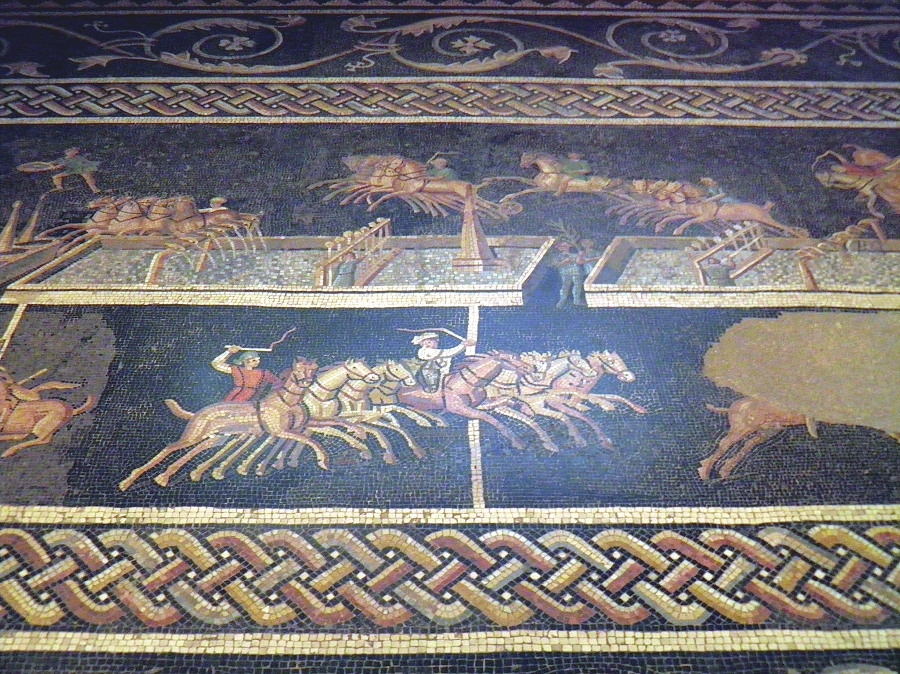
Second-century ad mosaic depicting circus games with multiple competing chariots, similar to what would have occurred in the Circus Maximus. The mosaic is on display at the Gallo-Roman Museum of Lyon-Fourvière, France.
Reproduced by permission from Carole Raddato
Return to the main text.
10:2 zealous for God. The Jews’ zeal for God (Ac 21:20; 22:3; Gal 1:14) was commendable in that God was its object, but it was flawed because it was not based on right knowledge about God’s way of salvation. Paul, before his conversion, was an example of such zeal (see Gal 1:14 and note).
10:3 the righteousness of God. Righteous standing based on faith (see 1:17 and note), which comes from God as a gift and cannot be earned by human works. their own. Righteous standing based on their own efforts.
10:4 Christ is the culmination of the law. Although the Greek for “culmination” (telos) can mean either (1) only “termination,” “cessation,” or (2) only “goal,” “fulfillment,” it seems best here to understand it as combining elements of both as in a “culmination.” Christ is the culmination of the law (see Mt 5:17 and note) in the sense that he brought it to completion by obeying perfectly its demands and by fulfilling its types and prophecies. Christians are no longer “under the law” (6:14; see note there), since Christ has freed them from its condemnation, but the law still plays a role in their lives. They are liberated by the Holy Spirit to fulfill its moral demands (see 8:4 and note), summed up in the command to love (13:8–10). righteousness. The righteous standing before God that Christ makes available to everyone who believes (see notes on 1:17; 3:24).
10:5 The person who does these things will live by them. Paul quotes Lev 18:5 (see note there; see also Dt 6:25 and note), which speaks of the righteousness to which Israel was called under the Sinaitic covenant. Of course, as Paul has already stated earlier in this letter, no one obeys the law perfectly, for “all have sinned and fall short of the glory of God” (3:23). In the OT, atonement was possible within the law itself by means of animal sacrifices; now atonement is possible only through faith in Jesus Christ.
10:6–7 The Scripture here quoted by Paul (Dt 30:12–14) was frequently quoted (sometimes rather loosely) in Jewish circles for various purposes. Paul uses it to sharpen the contrast between “the righteousness that is by the law” (v. 5) and “the righteousness that is by faith.” He takes a word that originally referred to the Mosaic law that was given as the way to life and applies it to the gospel of Christ as the way to life. In the case of Christ, just as in the case of the law, the way to life is accessible through God’s actions alone and without any superhuman effort on the part of people. They do not have to bring the transcended Christ down from heaven, since God has already done that, and they do not have to raise a dead Christ from the dead, since God has already done this as well. Salvation comes through trusting in Christ’s work alone.
10:8 The word is near you. In the OT passage (Dt 30:14; see note on 30:12,14) the “word” is God’s word as found in the law. Paul takes the passage and applies it to the gospel, “the message concerning faith”—the main point being the accessibility of the gospel. Righteousness is gained by faith, not by deeds, and is readily available to anyone who will receive it freely from God through Christ.
10:9 If you declare with your mouth. Although we are saved by faith alone, not by the words we utter, a verbal profession can be the external manifestation of saving faith. Jesus is Lord. This affirmation, the earliest known Christian confession of faith (see also 1Co 8:6; 12:3 and note), may have served as a partial Christian equivalent of the Jewish Shema (see Dt 6:4–9; Mk 12:29; Jas 2:19 and notes). It was probably used at baptisms. In view of the fact that “Lord” is used over 6,000 times in the Septuagint (the pre-Christian Greek translation of the OT) to translate the name of Israel’s God (Yahweh), it is clear that Paul, when using this title for Jesus, is affirming that, in Jesus, the God of Israel was himself present among his people. in your heart. In biblical terms the heart is not merely the seat of the emotions and affections but also of the intellect and will (see Ps 4:7 and note). God raised him from the dead. A bedrock truth of Christian doctrine (1Co 15:4, 14,17) and the central thrust of apostolic preaching (see, e.g., note on Ac 2:14–40; see also Ac 3:15 and note; 4:10; 10:40). Christians believe not only that Jesus lived but also that he still lives. will be saved. This may include final salvation—salvation at the last day (see Heb 9:28 and note).
10:10 Salvation involves inward belief (“with your heart”) as well as outward confession (“with your mouth”).
10:12 no difference between Jew and Gentile. In the sense that both are on the same footing as far as salvation is concerned (v. 13; 3:22).
10:13 Peter cited this same passage (Joel 2:32) on the day of Pentecost (see Ac 2:21 and note).
10:14–15 Since it might be argued that Jews had never had a fair opportunity to hear and respond to the gospel, Paul, by means of a series of rhetorical questions, states (in reverse order) the conditions necessary to call on Christ and be saved: (1) a preacher sent from God, (2) proclamation of the message, (3) hearing the message, (4) believing the message. Paul asserts in vv. 14–16 that all of these conditions have been met for the Israelites except the last one.
10:15 How beautiful are the feet of those who bring good news! The quotation is from Isa 52:7 (see note there), which refers to those who bring the exiles the good news of their imminent release from captivity in Babylonia. Here it is applied to gospel preachers, who bring the good news of release from captivity to sin.
10:16 the word about Christ. The Greek phrase could either mean the message about Christ or the message proclaimed by Christ.
10:18 Their voice . . . world. The quotation is from Ps 19:4 (see note there), which refers to the testimony of the heavens to the glory of God. Here “their voice” is applied to gospel preachers and is used to show that Israel cannot offer the excuse that they did not have opportunity to hear, since preachers went everywhere and often prioritized preaching in synagogues (e.g., Ac 13:14, 14:1, 17:1–2). These words (originally used to describe God’s revelation in nature) aptly describe the widespread preaching of the gospel. world. Perhaps meaning the known world, which for a Roman audience was roughly equivalent to the Roman Empire. Just as Jews were present at Pentecost from all parts of the empire, so some of the first 3,000 believers probably returned to all major parts of the empire and began to share their newfound faith with others.
10:19 Did Israel not understand? The quotation that follows (from Dt 32:21; see note there) answers this question by suggesting that the Gentiles, whom the Jews considered to be spiritually unenlightened, understood. Surely if Gentiles understood the message, Jews could have. those who are not a nation. The Gentiles, those who are not a nation of God’s forming in the sense that Israel was.
10:21 The responsibility for Israel’s unbelief rested with the nation itself. They had failed to meet God’s requirement, namely, faith. Yet, as Isa 65:2 stated, God continued to reach out in love to the people of Israel in spite of their disobedience.
11:1 reject. Meaning totally reject. There has always been a faithful remnant among the Jewish people (see note on 9:1—11:36).
11:2 whom he foreknew. Likely referring not just to foreknowledge, but to God’s divine choice to bring Israel into a covenant relationship. See note on 8:29.
11:5 remnant. As it was in Elijah’s day, so it was in Paul’s day. Despite widespread apostasy, a faithful remnant of Jews remained. chosen by grace. The grounds for the existence of the remnant was not their good works but God’s grace, as was God’s election of Israel from the start.
11:7 What the people of Israel sought so earnestly. A righteous standing before God, which eluded the greater part of Israel. The elect. The faithful remnant among the Jews. others were hardened. Because they refused the way of faith (see 9:30–32 and notes), God made them impervious to spiritual truth (see notes on v. 25; Ex 4:21; Isa 6:8–10; Mk 4:12; Lk 8:10)—a hardening of Israel as a consequence of their unbelief.
11:8 to this very day. The spiritual blindness (v. 10) of the Jews had continued from Isaiah’s day to Paul’s day.
11:9–10 The passage from Ps 69:22–23 (see notes there) was probably originally spoken by David concerning his enemies; Paul uses it to describe the results of God’s hardening.
11:11 their transgression. Their rejection of the gospel. make Israel envious. See v. 14; 10:19 and note; see also notes on 1Ki 17:16; 2Ki 5:14; Lk 4:26–27.
11:12 riches for the world. Equivalent to “riches for the Gentiles,” a reference to the abundant benefits of salvation already enjoyed by believing Gentiles, which had come about because of the rejection of the gospel by the Jews. That rejection caused the apostles to turn to the Gentiles (Ac 13:46–48; 18:6). their loss. Equivalent to “their transgression” (see note on v. 11), but focusing on the loss that this transgression entailed. greater riches. See note on v. 15. their full inclusion. The future salvation of Israel (see vv. 26–27 and notes; see also the “full number of the Gentiles,” v. 25).
11:13 apostle to the Gentiles. Paul viewed this as his fundamental mission, given to him at his conversion (Ac 22:21; 26:17). See 1:5; 15:9,12,16 and notes; Ac 9:15; Gal 1:16; 2:7,9 and note on 2:7; see also Eph 2:11–22; 3:3,6,10 and notes.
11:15 their rejection. God’s temporary and partial exclusion of the Jews (see v. 25 and note). reconciliation to the world. Somewhat equivalent to “riches for the world” (see note on v. 12). life from the dead. Equivalent to “greater riches” in v. 12. The sequence of redemptive events is: The “transgression” and “loss” (v. 12) of Israel leads to the salvation of the Gentiles, which leads to the jealousy or envy of Israel, which leads to the “full inclusion” (v. 12) of Israel when the hardening is removed, which leads to even more riches for the Gentiles. The “greater riches” (v. 12) for the Gentiles, which Paul describes here as “life from the dead,” appears to be a figurative expression describing the restoration of Israel as a joyful and glorious event (like resurrection)—which will result in even greater blessing for the world.
11:16 The first half of this verse is a reference to Nu 15:17–21. Part of the dough made from the first of the harvested grain (firstfruits) was offered to the Lord. This consecrated the whole batch. firstfruits. The patriarchs (cf. Ex 23:19 and note). whole batch. The Jewish people. holy. Not that all Jews are righteous (i.e., saved) but that God will be true to his promises concerning them (see 3:3–4 and notes). Paul foresaw a future for Israel, even though the nation was for a time set aside. root. The patriarchs (see v. 28). branches. The Jewish people.
11:17 branches. Individual Jews. broken off. “Because of unbelief” (v. 20). wild olive shoot. Gentile Christians. grafted in. The usual procedure was to insert a shoot or slip of one tree into another. olive root. The patriarchs. The whole olive tree (v. 24) represents the people of God (cf. Jer 11:16).
11:18 the root supports you. The salvation of Gentile Christians is dependent on the Jews, especially the patriarchs (e.g., the Abrahamic covenant). See Jn 4:22 and note.
11:19 Branches. Unbelieving Jews.
11:20 tremble. On the fear of God, see note on Ge 20:11; see also Pr 1:7 and note; 3:7; Php 2:12–13; Heb 4:1, “be careful”; 1Pe 1:17.
11:22 kindness and sternness of God. Any adequate doctrine of God must include these two elements. When we ignore his kindness, God seems a ruthless tyrant; when we ignore his sternness, he seems a negligent Father.
11:23 God is able to graft them in again. Paul holds out hope for the Jews—God is able (see vv. 26,29; Mk 10:27 and note).
11:24 contrary to nature. Paul recognized that such grafting was not commonly practiced (see note on v. 17). The inclusion of Gentiles in the family of God is “contrary to nature” (see Eph 2:12 and note). Obviously, the reasoning in this verse is more theological than horticultural. It would be difficult horticulturally to graft broken branches back into the parent tree, but the Jews really “belong” (historically and theologically) to the parent tree. Thus they will “much more readily . . . be grafted into their own olive tree.”
11:25 mystery. The so-called mystery religions of Paul’s day used the Greek word (mystērion) in the sense of something that was to be revealed only to the initiated. Paul himself, however, used it to refer to something formerly hidden or obscure but now revealed by God for all to know and understand (see 16:25; 1Co 2:7 and note; 4:1; 13:2; 14:2; 15:51 and note; Eph 1:9; 3:3,9 and note on 3:3; 5:32 and note; 6:19; Col 1:26–27 and notes; 2:2; 4:3; 2Th 2:7 and note; 1Ti 3:9,16). The word is used of (1) the incarnation (1Ti 3:16; see note there); (2) the death of Christ (1Co 2:1, NIV text note; 2:7, “God’s wisdom, a mystery”); (3) God’s purpose to sum up all things in Christ (Eph 1:9–10), and especially to include both Jews and Gentiles in the NT church (Eph 3:3–6); (4) the change that will take place at the resurrection (1Co 15:51); and (5) the plan of God by which both Jew and Gentile, after a period of disobedience by both, will by his mercy be included in his kingdom (here). so that you may not be conceited. God’s merciful plan to include the Gentiles in his great salvation plan should humble them, not fill them with arrogance. in part. Israel’s hardening is partial, not total. until. Israel’s hardening is temporary, not permanent. full number of the Gentiles. The total number of Gentiles who will be saved.
The term “mystery” or “secret” (Greek mystērion) is common in Paul’s letters (used 21 times; see Ro 11:25; 16:25; Eph 3:3–6; 1Ti 3:16 and notes), but also elsewhere in the NT (see Mk 4:11; Rev 10:7 and notes). It does not necessarily refer to something mysterious or difficult to understand, but rather to something previously unknown that has now been revealed by God to his people.
Some of the mysteries in Scripture include the reality that the kingdom of God has already drawn near with the coming of Jesus the Messiah (Mk 4:11; Mt 13:10), the truth that Gentiles are fellow heirs with the Jews as the people of God (Eph 3:6), the partial hardening of Israel until the full number of Gentiles are saved (Ro 11:25), the indwelling presence of Christ in the believer (Col 1:27), the transformation of the body at the return of Christ (1Co 15:51), and the unification of all things in heaven and on earth (Eph 1:10).
Go to the Articles Index.
11:26 all Israel. See article.
Romans 11:25–27 is a key passage with reference to the controversial question of whether the church has replaced Israel in God’s plan or whether Israel as a nation will ultimately respond to the message of salvation.
There are three main interpretations of the phrase “all Israel will be saved”: (1) Some claim “all Israel” means “spiritual Israel,” the total number of the elect who will be saved, both Jews and Gentiles, of every generation. (2) Others claim that “all Israel” means ethnic Jews, but refers to the total number of elect Jews of every generation—equivalent to the “full inclusion” of Israel (v. 12; see note there), which is analogous to the “full number of the Gentiles” (v. 25; see note there). (3) Still others see “all Israel” as ethnic Jews of the final generation. According to this perspective, Israel as a nation will repent and be saved shortly before or at (v. 26) Christ’s second coming. The strongest argument for this view is Paul’s statement that at present, “they are enemies” of the gospel (11:28). This would seem to apply to Jews who are presently in a state of unbelief.
Paul makes it clear that the salvation of the Jews will be on the same basis as anyone’s salvation: personal faith in Jesus Christ, crucified and risen from the dead.
Go to the Articles Index.
11:27 covenant. The new covenant of Jer 31:31–34 (see notes there and article). when I take away their sins. See Jer 31:34; Zec 13:1 and note. Just as salvation for Gentiles involves forgiveness of sins, so the Jews, when they are saved, are forgiven by the mercy of God in response to their repentance and faith (see v. 23; Zec 12:10—13:1 and notes).
11:28 they are enemies. Only temporarily. for your sake. Explained in v. 11. loved on account of the patriarchs. Not because any merit was passed on from the patriarchs to the Jewish people as a whole, but because God in love chose Israel, and that choice was “irrevocable” (v. 29).
11:29 God’s gifts and his call are irrevocable. God does not change his mind with reference to his call. Even though Israel is presently in a state of unbelief, God’s purpose will be fulfilled in them.
11:32 everyone. Both Jews and Gentiles are in view (as at 3:22). There has been a period of disobedience for each in order that God may have mercy on them all. Paul is not teaching universal salvation.
11:33–36 The doxology that ends this section of Romans is the natural outpouring of Paul’s praise to God, whose wisdom and knowledge brought about his great plan for the salvation of both Jews and Gentiles.
12:1—15:33 Righteousness practiced (see outline). Paul now turns to the practical application of all he has said previously in the letter. This does not mean that he has not said anything about Christian living up to this point. Chs. 6–8 have touched on this already, but now Paul goes into detail to show that Jesus Christ is to be Lord of every area of life. These chapters are not a postscript to the great theological discussions in chs. 1–11. In a real sense the entire letter has been directed toward the goal of showing that God demands our action as well as our believing and thinking. Faith expresses itself in obedience (see notes on Jas 2:14–26).
12:1 Therefore, I urge you. Paul draws an important inference from the truth set forth in chs. 1–11. God’s mercy. Much of the letter has been concerned with demonstrating this. bodies. Body here refers to the whole self. (See 6:13 and note.) living sacrifice. In contrast to dead animal sacrifices, or perhaps “living” in the sense of having the new life of the Holy Spirit (see 6:4; 8:2 and note). true and proper worship. The Greek word translated “true and proper” (logikos) is sometimes rendered as “reasonable,” “appropriate,” “authentic,” or “spiritual.” Here it indicates actions that are not merely external rituals but involve the heart, mind and will in worship and obedient service.
12:2 this world. Here meaning the evil world system, with all its sinfulness and corruption (see Gal 1:4; 1Jn 2:15 and notes). be transformed. Here a process, not a single event. mind. Thought and will as they relate to morality (1:28; Eph 4:23). God’s will. What God wants from the believer both now and in the future. good. That which leads to the spiritual and moral growth of the Christian. pleasing. To God, not necessarily to us. perfect. No improvement can be made on the will of God.
12:3 in accordance with the faith. The power given by God to each believer to fulfill various ministries in the church (see vv. 4–8 and notes). God has distributed. Since the power comes from God, there can be no basis for a superior attitude or self-righteousness.
12:4–8 Paul likens Christians to members of a human body. There are many members and each has a different function, but all are needed for the health of the body. The emphasis is on diversity within unity (see 1Co 12:12–31 and notes).
12:5 in Christ. The key to Paul’s concept of Christian unity. It is only in Jesus Christ that any unity in the church is possible. True unity is spiritually based. See note on 6:11.
12:6 gifts. Greek charismata, referring to special gifts of grace—freely given by God to his people to meet the needs of the body (see notes on 1Co 1:7; 12:4). prophesying. See notes on 1Co 12:10; 14:1–5. then prophesy. There is to be no false modesty that denies the existence of gifts or refuses to use them. in accordance with your faith. Probably means about the same thing as “in accordance with the faith” in v. 3 (see note there).
12:7 serving. Any kind of service needed by the body of Christ or by any of its members. teaching. See notes on 1Co 12:28; Eph 4:11.
12:8 show mercy. Including caring for the sick, the poor and the aged. cheerfully. Serving the needy should be a delight, not a chore (cf. 2Co 9:7).
12:9 Love. Believers’ love for fellow Christians and others. sincere. True love, not pretense. In view of the preceding paragraph, with its emphasis on social concern, the love Paul speaks of here is not mere emotion but love in action, as delineated in the rest of the chapter (cf. Jas 2:1–4, 14–17; 1Jn 3:16–18; 4:19–21). evil . . . good. See Am 5:15. “Evil” and “good” frame vv. 9–21.
12:10 love. Love within the family of God. Honor one another above yourselves. In the Greco-Roman world, giving honor to others was done according to status. Believers were to honor others, even those of lower status, above themselves—a radical teaching. Only a mind renewed by the Holy Spirit (v. 2) could possibly do this (see Php 2:3 and note).
12:11 spiritual fervor. Or “fervent in spirit.” If “spirit” means the “Holy Spirit” here, the reference would be to the fervor the Holy Spirit provides.
12:12 Be joyful in hope. The certainty of the Christian’s hope is a cause for joy (see 5:5 and note; see also 8:16–25; 1Pe 1:3–9). patient. Enduring triumphantly—necessary for Christians, because affliction is their inevitable experience (see Jn 16:33; 2Ti 3:12 and notes). faithful in prayer. One must not only pray in hard times but also maintain communion with God through prayer at all times (see Lk 18:1; 1Th 5:17 and note).
12:13 Share with the Lord’s people. The Christian has social responsibility to all people, but especially to other believers (Gal 6:10; 1Ti 5:8).
12:14 Bless those who persecute you. Paul is echoing Jesus’ teaching (see Mt 5:44 and note; Lk 6:28 and note on 6:27).
12:15 Identification with others in their joys and in their sorrows is a Christian’s privilege and responsibility.
12:17 Do not repay anyone evil for evil. See Mt 5:39–42, 44–45; 1Th 5:15; 1Pe 3:9 and notes. Be careful to do what is right in the eyes of everyone. A possible reflection of Pr 3:4 in the Septuagint (the pre-Christian Greek translation of the OT). Christian conduct should never betray the high moral standards associated with the gospel, or it will provoke the disdain of unbelievers and bring the gospel into disrepute (see 2Co 8:21 and note; 1Ti 3:7).
12:18 If it is possible . . . live at peace. Jesus pronounced a blessing on peacemakers (see Mt 5:9 and note), and believers are to cultivate peace with everyone to the extent that such peace depends on them (see Jas 3:18 and note).
12:20 heap burning coals on his head. Doing good to one’s enemy (v. 21), instead of trying to take revenge, may bring about their repentance (see note on Pr 25:22).
12:21 evil . . . good. See note on v. 9.
13:1 be subject to. A significant theme in vv. 1–7. governing authorities. The civil rulers, all of whom were probably pagans at the time Paul was writing. Christians may have been tempted not to submit to them out of loyalty to Christ. Paul is encouraging Christians to be good citizens as long as it doesn’t conflict with their allegiance to Christ. established by God. Even the possibility of a persecuting state did not shake Paul’s conviction that civil government is ordained by God (see 1Pe 2:13–17 and notes).
13:2 judgment. Either divine judgment or, more likely, punishment by the governing authorities, since v. 3 (“For”) explains this verse; see also v. 4.
13:3 do what is right and you will be commended. Paul is not stating that this will always be true but is describing the proper, ideal function of rulers. When civil rulers overstep their proper function, the Christian is to obey God rather than human authorities (Ac 4:19; 5:29).
13:4 God’s servant. In God’s providence the ruler is God’s servant (see Isa 45:1 and note). good. Rulers exist for the benefit of society—to protect the general public by maintaining good order. sword. The symbol of Roman authority on both the national and the international levels. Governments may have to use force to maintain good order. But the church’s responsibility and that of the Christian individual have already been outlined in 12:18–21. Here we find the biblical principle of using force for the maintenance of good order.
13:5 as a matter of conscience. Civil authorities are ordained by God, and in order to maintain a good conscience Christians must duly honor them.
13:6 you pay taxes. Because rulers are God’s agents, who function for the benefit of society in general.
13:8 continuing debt. To love is the one debt that is never paid off. No matter how much people have loved, they are under obligation to keep on loving. one another. Includes not only fellow Christians but all people (see 12:9–21). the law. The Mosaic law, which lays down both moral and social responsibilities.
13:9 Further explains the last statement of v. 8, namely, that love of neighbor encompasses all our social responsibilities. your neighbor. Jesus taught that our neighbor is anyone in need (see Lk 10:25–37 and notes), which is probably the idea Paul has in mind here. as yourself. Not a command to love ourselves but a recognition of the fact that we naturally do so (cf. Gal 5:13–14; Eph 5:33).
13:11–14 In this section, as in other NT passages, the certain coming of the end of the present age is used to provide motivation for godly living (see, e.g., Mt 25:31–46; Mk 13:33–37; Lk 21:36; Php 4:5; 1Th 5:6, 8; Titus 2:11–14; Jas 5:7–11; 2Pe 3:11–14; 1Jn 2:28; 3:2–3).
13:11 present time. The time of salvation, the closing period of the present age, before the consummation of the kingdom. The hour. The time for action. our salvation. The full realization of salvation at the second coming of Jesus Christ (see 8:23; Heb 9:28; 1Pe 1:5 and notes). is nearer now. Every day brings us closer to the second advent of Christ.
13:12 The night. The present evil age. is nearly over; the day is almost here. A clear example of the NT teaching of the imminence of the end times (see 1Co 7:29; Php 4:5; Jas 5:9; 1Pe 4:7; 1Jn 2:18 and notes). These texts do not necessarily mean that the early Christians believed that Jesus would return within a few years. Rather, they regarded the death and resurrection of Christ as the crucial events of history that began the last days (see Heb 1:1–2 and notes). Since the next great event in God’s redemptive plan is the second coming of Jesus Christ, “the night,” no matter how long it may chronologically last, is “nearly over.” the day. The appearing of Jesus Christ, which ushers in the consummation of the kingdom.
13:14 clothe yourselves with the Lord Jesus Christ. See Gal 3:27. Paul exhorts believers to display outwardly what has already taken place inwardly (see Col 3:1–10 and notes)—including practicing all the virtues associated with Christ. clothe . . . with. See note on Ps 109:29.
14:1—15:13 Paul addresses a conflict that is occurring between the “weak” and the “strong,” likely Jews and Gentiles, and commends unity and welcoming each other. Cf. 1Co 8:1—11:1 and notes.
14:1 whose faith is weak. Probably Jewish Christians at Rome who were continuing to observe the hallmarks of Jewish identity, such as dietary restrictions and the keeping of the Sabbath and other special days. Their concern was not the same as that of the Judaizers of Galatia. The Judaizers were claiming that circumcision and keeping the law were necessary for salvation and were trying to impose these standards on Gentiles in the Galatian churches. By contrast, the “weak” Roman Christians were wrestling with the status of OT regulations under the new covenant inaugurated by the coming of Christ. without quarreling over disputable matters. Fellowship among Christians is not to be based on everyone’s agreement on disputable questions. Christians do not agree on all matters pertaining to the Christian life, nor do they need to when those matters do not affect a person’s salvation.
14:2 One person’s faith. In contrast, Paul now describes the “strong” (15:1) Christian, likely primarily Gentiles. Here faith is used in the sense of assurance or confidence. The strong Christian’s understanding of the gospel allows them to recognize that one’s dietary choices have no spiritual significance.
14:4 someone else’s. God’s. A Christian is not to reject a fellow Christian, who is also a servant of God. To their own master, servants stand or fall. The “weak” Christian is not the master of the “strong” Christian, nor is the “strong” the master of the “weak.” God is Master, and to him alone all believers are responsible.
14:5 one day more sacred than another. The primary reference here is no doubt to the Sabbath, but it would also refer to all the special days of the OT ceremonial law. considers every day alike. All days are to be dedicated to God through holy living and godly service. fully convinced in their own mind. The importance of personal conviction in disputable matters of conduct runs through this passage (vv. 14,16,22–23). It is remarkable that Paul identifies one of the Ten Commandments (Ex 20:1–17) as no longer binding on Christians (cf. Gal. 4:10; Col. 2:16–17). Though we are still under God’s righteous standards, the OT law has been fulfilled in Christ and is now written on our hearts (Jer 31:33) instead of on tablets of stone.
14:6 The motivation behind the actions of both the strong and the weak is to be the same: Both should want to serve the Lord and give thanks for his provision.
14:7 none of us lives for ourselves alone. The reference is to Christians. We live not to please ourselves but to please the Lord. none of us dies for ourselves alone. Even in death the important thing is one’s relationship to the Lord. Paul repeats the truths of this verse in v. 8.
14:9 Lord. See note on 10:9. Christ’s Lordship over both the dead and the living arises out of his death and resurrection.
14:10 why do you judge your brother or sister? Addressed to weak Christians. why do you treat them with contempt? Addressed to strong Christians. we will all. Refers to every Christian. God’s judgment seat. All Christians will be judged, and the judgment will be based on works (see 2Co 5:10 and note; cf. 1Co 3:10–15 and notes).
14:13 Instead. The words that immediately follow are addressed to strong Christians. stumbling block or obstacle. Something that causes one to fall into sin.
14:14 I am convinced, being fully persuaded in the Lord Jesus. Now that Paul was a Christian, the Jewish dietary laws were no longer binding (see Mk 7:19–20; Ac 10:15,28 and notes). nothing is unclean in itself. For Paul’s teaching elsewhere on this subject, see 1Ti 4:4; Titus 1:15 and note. if anyone regards something as unclean, then for that person it is unclean. Not to be generalized to mean that sin is only a matter of subjective opinion or conscience. Paul is not discussing conduct that in the light of Scripture is clearly sinful but conduct concerning which Christians may legitimately differ (in this case, food regulations). With regard to such matters, decisions should be guided by conscience.
14:15 love. The key to proper settlement of disputes. someone for whom Christ died. Christ so valued weak Christians that he died for them. Surely strong Christians ought to be willing to make adjustments in their own behavior for the sake of such fellow believers (see 1Co 8:11–13; 10:23,28–29,32–33 and notes).
14:16 what you know is good. From your own understanding of Christian liberty. be spoken of as evil. To exercise freedom without responsibility can lead to evil results.
14:17 kingdom of God. See notes on Mt 3:2; Lk 4:43. is not a matter of eating and drinking. These things are not at the heart of Christian living, but Christians need to be sensitive to each other’s convictions regarding them. righteousness. Righteous living. Paul’s concern for the moral and ethical dimension of the Christian life stands out in all his letters. peace. See 5:1 and note. joy in the Holy Spirit. Joy given by the Holy Spirit (Gal 5:22–23).
14:19 mutual edification. The spiritual building up of individual Christians and of the church (see 1:11–12 and note on 1:12).
14:20 work of God. The weak Christian who as a redeemed person is God’s work and one in whom God continues to work (cf. Eph 2:10). causes someone else to stumble. Paul recognizes a strong Christian’s right to certain freedoms, but qualifies this with the principle of regard for a weak Christian’s scruples.
14:22 keep between yourself and God. Strong Christians are not required to go against their convictions or change their standards. Yet they are not to flaunt their Christian freedom but to keep it a private matter. what he approves. Probably a reference to the eating of certain foods.
14:23 everything. The matters discussed above, namely, conduct about which there can be legitimate differences of opinion among Christians. faith. Here the conviction that one’s action is in keeping with God’s will.
15:1 We who are strong. Paul identifies himself with the strong Christians, those whose personal convictions allow them more freedom than the weak. to bear with. Not merely to tolerate or put up with but to uphold lovingly. failings. Not sins, since in the matters under discussion there is no clear guidance in Scripture. not to please ourselves. Not that Christians should never please themselves, but that they should not insist on doing what they want without regard to the scruples of other Christians.
15:3 Christ did not please himself. He came to do the will of the Father, not his own will (see Jn 4:34 and note). This involved suffering and even death (see Mt 20:28; Mk 10:45; 2Co 8:9; Php 2:5–8 and notes). The insults of those who insult you have fallen on me. In the psalm quoted (69:9; see note there) “you” refers to God and “me” refers to the righteous sufferer, whom Paul identifies with Christ. The quotation serves to show how Christ did not please himself but voluntarily bore human hostility toward God.
15:4 Here Paul defends his application of Ps 69:9 to Christ. In so doing, he states a great truth concerning the purpose of Scripture: It was written for our instruction, so that as we patiently endure we might be encouraged to hold fast our hope in Christ (1Co 10:6,11).
15:5 the same attitude of mind toward each other that Christ Jesus had. Not that believers should all come to the same conclusions on the matters of conscience discussed above, but that they might agree to disagree in love (cf. Eph 4:1–6; Php 2:1–5 and notes).
15:7 just as Christ accepted you. See 14:3; see also 14:4,15 and notes.
15:8 Christ has become a servant of the Jews. Clearly revealed in his earthly ministry. He was sent to the Jewish people and largely limited his ministry to them (Mt 15:24). God gave a special priority, so far as the gospel is concerned, to the Jews (see 1:16 and note; 3:1–8; see also 9:4–5 and notes). promises made to the patriarchs. The covenant promises made to Abraham (Ge 12:1–3; 17:7; 18:19; 22:18), Isaac (Ge 26:3–4) and Jacob (Ge 28:13–15; 46:2–4; see chart).
15:9 that the Gentiles might glorify God. From the beginning, God’s redemptive work in and for Israel had in view the redemption of the Gentiles (see Ge 12:2–3 and note). They would both see God’s mighty and gracious acts for his people and hear the praises of God’s people as they celebrated what God had done for them (a common theme in the Psalms; see Paul’s quotations in vv. 9b–12 and note on Ps 9:1). Thus they would come to know the true God and glorify him for his mercy (see notes on Ps 46:10; 47:9). God’s greatest and climactic act for Israel’s salvation was the sending of the Messiah to fulfill the promises made to the patriarchs and so to gather in the great harvest of the Gentiles.
15:12 Root of Jesse. Jesse was the father of David (1Sa 16:5–13; Mt 1:6), and the Messiah was the “Son of David” (see Mt 1:1 and note; 21:9; see also Isa 11:1; Rev 5:5 and notes). in him the Gentiles will hope. The Gentile mission of the early church was a fulfillment of this prophecy (Isa 11:10; see note there), as is the continuing evangelization of the nations (cf. Isa 42:4 and note).
15:13 God of hope. Any hope the Christian has comes from God (see note on 5:5). Biblical hope is not wishful thinking but confident expectation. by the power of the Holy Spirit. Hope cannot be conjured up by human effort; it is God’s gift by his Spirit (8:24–25).
15:15 to remind you of them again. Since Paul had never preached or taught in Rome, he may be referring to Christian doctrine generally known in the church.
15:16 minister of Christ Jesus to the Gentiles. See notes on 11:13; Gal 2:7. This is further evidence that the church in Rome was predominantly Gentile (see 1:13 and note). priestly duty of proclaiming the gospel. Paul’s priestly function was different from that of the Levitical priests. They were involved with the rituals of the temple, whereas he served as a priestly mediator by preaching the gospel. an offering acceptable to God, sanctified by the Holy Spirit. The offering Paul brought to God was the Gentile church. sanctified. See note on 1Co 1:2.
15:17 I glory. Paul was not boasting of his own achievements but of what Christ had accomplished through him (v. 18).
15:19 signs and wonders. See Ac 14:8–10; 16:16–18, 25–26; 20:9–12; 28:8–9; 2Co 12:12 and note; Heb 2:4 and note. from Jerusalem. The home of the mother church, where the gospel originated and its dissemination began (see Ac 1:8 and note; see also map and Introduction to Acts: Plan and Outline). Illyricum. A Roman province north of Macedonia (present-day Albania, Serbia and Montenegro). Acts mentions nothing of Paul’s ministry there, but Acts is highly selective and Paul undoubtedly traveled to numerous places not mentioned in Luke’s second volume. I have fully proclaimed the gospel. Not everyone in the eastern Mediterranean area had heard the gospel, but Paul believed that enough churches had been planted in representative locations to carry on his work there, so that he could move on to the western Mediterranean area.
15:20 not be building on someone else’s foundation. Rather, Paul wanted to lay foundations on which others could build (see 1Co 3:6,10 and notes). This speaks of Paul’s ministry of starting churches and then trusting the Spirit to raise up and equip leaders within those churches to continue the work.
15:22 hindered from coming to you. Paul’s great desire to complete the missionary task in the eastern Mediterranean had prevented him from making a trip to Rome.
15:23 no more place for me to work. Because of the principle stated in v. 20. longing for many years to visit you. See 1:11–15.
15:24 to have you assist me on my journey there. Paul wanted to use the Roman church as a base of operations for a mission to Spain (see also v. 28). enjoyed your company for a while. More than a quick stop at Rome was contemplated (1:11–12).
15:25 in the service of the Lord’s people there. Paul wanted to present the gift (v. 26) personally to the Jerusalem church. The gift needed interpretation. It was not merely money; it represented the love and concern of the Gentile churches for their Jewish brothers and sisters in Christ. the Lord’s people. See note on 1:7.
15:26 Macedonia and Achaia. See note on 1Th 1:7. contribution. See 1Co 16:1–4; 2Co 8:1—9:15 and notes.
15:27 Jews’ spiritual blessings. Especially Christ and the gospel.
15:28 this contribution. The collection from the Gentile churches.
15:31 Pray that I may be kept safe from the unbelievers in Judea. Paul wanted to go to Jerusalem. The delivery of the collection was important to him, but he had received warnings about what might happen to him there (see Ac 20:22–23 and note on 20:22). may be favorably received. Perhaps a reference to the way in which the money was to be distributed—often a delicate and difficult task.
15:32 in your company be refreshed. See 1:11–12.
15:33 God of peace. See notes on 5:1; 1Th 5:23.
16:1 our sister. In the sense of being a fellow believer. Phoebe. Probably the carrier of the letter to Rome (cf. v. 2). deacon. See NIV text note; one who serves or ministers in any way. When church related, as it is here, it probably refers to a specific office (e.g., Php 1:1)—a female deacon. Cenchreae. A port located about six miles east of Corinth on the Saronic Gulf.
16:2 benefactor. A person of means and status who provided financial and/or other support for people of lower social status.
16:3 Priscilla and Aquila. Close friends of Paul, who worked in the same trade of tentmaking (see Ac 18:2–3 and notes).
16:4 risked their lives for me. There is no other record of this in the NT or elsewhere, but it must have been widely known, as the last part of the verse indicates (cf. Php 2:25–30 and notes).
16:5 the church that meets at their house. The first of five house churches in Rome mentioned in this chapter (cf. vv. 10,11,14,15). The early church did not meet in buildings of their own, but in the homes of their members.
16:6 Mary. Six persons are known by this name in the NT. This Mary is unknown apart from this reference.
16:7 Junia. A feminine name. Andronicus and Junia may have been husband and wife (cf. Priscilla and Aquila [v. 3] and probably Philologus and Julia [v. 15]). among the apostles. Two possible interpretations of “apostles” are: (1) Those who witnessed the resurrection and proclaimed the truth of the gospel (see Ac 14:4,14 and note on 14:4; 1Co 9:1, 15:3–8; 1Th 2:6). (2) The Twelve. If the latter is the case here, the meaning would be that these two persons were outstanding “in the opinion of” the apostles. Grammatically, however, this is less likely.
16:8–10 Ampliatus . . . Urbanus . . . Stachys . . . Apelles. All common slave names found in the imperial household.
16:10 Aristobulus. Perhaps refers to the grandson of Herod the Great and brother of Herod Agrippa I.
16:11 Narcissus. Sometimes identified with Tiberius Claudius Narcissus, a wealthy freedman of the Roman emperor Tiberius.
16:12 Tryphena and Tryphosa. Perhaps sisters, even twins, because it was common for such persons to be given names from the same root. Persis. Means “Persian woman.”
16:14–15 None of these persons can be further identified, except that they were slaves or freedmen in the Roman church.
16:16 holy kiss. See 1Co 16:20; 2Co 13:12; 1Th 5:26 and notes; 1Pe 5:14. Justin Martyr (ad 150) tells us that the holy kiss was a regular part of the worship service in his day. It is still a practice in some churches.
16:17–20 Throughout these verses there are echoes of the story of the fall in Ge 2–3.
16:17 those who cause divisions and put obstacles in your way. Who these people were we cannot tell, but some of their characteristics are mentioned in v. 18.
16:19 wise about what is good. Christians are to be experts in doing good.
16:20 God of peace. See 15:33 and note; cf. note on 1:7. will soon crush Satan. A reference to Satan’s final doom (see Ge 3:15 and note). For “soon,” see note on 13:12. grace. See note on 1:7. with you. See note on 2Co 13:14.
16:21 Jason. Possibly the Jason mentioned in Ac 17:5–9. Sosipater. Probably Sopater, son of Pyrrhus, from Berea (see Ac 20:4 and note).
16:22 I, Tertius, who wrote down this letter. He had functioned as Paul’s secretary in transcribing the letter.
 16:23 Gaius. Usually identified with Titius Justus, a God-fearer, in whose house Paul stayed while in Corinth (see Ac 18:7 and note; 1Co 1:14). His full name would be Gaius Titius Justus. here. In Corinth. Erastus. At Corinth archaeologists have discovered a reused block of stone in a paved square, with the Latin inscription: “Erastus, in return for his aedileship, laid [this pavement] at his own expense” (see photo; see also archaeology note). This may refer to the Erastus mentioned here. If it does, it is the earliest reference to a Christian by name outside the NT. He may also be the same person referred to in Ac 19:22 and 2Ti 4:20 (see notes there), though it is difficult to be certain because the name was fairly common. Quartus. Means “fourth (son).”
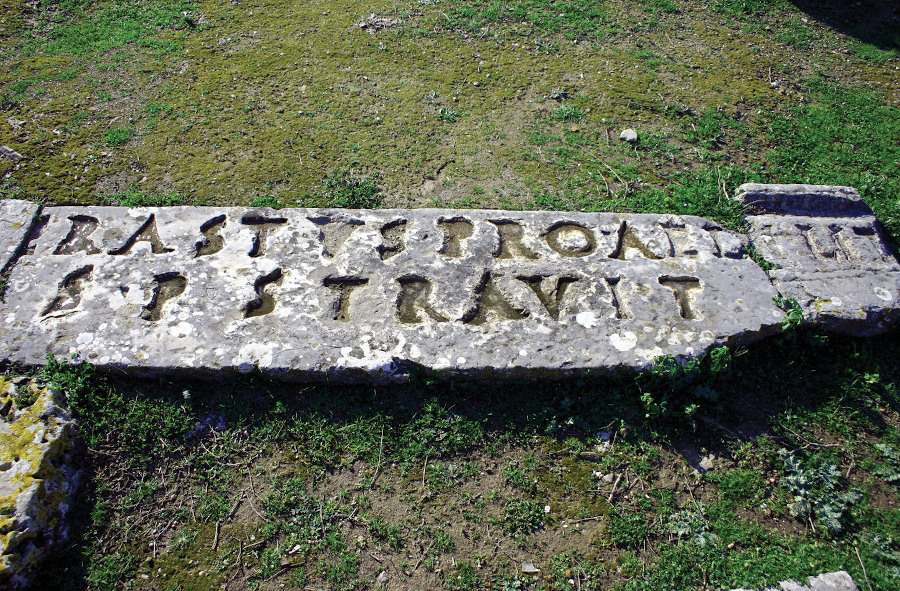
A Latin inscription in Corinth dating to the mid-first century ad mentions an “Erastus,” probably the same Erastus mentioned by Paul (Ro 16:23). The inscription reads: “Erastus, in return for his aedileship, laid [this pavement] at his own expense.”
www.HolyLandPhotos.org
Return to the main text.
16:25–27 This doxology to Romans occurs in some manuscripts earlier in the letter, suggesting that shorter versions of Romans may have circulated as well as the longer version with its greetings to specific Roman believers (ch. 16) and Paul’s future itinerary (ch. 15). See Introduction: Recipients.
16:25 my gospel. Not a gospel different from that preached by others, but the gospel Paul received by direct revelation (see Gal 1:12 and note on 1:11). message I proclaim about Jesus Christ. A description of the gospel; it is about Jesus Christ, who embodies its content (see 1:3; 1Co 15:3–4 and notes). mystery. See note on 11:25. for long ages. From eternity past (see 1Co 2:7 and note).
16:26 revealed and made known through the prophetic writings. See 1:2 and note. all the Gentiles. The universality of the gospel (see Mt 28:19 and note).
16:27 to . . . God be glory. The ultimate purpose of all things (see 11:36; Ps 29:1–2; 86:9,12; 96:7–8; 115:1; Lk 2:14 and note; 1Co 10:31 and note; Eph 1:12, 14; Rev 5:13; 7:12; 15:4; 19:1,7).