Study Notes
1:1 A summary statement introducing the six days of creative activity (see note on 2:1). The truth of this majestic verse was joyfully affirmed by poet (Ps 102:25) and prophet (Isa 40:21). In the beginning God. The Bible always assumes, and never argues, God’s existence. Although everything else had a beginning, God has always been (Ps 90:2). In the beginning. Jn 1:1–10, which stresses the work of Christ in creation, opens with the same phrase. God created. “God” renders the common Hebrew noun Elohim. It is plural but the verb is singular, a normal usage in the OT when reference is to the one true God. This use of the plural expresses intensification rather than number and has been called the plural of majesty, or of potentiality. In the OT the Hebrew verb for “create” is used only of divine, never of human, activity. the heavens and the earth. “All things” (Isa 44:24). That God created everything is also taught in Ecc 11:5; Jer 10:16; Jn 1:3; Col 1:16; Heb 1:2. The positive, life-oriented teaching of v. 1 is beautifully summarized in Isa 45:18.

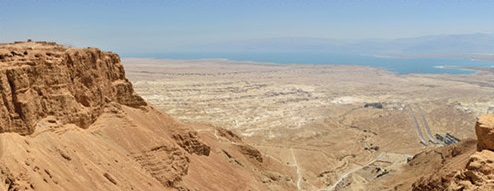
The Biblical Account of Creation
The Bible is clear from its very first verse that God created all things out of nothing (ex nihilo) simply by his divine command. Attempts at gaining further specificity regarding timing and methodology, however, encounter difficulties. These difficulties exist due to the nature, or genre, of the biblical creation account and the various ways its language can be understood. Genesis 1:1—2:3 is a highly stylistic literary work, perhaps even to be considered poetry. One can observe an intentional symmetry, for example, between the realms of creation described and the things occupying that realm. Thus, “light” (v. 3) is balanced by “lights” (v. 14); the “vault” or “sky” (v. 6) is balanced by “birds” (v. 20); the “seas” (vv. 9–10) are balanced by sea creatures (vv. 20–21); and the “land” (vv. 9–10) is balanced by terrestrial creatures (v. 24). The imbalance introduced by the extended account of the creation of mankind (vv. 26–30) serves to highlight the unique status and role of this particular aspect of God’s creation. The entire creation account, therefore, must be understood as a carefully crafted literary and schematic presentation. This fact calls into question the legitimacy of efforts to read the biblical creation account as though it were intended to recount the methodology of creation with scientific precision.
Further complicating a scientific reading of these verses is the vagueness of the terms used—particularly the word “day” (yom). This word can mean a 24-hour day, a special time of unspecified duration (e.g., the Day of the Lord), a short time, lifetime, or an indeterminate time. Similarly, “evening” and “morning” may refer to periods of a single day or rather the commencement and conclusion of the creative activity just described (cf. “the dawn of a new day”). This imprecision of language has resulted in a variety of attempts to reconcile the biblical account with scientific evidence suggesting a long period of geological and biological development. These attempts include reading “day” as representative of a long “age,” which could then allow for various permutations of the modern theory of evolution. Another way the biblical creation account is read to allow for an extended period of time is by seeing a “gap” of long geological ages between Gen 1:1 and 1:2. But ultimately all such attempts are unnecessary, and their difficulties are avoided, when we recognize that the biblical creation account is concerned not to describe the chronology or methodology of God’s activity, but rather to relate the fact that God created all things and that human beings are the capstone of that creative activity inasmuch as they alone are made in the image of their Creator.
Go to the Articles Index.
Creation in the Bible and the Ancient Near East
Most ancient Near Eastern peoples had myths relating how the world came to be. Prevalent in those myths were accounts of how one of the gods triumphed over a fierce and powerful beast that represented disorder, then fashioned the ordered world that people knew, and finally was proclaimed by the other gods to be the divine “king” over the world he had created—a position ever subject to the challenge of the forces of disorder.
Over against all those pagan myths, the author of Genesis teaches a totally different doctrine of creation: The one and only true God did not have to overcome a mighty cosmic champion of chaos but simply by a series of his royal creation decrees called into being the ordered world, the visible kingdom that those decrees continue to uphold and govern. The author teaches this doctrine of creation in the form of a narrative that recounts the story of God’s creative acts. Those acts are narrated from the perspective of one who was an eyewitness to events in God’s royal council chamber, from which he issues his creative decrees. For a similar narrative perspective, see Job 1:6–12; 2:1–6; for a different narrative perspective, see note on 2:4—4:26.
Go to the Articles Index.
1:2 earth. The focus of this account. formless and empty. The phrase, which appears elsewhere only in Jer 4:23, gives structure to the rest of the chapter (see note on v. 11). God’s “separating” and “gathering” on days 1–3 gave form, and his “making” and “filling” on days 4–6 removed the emptiness. darkness . . . the waters. Completes the picture of a world awaiting God’s light-giving, order-making and life-creating word. and. Or “but.” The awesome (and, for ancient people, fearful) picture of the original state of the visible creation is relieved by the majestic announcement that the mighty Spirit of God hovers over creation. The announcement anticipates God’s creative words that follow. Spirit of God. He was active in creation, and his creative power continues today (Job 33:4; Ps 104:30).
 1:3 God said. Merely by issuing his royal decree, God brought all things into being (Ps 33:6, 9; 148:5; Heb 11:3). Let there be light. God’s first creative word called forth light in the midst of the primeval darkness. Light is necessary for making God’s creative works visible and life possible. In the OT it is also symbolic of life and blessing (2Sa 22:29; Job 3:20; 30:26; 33:30; Ps 49:19; 56:13; 97:11; 112:4; Isa 53:11; 58:8,10; 59:9; 60:1,3). Paul uses this word to illustrate God’s re-creating work in sin-darkened hearts (2Co 4:6).
1:4 good. Everything God created is good (vv. 10,12,18,21, 25); in fact, the conclusion declares it to be “very good” (v. 31). The creation, as fashioned and ordered by God, had no lingering traces of disorder and no dark and threatening forces arrayed against God or people. Even darkness and the deep were given benevolent functions in a world fashioned to bless and sustain life (see Ps 104:19–26; 127:2—see also NIV text note there).
1:5 called. See vv. 8,10. In the ancient Near East, for a king to name people or things was an act of claiming dominion over them (17:5,15; 41:45; 2Ki 23:34; 24:17; Da 1:7). In this creation account, God named the great cosmic realities of day, night, sky, land and seas. He left to human beings the naming of the creatures they were given dominion over (see vv. 26,28; see also 2:19 and note). first day. Some say that the creation days were 24-hour days, others that they were indefinite periods (see article).
1:6 vault. The atmosphere, or “sky” (v. 8), as seen from the earth. “Hard as a mirror” (Job 37:18) and “like a canopy” (Isa 40:22) are among the many pictorial phrases used to describe it.
1:7 And it was so. The only possible outcome, whether stated (vv. 9,11,15,24,30) or implied, to God’s “Let there be” (see Ps 33:6,9 and note on 33:6).
1:9 one place. A picturesque way of referring to the “seas” (v. 10) that surround the dry land on all sides and into which the waters of the lakes and rivers flow. The earth was “formed out of water” (2Pe 3:5) and “founded . . . on the seas” (Ps 24:2), and the waters are not to cross the boundaries set for them (see Ps 104:7–9 and note on v. 9; Jer 5:22).
1:11 God said. This phrase is used twice on the third day (vv. 9,11) and three times (vv. 24,26,29) on the sixth day. These two days are climactic, as the following structure of ch. 1 reveals (see note on v. 2 regarding “formless and empty”).
Days of forming | Days of filling |
1. “light” (v. 3) | 4. “lights” (v. 14) |
2. “water under the vault . . . water above it” (v. 7) | 5. “every living thing with which the water teems . . . every winged bird” (v. 21) |
3a. “dry ground” (v. 9) | 6a1. “livestock, the creatures that move along the ground, and the wild animals” (v. 24) 6a2. “mankind” (v. 26) |
3b. “vegetation” (v. 11) | 6b. “every green plant for food” (v. 30) |
Both the horizontal and vertical relationships between the days demonstrate the literary structure of the chapter and stress the orderliness and symmetry of God’s creative activity. kinds. Refers to broad categories of animals, birds, fish, plants, and trees (vv. 12,21,24–25).
1:14 serve as signs. In the ways mentioned here, not in any astrological or other such sense (Ps 104:19; 136:7–9).
1:16 two great lights. The words “sun” and “moon” seem to be avoided deliberately here, since both were used as proper names for the pagan deities associated with these heavenly bodies. They are light-givers to be appreciated, not powers to be feared, because the one true God made them (Isa 40:26). Since the emphasis is on the greater light and lesser light, the stars seem to be mentioned almost as an afterthought. But Ps 136:9 indicates that the stars help the moon “govern the night.” govern. God, the great Creator-King, assigns subordinate regulating roles to certain created things. A subordinate regulating role would later also be assigned to God’s human creation (vv. 26,28).
 1:21 creatures of the sea. The Hebrew word underlying this phrase was used in Canaanite mythology to name a dreaded sea monster, such as Leviathan. This word is often used figuratively in OT poetry to refer to one of God’s most powerful opponents pictured as national (Babylonia, Jer 51:34; Egypt, Isa 51:9; Eze 29:3; 32:2) or cosmic (Job 7:12; Ps 74:13; Isa 27:1, though some take the latter as a reference to Egypt). In Genesis, however, the creatures of the sea are portrayed not as enemies to be feared but as part of God’s good creation to be appreciated (cf. Ps 104:26 and note).
1:22 Be fruitful and increase in number. God’s benediction on living things that inhabit the water and that fly in the air. By his blessing they flourish and fill both realms with life (see note on v. 28). God’s rule over his created realm promotes and blesses life.
1:26 us . . . our . . . our. God speaks as the Creator-King, announcing his crowning work to the members of his heavenly court (see 3:22; 11:7; Isa 6:8; see also 1Ki 22:19–23; Job 15:8; Jer 23:18). image . . . likeness. No distinction should be made between “image” and “likeness,” which are synonyms both in the OT (5:1; 9:6) and the NT (1Co 11:7; Col 3:10; Jas 3:9) and in a ninth-century bc Aramaic inscription found in 1979 on a life-size statue of a local ruler at Tell Fekheriyeh in Syria. Since human beings are made in God’s image, they are all worthy of honor and respect; they are neither to be murdered (9:6) nor cursed (Jas 3:9). “Image” includes such characteristics as “righteousness and holiness” (Eph 4:24) and “knowledge” (Col 3:10). Believers are to be “conformed to the image” of Christ (Ro 8:29) and will someday be “like him” (1Jn 3:2; see note on Col 1:15). so that they may rule. Within the realm of his visible creation God places a creature capable of acting as his agent in relationship to other creatures (1) to represent God’s claim to kingship over his creation and (2) to bring its full potential to realization—all to the praise of the Creator’s glory. For a celebration of humanity’s exalted role (under God) in the creation, see Ps 8:5–8 and notes. For the ultimate embodiment of humanity’s dominion over the creation, see Eph 1:22; Heb 2:5–9 and notes. rule. Humans are the climax of God’s creative activity, and God has “crowned them with glory and honor” and made them rulers over the rest of his creation (Ps 8:5–8). Since they were created in the image of the divine King, delegated sovereignty (kingship) was bestowed on them.
1:27 This highly significant verse is the first occurrence of poetry in the OT (which is about 40 percent poetry). created. The word is used here three times to describe the central divine act of the sixth day (see note on v. 1). male and female. Alike they bear the image of God, and together they share in the divine benediction that follows.
1:28 God blessed them . . . fill . . . subdue . . . Rule. Humankind goes forth from the hands of the Creator under his divine benediction—flourishing, filling the earth with their kind, and exercising dominion over the other earthly creatures (v. 26; 2:15; Ps 8:6–8). Human culture, accordingly, is not anti-God (though fallen human beings often have turned their efforts into proud rebellion against God). Rather, it is the activity of those who bear the image of their Creator and share, as God’s servants, in his kingly rule. As God’s representatives in the creaturely realm, they are stewards of God’s creatures. They are not to exploit, waste or despoil them, but are to care for them (see note on 2:15) and use them in the service of God and humankind.
1:29–30 People and animals seem to be portrayed as originally vegetarian (see 9:3 and note).
1:31 very good. See note on v. 4. the sixth day. Perhaps to stress the finality and importance of this day, in the Hebrew text the definite article is first used here in regard to the creation days.
2:1 Forms a frame with 1:1 for the entire creation account (see note on 1:1).
2:2 finished . . . rested. God rested on the seventh day, not because he was weary, but because nothing formless or empty remained. His creative work was completed—and it was “very good” (1:31). The Creator rested to commemorate his work.
2:3 God blessed the seventh day and made it holy . . . rested. Although the word “Sabbath” is not used here, the Hebrew verb translated “rested” (v. 2) is the origin of the noun “Sabbath.” Ex 20:11 quotes the first half of v. 3, but substitutes “Sabbath” for “seventh,” clearly equating the two. The first record of obligatory Sabbath observance is of Israel on her way from Egypt to Sinai (Ex 16), but according to Ne 9:13–14 the Sabbath was not an official covenant obligation until the giving of the law at Mount Sinai.
2:4—4:26 The beginning of human history, in distinction from the account of creation in 1:1—2:3 (see article).
2:4 account. The Hebrew word for “account” occurs ten times in Genesis—at the beginning of each main section (see Introduction: Literary Features). the heavens and the earth. See note on 1:1. The phrase “the account of the heavens and the earth” introduces the story of what happened to God’s creation. The blight of sin and rebellion brought a threefold curse that darkens the story of Adam and Eve in God’s good and beautiful garden: (1) on Satan (3:14); (2) on the ground, because of Adam’s sin (3:17); and (3) on Cain (4:11). LORD God. “LORD” (Hebrew YHWH, “Yahweh”) is the personal name of God, emphasizing his role as Israel’s Redeemer and covenant Lord (see article), while “God” (Hebrew Elohim) is a general term. Both names occur thousands of times in the OT, and often, as here, they appear together—clearly indicating that they refer to the one and only God.
2:7 formed. The Hebrew for this verb commonly referred to the work of a potter (Isa 45:9; Jer 18:6), who fashions vessels from clay (Job 33:6). “Make” (1:26), “create” (1:27) and “form” are used to describe God’s creation of both people and animals (v. 19; 1:21,25). breath of life. Humans and animals alike have the breath of life in them (1:30; Job 33:4). the man became a living being. The Hebrew phrase here translated “living being” is translated “living creatures” in 1:20,24. The words of 2:7 therefore imply that people, at least physically, have affinity with the animals. The great difference is that people are made “in the image of God” (1:27) and have a unique relation both to God as his servants and to the other creatures as God’s stewards over them (Ps 8:5–8).
2:8 in the east. From the standpoint of the author of Genesis. The garden was thought of as being near where the Tigris and Euphrates Rivers (v. 14) meet, in what is today southern Iraq. Eden. A name synonymous with “paradise” and related to either (1) a Hebrew word meaning “bliss” or “delight” or (2) a Mesopotamian word meaning “a plain.” Perhaps the author subtly suggests both.
 2:9 tree of life. Signifying and giving life, without death, to those who eat its fruit (3:22; Rev 2:7; 22:2,14). tree of the knowledge of good and evil. Signifying and giving knowledge of good and evil, leading ultimately to death, to those who eat its fruit (v. 17; 3:3). “Knowledge of good and evil” refers to moral knowledge or ethical discernment (Dt 1:39; Isa 7:15–16). God gave Adam and Eve both life and moral discernment. Their access to the fruit of the tree of life showed that God’s will and intention for them was life. Ancient pagans believed that the gods intended for human beings always to be mortal. In eating the fruit of the tree of the knowledge of good and evil, Adam and Eve sought a creaturely source of discernment in order to be morally independent of God.
2:11 Pishon. Location unknown. The Hebrew word may be a common noun meaning “gusher.” Havilah. Location unknown; perhaps mentioned again in 10:29. It is probably to be distinguished from the Havilah of 10:7 (see note there), which was in Arabia.
2:13 Gihon. Location unknown. The Hebrew word may be a common noun meaning “spurter.” Both the Pishon and the Gihon may have been streams in Lower Mesopotamia near the Persian Gulf. The names were those current when Genesis was written.
2:14 Ashur. An ancient capital city of Assyria (“Assyria” and “Ashur” are related words). Euphrates. Often called in Hebrew simply “the River” because of its size and importance (see note on 15:18).
2:15 work . . . take care. See notes on 1:26,28. The man is now charged to govern the earth responsibly under God’s sovereignty.
2:16 any tree. Including the tree of life (v. 9).
2:17 certainly die. Despite the serpent’s denial (3:4), disobeying God ultimately results in death.
2:18–25 The only full account of the creation of woman in ancient Near Eastern literature.
2:18 helper suitable. Without female companionship and a partner in reproduction, Adam could not fully realize his humanity.
The expression “helper suitable” (Ge 2:18) or “suitable helper” (Ge 2:20) translates two Hebrew terms. The first term (‘ezer) means “help” or “assistance.” It is a term often used to describe God’s gracious activity on behalf of his people (e.g., Ps 20:3; 115:9–11; 121:1–2; 124:8). The word does not, therefore, communicate the idea of inferiority. Rather, it suggests help and assistance beyond the recipient’s own ability. The second Hebrew term (kenegdo) is translated as “suitable” and consists of three parts: (1) a preposition meaning “like,” “as” or “according to”; (2) a noun meaning “something or someone that is in front of or corresponding to something else”; and (3) a pronoun suffix meaning “his.” The combination of these three grammatical components in this context roughly translates to “someone according to his correspondence.” This suggests someone God fashions for the man who would correspond to him.
Unlike the livestock, birds in the sky and all the wild animals that God brings to the man (2:20), this new divine creation would be like the man, but different. She would be uniquely his counterpart and so uniquely suited for him. The two Hebrew terms taken together, therefore, express the idea of someone who would correspond to the man in a unique way, enabling her to do for him those things beyond his own ability. In this sense, she is, in human terms, the only “suitable helper” for him.
Go to the Articles Index.
2:19 name them. His first act of dominion over the creatures around him (see note on 1:5).
2:24 leaves his father and mother. Marriage involves the transfer of one’s most important human allegiance from parents to spouse. united . . . one flesh. The divine intention for husband and wife was monogamy. Together they were to form as inseparable a union as that between parent and child. As parents and their children are the same “flesh and blood” (see 29:14 and note), so husband and wife should be bound together as “one flesh” as long as they live—of which sexual union is an expression (cf. 1Co 6:16 and note).
2:25 naked . . . no shame. Freedom from shame, signifying moral innocence, would soon be lost as a result of sin (see 3:7 and note).
3:1–24 The disobedience of Adam and Eve, and God’s response that affects the whole course of human history (cf. Ro 5:12–21 and notes).
3:1 serpent. The great deceiver clothed himself as a serpent, one of God’s good creatures. He insinuated a falsehood and portrayed rebellion as clever, but essentially innocent, self-interest. Therefore “the devil, or Satan,” is later referred to as “that ancient serpent” (Rev 12:9; 20:2). crafty. The Hebrew words for “crafty” and “naked” are almost identical. Though naked, the man and his wife felt no shame (2:25). The craftiness of the serpent led them to sin, and they then became ashamed of their nakedness (v. 7). Did God really say . . . ? The question and the response changed the course of human history. By causing the woman to doubt God’s word, the serpent brought evil into the world. Here the deceiver undertook to alienate people from God. Elsewhere he acts as an adversary or accuser to alienate God from people (see Job 1–2 and NIV text note on 1:6; see also Zec 3:1 and note).
3:3 and you must not touch it. The woman adds to God’s word, distorting his directive and demonstrating that the serpent’s subtle challenge was working its poison.
3:4 You will not certainly die. The blatant denial of a specific divine pronouncement (2:17).
3:5 God knows. The serpent accuses God of having unworthy motives. In Job 1:9–11; 2:4–5 he accuses righteous Job of the same. your eyes will be opened, and you will be like God. The statement is only half true. Their eyes were opened, to be sure (v. 7), but the result was quite different from what the serpent had promised. knowing good and evil. See note on 2:9.
3:6 good for food . . . pleasing to the eye . . . desirable for gaining wisdom. Three aspects of temptation. Cf. Lk 4:3, 5,9; 1Jn 2:16 and note.
3:7 they realized they were naked. No longer innocent, they had a new awareness of themselves and of each other in their nakedness, which now produced in them a sense of shame (see note on 2:25). they . . . made coverings. Their own feeble and futile attempt to hide their shame, which only God could cover (see note on v. 21).
3:8 garden. Once a place of joy and of fellowship with God, it became a place of fear and of hiding from God.
3:9 Where are you? A rhetorical question (4:9).
3:12 The woman you put here . . . gave me. The man blames God and the woman—anyone but himself—for his sin.
3:13 The serpent deceived me. The woman blames the serpent rather than herself.
3:14 Cursed. The serpent, the woman and the man were all judged, but only the serpent and the ground were cursed—the latter because of Adam (v. 17). dust. The symbol of death itself (v. 19) would be the serpent’s food.
3:15 he will crush your head, and you will strike his heel. The antagonism between people and snakes is used to symbolize the outcome of the titanic struggle between God and the evil one, a struggle played out in the hearts and history of humankind. The offspring of the woman would eventually crush the serpent’s head, a promise fulfilled in Christ’s victory over Satan—a victory in which all believers will share (Ro 16:20).
3:16 pains in childbearing. Her judgment fell on what was most uniquely hers as a woman and as a “suitable helper” (2:20) for her husband. Similarly, the man’s judgment was that his work would become particularly difficult. The same Hebrew word is used to describe the “labor” of both the woman (v. 16) and the man (v. 17). give birth to children. As a sign of grace in the midst of judgment, the original benediction (see 1:28 and note) is not withdrawn. desire . . . rule. The Hebrew for “desire” here may mean the desire for intimacy or the desire to rule over her husband. But God’s judgment is that the husband will dominate her. Consequently, their relationship will be characterized by trouble and anguish rather than joy and blessing.
3:17–19 you will eat. Though he would have to work hard and long (judgment), the man would be able to produce food that would sustain life (grace).
3:18 Cultivating the ground and sowing the seed of desired crops create a situation in which certain native plants become weeds—of which “thorns and thistles” are the most troublesome.
3:19 return to the ground . . . to dust you will return. Adam’s labor would not be able to stave off death. The origin of his body (2:7) and the source of his food (v. 17) became a symbol of his eventual death.
3:20 named his wife. Not an act of claiming dominion over her (see notes on 1:5; 2:19) but of memorializing her significance for him and the human race.
3:21 clothed them. In contrast to the feeble efforts of Adam and Eve (v. 7), only God could effectively cover their shame. Some suggest that the use of animal skins implies that a sacrificial death was necessary to remove their shame.
3:22 us. See note on 1:26. knowing good and evil. In a terribly perverted way, the serpent’s’ prediction (v. 5) came true. live forever. Sin, which always results in death (Ps 37:1–2; Pr 11:19; Eze 33:8–9; Ro 6:23; Jas 1:14–15), cuts the sinner off from God’s gift of eternal life.
3:23 banished him from the Garden . . . to work the ground. Before Adam sinned, he had worked in a beautiful and fruitful garden (2:15). Now he would have to till undeveloped land and struggle with the curse of thorns and thistles (v. 18).
3:24 cherubim. Similar to the statues of winged figures that stood guard at the entrances to palaces and temples in ancient Mesopotamia (see note on Ex 25:18). to guard. The sword of God’s judgment stood between fallen humanity and God’s garden. The reason is given in v. 22. Only through God’s redemption in Christ do people have access again to the tree of life (Rev 2:7; 22:2,14,19).
4:1–26 How human sin progressed from murder of a brother in the second generation to arrogant assertion of independence from God and a claim of total self-sufficiency in the seventh generation.
4:1 With the help of the LORD. Eve acknowledged that God is the ultimate source of life (Ac 17:25).
4:2 Abel. The name means “breath” or “temporary” or “meaningless” (the translation of the same basic Hebrew word that is in Ecc 1:2; 12:8) and hints at the shortness of Abel’s life.
4:3–4 Cain brought some of the fruits . . . And Abel also brought . . . fat portions from some of the firstborn of his flock. The contrast is not between an offering of plant life and an offering of animal life, but between a careless, thoughtless offering and a choice, generous offering (cf. Lev 3:16 and note). Motivation and heart attitude are all-important, and God looked with favor on Abel and his offering because of Abel’s faith (see Heb 11:4 and note). firstborn. Indicative of the recognition that all the productivity of the flock is from the Lord and all of it belongs to him.
4:7 it desires to have you. In Hebrew, the same expression as that for “your desire will be for [your husband]” in 3:16 (see also SS 7:10).
4:8 attacked his brother . . . and killed him. The first murder was especially monstrous because it was committed with deliberate deceit (“Let’s go out to the field”), against a brother (vv. 9–11; 1Jn 3:12) and against a good man (see Mt 23:35; Heb 11:4 and notes)—a striking illustration of the awful consequences of the fall.
4:9 Where . . . ? A rhetorical question (3:9). I don’t know. An outright lie. Am I my brother’s keeper? Demonstrating callous indifference—all too common through the whole course of human history.
4:10 Your brother’s blood cries out. For justice. “Righteous Abel” (Mt 23:35), in one sense a “prophet” (Lk 11:50–51), “still speaks, even though he is dead” (Heb 11:4), for his spilled blood continues to cry out to God against all those who do violence to others. But the blood of Christ “speaks a better word than the blood of Abel” (Heb 12:24).
4:11 curse. The ground had been cursed because of human sin (3:17), and now Cain himself is cursed. Formerly he had worked the ground, and it had produced life for him (vv. 2–3). Now the ground, soaked with his brother’s blood, would no longer yield its produce for him (v. 12).
4:12 wanderer. Estranged from other people and finding even the ground inhospitable, he became a wanderer in the land of wandering (see NIV text note on v. 16).
4:13 My punishment is more than I can bear. Confronted with his crime and its resulting curse, Cain responded not with remorse but with self-pity. His sin was virtually uninterrupted: impiety (v. 3), anger (v. 5), jealousy, deception and murder (v. 8), falsehood (v. 9) and self-seeking (v. 13). The final result was alienation from God himself (vv. 14,16).
4:14–15 whoever . . . anyone . . . no one. These words seem to imply the presence of substantial numbers of people outside Cain’s immediate family, but perhaps they only anticipate the future rapid growth of the race. Alternatively, Cain’s reference to himself was inclusive of his whole family line, which stood under judgment with him (as did the family line of Adam). Note that Cain built a city (v. 17) and that his descendant Lamech boasted of avenging (defending) himself (vv. 23–24).
4:15 mark. A warning sign to protect him from an avenger. For the time being, the life of the murderer is spared (but see 6:7; 9:6). For a possible parallel, see Eze 9:4.
4:16 Nod. Location unknown. See NIV text note.
4:17–18 Cain . . . Enoch . . . Irad . . . Mehujael . . . Methushael . . . Lamech. Together with that of Adam, these names add up to a total of seven, a number often signifying completeness (v. 15). Each of the six names listed here is paralleled by a similar or identical name in the genealogy of Seth in ch. 5 as follows: Kenan (5:12), Enoch (5:21), Jared (5:18), Mahalalel (5:15), Methuselah (5:25), Lamech (5:28). The similarity between the two sets of names is striking and may suggest the selective nature of such genealogies (see note on 5:5). For an example of such selectivity elsewhere, see Ezr 7:3, where comparison with 1Ch 6:7–10 indicates that six names were omitted between Azariah and Meraioth. See also Introduction to 1 Chronicles: Genealogies and notes on Mt 1:5, 8,11,17.
4:17 city. The Hebrew for this word can refer to any permanent settlement, however small. Cain tried to redeem himself from his wandering and vulnerable state by the activity of his own hands—in the land of wandering he builds a city.
4:19 married two women. Polygamy entered history. Haughty Lamech, the seventh from Adam in the line of Cain, perhaps sought to attain the benefits of God’s primeval blessing (see 1:28 and note) by his own device—multiplying his wives. Monogamy, however, was the original divine intention (2:23–24).
4:20–22 Jabal . . . Jubal . . . Tubal-Cain. Lamech’s three sons had similar names, each derived from a Hebrew verb meaning “to bring, carry, lead,” and emphasizing activity. Tubal-Cain’s name was especially appropriate, since “Cain” means “metalsmith.”
4:22 tools. For agriculture and construction; perhaps also for war (1Sa 13:19–21).
4:23 killed a man for wounding me. Violent and wanton destruction of human life by one who proclaimed his complete independence from God by taking vengeance with his own hands (see Dt 32:35 and note). Lamech proudly claimed to be master of his own destiny, thinking that he and his sons, by their own achievements, would redeem themselves from the curse on the line of Cain. This titanic claim climaxes the catalog of sins that began with Cain’s unworthy offering and the murder of his brother.
4:24 seventy-seven times. Lamech’s arrogant announcement of personal revenge would find its counterpoint in Jesus’ response to Peter’s question about forgiveness in Mt 18:21–22 (see note on Mt 18:22).
4:25 again . . . another child. Abel was dead, and Cain was alienated, so Adam and Eve were granted a third son to carry on the family line.
4:26 Enosh. The name, like “Adam” (see NIV text note on 2:7), means “man” or “humankind.” began to call on the name of the LORD. Lamech’s proud self-reliance, so characteristic of the line of Cain, is contrasted with dependence on God found in the line of Seth.
5:1 account. See note on 2:4. likeness. See note on 1:26.
5:2 male and female. See note on 1:27. blessed them. See 1:28 and note. named them. See note on 1:5.
5:3 his own likeness . . . his own image. See note on 1:26. As God created sinless Adam in his own perfect image, so now sinful Adam has a son in his own imperfect image.
Whether the large numbers describing human longevity before the flood are literal or have a conventional literary function—or both—is uncertain. Some believe that several of the numbers have symbolic significance, such as Enoch’s 365 (Ge 5:23) years (365 being the number of days in a year, thus a full life) and Lamech’s 777 (Ge 5:31) years (777 being an expansion and multiple of seven, the number of completeness; cf. the “seventy-seven times” of the other Lamech in Ge 4:24).
The fact that there are exactly ten names in the Ge 5 list (as in the genealogy of Ge 11:10–26) makes it likely that it includes gaps (see note on Ge 4:17–18), the lengths of which may be summarized by the large numbers. Other ancient genealogies outside the Bible exhibit similarly large figures. For example, three kings in a Sumerian list (which also contains exactly ten names) are said to have reigned 72,000 years each—obviously exaggerated time spans.
Go to the Articles Index.
5:22,24 walked faithfully with God. The phrase replaces the word “lived” in the other paragraphs of the chapter and reminds us that there is a difference between walking faithfully with God and merely living.
5:24 then he was no more, because God took him away. The phrase replaces “and then he died” in the other paragraphs of the chapter. Like Elijah, who was “taken” (2Ki 2:10) to heaven, Enoch was taken away (cf. Ps 49:15; 73:24) to the presence of God without experiencing death (Heb 11:5). Lamech, the seventh from Adam in the genealogy of Cain, was evil personified. But “Enoch, the seventh from Adam” (Jude 14) in the genealogy of Seth, “was commended as one who pleased God” (Heb 11:5).
5:27 969 years. Only Noah and his family survived the flood. If the figures concerning life spans are literal, Methuselah died in the year of the flood (the figures in vv. 25,28 and 7:6 add up to exactly 969).
6:1–8 How the early history of humankind led to such pervasive corruption that God was moved to bring a radical judgment on his creation.
6:1 increase in number. See note on 1:22.
6:2 sons of God saw . . . daughters of humans . . . and they married any. See v. 4. The phrase “sons of God” here has been interpreted to refer either to angels or to human beings. In such places as Job 1:6; 2:1 it refers to angels, and probably also in Ps 29:1 (where it is translated “heavenly beings”). Some interpreters also appeal to Jude 6–7 (as well as to Jewish literature) in referring the phrase here to angels.
Others, however, maintain that intermarriage and cohabitation between angels and human beings, though commonly mentioned in ancient mythologies, are surely excluded by the very nature of the created order (see ch. 1; Lk 20:34–36 and note on 20:36). Elsewhere, expressions equivalent to “sons of God” often refer to human beings, though in contexts quite different from the present one (Dt 14:1; 32:5; Ps 73:15; Isa 43:6; Hos 1:10; 11:1; Lk 3:38; 1Jn 3:1–2,10). “Sons of God” (vv. 2,4) possibly refers to godly men, and “daughters of humans” to sinful women (significantly, they are not called “daughters of God”), probably from the wicked line of Cain. If so, the context suggests that vv. 1–2 describe the intermarriage of the Sethites (“sons of God”) of ch. 5 with the Cainites (“daughters of humans”) of ch. 4, indicating a breakdown in the separation of the two groups.
Another plausible suggestion is that the “sons of God” refers to royal figures (kings were closely associated with gods in the ancient Near East) or other powerful people who proudly perpetuated and aggravated the corrupt lifestyle of Lamech, son of Cain (virtually a royal figure), and established for themselves royal harems.
6:3 Two key phrases in the Hebrew of this verse are obscure: the one rendered “contend with” (see NIV text note) and the one rendered “for they are mortal.” The verse seems to announce that the period of grace between God’s declaration of judgment and its arrival would be 120 years (cf. 1Pe 3:20). But if the NIV text note reading is accepted, the verse announces that the human life span would henceforth be limited to 120 years (but see 11:10–26).
6:4 Nephilim. People of great size and strength (see Nu 13:31–33; Dt 1:28 and note). The Hebrew word means “fallen ones.” They were viewed by people as “the heroes of old, men of renown,” but in God’s eyes they were sinners (“fallen ones”) ripe for judgment.
6:5 One of the Bible’s most vivid descriptions of total depravity. And because human nature remained unchanged, things were no better after the flood (8:21).
6:6 The LORD regretted . . . his heart was deeply troubled. “Regretted” may mean “felt deep sorrow” rather than “was sorry.” Human sin is God’s sorrow (Eph 4:30).
6:7 I will wipe from the face of the earth the human race. The period of grace (see v. 3 and note) was coming to an end. animals . . . birds . . . creatures. Though morally innocent, the animal world, as creatures under the corrupted rule of human beings, shared in their judgment.
6:8–9 found favor . . . righteous . . . blameless . . . walked faithfully with God. See note on 5:22. Noah’s godly life was a powerful contrast to the wicked lives of his contemporaries (see v. 5 and note; see also v. 12). “Blameless” does not imply sinless perfection.
6:9—9:29 In many legends circulating among the peoples of the ancient Near East, one of the major gods brought a devastating flood on the earth because he was disturbed by the noisy hubbub raised by humans (see Introduction: Background). The author of Genesis also tells of a worldwide flood that destroyed all humankind except a single family. In his account, the Creator (who alone is God) was deeply grieved by the moral evil embraced and practiced by the creatures he had created in his own image and to whom he had committed the care of his creation. In his eyes they had so corrupted life in his good creation that only a radical cleansing judgment could check the rampant evil and bring humanity to account. See 9:8–17 and notes.
6:9 account. See note on 2:4. righteous. See note on Ps 1:5.
6:14 ark. The Hebrew for this word is used elsewhere only in reference to the basket that saved the baby Moses (Ex 2:3,5). coat it with pitch. Moses’ mother made his basket watertight in the same way (Ex 2:3).
6:16 an opening one cubit high all around. Noah’s ark probably had a series of small windows (8:6) encircling the entire vessel 18 inches from the top to admit light and air.
Some believe the flood was worldwide, partly because of the apparently universal terms of the text (see Ge 6:7, 12–13,17; 7:4,19,21–23; 8:21; 9:11,15; cf. 2Pe 3:6 and note). Others argue that nothing in the narrative of chs. 6–9 prevents the flood from being understood as regional—destroying everything in its wake, but of relatively limited scope and universal only from the standpoint of Moses’ geographic knowledge; just as “all life under the heavens” may mean all life within the range of Noah’s perception. (See the universal language used to describe the drought and famine in the time of Joseph—Ge 41:54,57; see also note on Ge 41:57.) Also, “earth” may be understood in the more restricted sense of “land,” as it is, e.g., in Ge 2:5.
Whether of regional or worldwide scope, the flood was clearly of divine origin and was a radical cleansing judgment intended to check humanity’s rampant evil.
Go to the Articles Index.
6:18 covenant. See note on 9:9. Noah would not be given the particulars of God’s covenant with him until after the floodwaters had dried up (see 9:8–17 and note). enter the ark. The story of Noah’s deliverance from the flood foreshadows God’s full redemption of his children (Heb 11:7; 2Pe 2:5) and typifies baptism (1Pe 3:20–21). your sons and your wife and your sons’ wives with you. God extends his loving concern to the whole family of righteous Noah—a consistent pattern in God’s dealings with his people, underscoring the moral and responsible relationship of parents to their children (17:7–27; 18:19; Dt 30:19; Ps 78:1–7; 102:28; 103:17–18; 112:1–2; Ac 2:38–39; 16:31; 1Co 7:14).
6:19 two of all living creatures . . . to keep them alive. Most animals were doomed to die in the flood (see note on v. 7), but at least one pair of each kind was preserved to restock the earth after the waters subsided.
6:22 did everything just as God commanded. The account stresses Noah’s obedience (see 7:5,9,16; see also Heb 11:7; 2 Pe 2:5 and notes).
7:1 Go into the ark. The beginning of God’s final word to Noah before the flood. God’s first word to Noah after the flood begins similarly: “Come out of the ark” (8:16). righteous. See note on 6:8–9. Later, Noah was known as a “preacher of righteousness” (2Pe 2:5) who warned his contemporaries of coming judgment and exemplified authentic faith (Heb 11:7).
7:2 seven pairs of every kind of clean animal . . . one pair of every kind of unclean animal. The “unclean” animals would only have to reproduce themselves after the flood, but the “clean” animals would be needed also for the burnt offerings that Noah would sacrifice (8:20) and for food (9:3).
7:4 forty days and forty nights. A length of time often characterizing a critical period in redemptive history (v. 12; Dt 9:11; Mt 4:1–11).
7:7 entered the ark to escape the waters. Noah and his family were saved, but life as usual continued for everyone else until it was too late (Mt 24:37–39).
7:13 Noah and his sons . . . together with his wife and the wives of his three sons. “Only a few people, eight in all” (1Pe 3:20; see 2Pe 2:5), survived the flood.
7:14 wild animal . . . livestock . . . creature that moves along the ground . . . bird. Four of the five categories of animate life mentioned in 1:21–25. The fifth category—sea creatures—could remain alive outside the ark.
7:16 God had commanded Noah . . . the LORD shut him in. “God” gave the command, but in his role as redeeming “LORD” (see notes on 2:4; Ex 6:6) he closed the door of the ark behind Noah and his family. Neither divine name is mentioned in the rest of ch. 7, as the full fury of the flood was unleashed on sinful humankind.
7:20 covered the mountains to a depth of more than fifteen cubits. See NIV text note. The ark was 45 feet high (6:15; see NIV text note there), so the water was deep enough to keep it from running aground.
7:22 breath of life. God’s gift at creation (1:30; 2:7) was taken away because of sin.
8:1 So far the flood narrative has been an account of judgment; from this point on it is a story of redemption. God remembered Noah. Though he had not been mentioned since 7:16 or heard from for 150 days (7:24), God had not forgotten Noah and his family. To “remember” in the Bible is often not merely to recall people to mind but to express concern for them, to act with loving care for them. When God remembers his children, he does so “with favor” (Ne 5:19; 13:31). wind. The Hebrew word translated “Spirit” in 1:2 is here rendered “wind,” and it introduces a series of parallels between the events of chs. 8–9 and those of ch. 1 in their literary order: Compare 8:2 with 1:7; 8:5 with 1:9; 8:7 with 1:20; 8:17 with 1:25; 9:1 with 1:28a; 9:2 with 1:28b; 9:3 with 1:30. Ch. 1 describes the original beginning, while chs. 8–9 describe a new beginning after the flood.
8:4 mountains. The word is plural and refers to a range of mountains. Ararat. The name is related to Assyrian Urartu, which became an extensive mountainous kingdom (see Jer 51:27; see also Isa 37:38), including much of the territory north of Mesopotamia and east of modern Turkey.
8:11 dove returned . . . in its beak was a freshly plucked olive leaf. Olives do not grow at high elevations, and the fresh leaf was a sign to Noah that the water had receded from the earth. The modern symbol of peace represented by a dove carrying an olive branch in its beak has its origin in this story.
8:13 first day of the first month of Noah’s six hundred and first year. The date formula signals humankind’s new beginning after the flood.
8:14 twenty-seventh day of the second month. More than a year after the flood began (7:11).
8:16 Come out of the ark. See note on 7:1.
8:17 multiply . . . be fruitful . . . increase in number. See 1:22 and note. The animals and birds could now repopulate their former habitats.
8:20 LORD Since worship is a very personal matter, it is to God as “the LORD” (see note on 2:4) that Noah brought his sacrifice (4:4). burnt offerings. See Lev 1:3 and note.
8:21 smelled the pleasing aroma. A figurative way of saying that the Lord took delight in Noah’s offering (cf. Eph 5:2; Php 4:18). curse the ground. Although the Hebrew here has a different word for “curse,” the reference appears to be to the curse of 3:17. It may be that the Lord here pledged never to add curse upon curse as he had in regard to Cain (4:12). even though every inclination of the human heart is evil. For almost identical phraseology, see 6:5. Because of humanity’s extreme wickedness, God had destroyed people (6:7) by means of a flood (6:17). Although righteous Noah and his family had been saved, he and his offspring were descendants of Adam and carried in their hearts the inheritance of sin. God graciously promises never again to deal with sin by sending such a devastating deluge (9:11,15). Human history is held open for God’s dealing with sin in a new and redemptive way—the way that was prepared for by God’s action at Babel (see notes on 11:6,8) and that begins to unfold with the call of Abram (12:1). from childhood. The phrase replaces “all the time” in 6:5 and emphasizes the truth that sin infects a person’s life from conception and birth (Ps 51:5; 58:3; cf. Eph 2;3, “by nature”).
8:22 Times and seasons, created by God in the beginning (1:14), will never cease till the end of history.
9:1–7 At this new beginning, God renewed his original benediction (1:28) and his provision for humanity’s food (cf. v. 3; 1:29–30). But because sin had brought violence into the world and because God now appointed meat as a part of the human diet (v. 3), further divine provisions and stipulations are added (vv. 4–6). Yet God’s benediction dominates and encloses the whole (v. 7).
Major Covenants in the Old Testament
Covenants | Reference | Type | Participant | Description |
Noahic | Royal Grant | Made with righteous (6:9) Noah (and his descendants and every living thing on earth—all life that is subject to human jurisdiction) | An unconditional divine promise never to destroy all earthly life with some natural catastrophe, the covenant “sign” (9:13,17) being the rainbow in the storm cloud | |
Abrahamic A | Royal (land) Grant | Made with “righteous” (his faith was “credited . . . to him as righteousness,” v. 6) Abram (and his descendants, v. 16) | An unconditional divine promise to fulfill the grant of the land; a self-maledictory oath symbolically enacted it (v. 17; see note there) | |
Abrahamic B | Suzerain-vassal | Made with Abraham as patriarchal head of his household | A conditional divine pledge to be Abraham’s God and the God of his descendants (cf. “as for me,” v. 4; “as for you,” v. 9); the condition: total consecration to the Lord as symbolized by circumcision | |
Sinaitic | Suzerain-vassal | Made with Israel as the descendants of Abraham, Isaac and Jacob and as the people the Lord had redeemed from bondage to an earthly power | A conditional divine pledge to be Israel’s God (as her protector and the guarantor of her blessed destiny); the condition: Israel’s total consecration to the Lord as his people (his kingdom) who live by his rule and serve his purposes in history | |
Phinehas | Royal Grant | Made with the zealous priest Phinehas | An unconditional divine promise to maintain the family of Phinehas in a “lasting priesthood” (v. 13; implicitly a pledge to Israel to provide her forever with a faithful priesthood) | |
Davidic | Royal Grant | Made with faithful King David after his devotion to God as Israel’s king and the Lord’s anointed vassal had come to special expression (v. 2) | An unconditional divine promise to establish and maintain the Davidic dynasty on the throne of Israel (implicitly a pledge to Israel to provide her forever with a godly king like David and through that dynasty to do for her what he had done through David—bring her into rest in the promised land [1Ki 4:20–21; 5:3–4]) | |
New | Royal Grant | Promised to rebellious Israel as she is about to be expelled from the promised land in actualization of the most severe covenant curse (Lev 26:27–39; Dt 28:36–37,45–68) | An unconditional divine promise to unfaithful Israel to forgive her sins and establish his relationship with her on a new basis by writing his law “on their hearts” (v. 33)—a covenant of pure grace |
Major Types of Royal Covenants/Treaties in the Ancient Near East
Royal Grant (unconditional) | Parity | Suzerain-vassal (conditional) |
A king’s grant (of land or some other benefit) to a loyal servant for faithful or exceptional service. The grant was normally perpetual and unconditional, but the servant’s heirs benefited from it only as they continued their father’s loyalty and service. (Cf. 1Sa 8:14; 22:7; 27:6; Est 8:1.) | A covenant between equals, binding them to mutual friendship or at least to mutual respect for each other’s spheres and interests. Participants called each other “brother.” (Cf. Ge 21:27; 26:31; 31:44–54; 1Ki 5:12; 15:19; 20:32–34; Am 1:9.) | A covenant regulating the relationship between a great king and one of his subject kings. The great king claimed absolute right of sovereignty, demanded total loyalty and service (the vassal must “love” his suzerain) and pledged protection of the subject’s realm and dynasty, conditional on the vassal’s faithfulness and loyalty to him. The vassal pledged absolute loyalty to his suzerain—whatever service his suzerain demanded—and exclusive reliance on the suzerain’s protection. Participants called each other “lord” and “servant” or “father” and “son.” (Cf. Jos 9:6, 8; Eze 17:13–18; Hos 12:1.) |
Commitments made in these covenants were accompanied by self-maledictory oaths (made orally, ceremonially or both). The gods were called on to witness the covenants and implement the curses of the oaths if the covenants were violated.
Go to the Charts Index.
9:2 given into your hands. God reaffirmed that human beings would rule over all creation, including the animals (see note on 1:26).
9:3 Everything that lives and moves about will be food. Meat would now supplement the human diet.
9:4 you must not eat meat that has its lifeblood. Lev 17:14 stresses the intimate relationship between blood and life by twice declaring that “the life of every creature is its blood.” Life is the precious and mysterious gift of God, and people are not to seek to preserve it or increase the life force within them by eating “life” that is “in the blood” (Lev 17:11)—as many pagan peoples throughout history have thought they could do.
9:5 for your lifeblood . . . I will demand an accounting from every animal. God himself is the great defender of human life (4:9–12), which is precious to him because people were created in his image (v. 6) and because they are the earthly representatives and focal point of God’s kingdom. In the theocracy (kingdom of God) established at Sinai, a domestic animal that had taken human life was to be stoned to death (Ex 21:28–32).
9:6 Whoever sheds human blood, by humans shall their blood be shed. In the later theocracy, those guilty of premeditated murder were to be executed (see Ex 21:12–14; Nu 35:16–32; see also Ro 13:3–4; 1Pe 2:13–14). for in the image of God has God made mankind. See 1:26 and note. In killing a human being, a murderer demonstrates contempt for God (see Pr 14:31; 17:5; Jas 3:9 and notes).
9:8–17 God’s first and most basic covenant with his creatures (see chart). It concerns the creation order itself and has its “sign” embedded in that creation order. Since divine judgment had seemed to undo the creation completely, sinful humanity needed God’s covenanted assurance that his acts of judgment in history will not destroy the created order. This is the only divine covenant in which God pledges not to do something.
9:9 I now establish my covenant. God sovereignly promised in this covenant to Noah, to Noah’s descendants and to all other living things (as a kind of gracious reward to righteous Noah, the new father of the human race—see 6:18) never again to destroy the earth and its inhabitants until his purposes for his creation are fully realized (“as long as the earth endures,” 8:22). For similar commitments by God, see his covenants with Abram (15:18–20), Phinehas (Nu 25:10–13) and David (2Sa 7). See chart.
9:11 Never again will all life be destroyed by the waters of a flood. A summary of the provisions of the Lord’s covenant with Noah—an eternal covenant, as seen in such words and phrases as “never again” (see also v. 15), “for all generations to come” (v. 12) and “everlasting” (v. 16). See 8:21–22.
9:12 sign. The rainbow (v. 13). A covenant sign was a visible seal and reminder of covenant commitments. Circumcision would become the sign of the covenant with Abraham (17:11), and the Sabbath would be the sign of the covenant with Israel at Sinai (Ex 31:16–17).
9:13 rainbow. Rain and the rainbow doubtless existed long before the time of Noah’s flood, but after the flood the rainbow took on new meaning as the sign of the Noahic covenant. The Hebrew word can also be rendered “bow” (27:3; 48:22). The rainbow probably represents the bow with which God often shoots the arrows of his lightning bolts toward the earth (Ps 18:14; 77:17; 144:6; Hab 3:9,11). But after a rainstorm God’s bow is aimed away from the earth. Whenever he sees the rainbow, he is reminded of his pledge not to send another deluge to wipe out the earth (v. 16).
9:19 who were scattered. The clause anticipates the list of nations in ch. 10 (see note on 11:8).
9:20 man of the soil. Like his father Lamech (5:29).
9:21 uncovered. Excessive use of wine led, among other things, to immodest behavior (19:30–35).
9:22 father of Canaan. Mentioned here because Ham, in acting as he did, showed himself to be the true father of Canaan (i.e., of the Canaanites; see note on 15:16). told his two brothers. He broadcast, rather than covered, his father’s immodesty.
9:23 faces were turned . . . so that they would not see. They wanted to avoid further disgrace to their father (cf. Ex 20:12 and note; Lev 19:3).
9:24 from his wine. From the drunkenness caused by the wine.
Although Noah’s curse of Ham in Ge 9:25–27 has historically been used in the past to justify the enslavement of persons of color, this is an absolutely illegitimate application of the biblical text. Apart from other interpretive problems with this conclusion, most of Ham’s descendants are known to be Caucasian, as the Canaanites certainly were (as shown by ancient paintings of the Canaanites discovered in Egypt; see photo). Some maintain that Ham’s son (vv. 18,22) was to be punished because of his father’s sin, but Ex 20:5 (see note there) restricts such punishment to “those who hate me.”
This account of Noah’s cursing and blessing of his sons is addressed to Israel. Most likely it is for this reason that Canaan is here singled out from Ham’s descendants as the object of Noah’s curse. Israel would experience firsthand the depth of Canaanite sin (Lev 18:2–3,6–30) and the harshness of God’s judgment on it. In that judgment Noah’s curse came to be fulfilled in the experience of this segment of Ham’s descendants. But Ham’s offspring, as listed in 10:6–13, included many of Israel’s other long-term enemies (Egypt, Philistia, Assyria, Babylonia), who also experienced severe divine judgments because of their hostility to Israel and Israel’s God.
Go to the Articles Index.
9:26 Praise be to the LORD. The Lord (instead of Shem) is blessed (“praised”) because he is the source of Shem’s blessing. He is also the “God of Shem” (and his descendants, the Semites—which included the Israelites) in a special sense.
9:27 live in the tents of Shem. Share in the blessings bestowed on Shem.
9:29 and then he died. See note on 5:5. As the tenth and last member of the genealogy of Seth (5:3–32), Noah had an obituary that ends like those of his worthy ancestors.
10:1 account. See note on 2:4. The links affirmed here may not all be based on strictly physical descent, but may include geographic, historical and linguistic associations (see note on v. 5 and NIV text notes on vv. 2,8; 11:10). See also Introduction to 1 Chronicles: Genealogies.
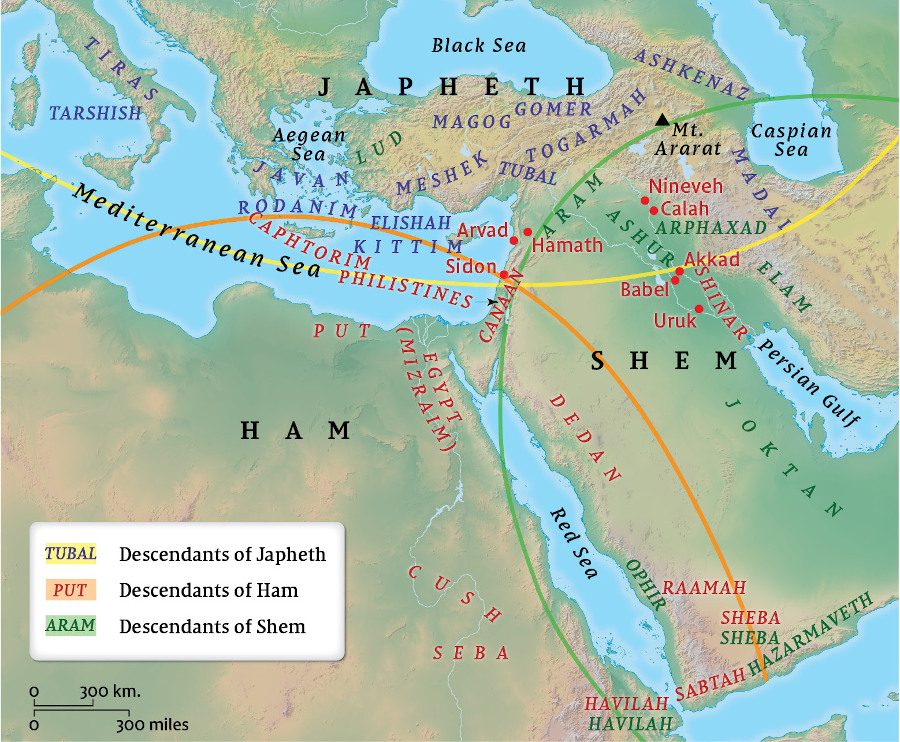
10:2 sons. See NIV text note. Japheth. As the least involved in the biblical narrative and perhaps also as the oldest of Noah’s sons (see v. 21 and NIV text note there), his descendants or successors are listed first. The genealogy of Shem, the chosen line, appears last in the chapter (vv. 21–31; see 11:10–26). The 14 nations that came from Japheth plus the 30 from Ham and the 26 from Shem add up to 70 (the multiple of 10 and 7, both numbers signifying completeness; see note on 5:5), perhaps in anticipation of the 70 members of Jacob’s family who went down to Egypt (see 46:27; Ex 1:5; see also Dt 32:8). The Japhethites lived generally north and west of Canaan in Eurasia. Gomer. The people of Gomer (the later Cimmerians) and related nations (v. 3) lived near the Black Sea (see map). Magog. Possibly the father of a Scythian people who inhabited the Caucasus and adjacent regions southeast of the Black Sea. Madai. The later Medes. Javan. Ionia (southern Greece) and perhaps western Asia Minor. Tubal, Meshek. Not related to Tobolsk and Moscow in modern Russia. Together with Magog they are mentioned in later Assyrian inscriptions. See also Eze 38:2 and note. Probably Tubal was in Pontus and Meshek was in the Moschian Mountains. Their movement was from eastern Asia Minor north to the Black Sea. Tiras. Possibly the Thrace of later times.
10:3 Ashkenaz. The later Scythians. All three names in this verse refer to peoples located in the upper Euphrates region.
10:4 Elishah. Either Alashia (an ancient name for Cyprus) or a reference to Sicily and southern Italy. Tarshish. Probably southern Spain. Kittites. A people living on Cyprus. Rodanites. A people whose name is perhaps reflected in Rhodes (a Greek isle).
10:5 See vv. 20,31. territories . . . clans . . . nations . . . language. Geographic, ethnic, political and linguistic terms, respectively. These several criteria were used to differentiate the various groups of people.
10:6 Ham. The Hamites named here were located in southwestern Asia and northeastern Africa. Cush. The upper Nile region, south of Egypt. Egypt. Hebrew Mizraim, which means “two Egypts,” a reference to Upper (southern) and Lower (northern) Egypt. Put. Probably Libya (see note on v. 13). Canaan. The name possibly means “land of purple” (as does Phoenicia, the Greek name for the same general region). Canaan was a major producer and exporter of purple dye, highly prized by royalty. The territory was much later called Palestine after the Philistines (see v. 14 and note).
10:7 sons of Cush. The seven Cushite nations here mentioned were all in Arabia. Sheba and Dedan (or their namesakes) reappear as two of Abraham’s grandsons (25:3). Together with Raamah they are mentioned in Eze 27:20–22.
10:8 Cush. Probably not the same as in v. 6. Located in Mesopotamia, the name may be related to that of the later Kassites. Nimrod. Possibly the Hebrew name of Sargon I, an early ruler of Akkad (v. 10).
10:10 Uruk. One of the important cities in ancient Mesopotamia (see maps here and here).
10:11 Calah. Modern Nimrud in Iraq, about 20 miles south of Nineveh.
10:12 great city. Possibly a reference to Calah (or even Resen), but most likely to Nineveh (Jnh 1:2; 3:2; 4:11), either alone or including the surrounding urban areas.
10:13 Ludites. Perhaps the Lydians in Asia Minor (see note on v. 22). Anamites. Located in north Africa, west of Egypt, near Cyrene. Lehabites. Perhaps the Libyan desert tribes (see note on v. 6). Naphtuhites. People of Lower Egypt.
10:14 Pathrusites. The inhabitants of Upper Egypt (see note on v. 6). Caphtorites. Crete, known as Caphtor in ancient times, was for a while the homeland of various Philistine groups (Jer 47:4; Am 9:7). The Philistines themselves were a vigorous Indo-European maritime people who invaded Egypt early in the twelfth century bc. After being driven out, they migrated in large numbers to southwest Canaan, later extending their influence over most of the land. The Philistines of the patriarchal period (21:32,34; 26:1,8,14–15,18) no doubt had earlier settled in Canaan more peacefully and in smaller numbers.
10:15 Sidon. An important commercial city on the northwest coast of Canaan. Hittites. A people group who moved into Anatolia (ancient Asia Minor, modern western Turkey) from southeast Europe in the late third millennium bc. They came to dominate north-central Anatolia in the mid-second millennium bc and called themselves Hittites, a name adapted from that of the native Hatti people. They established an empire powerful enough at times to challenge both Babylonia and Egypt. The relationship, if any, between these people and the “Hittites” of Canaan mentioned in the Bible remains obscure (but see Eze 16:3 and note).
10:16 Jebusites. Inhabitants of Jerusalem at the time of Israel’s conquest of Canaan. Jerusalem was also known as Jebus during part of its history (Jdg 19:10–11; 1Ch 11:4). Amorites. The name comes from an Akkadian word meaning “westerner” (west from the Babylonian perspective). Amorites lived in the hill country of Canaan at the time of the Israelite conquest.
10:17–18 Together with the Girgashites (v. 16), these groups in Canaan for the most part inhabited small city-states.
10:19 Sodom, Gomorrah, Admah and Zeboyim. See 14:2,8 (see also note on 13:10); probably located east and/or southeast of the Dead Sea.
10:21 Sons were also born to Shem. The descendants of Shem were called Shemites (later modified to Semites). Eber. Though a distant descendant of Shem (vv. 24–25; 11:14–17), Eber’s importance as the ancestor of the Hebrews (“Eber” is the origin of the Hebrew word for “Hebrew”) is already hinted at here.
10:22 Elam. The Elamites lived east of Mesopotamia. Ashur. An early name for Assyria (see note on 2:14) in northern Mesopotamia. Arphaxad. See also 11:10–13; perhaps a compound form of the Hebrew word for Chaldea, in southern Mesopotamia. Lud. Probably the Lydians of Asia Minor (see note on v. 13). Aram. Located north-northeast of Canaan, the area known today as Syria (see note on Dt 26:5).
10:25 Peleg. See NIV text note and 11:16–19. earth was divided. Perhaps resulting from the dispersion of peoples described in 11:1–9 (see note there).
10:26 Joktan. The predecessor of numerous south Arabian kingdoms.
10:28 Sheba. In southwest Arabia (roughly the area of Yemen). A later queen of Sheba made a memorable visit to King Solomon in the tenth century bc (1Ki 10:1–13).
10:29 Ophir. The source of much of King Solomon’s gold (1Ki 9:28; 10:11). Its location seems to have been south of Canaan, perhaps somewhere in Africa or south Arabia (but see note on 1Ki 9:28).
11:1–9 This section provides the main reason for the scattering of the peoples listed in ch. 10. The narrative is a beautiful example of inverted or hourglass structure (see Introduction: Literary Features). The author of Genesis uses the story of the flood and the story of Babel to characterize the ways of humankind and God’s responses through acts of judgment in order to thwart humanity’s proud efforts to rule over the creation not as God’s faithful representatives but as rebels. With this characterization of human history outside God’s saving work, the author sets the stage for God’s call of Abram out of the post-Babel world to begin his redemptive work that would unfold in Israel’s history.
11:1 whole world. The survivors of the flood and their descendants (vv. 4,8–9).
11:3 brick instead of stone, and tar for mortar. Stone and mortar were used as building materials in Canaan. Stone was scarce in Mesopotamia, however, so mud brick and tar were used (as indicated also by archaeological excavations).
11:4 us . . . ourselves . . . we . . . ourselves . . . we. The people’s plans were egotistical and proud. tower. The typical Mesopotamian temple-tower, known as a ziggurat, was square at the base and had sloping, stepped sides that led upward to a small shrine at the top (see photo). the heavens. A similar ziggurat may be described in 28:12. Other Mesopotamian ziggurats were given names demonstrating that they, too, were meant to serve as staircases from earth to heaven: “The House of the Link between Heaven and Earth” (at Larsa), “The House of the Seven Guides of Heaven and Earth” (at Borsippa), “The House of the Foundation-Platform of Heaven and Earth” (at Babylon), “The House of the Mountain of the Universe” (at Ashur). name. In the OT, “name” also refers to reputation, fame or renown. (The Nephilim were “men of renown,” 6:4.) At Babel (see note on v. 9) the rebellious human race undertook a united and godless effort to establish for themselves, by a titanic enterprise, a world renown by which they would dominate God’s creation (cf. 10:8–12; 2Sa 18:18). scattered. See note on v. 8.
11:6 If . . . then. If the whole human race remained united in the proud attempt to take its destiny into its own hands and, by its self-centered efforts, to seize the reins of history, there would be no limit to its unrestrained rebellion against God. A godless human kingdom would try to displace and exclude the kingdom of God.
11:7 let us. See notes on 1:1,26. God’s “Come, let us” from heaven counters proud people’s “Come, let us” (v. 4) from earth. not understand each other. Without a common language, joint effort became impossible (v. 8).
11:8 scattered. See v. 4; 9:1,19. God dispersed the people because of their rebellious pride. Even the greatest of human powers cannot defy God and long survive.
11:9 Babel. See NIV text note and 10:10. The word is of Akkadian origin and means “gateway of a god” (Jacob’s stairway was similarly called “gate of heaven”; 28:17). confused. The Hebrew word used here (balal) sounds like “Babel,” the Hebrew word for Babylon and the origin of the English word “babble.”
11:10–26 A ten-name genealogy, like that of Seth (see 5:3–31; see also note on 5:5). Unlike the Sethite genealogy, however, the genealogy of Shem does not give total figures for the ages of the men at death and does not end each paragraph with “and then he died.” It covers the centuries between Shem and Abram as briefly as possible.
11:10 account. See note on 2:4.
11:26 Terah . . . became the father of Abram, Nahor and Haran. As in the case of Shem, Ham and Japheth, the names of the three sons may not be in chronological order by age (see 9:24; see also 10:21 and NIV text note). Haran died while his father was still alive (v. 28).
11:27—25:11 With God’s calling of Abram out of the post-Babel peoples, the story of God’s ways with humankind shifts focus from universal history to the history of God’s relationship with a particular person and people. Here begins the history of his saving work, in which human sin is not only judged (the flood) or restrained (Babel) but forgiven (through atonement) and overcome (through the purifying of human hearts). Throughout the rest of Scripture the unfolding of this history remains the golden thread and central theme. Its final outcome is made sure through Jesus Christ, “the son of Abraham” (Lk 3:34; see also Mt 1:1–17 and note on 1:1; Gal 3:16)—which is the core message of the NT.
The account of the God-Abram relationship found here foreshadows in many ways the God-Israel relationship, and Abram’s response to his trials and triumphs exemplifies the life of faith and faithfulness for his descendants.
11:27 account. See note on 2:4.
11:28 Ur of the Chaldeans. Possibly in northern Mesopotamia, but more likely the site on the Euphrates in southern Iraq excavated by Leonard Woolley between 1922 and 1934. Ruins and artifacts from Ur reveal a civilization and culture that reached high levels before Abram’s time. King Ur-Nammu, who may have been Abram’s contemporary, is famous for his law code (see photo). Chaldeans. See notes on Ezr 5:12; Job 1:17.
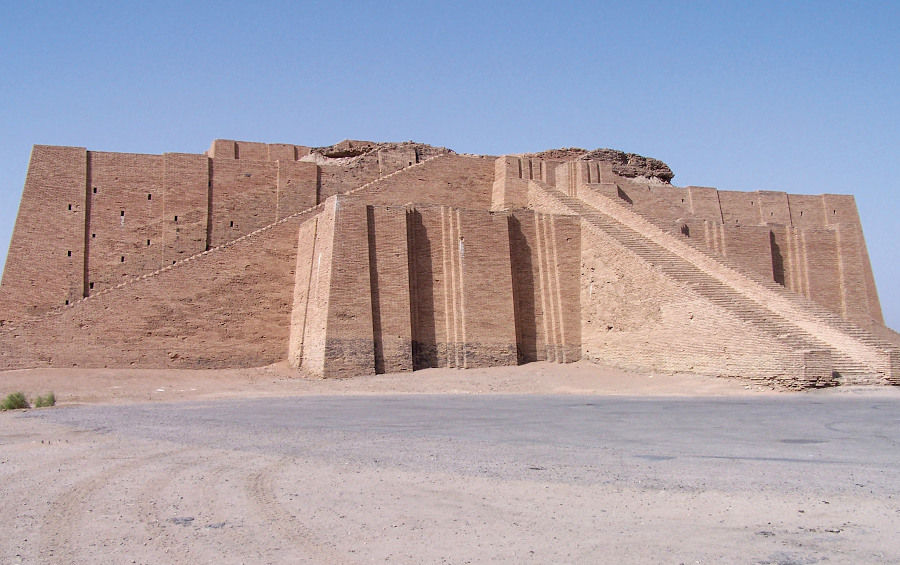
Partially restored ziggurat of Nanna at Ur.
Hardnfast/Wikimedia Commons, CC BY 3.0
Return to the main text.
11:29 Milkah. An ancestor of Rebekah (22:20,23; 24:15); the name means “queen.”
11:30 Sarai was . . . not able to conceive. The infertility of Abram’s wife (15:2–3; 17:17) emphasized the fact that God’s people would not come by natural generation from the post-Babel peoples. God was bringing a new humanity into being, of whom Abram was father (17:5), just as Adam and Noah were fathers of the fallen human race.
11:31 they came to Harran. The moon-god was worshiped at both Ur and Harran, and since Terah was an idolater (Jos 24:2), he probably felt at home in either place (his name probably means “moon worshiper”). Harran (an Akkadian word meaning “caravan”) was a flourishing caravan city in the nineteenth century bc. In the eighteenth century it was ruled by Amorites (see note on 10:16).
12:1 had said. God had spoken to Abram “while he was still in Mesopotamia, before he lived in Harran” (Ac 7:2). Go from . . . show you. Abram must leave the settled world of the post-Babel nations and begin a pilgrimage with God to a better world of God’s making (see 24:7; see also 11:1–9; Heb 11:8–10 and notes).
Here begins the story of how “the LORD [Yahweh] . . . the God of Abraham, Isaac and Jacob” (Ex 3:16), “the God of Israel” (Ex 5:1), created for himself a people who acknowledged him as the only true God and who had as their homeland a place in the world that would be called “their own land, which they had acquired in accordance with the command of the LORD through Moses” (Jos 22:9). In the ancient world of the OT, all the various gods that were worshiped and relied on were gods of a particular place and/or a particular people (a family, tribe or nation). The rest of Yahweh’s dealings with the patriarchs and with Israel is an important theme that relates how Abram’s pilgrimage moved ever forward toward the fulfillment of Yahweh’s purposes.
The first eleven chapters of Genesis display humanity’s continual spiral back toward sin. The entrance of Abraham (Ge 12:1–3), and God’s subsequent covenantal relationship with his family, marks a distinct turning point in Genesis and in history, charting a path toward redemption.
The Abrahamic covenant comes in a series of three covenantal interactions between God and Abraham, which build upon each other (Ge 12:1–3; 15:1–21; 17:1–27). Through these interactions, three overarching promises are made by God: (1) Abraham would be given land (12:1, 7; 15:7–19); (2) from him would come a great nation, even though he and his wife had not been able to have children at the time the promise was made (12:2; 15:4–5; 17:2); and (3) through God’s blessing of Abraham and his descendants the whole earth would be blessed (12:3).
Key aspects of this covenant are its unconditional elements, its universal benefit, and its everlasting nature. The promises that God gave to Abraham (12:1–3) do not require any righteous actions on Abraham’s part and are therefore considered unconditional in nature. In the exchange in ch. 15 God bears the responsibility of covenant fulfillment by participating in a self-maledictory covenantal ceremony (stipulating symbolically that he himself will bear the consequences should the covenant be broken by either party). God does, however, call Abraham to live in loyalty and faithfulness with him in response to divine grace (17:1, 10–14).
From the very outset, this covenant was not solely focused on the blessing of Abraham and his descendants, but rather the entire world was seen as the ultimate beneficiary of this covenant—it is universal. This covenant also finds significance as it is established as an “everlasting covenant” (17:7–8). The people of Israel across their history hold onto the promises of this covenant and appeal to them (Ex 32:13; 1Ch 16:15–18; Mic 7:14–20); and Yahweh himself remembers these promises and acts accordingly (Lev 26:42; 2Ki 13:23). In the NT, Mary and Zechariah saw Christ’s birth in terms of God’s covenant with Abraham (Lk 1:54–55,72–75).
The ultimate fulfillment of the Abrahamic covenant comes in Jesus Christ, the true “offspring” of Abraham (Gal 3:16). Those who are in Christ are now also considered “Abraham’s offspring” and heirs of the covenant promises through the new covenant (Gal 3:29). (See also chart.)
Go to the Articles Index.
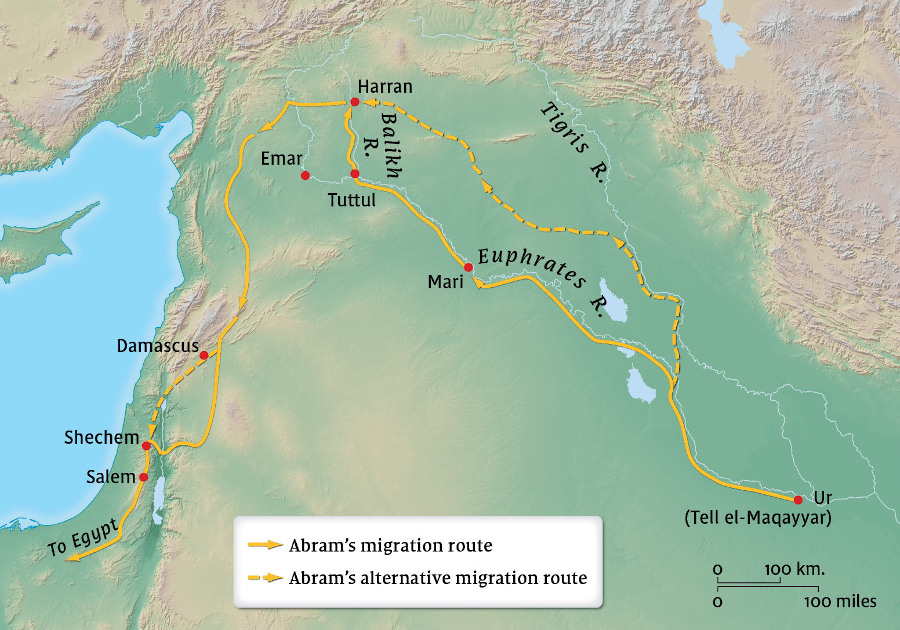
12:2–3 God’s promise to Abram has a sevenfold structure: (1) “I will make you into a great nation,” (2) “I will bless you,” (3) “I will make your name great,” (4) “you will be a blessing,” (5) “I will bless those who bless you,” (6) “whoever curses you I will curse,” and (7) “all peoples on earth will be blessed through you.” God’s original blessing on the whole human race (1:28) would be especially fulfilled in the lives of Abram and his offspring. In various ways and degrees, these promises were reaffirmed to Abram (v. 7; 15:5–21; 17:4–8; 18:18–19; 22:17–18), to Isaac (26:2–4), to Jacob (28:13–15; 35:11–12; 46:3) and to Moses (Ex 3:6–8; 6:2–8). The seventh promise is quoted in Ac 3:25 with reference to Peter’s Jewish listeners (Ac 3:12)—Abram’s physical descendants—and in Gal 3:8 with reference to Paul’s Gentile listeners—Abram’s spiritual descendants.
12:3 whoever curses you. The ancient Near Eastern peoples thought that by pronouncing curses on someone they could bring down the power of the gods (or other mysterious powers) on that person (cf. 1Sa 17:43). They had a large conventional stock of such curses, preserved in many sources, such as the Egyptian Execration Texts, the Hittite suzerainty-vassal treaties, kudurrus (stone boundary markers; see photo), the Code of Hammurapi (Epilogue), etc. For examples, see notes on Dt 9:14; Jer 15:3; see also note on Ge 27:33; cf. note on Ezr 6:11.
12:4 Abram went, as the LORD had told him. See Heb 11:8. Prompt obedience grounded in faith characterized this patriarch throughout his life (17:23; 21:14; 22:3). Lot went with him. See 13:1,5. Lot chose to go with his uncle Abram, seeking a better future. seventy-five years old. Although advanced in age at the time of his call, Abram would live for another full century (see 25:7; see also note on 5:5).
12:5 people they had acquired. Wealthy people in that ancient world always had servants. Some were slaves, others were servants by choice; all were considered to be members of the “household” in which they served (14:14; 15:3; 17:12–13; 24:2).
12:6 site of the great tree. Perhaps the same tree referred to in 35:4 (see also Jdg 9:6,37). Moreh. The name means “teacher.” It suggests that the Canaanites sought directions from their gods by this tree. Abram’s God (Yahweh) appeared to him there (v. 7). Shechem. An important city in central Canaan, founded in the patriarchal period.
12:7 The LORD appeared. The Lord at times “appeared” in some way to the patriarchs and others, but not in all his glory (Ex 33:18–20; Jn 1:18). altar. The first of several Abram built (v. 8; 13:18; 22:9). He acknowledged that the land of Canaan belonged to the Lord in a special way (Ex 20:24; Jos 22:19).
12:8 Bethel. Just north of Jerusalem (see map), it was an important town in the religious history of God’s ancient people (see, e.g., 28:10–22; 35:1–8; 1Ki 12:26–29).
12:9 Negev. The dry wasteland stretching southward from Beersheba (see map). This Hebrew word is translated “south” in 13:14.
12:10 went down to Egypt . . . because the famine was severe. Egypt’s food supply was usually plentiful because the Nile’s water supply was normally dependable. Abram’s experience in this episode foreshadows Israel’s later experience in Egypt, as the author of Genesis, writing after the exodus, was very much aware. The parallels are striking: a famine in the land (here; 47:4); affliction at the hands of the Egyptians (vv. 12–15; Ex 1:11–14); God’s plagues on the Egyptians (v. 17; Ex 8–11); the Egyptians sending the people away as a result (vv. 19–20; Ex 12:31–32); the Egyptians letting them take with them all their possessions (v. 20; Ex 12:32); the people obtaining wealth from the Egyptians (v. 16; Ex 12:36); return to Canaan by stages through the wilderness (13:1–3; Exodus; Numbers; Deuteronomy; Joshua); arrival back in Canaan, where they worship the Lord (13:4; Jos 5:10; 8:30–35; 24:1–27). Abram was truly the “father” of Israel.
Integrated Chronology of the Patriarchs
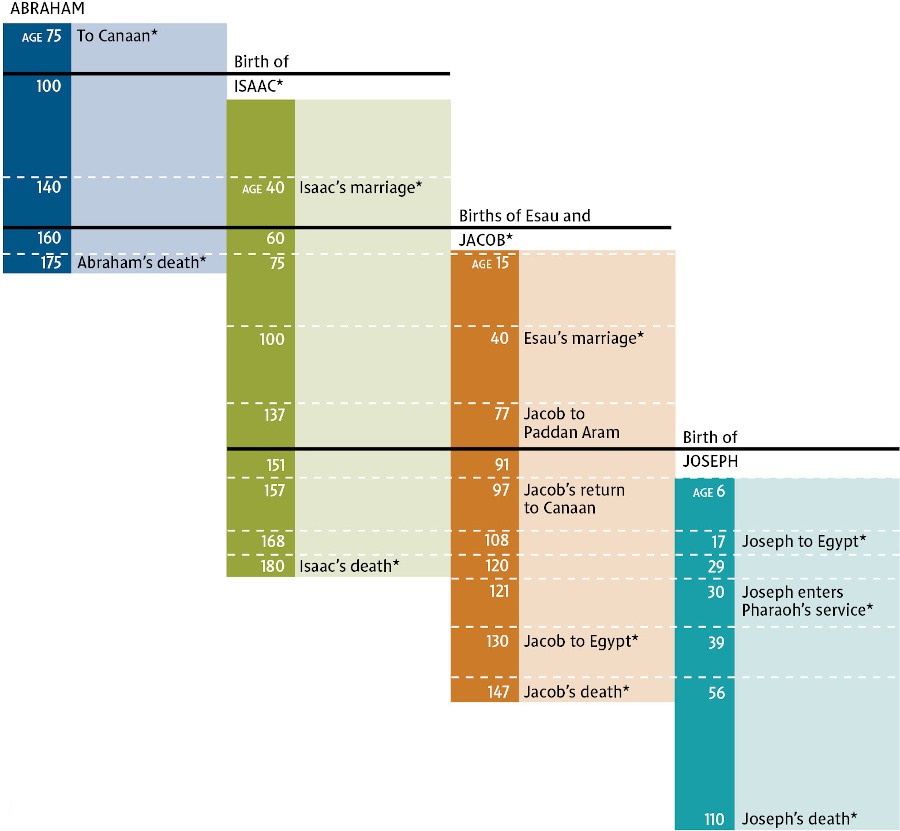
Note: The ages marked with (*) are expressly given
Go to the Charts Index.
12:11 As he was about to enter Egypt. Having left the promised land to find food in a time of famine (Ru 1:1), but doing so without God’s guidance or consent (46:3–4; 2Ki 8:1), Abram showed that he needed to learn that the God who had called him and made promises to him could and would protect him and Sarai (v. 3) even outside the promised land (ch. 20). Abram’s attempt to secure his own safety matches Sarai’s attempt to overcome her own barrenness (ch. 16). beautiful. See v. 14. She was 65 at the time (v. 4; 17:17). The Genesis Apocryphon (one of the Dead Sea Scrolls) also praises Sarai’s beauty.
12:13 Say you are my sister. If the pharaoh were to have added Sarai to his harem while knowing that she was Abram’s wife, he would have had to kill Abram first.
12:15 Pharaoh. See note on Ex 1:11.
12:16 Livestock was an important measure of wealth in ancient times (13:2). male and female servants. See note on v. 5. camels. Although camels were not widely used until much later (see, e.g., Jdg 6:5), archaeology has confirmed their occasional domestication as early as the patriarchal period.
12:19 Why did you say, ‘She is my sister’ . . . ? Egyptian ethics emphasized the importance of absolute truthfulness, and Abram was put in the uncomfortable position of being exposed as a liar (see 20:12 and note).
12:20 Pharaoh gave orders. See Ex 12:31–32.
13:1,3 Negev. See note on 12:9.
13:2 had become very wealthy. Abram left Egypt with greater wealth than he had before—even as Israel would later leave Egypt laden with wealth from the Egyptians (Ex 3:22; 12:36).
13:4 Abram called on the name of the LORD. As he had done earlier at the same place (12:8; see note there).
13:5–18 Lot’s separation from Abram and his choice of what appeared to him to be the most promising portion of the land kept him from participating in the blessings promised to Abram. Rather, he became involved in the history of Sodom and Gomorrah (14:12–16; 19:1–38), whereas Abram received assurances that his descendants would multiply and would inherit the whole land (vv. 15–17).
13:6 land could not support them. Livestock made up the greater part of their possessions, and the region around Bethel and Ai did not have enough water or pasture for such large flocks and herds (v. 10; 26:17–22,32; 36:7).
13:7 Perizzites. Their identity remains obscure, but reference may be to rural inhabitants, in contrast to city dwellers.
13:8 close relatives. See 12:5.
13:9 left . . . right. That is, north . . . south. Abram generously gave his young nephew the opportunity to choose the land he wanted. He himself would not obtain wealth except by the Lord’s blessing (14:22–24).
13:10 plain. The Hebrew for this word picturesquely describes this area as circular or oval in shape. The precise location of the “plain” and its “cities” (v. 12) is still disputed. One plausible proposal locates them just east and southeast of the Dead Sea; another proposal locates them just northeast of the Dead Sea. like the land of Egypt. Because of its abundant and dependable water supply (see note on 12:10), Egypt came close to matching Eden’s ideal conditions (2:10). the LORD destroyed Sodom and Gomorrah. See especially 18:16—19:29. The names of Sodom and Gomorrah became proverbial for vile wickedness and for divine judgment on sin.
13:12 Lot . . . pitched his tents near Sodom. Since the people of Sodom were known to be wicked (v. 13), Lot was flirting with temptation by choosing to live near them. Contrast the actions of Abram (v. 18).
13:14 Look around. See Dt 34:1–4. Lot and Abram are a study in contrasts. The former looked selfishly and coveted (v. 10); the latter looked as God commanded and was blessed.
13:16 like the dust of the earth. A simile (common in the ancient Near East) for the large number of Abram’s offspring (see 28:14; 2Ch 1:9; see also Nu 23:10). Similar phrases are: “as numerous as the stars in the sky” and “as the sand on the seashore” (22:17).
13:17 walk through the length . . . of the land. Either to inspect it or to claim the right to live in it while looking forward to the promised ownership (cf. Dt 32:48–49).
13:18 great trees. See note on 12:6. Mamre. A town named after one of Abram’s allies (14:13). Hebron. Kiriath Arba (see note on 23:2). altar. See note on 12:7.
14:1–24 Abram’s act of faith successfully challenged the foreign kings who were seeking to bring the promised land under their sphere of rule and enabled him to rescue his nephew Lot. It also won for him recognition among kings that he was a force to be reckoned with (12:2: “I will make your name great”) and provided him with an opportunity to bear witness to his God.
14:1 Amraphel was king of Shinar. Not the great Babylonian king Hammurapi, as once thought (see NIV text note). Elam. See note on 10:22. Goyim. The Hebrew word means “Gentile nations” and may be a common noun here (as in Isa 9:1).
14:3 Dead Sea. Hebrew “Salt Sea.” Its water contains an approximately five times greater concentration of chloride and bromide salts than the water in the world’s oceans, making it the densest large body of water on earth.
14:5 Rephaites. People of large stature (Dt 3:11).
14:6 Horites. Formerly thought to be cave dwellers (the Hebrew word ḥor means “cave”), they are now commonly identified with the Hurrians, a non-Semitic people widely dispersed throughout the ancient Near East.
14:7 En Mishpat. Another name for Kadesh, it means “spring of judgment/justice.” It is called Meribah Kadesh, “quarreling/litigation at Kadesh,” in Dt 32:51 (see also Nu 27:14). Kadesh. Located in the southwest Negev (see note on 12:9), it was later called Kadesh Barnea (Nu 32:8). Amalekites. A tribal people living in the Negev and in the Sinai peninsula. Amorites. See note on 10:16.
14:10 tar pits. Lumps of asphalt are often seen even today floating in the southern end of the Dead Sea. hills. The Dead Sea, the lowest body of water on earth (about 1,300 feet below sea level), is flanked by hills on both sides.
14:12 Lot . . . was living in Sodom. He moved into the town and was living among its wicked people (2Pe 2:8). Though Lot was “righteous,” he was now in danger of imitating the “depraved conduct of the lawless” (2Pe 2:7).
14:13 Hebrew. Abram, the father of the Hebrew people, is the first biblical character to be called a Hebrew (see “Eber” in note on 10:21). Usually an ethnic term in the Bible, it was normally used by non-Israelites in a disparaging sense (see, e.g., 39:17). Mamre. A town was named after him (see 13:18 and note).
14:14 318 trained men born in his household. A clear indication of Abram’s great wealth. The Hebrew for “trained men” is found only here in the Bible. A related word used elsewhere in very ancient texts means “armed retainers.” Dan. This well-known city in the north was not given the name “Dan” until the days of the judges (Jdg 18:29). It was formerly called Laish or Leshem (see notes on Jos 19:47; Jdg 18:7). Thus the designation here is most likely a later editorial updating.
14:17 King’s Valley. Near Jerusalem (2Sa 18:18).
14:18 Melchizedek king of Salem . . . priest. See Heb 7:1. In ancient times, particularly in non-Israelite circles, kingly and priestly duties were often performed by the same individual. “Melchizedek” means “My king is righteous” or “king of righteousness” (Heb 7:2). “Salem” is a shortened form of “Jerusalem” (Ps 76:2) and is related to the Hebrew word for “peace” (Heb 7:2; see Jos 10:1 and note). brought out bread and wine. Typical of ancient Near Eastern hospitality, unrelated to the NT ordinance of communion. Melchizedek’s interest in Abram’s military success was most likely political, and his entertainment of victorious Abram with refreshment and a priestly benediction constituted a recognition that Abram was a man to be reckoned with in kingly affairs.
14:19 God Most High, Creator of heaven and earth. The titles “most high,” “lord of heaven” and “creator of earth” were frequently applied to the chief Canaanite deity in ancient times. But Abram, by identifying Melchizedek’s “God Most High” with “the LORD” (v. 22), bore testimony to the one true God.
14:20 Abram gave him a tenth of everything. A tenth was a king’s share (1Sa 8:15,17). By offering Melchizedek a tenth, Abram responded to Melchizedek’s action by showing that he in turn acknowledged his kingship in Salem. At the same time, having recognized Melchizedek’s blessing as a benediction from the Lord, Abram’s tithe to Melchizedek constituted a declaration that he would be indebted to no king but the Lord (see v. 23 and note). Melchizedek is later spoken of as a type or prefiguration of Jesus, our “great high priest” (Heb 4:14), whose priesthood is therefore “in the order of Melchizedek, not in the order of Aaron” (Heb 7:11; see Ps 110:4).
14:22 With raised hand. A customary oath-taking practice in ancient times (Dt 32:40; Rev 10:5–6).
14:23 I will accept nothing belonging to you. Cf. 2Ki 5:16. Abram refused to let himself become obligated to anyone but the Lord. If he had done so, this Canaanite king might later have claimed the right of kingship over Abram.
15:1–21 In response to Abram’s faltering faith, the Lord graciously reinforces his promise (12:2–3) with a covenant oath.
15:1 I am your shield. Whether “shield” or “sovereign” is meant (see NIV text note), the reference is to the Lord as Abram’s King. As elsewhere, “shield” stands for king (e.g., Dt 33:29; 2Sa 22:3; Ps 7:10; 84:9). your very great reward. Though Abram was quite rich (13:2; 14:23), God himself was Abram’s greatest treasure (cf. Dt 10:9).
15:2 Eliezer of Damascus. A servant probably acquired by Abram on his journey southward from Harran (12:5). He may also be the unnamed “senior servant” of 24:2.
15:3–4 Ancient documents uncovered at Nuzi (see chart) near Kirkuk on a branch of the Tigris River, as well as at other places, demonstrate that a childless man could adopt one of his own male servants to be heir and guardian of his estate. Abram apparently contemplated doing this with Eliezer, or perhaps had already done so.
15:5 count the stars—if indeed you can. See 22:17. More than 8,000 stars are clearly visible to the naked eye in the darkness of a Near Eastern night. So shall your offspring be. The promise was initially fulfilled in Egypt (see Ex 1; see also Dt 1:10; Heb 11:12). Ultimately, all who belong to Christ are Abram’s offspring (see Gal 3:29 and note).
15:6 Abram is the “father of all who believe” (Ro 4:11), and this verse is the first explicit reference to faith in God’s promises (see Ro 4:3 and note). It also teaches that God graciously responds to faith by crediting righteousness to one who believes (see Heb 11:8 and note).
15:7 I am the LORD, who brought you out. Ancient royal covenants often began with (1) the self-identification of the king and (2) a brief historical prologue, as here (see Ex 20:2 and note).
15:8 how can I know . . . ? Cf. Lk 1:18. Abram believed God’s promise of a son, but he asked for a guarantee of the promise of the land.
15:9–21 This expression of God’s covenant with Abram was cast in the form of ancient Near Eastern royal land-grant treaties and contained a perpetual and unconditional divine promise to fulfill the grant of land to Abram and his descendants (1Ch 16:14–18; Ps 105:8–11). See chart.
15:10 cut in half. For the significance of cutting the animals in half, see note on v. 17. Perhaps the birds were not cut in half because they were so small (Lev 1:17).
15:13 four hundred years. A round number. According to Ex 12:40 Israel spent 430 years in Egypt. country not their own. Egypt (46:3–4).
15:15 The fulfillment is recorded in 25:8.
15:16 In the fourth generation. That is, after 400 years (v. 13). A “generation” was the age of a man when his firstborn son (from a legal standpoint) was born—in Abram’s case, 100 years (21:5). sin of the Amorites has not yet reached its full measure. Just how sinful many Canaanite practices were is now known from archaeological artifacts and from their own epic literature, discovered at Ras Shamra (ancient Ugarit) on the north Syrian coast beginning in 1929 (see chart). Their “worship” was polytheistic and included idolatry, religious prostitution, divination (cf. Dt 18:9–12) and at times even child sacrifice. God was patient in judgment, even with the wicked Canaanites.
15:17 smoking firepot with a blazing torch. Symbolizing the presence of God (Ex 3:2; 14:24; 19:18; 1Ki 18:38; Ac 2:3–4). passed between the pieces. Of the slaughtered animals (v. 10). In ancient times the parties sometimes solemnized a covenant by walking down an aisle flanked by the pieces of slaughtered animals (Jer 34:18–19). The practice signified a self-maledictory oath: “May this same thing be done to me if I do not keep my oath and pledge.” Having credited Abram’s faith as righteousness, God now graciously ministered to his need for assurance concerning the land. He granted Abram a promissory covenant, as he had to Noah (see 9:9 and note; see also chart).
15:18 made a covenant. The Hebrew for “made” can also be rendered “cut,” referring to the slaughtering of the animals in the making of a covenant (Jer 34:18). I give this land. The Lord initially fulfilled this covenant through Joshua (see Jos 1:2–9; 21:43; see also 1Ki 4:20–21). Wadi of Egypt. Probably the modern Wadi el-Arish in northeastern Sinai (see map). Euphrates. The longest river in western Asia (about 1,700 miles). See photo. It marked the boundary between Israel and Israel’s historic enemies (Assyria and Babylonia) to the east and northeast (cf. Isa 8:5–8), even though Israel rarely occupied all of that territory.
15:19–21 A similar list associated with Canaan is found in 10:15–18 (see notes there). Here ten peoples are listed, the number ten signifying completeness. For other lists of the inhabitants of Canaan, see Ex 3:8, 17; 13:5; 23:23; 33:2; 34:11; Nu 13:29; Dt 7:1; 20:17; Jos 3:10; 9:1; 11:3; 12:8; 24:11; Jdg 3:5; 1Ch 1:14; 2Ch 8:7; Ezr 9:1; Ne 9:8.
16:1–15 A failure in faith leads to a brazen attempt to provide by human means what the Lord is accused of withholding. Sarai at the beginning (v. 2) and Abram at the end (“Ishmael”; see v. 15 and NIV text note on v. 11) express their mutual impatience with the Lord’s failure as yet to overcome Sarai’s barrenness.
16:1 no children. See note on 11:30. Egyptian. Perhaps Hagar was acquired while Abram and Sarai were in Egypt (12:10–20).
16:2 The LORD has kept me from having children. Some time had passed since the revelation of 15:4 (see also 16:3), and Sarai impatiently implied that God was not keeping his promise. Go, sleep with my slave. An ancient custom, illustrated in Old Assyrian marriage contracts, the Code of Hammurapi and the Nuzi tablets (see note on 15:3–4), to ensure the birth of a male heir.
16:3 ten years. Abram was now 85 years old (12:4; 16:16).
16:4 despise her mistress. Peninnah acted similarly toward Hannah (1Sa 1:6).
16:5 May the LORD judge between you and me. An expression of hostility or suspicion (see 31:53; see also 31:49 and note).
16:7 The angel of the LORD. Since the angel of the Lord speaks for God in the first person (v. 10) and Hagar is said to name “the LORD who spoke to her: ‘You are the God who sees me’ ” (v. 13), the angel appears to be both distinguished from the Lord (in that he is called “messenger”—the Hebrew for “angel” means “messenger”) and identified with him (see also 48:16). Similar distinction and identification can be found in 19:1,21; 31:11,13; Ex 3:2, 4; Jdg 2:1–5; 6:11–12,14; 13:3,6,8–11,13,15–17,20–23; Zec 3:1–6; 12:8. Traditional Christian interpretation has held that this “angel” was a preincarnate manifestation of Christ as God’s Messenger-Servant. It may be, however, that, as the Lord’s personal messenger who represented him and bore his credentials, the angel could speak on behalf of (and so be identified with) the One who sent him (see especially 19:21; cf. 18:2,22; 19:2). Shur. Located just east of Lower Egypt (25:18; 1Sa 15:7).
16:8 I’m running away from my mistress. Not yet knowing exactly where she was going, Hagar answered only the first of the angel’s questions.
16:10 A promise reaffirmed in 17:20 and fulfilled in 25:13–16.
16:11 Ishmael. See NIV text note and 17:20.
16:12 wild donkey. Probably the onager, which roamed the dry steppes of the Near East. Ishmael would roam the desert like a wild donkey (Job 24:5; Hos 8:9). hostility. The hostility between Sarai and Hagar (vv. 4–6) was passed on to their descendants (25:18).
16:13 I have now seen the One who sees me. See NIV text note and cf. Ex 33:23. To see God’s face was believed to bring death (32:30; Ex 33:20).
16:14 Beer Lahai Roi. See NIV text note. Another possible translation that fits the context is: “well of the one who sees me and who lives,” i.e., Hagar. Kadesh. See note on 14:7.
17:1–27 God’s covenant with Abram renewed and expanded (see chart). After Abram’s and Sarai’s attempt to obtain the promised offspring by means of Sarai’s servant, God appears to Abram to reaffirm his promises. But he also makes it clear that if Abram is to receive God’s covenanted benefits, he must live out the “obedience that comes from faith for his name’s sake” (Ro 1:5; see also Ge 22). To that end he calls on Abram to make with him a covenanted commitment of loyal obedience.
17:1 ninety-nine years old. Thirteen years had passed since Ishmael’s birth (16:16; 17:24–25). appeared. See note on 12:7. I am. See note on 15:7. God Almighty. The Hebrew (El-Shaddai) perhaps means “God, the Mountain One,” either highlighting the invincible power of God or referring to the mountains as God’s symbolic home (Ps 121:1). It was the special name by which God revealed himself to the patriarchs (Ex 6:3). Shaddai occurs 31 times in the book of Job and 17 times in the rest of the Bible. walk before me faithfully and be blameless. Perhaps equivalent to “walk with me faithfully and be blameless” (see notes on 5:22; 6:8–9).
17:2 my covenant. See 15:4–5. The covenant is God’s; he calls it “my covenant” nine times in vv. 2–21, and he initiates (see 15:18), confirms (v. 2) and establishes (v. 7) it. increase your numbers. The language echoes 1:28 (Adam) and 9:7 (Noah), suggesting that God’s original purpose for humankind, threatened by the sins of the race, will be achieved through Abraham and his descendants (see also Ex 1:7 and note). See 13:16 and note. Earlier God had covenanted to keep his promise concerning the land (ch. 15); here he broadens his covenant to include the promised offspring.
17:5 Abram . . . Abraham. See NIV text notes. The first name means “Exalted Father,” probably in reference to God (i.e., “[God is] Exalted Father”); the second probably means “father of many,” in reference to Abraham. your name will be. By giving Abram a new name (Ne 9:7) God marked him in a special way as his servant (see notes on 1:5; 2:19).
17:6 nations . . . kings. This promise also came to Sarah (v. 16) and was renewed to Jacob (35:11; see 48:19). It referred to the proliferation of Abraham’s offspring, who, like the descendants of Noah (ch. 10), would someday become many nations and spread over the earth. Ultimately it finds its complete fulfillment in such passages as Ro 4:16–18; 15:8–12; Gal 3:29; Rev 7:9; 21:24.
17:7 everlasting. God’s commitment to his covenant was forever (vv. 13,19), but descendants of Abraham could break it (see v. 14; cf. Isa 24:5; Jer 31:32). to be your God. The heart of God’s covenant promise, repeated over and over in the OT (see, e.g., v. 8; Jer 24:7; 31:33; Eze 34:30–31; Hos 2:23; Zec 8:8 and note). This is God’s pledge to be the protector of his people and the One who provides for their well-being and guarantees their future blessing (15:1).
17:8 land. See 12:7; 15:18; Ac 7:5. everlasting possession. The land, though an everlasting possession given by God, could be temporarily lost because of disobedience (Dt 28:62–63; 30:1–10).
17:9 As for you. Balances the “As for me” of v. 4 (cf. also vv. 15,20). Having reviewed his covenanted commitment to Abraham (15:8–21), and having broadened it to include the promise of offspring, God now called upon Abraham to make a covenanted commitment to him—to “walk before me faithfully and be blameless” (v. 1). keep my covenant. Participation in the blessings of the Abrahamic covenant was conditioned on obedience (18:19; 22:18; 26:4–5).
Circumcision was God’s appointed “sign of the covenant” (17:11), which signified Abraham’s covenanted commitment to the Lord—that the Lord alone would be his God, whom he would trust and serve. It symbolized a self-maledictory oath: “If I am not loyal to the Lord, may the sword of the Lord cut off me and my offspring [7:14] as I have cut off my foreskin” (analogous to the oath to which God had submitted himself; see note on 15:17). Thus Abraham placed himself under the rule of the Lord as his King, consecrating himself, his offspring and all he possessed to the service of the Lord. For circumcision as signifying consecration to the Lord, see Dt 10:16; 30:6; Jer 4:4; 9:25–26; Eze 44:7 and note; 44:9; cf. Ro 2:29. Circumcision also marked God’s covenant commitment to Abraham in response to his faith (see notes on Ge 17:11; Ro 4:11).
Other nations also practiced circumcision (Jer 9:25–26; Eze 32:18–19), but not for the covenant reasons that Israel did.
Go to the Articles Index.
17:11 sign of the covenant. See notes on 9:12; 15:17. As the covenant sign, circumcision (v. 10; see article) also marked Abraham as the one to whom God had made a covenant commitment (15:7–21) in response to Abraham’s faith, which he “credited . . . to him as righteousness” (15:6). Paul comments on this aspect of the covenant sign in Ro 4:11.
17:12 eight days old. See 21:4 and Ac 7:8 (Isaac); Lk 1:59 (John the Baptist); 2:21 (Jesus); Php 3:5 (Paul). Abraham was 99 years old when the newly initiated rite of circumcision was performed on him (v. 24). The Arabs, who consider themselves descendants of Ishmael, are circumcised at the age of 13 (v. 25). For them, as for other peoples, circumcision serves as a rite of transition from childhood to manhood, thus into full participation in the community.
17:14 cut off from his people. Removed from the covenant people by divine judgment (see article).
17:15 Sarai . . . Sarah. Both names evidently mean “princess.” The renaming stressed that she was to be the mother of nations and kings (v. 16) and thus to serve the Lord’s purpose (see note on v. 5).
17:16 son. Fulfilled in Isaac (21:2–3).
17:17 laughed. In temporary disbelief (see 18:12; cf. Ro 4:19–21). The verb is a pun on the name “Isaac,” which means “he laughs” (see NIV text notes on v. 19 and 21:3; see also 18:12–15; 21:6).
17:20 numbers. See note on 13:16. father of twelve rulers. Fulfilled in 25:16.
17:21 Paul cites the choice of Isaac (and not Ishmael) as one proof of God’s right to choose for his sovereign purposes (see Ro 9:6–13). by this time next year. See 21:2.
17:22 God went up from him. A solemn conclusion to the conversation.
17:23 On that very day. Abraham was characterized by prompt obedience (see note on 12:4).
18:1–33 God appears to Abraham with two representatives (identified as “angels” in 19:1) of his heavenly council (see 1Ki 22:19–22 and note on 22:19; Jer 23:18,22 and note on 23:18). He comes to announce to Abraham what he is about to do (see note on v. 17).
18:1 appeared. See note on 12:7. great trees. See note on 12:6. Mamre. See note on 13:18. heat of the day. Early afternoon.
18:2 three men. Two of the “men” were angels (see 19:1; see also note on 16:7). The third was the Lord himself (see vv. 1,13,17,20,26,33; see especially v. 22). hurried. The story in vv. 2–8 illustrates Near Eastern hospitality in several ways: (1) Abraham gave prompt attention to the needs of his guests (vv. 2,6–7). (2) He bowed low to the ground (v. 2). (3) He politely addressed one of his guests as “my lord” and called himself “your servant” (vv. 3,5), a common way of speaking when addressing a superior (see, e.g., 19:2,18–19). (4) He acted as if it would be a favor to him if they allowed him to serve them (vv. 3–5). (5) He asked that water be brought to wash their feet (v. 4), an act of courtesy to refresh a traveler in a hot, dusty climate (19:2; 24:32; 43:24). (6) He prepared a lavish meal for them (vv. 5–8; a similar lavish offering was presented to a divine messenger in Jdg 6:18–19; 13:15–16). (7) He stood nearby (v. 8), assuming the posture of a servant (v. 22), to meet their every wish. Heb 13:2 (see note there) is probably a reference to vv. 2–8 and 19:1–3.
18:6 bread. Refers to round, thin loaves.
18:10 See 17:21. Paul quotes this promise of Isaac’s birth (see v. 14) in Ro 9:9 and relates it to Abraham’s spiritual offspring (Ro 9:7–8).
18:12 laughed. In disbelief, as also Abraham had at first (see note on 17:17). For Sarah’s later laugh of joy and faith, see 21:6–7.
18:14 Is anything too hard for the LORD? The answer is no, for Sarah as well as for her descendants Mary and Elizabeth (Lk 1:34–37). Nothing within God’s will, including creation (Jer 32:17) and redemption (Mt 19:25–26), is impossible for him.
18:16 Sodom. See notes on 10:19; 13:10.
18:17 Abraham was God’s friend (see v. 19; 2Ch 20:7; Jas 2:23; see also Isa 41:8). And because he was now God’s covenant friend (Job 29:4), God convened his heavenly council (see note on 1:26) at Abraham’s tent. There he announced his purpose for Abraham (v. 10) and for the wicked people of the plain (vv. 20–21)—redemption and judgment. He thus even gave Abraham opportunity to speak in his court and to intercede for the righteous in Sodom and Gomorrah. Accordingly, Abraham was later called a prophet (20:7). Here, in Abraham, is exemplified the great privilege of God’s covenant people throughout the ages: God has revealed his purposes to them and allows their voice to be heard (in intercession) in the court of heaven itself.
18:18 great and powerful nation . . . blessed through him. See note on 12:2–3.
18:19 what is right and just. See note on Ps 119:121.
18:20 outcry. A cry of righteous indignation (cf. the blood of Abel, 4:10) that became one of the reasons for the destruction of the cities (19:13). Gomorrah. See notes on 10:19; 13:10.
18:21 I will go down. The result would be judgment (as in 11:5–9), but God also comes down to redeem (as in Ex 3:8). see. Not a denial of God’s infinite knowledge but a figurative way of stating that he as “Judge” (v. 25) does not act on the basis of mere complaints.
18:22 Abraham remained standing before the LORD. The text and NIV text note both illustrate the mutual accessibility that existed between God and his servant.
18:23 The second time Abraham intervened for his relatives and for Sodom (14:14–16).
18:25 Judge of all the earth. Abraham based his plea on the justice and authority of God, confident that God would do what was right (Dt 32:4).
18:27 Lord. Abraham used the title “Lord” (Adonai), not the covenantal name “LORD” (Yahweh), throughout his prayer. He was appealing to God as “Judge of all the earth” (v. 25). dust and ashes. In contrast to God’s exalted position, Abraham described himself as insignificant (Job 30:19; 42:6).
18:32 just once more. Abraham’s questioning in vv. 23–32 did not arise from a spirit of haggling but of compassion for his relatives and of wanting to know God’s ways. ten. Perhaps Abraham stopped at ten because he had been counting while praying: Lot, his wife, possibly two sons (19:12), at least two married daughters and their husbands (see 19:14 and NIV text note), and two unmarried daughters (19:8).
18:33 home. To Mamre (v. 1). The next morning Abraham went back to see what God had done (19:27).
19:1 two angels. See notes on 16:7; 18:2. Lot was sitting in the gateway of the city. Lot had probably become a member of Sodom’s ruling council, since a city gateway served as the administrative and judicial center where legal matters were discussed and prosecuted (Ru 4:1–12).
19:2 square. An open space near the main city gateway (see 2Ch 32:6) where public gatherings were held.
19:3 bread without yeast. A flat bread that could be baked quickly (18:6; Ex 12:8,39).
19:4–9 See Jdg 19:22–25; Jude 7–8 and notes.
19:4 all the men. Hyperbole, indicating the total depravity of the city.
19:5 have sex with them. The sin here is homosexual assault; other forms of homosexual practice are condemned elsewhere in Scripture (see Lev 18:22; 20:13; Dt 22:5; Ro 1:26–27; 1Co 6:9; 1Ti 1:10 and notes).
19:8 under the protection of my roof. Ancient hospitality obliged a host to protect his guests in every situation. But in this case the way Lot chose to do this was clearly immoral. His overall godliness (see 2Pe 2:7 and note) need not be called into question by this one horrible lapse.
19:9 This fellow came here as a foreigner, and now he wants to play the judge. Centuries later, Moses was also considered an outsider and was accused of setting himself up as a judge (Ex 2:14; Ac 7:27).
19:13 we are going to destroy this place. Sodom’s wickedness had made it ripe for destruction (Isa 3:9; Jer 23:14; La 4:6; Zep 2:8–9; 2Pe 2:6; Jude 7).
19:14 his sons-in-law thought he was joking. Lot apparently had lost his power of moral persuasion even among his family members.
19:16 hesitated. Perhaps because of reluctance to leave his material possessions. his hand and the hands of his wife and of his two daughters. The ten righteous people required to save Sodom (18:32) had now been reduced to four. the LORD was merciful to them. Deliverance is due to divine mercy, not to human righteousness (cf. Titus 3:5 and note).
19:24 rained down burning sulfur. Perhaps from a violent earthquake spewing up asphalt, such as is still found in this region (cf. Isa 34:9 and note).
19:26 Lot’s wife looked back, and she became a pillar of salt. Her disobedient hesitation (v. 17) became proverbial in later generations (Lk 17:32). Even today, salt formations near the southern end of the Dead Sea are reminders of her folly.
19:29 God . . . remembered Abraham. See note on 8:1. he brought Lot out of the catastrophe. Lot’s deliverance was the main concern of Abraham’s prayer (18:23–32), which God now answered.
19:33 the older daughter went in and slept with him. Though Lot’s role was mainly passive, he bore the basic responsibility for what happened here and reaped the harvest of his move toward Sodom (see 13:10–12 and notes).
19:36–38 The sons born to Lot’s daughters were the ancestors of the Moabites and Ammonites (Dt 2:9,19), two nations that were to become bitter enemies of Abraham’s descendants (see, e.g., 1Sa 14:47; 2Ch 20:1).
20:1–18 See 12:10–20 and notes.
20:1 Negev. See note on 12:9. between Kadesh and Shur. See notes on 14:7; 16:7. Gerar. Located at the edge of Philistine territory, about halfway between Gaza near the Mediterranean coast and Beersheba in the northern Negev.
20:2 Abimelek. Probably the father or grandfather of the later king who bore the same name (26:1).
20:3 dream. Once again God intervened to spare the mother of the promised offspring. Dreams were a frequent mode of revelation in the OT (28:12; 31:10–11; 37:5–9; 40:5; 41:1; Nu 12:6; Jdg 7:13; 1Ki 3:5; Da 2:3; 4:5; 7:1).
20:7 prophet. See notes on 18:17; Zec 1:1. Abraham was the first man to bear this title (Ps 105:15).
20:9 brought such great guilt upon me and my kingdom. The “great guilt” would have been caused by adultery (see vv. 2–3,6; the same meaning for this expression is attested also in Egyptian and Canaanite texts). Everywhere else the Hebrew expression occurs in the OT it refers to idolatry (Ex 32:21, 30–31; 2Ki 17:21), which is spiritual adultery (see Hos 1:2 and note). Adultery and idolatry are supreme forms of covenant infidelity (see note on Ex 34:15).
20:11 fear of God. A conventional phrase equivalent to “true religion.” “Fear” in this phrase has the sense of reverential trust in God and commitment to his revealed will; see Ps 34:8–14 and note.
20:12 she really is my sister, the daughter of my father though not of my mother. Abraham’s half-truth was a sinful deception, not a legitimate explanation.
20:14–16 Abimelek’s generosity was a strong contrast to Abraham’s fearfulness and deception. God’s grace is evident as he blesses Abraham despite his failures.
20:16 shekels. Though not in the Hebrew, the word is correctly supplied here as the most common unit of weight in ancient times. Originally the shekel was only a weight, not a coin, since coinage was not invented till the seventh century bc.
21:1 See 17:16. did for Sarah what he had promised. See Gal 4:22–23,28. The promised son through whom God will continue the covenant line (17:21) is born at last.
21:3 Isaac. See note on 17:17.
21:5 In fulfillment of the promise made to him (17:16), Abraham miraculously became a father at the age of 100 years (see 17:17 and chart).
21:6 laughter . . . laugh. See note on 17:17; contrast 18:12 (see note there).
21:8 weaned. At age two or three, as was customary in the ancient Near East.
21:9 the son whom Hagar the Egyptian had borne. Ishmael, who was in his late teens at this time (16:15–16). mocking. Or “at play.” In either case, Sarah saw Ishmael as a potential threat to Isaac’s inheritance (v. 10).
21:10 Get rid of that slave woman and her son. See Gal 4:21–31. Driving them out would have had the effect of disinheriting Ishmael.
21:11 The matter distressed Abraham. Both love and legal custom played a part in Abraham’s anguish. He knew that the customs of his day, illustrated later in the Nuzi tablets (see chart), prohibited the arbitrary expulsion of a female servant’s son (whose legal status was relatively weak in any case).
21:12 Listen to whatever Sarah tells you. God overruled in this matter (as he had done earlier; see 15:4), promising Abraham that both Isaac and Ishmael would have numerous descendants. it is through Isaac that your offspring will be reckoned. See 17:19; 22:18; see also Ro 9:6–8 and Heb 11:17–19 for broader spiritual applications of this statement.
21:14 Early the next morning. Though Abraham would now be separated from Ishmael for the first time, he responded to God’s command with prompt obedience (see note on 12:4). Beersheba. See note on v. 31.
21:15 one of the bushes. See note on v. 33.
21:17 God heard . . . God has heard. A pun on the name “Ishmael” (see NIV text note on 16:11; see also 17:20).
21:21 Desert of Paran. Located in north-central Sinai. his mother got a wife for him from Egypt. Parents often arranged their children’s marriages (ch. 24).
21:22 Abimelek. See 20:2 and note. Phicol. Either a family name or an official title, since it reappears over 60 years later (25:26) in a similar context (26:26).
21:23 swear to me . . . before God . . . Show to me . . . kindness. Phrases commonly used when making covenants or treaties (vv. 27,32). “Kindness” as used here refers to acts of friendship (cf. v. 27; 20:14; Ps 6:4 and note). Such covenants always involved oaths.
21:27 sheep and cattle. Probably to be used in the treaty ceremony (15:10).