119:110 set a snare. See v. 85 and note.
119:111–112 heart. See note on 4:7.
119:111 my heritage. The possession I have received from God as my homestead and that from which I draw the provisions for my life (see note on vv. 57–64).
 119:113 hate double-minded people. See v. 115; see also note on v. 53. “Double-minded” people are “unstable in all they do” (Jas 1:8).
119:114 word. See note on v. 25.
119:118 reject. Or “shake off” or “make light of.” their delusions. Probably their deceitful ways (see note on v. 29).
119:119 dross. Scum removed from molten ore or metal. The Hebrew for this word is a pun on the word for “stray” in v. 118: Those who stray are treated like dross.
119:120 My flesh trembles. He quivers out of his deep reverence for God.
119:121–128 As your faithful servant, I pray for deliverance from my oppressors—another stanza in which prayer for deliverance is dominant (see vv. 81–88 and note; see also note on v. 25, “laid low”).
119:121 what is righteous and just. A phrase commonly used to sum up the whole will of God for moral action (106:3; Ge 18:19; 2Sa 8:15; Pr 1:3; 21:3; Isa 56:1; Jer 22:15; 33:15; Eze 18:5, 19,21,17; 33:14,16,19; 45:9).
119:122 The only verse in this psalm that does not have either a direct or an indirect (as in vv. 90,121,132; see note on v. 75) reference to God’s word. the arrogant. See note on v. 21.
119:123 My eyes fail. See note on 6:7.
119:126 act. Either in defense of his servant or in judgment on the lawbreakers or both. Cf. Hab 1:2–4 and notes.
119:127 more than gold. See vv. 14,57,72,111.
119:128 I hate every wrong path. See note on v. 53.
119:129 wonderful. See v. 18 and note.
119:130 unfolding. Meaning (1) the revelation of your words, (2) the interpretation (see “expound,” 49:4) of your words or (3) the entering of your words into the heart. the simple. See 19:7 and note.
119:132 as you always do. Or “as is (your) custom” (the Hebrew for “custom” is mishpaṭ); hence an indirect reference (see note on v. 122) to God’s law (see note on v. 7).
119:134,154 Redeem. Here, as often, a synonym for “deliver.”
119:134 oppression. See note on v. 25 (“laid low”).
119:135 your face shine. See note on 13:1 (“hide your face”).
119:137–144 The Lord and his laws are righteous.
119:137 righteous. See note on 4:1.
119:138 trustworthy. See v. 142; see also note on v. 29 (“deceitful ways”).
119:139 My zeal. See note on v. 53.
119:141 lowly and despised. Cf. v. 143; see also note on v. 25.
119:145–152 Save me, Lord, and I will keep your law. As the psalm draws to a close, prayer for deliverance becomes more dominant (see note on v. 25, “laid low”).
119:148 watches of the night. See note on Jdg 7:19; see also La 2:19.
119:149 love. See article. your laws. Or “your justice” (complementing “your love”); Hebrew mishpaṭ (see note on v. 75).
119:150 far from your law. See vv. 21,53,85,118,126,139,155,158.
119:151 are true. See note on v. 29 (“deceitful ways”).
119:152 last forever. See note on v. 52.
119:153–160 See note on vv. 145–152.
119:155 the wicked. See note on v. 21 (“the arrogant”).
119:156 your laws. See v. 149 and note.
119:158 word. Hebrew ‘imrah (see note on v. 11).
119:160 true. See note on v. 29 (“deceitful ways”). eternal. See note on v. 52.
119:161–168 See note on vv. 145–152.
119:161 Rulers. See note on v. 23. heart. See note on 4:7.
119:162 great spoil. See vv. 14,72,111.
119:163 I hate. See note on v. 53. falsehood. Or “that which is (ways that are) deceitful” (see v. 29 and note).
119:164 Seven. A number signifying completeness—he praises God throughout the day.
119:165 Great peace. Complete security and well- being.
119:169–176 See note on vv. 145–152.
119:171 overflow with praise. Because you have delivered me.
119:172 righteous. See note on v. 7.
119:174–176 The conclusion to the psalm.
119:176 I have strayed. See Isa 53:6; the clearest expression of the author’s acknowledgment that, for all his devotion to God’s law, he has again and again wandered into other (deceitful) ways and, like a lost sheep, must be brought back by his heavenly Shepherd. For one who has made God’s law the guide and dearest treasure of his life, the last word can only be such a confession—and such a prayer.
Ps 120–137 A collection of 15 psalms (120–134), each bearing the title “song of ascents,” to which has been attached Ps 135–137. Ps 120–136 have been referred to in some Jewish traditions as the “Great Hallel” (in distinction from the “Egyptian Hallel”; see introduction to Ps 113–118). Ps 137, expressive of deep devotion to Zion/Jerusalem, the city containing the great symbols of the Lord’s presence with his people, brings the collection to its close. These “songs of ascents” most likely refer to the annual religious pilgrimages to Jerusalem (see 84:5–7; Ex 23:14–17; Dt 16:16; Mic 4:2; Zec 14:16 and note), which brought the singing worshipers to Mount Zion (Isa 30:29). The spirit of these songs is similar to that of Ps 84 (cf. Ps 42–43).
In the main Hebrew text tradition the middle psalm (127) is ascribed to Solomon, while four of the others (122; 124; 131; 133), two on each side of the middle, are ascribed to David. For further observations relative to arrangement within this collection, see introductions to the individual psalms.
Ps 120 The lament of an individual asking for deliverance from false accusers (see 5:9 and note). The reference to “war” (v. 7) is probably metaphorical. The theme is developed in three short stanzas: The prayer uttered (vv. 1–2), the adversaries addressed (vv. 3–4), the circumstances lamented (vv. 5–7).
120 title See introduction to Ps 120–137.
120:1–2 The prayer.
120:1 I call . . . he answers. See note on 118:5.
120:2 lying lips . . . deceitful tongues. See note on 5:9.
120:3–4 Assurance that God will act (see 6:8–10 and note on 3:8).
120:3 he. The Lord. what more besides. An echo of a common oath formula (see 1Sa 3:17 and note), thus suggesting the certainty and severity of God’s judgment on the enemies.
120:4 sharp arrows . . . burning coals. As a weapon, the tongue is a sharp arrow (see Pr 25:18; Jer 9:8; see also 57:4; 64:3) and a searing fire (Pr 16:27; Jas 3:6), and God’s judgment will answer in kind (7:11–13; 11:6; 64:7). For judgment in kind, see 63:9–10; 64:7–8 and notes. broom bush. A desert shrub, sometimes large enough to provide shade. Charcoal made from its wood produced an especially hot and durable fire.
120:5–7 Complaint over prolonged harassment.
120:5 Meshek . . . Kedar. The former was in central Asia Minor (see note on Ge 10:2), the latter in Arabia (see note on Isa 21:16). Besieged by slanderers, the psalmist feels as though he is far from home, surrounded by barbarians.
Ps 121 A dialogue (perhaps liturgical) of confession and assurance. Its use as a pilgrimage song provides the key to its understanding. Whether the dialogue takes place in a single heart (cf. the refrain in Ps 42–43) or between individuals in the caravan is of no great consequence since all would share the same convictions. The comforting assurance expressed (Ps 33) is equally appropriate for the pilgrimage to Jerusalem and for the pilgrimage of life to the “glory” into which the faithful will be received (see notes on 49:15; 73:24). The psalm is composed of four couplets, each having an introductory line, which the rest of the couplet develops. Key terms are “the LORD” and “watch over,” each occurring five times.
121 title See introduction to Ps 120–137.
121:1–2 Confession of trust in the Lord.
121:1 mountains. Those in the vicinity of Jerusalem, of which Mount Zion is one (125:2), or, if the plural indicates majesty (as in the Hebrew in 87:1; 133:3), Mount Zion itself.
121:2 Maker of heaven and earth. The one true God, the King of all creation (see 124:8; 134:3; see also 33:6; 89:11–13; 96:4–5; 104:2–9; 136:4–9).
121:3–4 Assurance concerning the unsleeping guardian over Israel.
121:3 not let your foot slip. Not even where the way is treacherous. not slumber. Like the pagan god Baal (1Ki 18:27)—though sometimes he seemed to (44:23; 78:65).
121:4 he who watches over Israel. The Lord of all creation and the guardian over Israel—the One in whom the faithful may put unfaltering trust.
121:5–6 Assurance concerning unfailing protection.
121:5 shade. See 91:1 (“shadow”) and note on 17:8. at your right hand. See 16:8 and note.
121:6 sun . . . moon. Here, in agreement with the “shade” metaphor, these serve as figures for all that distresses or threatens, day or night (Isa 4:6; 25:4–5; 49:10; Jnh 4:8).
121:7–8 Assurance concerning all of life.
Ps 122 A hymn of joy over Jerusalem (see Ps 42–43; 46; 48; 84; 87; 137 and the introductions to those psalms). Sung by a pilgrim in Jerusalem (very likely at one of the three annual festivals, Dt 16:16), it expresses deep joy over the city and offers a prayer for its welfare. As the third of the pilgrimage psalms (see introduction to Ps 120–137), it shares many dominant themes with Ps 132, the third from the end of this collection—possibly a deliberate arrangement. Structurally, a two-verse introduction locates the worshiper with the festival throng in the city of his joy, and the major themes are developed in two closely balanced stanzas of four verses each (in Hebrew the first has a total of 57 syllables, the second 60 syllables; see also introductions to Ps 127; 128; 129). References to “the house of the LORD” (vv. 1,9) frame the song.
122 title ascents. See introduction to Ps 120–137. Of David. This element is not present in all ancient witnesses to the text, and the content suggests a later date (see note on v. 1).
122:1–2 Joy for having joined the pilgrimage to Jerusalem.
122:1 the house of the LORD. The temple (2Sa 7:5, 13; 1Ki 5:3, 5; 8:10, “temple”). That Jerusalem became the city of pilgrimage before the dedication of the temple is doubtful in light of 1Ki 3:4; 8:1–11.
122:2 gates. Gateways.
122:3–5 Jerusalem’s significance for the faithful.
122:4 to praise . . . the LORD. For his saving acts in behalf of Israel and his blessings on the nation. name. See note on 5:11. statute given to Israel. See 81:3–5; Dt 16:1–17.
122:5 There . . . the thrones of the house of David. Jerusalem is both the city of the Lord and the royal city of his chosen dynasty, through which he (ideally) protects and governs the nation (see 2:2,6–7; 89:3–4,19–37; 110; 2Sa 7:8–16 and notes). In postexilic times it remained, though now in Messianic hope, the city of David.
122:6–9 Prayers for Jerusalem’s peace.
122:6 In Hebrew a beautiful wordplay tightly binds together “Pray,” “peace,” “Jerusalem” and “be secure.” peace. See vv. 7–8; includes both security and prosperity. those who love you. The psalmist, those referred to in vv. 1,8 and all who love Jerusalem because they are devoted to the Lord and his chosen king. These constitute a loving fellowship of those who worship together, pray together and seek each other’s welfare as the people of God (Ps 133).
122:7 walls . . . citadels. See 48:13 (“ramparts . . . citadels”).
122:8–9 For the sake of . . . For the sake of. Because Jerusalem is the place supreme where God and his people meet together in fruitful communion, the psalmist vows to seek the city’s peace and prosperity.
122:9 the house of the LORD. See v. 1 and note; the phrase provides a literary frame for the psalm.
Ps 123 A lament of God’s humble people asking him to show mercy and so foil the contempt of the proud. See introduction to Ps 124. As to its structure, a one-verse introduction is followed by two brief stanzas, each developing its own theme.
123 title See introduction to Ps 120–137.
123:1 I lift up my eyes. The psalmist speaks as a representative member of or as spokesperson for the community—see the first-person plurals that follow. who sit enthroned in heaven. The same God whose earthly throne is in the temple on Mount Zion (see 122:5 and note; see also 2:4; 9:11; 11:4; 80:1; 99:1; 113:5; 132:14).
123:2 With the use of two similes drawn from domestic life, the faithful (men and women alike) present themselves as dependent and confidently reliant on God.
 123:4 the arrogant . . . the proud. Those who live by their own wits and strength (see notes on 10:2–11; 31:23) and pour contempt on those who humbly rely on the Lord. For examples, see those with whom King Hezekiah (2Ki 18:17—19:19) or Governor Nehemiah (Ne 4; 6:1–4) had to contend.
Ps 124 Israel’s praise of the Lord for deliverance from powerful enemies—an appropriate sequel to Ps 123. Very likely a Levite speaks in vv. 1–5, while the worshipers answer in vv. 6–8. That it shares with Ps 129 a similar introduction and a theme focused on Zion’s deliverance from powerful enemies suggests that these two psalms were arranged to frame the intervening four (see note on 125:5).
124 title ascents. See introduction to Ps 120–137. Of David. Not all ancient witnesses to the text contain this element, and both language and theme may suggest a postexilic date (see note on Ps 122 title). It may have been assigned to David because of supposed echoes of Ps 18; 69.
124:1–5 Let Israel acknowledge that the Lord alone has saved them from extinction (20:7; 94:17).
124:2 people attacked. Proud and arrogant people (123:4) may attack, but the Lord is Israel’s help (v. 8).
124:3 swallowed us. Like death (see note on 49:14). But see 69:15.
124:4–5 flood . . . torrent . . . raging waters. See 18:16; see also 32:6; 69:1–2 and notes.
124:6–8 Response of praise for deliverance—with a vivid enrichment of the imagery.
124:6 torn by their teeth. As by wild beasts (see note on 7:2).
124:7 escaped like a bird from the fowler’s snare. A most apt figure for Israel’s release from Babylonian captivity (cf. notes on 9:15; 91:3).
124:8 In climax, the great confession (see 121:2 and note).
Ps 125 Israel’s security celebrated in testimony, prayer and benediction. Ps 125 and 126 are thematically linked and precisely balanced, each being composed (in Hebrew) of 116 syllables. Their juxtaposition was no doubt deliberate.
125 title See introduction to Ps 120–137.
125:1–2 The solid security of God’s people.
125:1 Those who trust in the LORD. God’s “people” (v. 2) are also characterized as “the righteous” (v. 3; see note on 1:5) and “those who are good,” “who are upright in heart” (v. 4). For a similar description of the “righteous,” see 34:8–14 and note. like Mount Zion. In their security (Ps 46; 48).
125:2 mountains surround Jerusalem. The city is located in what OT writers called a mountainous region. so the LORD surrounds his people. As surely, as substantially and as immovably (2Ki 6:17; Zec 2:5).
125:3 Wicked rulers, whether by example or by oppression, tend to corrupt even the righteous, but the Lord will preserve his people also from this corrosive threat. scepter of the wicked. Probably referring to Persian rule (Ne 9:36–37) and its appointed authorities, such as those Nehemiah had to contend with (Ne 2:19; 4:1–3,7–8; 6:1–14,17–19; 13:7–8,28). land allotted to the righteous. The promised land (78:55).
125:4–5 To everyone as they are and do—that is God’s way (18:25–27); thus the confident prayer (v. 4) and the equally confident assertion (v. 5).
125:5 Peace be on Israel. Perhaps a concise form of the priestly benediction (Nu 6:24–26; see notes there). This benediction has its counterpart in the prayer of 126:4–6. Its repetition at the end of Ps 128 suggests a frame around the four closely balanced psalms (made up of two pairs: 125–126; 127–128).
Ps 126 A hymn of joy for the restoration of the exiled community to Zion (cf. Ps 42–43; 84; 137). The psalm divides into two stanzas of four (Hebrew) lines each, with their initial lines sharing a common theme. Thematic unity is further served by repetition (cf. vv. 2–3) and other key words (“the LORD,” “songs of joy,” “carrying”). References to God’s action (vv. 1,3) frame the first stanza, while v. 2 offers exposition. For this psalm’s relationship to Ps 125, see introduction to that psalm.
126 title See introduction to Ps 120–137.
126:1–3 Joy over restoration experienced.
126:1 restored the fortunes of. This translation and its alternative (see NIV text note here and on v. 4) have essentially the same result. dreamed. The wonder and joy of the reality were so marvelous that they hardly dared believe it. It seemed more like the dreams with which they had so long been tantalized.
126:2 The twofold effect: joy for those who returned and honor for God among the nations (see note on 46:10).
126:4–6 Prayer for restoration to be completed.
126:4 Restore our fortunes. Either complete the repatriation of exiles (see NIV text note) or fully restore the security and prosperity of former times. like streams in the Negev. Which are bone-dry in summer, until the winter rains renew their flow.
126:5–6 An apt metaphorical portrayal of the joy already experienced and the joy anticipated. with tears . . . weeping. Even when sowing is accompanied by trouble or sorrow, harvest brings joy. For a related figure, see 20:5.
Ps 127 Godly wisdom concerning home and hearth. Its theme is timeless; it reminded the pilgrims on their way to Jerusalem that all of life’s securities and blessings are gifts from God rather than their own achievements (Dt 28:1–14). Two precisely balanced stanzas (in Hebrew having four poetic lines each, and each composed of 57 syllables) develop, respectively, two distinct but related themes. Since this psalm shares with Ps 128 the theme of domestic happiness and is structurally very similar to it, their juxtaposition appears to be deliberate.
127 title ascents. See introduction to Ps 120–137. Of Solomon. If Solomon was not the author (not all witnesses to the text ascribe it to him), it is easy to see why some thought him so.
127:1–2 It is the Lord who provides shelter, security and sustenance.
127:1 house. Domestic shelter. builders. The Hebrew for this word is a pun on that for “Children” in v. 3. watches over. See 121:3–8. city. The center of power, the refuge when enemies invade the land. guards stand watch. See 2Sa 13:34; 18:24–27; SS 3:3; 5:7.
127:2 he grants sleep. A good harvest is not the achievement of endless toil but the result of God’s blessing (Pr 10:22; Mt 6:25–34; 1Pe 5:7). those he loves. See especially Dt 33:12; Jer 11:15.
127:3–5 Children are God’s gift and a sign of his favor.
127:3 Children. See note on v. 1. Children too are a gift—not the mere product of virility and fertility (see 113:9 and note; Ge 30:2). heritage. Emphasis here is on gift rather than possession. But perhaps more is implied. In the OT economy an Israelite’s “inheritance” from the Lord was first of all property in the promised land (Nu 26:53; Jos 11:23; Jdg 2:6), which provided a sure place in the life and “rest” (Jos 1:13) of the Lord’s kingdom. But without children the inheritance in the land would be lost (Nu 27:8–11), so that offspring were a heritage in a double sense. reward from him. Bestowed by God on one who stands in his favor because he has been faithful.
127:5 when they contend with their opponents. Fathers with many children have many defenders when falsely accused in court. Moreover, the very fact that they have many children as God’s “reward” (v. 3) testifies to God’s favor toward them (in effect, they are God-provided character witnesses; see 128:3–4). in court. Or “in the gate.” For “[city/town] gate” as court, see Dt 17:5; 21:19; 22:15,24; 25:7; Ru 4:1; Isa 29:21 (“court”); Am 5:12 (“courts”).
Ps 128 The blessedness of the godly man; another word of wisdom concerning hearth and home (see introduction to Ps 127). Structurally, the frame (“who fear[s] the LORD”) around vv. 1–4 sets off those verses as the main body of the psalm.
128 title See introduction to Ps 120–137.
128:1–4 Blessedness affirmed.
128:1 Blessed. See note on 1:1. fear the LORD. See v. 4; see also note on 66:16.
128:2 Blessings upon labor.
128:3 fruitful vine. Bearing many children, productive and beneficial to her husband and family. within your house. She is not like the faithless wife whose “feet never stay at home” (Pr 7:11). olive shoots. Ever green and with the promises of both long life and productivity (of staples: wood, fruit, oil). The vine and the olive tree are frequently paired in the OT (as, e.g., in Ex 23:11). Both were especially long-lived, and they produced the wine and the oil that played such a central role in the lives of the people.
128:5–6 The benediction pronounced—completing the scope of true blessedness: unbroken prosperity, secure relationship with God and secure national existence (the prosperity of Jerusalem entailed both), and long life.
128:5 from Zion. See 9:11 and note; 20:2; 135:21.
128:6 peace be on Israel. See 125:5 and note.
Ps 129 Israel’s prayer for the continued withering of all their powerful enemies. The rescue celebrated (v. 4) is probably from Babylonian exile. Against the background of Ps 124–128, this prayer for the withholding of God’s blessing (v. 8) is set in sharp relief. Like Ps 127, its two main stanzas (vv. 1–4,5–8a) are perfectly balanced, having a total of 59 Hebrew syllables each. Its total syllable count (127) closely matches that of Ps 130 (128 syllables). For its apparent link with Ps 124, see introduction to that psalm.
129 title See introduction to Ps 120–137.
129:1–4 The wicked oppressors have not prevailed.
129:1 from my youth. From the time Israel was enslaved in Egypt, they have suffered much at the hands of hostile powers.
129:2 have not gained the victory. Have not succeeded in their efforts to destroy Israel totally or to hold God’s people permanently in bondage.
129:4 righteous. See note on 4:1.
129:5–8 May all those oppressors who have shown hatred toward Zion wither away (Ps 137).
129:6 like grass on the roof. May those who attack or oppress Israel (vv. 2–3) wither like grass that sprouts on the flat, sunbaked housetops, where no plow can prepare a nurturing soil to sustain the young shoots—and so there is no harvest (v. 7).
129:8 those who pass by. Whoever may pass by the harvesters in the fields will exchange no joyful greetings (Ru 2:4) because the hands of the harvesters will be empty.
Ps 130 A lament by one who knows that even though he is a sinner, the Lord hears his cry out of the depths. This is the sixth of seven penitential psalms (see introduction to Ps 6). Composed of four couplets, the psalm further divides into two halves of two couplets each. Its total syllable count closely matches that of Ps 129 (see introduction to that psalm).
130 title See introduction to Ps 120–137.
130:1–4 A prayer for mercy and grounds for assurance.
130:1 the depths. As in 69:2 (see notes on 30:1; 32:6; cf. 121:1; 123:1).
130:4 there is forgiveness. No doubt recalling such reassuring words as Ex 34:6–7. with reverence, serve you. Honor, worship, trust and serve you as the one true God (see Ps 34:8–14 and note). If God were not forgiving, people could only flee from him in terror.
130:5–8 Trust in the Lord: a personal testimony, expanding into a reassuring invitation (131:3).
130:5 I wait. In hopeful expectation. his word. Especially his covenant promises (119:25,28,37,42,49,65,74,81,107,114,147).
130:6 watchmen. See 127:1; 2Sa 13:34; 18:24–27; SS 3:3; 5:7. the morning. See introduction to Ps 57; see also note on 59:9.
130:7 See 131:3. unfailing love. See article.
130:8 from all their sins. From the root of trouble—but also from all its consequences. This greatest of all hopes has been fulfilled in Christ.
Ps 131 A hymn of humble trust in the Lord—appropriately placed next to Ps 130.
131 title ascents. See introduction to Ps 120–137. Of David. See Introduction: Authorship and Titles (or Superscriptions).
131:1 heart. See note on 4:7. proud . . . haughty. Pride in humanity’s presumed ability to master the whole creation, design its own moral world and control its own destiny (of which Babel is the prime biblical example; see Ge 11:1–9) is that which, more than all else, alienates humans from God (see note on 31:23). concern myself with. (Presume to) walk among, live among, be party to. great matters . . . too wonderful for me. Heroic exploits or achievements to rival, if not substitute for, the mighty works of God.
131:2 weaned child. A child who no longer nurses but remains quiet and content in the presence of their mother.
131:3 As the psalmist, so ought all Israel (130:7)—for all time.
Ps 132 A prayer for God’s favor on the reigning son of David and on the regime that David founded—as the structure makes clear (and see note on v. 10). Its language suggests a date early in the monarchy. The venerable belief that it was composed for the dedication of the temple may be correct (compare vv. 8–10 with 2Ch 6:41–42), but the possibility cannot be ruled out that it was used in the coronation ritual (cf. Ps 2; 72; 110). The author of Chronicles places the prayer (or a portion of it) on the lips of the king himself. As used in postexilic liturgies, it had Messianic implications.
Two verses of petition (vv. 1,10) are each followed (in Hebrew) by two four-line stanzas, all having an identical form: an introductory line followed by a three-line quotation (see the structure of these quotations). A final couplet brings the prayer to its climactic conclusion. The four stanzas, together with the final couplet, ground the prayer made in vv. 1,10. Verses 2–9 appeal to David’s oath to the Lord to find a “place” for the Lord and to bring the ark to its “resting place,” while vv. 11–18 appeal to the Lord’s oath to David and to his election of Zion as his “resting place” (but see note on v. 10).
132 title See introduction to Ps 120–137.
132:1 The initial petition (v. 10). remember. See 20:3; see also 1Ki 11:12–13; 15:4–5. self-denial. What David took on himself in his vow (vv. 2–5; see Nu 30:13, where the same technical term for a self-denying oath is used).
132:2–5 David’s oath concerning a temple for the Lord is recalled.
132:2 He swore an oath. This prayer for David’s son is grounded in the special relationship between David and the Lord, as epitomized in their mutual oaths (vv. 11–12). In 2Sa 6–7, which narrates the events here recalled, David’s oath is not mentioned. LORD . . . Mighty One of Jacob. See v. 5; Isa 1:24; see also note on 3:7. Jacob. A synonym for Israel (Ge 32:28).
132:6–9 Moments in the people’s procession to the temple for worship are recalled.
132:6 it . . . it. Often thought to refer to the ark (see NIV text note), but more likely it refers to the call to worship that follows (in Hebrew the pronoun is feminine, but the Hebrew for “ark” is masculine). Ephrathah. The region around Bethlehem, David’s hometown (Ru 4:11; Mic 5:2). fields of Jaar. See NIV text note; see also 2Sa 6:2 and first NIV text note there. The call to worship is depicted as emanating from both Bethlehem and the place where the ark had been since the days of Samuel (Kiriath Jearim; see 1Sa 7:1).
132:7 footstool. See 99:5 and note.
132:8 Arise. Although (in accordance with a common feature in Hebrew poetry) the Hebrew omits an introductory word, such as “saying” (which the NIV supplies at the end of v. 7 for clarity), vv. 8–9 are probably words on the lips of the worshipers. See introduction to Ps 24. resting place. As the promised land was Israel’s place of rest at the end of their wanderings (Nu 10:33; Jos 1:13; Mic 2:10), so the temple was the Lord’s resting place after he had been moving about in a tent (see 2Sa 7:6; see also 1Ch 28:2). The expression may suggest that the temple was the place of God’s throne (v. 14). ark of your might. See note on 78:61.
132:9 clothed with. Beyond their normal priestly garb—may their ministry be characterized by, i.e., result in, righteousness. See note on 109:29. righteousness. Since the corresponding word in v. 16 is “salvation,” the same word used by the author of Chronicles when quoting this verse (2Ch 6:41), and since “righteousness” and “salvation” are often paralleled (40:10; 51:14; 71:15; 98:2; Isa 45:8; 46:13; 51:5–6; 56:1; 59:17; 60:17–18; 61:10; 62:1), the reference is clearly to God’s righteousness that effects the salvation of his people (see note on 4:1). faithful people. See note on 4:3.
132:10 The second petition (see v. 1). your servant. See note on Ps 18 title. do not reject. Do not refuse his petitions (as in 1Ki 2:16–17,20; see 1Ki 8:59; 2Ch 6:41–42). If, as some have proposed, the petitions in vv. 1,10 form a frame around the first half of the psalm, the second half offers assurance that the prayer will be heard (perhaps spoken by a priest or Levite). In any event, David’s vow to provide the Lord a dwelling place, which would be for his royal sons and for Israel a house of prayer (1Ki 8:27–53; 9:3; 2Ch 7:15–16; Isa 56:7), is made the basis for the appeal that God will hear his anointed’s prayer. your anointed one. See note on 2:2.
132:11–12 The Lord’s covenant with David is recalled, as grounds for the prayer. These and vv. 13–18 are a poetic recollection of 1Ki 9:1–5 (2Ch 7:11–18).
132:11 swore an oath. See v. 2 and note. 2Sa 7 does not mention an oath, but elsewhere God’s promise to David is called a covenant (89:3,28,34,39; 2Sa 23:5; Isa 55:3), and covenants were made on oath. will not revoke. See 110:4. One of your own descendants . . . on your throne. Peter alludes to this verse with reference to Jesus in Ac 2:30.
132:12 covenant . . . statutes. The stipulations of the Sinaitic covenant, which all Israelites were to keep (see 1Sa 10:25 and note; see also 1Ki 2:3–4).
132:13–16 The Lord’s election of Zion recalled, as grounds for the prayer (see Introduction: Theology: Major Themes, 7).
132:13 desired it for his dwelling. David’s and the Lord’s desires harmonize (Dt 12:5–14).
132:15 The Lord, enthroned in his resting place (vv. 8,14), will bless the land, making it a place of rest for his people (see Dt 12:9; Jos 1:13; 1Ki 5:4 and note).
132:17–18 Concluding word of assurance, which addresses the petition (vv. 1,10) directly and climactically.
132:17 horn. The Lord’s anointed (see NIV text note). grow. Like a plant or branch. set up a lamp for. See note on 1Ki 11:36.
132:18 clothe . . . with . . . adorned with. See note on 109:29. clothe . . . with shame. In contrast to v. 16. be adorned with. Or “blossom”—subtly evoking the imagery: “grow” (v. 17) and blossom.
Ps 133 A hymn in praise of unity among the people of God. If David was the author (but see note on title), he may have been moved to write it by some such occasion as when, after many years of conflict, all Israel came to Hebron to make him king (2Sa 5:1–3). Other historical possibilities are after the influx of many refugees from the northern tribes into the kingdom of Judah during the great Assyrian invasions (see introduction to Ps 80) or the postexilic regathering of representatives of “all Israel,” as reflected in Ezra and Nehemiah (Ezr 8:25; Ne 12:47). The first and last (Hebrew) lines (vv. 1,3b) frame the whole with the song’s main theme. Next to these an inner frame (lines 2,4) elaborates with two striking, complementary similes (vv. 2a,3a). The center line (v. 2b) extends the first simile.
133 title ascents. See introduction to Ps 120–137. Of David. See Introduction: Authorship and Titles (or Superscriptions); see also notes on titles of Ps 122; 124; 127.
133:1 good and pleasant. See 135:3; 147:1.
133:2 like precious oil . . . on Aaron’s beard . . . on the collar of his robe. The oil of Aaron’s anointing (Ex 29:7; Lev 21:10) saturated all the hair of his beard and ran down on his priestly robe, signifying his total consecration to holy service. Similarly, communal harmony sanctifies God’s people.
133:3 dew of Hermon . . . on Mount Zion. A dew as profuse as that of Mount Hermon would make Mount Zion (or the mountains of Zion) richly fruitful (Ge 27:28; Hag 1:10; Zec 8:12). So would communal unity make Israel richly fruitful. The two similes (vv. 2–3) are well chosen: God’s blessings flowed to Israel through the priestly ministrations at the sanctuary (Ex 29:44–46; Lev 9:22–24; Nu 6:24–26)—epitomizing God’s redemptive mercies—and through heaven’s dew that sustained life in the fields—epitomizing God’s providential mercies in the creation order. life. The great covenant blessing (Dt 30:15, 19–20; 32:47).
Ps 134 A hymn of praise possibly comprised of a brief exchange between the worshipers, as they are about to leave the temple after the evening service, and the Levites, who kept the temple watch through the night. In the Psalter it concludes the “songs of ascents,” as Ps 117 concludes a collection of Hallelujah psalms (Ps 111–117). Its date is probably postexilic.
134 title See introduction to Ps 120–137.
134:1–2 The departing worshipers call on the Levites to continue the praise of the Lord through the night (1Ch 9:33).
134:2 Lift up your hands. See 63:4 and note.
134:3 Possibly one of the Levites responds with a benediction on the worshipers (see note on 121:2; see also 124:8; 128:5).
Ps 135 A salvation-history hymn, calling Israel to praise the Lord—the one true God: Lord of all creation, Lord over all the nations, Israel’s Redeemer. No doubt postexilic, it echoes many lines found elsewhere in the OT. It was clearly composed for the temple liturgy. Framed with “Praise the LORD” (as are also Ps 146–150), its first and last stanzas are also calls to praise God. Recital of God’s saving acts for Israel in Egypt and Canaan (vv. 8–12) makes up the middle of seven stanzas, while the remaining four constitute two pairs related to each other by theme and language (vv. 3–4,13–14; vv. 5–7,15–18).
135:1–2 Initial call to praise, addressed to priests and Levites (134:1–2).
135:1,3,13 name. See note on 5:11.
135:3–4 A central reason for Israel to praise the Lord (vv. 13–14).
135:3 that is pleasant. See 133:1.
135:4 Jacob. A synonym for Israel (Ge 32:28). his treasured possession. See Ex 19:5 and note.
135:5–7 The Lord is great, as well as good (v. 3); he is the absolute Lord in all creation (cf. the word about idols in vv. 15–18; see Jer 10:11–16; see also 115:3 and 96:5; 97:7 and notes).
135:6 does whatever pleases him. The idols can do nothing (vv. 16–17); they are themselves done (made) by their worshipers (v. 18). heavens . . . earth . . . seas. The three great domains of the visible creation, as the ancients viewed it (see Ge 1:8–10 and introduction to Ps 104).
135:7 He makes clouds. The Lord, not Baal or any other god, brings the life-giving rains (see Ps 29 and its introduction; see also Jer 14:22; Zec 10:1 and notes). wind. See 104:4; 148:8. The idols do not even have any “wind” (breath) in their mouths (v. 17). storehouses. See 33:7 and note; Job 38:22.
135:8–12 The Lord’s triumph over Egypt and over the kings whose lands became Israel’s inheritance, a concise recollection of Ex 7–14; Nu 21:21–35; Joshua.
135:13–14 See vv. 3–4 and note.
135:14 vindicate. Uphold against all attacks by the world powers both Israel’s cause and their claim that the Lord is the only true God. have compassion on. See Ex 34:6–7 and note. his servants. His covenant people.
135:15–18 The powerlessness of the false gods and of those who trust in them (see vv. 5–7 and note; see also 115:4–8 and notes).
135:19–21 Concluding call to praise, addressed to all who are assembled at the temple (115:9–11; 118:2–4).
135:20 house of Levi. Mentioned expressly only here in the Psalter (cf. 1Ch 23:4, 30–31; 25:1; 2Ch 20:19,21).
135:21 from Zion. Not only in Zion but also from Zion—to the ends of the earth (see notes on 9:1; 22:22–31).
Ps 136 A salvation-history liturgy of praise to the Lord as Creator and as Israel’s Redeemer. Its theme and many of its verses parallel much of Ps 135. Most likely a Levitical song leader led the recital, while the Levitical choir (1Ch 16:41; 2Ch 5:13; Ezr 3:11) or the worshipers (2Ch 7:3, 6; 20:21) responded with the refrain (106:1; 107:1; 118:1–4,29).
Following the initial call to praise God (vv. 1–3), the recital devotes six verses to God’s creation acts (vv. 4–9), six to his deliverance of Israel out of Egypt (vv. 10–15), one to the wilderness journey (v. 16) and six to the conquest (vv. 17–22). The four concluding verses return to the same basic themes in reverse order: God’s action in history in behalf of his people (vv. 23–24), God’s action in the creation order (v. 25) and a closing call to praise God (v. 26). The echoing response (“His love endures forever”) occurs 26 times, the numerical value of the divine name Yahweh (when the Hebrew letters were used as numbers). This psalm is the only one that repeats the same refrain after each verse.
136:1–3,26 Give thanks to. Or “Praise” (see 7:17 and note).
136:2 the God of gods. See Dt 10:17; see also 135:5.
136:5 by his understanding. See Pr 3:19; Jer 10:12.
136:6 upon the waters. See 24:2 and note.
136:7–9 Direct echoes of Ge 1:16.
136:15 Pharaoh and his army. Probably a hendiadys (two words expressing a single idea) for “Pharaoh’s army,” since pharaohs did not usually march with their armies.
136:23–24 Probably a concluding summary of the deliverance recalled above, but may allude also to the deliverances experienced during the period of the judges and the reign of David.
 136:26 the God of heaven. A Persian title for God (see note on Ezr 1:2) found frequently in Ezra, Nehemiah and Daniel. Its intent is similar to that of the language of vv. 2–3.
Ps 137 A plaintive lament of one who has recently returned from Babylon but in whose soul there lingers the bitter memory of the years in a foreign land and of the cruel events that led to that enforced stay. Here speaks the same deep love of Zion as that found in Ps 42–43; 46; 48; 84; 122; 126. The editors of the Psalter attached this song to the Great Hallel as a closing expression of supreme devotion to the city at the center of Israel’s worship of the Lord (see introduction to Ps 120–137). The 12 poetic lines of the Hebrew song divide symmetrically into three stanzas of four lines each: the remembered sorrow and torment (vv. 1–3), an oath of total commitment to Jerusalem (vv. 4–6) and a call for retribution on Edom and Babylon (vv. 7–9).
137:1 rivers. The Tigris and Euphrates and the many canals associated with them (see photo). we sat. Again and again the thought of their forced separation from Zion brought them down to the posture of mourning (Job 2:8, 13; La 2:10).


Town along the Euphrates River. Babylon was located between the Euphrates and Tigris Rivers. “By the rivers of Babylon we sat and wept when we remembered Zion” (Ps 137:1), but the “rivers” (or “streams”) may have also included irrigation canals.
MehmetO/Shutterstock
Return to the main text.
137:2 we hung our harps. “The joyful harp is silent” (Isa 24:8) because the callous Babylonians demanded joyful songs of distant Zion, while the exiles’ instruments were only “tuned to mourning” (Job 30:31).
137:4–6 Only someone whose heart had disowned the Lord and his holy city, Jerusalem, could play the puppet on a Babylonian stage. But may I never play the harp again or sing another syllable if I am untrue to that beloved city!
137:7–9 Lord, remember Edom; and as for you, Babylon, I bless whoever does to you what you did to Jerusalem: a passionate call for redress from a loyal son of the ravaged city (see note on 5:10).
137:7 Edomites. The agelong animosity of Edom—descendants of Esau, Jacob’s brother—showed its most dastardly face in Jerusalem’s darkest hour. No doubt the author knew the Lord’s judgments against that nation announced by the prophets (Isa 63:1–4; Jer 49:7–22; Eze 25:8, 12–14; 35; Obadiah). Tear it down. Or “Strip her”—cities were conventionally portrayed as women. La 4:21 anticipates that Edom will be punished by suffering the same humiliation.
137:8 Daughter Babylon. A personification of Babylon (see note on 2Ki 19:21). doomed to destruction. The author and those who took up this psalm surely knew of the Lord’s announced judgments on this cruel destroyer (Isa 13; 47; Jer 50–51). In the day of the Lord’s judgment Babylon was to receive what she had done to others (see Jer 50:15, 29; 51:24,35,49; cf. Rev 18:5–6). For the principle involved, see note on Pr 26:27. happy is the one who repays you. Because a cruel international predator has been removed from the earth (see Isa 14:3–8 and notes; cf. Jer 51:47–48; Rev 19:1–3).
137:9 your infants. War was as cruel then as now; women and children were not spared (2Ki 8:12; 15:16; Isa 13:16,18; Hos 10:14; 13:16; Am 1:13; Na 3:10). For the final announcement of the destruction of the “Babylon” that persists in its warfare against the City of God, and the joy with which that announcement is greeted, see Rev 14:18 and note; 18:1—19:4.
Ps 138–145 A final collection of eight Davidic psalms brings the Psalter toward its close. While much in some of these psalms points to a later, even postexilic, date, they clearly stand in the tradition of psalmody of which David was the reputed father and echo the language and concerns of the earlier Davidic psalms. The collection is framed by songs of praise (Ps 138; 145). The first of these extols the greatness of the Lord’s glory as displayed in his answering the prayer (“call”) of the “lowly” when suffering at the hands of the proud. The last, employing a grand and intricately woven alphabetic acrostic design (see Introduction: Literary Features), extols the glorious majesty of the Lord as displayed in his benevolent care over all his creatures—especially those who “call” on him (look to him in every need). Within this frame have been placed six psalms—with certain interlocking themes that will be pointed out in the notes on the individual psalms.
This final Davidic collection contains the Psalter’s two most magnificent expositions of the greatness and goodness of God, one of them (Ps 139) focusing on his relationship with an individual, the other (Ps 145) on his relationship with his whole creation.
Ps 138 A psalm of thanksgiving for God’s saving help against threatening foes—understood by many to have been originally on the lips of a king. In some respects it is like Ps 18, though in style and scope much less grand. Two (Hebrew) four-line stanzas (vv. 1–3,6–8) develop the main theme; at the center a two-line stanza (vv. 4–5) expands the company of those who praise the Lord to “all the kings of the earth.” The psalm shares nearly a third of its vocabulary with Ps 145.
138 title See introduction to Ps 138–145.
138:1–3 Praise for God’s faithful covenant love shown in answer to prayers for help.
138:1 heart. See note on 4:7. “gods.” Either pagan kings (vv. 4–5) or the “gods” they claimed to represent (see introduction to Ps 82; see also note on 82:1).
138:2 your holy temple. If David is in fact the author, reference is to the tent he set up for the ark (2Sa 6:17)—many psalms ascribed to David refer to the “temple” (see, e.g., 5:7; 11:4; 18:6; 27:4; see also Ps 30 title; cf. note on 1Sa 1:9). name. See note on 5:11. love. See v. 8; see also article. your solemn decree. Perhaps God’s command that effects his purposes in the world (147:15), but more likely his promises (see v. 4 and note). God’s display of his love and faithfulness in his answers to prayer (v. 3) has made his name (“fame”) and promises more magnificent than anything else that even kings may prize.
138:3 I called, you answered. See note on 118:5.
138:4–5 The center of the poem (see note on 6:6): a wish that all the kings of earth may come to join in praising the Lord (see note on 9:1). The verbs, however, could be read as simple futures. In that case, these verses voice a confident expectation.
138:4 what you have decreed. God’s grand commitments either to his people or to the royal house of David (see 18:30 and note; there, too, God’s word and “ways” [v. 5] are linked).
138:5 ways of the LORD. See 25:10 and note. God’s words and his ways are in harmony, and together they display his great glory (cf. Ps 145).
138:6–8 A testimony to God’s condescending and faithful love, concluded with a prayer.
138:6 See 113:4–9 and notes. sees them from afar. Cf. the acknowledgment of the psalmist in 139:2.
138:8 will vindicate me. See 57:2 and note. do not abandon the works of your hands. A concluding prayer that the faithfulness of God celebrated here truly “endures forever.”
Ps 139 A prayer for God to examine the heart and see its true devotion. Like Job, the author firmly claims his loyalty to the Lord. Nowhere (outside Job) does one find expressed such profound awareness of how awesome it is to ask God to examine not only one’s life but also one’s soul. The thought progresses steadily in four poetic paragraphs of six verses each (vv. 1–6,7–12,13–18,19–24), and each paragraph is concluded with a couplet that elaborates on the unit’s central theme. References to God’s searching and knowing begin and end the prayer.
139 title For the director of music. See note on Ps 4 title. Of David. See introduction to Ps 138–145.
139:1–6 God knows David perfectly—far beyond David’s knowledge of himself: his every action (v. 2a), his every undertaking (v. 3a) and the manner in which he pursues it (v. 3b), even his thoughts before they are fully crystallized (v. 2b) and his words before they are uttered (v. 4). See also v. 23.
139:1 searched me . . . know me. See note on vv. 23–24.
139:2 perceive . . . from afar. See the contrast in 138:8 (see also note there). my thoughts. Those that pertain to my wishes, desires and/or plans.
139:5–6 The psalmist’s response to the fact that God knows him so well.
139:5 You hem me in. To keep me under scrutiny. lay your hand upon me. So that I do not escape you. The figures are different in Job 13:27, but the thought is much the same.
139:6 too wonderful for me. Beyond human capacity. The Hebrew term regularly applies to God’s wondrous acts (see 77:11,14, “miracles”; Ex 15:11).
139:7–12 There is no hiding from God—an awed confession that God cannot be escaped (Jer 23:23–24).
139:7 your Spirit . . . your presence. See 51:11 and note; Isa 63:9–10; Eze 39:29 (“face . . . Spirit”).
139:8 the heavens . . . the depths. The two vertical extremes.
139:9 wings of the dawn . . . far side of the sea. The two horizontal extremes: east and west (the sea is the Mediterranean). Using a literary figure in which the totality is denoted by referring to its two extremes (merism), vv. 8–9 specify all spatial reality, the whole creation.
139:10 guide me . . . hold me fast. Though this language occurs in 73:23–24 to indicate God’s solicitous care, it here denotes God’s inescapable supervision, not unlike the thought of v. 5.
139:11–12 Just as the whole creation offers no hiding place from God (vv. 8–9), neither does the darkness of night (Job 34:22).
139:13–18 God himself put David together in the womb and ordained the span of David’s life before he was born. God knew him so thoroughly because he made him.
139:13 created. The Hebrew for this verb is the same as in Ge 14:19, 22; Pr 8:22 (“brought . . . forth”), not as in Ge 1:1, 21,27. inmost being. That which God tests and examines when he searches (vv. 1,23) a person (see note on 7:9).
139:14 fearfully . . . wonderfully . . . wonderful. You know me as the One who formed me (vv. 15–16), but I cannot begin to comprehend this creature you have fashioned. I can only look upon him with awe and wonder (see note on v. 6)—and praise you (Ecc 11:5).
139:15 secret place . . . depths of the earth. Reference is to the womb: called “the secret place” because it normally conceals (2Sa 12:12), and it shares with “the depths of the earth” (see note on 30:1) associations with darkness, dampness and separation from the visible realm of life. Moreover, both phrases refer to the place of the dead (63:9; Job 14:13; Isa 44:23; 45:19), with which on one level the womb appears to have been associated: Humans come from the dust and return to the dust (90:3; Ge 3:19; Ecc 3:20; 12:7), and the womb is the “depth”-like place where they are formed (Isa 44:2, 24; 49:5; Jer 1:5).
139:16 all the days ordained. The span of life and its events sovereignly determined. your book. The heavenly royal register of God’s decisions (see note on 56:8).
139:17–18 The psalmist’s response: God’s thoughts of him are vast and precious.
139:17 your thoughts. As expressed in his works—and in contrast with “my thoughts” (v. 2; see note there).
139:18 when I awake. The sleep of exhaustion overcomes every attempt to count God’s thoughts/works (63:6; 119:148), and waking only floods my soul once more with the sense of the presence of this God. On the other hand, reference may be to “awaking” from the sleep of death, as in Ps 17:15 (see also 2Ki 4:31; Job 14:12; Isa 26:9; Jer 51:39, 57; Da 12:2). If so, the psalmist extends the sphere of God’s presence to beyond death.
139:19–24 David’s zeal for God and his loyalty to God set him against all God’s adversaries (see 5:10 and note).
139:19 If only you . . . would slay the wicked! Frustrated impatience with God’s patience toward the wicked—whose end will come (Isa 11:3–4). But the psalmist leaves it to God (see Dt 32:35 and note).
139:20 misuse your name. Perhaps by calling down curses on those trying to be the faithful servants of God (see note on Ge 12:3).
139:21–22 A declaration of loyalty that echoes the pledge required by ancient Near Eastern kings of their vassals (e.g., “With my friend you shall be friend, and with my enemy you shall be enemy,” from a treaty between Mursilis II, a Hittite king, and Tette of Nuhassi, fourteenth century bc).
139:23–24 A concluding prayer, submitting to God’s penetrating examination: Examine me, see the integrity of my devotion and keep me true (see v. 1; 17:3–5 and notes).
139:23 Search me . . . know my heart. After David calls for redress against God’s and his enemies (vv. 19–22), he then asks God to see if he has said or done anything offensive (vv. 23b–24). heart. See note on 4:7. anxious thoughts. See 94:19. It is no light matter to be examined by God.
139:24 the way everlasting. See note on 16:9–11.
Ps 140 A lament to God asking for deliverance from the plots and slander of unscrupulous enemies. It recalls Ps 58 and 64 but employs a number of words found nowhere else in the OT. Four well-balanced stanzas are followed by a two-verse conclusion. The psalm is strikingly rich in physiological allusions: heart, head, tongue, lips, hands, feet and teeth (by a wordplay on the Hebrew for “make . . . sharp,” v. 3). See introduction to Ps 141; see also introduction to Ps 138–145.
140 title For the director of music. See note on Ps 4 title. of David. See note on Ps 138 title.
140:1–3 Rescue me from those “vipers.”
140:1 LORD Hebrew Yahweh (see article); God’s personal name occurs seven times (the number of completeness) in this psalm.
140:2 hearts. See note on 4:7.
140:3 tongues. See note on 5:9. poison of vipers. See 58:4 and note. For Selah, see NIV text note and note on 3:2.
140:4–5 Protect me from those proud and wicked hunters (see 10:2–11 and notes).
140:5 The arrogant. See note on 31:23. snare . . . net . . . traps. See 141:9–10.
140:6–8 Do not let these wicked men attain their evil designs against me.
140:6 Hear, LORD, my cry for mercy. A thematic and verbal link with 141:1; 142:1; 143:1.
140:9–11 Let the harm they plot against me recoil on their heads (see note on 5:10; cf. note on Pr 26:27).
140:10 burning coals. For the reference, see Lev. 16:12; Job 41:21; Pr 6:28; Isa 47:14; Eze 24:11. Other examples of this imagery for divine judgment may be found in Ps 18:8; 120:4; Eze 10:2. fire . . . miry pits. This combination, together with the conjunction of fire and darkness in Job 15:30; 20:26, suggests the idea that the fire of God’s judgment (see, e.g., 21:9; 97:3; Isa 1:31; 26:11; 33:14) reaches even into the realm of the dead (see Job 31:12 and note on Ps 30:1). never to rise. See 36:12; Isa 26:14.
140:11 hunt down. May the ruin these hunters (vv. 4–5) intended to bring on me hunt them down.
140:12–13 Confidence in God’s just judgment (see note on 3:8).
140:12 poor . . . needy. See notes on 9:18; 34:6.
140:13 the righteous. See note on 1:5. will praise. Having experienced God’s help (see notes on 7:17; 9:1). will live in your presence. In contrast to the wicked (v. 10; see notes on 11:7; 16:9–11).
Ps 141 A lament to God asking for deliverance from the wicked and their evil ways. The stanza structure of the first half (vv. 1–4: two couplets plus three couplets) is repeated in the second half (vv. 6–10), while at the center (v. 5) a single couplet develops a complementary theme (see note on v. 5). Like Ps 140, the psalm is profuse in its physiological allusions: hands, mouth, lips, heart, head, bones, eyes (see introduction to that psalm).
141 title See introduction to Ps 138–145.
141:1–2 Initial appeal for God to hear.
141:1 hear me when I call. See 140:6 and note.
141:2 my prayer . . . like incense. See notes on Ex 30:1; Lk 1:9; Rev 5:8. like the evening sacrifice. See Ex 29:38–41; Nu 28:3–8. These sacrifices are frequently mentioned (1Ki 18:29; 2Ki 16:15; 1Ch 16:40; 2Ch 13:11; 31:3; Ezr 3:3; 9:4–5; Da 9:21).
141:3–4 A plea that God will keep him from speaking, desiring or doing what is evil.
141:4 Do not let my heart be drawn to . . . evil. Keep me from yielding to the example and urgings of the wicked (Pr 1:10–16). heart. See note on 4:7. their delicacies. Usually taken to refer to the luxuriant tables the wicked set from their unjust gains—thus a prayer that the psalmist be kept from acquiring an appetite for such unholy dainties. But the noun occurs only here, and it may refer to the pleasant sounding, but deceptive and evil, words of the wicked—thus a prayer that the psalmist be kept from taking into his mouth the talk of the wicked that corresponds with their evil way of life (cf. v. 6 and note). Words related to this noun are elsewhere used to characterize words/thoughts (Pr 15:26; 16:21; 23:8).
141:5 The center of the poem (see note on 6:6). Let a righteous man strike me. The disciplining blows and rebukes of the righteous are the true “kindness” (Hebrew ḥesed, meaning “love” or “acts of authentic friendship”; see Pr 27:6; see also article). oil on my head. See note on 23:5.
141:6–7 The destiny of the wicked.
141:6 my words. Of commitment to righteousness, as in vv. 3–5. well spoken. Good and right.
141:8–10 A plea that God will deliver from the designs of the wicked.
141:8 do not give me over to death. As you do the wicked (see v. 7; see also 73:18–20,23–26 and notes).
141:9 traps . . . snares. Perhaps, as usual, the plots of enemies to bring him down (as in 38:12; 64:5; 91:3; 140:5; 142:3; see note on 9:15)—note this link with Ps 140; 142.
141:10 Let the wicked fall. See note on 5:10. fall into their own nets. In Hebrew a verbal echo of 140:10 (“thrown into . . . miry pits”).
Ps 142 A plaintive lament to God requesting deliverance from powerful enemies—when powerless, alone and without refuge. Much of its language echoes that of other psalms (see notes below). Apart from the introduction (vv. 1–2) and conclusion (v. 7b), the prayer (in Hebrew) is composed of two four-line stanzas (vv. 3–4,5–7a).
142 title maskil. See note on Ps 32 title. of David. See introduction to Ps 138–145. When . . . cave. See note on Ps 57 title. A prayer. See note on Ps 17 title.
142:1–2 Initial appeal—using the formal third person “I cry aloud to the LORD” (as was often done when addressing kings), equivalent to: “I cry aloud to you, LORD.”
142:1 Very similar to 77:1. lift up my voice to the LORD for mercy. See 140:6 and note.
142:2 I pour out before him my complaint. Very similar to language found in the title of Ps 102.
142:3–4 Description of his “desperate need” (v. 6).
142:3 When my spirit grows faint. Because he is overwhelmed by his situation (22:14–15)—a thematic and verbal link with 143:6 (see also 77:3; Ps 102 title; Jnh 2:7). you who watch over. And are concerned about (cf. v. 4). hidden a snare for me. A thematic and verbal link with 140:5; 141:9–10 (see note on 9:15).
142:4 right hand. Where one’s helper or defender stands (see 16:8 and note). is concerned. In Hebrew a less common synonym of “know” (v. 3, “watch over”); see Ru 2:10,19 (“notice”). cares for. See Dt 11:12.
142:5–7 Prayer for rescue.
142:5 You are my refuge. See 71:7; Jer 17:17. portion. The sustainer and preserver of his life (see 73:26 and note). in the land of the living. See 27:13 and note; 52:5; 116:9.
142:6 Listen to my cry. See 17:1. rescue me. See 143:9; 144:7.
142:7 prison. Metaphor for the sense of being fettered by affliction (see note on 18:19; see also Job 36:8). that I may praise your name. In celebration of your saving help (see note on 7:17). name. See note on 5:11. righteous. See note on 1:5. will gather about me. He will no longer be alone. The conclusion expresses an expectant word of confidence (see note on 3:8). your goodness to me. See 13:6; 116:7.
Ps 143 A lament to God asking for deliverance from enemies and for divine leading. This is the seventh and final penitential psalm (see introduction to Ps 6). The psalm is composed of two balanced divisions of seven Hebrew lines each (vv. 1–6,7–10) and a two-line concluding reiteration of the basic appeal of the prayer (vv. 11–12). The three middle lines (vv. 3–4) of the first division describe the psalmist’s distress, while the three middle lines (vv. 8–9) of the second division express the psalmist’s trust in the Lord to deliver him from his distress. Appeal to God’s righteousness (vv. 1,11) and the author’s self-identification as “your servant” (vv. 2,12) enclose the prayer. See also his appeal to God’s faithfulness (v. 1) and unfailing love (v. 12), which together form a frequent pair (see note on 36:5). For another enclosure, see note on v. 7.
143 title See introduction to Ps 138–145.
143:1–2 Initial appeal.
143:1 my cry for mercy. See 140:6 and note. righteousness. See note on 4:1.
143:2 As he begins his prayer, he pleads that God not sit in judgment over his servant (he knows his own failings; see also v. 10) but that he focus his judicial attention on the enemy’s harsh and unwarranted attacks. your servant. A verbal link with 144:10—which suggests why this psalm was traditionally ascribed to David (see also 78:70; 132:10 and notes).
143:3–4 The distress he suffers.
143:3 The last half of this verse appears almost verbatim in La 3:6. in the darkness. As one cut off from the enjoyments of life (see v. 7; see also notes on 27:1; 30:1).
143:4 my spirit grows faint. See note on 142:3. heart. See note on 4:7.
143:5–6 Remembrance of God’s past acts of deliverance encourages him in his appeal.
143:6 spread out my hands. In prayer (44:20; 88:9; Ex 9:29). thirst for you. See note on 63:1. For Selah, see NIV text note and note on 3:2.
143:7–10 The prayer.
143:7 my spirit fails. Or perhaps: “my spirit faints with longing,” which parallels the construction in 119:81. Ultimately, the failing of “my spirit” will be healed by the leading of “your good Spirit” (v. 10)—the two references enclose the prayer. hide your face. See note on 13:1. the pit. See v. 3 and note on 30:1.
143:8 the morning. Of salvation from the present “darkness” (v. 3; see introduction to Ps 57; see also note on 101:8). unfailing love. See v. 12; see also article. I have put my trust in you . . . to you I entrust my life. See 25:1–2; see also 24:4 and note. Show me the way. See v. 10. Deliverance from the enemy is not enough—either for God’s “servant” (vv. 2,12) or for entrance into life.
143:10 level ground. See note on 26:12.
143:11–12 Concluding reiteration of the prayer (see introduction). Note how “your righteousness,” “your unfailing love” and “your servant” all establish links with vv. 1–2.
143:11 For your name’s sake. See note on 23:3.
143:12 destroy all my foes. See note on 5:10.
Ps 144 A lament to God requesting deliverance from treacherous enemies, composed in the mode of a royal prayer. Verses 1–10 show much affinity to Ps 18, with vv. 5–7 all appearing to be variations on lines found there (see notes below). The remaining lines of this section contain similar echoes of other psalms, and the author may have drawn directly on them. This first part of the psalm is fairly typical of the laments of the Psalter. Verse 11 recapitulates the prayer of vv. 5–8; vv. 12–14 describe a people enjoying ideal conditions; v. 15 closes the psalm with an echo of 33:12. For thematic continuities, see notes below.
144 title See introduction to Ps 138–145.
144:1–2 Praise of the Lord. As the opening words of a prayer, it seems to function both as an initial appeal (143:1–2) and as a confession of confidence that the prayer will be heard. The unusual piling up of epithets for God echoes Ps 18 (see note on 18:2).
144:2 my loving God. More formally, “My unfailing love,” so called because God is the source of benevolent acts of love that David can count on—just as God can be called “my salvation” because he is the source of salvation (27:1; 35:3; 62:2; see article).
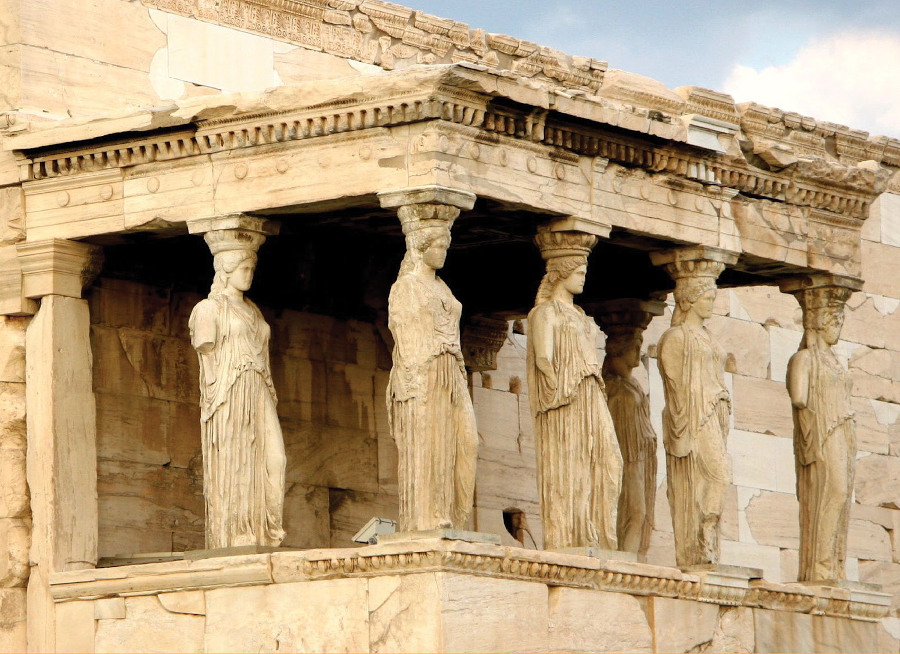
Detail of the Porch of the Caryatids on the Acropolis of Athens, Greece. Psalm 144:12 mentions daughters being “like pillars carved to adorn a palace.”
Rob & Lisa Meehan/Wikimedia Commons, CC BY 2.0
Return to the main text.
144:3–4 Acknowledgment of the relative insignificance of human beings and an expression of wonder that God cares for them.
144:4 breath. See 39:4–6 and notes. shadow. See 102:11 and note.
144:5–8 Prayer for deliverance.
144:5 See 18:9 and note on 18:7–15; see also Isa 64:1 and note.
144:7 See 18:16–17 and note on 32:6.
144:8 mouths. See note on 5:9. right hands. Hands raised to swear covenant oaths of allegiance or submission (106:26; Ex 6:8; Dt 32:40).
144:9–10 Vow to praise God (see note on 7:17).
144:9 new song. See note on 33:3.
144:10 his servant David. See 143:2 and note.
144:11 Repetition of the prayer in vv. 7–8, apparently to serve as transition to what follows: If God will deliver his servant David, the realm will prosper and be secure.
144:12–15 Many believe this to be a separate prayer (“May our sons . . . ”), unrelated to vv. 1–11, but the apparently transitional function of v. 11 supports the NIV rendering.
144:12–14 Possibly a postexilic echo of Dt 28:3–8.
144:12 sons . . . like . . . plants. Strong and healthy. daughters . . . like pillars carved. An honor by which their beauty will be remembered. Temple columns in the shape of women were not uncommon (e.g., the caryatids on the Acropolis in Athens; see photo).
144:14 our oxen will draw heavy loads. Or “our oxen will be heavy with flesh” or “our oxen will be heavy with young” (see also NIV text note).
144:15 Blessed. See note on 1:1. the people of whom this is true. Cf. 33:12; see Dt 28:3–8; 1Ki 5:4 and note.
Ps 145 A magnificent hymn to the Lord, the Great King, for his mighty acts and benevolent virtues, which are the glory of his kingly rule. It exploits to the full the traditional language of praise and, as an alphabetic acrostic (see Introduction: Literary Features), reflects the care of studied composition. This care can be seen also in the manner in which the whole is structured. Between the two-line introduction (vv. 1–2) and one-line conclusion (v. 21), four main stanzas (vv. 3–7,9–13a,13b–16,17–20) describe these divine attributes: greatness, goodness, trustworthiness, righteousness. The first two of these stanzas are each composed of five poetic lines, the last two of four lines. Centered between the first two is an additional thematic line (v. 8) echoing Ex 34:6–7. This significant theme is centered (see note on 6:6) and not elaborated here (but see 86:15; 103:8–12; 111:4–5; 116:5–6) to allow the author to remain within the 22-line limits of the Hebrew alphabet. Further, the first two stanzas (vv. 3–13a) highlight the commending, telling, celebrating, singing and extolling of the glory of the Lord’s reign, while the last two (vv. 13b–20) focus on what it is he does that is worthy of praise.
145 title praise. Hebrew tehillah, occurring only here in the psalm titles, but from a plural form (tehillim) has come the traditional Hebrew name of the Psalter. Of David. See introduction to Ps 138–145.
145:1–2 Initial commitment to praise God. name. See v. 21, thus framing the psalm (see note on 5:11).
145:3–7 Praise of God’s mighty acts, which display his greatness (v. 3) and his goodness (v. 7)—as the author underscores by framing the paragraph with these two references. For the same combination, see 86:10,17; 135:3,5.
145:4 commends . . . tell. See vv. 5–7,10–12,21; see also note on 9:1. your works. In creation, providence and redemption.
145:7 righteousness. See v. 17; see also note on 4:1.
145:8 This centered line (see introduction above) is equal in thematic importance to vv. 3,9,13b,17. It echoes the classic exposition of the divine attributes in Ex 34:6–7 (see note there).
145:9–13a Praise of God’s benevolent virtues, which move all creatures to celebrate the glory of his kingdom.
145:10 All your works praise you. See v. 21; see also note on 65:13. faithful people. See note on 4:3.
145:13b–16 Praise of God’s faithfulness.
145:13b,17 faithful. See article.
145:17–20 Praise of God’s righteousness.
145:18 in truth. With godly integrity.
145:21 The praise of God must continue, and every creature take it up—forever. every creature. Or perhaps “every human” (see 65:2, “all people”; but see also 150:6).
Ps 146–150 A final cluster of five hymns all bracketed by shouts of Hallelujah! (“Praise Yahweh!”)—which may have been added by the final editors (see introductions to Ps 105–106; see also Ps 111–117). The Psalter collection begins with two psalms that address the reader and whose function is to identify those to whom the collections specifically belong (see introduction to Ps 1–2). Here, at the collection’s end, that congregation gives voice to its final themes. They are the themes of praise—and calls to praise—of Zion’s heavenly King (146:10; 147:12; 149:2), the Maker, Sustainer and Lord over all creation (146:6; 147:4,8–9,15–18; 148:5–6); the one sure hope of those who in their need and vulnerability look to him for help (146:5–9; 147:2–3,6,11,13–14; 149:4); the Lord of history whose commitment to his people is their security and the guarantee that, as his kingdom people (see especially 147:19–20), they will ultimately triumph over all the forces of this world arrayed against them (146:3,10; 147:2,6,10,13–14; 148:14; 149:4–9).
Ps 146 A hymn in praise of Zion’s heavenly King, with special focus on his powerful and trustworthy care for Zion’s citizens who look to him when oppressed, broken or vulnerable. It has many thematic links with Ps 33; 62; 145. For its placement, see introduction to Ps 146–150.
146:1–2 Initial vow to praise God—as long as life continues (see 145:21 and note on 7:17).
146:1 Praise the LORD, my soul. See the frames around Ps 103–104. soul. See note on 6:3.
146:3–4 A call to trust ultimately in the Lord rather than in any human help (see 118:10–11 and note; 147:10–11).
146:5–9 Encouragement to trust in the covenant God of Jacob (see note on 14:7), who as Creator is Lord over all, as the Faithful One defends the defenseless and provides for the needy, and as the Righteous One shows favor to the righteous but checks the wicked in their pursuits.
146:6 Maker of heaven and earth. See note on 121:2.
146:7 upholds the cause of the oppressed. See 9:9; 10:18; 103:6. gives food to the hungry. See 17:14; 34:10; 107:9; cf. Isa 49:10. sets prisoners free. See 68:6; 79:11; 102:20; 107:10,14; cf. Isa 42:7 and note; 61:1.
146:8 gives sight to the blind. See Isa 29:18; 35:5; cf. Isa 42:7; 43:8. lifts up those who are bowed down. See 145:14. righteous. See note on 1:5.
146:9 watches over the foreigner . . . fatherless . . . widow. See Dt 10:18; cf. Isa 1:17; 9:17 and notes; cf. also Jer 22:16; Jas 1:17. frustrates the ways of the wicked. Cf. 104:35; 145:20.
146:10 Concluding exultant testimony to the citizens of God’s royal city. The LORD reigns forever. See 93:1 and note. Zion. See note on 9:11.
Ps 147 A hymn of praise to God, the Creator and Lord over all, for his special mercies to Israel—possibly composed for the Levitical choirs on the joyous occasion of the dedication of the rebuilt walls of Jerusalem (Ne 12:27–43). Following the introduction (v. 1), two couplets in which the Lord’s unique favors to Israel are celebrated (vv. 2–3,19–20) frame its main body, while at the center another couplet (vv. 10–11) highlights the Lord’s special pleasure in those who rely finally on him rather than on any of his creatures. In the balanced stanzas that intervene (vv. 4–9,12–18), this thematic core is placed in the larger context of God’s works and ways. See introduction to Ps 146–150.
147:2 builds up. Refers to the postexilic rebuilding of Jerusalem. exiles. Translates an unusual Hebrew word found also in Isa 11:10; 56:8—all of which speak of gathering (restoring) “the exiles of Israel.”
147:3 brokenhearted. Such as the exiles (see Ps 137; cf. Ps 126) and those who struggled in the face of great opposition to rebuild Jerusalem’s walls (Ne 2:17–20; 4:1–23).
147:4–6 He whose power and understanding are such that he fixes the number of (or counts) the stars and names them is able to sustain his humble ones and bring the wicked down (see 20:8; 146:9; see also Isa 40:26–29).
147:6 humble. Those who acknowledge that they are without resources to deliver or maintain themselves—those who, as God’s people, put their trust in him (see 149:4; see also 22:26, “the poor”; 37:11, “the meek,” and note; 69:32, “the poor”). ground. Probably the grave (see note on 61:2).
147:7–9 Israel’s God is Lord of creation, the one who provides for all living things.
147:10–11 The central couplet (see note on 6:6), thematically linked with vv. 2–3 and vv. 19–20 (see introduction to Ps 147). Israel’s God is not particularly impressed by the creaturely capacities that humans are prone to rely on (cf. 146:3–4 and note); it gives him delight when his people rely on him (cf. 146:5–9).
147:11 fear. See note on 34:8–14. unfailing love. See article.
147:12–18 The Lord of all creation, Zion’s God, secures his people’s defenses and prosperity, their peace and abundant provision. The verses mention clouds and rain (v. 8); snow, frost and hail (vv. 16–17); icy winds and warm breezes (vv. 17–18)—the whole range of weather.
147:15 his command . . . his word. Personified as messengers commissioned to carry out a divine order (see v. 18; see also notes on 23:6; 33:4; 104:4).
147:19–20 God’s most unique gift to Israel: his redemptive word, by which he makes known his program of salvation and his holy will. These verses constitute the end frame, thematically linked with vv. 2–3 and vv. 10–11 (see introduction to Ps 147 and note on vv. 10–11).
Ps 148 A hymn that calls all things in creation to praise the Lord. Whatever its original liturgical purpose, its placement here at the center of the five concluding hymns serves to complete the scope of the calls to praise with which the Psalter closes (see introduction to Ps 146–150). Two similarly constructed stanzas call on all creatures in the heavens (vv. 1–6) and all creatures beneath the heavens (vv. 7–14) to join in the chorus of praise (see 103:20–22 and note). Both stanzas end with a couplet setting forth the motivation for praise. The second of these (vv. 12–14), made up of extended lines, clearly constitutes the climax.
148:1–6 Let all creatures in the heavens praise the Lord.
148:2 heavenly hosts. See 103:21 and note.
148:3 sun and moon . . . shining stars. See note on 65:13.
148:4 waters above the skies. The “deep” above (see Ge 1:7; cf. “ocean depths” in v. 7; see also note on 42:7).
148:5–6 Motivation (“for,” v. 5) for the heavenly creatures to praise the Lord (cf. vv. 13–14 and “for,” v. 13).
148:5,13 name of the LORD. See note on 5:11. They are to praise the Lord because he has created them and made their existence secure.
148:7–14 Let all creatures of earth praise the Lord (“the earth and the heavens” [v. 13] are the sum of all creation; see 89:11; 113:6; 136:5–6; Ge 2:1,4).
148:7 sea creatures and all ocean depths. Likely with Ge 1 in mind (Ge 1:7, 10,21), the call begins with these and moves toward the human components. This and the pairs that follow employ a figure of speech that refers to all reality pertaining to the sphere to which they belong—here, all creatures great and small that belong to the realm of lakes and seas.
148:8 his bidding. Or “his word” (see 147:15 and note).
148:13–14 Climactic conclusion, with focus again on motivation for praising God (cf. vv. 5–6 and note).
148:13 his name . . . his splendor. As shown in the glory of his creation. is above. The glory of the Creator is greater than the glory of the creation.
148:14 horn. The Lord’s anointed (see NIV text note; 132:17 and note; see also notes on 2:2; Ps 18 title). It may be, however, that “horn” here represents the strength and vigor of God’s people (92:10; 1Sa 2:1; Jer 48:25; La 2:17). In any event, reference is to God’s saving acts for Israel—God is to be praised for his works in creation and redemption (see note on 65:6–7). praise. See 22:3 and note. faithful servants. See note on 4:3.
Ps 149 A hymn of praise to God for the high honor bestowed on his people Israel. Israel’s unique honor has two sides: They were granted salvation (in fact and in promise), and, under the particular administration of the emerging kingdom of God put in place in the inauguration of the Sinaitic covenant (see chart), they were armed to execute God’s sentence of judgment on the world powers that have launched attacks against the kingdom of God. Under that arrangement, Israel served as the earthly contingent of the armies of the King of heaven (see 68:17 and note; see also Jos 5:14; 2Sa 5:23–24; 2Ch 20:15–17, 22; Hab 3:3–15). This next-to-last psalm should be read in the light of the second psalm (see introduction to Ps 2; see also introduction to Ps 146–150).
Following an introductory verse, the two main themes are developed in two balanced stanzas of four verses each. References to God’s “faithful people” enclose the song (see also v. 5). The common pair of synonyms, “honor” (v. 5) and “glory” (v. 9), effectively link the two stanzas (see 8:5; 21:5, “glory . . . majesty”; 104:1,31, “majesty . . . glory”; 145:5,12, “glorious splendor”; Isa 35:2, “glory . . . splendor”).
149:1 new song. See note on 33:3. in the assembly. See note on 9:1. his faithful people. See vv. 5,9; see also note on 4:3.
149:2–5 Let Israel rejoice in their King, who has crowned them with the honor of salvation.
149:3 his name. See note on 5:11.
149:4 crowns. Endows with splendor (Isa 55:5; 60:9; 61:3). humble. Those who acknowledge that they are without resources (see 147:6 and note).
149:5 on their beds. The salvation (v. 4) so tangible in the daytime evokes songs in the night (42:8; 63:6; 77:6).
149:6–9 Let Israel praise their God, who has given them the glory of bearing the sword as his army in service (cf. Ps 137; 139:19–22; Eze 38–39; Da 2:44; 7:22,26–27; Am 9:12).
149:7 vengeance. God’s just retribution on those who have attacked his kingdom. Of this divine retribution the OT speaks often: 58:10; 79:10; 94:1; Nu 31:2; Dt 32:35, 41,43; 2Ki 9:7; Isa 34:8; 35:4; 47:3; 59:17; 61:2; 63:4; Jer 46:10; 50:15,28; 51:6,11,36; Eze 25:14, 17; Mic 5:15; Na 1:2. In the NT age, however, God’s people are armed with the “sword of the Spirit” for overcoming the powers arrayed against God’s kingdom (2Co 6:7; 10:4; Eph 6:12,17; Heb 4:12); their participation in God’s retribution on the world awaits the final judgment (1Co 6:2–3).
149:9 sentence written. God’s firmly determined judgment (see 139:16 and note).
Ps 150 The final great Hallelujah—perhaps composed specifically to close the Psalter. See the doxologies that conclude the first four Books: 41:13; 72:18–19; 89:52; 106:48. This final call to praise God moves powerfully by stages from place to themes to orchestra to choir, framed with Hallelujahs. See introduction to Ps 146–150.
150:1 Where God should be praised. his sanctuary. At Jerusalem. his mighty heavens. Or “the vault of his power” (see 19:1, “skies”; Ge 1:6), i.e., the vault that displays or symbolizes his power or in which his power resides. Usually thought to refer to God’s heavenly temple (11:4), it may signify the vaulted ceiling of the visible universe viewed as a cosmic temple.
150:2 Why God should be praised. his acts of power. What he does (in creation and redemption). his surpassing greatness. Who he is.
150:3–5 How God should be praised—with the whole orchestra (eight instruments: wind, string, percussion), with dancing aptly placed at the middle (see photos here, here, here, and here).
150:6 Who should praise God. The choir, with articulate expression, celebrates God’s “acts of power” and “surpassing greatness” (v. 2). Praise the LORD. Hebrew Hallelu Yah. For another final great Hallelujah (see introduction to this psalm), see Rev 19:1–8 and note on 19:1.