21:30 as a witness. “Witnesses” to covenant/treaty-making (or other events of continuing significance) served as disinterested (third-party) testimonies to the event they “witnessed” (31:44,48,52; Dt 4:26; 30:19; 31:19,26; 32:1; Jos 22:27–28; 24:27; 1Sa 6:18) and could be appealed to (see Ps 50:1 and note; Isa 1:2; Mic 6:1–2).
21:31 Beersheba, because the two men swore an oath there. See NIV text note; see also photo. For a similar pun on the name, see 26:33. Beersheba, an important town in the northern Negev, marked the southernmost boundary of the Israelite monarchy in later times (see, e.g., 2Sa 17:11). An ancient well there is still pointed out as “Abraham’s well” (v. 25), but its authenticity is not certain. because. Or “when.”
21:32 Philistines. See note on 10:14.
21:33 tamarisk. A shrub or small tree that thrives in arid regions. Its leafy branches provide welcome shade, and it is probably the unidentified bush under which Hagar put Ishmael in v. 15. Eternal God. Hebrew El Olam, a phrase unique to this passage. It is one of a series of names that include El, “God,” as an element (see 14:19; 17:1 and notes; 33:20; 35:7).

 22:1–19 The climax to the account of God’s dealings with Abraham. Here we are told of God’s supreme test of Abraham’s faith and of his final confirmation of his covenanted promises—once again confirmed by an oath (vv. 15–18). After this, there follows only the account of how Abraham put his affairs in order with a view to the future: providing a place of burial for Sarah and himself in the promised land (ch. 23), obtaining a suitable wife for Isaac (ch. 24), and seeing to the distribution of his inheritance among his offspring (25:1–6).
This climax in many ways echoes the beginning (12:1–7) and with it frames the main body of the Abraham story. Cf., e.g., 12:1: “Go from your country, your people and your father’s household to the land I will show you”; 22:2: “Go to the region of Moriah . . . [to] a mountain I will show you.”
22:1 Some time later. Isaac had grown into adolescence or young manhood, as implied also by 21:34 (“a long time”). Here I am. Abraham answered with the response of a servant, as did Moses and Samuel when God called them by name (Ex 3:4; 1Sa 3:4, 6,8).
22:2 your son, your only son, whom you love—Isaac. “Isaac” follows the clause “whom you love” in order to heighten the effect. Isaac was the “only son” of the promise (21:12; cf. Gal 4:23), and Ishmael had been sent away (21:8–21). region of Moriah. The author of Chronicles identifies the area as the temple mount in Jerusalem (2Ch 3:1). Today “Mount Moriah” is occupied by the Dome of the Rock, an impressive Muslim structure erected in ad 691. Sacrifice him. Abraham had committed himself by covenant to be obedient to the Lord and had consecrated his son Isaac to the Lord by circumcision. The Lord put his servant’s faith and loyalty to the supreme test, thereby instructing Abraham, Isaac and their descendants as to the kind of total consecration the Lord’s covenant requires. The test also foreshadowed the perfect consecration in sacrifice that another offspring of Abraham would undergo in the same vicinity (see note on v. 16) in order to wholly consecrate Abraham and his spiritual descendants to God and to fulfill the covenant promises.
22:3 Early the next morning. Prompt obedience, even under such trying circumstances, characterized Abraham’s response to God (see note on 12:4).
22:4 third day. Parts of three days were likely required for the journey from Beersheba (v. 19) to “the region of Moriah” (Jerusalem; see v. 2 and note), a distance of about 48 miles. On the other hand, a “journey of three days” may have been a conventional expression for a short trip rather than a journey of exactly three days (30:36; Ex 3:18; 5:3; 8:27; 15:22; Nu 10:33; 33:8; Jos 9:16; Jnh 1:17; 3:3).
22:5 boy. See v. 12; see also note on v. 1. The Hebrew for this word has a wide range of meaning, from an infant (Ex 2:6) to a young man of military age (1Ch 12:28). we will come back to you. Abraham, the man of faith and “the father of all who believe” (Ro 4:11), “reasoned that God could even raise the dead” (Heb 11:19) if that were necessary to fulfill his promise.
22:8 God himself will provide the lamb. The immediate fulfillment of Abraham’s trusting response was the ram of v. 13, but its ultimate fulfillment is the Lamb of God (Jn 1:29,36).
22:9 laid him on the altar, on top of the wood. Isaac is here a type (prefiguration) of Christ (see note on v. 16).
22:11 angel of the LORD. See note on 16:7. The “angel of the LORD” who had seen to the safety of Abraham’s son Ishmael and had spoken of Ishmael’s future (16:7–12; 21:17–18) now intervenes to save Abraham’s son Isaac and afterward speaks of Isaac’s future (vv. 17–18). Abraham! Abraham! The repetition of the name indicates urgency (46:2; Ex 3:4; 1Sa 3:10; Ac 9:4). Here I am. See note on v. 1.
22:12 fear God. See note on 20:11. you have not withheld from me your son, your only son. See v. 16 and note. Abraham’s “faith was made complete by what he did” (Jas 2:22).
22:13 instead of. Substitutionary sacrifice of one life for another is here mentioned for the first time. As the ram died in Isaac’s place, so also Jesus gave his life as a ransom “for” (or “instead of”) many (Mk 10:45).
22:14 The LORD Will Provide. Thus Abraham memorializes the remarkable way in which God fulfilled his expectation (v. 8). mountain of the LORD. During the Israelite monarchy the phrase referred to the temple mount in Jerusalem (Ps 24:3; Isa 2:3; 30:29; Zec 8:3).
22:16 I swear by myself. There is no greater name in which the Lord can take an oath (Heb 6:13). you . . . have not withheld your son, your only son. Abraham’s devotion is paralleled by God’s love to us in Christ as reflected in Jn 3:16 and Ro 8:32, which may allude to this verse.
22:17 descendants as numerous as the stars in the sky. See 13:16; 15:5 and notes. sand on the seashore. Fulfilled, at least in part, during Solomon’s reign (1Ki 4:20). cities. See 24:60.
22:18 all nations on earth will be blessed. See note on 12:2–3. because you have obeyed me. See note on 17:9.
22:23–24 Abraham’s brother Nahor became the father of eight sons by his wife and four by his concubine (see note on 25:6). They would later become the ancestors of 12 Aramean (v. 21) tribes, just as Abraham’s son Ishmael would become the ancestor of 12 tribes (25:16) and Abraham’s grandson Jacob would become the ancestor of the 12 tribes of Israel (49:28).
23:1–20 How Abraham provided a burial place for Sarah and himself in Canaan, thus in faith laying claim to Canaan as his homeland in accordance with God’s promise.
23:2 Kiriath Arba. Means “the town of Arba” (Arba was the most prominent member of a tribe living in the Hebron area [see Jos 14:15]). It can also mean “the town of four,” referring to the place where Anak (Jos 15:13–14; 21:11) and his three sons lived (Jdg 1:10,20). went. Either from Beersheba to Hebron or into the place where Sarah’s body was lying.
23:3 Hittites. See note on 10:15. They were apparently in control of the Hebron area at this time.
23:4 a foreigner and stranger. The phrase was used often by the patriarchs and their descendants in reference to themselves (see 1Ch 29:15; Ps 39:12; see also Heb 11:13). On this earth Abraham “lived in tents” (Heb 11:9), the most temporary of dwellings. But he looked forward to the more permanent home promised him, which the author of Hebrews calls “the city with foundations, whose architect and builder is God” (Heb 11:10).
23:6 You are a mighty prince. Probably intended as flattery.
 23:9 cave of Machpelah. The tombs of several patriarchs and their wives—Abraham and Sarah, Isaac and Rebekah, Jacob and Leah (v. 19; 25:8–10; 49:30–31; 50:12–13)—are, according to tradition, located in a large cave deep beneath the Mosque of Abraham, a Muslim shrine in Hebron. end of his field. Apparently Abraham wanted to buy only a small part of the field (namely, the part where the cave was located), but Ephron insisted that he purchase the entire field (see note on v. 15).
23:10 in the hearing of all the Hittites who had come to the gate. The main gateway of a city was usually the place where legal matters were transacted and attested (see v. 18; see also note on 19:1).
23:11 my lord. Perhaps intended to flatter Abraham (v. 15). give. See NIV text note.
23:15 four hundred shekels of silver, but what is that between you and me? See note on 20:16. Despite Ephron’s pretense of generosity, 400 shekels of silver was an exorbitant price for a field (see, e.g., Jer 32:9). Ephron was taking advantage of Abraham during a time of grief and bereavement. He knew that Abraham had to deal quickly in order to have a place to bury Sarah, so he insisted that Abraham buy the entire lot.
23:16 weight current among the merchants. Subject to more variation and therefore greater dishonesty than the later royal standard (2Sa 14:26), which was carefully regulated and more precise.
23:17 the field and the cave in it, and all the trees. Ephron had held out for the sale of the entire field and its contents (see notes on vv. 9,15).
23:19 buried his wife . . . in the land of Canaan. In that culture, people had a strong desire to be buried with their ancestors (see note on 25:8) in their native land. By purchasing a burial place in Canaan, Abraham indicated his unswerving commitment to the Lord’s promise. Canaan was his new homeland.
24:1–67 Abraham obtains a suitable wife for Isaac, relying on God who has made a covenant with him to provide an appropriate mother for his descendants who would inherit the land (vv. 6–7).
24:2 senior servant in his household. Probably Eliezer of Damascus (see note on 15:2). Put your hand under my thigh. Near the organ of procreation, probably because this oath was related to Abraham’s last will and testament and called for faithful implementation on the part of his son. Isaac must accept Abraham’s and God’s choice (see also 47:29 and note).
24:3 the LORD, the God of heaven and the God of earth. See v. 7; see also note on 1:1. For a similar majestic title used by Abraham in an oath, see 14:22.
24:4 my country. Mesopotamia (see note on v. 10). get a wife for my son. See note on 21:21.
24:7 To your offspring I will give this land. Repeats the promise of 12:7. his angel. See note on 16:7.
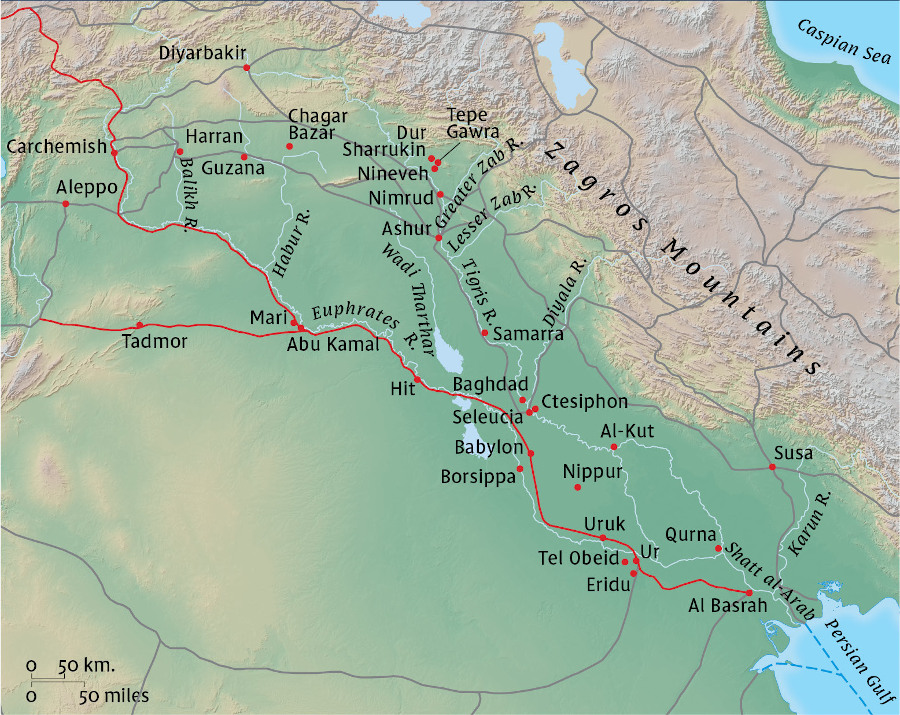
24:10 camels. See note on 12:16. Aram Naharaim. See NIV text note; the name means “Aram of the two rivers”—the Euphrates and the Tigris. Aram (see note on 10:22) Naharaim was the northern part of the area called later by the Greeks “Mesopotamia,” meaning “between the rivers” (see map). town of Nahor. Nahor is the same name as that of Abraham’s brother (v. 15; 11:26). The town is mentioned in clay tablets excavated beginning in 1933 at the ancient city of Mari on the Euphrates (see chart; see also map). Nahor was located in the Harran (see note on 11:31) district and was ruled by an Amorite prince in the eighteenth century bc.
24:11 toward evening, the time the women go out to draw water. After the midday heat had cooled.
24:14 By this I will know. Like his master Abraham, the servant asked God for a sign to validate his errand (see note on 15:8). kindness. See v. 27; probably a reference to God’s covenant with Abraham, which had promised numerous descendants through Isaac (17:19; 21:12).
24:15 Before he had finished praying. God had already begun to answer. Rebekah . . . was the daughter of Bethuel son of . . . the wife of Abraham’s brother. Isaac would thus be marrying his father’s grandniece (v. 48).
24:22 beka. Half a shekel (Ex 38:26); see note on 20:16.
24:34–49 The servant explained his mission to Rebekah’s family. His speech, which summarizes the narrative of the earlier part of the chapter, is an excellent example of the ancient storyteller’s art, which was designed to fix the details of a story in the hearer’s memory.
24:40 before whom I have walked faithfully. See notes on 5:22; 6:8–9; 17:1.
24:53 The rich gifts bestowed on Rebekah and her family indicated the wealth of the household into which she was being asked to marry—far from her loved ones and homeland.
24:62 Beer Lahai Roi. See note on 16:14. Negev. See note on 12:9.
24:65 she took her veil and covered herself. Apparently a sign that she was unmarried (cf. 38:14,19).
24:67 tent. Often used as a bridal chamber (Ps 19:4–5).
25:1–6 Abraham’s final disposition of his estate.
25:1 had taken. The order is not chronological. Otherwise Abraham would have to be 140 years old; hence, “had taken” instead of “took.” wife. Elsewhere called Abraham’s “concubine” (1Ch 1:32).
25:2 She bore him. The listing of Keturah’s offspring shows that Abraham indeed became “the father of many nations” (17:4; see note on 17:6).
25:5 left everything he owned to Isaac. Isaac was the “only son” (22:2; see note there) of Abraham’s wife Sarah, so he was the legal heir to Abraham’s estate (cf. 21:10 and note).
25:6 concubines. Secondary wives, a common cultural phenomenon in the ancient Near East. Polygamy was practiced even by godly men in ancient times, though it was not the original divine intention (see notes on 2:24; 4:19).
25:7 a hundred and seventy-five years. Abraham thus lived for a full 100 years in the promised land (see 12:4 and note).
25:8 died at a good old age. As God had promised (15:15). old man and full of years. A phrase used also of the patriarch Job (Job 42:17). was gathered to his people. Joined his ancestors and/or deceased relatives in death (2Ki 22:20; 2Ch 34:28).
25:9 Isaac and Ishmael. Isaac, as the heir of the covenant and estate (see note on v. 5), is listed first.
25:11 Beer Lahai Roi. See note on 16:14.
25:12–18 A brief account of Ishmael’s family line, showing the fulfillment of the promises made to Hagar (16:10) and Abraham (17:20) concerning their son but also noting the fulfillment of his predicted alienation from the descendants of Abraham and Sarah (16:12).
25:12 account. See note on 2:4.
25:13 names of the sons of Ishmael. Many are Arab names, giving credence to the Arab tradition that Ishmael is their ancestor.
25:16 twelve tribal rulers. Twelve major tribes descended from Abraham’s son Ishmael (as predicted in 17:20)—as was also true of Abraham’s brother Nahor (see note on 22:23–24).
25:18 in hostility toward. See note on 16:12; or possibly “to the east of” (see NIV text notes here and on 16:12; see also 25:6).
25:19—35:29 The author now takes up the story of Jacob, which he continues until the death of Isaac. Isaac is the link between Abraham and Jacob, and his story is interwoven with theirs.
25:19 account. See note on 2:4. Abraham became the father of Isaac. In c. 2066 bc.
25:20 Paddan Aram. See NIV text note; means “plain of Aram,” another name for Aram Naharaim (see note on 24:10).
25:21 because she was childless. As Sarah had been (see 11:30 and note). Rebekah was barren for 20 years (vv. 20,26). Isaac’s offspring, like Abraham’s, were a special gift in fulfillment of God’s covenant promises.
25:22 jostled each other. The struggle between Jacob and Esau began in the womb (see also v. 26). went. Perhaps to a nearby place of worship, such as an altar (12:6–8; 13:18; 22:9).
25:23 the older will serve the younger. The ancient law of primogeniture (cf. Dt 21:15–17 and notes) provided that, under ordinary circumstances, the younger of two sons would be subservient to the older. God’s election of the younger son highlights the fact that God’s people are the product not of natural or worldly development but of his sovereign intervention in human affairs (see note on 11:30). Part of this verse is quoted in Ro 9:10–12 as an example of God’s sovereign right to do “whatever pleases him” (Ps 115:3)—not in an arbitrary way (Ro 9:14), but according to his own perfect will.
25:24–26 For another unusual birth of twin boys, see 38:27–30.
25:25 red. A pun on Edom, one of Esau’s other names (see v. 30 and NIV text note).
25:26 his brother came out . . . Jacob. In c. 2006 bc. his hand grasping Esau’s heel. Hostility between the Israelites (Jacob’s descendants) and Edomites (Esau’s descendants) became the rule rather than the exception (see, e.g., Nu 20:14–21; Ob 9–10). Jacob. See NIV text note. The name became proverbial for the unsavory quality of deceptiveness (see NIV text note on Jer 9:4).
25:31 sell me your birthright. In ancient times the birthright included the inheritance rights of the firstborn (Heb 12:16). Jacob was ever the schemer, seeking by any means to gain advantage over others. But it was by God’s appointment and care, not Jacob’s wits, that he came into the blessing.
25:33 Swear to me first. A verbal oath was all that was required to make the transaction legal and forever binding.
25:34 Esau despised his birthright. In so doing, he proved himself to be “godless” (Heb 12:16), since at the heart of the birthright were the covenant promises that Isaac had inherited from Abraham.
26:1–33 The events of some of these verses (e.g., vv. 1–11) occurred before the birth of Esau and Jacob. Verses 1–11 are placed here to highlight the fact that the birthright and blessing Jacob struggled to obtain from his father (25:22,31–33; 27:5–29) involved the covenant inheritance of Abraham that Isaac had received.
26:1 previous famine in Abraham’s time. See 12:10. Abimelek. Probably the son or grandson of the earlier king who bore the same name (20:2). Philistines. See note on 10:14. Gerar. See note on 20:1.
26:2 appeared. See note on 12:7.
26:3 I will be with you. God’s promise to be a sustainer and protector of his people is repeated often (see, e.g., v. 24; 28:15 and note; 31:3; Jos 1:5; Isa 41:10; Jer 1:8, 19; Mt 28:20; Ac 18:10; see also Ge 17:7 and note). the oath I swore to your father Abraham. See 22:16–18.
26:4 descendants as numerous as the stars in the sky. See 13:16; 15:5 and notes. through your offspring all nations on earth will be blessed. See note on 12:2–3.
26:5 because Abraham obeyed me. See note on 17:9. everything I required . . . commands . . . decrees . . . instructions. Legal language describing various aspects of the divine regulations that God’s people were expected to keep (Lev 26:14–16, 46; Dt 11:1). The author of Genesis, writing after the giving of the covenant at Sinai, used language that strictly applied only to that covenant. But he emphasized to the Israelites that their father Abraham had been obedient to God’s will in his time and that they must follow his example if they were to receive the covenant promises.
26:7 She is my sister. Like his father before him (12:11–13), Isaac trusted in his own schemes (20:1–2) instead of God’s protection. because she is beautiful. See 12:11,14.
26:8 caressing. The word in Hebrew (a form of the verb translated “laugh” in 17:17; 18:12–13,15; 21:6 and “mock” in 21:9) is yet another pun on Isaac’s name.
26:12 reaped a hundredfold. Indicative of the fertility of the promised land.
26:16 you have become too powerful for us. An indication that the covenant promises were being fulfilled. Already in the days of the patriarchs, the presence of God’s people in the land was seen as a threat by the peoples of the world. As the world’s people pursued their own godless living, God’s people aroused their hostility. A similar complaint was voiced by an Egyptian pharaoh hundreds of years later (Ex 1:9).
26:20 The water is ours! In those arid regions, disputes over water rights and pasturelands were common (see 13:6 and note; 21:25; 36:7).
26:25 built an altar. See note on 12:7. called on the name of the LORD. See 4:26 and note.
26:26 Phicol. See note on 21:22.
26:30 made a feast. Covenants were often concluded with a shared meal, signifying the bond of friendship (see 31:54; Ex 24:11 and notes).
26:33 name of the town has been Beersheba. See note on 21:31.
26:34 When Esau was forty years old, he married. As had his father Isaac (25:20). Forty years was roughly equivalent to a generation in later times (Nu 32:13). Judith . . . Basemath. In addition to these two wives, Esau also married Mahalath, “sister of Nebaioth and daughter of Ishmael” (28:9). The Esau genealogy of ch. 36 also mentions three wives, but they are identified as “Adah daughter of Elon the Hittite,” “Oholibamah daughter of Anah . . . the Hivite” and “Basemath daughter of Ishmael and sister of Nebaioth” (36:2–3). Possibly the lists have suffered in the transmission of the texts, or perhaps alternative names or nicknames are used. It is also possible that Esau married more than three wives.
26:35 They were a source of grief. Isaac and Rebekah were determined not to allow Jacob to make the same mistake of marrying Hittite or Canaanite women (see 27:46—28:2).
27:1–40 How Rebekah and Jacob manipulated Isaac’s last will and testament.
27:1 eyes were so weak that he could no longer see. In ancient times, blindness and near blindness were common among elderly people (48:10; 1Sa 4:15). Here I am. See note on 22:1.
27:4 give you my blessing before I die. Oral statements, including deathbed bequests (49:28–33), had legal force in ancient Near Eastern law. blessing. See note on v. 36.
27:5 listening. Eavesdropping.
27:6 Rebekah. Throughout the Jacob story the author develops a wordplay on “birthright” (bekorah) and “blessing” (berakah), both of which Jacob seeks to obtain, and Rebekah (ribqah) does her best to further the cause of her favorite son. said to her son Jacob. The parental favoritism mentioned in 25:28 is about to bear its poisonous fruit.
27:8 my son, . . . do what I tell you. Rebekah proves to be just as deceitful as Jacob, whose very name signifies deceit (see NIV text notes on v. 36; 25:26).
27:20 your God. Consistent with Jacob’s language elsewhere (31:5,42; 32:9). Not until his safe return from Harran did he speak of the Lord as his own God (cf. 28:20–21; 33:18–20 and notes).
27:24 Are you really my son Esau? To the very end of the charade, Isaac remained suspicious.
27:29 Be lord over your brothers. Isaac was unwittingly blessing Jacob and thus fulfilling God’s promise to Rebekah in 25:23 (see note there). curse . . . be cursed . . . bless . . . be blessed. Cf. 12:2–3.
27:33 indeed he will be blessed. The ancient world believed that blessings and curses had a kind of magical power to accomplish what they pronounced (see note on 12:3). But Isaac, as heir and steward of God’s covenant blessing, acknowledged that he had solemnly transmitted that heritage to Jacob by way of a legally binding bequest (see note on v. 4).
27:34 loud and bitter cry. Esau’s tears “could not change what he had done” (Heb 12:17).
27:36 Isn’t he rightly named Jacob? See NIV text notes here and on 25:26. He took my birthright, and now he’s taken my blessing! The Hebrew for “birthright” is bekorah, and for “blessing” it is berakah (see note on v. 6). Though Esau tried to separate birthright from blessing, the former led inevitably to the latter, since both involved the inheritance of the firstborn (Heb 12:16–17).
27:39 away from the earth’s richness, away from the dew of heaven. Cf. v. 28. Isaac’s secondary blessing of Esau could be only a parody of his primary blessing of Jacob.
27:40 See 25:23 and notes on 25:22,26.
27:41–45 Esau’s fierce hostility toward Jacob and its consequences. This account of Esau’s “grudge” and the later account of the brothers’ reconciliation (33:1–17) frame the story of Jacob’s flight from Canaan to Paddan Aram, where he finds his wives, fathers many children and obtains great wealth before returning to the promised land. This chain of events parallels Joseph’s experiences as seen in his words to his brothers in 50:20 (see note there).
27:43 do what I say. Bad advice earlier (vv. 8,13), but sensible counsel this time.
27:44 for a while. Twenty years, as it turned out (31:38,41).
27:45 both of you. Jacob and Esau. Esau would have had to pay for his deed (v. 41) with his life (see 9:6 and note; see also Ex 21:12; Lev 24:17; Nu 35:19, 21,27,33 and note on 35:33; 2Sa 14:6–7).
28:2 Paddan Aram. See note on 25:20. Take a wife for yourself there. See 24:3–4.
28:3 God Almighty. See note on 17:1.
28:4 the blessing given to Abraham. For Paul’s application of this phrase to Christian believers, see Gal 3:14.
28:5 See map and accompanying text.
28:9 in addition to the wives he already had. See 26:34 and note. In order to please his father, Esau married in the family line of Abraham.
28:10–22 God’s reassuring appearance to Jacob as he is about to leave the promised land. This event and God’s appearance to him at the Jabbok River upon his return (32:22–32) form a frame around Jacob’s stay in Paddan Aram, to which he went empty but from which he returned full.
28:11 one of the stones . . . under his head. In ancient times headrests (e.g., in Egypt) were often quite hard, sometimes being made of metal. People were used to sleeping on the ground.
28:12 stairway. Not a ladder with rungs, it was more likely a stairway such as mounted the sloping side of a ziggurat (see note on 11:4). angels of God were ascending and descending on it. A sign that the Lord offered to be Jacob’s God. Jesus told a disciple that he would “see ‘heaven open, and the angels of God ascending and descending on’ the Son of Man” (Jn 1:51). Jesus himself is the bridge between heaven and earth (Jn 14:6), the only “mediator between God and mankind” (1Ti 2:5).
28:13 above it stood the LORD. Mesopotamian ziggurats were topped with a small shrine where worshipers prayed to their gods (see photo).
28:14 like the dust of the earth. See note on 13:16. All peoples on earth will be blessed through you. Repeats the blessing of 12:3.
28:15 I am with you. See note on 26:3. I will not leave you. Unlike the gods of pagan religions, in which the gods were merely local deities who gave protection only within their own territories, the one true God assured Jacob that he would always be with him wherever he went (see Dt 31:6 and note).
28:17 house of God . . . gate of heaven. Phrases that related Jacob’s stairway to the Mesopotamian ziggurats (see notes on 11:4,9).
28:18 pillar. A memorial of worship or of communion between people and God, common in ancient times. poured oil on top of it. To consecrate it (Ex 30:25–29).
28:21 return safely. Partially fulfilled in 33:18. the LORD will be my God. For the first time Jacob considered (conditionally: “If . . . . ” v. 20) acknowledging the God of Abraham and Isaac (see v. 13; 27:20) as his own. His full acknowledgment came only after his safe return from Harran (see 33:20 and note).
28:22 this stone . . . will be God’s house. In the sense that it would memorialize Jacob’s meeting with God at Bethel (see NIV text note on v. 19). of all that you give me I will give you a tenth. A way of acknowledging the Lord as his God and King (see note on 14:20).
29:5 Laban, Nahor’s grandson. See 24:15,29. The Hebrew word here for “grandson” (24:15,29) can refer to a son or any other male descendant (see NIV text note on 10:2).
29:9 shepherd. The task of caring for sheep and goats in the Middle East was shared by men and women (cf. Ex 2:16–17; SS 1:8 and note).
29:10 rolled the stone away. A feat of unusual strength for one man, because the stone was “large” (v. 2).

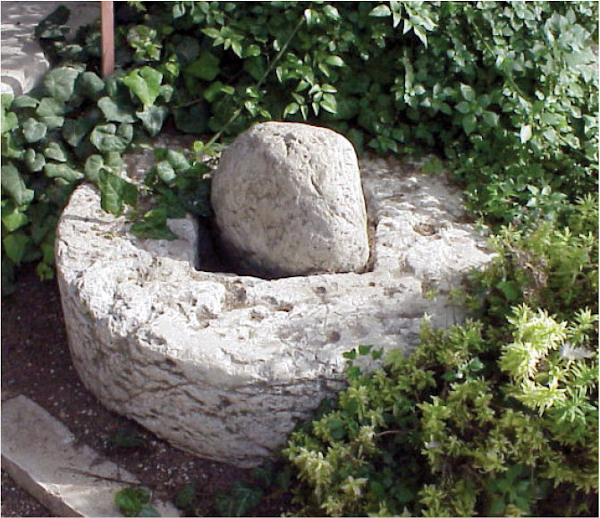
View of a large round stone that covered and protected the opening to a cistern or well (Ge 29:10).
www.HolyLandPhotos.org
Return to the main text.
29:11 weep aloud. For joy.
29:13 kissed him. A common sign of affection among relatives (see 33:4; Ex 4:27; see also notes on Ro 16:16; 1Co 16:20).
29:15 Laban’s question and the author’s observation in 30:43 frame the account of Jacob’s receiving the fulfillment of Isaac’s blessing. See also God’s blessing on Jacob (28:13–15).
29:16 Leah . . . Rachel. The names mean “cow” and “ewe,” respectively, appropriate in a herdsman’s family.
29:22 feast. A wedding feast was usually seven days long (vv. 27–28; Jdg 14:10,12).
29:23 when evening came . . . Jacob made love to her. The darkness, or perhaps a veil (24:65), may have concealed Leah’s identity.
29:24 See v. 29; a wedding custom documented in Old Babylonian marriage contracts.
29:25 you deceived me. Jacob, the deceiver in name (see NIV text notes on 25:26; 27:36) as well as in behavior (27:36), had himself been deceived. The one who had tried everything to obtain the benefits of the firstborn had now, against his will, received the firstborn (vv. 16,26).
29:28 then Laban gave him his daughter Rachel. Before Jacob worked another seven years (v. 30).
29:31–35 Leah, though unloved, nevertheless became the mother of Jacob’s first four sons, including Levi (ancestor of the Aaronic priestly line) and Judah (ancestor of David and his royal line, and ultimately of Jesus).
29:32 named him Reuben . . . because the LORD has seen my misery. See NIV text note. Ishmael had received his name in similar circumstances (16:11).
30:1 she became jealous of her sister. As Jacob was of his older brother. Give me children, or I’ll die! Tragically prophetic words (35:16–19).
30:2 Am I in the place of God . . . ? Jacob was forever trying to secure the blessing by his own efforts. Here he has to acknowledge that the blessing of offspring could come only from God (see 31:7–13 for the blessing of flocks). Joseph later echoed these words (50:19).
30:3 Sleep with her. See v. 9; see also 16:2 and note. for me. The Hebrew suggests that whatever children Bilhah bore would be adopted by Rachel as her own (see 50:23 and NIV text note).
30:4 as a wife. As a concubine (35:22).
30:5–12 Jacob’s fifth, sixth, seventh and eighth sons were born to him through his concubines.
30:14 give me some of your son’s mandrakes. The mandrake has fleshy, forked roots that resemble a human body and were therefore superstitiously thought to induce pregnancy when eaten (SS 7:13). Rachel, like Jacob (vv. 37–43), tried to obtain what she wanted by magical means.
30:16 hired. The Hebrew for this word is a pun on the name Issachar (see NIV text note on v. 18).
30:17–20 Jacob’s ninth and tenth sons were born through Leah, who was thus the mother of half of Jacob’s 12 sons (see note on 29:31–35).
30:20 presented . . . gift. The Hebrew terms for these words are puns on the name Zebulun (see NIV text note).
30:22 God remembered Rachel. See note on 8:1.
30:23 disgrace. Barrenness was considered to be shameful, a mark of divine disfavor (16:2; 30:2).
30:24 May the LORD add to me another son. The fulfillment of Rachel’s wish would bring about her death (35:16–19).
30:26 I will be on my way. Jacob had fulfilled his commitments. With his accounts squared with Laban, he asked permission to leave, taking only his family with him. Later, he will take with him also much of Laban’s wealth (30:43—31:1).
30:27 divination. The attempt to discover hidden knowledge through the interpretation of omens (Eze 21:21) or the aid of supernatural powers (see Ac 16:16 and note). It was strictly forbidden to Israel (Lev 19:26; Dt 18:10,14) because it reflected a pagan concept of the world controlled by evil forces, and therefore obviously not under the sovereign rule of the Lord. the LORD has blessed me because of you. As God had promised Jacob at Bethel (28:14) and in accordance with the promise made to Abraham (see 12:2–3 and note; 22:18; see also 39:5,23; 41:41–57).
30:32 Most commonly the sheep were all white and the goats all black. So Jacob chose to identify as his wages the sheep with dark markings and the goats with white markings—on the face of it a very modest request.
30:35 he removed. Secretly and without telling Jacob.
30:36 the rest of Laban’s flocks. Now made up of only pure-white sheep and all-black goats.
30:37 poplar . . . white. The Hebrew terms for these words are puns on the name Laban. As Jacob had gotten the best of Esau (whose other name, Edom, means “red”; see note on 25:25) by means of red stew (25:30), so he now tries to get the best of Laban (whose name means “white”) by means of white branches. In effect, Jacob was using Laban’s own tactic (deception) against him.
30:39 The scheme worked—but only because of God’s intervention (see Jacob’s own admission in 31:9), not because of Jacob’s superstition.
30:43 the man grew exceedingly prosperous. Over a period of six years (31:41). While in Harran, Jacob obtained both family and wealth. His wealth came at the expense of people in Northwest Mesopotamia, just as Abram’s (12:16) and later Israel’s (Ex 12:36) were obtained at the expense of the Egyptians (see also Isa 60:5–17 and note on 60:5; 61:6).
31:1 has taken everything. Since Laban’s sons had been caring for flocks containing the spotted and speckled animals that Laban had sorted out, Jacob could potentially lay claim to a large proportion of the flocks under their care.
31:3 Go back to the land of your fathers. Every sign Jacob was getting—from his wives (vv. 14–16), from Laban (v. 2), from Laban’s sons (v. 1) and now from God himself—told him that it was time to return to Canaan. I will be with you. See note on 26:3.
31:4 Rachel and Leah. At long last (v. 14) Rachel, the younger, has been given precedence over Leah—but she will soon become a deceiver like her husband Jacob (vv. 31,35).
31:7 ten times. See v. 41. “Ten” here probably signifies completeness. In effect, Jacob accused Laban of cheating him at every turn.
31:11 angel of God. See note on 16:7. Here I am. See note on 22:1.
31:13 Bethel, where you anointed a pillar. See note on 28:18.
31:15 what was paid for us. Jacob had come empty-handed to Paddan Aram and had offered his labors instead of wealth for his wives (cf. 24:10). So what had been “paid” for them was the fruit of Jacob’s labors for their father (30:27,30).
31:18 Paddan Aram. See note on 25:20; see also map.
31:19 household gods. Small portable idols, which Rachel probably stole because she thought they would bring her protection and blessing. Or perhaps she wanted to have something tangible to worship on the long journey ahead, a practice referred to much later in the writings of Josephus, a first-century ad Jewish historian. In any case, Rachel was not yet free of her pagan background (35:2; Jos 24:2).
31:21 So he fled. As he had fled earlier from Esau (27:42–43). Jacob’s devious dealings produced only hostility from which he had to flee. Gilead. An area of exceptionally good grazing land southeast of the Sea of Galilee (see Nu 32:1 and note).
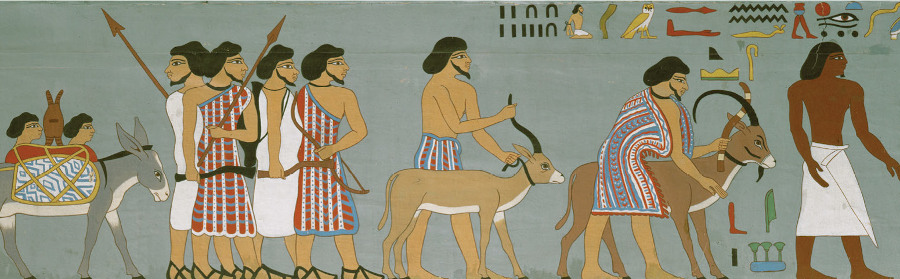
Reproduction of an Egyptian wall painting from a tomb at Beni Hasan depicts a group of Semitic traders being escorted by a dark-skinned Egyptian into the presence of an Egyptian provincial governor. The painting is from c. 1900 bc, about the time of Jacob’s journeys.
Erich Lessing. Art Resource, New York
Return to the main text.
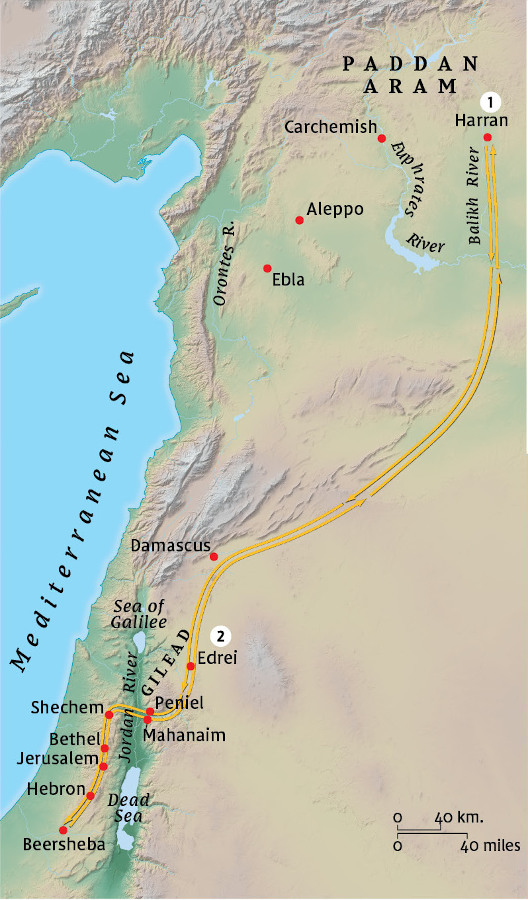
➊ The Euphrates-Balikh River basin was Jacob’s destination as he fled from Esau, ultimately reaching the home of his maternal uncle (Laban) near Harran.
➋ Jacob’s lengthy sojourn ended in a dispute with Laban and another flight—this time back to Canaan. His route likely took him toward Aleppo, then to Damascus and Edrei before reaching Peniel on the Jabbok River.
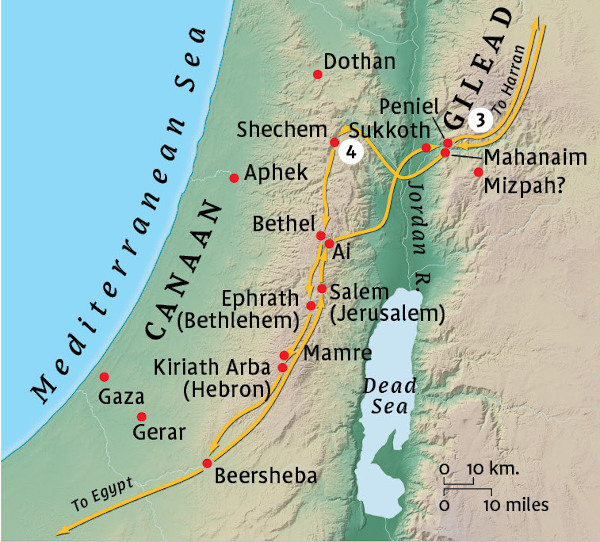
➌ He and his dependents reached the hill country of Gilead before their caravan was overtaken by Laban. The covenant at Mizpah [see above] was celebrated on one of the hills later used as a border station between Aramean and Israelite territories.
➍ Jacob lingered at Sukkoth, entered Canaan and proceeded to Shechem, where he erected an altar to the Lord (33:18–20).
Go to the Maps Index.
31:24 not to say anything . . . good or bad. Do not enter into a dispute with him; or do not press any claim against him (see also v. 29; cf. 24:50).
31:26 deceived. Jacob’s character, reflected in his name (see NIV text notes on 25:26; 27:36), is emphasized in the narrative again and again.
31:27 harps. Much smaller, and with fewer strings (usually 6 to 12), than their modern counterparts.
31:32 if you find anyone who has your gods, that person shall not live. Cf. 44:7–12. Though he made the offer in all innocence, Jacob almost lost his beloved Rachel. He had now been deceived even by his wife.
31:34 inside her camel’s saddle . . . sitting on them. Indicating the small size and powerlessness of the household gods.
31:35 I’m having my period. In many ancient cultures, as for Israel later (see Lev 15:20 and article), anything a menstruating woman sat on was considered ritually unclean. Rachel may be referring to this uncleanness or the pain associated with menstruation as her excuse for not standing up.
31:39 I bore the loss. Ancient laws (as in Ex 22:13) held that a shepherd did not have to compensate for losses to wild animals.
31:42 Fear. Here a term for God. Or perhaps the Hebrew for this word means “Kinsman,” stressing the intimacy of God’s relationship to the patriarch.
31:44 See vv. 48,52; see also 21:30 and note.
31:48 For the naming of an altar under similar circumstances, see Jos 22:10–12,34.
31:49 May . . . other. The so-called Mizpah benediction, which in context is in fact a denunciation or curse.
31:51 heap . . . pillar . . . between you and me. Boundary markers between Laban’s territory and Jacob’s territory. Galeed, Jacob’s name for the heap, is a pun on Gilead (see v. 47 and NIV text note).
31:53 God of their father. Or possibly “gods of their father [i.e., Terah],” reflecting Laban’s polytheistic background (Jos 24:2). Fear of his father Isaac. See note on v. 42. Jacob had met the “God of Isaac” (28:13) at Bethel 20 years earlier.
31:54 sacrifice . . . meal. Two important aspects of the covenant-making (v. 44) process (Ex 24:5–8,11). relatives. Those with whom he had now entered into a covenant. The common meal indicated mutual acceptance (see note on 26:30).
31:55 blessed. Or “said farewell to” (see NIV text note on 47:10; see also 31:28).
32:1–32 Jacob’s peaceful meeting with once-hostile Esau and his safe arrival in the promised land.
32:1 angels of God met him. Jacob had just left the region of hostile Laban and was about to enter the region of hostile Esau. He was met by the angels of God, whom he had seen at Bethel when he was fleeing from Esau to go to Laban (28:12). Thus God was with Jacob, as he had promised (see 28:15; 31:3; see also note on 26:3).
32:2 Mahanaim. Located in Gilead (see note on 31:21) east of the Jordan and north of the Jabbok (see note on v. 22). Two camps (see NIV text note) had just met in hostility and separated in peace. Two camps were again about to meet (in hostility, Jacob thought) and separate in peace. But Jacob called this crucial place “two camps” after seeing the angelic encampment, suggesting that he saw God’s encampment as a divine assurance. God’s host had come to escort him safely to Canaan (33:12,15). Yet he also feared meeting with Esau, so he divided his household into two camps (see vv. 7,10 and NIV text note on v. 7), still trying to protect himself by his own devices.
32:3 Seir . . . Edom. Far to the south of Jacob’s ultimate destination, but he assumed that Esau would come seeking revenge as soon as he heard that Jacob was on his way back.
32:4 my lord Esau. This is the opposite of Isaac’s blessing in 27:29. Instead of Esau bowing down to Jacob, Jacob calls Esau lord and bows down to him. By this the author may be suggesting that the divine plan is in jeopardy, or at least that Jacob still doubts God’s plan. Your servant. A phrase suggesting both courtesy and humility.
32:6 four hundred. A round number for a sizable unit of fighting men (1Sa 22:2; 25:13; 30:10). While Jacob lived the peaceful life of a shepherd, Esau lived “by the sword,” as Isaac had foretold (27:40).
32:9 Jacob prayed. His first recorded prayer since leaving Bethel.
32:12 your descendants like the sand of the sea. A reference to God’s promise in 28:14 (see 22:17 and note).
32:13 gift. Probably a wordplay: Out of his “two camps” (Hebrew maḥanayim, v. 2; see vv. 7–8,10) Jacob selects a “gift” (minḥah) for his brother.
32:22 Jabbok. Today called the Wadi Zerqa, flowing westward into the Jordan about 20 miles north of the Dead Sea.
32:24 left alone. As he had been at Bethel (28:10–22). a man. God himself (as Jacob eventually realized; see v. 30) in the form of an angel (see Hos 12:3–4 and note on Ge 16:7). wrestled. God wrestled (ye’abeq) with Jacob (ya’aqob) by the Jabbok (yabboq)—the author delighted in wordplay. Jacob had struggled all his life to prevail, first with Esau, then with Laban. Now, as he was about to reenter Canaan, he was shown that it was with God that he must “wrestle”—not with Esau or any other human being.
32:25 could not overpower him . . . touched the socket. God came to him in such a form that Jacob could wrestle with him successfully, yet he showed Jacob that he could disable him at will.
32:26 I will not let you go. Jacob’s persistence was soon rewarded (v. 29). unless you bless me. Jacob finally acknowledged that the blessing must come from God.
32:28 Your name will no longer be Jacob. Now that Jacob had acknowledged God as the source of blessing and was about to reenter the promised land, the Lord acknowledged Jacob as his servant by changing his name (see 17:5 and note). Israel. See NIV text note. Here in Jacob/Israel, the nation of Israel got its name and characterization: the people who struggle with God (memorialized in the name Israel) and with human beings (memorialized in the name Jacob) and overcome. God later confirmed Jacob’s new name (35:10).
32:30 I saw God face to face. See note on 16:13; see also Jdg 6:22–23; 13:22. Even this experience falls short of a full encounter with God. Only God’s “back” (Ex 33:23) or “feet” (Ex 24:10; see note there) or “form” (Nu 12:8), in a symbolic sense, may be seen with impunity. yet my life was spared. If Jacob’s life was spared in his encounter with God, his prayer for his life to be spared in his encounter with Esau (v. 11) will surely be granted.
32:31 The sun rose above him. A new day dawns in Jacob’s life (see Ps 5:3 and note).
32:32 do not eat the tendon. Probably the sciatic muscle. Mentioned nowhere else in the Bible, this dietary prohibition is found in the later writings of Judaism. Jacob retained in his body, and Israel retained in her dietary practice, a perpetual reminder of this fateful encounter with God.
33:2 Rachel and Joseph in the rear. Jacob wanted to keep his favorite wife and child farthest away from potential harm.
33:3 bowed down to the ground seven times. A sign of total submission, documented also in texts found at Tell el-Amarna in Egypt and dating to the fourteenth century bc (see chart). Cf. note on 32:4.
33:4 All Jacob’s fears proved unfounded. God had been at work and had so blessed Esau (v. 9) that he no longer held a grudge against Jacob.
33:9 I already have plenty. Esau had obtained his “plenty” while residing in “the land of Seir” (32:3; cf. 33:16) south of the promised land, just as Jacob had obtained his “plenty” in Paddan Aram north of the promised land. my brother. Esau’s response was in contrast to Jacob’s cautious and fearful “my lord” (v. 8).
33:11 present. The Hebrew for “present” is the same as that used for “blessing” in 27:35. The author of Genesis was conscious of the irony that Jacob now acknowledged that the blessing he had struggled for was from God. In his last attempt to express reconciliation with Esau, Jacob in a sense gave back the “blessing” he had stolen from his brother, doing so from the blessings the Lord had given him.
33:12 I’ll accompany you. Resulting in another “two camps” (see 32:2 and note). Esau’s proposal suggests that he had come with his 400 men to escort Jacob’s vulnerable company safely home (v. 15). Jacob declines the offer because he still mistrusts Esau and his men.
33:14 until I come to my lord in Seir. But Jacob, still the deceiver, had no intention of following Esau all the way to Seir.
33:18 Paddan Aram. See note on 25:20. arrived safely. The answer to Jacob’s prayer 20 years earlier (28:21). Shechem. See note on 12:6. Jacob followed in the footsteps of Abraham (12:6). Jacob dug a well there (see Jn 4:5–6 and note on 4:11) that can still be seen today.
33:19 pieces of silver. See NIV text note. The Hebrew word translated by this phrase is found only three times and always in patriarchal contexts (Jos 24:32; Job 42:11).
33:20 set up an altar. See note on 12:7. called it El Elohe Israel. See NIV text note. Jacob formally acknowledged the God of his ancestors as his God also (28:21). But he lingered at Shechem and did not return to Bethel (35:1), and that meant trouble (ch. 34).
34:1–31 Jacob is now confronted in the promised land with the danger of being absorbed by the native Canaanites (vv. 9,16) and then with the threat of their hostility after his sons’ vengeful acts (v. 30). These were dangers the Israelites constantly faced from the peoples around them—either absorption or hostility, both of which are perpetual threats to God’s people. The name of God ends ch. 33 and begins ch. 35 but is completely absent from this sordid chapter (see note on 7:16).
34:2 Shechem. See 33:19. He was probably named after the city. Hivite. See note on Jos 9:7. raped. Shechem violated Dinah, thus making her ineligible for a legitimate marriage.
34:4 Get me this girl as my wife. See note on 21:21.
34:7 Israel. The clan of Israel. a thing that should not be done. Cf. Tamar’s plea to Amnon in a similar situation (2Sa 13:12).
34:9 Intermarry with us. The Canaanites wanted to benefit from the blessings Jacob had received from the Lord (both his offspring and his possessions—vv. 21–23).
34:12 price for the bride. For a specific example of this marriage custom, see 24:53 and note.
34:13 Jacob’s sons replied deceitfully. Like father, like son (see 27:24; see also note on 25:26).
34:15 Using a sacred ceremony for a sinful purpose (vv. 24–25).
34:20 gate of their city. See notes on 19:1; 23:10.
34:23 The greed of the men of Shechem led to their destruction.
34:24 The Canaanites were even willing to submit to Israel’s covenant rite in order to attain their purposes.
34:25 Simeon and Levi. Because they slaughtered the men of Shechem, their own descendants would be scattered far and wide (see note on 49:7). Dinah’s brothers. All three were children of Leah (29:33–34; 30:21). killing every male. Shechem’s crime merited capital punishment (9:6), but did not warrant such extensive retaliation (vv. 27–29). Jacob’s sons ran ahead of God’s judgment on the Canaanites (see 15:16 and note).
34:30 Perizzites. See note on 13:7.
35:1–15 Whereas Abram’s arrival at Shechem marked the end of his journey to Canaan—it was there that God promised to give the land to his offspring (12:6–7)—the final stage of Jacob’s journey back was from Shechem to Bethel, where Jacob’s pilgrimage with God had begun (28:10–22).
35:1 God . . . appeared to you when you were fleeing. See v. 7; 28:13.
35:2 foreign gods you have with you. See note on 31:19 (see also Jos 24:23).
35:3 God . . . who has been with me. See 28:15; see also note on 26:3.
35:4 rings. Worn as amulets or charms; a pagan religious custom (cf. Hos 2:13). oak at Shechem. Obviously a well-known tree, perhaps the “great tree” mentioned in 12:6 (Jos 24:26).
35:5 terror of God. God protected his people.
35:7 built an altar. See note on 12:7.
35:8 Deborah, Rebekah’s nurse, died. After long years of faithful service (24:59). the oak. Again probably a well-known tree (see note on v. 4), perhaps the “great tree” mentioned in 1Sa 10:3.
35:9 Jacob returned. See map. Paddan Aram. See note on 25:20.
35:10 Jacob . . . Israel. The previous assignment of an additional name (32:28) is here confirmed. For similar examples compare 21:31 with 26:33 and 28:19 with 35:15.
35:11–12 This event climaxes the Isaac-Jacob cycle (see Introduction: Literary Features). Now that Jacob was at last back at Bethel, where God had begun his direct relationship with him, God confirmed to this chosen son of Isaac the covenant promises made to Abraham (17:1–8; see 28:3). His words echo his original benediction pronounced on humankind in the beginning (1:28) and renewed after the flood (9:1,7). God’s blessing on the human race would be fulfilled in and through Jacob and his offspring. See also 47:27; Ex 1:7.
35:11 God identifies himself to Jacob here as “God Almighty” (El-Shaddai). At Bethel he had identified himself as “the God of your father Abraham and the God of Isaac” (28:13), but that was also as El-Shaddai (see 17:1 and note; see also 28:3; 48:3; Ex 6:3). kings . . . your descendants. Fulfilled primarily through the Davidic dynasty and ultimately in Christ.
35:14 See 28:18 and note. drink offering. A liquid poured out as a sacrifice to a deity.
35:15 See 28:19; see also note on v. 10.
35:16–29 The conclusion to the main story of Jacob’s life.
35:16 Ephrath. The older name for Bethlehem (v. 19) in Judah; it apparently refers to the area in which Bethlehem was located (see Ru 1:2; Mic 5:2 and notes).
35:17 another son. An echo of Rachel’s own plea at the time of Joseph’s birth (30:24).
35:18 Benjamin. See NIV text note. The name can also mean “son of the south”—in distinction from the other sons, who were born in the north. One set of Hebrew terms for indicating direction was based on facing east, so south was on the right.
35:19 Rachel died. In childbirth (see note on 30:1). Ephrath . . . Bethlehem. See note on v. 16.
35:20 Rachel’s tomb. See 1Sa 10:2. The traditional, though not authentic, site is near Bethlehem.
35:21 Migdal Eder. Means “tower of the flock,” perhaps referring to a watchtower built to discourage thieves from stealing sheep and other animals (see, e.g., 2Ch 26:10). The same Hebrew phrase is used figuratively in Mic 4:8, where “flock” refers to the people of Judah (Mic 4:6–7).
35:22 Reuben’s act was an arrogant and premature claim to the rights of the firstborn (see 2Sa 3:7; 12:8; 16:21; 1Ki 2:22 and notes). For this he would lose his legal status as firstborn (see 49:3–4; 1Ch 5:1; see also note on Ge 37:21).
35:26 sons of Jacob . . . born to him in Paddan Aram. A summary statement since Benjamin was born in Canaan (vv. 16–18).
35:27 Mamre, near Kiriath Arba (that is, Hebron). See notes on 13:18; 23:2.
35:29 See note on 25:8. buried him. In the family tomb, the cave of Machpelah (49:30–31).
36:1–43 A concise account of Esau’s descendants, who also belonged to the “many nations” promised to Abraham and Sarah (17:5–6,16), before the more full-blown account of Jacob’s descendants (see notes on 37:2—50:26 and 37:2). Cf. the account of Ishmael’s offspring in 25:12–18.
36:1 account. See note on 2:4. Though repeated in v. 9, the word does not mark the start of a new main section there since the information in vv. 9–43 is merely an expansion of that in vv. 1–8. Esau (that is, Edom). See 25:30 and NIV text note there. Reddish rock formations, primarily sandstone, are conspicuous in the territory of the Edomites, located south and southeast of the Dead Sea.
36:7 See 13:6; 26:20 and notes.
36:8 Seir. Another name for Edom. The word itself is related to the Hebrew word meaning “hair,” a possible meaning also for the name “Esau” (see NIV text note on 25:25). Esau’s clan must have driven away the original Horite (v. 20) inhabitants of Seir (see 14:6 and note). The descendants of Seir are listed in vv. 20–28.
36:10–14 The same list of Esau’s descendants (1Ch 1:35–37) is repeated in vv. 15–19 as a list of tribal chieftains.
36:12 Amalek. See notes on 14:7; Est 3:1; 9:5–10.
36:20–28 See note on v. 8. The same list of Seir’s descendants (see 1Ch 1:38–42) is repeated in abbreviated form in vv. 29–30 as a list of tribal chieftains.
36:30 divisions. Tribal divisions (cf. Jos 11:23).
36:31 before any Israelite king reigned. Appears to presuppose the Israelite monarchy and thus to be a later editorial updating (see note on 14:14).
36:43 This . . . Edomites. A summary statement for the whole chapter (just as v. 1 is a title for the whole chapter).
37:1 Canaan. Jacob made the promised land his homeland and was later buried there (49:29–30; 50:13). His son Joseph also insisted on being buried in Canaan, which he recognized as the land the Lord had promised to Israel (50:24–25).
37:2—50:26 The Jacob-Joseph cycle (see Introduction: Literary Features). It focuses mainly on Jacob’s sons and how they embodied for both good and ill the family line of Abraham, Isaac and Jacob, which God had chosen to be the channel of his saving acts in history.
37:2 account. See note on 2:4. The word here introduces the tenth and final main section of Genesis. Joseph. The author immediately introduces Joseph, on whom the last cycle of the patriarchal narrative centers. In his generation he, more than any other, represented Israel—as a people who struggled with both God and human beings and overcame (see 32:28 and note) and as a source of blessing to the nations (12:2–3). It is, moreover, through the life of Joseph that the covenant family in Canaan becomes an emerging nation in Egypt, thus setting the stage for the exodus. The story of God’s dealings with the patriarchs foreshadows the subsequent biblical account of God’s purpose with Israel. It begins with the election and calling out of Abram from the post-Babel nations and ends with Israel in Egypt (in the person of Joseph) preserving the life of the nations (41:57; 50:20). So God would deliver the Israelites out of the nations (the exodus), eventually to send them on a mission of life to the nations (see Ex 19:5–6 and note on 19:6; Isa 49:6 and note; cf. Mt 28:18–20; Ac 1:8 and notes). bad report about them. Doubtless about all his brothers (see vv. 12–18), not just the sons of his father’s concubines.
37:3 ornate robe. A mark of Jacob’s favoritism, “the kind of garment the virgin daughters of the king wore” (2Sa 13:18).
37:7 bowed down. Joseph’s dream would later come true (42:6; 43:26; 44:14).
37:8 Will you actually rule us? Joseph would later become the “prince among his brothers” (Dt 33:16) and receive “the rights of the firstborn” (1Ch 5:2), since his father adopted his two sons (48:5).
37:10 your mother. Jacob possibly refers to Leah, since Rachel has already died (35:19). bow down . . . before you. An echo of Isaac’s blessing of Jacob (27:29).
37:11 kept the matter in mind. A hint that Jacob later recalled Joseph’s dreams when events brought about their fulfillment. Cf. Mary’s equally sensitive response to events during Jesus’ boyhood days (Lk 2:19,51).
37:12 Shechem. See 12:6; 33:18 and notes.
37:17 Dothan. Located about 13 miles north of Shechem, Dothan was already an ancient city by this time.
37:21 Reuben . . . tried to rescue him. Perhaps to try to restore himself to his father’s favor. He would later remind his brothers of this day (42:22). Initially Reuben’s attempts to influence events seemed successful (30:14–17). But after his arrogant incest with Bilhah (see 35:22 and note) his efforts were always ineffective (42:37–38)—demonstrating his loss of the status of firstborn (49:3–4). Effective leadership passed to Judah (vv. 26–27; 43:3–5,8–10; 44:14–34; 46:28; 49:8–12).
37:25 Ishmaelites. Also called Midianites (v. 28; see Jdg 8:22, 24,26) and Medanites (see NIV text note on v. 36). These various tribal groups were interrelated, since Midian and Medan, like Ishmael, were also sons of Abraham (25:2). Gilead. See note on 31:21. balm. A soothing oil with healing properties (Jer 51:8), exuded by the fruit or stems of one or more kinds of small trees. The balm of Gilead was especially effective (Jer 8:22; 46:11). myrrh. Probably to be identified with labdanum, an aromatic gum (Ps 45:8; Pr 7:17; SS 3:6; 5:13) extracted from the leaves of the cistus rose. Its oil was used in beauty treatments (Est 2:12), and it was sometimes mixed with wine and drunk to relieve pain (Mk 15:23). As a gift fit for a king, myrrh was brought to Jesus after his birth (Mt 2:11) and applied to his body after his death (Jn 19:39–40).
37:28 twenty shekels of silver. In later times this amount was the value of a male of Joseph’s age who had been dedicated to the Lord (Lev 27:5).
37:31–33 Again a slaughtered goat figures prominently in an act of deception (27:5–13).
37:34 tore his clothes, put on sackcloth. Tearing one’s clothes (v. 29) and wearing coarse and uncomfortable sackcloth instead of ordinary clothes were both signs of mourning (see note on Rev 11:3).
37:35 daughters. Jacob may have had more daughters than Dinah (30:21), but the term can also include daughters-in-law (e.g., a daughter-in-law of Jacob is mentioned in 38:2). grave. The Hebrew for “grave” (Sheol) can also refer in a more general way to the realm of the dead, the netherworld, where, it was thought, departed spirits live (see notes on Dt 32:22; Job 17:16).
37:36 sold. “As a slave” (Ps 105:17). The peoples of the Arabian Desert were long involved in international slave trade (cf. Am 1:6,9). guard. The Hebrew for this word can mean “executioners” (the captain of whom was in charge of the royal prisoners; see 40:4), or it can mean “butchers” (the captain of whom was the chief cook in the royal court; cf. 1Sa 9:23–24).
38:1–30 The unsavory events of this chapter illustrate the danger that Israel as God’s separated people faced if they remained among the Canaanites (see 15:16 and note). In Egypt the Israelites were kept separate because the Egyptians despised them (43:32; 46:34). While there, God’s people were able to develop into a nation without losing their identity. Judah’s actions contrasted with those of Joseph (ch. 39)—demonstrating the moral superiority of Joseph, to whom leadership in Israel fell in his generation (37:5–9).
38:1 left his brothers. Joseph was separated from his brothers by force, but Judah voluntarily separated himself to seek his fortune among the Canaanites. Adullam. A town southwest of Jerusalem (2Ch 11:5,7).
38:3–4 Er . . . Onan. The names also appear as designations of tribes in Mesopotamian documents of this time.
38:5 Kezib. Probably the same as Akzib (Jos 15:44), three miles west of Adullam. The “men of Kozeba” (another form of the same word) were descendants of Shelah, son of Judah (1Ch 4:21–22). The Hebrew root of the name means “deception” (see Mic 1:14 and NIV text note), a theme running throughout the story of Jacob and his sons.
38:6 Judah got a wife for Er. See note on 21:21.
38:8 A concise description of the custom known as “levirate marriage” (Latin levir means “brother-in-law”). Details of the practice are given in Dt 25:5–6 (see note there), where it is laid down as a legal obligation within Israel (cf. Mt 22:24 and note). The custom is illustrated in Ru 4:5 (see note there), though there it is extended to the nearest living relative (“guardian-redeemer,” Ru 3:12; see note there and on 2:20), since neither Boaz nor the nearer relative was a brother-in-law.
38:9 knew that the child would not be his. Similarly, Ruth’s nearest relative was fearful that if he married Ruth he would endanger his own estate (Ru 4:5–6; see note on 4:6).
38:10 What he did. His refusal to perform his levirate duty.
38:11 he thought, “He may die too, just like his brothers.” Thus Judah had no intention of giving Shelah to Tamar (v. 14).
38:12 Timnah. Exact location unknown, but somewhere in the hill country of Judah (see map).
38:14 sat down . . . the road. Prostitutes (v. 15) customarily stationed themselves by the roadside (Jer 3:2; see note there). Enaim. Means “two springs”; probably the same as Enam in the western foothills of Judah (Jos 15:33–34).
38:18 seal and its cord. Probably a small cylinder seal of the type used to sign clay documents by rolling them over the clay (see photo). The owner wore it around his neck on a cord threaded through a hole drilled lengthwise through it.
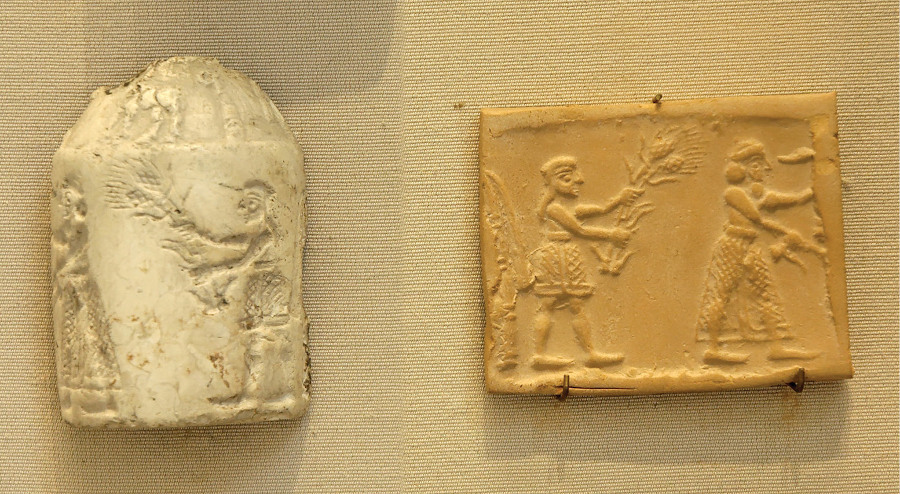
Cylinder seal and sealing impression: the king-priest and his acolyte feeding the sacred herd. White limestone, Uruk period, c. 3200 bc
Louvre Museum/Public Domain
Return to the main text.
38:21 shrine prostitute. The Hebrew here differs from that used for “prostitute” in v. 15. Judah’s friend perhaps deliberately used the more acceptable term, since ritual prostitutes enjoyed a higher social status in Canaan than did ordinary prostitutes (see note on 20:9).
38:24 have her burned to death. In later times, burning was the legal penalty for prostitution (Lev 21:9).
38:26 She is more righteous than I. Or “She is righteous, not I.” Although Tamar deceived Judah, he acknowledges that she did so only to restore her rights to offspring from her deceased husband’s line.
38:27–30 For a similarly unusual birth of twin boys, see 25:24–26.
38:29 Perez. Became the head of the leading clan in Judah and the ancestor of David (see Ru 4:18–22 and note) and ultimately of Christ (Mt 1:1–16).
39:1–23 A continuation of the Joseph story (see 37:36)—the first stage in the movement of Israel from Canaan to Egypt (see map).
39:1 Ishmaelites. See note on 37:25.
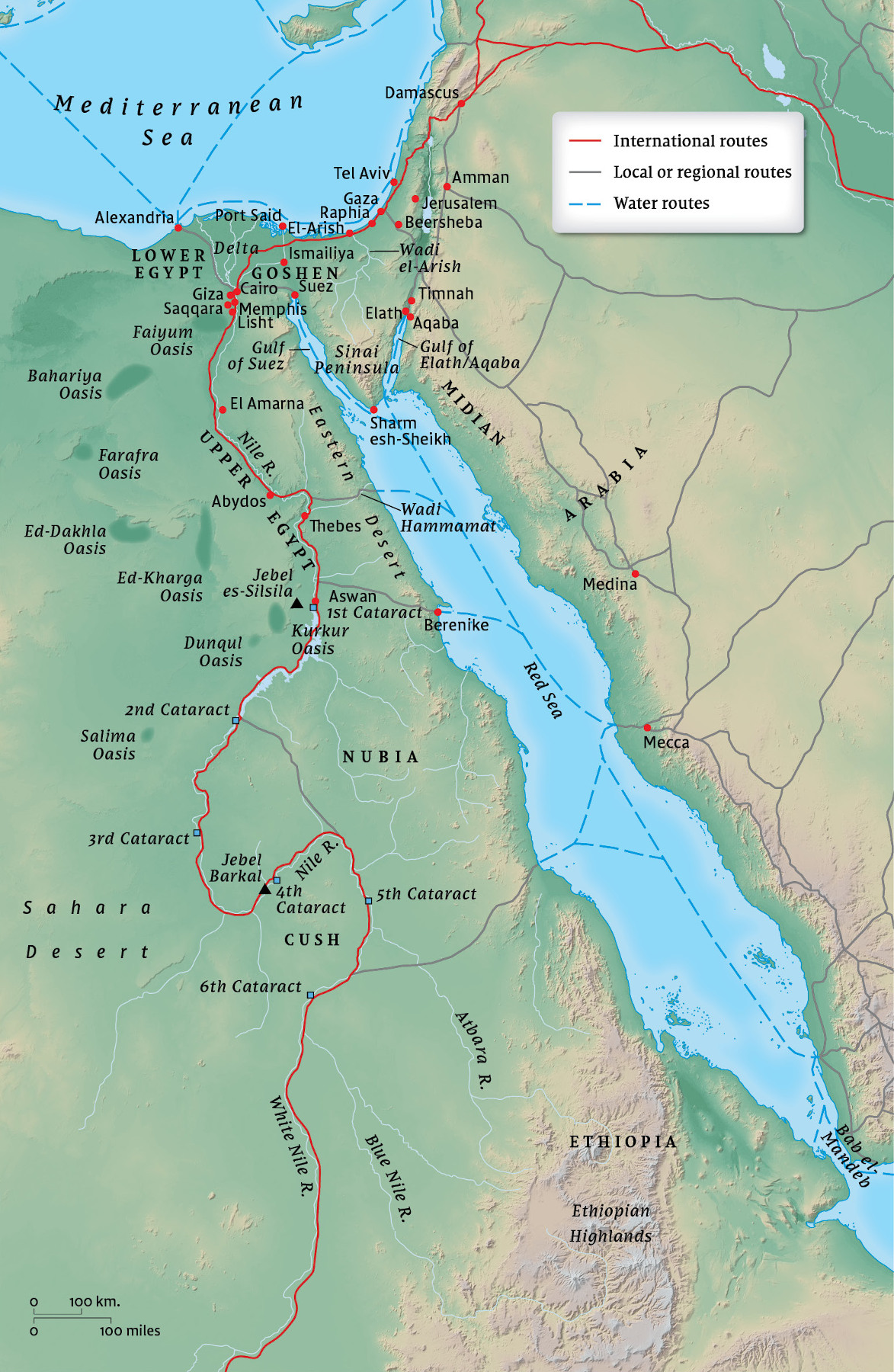
39:2–6 See vv. 20–23. Though Joseph’s situation changed drastically, God’s relationship to him remained the same.
39:2 The LORD was with Joseph. See note on 26:3. This fact, mentioned several times here (vv. 3,21,23), is stressed also by Stephen (Ac 7:9–10).
39:5 the LORD blessed the household of the Egyptian because of Joseph. As God had blessed Laban because of Jacob (30:27). The offspring of Abraham continue to be a blessing to the nations (see 12:2–3 and note).
39:6 left everything he had in Joseph’s care. As Laban had entrusted his flocks to Jacob’s care (30:31–34). Joseph had full responsibility for the welfare of Potiphar’s house, as later he would have full responsibility in prison (vv. 22–23) and later still in all Egypt (41:41). Always this Israelite came to hold the welfare of his “world” in his hands—but always by the blessing and overruling of God, never by his own wits, as his father Jacob had so long attempted.
39:7 took notice of. Looked at with desire. The phrase is used in the same sense in Akkadian in Section 25 of the Code of Hammurapi (see chart).
39:9 sin against God. All sin is against God, first and foremost (see Ps 51:4 and note).
39:10 though she spoke to Joseph day after day, he refused. Samson twice succumbed under similar pressure (Jdg 14:17; 16:16–17).
39:14 this Hebrew. See v. 17; see also note on 14:13.
39:14,17 this Hebrew . . . That Hebrew slave. See note on 14:13. Potiphar’s wife changes several details of her story to suit her audience. When she talks to her servants, she does not call Joseph a slave (v. 14), but she does to her husband (v. 17). When she talks to her servants, she says Joseph was brought “to make sport of us” (v. 14). But when she talks to her husband, she accuses him of bringing Joseph “to make sport of me” (v. 17).
39:20 place where the king’s prisoners were confined. Though understandably angry (v. 19), Potiphar put Joseph in the “house of the captain of the guard” (40:3)—certainly not the worst prison available.
40:1–23 God gives Joseph the interpretation of two dreams, which prepares the way for Joseph to be used by God to interpret the pharaoh’s two dreams (ch. 41), leading to the subsequent fulfillment (chs. 42–46) of Joseph’s two dreams (37:5–11).
40:2 Pharaoh. See note on Ex 1:11. chief cupbearer. See note on Ne 1:11. This person would be the divinely appointed agent for introducing Joseph to the pharaoh (41:9–14).
40:5 each dream had a meaning. Throughout the ancient Near East it was believed that dreams sometimes contained disclosures about the future that a proper interpretation would bring to light (see note on 20:3). God was beginning to prepare the way for Joseph’s rise in Egypt.
40:8 interpretations belong to God. Only God, who knows the future, can properly interpret dreams (41:16,25,28; Da 2:28). Tell me. Joseph presents himself as God’s agent through whom God will make known the revelation contained in their dreams—Israel is God’s prophetic people through whom God’s revelation comes to the nations (see 18:17 and note; 41:16,28,32).
40:13 lift up your head and restore you to your position. See Ps 3:3; 27:6. For this meaning of the idiom “lift up one’s head,” see 2Ki 25:27 and Jer 52:31, where this idiom is used in the context of freeing a prisoner.
40:14 when all goes well with you, remember me. Unfortunately, the cupbearer “forgot him” (v. 23) until two full years later (see 41:1,9–13).
40:15 dungeon. Probably hyperbole to reflect Joseph’s despair (see note on 39:20). Since the same Hebrew word refers to a cistern in 37:24, the author of Genesis has established a link with Joseph’s earlier experience at the hands of his brothers.
40:19 lift off your head. A grisly pun based on the same idiom used in v. 13 (see note there).
41:2 out of the river there came up seven cows. Cattle often submerged themselves up to their necks in the Nile to escape sun and insects.
41:6 scorched by the east wind. The Palestinian sirocco (in Egypt the khamsin), which blows in from the desert (Hos 13:15) in late spring and early fall, often withers vegetation (see Isa 40:7; Eze 17:10 and note).
41:8 his mind was troubled. See 40:6–7. magicians. Probably priests who claimed to possess occult knowledge. no one could interpret them. See 40:8; cf. Da 2:10–11.
41:13 things turned out exactly as he interpreted them. Because his words were from the Lord (Ps 105:19).
41:14 Pharaoh sent for Joseph. Effecting his permanent release from prison (Ps 105:20). shaved. Egyptians were normally smooth-shaven, while Palestinians wore beards (see 2Sa 10:4; Jer 41:5 and notes; see also photo).
41:16 I cannot do it . . . but God will give Pharaoh the answer. See 40:8 and note; Da 2:27–28,30; cf. 2Co 3:5.
41:27 seven years of famine. See Ac 7:11. Long famines were rare in Egypt because of the regularity of the annual overflow of the Nile, but not uncommon elsewhere (see 2Ki 8:1 and note; see also chart [“Seven Lean Years Tradition”]).
41:32 Repetition of a divine revelation was often used for emphasis (37:5–9; Am 7:1–6, 7–9; 8:1–3).
41:38 spirit of God. See NIV text note. The word “spirit” should probably not be capitalized in such passages, since reference to God’s Spirit would be out of character in statements by pagan rulers.
41:40 You shall be in charge. The pharaoh took Joseph’s advice (v. 33) and decided that Joseph himself should be “ruler over Egypt” (Ac 7:10; see also Ps 105:21). all my people are to submit to your orders. The Hebrew here suggests kissing a superior’s hands or feet in an act of homage and submission (see Ps 2:12 and note).
41:42 Three symbols of transfer and/or sharing of royal authority, referred to also in Est 3:10 (signet ring); Est 6:11 (robe); and Da 5:7, 16,29 (gold chain).
41:43 second-in-command. The position was probably that of vizier, the highest executive office below that of the king himself.
41:45 gave Joseph the name Zaphenath-Paneah. As a part of assigning Joseph an official position within his royal administration (see note on 1:5). The pharaoh presumed to use this marvelously talented servant of the Lord for his own royal purposes—as a later pharaoh would attempt to use divinely blessed Israel for the enrichment of Egypt (Ex 1). He did not recognize that Joseph served a Higher Power, whose kingdom and redemptive purposes are being advanced. (The meaning of Joseph’s Egyptian name is uncertain—perhaps “God speaks and lives.”) Asenath. The name is Egyptian and probably means “She belongs to (the goddess) Neith.” A fictional first-century Jewish narrative called Joseph and Asenath describes their romance. Potiphera. Not the same person as “Potiphar” (37:36; 39:1); the name (also Egyptian) means “he whom (the sun-god) Ra has given.” On. Located ten miles northeast of modern Cairo, it was called Heliopolis (“city of the sun”) by the Greeks and was an important center for the worship of Ra, who had a temple there. Potiphera therefore bore an appropriate name.
41:46 thirty years old. In just 13 years (37:2), Joseph had become second-in-command (v. 43) in Egypt.
41:49 like the sand of the sea. A simile also for the large number of offspring promised to Abraham and Jacob (22:17; 32:12).
41:52 Ephraim. The wordplay on the name (see NIV text note) reflects the fact that God gave Joseph “two” (v. 50) sons. See 49:22 and note.
41:57 all the world. The known world from the writer’s perspective (the Middle East). This description of the famine in the time of Joseph echoes the author’s description of the flood in the time of Noah (7:24).
42:1—45:28 The reunion and reconciliation of Jacob’s sons—but now in Egypt.
42:2–3 Stephen refers to this incident (Ac 7:12).
42:4 did not send Benjamin, Joseph’s brother. Their mother Rachel had died (35:19), and Jacob thought Joseph also was dead (37:33). Jacob did not want to lose Benjamin, the remaining son of his beloved Rachel.
42:5 famine in the land of Canaan also. As in the time of Abram (see 12:10 and note).
42:6 they bowed down to him. In partial fulfillment of Joseph’s dreams (see 37:7,9; see also note on 40:1–23); Benjamin was not present (v. 4).
42:8 Joseph recognized his brothers. Although 21 years had passed since he had last seen them (37:2; 41:46, 53–54), they had been adults at the time and their appearance had not changed much. they did not recognize him. Joseph, 17 years old at the time of his enslavement (37:2), was now an adult in an unexpected position of authority, wearing Egyptian clothes and speaking to his brothers through an interpreter (v. 23). He was, moreover, shaven in the Egyptian manner (see note on 41:14).
42:9,14,16 You are spies! See note on Jos 2:1–24.
42:10 my lord . . . Your servants. Unwittingly, Joseph’s brothers again fulfilled his dreams and their own scornful fears (37:8).
42:15 As surely as Pharaoh lives. The most solemn oaths were pronounced in the name of the reigning monarch (as here) or of the speaker’s deities (Ps 16:4; Am 8:14) or of the Lord himself (Jdg 8:19; 1Sa 14:39, 45; 19:6).
42:21 how distressed he was . . . distress has come on us. The brothers realized they were beginning to reap what they had sown (Gal 6:7).
42:22 See 37:21–22 and note on 37:21.
42:24 He had Simeon taken. Jacob’s second son (29:32–33) is imprisoned instead of the firstborn Reuben, perhaps because the latter had saved Joseph’s life years earlier (37:21–22) or because the second son of Leah would be a fitting hostage for the second son of Rachel.
42:37 both of my sons. Contrast this with Judah’s later offer to hold himself personally responsible for Benjamin’s safety (43:9).
42:38 grave. See note on 37:35.
43:3 Judah said. From this point on, Judah became the spokesman for his brothers (vv. 8–10; 44:14–34; 46:28). His tribe would become preeminent among the 12 (49:8–10), and he would be an ancestor of Jesus (Mt 1:2–3, 16–17; Lk 3:23,33).
43:9 Judah offered himself as security for Benjamin’s safety—a more responsible gesture than that of Reuben (42:37 and note).
43:11 take them . . . as a gift. A customary practice when approaching one’s superior, whether political (1Sa 16:20), military (1Sa 17:18) or religious (2Ki 5:15). balm . . . myrrh. See 37:25 and note. honey. Either that produced by bees, or an inferior substitute made by boiling grape or date juice down to a thick syrup. pistachio nuts. Mentioned only here in the Bible, they are the fruit of a small, broad-crowned tree that is native to Asia Minor, Syria (Aram) and Canaan but not to Egypt.
43:14 God Almighty. See notes on 17:1; 35:1. if I am bereaved, I am bereaved. Cf. Esther’s similar phrase of resignation in Est 4:16.
43:21 The brothers’ statement to Joseph’s steward compressed the details (42:27,35).
43:23 Your God . . . has given you treasure. The steward spoke better than he knew. Although he was lying, the steward was right in saying that God was behind these actions.
43:26 bowed down. Additional fulfillment of Joseph’s dreams (37:7,9; see also 42:6; 43:28).
43:29 Benjamin, his own mother’s son. Joseph’s special relationship to Benjamin is clear. God be gracious to you. Later blessings and benedictions would echo these words (Nu 6:25; Ps 67:1).
43:32 Egyptians could not eat with Hebrews. The taboo was probably based on ritual or religious reasons (Ex 8:26), unlike the Egyptian refusal to associate with shepherds (46:34), which was possibly based on social custom or distrust of nomadic people.
43:34 Benjamin’s portion was five times as much. Again reflecting his special status with Joseph (see note on v. 29; see also 45:22).
44:4 city. Identity unknown, though Memphis (about 13 miles south of modern Cairo) and Zoan (in the eastern delta region) have been suggested.
44:5 divination. See v. 15; see also note on 30:27.
44:9 If any of your servants is found to have it, he will die. Years earlier, Jacob had given Laban a similar rash response (see 31:32 and note).
44:10 The steward softened the penalty contained in the brothers’ proposal.
44:12 beginning with the oldest and ending with the youngest. For a similar building up of suspense, see 31:33.
44:13 tore their clothes. A sign of distress and grief (see 37:29 and note on 37:34).
44:14 threw themselves to the ground before him. Further fulfillment of Joseph’s dreams in 37:7,9 (42:6; 43:26,28).
44:16 God has uncovered your servants’ guilt. Like Joseph’s steward (see note on 43:23), Judah spoke better than he knew. Or perhaps he refers both to the present event and to the guilt of their sin against Joseph (see 42:21 and note).
44:18 Judah . . . said. See note on 43:3. lord . . . servant. See note on 42:10. you are equal to Pharaoh. Words more flattering than true (41:40,43).
44:29,31 grave. See note on 37:35.
44:30 whose life is closely bound up with the boy’s life. The Hebrew underlying this clause is later used of Jonathan’s becoming “one in spirit with David” (1Sa 18:1).
44:33 in place of the boy. Judah’s willingness to be a substitute for Benjamin helped make amends for his role in selling Joseph (37:26–27).
44:34 Do not let me see the misery. Judah remembers an earlier scene (37:34–35).
45:3 brothers . . . were terrified. Either because they thought they were seeing a ghost or because they were afraid of what Joseph would do to them.
45:4 I am your brother Joseph. See v. 3; Ac 7:13. This time Joseph emphasized his relationship to them. you sold. See note on 37:28.
45:5 God sent me. See vv. 7–9; Ac 7:9; cf. 50:20. God had a purpose to work through the brothers’ jealous and cruel act (see Ac 2:23; 4:28; cf. Ro 8:28).
45:6 Joseph was now 39 years old (41:46,53).
45:7 remnant. Although none had been lost, they had escaped a great threat to them all; so Joseph called them a remnant in the confidence that they would live to produce a great people.
45:8 father. A title of honor given to viziers (see note on 41:43) and other high officials (in the Apocrypha see 1 Maccabees 11:32).
45:10 Goshen. A region in the eastern part of the Nile delta, it was very fertile (v. 18) and remains so today.
45:12 I . . . am speaking. Not through an interpreter as before (42:23).
45:15 his brothers talked with him. In intimate fellowship and friendship, rather than in hostility or fear, for the first time in over 20 years (see 37:2 and note on 45:6).
45:18 you can enjoy the fat of the land. An echo of Isaac’s blessing on Jacob (27:28).
45:22 to Benjamin he gave . . . five sets of clothes. See note on 43:34. shekels. See note on 20:16.
45:24 Don’t quarrel. Joseph wanted nothing to delay their return (see note on v. 9), and he wanted them to avoid mutual accusation and recrimination concerning the past.
46:1—47:12 Israel’s (Jacob’s) move to and settlement in Egypt (see 15:13 and note).
46:1 set out. Probably from the family estate at Hebron (see 35:27 and note). when he reached Beersheba, he offered sacrifices. Abraham and Isaac had also worshiped the Lord there (21:33; 26:23–25).
46:2 God spoke to Israel in a vision at night. See 26:24. Jacob! Jacob! See note on 22:11. Here I am. See note on 22:1.
46:3–4 As Israel and his family were about to leave Canaan, God reaffirmed his covenant promises.
46:3 I am . . . the God of your father . . . Do not be afraid. A verbatim repetition of God’s statement to Isaac in 26:24. I will make you into a great nation. The Lord reaffirmed one aspect of his promise to Abraham (12:2). there. See Ex 1:7.
46:4 I will go down to Egypt with you. God would be with Jacob as he went south to Egypt, just as he was with him when he went north to Harran, and would again bring him back as he had done before (see 28:15 and note; see also 15:16 and note; 48:21). will close your eyes. A reference to Jacob’s death (49:33—50:1).
46:8 These are the names of the sons of Israel . . . who went to Egypt. Repeated verbatim in Ex 1:1 (see note there), where it introduces the background for the story of the exodus (predicted here in v. 4).
46:15 Paddan Aram. See note on 25:20. thirty-three in all. There are 34 names in vv. 8–15. To bring the number to 33 the name Ohad in v. 10 should probably be removed, since it does not appear in the parallel lists in Nu 26:12–13; 1Ch 4:24. The Hebrew form of “Ohad” looks very much like that of the nearby “Zohar” (Ex 6:15), and perhaps a later scribe added Ohad to the text accidentally.
46:26 All those who went to Egypt with Jacob . . . numbered sixty-six persons. The total of 33 (see v. 15 and note), 16 (v. 18), 14 (v. 22) and 7 (v. 25) is 70 (v. 27). To arrive at 66 one must subtract Er and Onan, who “had died in the land of Canaan” (v. 12), and Manasseh and Ephraim (v. 20), who “had been born . . . in Egypt” (v. 27).
46:27 seventy. See NIV text note; see also Dt 10:22. Seventy is the ideal and complete number (see Introduction: Literary Features; see also notes on 5:5; 10:2) of Jacob’s descendants who would have been in Egypt if Er and Onan had not died earlier (38:7–10). For the number 75 in Ac 7:14, see note there.
46:28 Jacob sent Judah ahead. See note on 43:3.
46:29 wept. See 43:30 and note.
46:34 shepherds are detestable to the Egyptians. See note on 43:32.
47:9 pilgrimage. Jacob referred to the itinerant nature of patriarchal life in general and of his own in particular as he awaited the fulfillment of the promise of a land (see also Dt 26:5 and note). they do not equal the years of . . . my fathers. Abraham lived to the age of 175 (25:7), Isaac to 180 (35:28).
47:11 best part of the land. See note on 45:10. district of Rameses. The city of Rameses is mentioned in Ex 1:11; 12:37; Nu 33:3,5. The name doubtless refers to the great Egyptian pharaoh Rameses II, who reigned centuries later (the designation here may involve an editorial updating; see Introduction to Exodus). In addition to being known as Goshen (v. 27), the “district of Rameses” was also called the “region of Zoan” in Ps 78:12,43 (see note on Ge 44:4).
47:13 famine was severe. After the people used up all their money to buy grain (vv. 14–15), they traded their livestock (vv. 16–17), then their land (v. 20), then themselves (v. 21).
47:21 reduced the people to servitude. Joseph’s actions may seem harsh, but they were viewed as benevolent in the ancient world—he saved many lives. The NIV text note reading would mean that the Egyptians were to move temporarily into the cities until seed could be distributed to them for planting (v. 23).
47:26 a fifth of the produce belongs to Pharaoh. The same was true “during the seven years of abundance” (41:34)—but now all the land on which the produce grew belonged to the pharaoh as well.
47:27 Israelites . . . were fruitful and increased greatly in number. See 35:11–12; 46:3 and notes.
47:29 put your hand under my thigh. See 24:2 and note. In both cases, ties of family kinship are being stressed.
47:30 rest with my fathers. See note on 25:8. bury me where they are buried. In the cave of Machpelah (50:12–13).
47:31 worshiped as he leaned on the top of his staff. Quoted in Heb 11:21. Compare 48:2 with the NIV text note reading here.
48:1–22 How Joseph, Rachel’s beloved older son, received the inheritance of the firstborn among his brothers.
48:3 God Almighty. See notes on 17:1; 35:11. Luz. The older name for Bethel (28:19).
48:5 your two sons . . . will be reckoned as mine. Jacob adopts them as his own. Ephraim and Manasseh. See v. 1 for the expected order, since Manasseh was Joseph’s firstborn (41:51). Jacob mentions Ephraim first because he intends to give him the primary blessing and thus “put Ephraim ahead of Manasseh” (v. 20; see Introduction). mine, just as Reuben and Simeon are mine. Joseph’s first two sons would enjoy equal status with Jacob’s first two sons (35:23) and in fact would eventually supersede them. Because of an earlier sinful act (see 35:22 and note), Reuben would lose his birthright to Jacob’s favorite son, Joseph (49:3–4; 1Ch 5:2), and thus to Joseph’s sons (1Ch 5:1).
48:6 children born to you after them will be yours. They would take the place of Ephraim and Manasseh, whom Jacob had adopted. in the territory they inherit they will be reckoned under the names of their brothers. They would perpetuate the names of Ephraim and Manasseh for purposes of inheritance (for a similar provision, see 38:8 and note; Dt 25:5–7). Joseph’s territory would thus be divided between Ephraim and Manasseh, but Levi (Jacob’s third son; see 35:23) would receive “no share of the land” (Jos 14:4). The total number of tribal allotments would therefore remain the same.
48:7 Paddan. That is, Paddan Aram (see note on 25:20). Rachel died. See 35:16–19. Ephrath. See note on 35:16.
48:8 Israel . . . asked, “Who are these?” Either because he had never met them or because, being old, he could not see them clearly.
48:10 because of old age . . . he could hardly see. See note on 27:1. kissed them and embraced them. While they were on Jacob’s knees (v. 12), probably symbolizing adoption (see note on 30:3).
48:13 Manasseh . . . toward Israel’s right hand. Joseph wanted Jacob to bless Manasseh, Joseph’s firstborn, by placing his right hand on Manasseh’s head.
48:15 blessed. As his father Isaac had blessed him (27:27–29). Joseph. Used here collectively for Ephraim and Manasseh (see NIV text note on v. 21). before whom . . . Abraham and Isaac walked faithfully. See notes on 5:22; 17:1. shepherd. Widely used in the ancient Near East as a metaphor for the king. It highlighted his care for his people. Here and in 49:24 it is used of God (see Ps 23:1 and note; see also article and photo).
48:16 Angel. See note on 16:7. The angel—God himself—had earlier blessed Jacob (see 32:29; see also note on 32:24).
48:19 his younger brother will be greater than he. See note on 25:23. During the divided monarchy (930–722 bc), Ephraim’s descendants were the most powerful tribe in the north. “Ephraim” was commonly used in the prophetic books to refer to the northern kingdom as a whole (see, e.g., Isa 7:2, 5,8–9; Hos 9:13; 12:1,8).
48:20 he put Ephraim ahead of Manasseh. Jacob, the younger son who struggled with Esau for the birthright and blessing and who preferred the younger sister (Rachel) above the older (Leah), now advanced Joseph’s younger son ahead of the older.
48:21 Joseph. See note on v. 15. I am about to die. Years later, Joseph spoke these words to his brothers (50:24).
48:22 ridge of land. The Hebrew for this phrase is identical with the place-name Shechem, where Joseph was later buried in a plot of ground inherited by his descendants (see Jos 24:32 and note; see also 33:19; Jn 4:5 and note). I took from the Amorites. Possibly referring to the event of 34:25–29.
49:2–27 Often called the “Blessing of Jacob,” this is the longest poem in Genesis. Its various blessings were intended not only for Jacob’s 12 sons but also for the tribes that descended from them (v. 28). For other poetic blessings in Genesis, see 9:26–27; 14:19–20; 27:27–29; 27:39–40; 48:15–16; 48:20.
49:4 Turbulent. Reuben’s descendants were characterized by indecision (Jdg 5:15–16). you will no longer excel, for you went up onto your father’s bed. See 35:22 and note; see also notes on 37:21; 48:5.
49:5 Simeon and Levi are brothers. They shared the traits of violence, anger and cruelty (see vv. 6–7; see also note on 34:25).
49:7 I will scatter them. Fulfilled when Simeon’s descendants were absorbed into the territory of Judah (see Jos 19:1,9 and note on 19:1) and when Levi’s descendants were dispersed throughout the land, living in 48 towns and the surrounding pasturelands (see note on 48:6; see also Nu 35:2, 7; Jos 14:4; 21:41).
49:8 Cf. 27:29,40; 37:7,9. Judah, your brothers . . . will bow down to you. See note on 43:3. As those who would become the leading tribes of southern and northern Israel, respectively, Judah and Joseph were given the longest (vv. 8–12 and vv. 22–26) of Jacob’s blessings. Judah was the fourth of Leah’s sons and also the fourth son born to Jacob (29:35), but Reuben, Simeon and Levi had forfeited their right of leadership. So Jacob assigns leadership to Judah (a son of Leah) but a double portion to Joseph (a son of Rachel). See also 1Ch 5:2.
49:9 You are a lion’s cub. A symbol of sovereignty, strength and courage. Judah (or Israel) is often pictured as a lion in later times (see Eze 19:2; Mic 5:8 and notes; and especially Nu 24:9). Judah’s greatest descendant, Jesus Christ (see note on 43:3), is himself called “the Lion of the tribe of Judah” (Rev 5:5; see note there).
49:10 Though difficult to translate (see NIV text note), the verse has been traditionally understood as Messianic. It was initially fulfilled in David, and ultimately in Christ. scepter. See Nu 24:17 and note. until he to whom it belongs shall come. Repeated almost verbatim in Eze 21:27 (see note there) in a section where Zedekiah, the last king of Judah, is told to “remove the crown” (Eze 21:26) from his head because dominion over Jerusalem will ultimately be given to the one “to whom it rightfully belongs” (v. 27).
49:11 Judah’s descendants would someday enjoy a settled and prosperous life.
49:13 Though landlocked by the tribes of Asher and Manasseh, the descendants of Zebulun were close enough to the Mediterranean (within ten miles) to “feast on the abundance of the seas” (Dt 33:19).
49:17 Dan will be a snake. The treachery of a group of Danites in later times is described in Jdg 18:27. a viper . . . that bites the horse’s heels. Samson, from the tribe of Dan, would single-handedly hold the Philistines at bay (Jdg 14–16) like a viper that stops a horse in its tracks.
49:18 Jacob pauses midway through his series of blessings to utter a brief prayer for God’s help.
49:19 Gad will be attacked. Located east of the Jordan (Jos 13:24–27), the descendants of Gad were vulnerable to raids by the Moabites to the south, as the Mesha (2Ki 3:4) Stele (a Moabite inscription dating from the late ninth century bc) illustrates (see chart).
49:20 Asher’s food will be rich. Fertile farmlands near the Mediterranean (Jos 19:24–30) would ensure the prosperity of Asher’s descendants.
49:21 Naphtali is a doe set free. Perhaps a reference to an independent spirit fostered in the descendants of Naphtali by their somewhat isolated location in the hill country north of the Sea of Galilee (Jos 19:32–38).
49:22 fruitful . . . fruitful. A pun on the name Ephraim (see NIV text note on 41:52), who Jacob predicted would be greater than Joseph’s firstborn son, Manasseh (48:19–20). branches climb over a wall. Ephraim’s descendants tended to expand their territory (Jos 17:14–18).
49:24 his bow remained steady. The warlike Ephraimites (Jdg 8:1; 12:1) would often prove victorious in battle (Jos 17:18). Mighty One of Jacob. Stresses the activity of God in saving and redeeming his people (Isa 49:26). Shepherd. See note on 48:15. Rock of Israel. Israel’s sure defense (Dt 32:4, 15,18,30–31)—a figure often used also in Psalms (see note on Ps 18:2) and Isaiah.
49:25 Almighty. See note on 17:1. blessings of the skies . . . of the deep springs. The fertility of the soil watered by rains from above and springs and streams from below. breast and womb. The fertility of people and animals. For the later prosperity of Ephraim’s descendants, see Hos 12:8.
49:26 Joseph . . . prince among his brothers. See notes on v. 8; 48:19. Ephraim would gain supremacy, especially over the northern tribes (Jos 16:9; Isa 7:1–2; Hos 13:1).
49:27 Benjamin is a ravenous wolf. See the exploits of Ehud (Jdg 3:12–30) and Saul and Jonathan (1Sa 11–15)—all from the tribe of Benjamin. See Jdg 19–21 for examples of the savagery that characterized one group of Benjamin’s descendants.
49:28 twelve tribes of Israel. See note on vv. 2–27.
49:29 Bury me with my fathers. See note on 25:8. Jacob does not forget that the land of his ancestors is his God-appointed homeland (see note on 23:19).
49:33 was gathered to his people. See note on 25:8.
50:2 physicians embalmed him. Professional embalmers could have been hired for the purpose, but Joseph perhaps wanted to avoid involvement with the pagan religious ceremonies accompanying their services.
50:3 forty days . . . seventy days. The two periods probably overlapped.
50:5 My father made me swear an oath. See 47:29–31. dug. Or “bought,” as the Hebrew for this verb is translated in Hos 3:2 (see also Dt 2:6). go up. To Hebron, which has a higher elevation than Goshen.
50:10 threshing floor. Grain was threshed on a flat, circular area, either of rock or of pounded earth. Threshing floors were located on an elevated, open place exposed to the wind, usually at the edge of town or near the main gate (1Ki 22:10). See note on Ru 1:22.
50:15 holds a grudge . . . and pays us back. Similarly, Esau had once planned to kill Jacob as soon as Isaac died (see 27:41–45 and note).
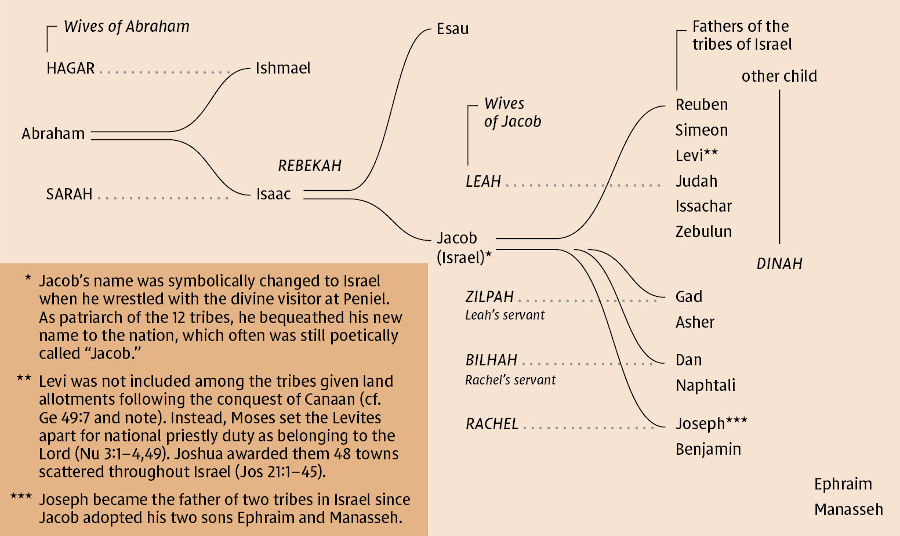
50:18 threw themselves down. A final fulfillment of Joseph’s earlier dreams (see note on 37:7; see also 37:9). We are your slaves. They had earlier expressed a similar willingness, but under quite different circumstances (44:9,33).
50:19 Am I in the place of God? See note on 30:2.
50:20 God intended it for good. See 45:5 and note. Their act, out of personal animosity toward a brother, had been used by God to save life—the life of the Israelites, the Egyptians and all the nations that came to Egypt to buy food in the face of a famine that threatened the known world. At the same time, God showed by these events that his purpose for the nations is life and that this purpose would be effected through the descendants of Abraham.
50:23 saw the third generation. Cf. Job’s experience (Job 42:16). Makir. Manasseh’s firstborn son and the ancestor of the powerful Gileadites (Jos 17:1). The name of Makir later became almost interchangeable with that of Manasseh himself (see Jdg 5:14 and note). placed at birth on Joseph’s knees. Joseph probably adopted Makir’s children (see note on 30:3).
50:24 I am about to die. See note on 48:21. God will . . . take you up out of this land. Joseph did not forget God’s promises (cf. 15:16; 46:4; 48:21) concerning “the exodus” (Heb 11:22).
50:25 See 47:29–31 for a similar request by Jacob. carry my bones up from this place. Centuries later Moses did so to fulfill his ancestor’s oath (Ex 13:19). Joseph’s bones were eventually “buried at Shechem in the tract of land that Jacob bought . . . from the sons of Hamor” (Jos 24:32; see note there; see also Ge 33:19).
50:26 Joseph died at the age of a hundred and ten. See v. 22. Ancient Egyptian records indicate that 110 years was considered to be the ideal life span; to the Egyptians this would have signified divine blessing upon Joseph (Jos 24:29).