Study Notes
1:1—3:6 An introduction in two parts: (1) an account of the Israelites’ failure to lay claim completely to the promised land as the Lord had directed (1:1–36; see note there) and of his rebuke for their disloyalty (2:1–5; see note there); (2) an overview of the main body of the book (3:7—16:31), portraying Israel’s rebellious ways in the centuries after Joshua’s death and showing how the Lord dealt with them in that period (2:6—3:6; see note there). See Introduction: Literary Features.
1:1–36 Judah is assigned leadership in occupying the land (v. 2; see 20:18). Its vigorous efforts (together with those of Simeon) highlight by contrast the sad story of failure that follows. Only Ephraim’s success at Bethel (vv. 22–26) breaks the monotony of that story.
 1:1 After the death of Joshua. The book of Judges, like that of Joshua, tells of an era following the death of a leading figure in the history of redemption (Jos 1:1). Joshua probably died c. 1390 bc (but see Introduction: Background). The battles under his leadership broke the power of the Canaanites to drive the Israelites out of the land. The task that now confronted Israel was the actual occupation of Canaanite territory (see notes on Jos 18:3; 21:43–45). asked the LORD. Probably by the priestly use of the Urim and Thummim (see notes on Ex 28:30; 1Sa 2:28). go up. The main Israelite encampment was at Gilgal, near Jericho in the Jordan Valley (about 800 feet below sea level), while the Canaanite cities were mainly located in the central hill country (about 2,500–3,500 feet above sea level).
1:2 Judah shall go up. See 20:18. Judah was also the first to be assigned territory west of the Jordan (Jos 15). The leadership role of the tribe of Judah had been anticipated in the blessing of Jacob (Ge 49:8–12; see also note on Jos 15:1).
1:3 Simeonites. Joshua assigned to Simeon cities within the territory of Judah (Jos 19:1,9; see Ge 49:5–7).
1:4 Canaanites. See note on Ge 10:6. Perizzites. See note on Ge 13:7. Bezek. Saul would later marshal his army there before going to Jabesh Gilead (for location, see 1Sa 11:8 and note).
1:5 Adoni-Bezek. Means “lord of Bezek.”
1:6 cut off his thumbs and big toes. Physically mutilating prisoners of war was a common practice in the ancient Near East (see note on 16:21). It rendered them unfit for military service.
1:7 Seventy kings. Canaan was made up of many small city-states, each of which was ruled by a king. “Seventy” may be a round number, or it may be symbolic of a large number. under my table. Humiliating treatment, like that given to a dog (Mt 15:27; Lk 16:21). God has paid me back. See note on Ex 21:23–25.
1:8 attacked Jerusalem. Although the city was defeated, it was not occupied by the Israelites at this time (v. 21). Israel did not permanently control the city until David captured it c. 1000 bc (2Sa 5:6–10).
1:10 Kiriath Arba. See note on Jos 14:15.
1:11–15 Virtually a word-for-word repetition of Jos 15:15–19. In Joshua the passage functions as part of the description of the territory allotted to the tribe of Judah. Here it serves as part of the account of Judah’s success in taking possession of its tribal territory.
1:11 Debir. See note on Jos 10:38.
1:12 Caleb. He and Joshua had brought back an optimistic report about the prospects of conquering Canaan (Nu 14:6–9). daughter . . . in marriage. Victory in battle was one way to pay the bride-price for a bride (1Sa 18:25).
1:13 Othniel. First major judge (3:7–11).
1:16 Moses’ father-in-law. See note on Ex 2:16.
1:17 men of Judah . . . Simeonites. The Judahites were fulfilling their commitment (v. 3). Hormah. See NIV text note.
1:18 Gaza, Ashkelon and Ekron. Three of the five main cities inhabited by the Philistines (see map and accompanying text; see also photo). For the origin of the Philistines, see notes on Ge 10:14; Jer 47:4.
1:19 unable to drive the people from. The Israelites failed to comply with God’s commands (Dt 7:1–5; 20:16–18) to drive the Canaanites out of the land. Five factors were involved in that failure: (1) the Canaanites possessed superior weapons (here); (2) the Israelites disobeyed God by making treaties with the Canaanites (2:1–3); (3) The Israelites took up the worship of other gods and so violated the covenant the Lord had made with their ancestors (2:20–21); (4) God was testing the Israelites’ faithfulness to obey his commands (2:22–23; 3:4); (5) God was giving the Israelites, as his army, the opportunity to develop their skills in warfare (3:1–2). chariots fitted with iron. Wooden vehicles with certain iron fittings, perhaps axles (see note on Jos 17:16).
1:20 As Moses had promised. See Nu 14:24; Dt 1:36; Jos 14:9–14. Anak. See notes on Nu 13:22; Jos 14:15.
1:21 Benjamites . . . did not drive out. See note on v. 8. Jerusalem lay on the border between Benjamin and Judah but was allotted to Benjamin (Jos 18:28). Jebusites. See note on Ge 10:16.
 1:22 tribes of Joseph. Ephraim and West Manasseh. Bethel. See note on Ge 12:8. There is archaeological evidence of a destruction in the thirteenth century bc that may reflect the battle mentioned in this verse.
1:23 spy out. See note on Nu 13:2.
1:25 spared the man. Cf. the treatment of Rahab (Jos 6:25).
1:26 land of the Hittites. A name for Aram (Syria) at the time of the conquest (see note on Ge 10:15). Luz. A new city, not to be confused with Bethel, formerly called Luz (v. 23).
1:27–29 See Jos 17:16–18.
1:33 Beth Shemesh. Location unknown. The name means “house of the sun (god).” There was also a Beth Shemesh in Judah (see note on v. 35). Beth Anath. Means “house of (the goddess) Anath” (see notes on 3:31; Jer 1:1).
1:34 Amorites. See note on Ge 10:16. confined the Danites. Joshua had defeated the Amorites earlier (Jos 10:5–11), but they were still strong enough to withstand the Danites. For this reason a large number of Danites migrated northward a short time later (ch. 18).
1:35 Mount Heres. Means “mountain of the sun (god)”; probably the Beth Shemesh in Judah, which is also called Ir Shemesh, “city of the sun (god)” (Jos 19:41).
1:36 boundary of the Amorites. Their southern boundary (Jos 15:2–3).
2:1–5 Because Israel had not zealously laid claim to the land as the Lord had directed (1:27–36), he withdrew his helping hand. On this note the first half of the introduction ends. Although the actual time of the Lord’s rebuke is not indicated, it was probably early in the period of the judges and may even have been connected with the event in Jos 9 (or possibly Jos 18:1–3).
 2:1 angel of the LORD. See note on Ge 16:7. The role of the angel of the Lord in this passage parallels that of the unnamed prophet in 6:8–10 and the word of the Lord in 10:11–14, calling his people to account. Gilgal. The place where Israel first became established in the land under Joshua (Jos 4:19—5:12). out of Egypt. The theme of Exodus, frequently referred to as the supreme evidence of God’s redemptive love for his people in the OT (Ex 20:2). swore to give. See Ge 15:18; see also note on Heb 6:13.

Five Cities of the Philistines
Gaza, Ashkelon, Ashdod, Ekron and Gath comprise a list of familiar biblical names. Each of these cities was a commercial center with important connections both north (as far as Mesopotamia) and south (as far as Egypt) by way of the coastal highway that served as one of the major highways of the ancient world. Also the ships of Phoenicia, Cyprus, Crete and the Aegean called at Philistia’s seaports. Among these seaports was a place today called Tel Qasile on the Yarkon River (the “Kanah Ravine” of Jos 16:8; 17:9) just north of modern Tel Aviv. A Philistine temple has been found at Tel Qasile.
The Philistine plain itself was an arid, loam-covered lowland between the Mediterranean Sea and the foothills of the Judahite plateau on the east (see map). To the south lay a stretch of undulating sand dunes adjacent to the sea. No area in biblical history was more frequently contested than the western foothills, lying on the border between Judah and Philistia. Originally a part of Judah’s tribal allotment, the coastal area was never totally wrested away from the Philistines. Beth Shemesh, Timnah, Azekah and Ziklag were among the towns coveted by both Israelites and Philistines, and they figure in the stories of Samson, Goliath and David. The area to the north of Philistia, the plain of Sharon, was also contested at various periods. During Saul’s reign the Philistines even held Beth Shan and the Valley of Jezreel. Later, from about the time of Baasha on, a long border war was conducted by the Israelites at Gibbethon.
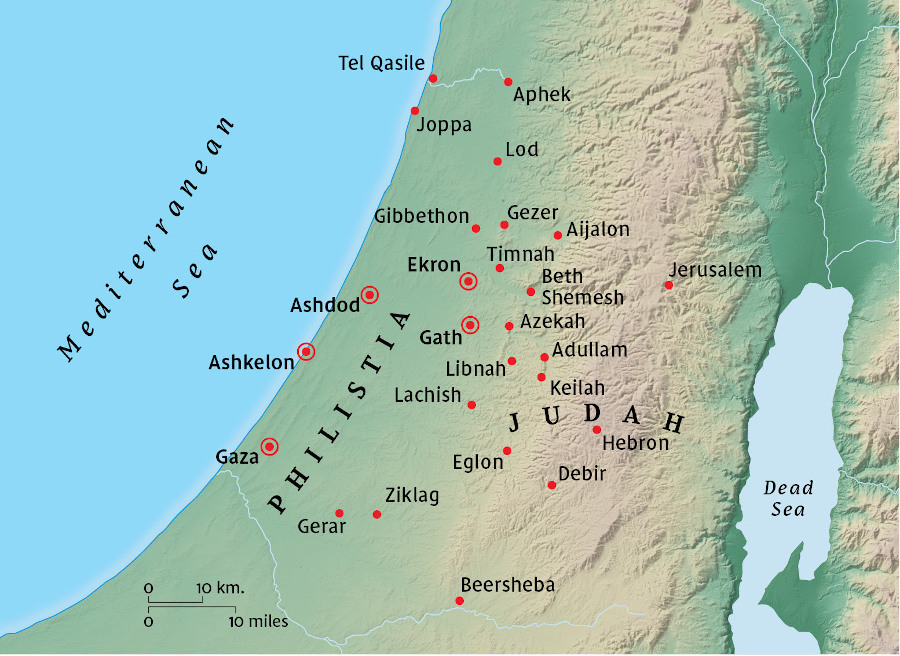
Go to the Maps Index.
2:2 not make a covenant. To have done so would have broken their covenant with the Lord (Ex 23:32).
2:6—3:6 The second half of the introduction continues the narrative of Jos 24:28–31. It is a preliminary survey of the accounts narrated in Jdg 3:7—16:31, showing that Israel’s first centuries in the promised land are a recurring cycle of apostasy, oppression, cries of distress and gracious deliverance (see Introduction: Literary Features). The author reminds the Israelites that they will enjoy God’s promised rest in the promised land only when they are loyal to him and to his covenant.
2:6 take possession of the land. See note on 1:1.
2:8 servant of the LORD. Joshua is identified as the Lord’s official representative (see notes on Ex 14:31; Ps 18 title; Isa 41:8–9; 42:1). a hundred and ten. For the significance of this number, see note on Ge 50:26.
2:10–15 The Lord withdraws his help because of Israel’s apostasy. He “sells” the people he had “bought” (Ex 15:16) and redeemed (Ex 15:13; cf. Ps 74:2).
2:10 gathered to their ancestors. See Ge 15:15; see also note on Ge 25:8. who knew neither the LORD . . . Israel. They had no direct experience of the Lord’s acts (Ex 1:8).
2:11 did evil in the eyes of the LORD. The same expression is used in 3:7,12; 4:1; 6:1; 10:6. Baals. The many local forms of this Canaanite deity (see note on v. 13).
2:12 aroused the LORD’s anger. See Dt 4:25; see also note on Zec 1:2.
2:13 Baal. Means “lord.” Baal, the god worshiped by the Canaanites and Phoenicians, was variously known to them as the son of Dagon and the son of El. In Aram (Syria) he was called Hadad and in Babylonia, Adad. Believed to give fertility to the womb and life-giving rain to the soil, he is pictured as standing on a bull, a popular symbol of fertility and strength (see Jos 24:14; 1Ki 12:28 and notes). The storm cloud was his chariot, thunder his voice, and lightning his spear and arrows. The worship of Baal involved sacred prostitution and sometimes even child sacrifice (Jer 19:5). The stories of Elijah and Elisha (1Ki 17-2Ki 13), as well as many other OT passages, directly or indirectly protest Baalism (e.g., Ps 29:3–9; 68:1–4,32–34; 93:1–5; 97:1–5; Jer 10:12–16; 14:22; Hos 2:8, 16–17; Am 5:8). Ashtoreths. Female deities such as Ashtoreth (wife of Baal) and Asherah (wife of El, the chief god of the Canaanite pantheon). Ashtoreth was associated with the evening star and was the beautiful goddess of war and fertility. She was worshiped as Ishtar in Babylonia and as Athtart in Aram. To the Greeks she was Astarte or Aphrodite, and to the Romans, Venus. Worship of the Ashtoreths involved extremely lascivious practices (1Ki 14:24; 2Ki 23:7).
2:14 gave them into the hands of. The same Hebrew expression is used in 6:1; 13:1. sold them. The same expression is used in 3:8; 4:2; 10:7.
2:16–19 The Lord was merciful to his people in times of distress, sending deliverers to save them from oppression. But Israel repeatedly forgot these saving acts, just as they had forgotten those God had performed through Moses and Joshua.
2:16 judges. See Introduction: Title. There were six major judges (Othniel, Ehud, Deborah, Gideon, Jephthah and Samson) and six minor ones (Shamgar, Tola, Jair, Ibzan, Elon and Abdon). Major and minor are designations pertaining to length of text devoted to them, not their significance as judges over Israel.
2:17 prostituted themselves. See Ex 34:15 and note.
2:18 groaning . . . oppressed. The language of the Egyptian bondage (Ex 2:24; 3:9; 6:5).
2:20–23 The Lord decided to leave the remaining nations to test Israel’s loyalty.
3:1–6 The list of nations the Lord left roughly describes an arc along the western and northern boundaries of the area actually occupied by Israel at the death of Joshua (vv. 1–4). Within Israelite-occupied territory there were large groups of native peoples (v. 5; see 1:27–36) with whom the Israelites intermingled, often adopting their religions (v. 6).
3:2 to teach warfare. As his covenant servant, Israel was the Lord’s army for fighting against the powers of the world that were settled in his land. Because of the incomplete conquest, succeeding generations in Israel needed to become capable warriors.
3:3 five rulers. See note on Jos 13:3. These rulers had control of a five-city confederacy (see map). At one point Judah defeated three of the cities (1:18) but was unable to hold them. Sidonians. Here used collectively of the Phoenicians. Hivites. Here identified with a region in northern Canaan reaching all the way to Hamath (see Jos 11:3 and note). Mount Baal Hermon. The same as Mount Hermon (1Ch 5:23).
3:6 took their daughters . . . and served their gods. See note on Jos 23:12. The degenerating, idolatrous effect of such intermarriage is well illustrated in Solomon’s experience (1Ki 11:1–8).
3:7–11 In the account of Othniel’s judgeship the author provides the basic literary form he uses in his accounts of the major judges (i.e., beginning statement; cycle of apostasy, oppression, distress, deliverance; recognizable conclusion), filling it out in each case with the materials he considered necessary to his purpose (see Introduction: Literary Features).
3:7 did evil in the eyes of the LORD. A recurring expression (v. 12; 4:1; 6:1; 10:6; 13:1) used to introduce the cycles of the judges (see Introduction: Literary Features). served the Baals and the Asherahs. Thus violating Ex 20:3–6. Baals. See note on 2:13. Asherahs. See notes on 2:13; Ex 34:13.
3:8 Cushan-Rishathaim. Probably means “doubly wicked Cushan,” perhaps a caricature of his actual name (see note on 10:6 regarding Baal-Zebub). Aram Naharaim. See note on Ge 24:10.
3:9 they cried out to the LORD. The Israelites’ cries of distress occurred in each recurring cycle of the judges (see Introduction: Literary Features). Othniel. See 1:13.
3:10 Spirit of the LORD came on him. The Spirit empowered Othniel to deliver his people, as he did Gideon (6:34), Jephthah (11:29), Samson (14:6,19)—and also David (1Sa 16:13). Cf. Nu 11:25–29.
3:11 the land had peace . . . years. A recognizable conclusion to the cycle of a judge (noted only here and in v. 30; 5:31; 8:28). After the judgeship of Gideon this formula is replaced by “led Israel . . . years” (12:7; 15:20; 16:31). See Introduction: Literary Features. forty years. A conventional number of years for a generation (see Introduction: Background).
3:12–30 Ehud’s triumph over Eglon, king of Moab. The left-handed Benjamite was an authentic hero. All alone, and purely by his wits, he cut down the king of Moab, who had established himself in Canaan near Jericho. This account balances that of Samson in the five narrative units central to the book of Judges (see Introduction: Literary Features).
3:12 Moab. See note on Ge 19:36–38.
3:13 Ammonites. See note on Ge 19:33. Amalekites. These descendants of Esau (Ge 36:12,16) lived in the Negev, the southern desert (Nu 13:29). See note on Ge 14:7.
3:14 Israelites. Here mainly Benjamin and Ephraim.
3:15 left-handed man. Left-handedness was noteworthy among Benjamites (20:15–16)—which is ironic since Benjamin means “son of (my) right hand.” Being left-handed, Ehud could conceal his dagger on the side where it was not expected (v. 21). tribute. An annual payment, perhaps of agricultural products (cf. 2Ki 3:4).
3:16 made a double-edged sword. That is, a straight-bladed sword useful for a stabbing thrust, in distinction from the more common sickle sword intended for slashing blows. During the period of the judges, Israelite weapons were often fashioned or improvised for the occasion: Shamgar’s oxgoad (v. 31), Jael’s tent peg (4:21–22), Gideon’s jars and torches (7:20), the woman’s millstone (9:53) and Samson’s donkey jawbone (15:15). See 1Sa 13:19.
3:19 stone images. A term frequently used to refer to idols, but here the reference may be to carved stone statues of Eglon, marking the boundary of the territory he now claims as part of his expanded realm—a common practice in the ancient Near East. Gilgal. Perhaps the one mentioned in Jos 15:7, located on the border between Benjamin and Judah, not the well-known city east of Jericho near the Jordan River.
3:20 upper room. Rooms built on the flat roofs of houses (2Ki 4:10–11) and palaces (Jer 22:13–14) had latticed windows (2Ki 1:2) that provided comfort in the heat of summer.
3:28 took possession of the fords. This move enabled the Israelites to cut off the Moabites fleeing Jericho and also prevented the Moabites from sending reinforcements.
3:30 eighty years. Round numbers are frequently used in Judges (see Introduction: Background).
3:31 Shamgar. The first of six minor judges and a contemporary of Deborah (5:6–7). His name is foreign, so he was possibly not an Israelite. son of Anath. Indicates either that Shamgar came from the town of Beth Anath (see 1:33 and note) or that his family worshiped the goddess Anath. Since Anath, Baal’s sister, was a goddess of war who fought for Baal, the expression “son of Anath” may have been a military title, meaning “a warrior.” oxgoad. A long, wooden rod, sometimes having a metal tip, used for driving draft animals (1Sa 13:21).
4:1—5:31 Deborah’s triumph over Sisera (commander of a Canaanite army)—first narrated in prose (ch. 4), then celebrated in song (ch. 5). At the time of the Canaanite threat from the north, the Israelites had not taken united action until a woman (Deborah) summoned them to the Lord’s battle. Because Barak refused to rise up and face the enemy, the glory of victory went to a woman (Jael)—and she may not have been an Israelite (4:17). In this way, Judges highlights the Lord’s use of unexpected leaders to bring about Israel’s deliverance.
4:1–2 Israel’s enemies from outside Canaan, like Aram Naharaim, Moab, Midian and Ammon, were mainly interested in plunder, but the Canaanite uprising of chs. 4–5 was an attempt to restore Canaanite power in the north. The Philistines engaged in continual struggle with Israel for permanent control of the land in the southern and central regions.
Enemy | Deliverer | Tribal supporters | Locus of pressure |
Moabites | Ehud | Benjamin | Heartland |
Philistines | Shamgar | Southwest | |
Canaanites | Barak | Ephraim, Zebulun, Naphtali, Issachar | North |
Midianites | Gideon | Manasseh, Ephraim | Heartland |
Ammonites | Jephthah | Gileadites | Transjordan |
Philistines | Samson | Dan | Southwest |
Taken from Zondervan Illustrated Bible Backgrounds Commentary: OT: Vol. 2 by John H. Walton. Judges—Copyright © 2009 by Daniel I. Block, p. 100. Used by permission of Zondervan.
Go to the Charts Index.
4:2 Jabin. See Ps 83:9–10; possibly a royal title rather than a personal name. Joshua is credited with having earlier slain a king by the same name (Jos 11:1,10). Hazor. The original royal city of the Jabin dynasty; it may still have been in ruins (see note on Jos 11:10). Sisera sought to recover the territory once ruled by the kings of Hazor.
4:3 nine hundred. The number probably represents a coalition rather than the chariot force of one city. In the fifteenth century bc, Pharaoh Thutmose III boasted of having captured 924 chariots at the battle of Megiddo. Israelites. Mainly Zebulun and Naphtali, but West Manasseh, Issachar and Asher were also affected.
4:4 Deborah. The only judge said to have been a prophet. Other women spoken of as prophets are Miriam (Ex 15:20), Huldah (2Ki 22:14), Noadiah (Ne 6:14) and Anna (see note on Lk 2:36); see also Ac 21:9.
4:6 Barak. He is named among the heroes of faith in Heb 11:32. Kedesh in Naphtali. A town affected by the Canaanite oppression. Naphtali and Zebulun. Issachar, a near neighbor of these tribes, is not mentioned here but is included in the poetic description of the battle in 5:15. In all, six tribes are mentioned as having participated in the battle. Mount Tabor. A mountain about 1,300 feet high, northeast of the battle site.
4:7 With the Israelites encamped on the slopes of Mount Tabor, safe from chariot attack, the Lord’s strategy was to draw Sisera into a trap. For the battle site, Sisera cleverly chose the Valley of Jezreel along the Kishon River, where his chariot forces would have ample maneuvering space. But that was to be his undoing, for he did not know the power of the Lord, who would fight for Israel with storm and flood (5:20–21), as he had done in the days of Joshua (Jos 10:11–14). Even in modern times storms have rendered the plain along the Kishon virtually impassable. In April of 1799 the flooded Kishon River aided Napoleon’s victory over a Turkish army.
4:9 a woman. Jael (vv. 21–22). That Barak surrendered his place in battle to a woman was dishonoring, since women were not considered fit for battle (see note on 9:54).
4:11 Heber the Kenite. Since one meaning of Heber’s name is “ally,” and since “Kenite” identifies him as belonging to a clan of metalworkers, the author hints at the truth that this member of a people allied with Israel since the days of Moses has moved from south to north to ally himself (v. 17) with the Canaanite king who is assembling a large force of “chariots fitted with iron” (v. 3; see note on Jos 17:16). It is no doubt he who informs Sisera of Barak’s military preparations. other Kenites. Settled in the south not far from Kadesh Barnea in the Negev (1:16). Hobab. See Nu 10:29.
4:14 gone ahead of you. As a king at the head of his army (1Sa 8:20). See also Ex 15:3 (“the LORD is a warrior”); Jos 10:10–11; 2Sa 5:24; 2Ch 20:15–17, 22–24.
4:15 routed. See note on v. 7. The Hebrew for this word is also used of the panic that overcame the Egyptians at the Red Sea (Ex 14:24) and the Philistines at Mizpah (1Sa 7:10).
4:18 he entered her tent. Since ancient Near Eastern custom prohibited any man other than a woman’s husband or father from entering her tent, Jael seemed to offer Sisera an ideal hiding place.
4:19 skin. Containers for liquids were normally made from the skins of goats or lambs. milk. See note on 5:25.
4:21 drove the peg through his temple. The laws of hospitality normally meant that one tried to protect a guest from any harm (19:23; Ge 19:8). Jael remained true to her family’s previous alliance with Israel (she may not have been an Israelite) and so undid her husband’s deliberate breach of faith. Armed only with domestic implements, this brave woman destroyed the great warrior whom Barak had earlier feared.
4:22 there lay Sisera . . . dead. With Sisera dead the kingdom of Jabin was no longer a threat.
5:1–31 To commemorate a national victory with songs was a common practice (Ex 15:1–18; Nu 21:27–30; Dt 32:1–43; 1Sa 18:7). The Book of the Wars of the Lord (see note on Nu 21:14) and the Book of Jashar (see note on Jos 10:13) were probably collections of such songs.
The song was probably written by Deborah or a contemporary (vv. 1,3,7). It highlights some of the central themes of the narrative (cf. Ex 15:1–18; 1Sa 2:1–10; 2Sa 22; 23:1–7; Lk 1:46–55,68–79). In particular, it celebrates before the nations (v. 3) the righteous acts of the Lord and of his warriors (v. 11). The song may be divided into the following sections: (1) the purpose of the song (praise) and the occasion for the deeds it celebrates (vv. 2–9); (2) the exhortation to the Israelites to act in accordance with their heroic past (vv. 10–11a); (3) the people’s appeal to Deborah (vv. 11b–12); (4) the gathering of warriors (vv. 13–18); (5) the battle (vv. 19–23); (6) the crafty triumph of Jael over Sisera (vv. 24–27); (7) the anxious waiting of Sisera’s mother (vv. 28–30); and (8) the conclusion (v. 31).
5:4–5 Poetic recalling of the Lord’s terrifying appearance in a storm cloud many years before, when he had brought Israel through the wilderness into Canaan (see Dt 33:2; Ps 68:7–8; Mic 1:3–4; see also Ps 18:7–15).
5:4 Seir. Mount Seir (in Edom). For a similar association of Seir (and Mount Paran) with Sinai, see Dt 33:2. the heavens poured. See Ps 68:7–10.
5:5 the One of Sinai. See Ps 68:8. An earthquake and thunderstorm occurred when God appeared at Mount Sinai (Ex 19:16–18).
5:6 Shamgar. See note on 3:31. highways were abandoned. Because of enemy garrisons and marauding bands (see note on 4:1–2) the roads were unsafe.
5:8 not a shield or spear was seen. Either because Israel had made peace with the native Canaanites (3:5–6) or because the Israelites had been disarmed (1Sa 13:19–22).
5:10 who ride on white donkeys. An allusion to the nobles and the wealthy (10:4; 12:14).
5:11 voice of the singers. The leaders are encouraged by the songs of the minstrels at the watering places—songs that rehearse the past heroic achievements of the Lord and his warriors.
5:12 Wake up. A plea to take action (Ps 44:23; Isa 51:9). Take captive your captives. The same action is applied to God in Ps 68:18 and to Christ in Eph 4:8 (see notes on those verses).
5:13–18 The warriors of the Lord who gathered for the battle. The tribes who came were Ephraim, Benjamin, Manasseh (“Makir” is possibly both East and West Manasseh; see Dt 3:15; Jos 13:29–31; 17:1), Zebulun (vv. 14,18), Issachar (v. 15) and Naphtali (v. 18). Especially involved were Zebulun and Naphtali (v. 18; see 4:10), the tribes most immediately affected by Sisera’s tyranny. Reuben (vv. 15–16) and Gad (here referred to as Gilead, v. 17), from east of the Jordan, and Dan and Asher, from along the coast (v. 17), are rebuked for not responding. Judah and Simeon are not even mentioned, perhaps because they were already engaged with the Philistines. Levi is not mentioned because it did not have military responsibilities in the theocracy (kingdom of God).
5:14 roots . . . in Amalek. Some Amalekites apparently once lived in the hill country of Ephraim (12:15). Makir. The firstborn son of Manasseh (Jos 17:1). Although the descendants of Makir settled on both sides of the Jordan (Dt 3:15; Jos 13:29–31; 17:1; 1Ch 7:14–19), reference here is to those west of the Jordan (v. 17; Jos 17:5).
5:19 Megiddo. Megiddo and Taanach dominated the main pass that runs northeast through the hill country from the plain of Sharon to the Valley of Jezreel (see map). Because of its strategic location, the “plain of Megiddo” (2Ch 35:22) has been a frequent battleground from the earliest times. There Pharaoh Thutmose III defeated a Canaanite coalition in 1468 bc, and there in ad 1917 the British under General Allenby ended the rule of the Turks in Palestine by vanquishing them in the Valley of Jezreel opposite Megiddo. In biblical history the forces of Israel under Deborah and Barak crushed the Canaanites “by the waters of Megiddo,” and there Judah’s good king Josiah died in battle against Pharaoh Necho II in 609 bc (2Ki 23:29). See also the reference in Rev 16:16 (and note there) to “the place that in Hebrew is called Armageddon” (i.e., “Mount Megiddo”) as the site of the “battle on the great day of God Almighty” (Rev 16:14). See photo.
5:20 stars fought. A poetic way of saying that the powers of heaven fought in Israel’s behalf (see notes on 4:7; Jos 10:11; Ps 18:7–15).
5:21 swept them away. See note on 4:7.
5:23 Meroz. Because of its refusal to help the army of the Lord, this Israelite town in Naphtali was cursed. Other cities were also punished severely for refusing to participate in the wars of the Lord (8:15–17; 21:5–10).
5:25 water . . . milk. She lured him into trusting her by giving him better than he requested. curdled milk. Artificially soured milk made by shaking milk in a skin-bottle and then allowing it to ferment.
5:28 This graphic picture of the anxious waiting of Sisera’s mother heightens the triumph of Jael over the powerful Canaanite general and presents a contrast between this mother in Canaan and the triumphant Deborah, “a mother in Israel” (v. 7).
5:31 The song ends with a prayer that the present victory would be the pattern for all future battles against the Lord’s enemies (Nu 10:35; Ps 68:1–2). your enemies . . . all who love you. The two basic attitudes of people toward the Lord. As Lord of the covenant and royal head of his people Israel, he demanded their love (Ex 20:6), just as kings in the ancient Near East demanded the love of their subjects. forty years. A conventional number of years for a generation (see Introduction: Background).
6:1—9:57 The Gideon and Abimelek narratives are a literary unit and constitute the central account of the judges. They are bracketed by the stories of Deborah (from Ephraim, a son of Joseph; west of the Jordan) and Jephthah (from Manasseh, the other son of Joseph; east of the Jordan)—which in turn are bracketed by the stories of the heroes Ehud (from Benjamin) and Samson (from Dan). In this central narrative, the crucial issues of the period of the judges are emphasized: the worship of Baal and the Lord’s kingship over his covenant people Israel (see note on 8:23).
6:1 Midianites. See notes on Ge 37:25; Ex 2:15. Since they were apparently not numerous enough to wage war against the Israelites alone, they often formed coalitions with surrounding peoples—as with the Moabites (Nu 22:4–6; 25:6–18), the Amalekites and other tribes from the east (v. 3). Their defeat was an event long remembered in Hebrew history (Ps 83:9; Isa 9:4; 10:26; Hab 3:7).
6:3 Amalekites. See note on Ge 14:7. Normally they were a people of the Negev, but they are in coalition here with the Midianites and other eastern peoples, who were nomads from the desert east of Moab and Ammon.
6:5 swarms of locusts. A vivid picture of the marauders who swarmed across the land, leaving it stripped bare (7:12; Ex 10:13–15; Joel 1:4). camels. The earliest OT reference to the use of mounted camels in warfare (cf. note on Ge 12:16).
6:7 cried out to the LORD. The Israelites’ cries of distress occurred in each recurring cycle of the judges (see Introduction: Literary Features).
6:8 prophet. See notes on 2:1; 10:11. The unnamed prophet rebuked Israel for forgetting that the Lord had saved them from Egyptian bondage and had given them the land (vv. 9–10).
6:10 Amorites. Probably here includes all the inhabitants of Canaan (see note on Ge 10:16).
6:11 angel of the LORD. See note on Ge 16:7. Ophrah. To be distinguished from the Benjamite Ophrah (Jos 18:23). Abiezrite. The Abiezrites (v. 24) were from the tribe of Manasseh (Jos 17:2). threshing wheat in a winepress. Rather than in the usual, exposed area (see note on Ru 1:22). Gideon felt more secure threshing in this better protected but very confined space.
6:12 mighty warrior. Apparently Gideon belonged to the upper class, perhaps a kind of aristocracy (v. 27), in spite of his disclaimer in v. 15.
6:14 LORD turned. See v. 23; see also note on Ge 16:7. Go . . . Am I not sending you? Gideon was commissioned to deliver Israel as Moses had been (Ex 3:7–10).
6:15 how can I . . . ? Cf. Moses’ and Jeremiah’s reactions to God’s call to serve (Ex 3:11; 4:10; see Jer 1:6–7 and notes). The Lord usually calls the lowly rather than the mighty to act for him (see Nu 12:3 and notes on Ge 25:23; 1Sa 9:21; cf. 1Co 1:26–31 and note).
6:17 give me a sign. See vv. 36–40; cf. the signs the Lord gave Moses as assurance that he would be with him in his undertaking (Ex 3:12; 4:1–17).
6:21 consuming the meat. Indicating that Gideon’s offering was accepted (Lev 9:24).
6:23 not going to die. See 13:22 and notes on Ge 16:13; 32:30.
6:25 Tear down . . . altar. Gideon’s first task as the Lord’s warrior was to tear down his father’s altar to Baal (cf. 2:2; Ex 34:13; Dt 7:5). Baal. See note on 2:13. Asherah pole. See NIV text note; see also notes on 2:13; Ex 34:13.
6:26 proper kind of altar. See Ex 20:25.
6:30 He must die. The Israelites were so apostate that they were willing to kill one of their own people for the cause of Baal (contrast Dt 13:6–10, where God told Moses that idolaters must be stoned).
6:32 Jerub-Baal. See NIV text note. This name later occurs as Jerub-Besheth (2Sa 11:21) by substituting a degrading term (Hebrew bosheth, “shameful thing”) for the name of Baal (see note on Jer 2:26), as in the change of the names Esh-Baal and Merib-Baal (1Ch 8:33–34) to Ish-Bosheth and Mephibosheth (see notes on 2Sa 2:8; 4:4). Let Baal contend with him. Let Baal defend himself against Gideon.
6:33 Valley of Jezreel. See note on 5:19.
6:34 Spirit . . . came on. The Hebrew phrase, used only three times (here; 1Ch 12:18; 2Ch 24:20), emphasizes that the Spirit of the Lord empowered and acted through the human agent (see note on 3:10). Abiezrites. His clan (see note on v. 11).
6:35 Manasseh. The half-tribe of Manasseh on the west side of the Jordan River. Asher. This tribe had earlier failed to answer the call to arms (5:17).
6:36–40 Gideon inappropriately tested the Lord (Dt 6:16), yet God graciously provided the assurance Gideon needed. Gideon’s requests came from inadequate faith and should not serve as precedent for testing the Lord in this way (see article below).
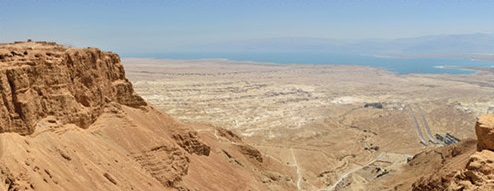
Christians today sometimes imitate Gideon’s example by “putting out a fleece”—asking God for a particular sign to discern his will in a particular situation. This may mean asking God to do something miraculous, as in Gideon’s case. Or it may mean simply asking for positive circumstances to open up a course of action.
In either case, is this a legitimate way to discern God’s will? One thing is clear. Gideon’s request showed a lack of faith. God had given him a clear command and he should have obeyed instead of asking for signs. In the New Testament, the request for signs is treated as a lack of faith (Mt 12:38–39; 16:1, 4; Mk 8:11–12; Lk 11:16, 29–30). Jesus said, “A wicked and adulterous generation asks for a sign!” (Mt 12:39). Furthermore, God’s people are commanded not to put the Lord their God to a test (Dt 6:16; Mt 4:7; Lk 4:12). Some have suggested that the fleece was meant to be confirmation that the messages Gideon was receiving were truly from God. But there is no indication in the narrative that Gideon doubted this.
While God, because of his grace, love and patience, was willing to answer Gideon’s request for this sign, Gideon’s actions should not be viewed as a model for us. We discern God’s will best by nurturing our relationship with him, knowing his Word, praying consistently, seeking godly counsel, and living a life of obedience and faith.
Go to the Articles Index.
6:39 not be angry . . . just one more request. Cf. Abraham’s words in Ge 18:32.
7:1–8 As supreme commander of Israel, the Lord reduced the army so that Israel would know that the victory was by his power, not theirs.
7:1 Harod. Means “trembling” and may refer to either the timidity of the Israelites (v. 3) or the great panic of the Midianites when Gideon attacked (v. 21). valley. That is, the Valley of Jezreel. hill of Moreh. Located across the valley from Harod, approximately four miles from the Israelite army.
The story of Gideon begins with a graphic portrayal of one of the most striking facts of life in the Fertile Crescent: the periodic migration of northern nomadic peoples into the settled areas of Canaan. Each spring the tents of the Bedouin herdsmen appeared overnight almost as if by magic, scattered on the hills and fields of the farming districts. Conflict between these two ways of life (herdsmen and farmers) was inevitable.
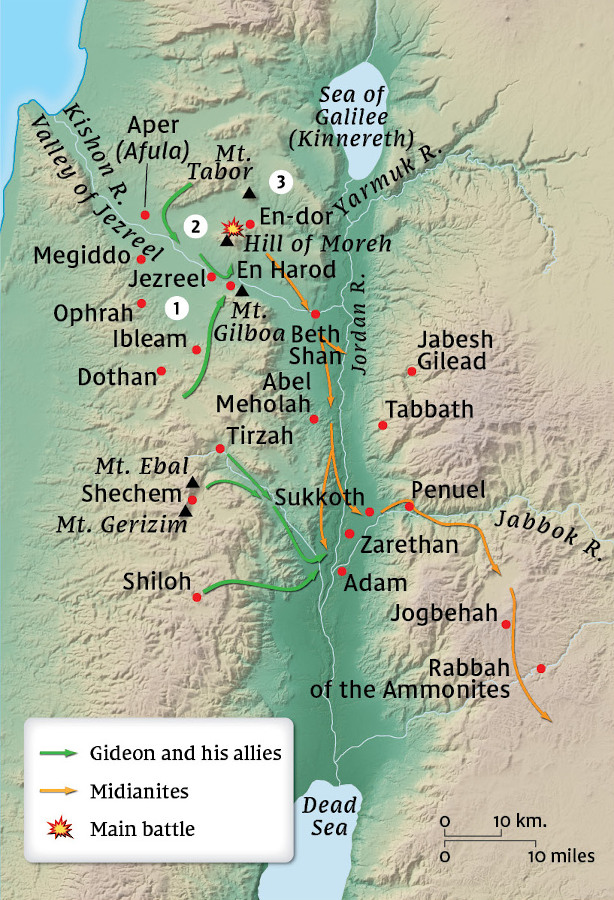
➊ In the biblical period, the vast numbers and warlike practice of the herdsmen reduced the village people to near vassalage. God’s answer was twofold: (1) religious reform, starting with Gideon’s own family; and (2) military action, based on a coalition of northern Israelite tribes. The location of Gideon’s hometown, “Ophrah of the Abiezrites” (6:24), is not known with certainty, but it probably was ancient Aper (modern Afula) in the Valley of Jezreel.
➋ The battle at the spring of Harod is justly celebrated for its strategic brilliance. Denied the use of the only local water source, the Midianites camped in the valley and fell victim to the small band of Israelites that attacked them from the heights of the hill of Moreh.
➌ The main battle took place north of the hill near the village of En-dor at the foot of Mount Tabor. Fleeing by way of the Jordan valley, the Midianites were trapped when the Ephraimites seized the fords of the Jordan from below Beth Shan to Beth Barah near Adam.
Go to the Maps Index.
7:3 may turn back. Those who were afraid to fight the Lord’s battle were not to go out with his army so that they would not demoralize the others (Dt 20:8). Mount Gilead. Perhaps used here as another name for Mount Gilboa.
7:6 lapping like dogs. With cupped hands, lapping as a dog would drink from a bowl. These 300 remained on their feet, prepared for any emergency.
7:8–14 The Lord provided Gideon with encouraging military intelligence for the battle.
7:13–14 Although revelations by dreams are frequently mentioned in the OT, here both dreamer and interpreter are non-Israelites. Contrast Joseph, who interpreted dreams in Egypt (Ge 40:1–22; 41:1–32), and Daniel, who interpreted dreams in Babylon (Da 2:1–45; 4:4–27).
7:13 round loaf of barley bread. Since barley was considered an inferior grain and only half the value of wheat (2Ki 7:1), it is a fitting symbol for Israel, which was inferior in numbers.
7:16 three companies. A strategy adopted by Israel on several occasions (9:43; 1Sa 11:11; 2Sa 18:2). trumpets. Rams’ horns (Ex 19:13).
7:19 middle watch. The Israelites divided the night into three watches (see note on Mt 14:25). The “beginning of the middle watch” would be after the enemy had gone to sleep.
7:22 three hundred trumpets. Normally only a comparatively small number of men in an army carried trumpets. So the sound of this many trumpets would suggest a vast army. The torches and the sound of smashing jars increased this effect. turn on each other. A similar panic occurred among the Ammonites, Moabites and Edomites (2Ch 20:23) and among the Philistines at Gibeah (1Sa 14:20). See Eze 38:21; Zec 14:13; see also note on Jdg 4:15. toward Zererah. Toward the southeast.
7:23 were called out. Encouraged by the turn of events, many of those who had departed now joined the battle.
7:24 hill country of Ephraim. Gideon needed the aid of the Ephraimites to cut off the retreat of the Midianites into the Jordan Valley. waters of the Jordan. Probably the river crossings in the vicinity of Beth Shan. By controlling the river the Israelites could prevent the escape of the fleeing Midianites (see note on 3:28). Beth Barah. Exact location unknown, but it must have been some distance down the river. Gideon’s pursuit of the enemy across the river took him to Sukkoth, a town near the Jabbok River (8:5).
7:25 Oreb. Means “raven” (Isa 10:26). Zeeb. Means “wolf.” heads. Frequently parts of the bodies of dead victims, such as heads, hands (8:6) and foreskins (1Sa 18:25), were cut off and brought back as trophies, to humiliate one’s enemies, to confirm the identities of the victims or as a kind of body count.
8:1 Ephraimites. Contrast Gideon, who placates the wrath of this tribe (vv. 2–3), with Jephthah, who brings humiliation and defeat to it (12:1–6).
8:2 gleanings. Leftover grain after the main gathering of the harvest (see note on Ru 1:22). Here Gideon implies that Ephraim has accomplished more than he and all the other forces involved in the initial attack. Abiezer. Gideon’s clan (see note on 6:11).
8:3 their resentment . . . subsided. “A gentle answer turns away wrath” (Pr 15:1).
8:5 kings of Midian. Zebah and Zalmunna may have belonged to different Midianite tribes (Nu 31:8).
8:6 hands. See note on 7:25. Why should we give bread . . . ? The officials of Sukkoth doubted Gideon’s ability to defeat the Midianite coalition and feared reprisal if they gave his army food.
8:8 Peniel. The place where Jacob had wrestled with God (Ge 32:30–31).
8:19 sons of my own mother. In an age when men often had several wives, it was necessary to distinguish between full brothers and half brothers.
8:21 do it yourself. Dying at the hands of a boy may have been considered a disgrace (1Sa 17:42). ornaments. Valuable crescent necklaces, as in Isa 3:18.
8:23 I will not rule . . . The LORD will rule. Gideon, like Samuel (1Sa 8:4–20), rejected the establishment of a monarchy because he regarded it as a replacement of the Lord’s rule. God’s rule over Israel (theocracy) is a central issue in Judges.
8:24 earring. Or possibly “nose ring” (Ge 24:47; Eze 16:12). Ishmaelites. Related to the Midianites (Ge 25:1–2) and sometimes identified with them (vv. 22,24; Ge 37:25–28; 39:1). See note on Ge 37:25.
8:27 ephod. Sometimes a holy garment associated with the priesthood (Ex 28:6–30; 39:2–26; Lev 8:7) and at other times a pagan object associated with idols (17:5; 18:14,17). prostituted themselves. See Ex 34:15 and note.
8:28 forty years. A conventional number of years for a generation (see Introduction: Background).
8:29 Jerub-Baal. See note on 6:32.
8:30 seventy sons. A sign of power and prosperity (12:14; 2Ki 10:1).
8:31 concubine. She was originally a slave in his household (9:18; see note on Ge 16:2). Abimelek. Appears elsewhere as a royal title (Ge 20:2; 26:1; Ps 34 title) and means “My (divine) Father is King.” Gideon, in naming his son, acknowledges that the Lord (here called “Father”) is King.
8:32 at a good old age. A phrase used elsewhere only of Abraham (Ge 15:15; 25:8) and David (1Ch 29:28).
8:33 prostituted themselves. Although Gideon had led a spiritual revival, it was short-lived. See Ex 34:15 and note. Baals. See notes on 2:11,13. Baal-Berith. Means “lord of the covenant”; the same deity is called El-Berith (“god of the covenant”) in 9:46. There was a temple dedicated to him (9:4) in Shechem. The word “covenant” in his name probably refers to a solemn treaty that bound together a league of Canaanite cities whose people worshiped him as their god. Ironically, Shechem (v. 31), near Mount Ebal, was the site at which Joshua had twice renewed the Lord’s covenant with the Israelites after they had entered Canaan (Jos 8:30–35; 24:25–27). See also note on 2:11.
9:1–57 The stories of Gideon and Abimelek form the literary center of Judges (see Introduction: Literary Features). Abimelek, who tried to set himself up like a Canaanite city king with the help of Baal (v. 4), stands in sharp contrast to his father, Gideon (Jerub-Baal), who had attacked Baal worship and insisted that the Lord ruled over Israel. Abimelek attempted this Canaanite revival in the very place where Joshua had earlier reaffirmed Israel’s allegiance to the Lord (Jos 24:14–27). In every respect Abimelek was the antithesis of the Lord’s appointed judges.
9:1 Shechem. See note on Ge 33:18. Ruins dating from the Canaanite era give evidence of a sacred area, probably to be associated with the temple of Baal-Berith or El-Berith (vv. 4,46). Archaeological evidence, which is compatible with the destruction of Shechem by Abimelek, indicates that its sacred area was never rebuilt after this time.
9:2 citizens. The singular form of the Hebrew for this word is ba’al. It means “lord” or “owner” and probably refers here to the aristocracy or landowners of the city. flesh and blood. Being half-Canaanite, Abimelek intimated that it was in their best interest to make him king rather than be under the rule of Gideon’s other 70 sons. The following he gathered was based on this relationship and became a threat to the people of Israel.
9:4 from the temple. Ancient temples served as depositories for personal and civic funds. The payments of vows and penalties, as well as gifts, were also part of the temple treasury. The temple of Baal-Berith is probably to be identified with a large building found at Shechem by archaeologists. reckless scoundrels. Use of mercenaries to accomplish political or military goals was common in ancient times. Others who used them are Jephthah (11:3), David (1Sa 22:1–2), Absalom (2Sa 15:1), Adonijah (1Ki 1:5), Rezon (1Ki 11:23–24) and Jeroboam (2Ch 13:6–7).
9:5 on one stone. Abimelek’s 70 brothers were slaughtered like sacrificial animals (13:19–20; 1Sa 14:33–34). In effect, he inaugurated his kingship by using his Israelite half brothers as his coronation sacrifices (2Sa 15:10, 12; 1Ki 1:5, 9; 3:4).
9:6 Beth Millo. “Millo” is derived from a Hebrew verb meaning “to fill” and perhaps refers to the earthen fill on which walls and other large structures were built. Beth Millo may be identical to the “stronghold” of v. 46. great tree. See Jos 24:25–26; see also note on Ge 12:6.
9:7 top. Probably a ledge that overlooked the city.
9:8 trees went out. Fables of this type, in which inanimate objects speak and act, were popular among Eastern peoples of that time (2Ki 14:9).
9:9–13 The olive tree, the fig tree and the vine were all plants that produced fruit of great importance to the people of the Near East.
9:13 gods. It was commonly believed that the gods participated in such human experiences as drinking wine (cf. Ex 29:40).
9:14 thornbush. Probably the well-known buckthorn, a scraggly bush common in the hills of Israel and a constant menace to farming. It produced nothing of value and was an apt figure for Abimelek.
9:15 shade. Ironically, in offering shade to the trees, the thornbush symbolized the traditional role of kings as protectors of their subjects (see Isa 30:2–3; 32:1–2; La 4:20; Da 4:12; Am 9:11 and note). cedars of Lebanon. The most valuable of Near Eastern trees, here symbolic of the leading men of Shechem (v. 20).
9:20 fire come out . . . and consume. A grim prediction that Abimelek and the people of Shechem would destroy each other. Fire spreads rapidly through bramble bushes and brings about swift destruction to everything around them (Ex 22:6; Isa 9:18).
9:21 Beer. A very common name, meaning “a well.” Its location is therefore uncertain.
9:22 Israel. Those Israelites who recognized Abimelek’s authority, mainly in the vicinity of Shechem.
9:23 animosity. The Hebrew for “animosity” is frequently rendered “evil spirit” or “harmful spirit” (cf., e.g., 1Sa 16:14 and NIV text note); here perhaps a “spirit” of distrust and bitterness. The Hebrew for “spirit” is often used to describe an attitude or disposition. acted treacherously. The one who founded his kingdom by treachery is himself undone by treachery.
9:26 put their confidence in him. Just as the fickle population had followed Abimelek, so they are now swayed by the deceptive proposals of Gaal.
9:27 held a festival. The grape harvest was one of the most joyous times of the year (Isa 16:9–10; Jer 25:30), but festivals and celebrations held at pagan temples often degenerated into debauched drinking affairs.
9:28 Hamor. The Hivite ruler who had founded the city of Shechem (Ge 33:19; 34:2; Jos 24:32).
9:32 lie in wait. Ambush succeeded against Gibeah in Benjamin (20:37) and against Ai (Jos 8:2).
9:34 four companies. Smaller units meant less chance of detection. Also, attack from several directions was a good tactical strategy.
9:37 central hill. See NIV text note; see also note on Eze 38:12, where the same Hebrew is translated “center of the land.” diviners’ tree. Probably a sacred tree in some way related to the temple of Baal-Berith (see note on Ge 12:6).
9:43 three companies. See note on 7:16.
9:45 scattered salt over it. To condemn it to perpetual barrenness and desolation (Dt 29:23; Ps 107:33–34; Jer 17:6; Zep 2:9).
9:46 stronghold. Probably the Beth Millo of v. 6. El-Berith. Baal-Berith (v. 4).
9:49 set it on fire. In fulfillment of Jotham’s curse (v. 20).
9:53 woman. While the men used bows, arrows and spears, women helped to defend the tower by dropping heavy stones on those who came near it. upper millstone. See note on 3:16. The upper, revolving stone of a mill was circular, with a hole in the center. Grinding grain was women’s work (Ex 11:5), usually considered too lowly for men to perform (Jdg 16:21). Abimelek was killed by a woman using a domestic implement (4:21).
9:54 armor-bearer. In Israel’s earlier years in Canaan, military leaders were usually served by a personal attendant (1Sa 14:6; 31:4), but no armor-bearers are mentioned after the time of David. A woman killed him. It was considered a disgrace for a soldier to die at the hands of a woman. Abimelek’s shameful death was long remembered (2Sa 11:21).
9:56 God repaid. God was in control of the events. As Israel’s true King, he brought Abimelek’s wickedness to a quick and shameful end.
9:57 curse of Jotham. See v. 20.
10:1 a man of Issachar named Tola son of Puah. Tola and Puah bear names of two of the sons of Issachar (Ge 46:13; Nu 26:23; 1Ch 7:1).
10:3 Jair. Since Jair came from Gilead (the territory assigned to Manasseh) and since a descendant of Manasseh bore the same name (Nu 32:41; Dt 3:14; 1Ki 4:13), it appears that Jair was a Manassite.
10:4 thirty sons . . . thirty donkeys . . . thirty towns. Evidence of wealth and position. Havvoth Jair. See NIV text note.
10:6—12:7 Israel now turned to Jephthah, a social outcast whom they had driven from the land and caused to become an outlaw without an inheritance in Israel. The author notes this to Israel’s shame. The account of Jephthah’s judgeship balances that of Deborah in the story of the judges (see note on 4:1—5:31; see also Introduction: Literary Features).
10:6 gods of Aram. The chief gods were Hadad (Baal), Mot, Anath and Rimmon. gods of Sidon. The Sidonians worshiped essentially the same gods as the Canaanites (see notes on 2:11,13). gods of Moab. The chief deity of Moab was Chemosh. gods of the Ammonites. Molek was the chief Ammonite deity (1Ki 11:7) and was sometimes worshiped by the offering of human sacrifice (Lev 18:21; 20:2–5; 2Ki 23:10). This god is also called Milkom in Hebrew. Both Molek and Milkom are forms of a Semitic word for “king.” gods of the Philistines. While the Philistines worshiped most of the Canaanite gods, their most popular deities appear to have been Dagon and Baal-Zebub. The name Dagon is the same as a Hebrew word for “grain,” suggesting that he was a vegetation deity. He was worshiped in Babylonia as early as the second millennium bc. Baal-Zebub was worshiped in Ekron (2Ki 1:2–3, 6,16). The name means “lord of the flies,” a deliberate change by followers of the Lord (Yahweh) to ridicule and protest the worship of Baal-Zebul (“Baal the Prince”), a name known from ancient Canaanite texts. The name later came to be used of Satan (see Mt 10:25 and note; 12:24).
10:7 Philistines. The account of Philistine oppression is resumed in 13:1.
10:11 The LORD replied. Probably speaking through a prophet or perhaps an angel (see note on 2:1). The Lord rebuked the Israelites for forgetting that he had delivered them from their oppressors in Canaan (see notes on 2:16–19; 6:8).
10:12 Maonites. See NIV text note; or perhaps the same as the Meunites, who along with the Philistines and Arabs opposed Israel (2Ch 26:7).
10:17 Mizpah. Means “watchtower.” Several places bore this name. Jephthah’s headquarters was a town or fortress in Gilead (11:11) called “Mizpah of Gilead” (11:29). It may have been the same as Ramath Mizpah (Jos 13:26), located about 30 miles east of Beth Shan.
10:18 The Gileadites wanted to resist the Ammonite incursion but lacked the courageous military leadership to press their cause.
11:1 his mother was a prostitute. One reason Jephthah was a social outcast.
11:3 the land of Tob. The Hebrew name sounds exactly like “the good land,” a common way of referring to the promised land in Deuteronomy. The narrator appears to call attention to the irony of this outcast from Israel finding a refuge in “a land of good (things).” The men of Tob were later allied with the Ammonites against David (2Sa 10:6–8). scoundrels. See note on 9:4.
11:8 you will be head over all of us. The Gileadites are desperate for leadership. So in addition to their initial offer of military command during the war with Ammon (v. 6), they now pledge to make Jephthah regional head after the fighting is over.
11:11 The proposal of the elders was ratified by the people, a process followed later in the election of Saul (1Sa 11:15), Rehoboam (1Ki 12:1) and Jeroboam (1Ki 12:20). Jephthah’s final act here suggests that the agreement reached between himself and the elders had the formal status of a covenant (compare David’s covenant with the representatives of the northern tribes, 2Sa 5:3). In any event, Jephthah lays his conditions “before the LORD” as a way of calling on the Lord to enforce the pledge made to him by the elders of Gilead.
11:13 my land. When the Israelites had first approached Canaan, this area was ruled by the Amorite king Sihon, who had taken it from the Moabites (Nu 21:29). The Ammonites had since become dominant over Moab and now claimed all previous Moabite territory. from the Arnon to the Jabbok. The rivers that formed the southern and northern boundaries of Ammon.
11:14–27 Jephthah responded in accordance with international policies of the time; his letter is a classic example of contemporary international correspondence. It also reflects—and appeals to—the common recognition that the god(s) of a people established and protected their political boundaries and decided all boundary disputes. Jephthah’s defense of Israel’s claim to the land is threefold: (1) Israel took it from Sihon, king of the Amorites, not from the Ammonites (vv. 15–22); (2) the Lord gave the land to Israel (vv. 23–25); and (3) Israel had long possessed it (vv. 26–27).
11:16 Kadesh. Kadesh Barnea; see note on Nu 20:1.
11:21 LORD, the God of Israel. War was viewed not only in military terms but also as a contest between deities (v. 24; Ex 12:12; Nu 33:4).
11:24 Chemosh. The chief deity of the Moabites. At this time either the king of Ammon also ruled Moab or there was a military confederacy of the two peoples.
11:26 three hundred years. For the relevance of this phrase in establishing the time span for Judges, see Introduction: Background.
11:27 Judge. See 1Sa 24:15. As the divine Judge, the Lord is the final court of appeal. It is significant that in the book of Judges the singular Hebrew noun translated “judge” is found only here, where it is used of the Lord, Israel’s true Judge.
11:29 Spirit of the LORD. See note on 3:10. In the OT the unique empowering of the Spirit was given to individuals primarily to enable them to carry out the special responsibilities God had given them.
11:30 made a vow. A common practice among the Israelites (Ge 28:20; 1Sa 1:11; 2Sa 15:8). Here Jephthah was seeking to assure the outcome of the battle by bargaining for God’s help. The precise nature of this vow has been the subject of wide speculation, but v. 31 indicates the promise of a burnt offering and leads to the conclusion that Jephthah probably offered his daughter as a human sacrifice (v. 39). A vow was not to be broken (see Nu 30:2; Dt 23:21–23; see also Ecc 5:4–5).
11:34 dancing. It was customary for women to greet armies returning victoriously from battle in this way (see Ex 15:20; 1Sa 18:6).
11:35 tore his clothes. A common practice for expressing extreme grief (see Ge 37:34 and note). a vow to the LORD that I cannot break. In his determination to secure the position of leadership over his old adversaries, Jephthah had made a rash vow. Now he thinks he cannot go back on his vow to the Lord. Thus all his efforts to gain a position of power in Israel by manipulating God backfired and created a moral dilemma for himself.
11:37 I will never marry. To be kept from marrying and rearing children was a bitter prospect for an Israelite woman.
11:39 Israelite tradition. Probably a local custom, since no other mention of it is found in the OT.
12:1 Zaphon. See map. burn down your house. The Philistines issued a similar threat to Samson’s wife (14:15). See also 20:48.
12:2 answered. Again Jephthah tried diplomacy first (see 11:12,14; see also note on 8:1). I called. Either this is a lie, or information not reported earlier.
12:6 Shibboleth. Ironically, the word meant “flood” (see, e.g., Ps 69:2,15). Apparently the Israelites east of the Jordan pronounced its initial letter with a strong “sh” sound, while those in Canaan gave it a softer “s” sound. (Peter was similarly betrayed by his accent; see Mt 26:73.)
12:7 led Israel . . . years. A new formula for closing out the account of a judge (see note on 3:11; see also Introduction: Literary Features).
12:8 Bethlehem. Probably the Bethlehem in western Zebulun (Ge 35:19; 48:7; Jos 19:15).
12:9 thirty sons and thirty daughters. See note on 10:4.
12:11 Elon. Also the name of a clan in the tribe of Zebulun (Ge 46:14; Nu 26:26).
12:14 forty sons and thirty grandsons. A sign of power and prosperity (8:30; 10:4).
12:15 hill country of the Amalekites. See note on 5:14. The background of this reference is unknown; the Amalekites are otherwise associated with the Negev (Nu 13:29).
13:1—16:31 Samson (from the tribe of Dan), like Ehud (from the tribe of Benjamin), was a loner, whose heroic exploits involved single-handed triumphs over powerful enemies. His story therefore balances that of Ehud (see note on 3:12–30). Significantly, this last of the judges typifies the nation of Israel. Born by special divine provision to a barren woman, consecrated to the Lord from birth and endowed by God’s Spirit with unique powers to overcome Israel’s enemies, he was repeatedly drawn to Philistine women. This ultimately led to his destruction, just as God’s people Israel, who were consecrated by circumcision and especially empowered for the conquest of Canaan, were continually drawn to the gods and ways of the Canaanites to their destruction (see note on Ex 34:15). The story of Samson is the story of Israel in cameo. The author provides a mirror image of Israel in the days of the judges—and of God’s unfailing mercies to his wayward people whom he would not abandon.
13:1–25 The account of Samson’s birth helps the author to point out the parallels between Samson and Israel that he wanted his readers to see.
13:1 did evil in the eyes of the LORD. See note on 3:7.
13:2 Zorah. A town first assigned to Judah (Jos 15:33) but later given to Dan (Jos 19:41). It became the point of departure for the Danite migration northward (18:2,8,11). Danites. See 1:34 and note. childless, unable to give birth. The same condition as that of Sarah, the mother of Isaac (Ge 11:30; 16:1), and Rebekah, the mother of Jacob (Ge 25:21). Cf. also Hannah, the mother of Samuel (1Sa 1:2), and Elizabeth, the mother of John the Baptist (Lk 1:7). Childlessness was a cause of great shame in ancient Near Eastern culture, but in these cases prepared the way for God’s power to be demonstrated.
13:3 angel of the LORD. See note on Ge 16:7. you are going to . . . give birth to a son. See the announcement of Isaac’s birth (Ge 18:10). Cf. the announcements of the births of Ishmael (Ge 16:11), Immanuel (Isa 7:14), John the Baptist (Lk 1:13) and Jesus (Lk 1:31).
13:5 Nazirite. From a Hebrew word meaning “set apart” or “dedicated.” For the stipulations of this vow, see Nu 6:1–21 and notes. Samson’s Nazirite consecration was not voluntary—like Israel, he was consecrated to special service by God himself—and his consecration applied to his whole lifetime (v. 7). The same was true of Samuel (1Sa 1:11) and John the Baptist (Lk 1:15). take the lead in delivering . . . from . . . the Philistines. The deliverance was continued in the time of Samuel (1Sa 7:10–14) and completed under David (2Sa 5:17–25; 8:1).
13:6 man of God. An expression often used of prophets (Dt 33:1; 1Sa 2:27; 9:6–10; 1Ki 12:22), though it is clear from vv. 3,21 that this messenger was the angel of the Lord.
13:8 teach us. Not the usual parental concern, but a special concern based on the boy’s special calling.
13:12 A declaration of faith. To Manoah it was not a matter of whether these events would occur, but of when (v. 17).
13:15 stay until we prepare a young goat. Such food was considered a special delicacy. Hospitality of this kind was common in the ancient Near East (6:18–19; Ge 18:1–8).
13:17 What is your name . . . ? A messenger’s name would identify who sent them and thus establish their authority. when your word comes true. Fulfilled prophecy was a sign of the authenticity of a prophet (Dt 18:21–22; 1Sa 9:6).
13:18 beyond understanding. See NIV text note. In Isa 9:6 the Hebrew for this phrase (translated “Wonderful”) applies to One who would come as “Mighty God.”
13:22 doomed to die. See 6:23 and notes on Ge 16:13; 32:30.
13:24 Samson. The name is derived from a Hebrew word meaning “sun” or “brightness,” and is used here as an expression of joy over the birth of the child. He grew and the LORD blessed him. Cf. 1Sa 2:26 (Samuel) and Lk 2:52 (Jesus).
13:25 began to stir him. See notes on 3:10; 11:29. Mahaneh Dan. Means “Dan’s camp” (see NIV text note on 18:12).
14:1—16:31 The account of Samson’s extraordinary exploits and flawed character has a literary structure of special note. His first encounter with a Philistine woman (14:1–20) and its aftermath (15:1–8) are closely balanced by the account of his last encounter with a Philistine woman (16:4–22) and its aftermath (16:23–31). And what happens in his first encounter foreshadows what happens in his final encounter. Between these two major cycles are three episodes: (1) Judah’s attempt to appease the Philistines by binding Samson over to them (15:9–17); (2) God’s rescue of Samson from life-threatening dehydration (15:18–19); and (3) Samson’s escape from Gaza, the gates of which he deposits on a hill overlooking Hebron, Judah’s main city (16:1–3). The author reminds his readers in the brief centerpiece (15:18–19) that mighty Samson shared in the universal vulnerabilities of human life.
14:1 Timnah. Identified as Tell Batash in the Sorek Valley, northwest of Beth Shemesh (see maps here and here). Archaeologists have uncovered the Philistine layer of the town. young Philistine woman. The disappointment of Samson’s parents (v. 3; cf. Esau, Ge 26:35; 27:46; 28:1) is understandable in light of the prohibition against marriage with the pagan peoples of Canaan (Ex 34:11, 16; Dt 7:1,3; see also Jdg 3:5–6).
14:2 get her for me. See Ge 34:4. As the head of the family, the father exercised authority in all matters, often including the choice of wives for his sons (12:9; Ge 24:3–9; Ne 10:30).
14:3 uncircumcised. A term of scorn, referring to those not bound by covenant to the Lord, used especially of the Philistines (see note on 1Sa 14:6). right one for me. This Hebrew idiom (“is right in my eyes”) is similar to that translated “did as they saw fit” (or “did what was right in their own eyes”) in 17:6; 21:25. The author anticipates this theme, which recurs in chs. 17–21.
14:4 this was from the LORD. See Jos 11:20; 1Ki 12:15. The Lord uses even sinful human weaknesses to accomplish his purposes and bring praise to his name (Ge 45:8; 50:20; 2Ch 25:20; Ac 2:23; 4:28; Ro 8:28–29).
14:5 vineyards of Timnah. The Sorek Valley (in which Timnah was located) and its surrounding areas were noted for their luxuriant vineyards (see photos here and here). For anyone under Nazirite vows, vineyards could be a powerful source of temptation (Nu 6:1–4). young lion. Lions were once common in southern Canaan (1Sa 17:34; 2Sa 23:20; 1Ki 13:24; 20:36).
14:6 Spirit . . . came powerfully upon him. See 13:25; 14:19; 15:14; see also notes on 3:10; 11:29. tore the lion apart. With such unique power God’s Spirit endowed Samson to overcome the Philistines. Later, David (1Sa 17:34–37) and Benaiah (2Sa 23:20) performed similar feats. See photo.
14:8–9 carcass . . . honey. He scooped out the honey with his hands. Samson violated his Nazirite vows by touching a dead body (Nu 6:6–7) in order to delight himself with something sweet.
14:10 feast. Such a special feast was common in the ancient Near East (Ge 29:22) and here lasted seven days (v. 12; see Ge 29:27). Since it would have included drinking wine, Samson may have violated his Nazirite vow (13:4,7).
14:11 companions. These are the “guests of the bridegroom” (cf. Mt 9:15). They were probably charged with protecting the wedding party against marauders.
14:12 riddle. The use of riddles at feasts and special occasions was popular in the ancient world. sets of clothes. Mentioned, together with silver, as gifts of great value in Ge 45:22; 2Ki 5:22 (see also Zec 14:14).
14:14 the eater . . . the strong. Samson refers to the lion he had killed, from the carcass of which he had taken honey to eat. He confidently uses his riddle as his opening shot in a battle of wits with the Philistines.
14:16 don’t really love me. Delilah used the same tactics (16:15).
14:18 my heifer. A reference to Samson’s wife (see v. 15). Since heifers were not used for plowing, Samson is accusing them of unfairness.
14:19 Spirit . . . came powerfully upon him. God’s purposes for Samson included humbling the Philistines. Ashkelon. One of the five principal cities of the Philistines (see map).
14:20 one of his companions. See 15:2; probably the young man who had attended Samson (cf. Jn 3:29), in all likelihood one of his 30 companions (v. 11).
15:1 time of wheat harvest. Near the end of May or the beginning of June (see note on Ru 1:22). young goat. Such a gift was customary, as with Judah and Tamar (Ge 38:17).
15:2 younger sister. Samson’s father-in-law felt he had to make a counterproposal because he had received the bride-price from Samson. Similar marital transactions were made by Laban and Jacob (Ge 29:16–28) and Saul and David (1Sa 18:19–21).
15:5 burned up. The wheat harvest (v. 1) comes at the end of a long dry season, thus making the fields extremely vulnerable to fire. Samson’s burning of the grainfields foreshadows his destruction of the temple of Dagon (whose name means “grain”) in his last attack on the Philistines (16:23–30; see also note on 10:6).
15:6 because his wife was given to his companion. See 14:20.
15:7 revenge. A common feature of life in the ancient Near East. Six cities of refuge were designated by the Lord to prevent endless killings (see Jos 20:1–9 and note).
15:9–17 See note on 14:1—16:31.
15:9 Lehi. Means “jawbone.” This locality probably did not receive the name until after the events described here; the author uses the name in anticipation of those events—a common device in Hebrew narrative.
15:11 three thousand men from Judah. The only time a force from Judah is explicitly mentioned in connection with any of the judges (but see note on 1:2). The men of Judah were well aware of Samson’s capabilities, and even with a large force they did not attempt to tie him up without his consent (vv. 12–13). Philistines are rulers over us. Much of Judah was under Philistine rule, and the tribe was apparently content to accept it. They mustered a force, not to support Samson, but to capture him for the Philistines. Contrast the role assigned Judah in 1:2 and 20:18.
15:14 shouting. A battle cry (1Sa 17:52). Spirit of the LORD. See notes on 3:10; 11:29; 14:19.
15:15 struck down a thousand men. Cf. the exploits of Shamgar, who struck down 600 Philistines with an oxgoad (3:31).
15:18–19 See note on 14:1—16:31.
15:18 Must I now die of thirst . . . ? Mighty Samson was, after all, only a mortal man.
15:19 water came out of it. God provided for Samson as he had for Israel in the wilderness. See Ex 17:1–7 (Massah and Meribah); Nu 20:2–13 (Meribah).
15:20 led Israel . . . years. See note on 12:7. twenty years. Round numbers are frequently used in Judges (see Introduction: Background).
16:1–3 See note on 14:1—16:31.
16:1 Gaza. An important Philistine city near the Mediterranean coast of southwest Canaan. prostitute. While Samson certainly possessed physical strength, he lacked moral strength, which ultimately led to his ruin.
16:2 dawn. By that time they expected Samson to be exhausted and sleeping soundly.
16:3 bar. Probably made of bronze (1Ki 4:13) or iron (Ps 107:16; Isa 45:2). faces Hebron. That is, in the direction of Hebron, which was 38 miles away in the hill country. Since Hebron was the chief city of Judah, this must be seen as Samson’s response to what the men of Judah had done to him (15:11–13).
16:4–31 See note on 14:1—16:31.
16:4 Valley of Sorek. See photo.
16:5 rulers of the Philistines. See note on 3:3. subdue him. The Philistines were not interested in killing him quickly; they sought revenge by a prolonged period of torture. eleven hundred shekels. An extraordinarily generous payment in light of 17:10 (see note there). (The total amount paid by the five Philistines would have been equivalent to the price of 275 slaves, at the rate offered for Joseph centuries earlier; see Ge 37:28.) Micah stole a similar amount of silver from his mother (17:2). shekels. See note on Ge 20:16.
16:7 seven fresh bowstrings. The number seven had special significance to the ancients, symbolizing completeness or fullness (see notes on Ge 4:17–18; 5:5). Note that Samson’s hair was divided into seven braids (v. 13).
16:11 new ropes. The Philistines apparently did not know that this method had already been tried and had failed (15:13–14).
16:13 Out of disdain, Samson arrogantly played with his Philistine adversaries. tighten it with the pin. Probably from a weaver’s shuttle (see photo). The details of the account suggest that the loom in question was the vertical type with a crossbeam from which warp threads were suspended (see photo). Samson’s long hair was woven into the warp and beaten up into the web with the pin, thus forming a tight fabric.
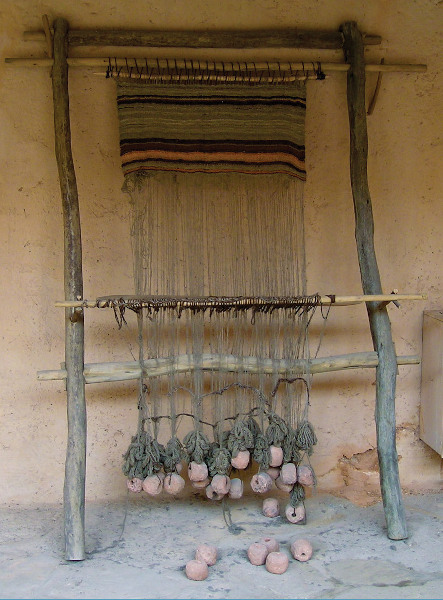
Reconstruction of a weighted loom (Jdg 16:13) with crossbeam.
Eretz Israel Museum. Todd Bolen/BiblePlaces.com
Return to the main text.
16:19–20 his strength left him . . . the LORD had left him. The source of Samson’s strength was ultimately God himself.
16:20 he did not know. One of the most tragic statements in the OT. Samson was unaware that he had betrayed his calling. He had permitted a Philistine woman to rob him of the sign of his special consecration to the Lord.
16:21 gouged out his eyes. Brutal treatment of prisoners of war to humiliate and incapacitate them was common (see 1Sa 11:2; 2Ki 25:7; see also note on Jdg 1:6). to Gaza. In shame and weakness, Samson was led to Gaza, the place where he had displayed great strength (vv. 1–3). set him to grinding. See notes on 9:53; 14:14.
16:22 hair . . . began to grow again. The author hints at the great truth that shines through the Samson story and would soon receive its final confirmation for Samson, namely, that God had not and would not abandon his flawed servant—or his flawed people Israel.
16:23 Dagon. See notes on 10:6; 15:5. Our god has delivered. It was common to attribute a victory to the national deities.
16:27 on the roof. The temple complex probably surrounded an open court and had a flat roof where a large number of people had gathered to get a glimpse of the fallen champion.
16:28 revenge . . . for my two eyes. See note on 15:7.
16:30 pushed. Samson pushed the wooden pillars from their stone bases. Archaeologists have discovered a similar Philistine temple at Tell Qasile with a pair of closely spaced pillar bases (see archaeology note in map text). killed many more. Samson previously had slain well over 1,000 people (see 15:15; see also 14:19; 15:8). His final exploit was a mighty demonstration that the Philistine celebration of their god’s victory over the Lord’s champion was premature. when he died. If the Nazirite vow was violated and the uncut hair marking special dedication to God had become “defiled,” that hair had to be cut off and the period of consecration started over again (Nu 6:9–12). When Samson’s hair was cut off by Delilah, God showed that it had been defiled by Samson’s many defiling acts. But when his hair “began to grow again,” a new time of consecration began (see v. 22 and note). He then could offer up his life as God’s champion warrior against the Philistines (Heb 11:32).
16:31 went down to get him. The freedom of his family to secure his body and give it a burial indicates that the Philistines had no intention of further dishonoring him (contrast Saul’s death, 1Sa 31:9–10). led Israel . . . years. See note on 12:7. twenty years. Round numbers are frequently used in Judges (see Introduction: Background).
17:1—21:25 Two cycles of events forming an epilogue to the story of the judges (see Introduction: Literary Features). The events narrated evidently took place fairly early in the period of the judges (see notes on 18:30; 20:1,28). They illustrate the religious and moral degeneracy that characterized the age—when “Israel had no king” and “everyone did as they saw fit” (17:6; 21:25). Writing at a time when the monarchy under the Davidic dynasty had brought cohesion and order to the land and had reestablished a center for the worship of the Lord, the author portrays this earlier era of the judges as a dismal period of national decay, from which it was to be rescued by the house of David.
17:1—18:31 The first cycle of events illustrates corruption in Israelite worship by telling of Micah’s establishment of a local place of worship in Ephraim, aided by a Levite claiming descent from Moses. This paganized worship of the Lord is taken over by the tribe of Dan when that tribe abandons its appointed inheritance and migrates to Israel’s northern frontier.
17:2 eleven hundred shekels. See note on 16:5. I heard you utter a curse. Fear of the curse seems to have motivated his returning the stolen money. The LORD bless you. A blessing to counteract the curse.
17:3 mother . . . son. With their paganized view of the God of Israel, both were idolaters in disobedience to the law (Ex 20:4, 23; Dt 4:16). image. Probably made of wood “overlaid with silver.”
17:4 silversmith. A maker of idols, as in Ac 19:24 (cf. Isa 40:19 and Jer 10:9, where gold is used by a craftsman for the same purpose).
17:5 ephod. See 8:27 and note on Ex 28:6. household gods. Used in this case for divining (cf. Eze 21:21; Zec 10:2). Some of them were in human form (1Sa 19:13).
17:6 had no king. See 18:1; 19:1; 21:25; suggests that Judges was written after the establishment of the monarchy (see Introduction: Author and Date). did as they saw fit. The expression implies that Israel had departed from the covenant standards of conduct found in the law (Dt 12:8).
17:7 Levite. His name was Jonathan (see 18:30 and note). Bethlehem in Judah. Not among the 48 designated Levitical cities (Jos 21), suggesting the man was not fulfilling his duties as a Levite, or perhaps poverty had taken him there (see note on v. 8).
17:8 left that town. The failure of the Israelites to obey the law probably resulted in a lack of support for the Levites, which could explain the man’s wandering in search of his fortune.
17:10 father. A term of respect used also for Elijah (2Ki 2:12) and Elisha (2Ki 6:21; 13:14). See Ge 45:8; Mt 23:9. ten shekels. See NIV text note. In the light of this remuneration for a year’s service, the stated amounts in 16:5 and 17:2 take on special significance. The offer of wages, clothing and food was more than this Levite could resist (v. 11). Clearly, material concerns were at the root of his decision, because later he accepts an even more attractive offer (18:19–20).
17:12 installed the Levite. An attempt to make his shrine legitimate and give it prestige. Micah probably removed his son (v. 5).
18:1 seeking a place. The Danite allotment was at the west end of the strip of land between Judah and Ephraim (Jos 19:41–46), but due to the opposition of the Amorites (Jdg 1:34) and the Philistines, the Danites were unable to occupy that territory (see note on 13:2).
18:2 spy out. See 1:23 and note on Nu 13:2.
18:3 recognized the voice. Perhaps they recognized him by his dialect or accent, or they actually knew him.
18:5 inquire of God. The request is for a message, probably by using the ephod and household gods (see note on 17:5). God had already revealed his will by the allotments given to the various tribes (Jos 14–20). They were searching for a message that would guarantee the success of their journey.
18:6 Go in peace. The Levite gave them the message they wanted to hear. He was even careful to use the name of the Lord to give the message credibility and authority.
18:7 Laish. The journey northward was about 100 miles from Zorah and Eshtaol (v. 2). This town is called Leshem in Jos 19:47. After its capture by the Danites, Laish was renamed Dan (v. 29), and it was Israel’s northernmost settlement (20:1; 1Sa 3:20; 2Sa 3:10). Excavations there have disclosed that the earliest Israelite occupation of Dan was in the twelfth century bc and that the first Israelite inhabitants apparently lived in tents or temporary huts. Occupation of the site continued into the Assyrian period, but the town was destroyed and rebuilt many times. A large high place (a place of worship) attached to the city was often extensively rebuilt and refurbished and was in use into the Hellenistic period. Sidonians. A peaceful Phoenician people who engaged in commerce throughout the Mediterranean world. had no relationship. They did not feel threatened by other powers and therefore sought no treaties for mutual defense.
18:11 six hundred men. As leaders of the tribe of Dan, they represented the entire tribe’s migration to its new location in the north. Cf. the 600 men who constituted the remnant of the tribe of Benjamin (20:47).
18:19 father. See note on 17:10. a tribe and clan. Only one clan from the tribe of Dan is ever mentioned—Shuham (Nu 26:42; called Hushim in Ge 46:23). The Danites appealed to the Levite’s vanity and materialism.
18:21 in front of them. For protection in case of attack by Micah and his neighbors (cf. Ge 33:2–3, Jacob and Esau).
18:24 You took the gods. Micah was concerned about the loss of gods that could not even protect themselves. What else do I have? The agonizing cry of one whose faith is centered in helpless gods.
18:28 Beth Rehob. Probably the same as Rehob in Nu 13:21 (see also 2Sa 10:6,8).
18:29 named it Dan. For the city’s location, see maps here, here, and here.
18:30 Jonathan. The Levite is here identified as “Jonathan, son of Gershom, the son of Moses” (Ex 2:22; 18:3; 1Ch 23:14–15). In an effort to prevent desecration of the name of Moses, later scribes modified the name slightly, making it read “Manasseh” (see NIV text note). If Jonathan was the grandson of Moses, the events in this chapter must have occurred early in the period of the judges (see notes on 20:1,28). captivity of the land. Either the exile of the northern kingdom in 722 bc or an earlier, more localized deportation (see note on v. 7 regarding Laish).
18:31 all the time the house of God was in Shiloh. See Jos 18:1. For Shiloh’s destruction, see Ps 78:60; Jer 7:12,14 and note on 7:12; 26:6. Archaeological work at Shiloh indicates that the site was destroyed c. 1050 bc and was left uninhabited for many centuries.
19:1—21:25 The second cycle of events in the epilogue (see note on 17:1—18:31). It illustrates Israel’s moral corruption by telling of the degenerate act of the men of Gibeah—an act remembered centuries later (Hos 9:9; 10:9). Although that town showed itself to be as wicked as any Canaanite town, it was defended by the rest of the tribe of Benjamin against the Lord’s discipline through the Israelites, until nearly the whole tribe was destroyed.
19:1–30 An account of an Israelite town (Gibeah) that revived the ways of Sodom (Ge 19).
19:1 Levite. Unlike the Levite of chs. 17–18, this man is not named. concubine. See note on Ge 25:6.
19:3 gladly welcomed him. The separation of the concubine from the Levite was probably a matter of family disgrace, so his father-in-law was glad for the prospect of the two being reunited and wanted to prolong the reunion as long as possible (vv. 4–9).
19:10 Jebus. See 1:21; see also note on Ge 10:16.
19:12 city whose people are not Israelites. With the city under the control of the Jebusites, the Levite was afraid that he would receive no hospitality and might be in mortal danger. Ironically, the real danger came from fellow Israelites in Gibeah.
19:14 Gibeah in Benjamin. Distinguished from the Gibeah in Judah (Jos 15:20,57) and the Gibeah in the hill country of Ephraim (Jos 24:33). As the political capital of Saul’s kingdom, it is called Gibeah of Saul in 1Sa 11:4; see also 1Sa 13:15.
19:15 took them in. See notes on 13:15; Ge 18:2.
19:18 house of the LORD. Apparently the Levite was planning to go to Shiloh (18:31; Jos 18:1) to present a thank offering to the Lord or a sin offering for himself and his concubine.
19:21 washed their feet. An evidence of hospitality in the ancient Near East, where travelers commonly wore sandals as they walked the dusty roads (Ge 18:4; 24:32; 43:24; Lk 7:44; Jn 13:5–14).
19:22 wicked men. The Hebrew for this expression refers to the morally depraved (see note on Dt 13:13). Elsewhere the expression is associated with idolatry (Dt 13:13), drunkenness (1Sa 1:16) and rebellion (1Sa 2:12). Here the reference is to homosexual assault. Bring out the man. The sexual perversion of these wicked men is yet another example of the decadence of an age when “everyone did as they saw fit” (17:6; 21:25). A similar request was made by the men of Sodom (Ge 19:5). Homosexual acts were integral to Canaanite religion, to which Israelites were regularly exposed.
19:23 don’t be so vile. An expression of outrage at their willful violence and perversion (see Ge 19:7; 2Sa 13:12; see also Ro 1:27).
19:24 my virgin daughter, and his concubine. The tragedy of this story lies not only in the decadence of Gibeah but also in the callous selfishness of men who would betray defenseless women to be brutally violated for a whole night. Cf. Ge 19:8, where Lot offered his two daughters to the men of Sodom.
19:25 took. Here the Hebrew for this verb suggests taking by force.
19:29 cut up his concubine. Dismembering the concubine’s body and sending parts to each of the 12 tribes was intended to awaken Israel from its moral lethargy and to marshal the tribes to face up to their responsibility. It is ironic that the one who issued such a call was himself so selfish and brutal. See also Saul’s similar action in 1Sa 11:7.
20:1–48 All Israel (except Jabesh Gilead; see 21:8–9) assembled before the Lord to deal with the moral outrage committed by the men of Gibeah. Having first inquired of God for divine direction, they marched against Gibeah and the Benjamites as the disciplinary arm of the Lord (Jos 22:11–34), following him as their King.
20:1 Dan to Beersheba. A conventional way of speaking of all Israel from north (Dan) to south (Beersheba); see 1Sa 3:20; 2Sa 3:10; 24:2; 1Ch 21:2; 2Ch 30:5. The use of this expression, however, does not mean that the events of this chapter occurred after Dan’s move to the north (18:27–29); rather, it indicates the author’s perspective at the time of writing (Judges was probably written after the Davidic dynasty was fully established; see Introduction: Author and Date). Here the expression refers to the disciplinary action of all Israel (except Jabesh Gilead; see 21:8–9) against Gibeah and the rest of the Benjamites. Such a united response must have occurred early in the time of the judges, before the period of foreign domination of various parts of the land. as one. Cf. vv. 8,11; 1Sa 11:7. assembled . . . in Mizpah. A place where the tribes gathered to meet before the Lord also during the days of Saul (1Sa 7:5–17; 10:17).
20:9 casting lots. A common method of determining the will of God (see notes on Ex 28:30; 1Sa 2:28; Jnh 1:7; Ac 1:26).
20:10 ten men. Support for the large army had to be well organized and efficient. One man was responsible for providing food for nine men fighting at the front.
20:13 turn those wicked men . . . over to us. The demand of Israel was not unreasonable. The intent was to punish only those directly involved in the crime. wicked men. See note on Dt 13:13. put them to death. The sin of the men of Gibeah called for the death penalty, and Israel had to punish the sin if it was to avoid guilt (Dt 13:5; 17:7; 19:19–20).
20:16 left-handed. The Benjamite Ehud was also left-handed (see 3:15 and note). sling a stone. Cf. Zec 9:15. The sling was a very effective weapon, as David later demonstrated in his encounter with Goliath (1Sa 17:49). A slingstone, weighing one pound or more, could be hurled at 90–100 miles an hour (see photo).
20:18 Bethel. At this time the ark of the covenant and the high priest Phinehas were at Bethel (vv. 26–28). inquired of God. Probably by priestly use of the Urim and Thummim (see v. 9 and note). Who of us is to go up first . . . ? See 1:1–36. Judah. See Introduction and note on 1:2.
20:21 twenty-two thousand Israelites. A rousing victory for the Benjamites, who numbered 26,700 (v. 15) and therefore had struck down nearly one man apiece.
20:27 ark. The only mention of the ark in Judges.
20:28 Phinehas. Phinehas was the priest in the tabernacle in the days of Joshua (Jos 22:13), and the fact that he was still serving is further evidence that these events took place early in the days of the judges (see notes on v. 1; 18:30).
20:29 set an ambush. See 9:32; Jos 8:2.
20:35 25,100. Apparently 1,000 Benjamites had been killed in the first two battles (see note on v. 21).
20:36b–45 Details of the account in vv. 29–36a.
20:46 twenty-five thousand. A round number for 25,100 (v. 35).
20:47 six hundred of them. If these had not escaped, the tribe of Benjamin would have been annihilated. The same number of Danites went to Laish (18:11).
21:1–25 Second thoughts about the slaughter of their Benjamite brothers caused the Israelites to grieve over the loss. Only 600 Benjamites were left alive, and the men of Israel decided to provide wives for them in order to keep the tribe from disappearing. After slaughtering most of the people of Jabesh Gilead, the Israelites took 400 young women from the survivors and gave them to 400 Benjamites. Shortly afterward, each of the remaining Benjamites seized a wife from the women of Shiloh, and the tribe of Benjamin began to grow in number. The horrible exploitation of women throughout this section and the previous one is further evidence of Israel’s godlessness during the period of the Judges.
21:1 taken an oath. This vow, probably taken in the name of the Lord, was not an ordinary vow but invoked a curse on oneself if the vow was broken (v. 18; see also Ac 23:12–15).
21:2 Bethel. See 20:18,26–27. weeping bitterly. Earlier the Israelites wept because they were defeated by the Benjamites (20:23,26). Now they weep because the disciplinary action against the Benjamites has nearly annihilated one of the tribes (v. 3).
21:5 failed to assemble. The tribes had a mutual responsibility in times of military action (see note on 5:13–18). Those who failed to participate were often singled out and sometimes punished (5:15–17,23). solemn oath. Complicating the situation for Israel was the fact that they had taken a second oath, calling for the deaths of those who had not participated in the battle.
21:10 twelve thousand. Presumably a thousand from each tribe (Nu 31:6), with 1,000 supplied to represent the tribe of Benjamin.
21:11 Kill every male. The punishment of Jabesh Gilead is brutal, but the covenant bond between the tribes was extremely important. Even though delinquency on some occasions was not punished (5:15–17), the nature of the crime in this case, coupled with Benjamin’s refusal to turn over the criminals, caused Israel to take this oath (v. 5).
21:12 in Canaan. Emphasizes the fact that the women were brought across the Jordan from the east.
21:19 festival of the LORD. In light of the mention of vineyards (v. 20), it is likely that this reference is to the Festival of Tabernacles (see note on 1Sa 1:3), though it may have been a local festival. north of Bethel . . . south of Lebonah. This detailed description of Shiloh’s location may indicate that this material was written at a time when Shiloh was in ruins, perhaps after its destruction during the battle of Aphek (1Sa 4:1–11).
21:21 seize one of them to be your wife. With the Benjamites securing wives in this manner, the other tribes were not actually “giving” (v. 7) their daughters to them (see note on v. 22).
21:22 When their fathers or brothers complain. It was customary for the brothers of a young woman who had been abducted to demand satisfaction (Ge 34:7–31; 2Sa 13:20–38). It was therefore important that the elders anticipate this response and be prepared to get cooperation from the young women’s families.
21:24 went home. These soldiers had probably been away from home at least five months (20:47).
21:25 Israel had no king. See Introduction: Author and Date; see also note on 17:6. did as they saw fit. See note on 17:6; see also Introduction: Themes and Theology; Literary Features.