Study Notes
1:1—7:38 Regulations for the five main offerings: burnt, grain, fellowship, sin and guilt offerings.
 1:1 The LORD called to Moses. See Introduction to Genesis: Author and Date of Writing. tent of meeting. The tabernacle, where God met with Israel (see note on Ex 27:21).
1:2–17 Three categories of sacrifices are mentioned: (1) herds (vv. 3–9), (2) flocks (vv. 10–13) and (3) birds (vv. 14–17).
1:2 brings an offering. The Hebrew word used here for “offering” (qorban) is related to the verb meaning “bring” (qarab). An “offering” is something that people “bring” to God as a gift (most offerings were voluntary, such as the burnt offering). This word for “offering” is also used in Mk 7:11 (Corban), where Mark translates it “devoted to God” (see note there).
 1:3 burnt offering. See further priestly regulations in 6:8–13 (see also chart). A burnt offering was offered every morning and evening for all Israel (Ex 29:39–42). Double burnt offerings were brought on the Sabbath (Nu 28:9–10) and extra ones on festival days (Nu 28–29). In addition, anyone could offer special burnt offerings to express devotion to the Lord. male. The burnt offering had to be a male animal because of its greater value for breeding, and also perhaps because it was thought to better represent vigor and fertility. It was usually a young sheep or goat (for the average individual), but bulls (for the wealthy) and doves or pigeons (for the poor) were also specified. without defect. The animal had to be unblemished (cf. Mal 1:8; 1Pe 1:19 and note). As in all offerings, the offerers were to lay their hands on the head of the animal to express identification between themselves and the animal (16:21), whose death would then be accepted in “atonement” (v. 4). The blood was splashed against the sides of the bronze altar of burnt offering (located outside the tabernacle—later the temple—in the eastern half of the courtyard), where the fire of sacrifice was never to go out (6:13). The whole sacrifice was to be burned up (v. 9), including the head, legs, fat and internal organs. When a bull was offered, however, the officiating priest could keep its hide (7:8). The burnt offering was the most comprehensive in its meaning. Its Hebrew name means “going up,” perhaps symbolizing worship and prayer as its aroma ascended to the Lord (v. 17). The completeness of its burning also speaks of dedication on the part of the worshiper. entrance to the tent of meeting. Where the altar of burnt offering was (Ex 40:29). acceptable to the LORD. See Ro 12:1; Php 4:18 and note; see also photo.
1:4 lay your hand on. See notes on v. 3; Ex 29:10. atonement. See notes on 16:20–22; 17:11; Ex 25:17.
1:5 Only after the offerer killed the animal (symbolizing substitution of a perfect animal sacrifice for a sinful human life) did the priestly work begin. blood. See notes on 17:11; Heb 9:18. splash it against the sides of the altar. See Ex 24:6; Heb 9:19–21.
1:6 skin. The whole animal was burned except the hide, which was given to the priest (7:8).
1:9,13,17 aroma pleasing to the LORD. The OT sacrifices foreshadowed Christ, who was a “fragrant offering” (Eph 5:2; cf. Php 4:18).
1:14 birds. Sacrifices of birds were allowed for the poor (5:7; 12:8; Lk 2:24).
1:17 not dividing it completely. See note on Ge 15:10.
2:1 grain offering. See further priestly regulations in 6:14–23; 7:9–10; see also chart. It was made of grain or fine flour. If baked or cooked, it consisted of cakes or wafers made in a pan or oven or on a griddle. It was the only bloodless offering, but it was to accompany the burnt offering (Nu 28:3–6), sin offering (Nu 6:14–15) and fellowship offering (9:4; Nu 6:17). The amounts of grain offering ingredients specified to accompany a bull, ram or lamb sacrificed as a burnt offering are given in Nu 28:12–13. A representative handful of flour was to be burned on the altar with the accompanying offerings, and the balance was to be baked without yeast and eaten by the priests in their holy meals (6:14–17). The flour that was burned on the altar was mixed with olive oil for shortening, salted for taste and accompanied by incense, but it was to have no yeast or honey—neither of which was allowed on the altar (vv. 11–13). The worshiper was not to eat any of the grain offering, and the priests were not to eat any of their own grain offerings, which were to be totally burned (6:22–23). The Hebrew word for grain offering can mean “present” or “gift” and is often used in that way (Ge 43:11). The sacred gifts expressed devotion to God (v. 2). finest flour. Grain that was milled and sifted. oil. Olive oil is often mentioned in connection with grain and new wine as fresh products of the harvest (Dt 7:13). Used extensively in cooking, it was a suitable part of the worshiper’s gift. incense. Frankincense was the chief ingredient (Ex 30:34–35).
2:2,9,16 memorial portion. Either (1) to remind the worshiper that all good things come from the Lord (cf. Jas 1:17) or (2) to cause the Lord to “remember” and bless the offerer in covenant faithfulness (cf. Ge 9:13–16). It may have been a combination of both. See also 5:12; 6:15; 24:7.
2:3 most holy part. For this reason, the priests and their sons were to eat it in the sanctuary area proper (6:16–18). See also v. 10. holy. See Ex 29:37 and note.
2:4 without yeast. See notes on Ex 12:8,15.
2:5 griddle. A clay pan that rested on a stone heated by a fire. Later, iron pans were sometimes used.
2:11 honey. It was forbidden on the altar, perhaps because of its use as an aid to fermentation (like the yeast).
2:12 firstfruits. See 23:10–11; Ex 23:16, 19; Nu 15:18–20; Dt 18:4–5; 26:1–11.
2:13 salt of the covenant. See note on Nu 18:19.
3:1 fellowship offering. See further priestly regulations in 7:11–21,28–34; see also chart. Two basic ideas are included in this offering: peace and fellowship. The traditional translation is “peace offering,” a name that comes from the Hebrew word for the offering, which in turn is related to the Hebrew word shalom, meaning “peace” or “wholeness” (see article). Thus the offering perhaps symbolized peace between God and his people, as well as the inward peace that resulted. The fellowship offering was the only sacrifice of which the offerer might eat a part. Fellowship was involved because the offerer, on the basis of the sacrifice, had fellowship with God and with the priest, who also ate part of the offering (7:14–15,31–34). This sacrifice—along with others—was offered by the thousands during the three annual festivals in Israel (Ex 23:14–17; Nu 29:39) because multitudes of people came to the temple to worship and share in a communal meal. During the monarchy, the animals offered by the people were usually supplemented by large numbers given by the king (1Ki 8:63–65).
3:2 lay your hand on. See notes on 1:3; Ex 29:10.
3:5 on top of the burnt offering. The burnt offerings for the nation as a whole were offered every morning and evening, and the fellowship offerings were offered on top of them.
3:9 fat tail. From a breed of sheep still much used in the Middle East that has a tail heavy with fat.
3:11,16 on the altar as a food offering. Israelite sacrifices were not “food to the idols” (as in other ancient cultures; see Eze 16:20; cf. Ps 50:9–13) but were sometimes called “food” metaphorically (21:6,8,17,21; 22:25) in the sense that they were gifts to God, which he received with delight.
3:16 All the fat is the LORD’s. Because it signified the best (see 7:23; Ge 4:3–4; Ex 29:13 and notes).
3:17 not eat any fat or any blood. See note on 17:11.
4:2 unintentionally. See 5:15; contrast Nu 15:30–31. Four classes of people involved in committing unintentional sins are listed: (1) “the anointed priest” (vv. 3–12), (2) the “whole Israelite community” (vv. 13–21), (3) a “leader” (vv. 22–26) and (4) a “member of the community” (vv. 27–35). Heb 9:7 speaks of sins “committed in ignorance” in referring to the Day of Atonement.
4:3 anointed priest. The high priest (6:20,22). sins. All high priests sinned except the high priest Jesus Christ (Heb 5:1–3; 7:26–28). on the people. The priests represented the people so closely that the people became guilty when the priest sinned. must. Although the burnt, grain and fellowship offerings (chs. 1–3) were voluntary, the sin offering was compulsory (vv. 14,23,28). without defect. A defective sacrifice could not be a substitute for a defective people (see Mal 1:8 and note; see also photo). The final perfect sacrifice for the sins of God’s people was the crucified Christ, who was without any moral defect (Heb 9:13–14; 1Pe 1:19). sin offering. See further priestly regulations in 6:24–30; Nu 15:22–29; see also chart. As soon as an “anointed priest” (or a person from one of the other classes of people) became aware of unintentional sin, he was to bring his sin offering to the Lord. On the other hand, if the priest (or others) should remain unaware of unintentional sin, this lack was atoned for on the Day of Atonement.

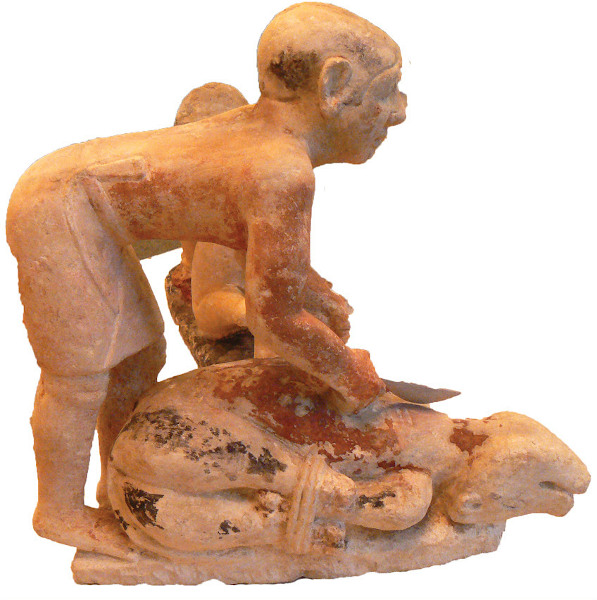
Model of a man slaughtering a bull (Egyptian, 2200 bc). The sin offering required a “young bull without defect” (Lev 4:3).
Kim Walton, taken at the Oriental Institute Museum, University of Chicago
Return to the main text.
4:4 Three principles of atonement are found in this verse: (1) substitution (“present the bull”), (2) identification (“lay his hand on its head”) and (3) the death of the substitute (“slaughter it”).
4:5 blood. See note on 17:11. There were two types of sin offerings. The first (vv. 3–21) and more important was offered by and for a priest or by the elders for the whole community. It involved sprinkling the blood in the tabernacle in front of the inner curtain or, in the case of the solemn Day of Atonement (ch. 16), on and in front of the atonement cover (traditionally “mercy seat”) itself. This type of sin offering was not eaten. The fat, kidneys and covering of the liver were burned on the altar of burnt offering, but all the rest was burned outside the camp (v. 12). Heb 13:11–13 clearly draws the parallel to our sin offering, Jesus, who suffered outside the city gate. In general, the animal to be sacrificed was a young bull, but on the Day of Atonement the sin offering was to be a goat (16:9).
The second type of sin offering (4:22—5:13) was for a leader of the nation or a private individual. Some of the blood was applied to the horns of the altar; the rest was poured out at its base. The fat, kidneys and covering of the liver were burned on the altar, but the rest of the offering was given to the priest and his male relatives as food to be eaten in a holy place (6:29–30; see 10:16–20). The sin offering brought by a private person was to be a female goat or lamb. If such persons were poor, they could bring a dove or young pigeon (5:7–8; 12:6,8; cf. Lk 2:24), or even about two quarts of flour (5:11). The offering included confession (5:5) and the symbolic transfer of guilt by laying hands on the sacrifice (v. 29; 16:21). Then the priest who offered the sacrifice made atonement for the sin, and the Lord promised forgiveness (5:13). By bringing such a sin offering, a faithful Israelite under conviction of sin sought restoration of fellowship with God.
4:6 finger. The right forefinger (14:16). seven. The number was symbolic of perfection and completeness (see note on Ge 5:5). curtain. The shielding curtain that separated the Holy Place from the Most Holy Place (see Ex 26:33 and note on 26:31).
4:7,30 horns. The four horns of the altar (Ex 30:1–3) were symbols of the atoning power of the sin offering (Ex 30:10).
4:12 outside the camp. See note on 13:45–46. So also Jesus was crucified outside Jerusalem (Heb 13:11–13; cf. Lev 9:11; 16:26–28; Nu 19:3; Eze 43:21). ceremonially clean. The distinction between clean and unclean was a matter of ritual or religious purity, not a concern for physical cleanliness (see chs. 11–15 for examples; see also Mk 7:1–4). burn. Since the sins of the offerer were symbolically transferred to the sacrificial bull, the bull had to be entirely destroyed and not thrown on the ash pile of 1:16.
4:15 elders. See note on Ex 3:16.
4:18 altar. Of incense (v. 7).
4:20 sin offering. The offering of the priest who had sinned (see v. 3 and note). will be forgiven. In 4:20—6:7 this is a key phrase, occurring nine times and referring to forgiveness by God.
Sacrifice | OT References | Elements | Purpose |
Burnt Offering | Bull, ram or male bird (dove or young pigeon for the poor); wholly consumed; no defect | Voluntary act of worship; atonement for unintentional sin in general; expression of devotion, commitment and complete surrender to God | |
Grain Offering | Grain, finest flour, olive oil, incense, baked bread (cakes or wafers), salt; no yeast or honey; accompanied burnt offering and fellowship offering (along with drink offering) | Voluntary act of worship; recognition of God’s goodness and provisions; devotion to God | |
Fellowship Offering | Any animal without defect from herd or flock; variety of breads | Voluntary act of worship; thanksgiving and fellowship (it included a communal meal) | |
Sin Offering | 1. Young bull: for high priest and congregation 2. Male goat: for leader 3. Female goat or lamb: for common person 4. Dove or pigeon: for the poor 5. Tenth of an ephah of finest flour: for the very poor | Mandatory atonement for specific unintentional sin; confession of sin; forgiveness of sin; cleansing from defilement | |
Guilt Offering | Ram | Mandatory atonement for unintentional sin requiring restitution; cleansing from defilement; make restitution; pay 20% fine | |
| |||
Go to the Charts Index.
4:23 male goat. Less valuable animals were sacrificed for those with lesser standing in the community or of lesser economic means. Thus a bull was required for the high priest (v. 3) and the whole community (v. 14), but a male goat for a civic leader (here) and a female goat (v. 28) or lamb (v. 32) for an ordinary Israelite. If an offerer was too poor, then doves and pigeons were sufficient (5:7) or even a handful of finest flour (see 5:11–12 and note on 5:11).
4:25 priest. The priest who officiated for the civil authority or the lay person (vv. 30,34).
4:28 female goat. See note on v. 23.
4:29 lay their hand on. See notes on 1:3; Ex 29:10.
4:32 lamb . . . female. See note on v. 23.
4:35 fat . . . of the fellowship offering. See 3:3–5.
5:1–4 Four examples of the unintentional sins (see 4:2–3,13,22,27) that the sin offering covers.
5:2 ceremonially unclean. See note on 4:12.
5:3 human uncleanness. See chs. 11–15.
5:5 confess. The offerers had to acknowledge their sin to God in order to receive forgiveness (cf. Pr 28:13 and note).
5:7 two doves . . . pigeons. See note on 4:23.
5:11 finest flour. See note on 4:23. Although no blood was used with a flour offering, it was offered “on top of the food offerings presented to the LORD” (v. 12). Heb 9:22 may refer to such a situation.
5:12 memorial portion. See note on 2:2,9,16.
5:15 LORD’s holy things. See note on Ex 3:5. according to the sanctuary shekel. See note on Ex 30:13. guilt offering. See further priestly regulations in 7:1–6 (see also Isa 53:10 and note, as well as chart). Traditionally called the “trespass offering,” it was very similar to the sin offering (cf. 7:7), and the Hebrew words for the two were apparently sometimes interchanged. The major difference between the guilt and sin offerings was that the guilt offering was brought in cases where restitution for the sin was possible and therefore required (v. 16). Thus, in cases of theft and cheating (6:2–5), the stolen property had to be returned along with 20 percent indemnity (the standard ancient Near Eastern interest rate on loans). By contrast, the sin offering was prescribed in cases of sin where no restitution was possible. The animal sacrificed as a guilt offering was always a ram.
6:3 lost property. See Dt 22:1–3.
6:6 to the priest, that is, to the LORD. Sacrifices were brought to the Lord, but priests were his authorized representatives.
6:8—7:36 Further regulations concerning the sacrifices, dealing mainly with the portions to be eaten by the priests or, in the case of the fellowship offering, by the one offering the sacrifice.
6:9 burnt offering. See ch. 1; Nu 15:1–16 and notes.
6:13 The perpetual fire on the altar represented uninterrupted offering to and appeal to God on behalf of Israel.
6:14 grain offering. See ch. 2 and notes.
6:15 memorial portion. See note on 2:2,9,16.
6:18 will become holy. See Ex 29:37 and note.
6:25 sin offering. See 4:1—5:13 and notes.
6:28 clay. Ordinary kitchen utensils and domestic ware were made of clay, usually fired in a kiln and often painted or burnished. must be broken. Clay pots, unlike bronze pots, were porous and so might not have been able to be adequately cleansed.
7:2 guilt offering. See 5:14—6:7 and notes. place. On the north side of the altar of burnt offering in front of the tabernacle (1:11; see note there).
7:3 fat tail. See note on 3:9.
7:7–10 See Nu 18:8–20; 1Co 9:13 and notes.
7:11–36 This section supplements ch. 3, adding regulations about (1) three types of fellowship offerings (thank, vv. 12–15; vow, v. 16; freewill, v. 16), (2) prohibition of eating fat and blood (vv. 22–27) and (3) the priests’ share (vv. 28–36).
7:12–15 Thank offerings were given in gratitude for deliverance from sickness (Ps 116:17), trouble (Ps 107:22) or death (Ps 56:12) or for a blessing received.
7:13 with yeast. This regulation does not contradict the prohibition of 2:11 or Ex 23:18 since the offering here was not burned on the altar.
7:15–18 See 19:5–8. All meat had to be eaten promptly (in the case of the thank offering on the same day and in the case of the vow and freewill offerings within two days). One reason may have been that meat spoiled quickly and thus became ceremonially impure (v. 18) because it was then not perfect (1:3; see 21:16–23). The prohibition applied also to the Passover (Ex 12:10).
7:16 vow. See 22:18–23. A vow was a solemn promise to offer a gift to God in response to a divine deliverance or blessing. Such vows often accompanied prayers for deliverance or blessing (see note on Ps 7:17; see also Introduction to Psalms: Psalm Types). freewill offering. See 22:18–23.
7:19 ceremonially unclean. See note on 4:12.
7:20 cut off from their people. Removed from the covenant people through direct divine judgment (Ge 17:14), or (as here and in vv. 21,25,27; 17:4,9–10,14; 18:29; 19:8; 20:3,5–6,17–18; 23:29) through execution (see, e.g., 20:2–3; Ex 31:14) or possibly through banishment.
7:23 fat. The prohibition of fat for food was as strict as that of blood, but the reason was different. The fat of the fellowship offerings was the Lord’s and was to be burned on the altar (see 3:16 and note). There was no explicit prohibition of eating the fat of hunted animals like the gazelle or deer, but probably that was included (3:17; Dt 12:15–22).
7:26 not eat the blood. See note on 17:11; see also 3:17; 19:26; Ge 9:4–6; Dt 12:16, 23–25; 15:23; 1Sa 14:32–34; Eze 33:25.
7:28–36 See 10:12–15; Nu 18:8–20; Dt 18:1–5.
7:30–32 breast . . . right thigh. The breast and right thigh given to the priest were first presented to the Lord with gestures described as waving the breast and presenting the thigh (v. 34). See 8:25–29; 9:21; 10:14–15; Ex 29:26–27; Nu 6:20; 18:11,18.
7:37–38 A summary of chs. 1–7.
7:37 ordination offering. See 8:14–36; Ex 29:1–35.
8:1—10:20 The ordination, installation and ministry of Aaron and his sons, and the deaths of Nadab and Abihu and attendant regulations.
8:2 their garments. See Ex 39:1–31; 40:12–16. The garments that the high priest was to wear when he ministered are detailed in Ex 28:4–43 (see notes there). anointing oil. See note on Ex 25:6. The oil was used to anoint the tabernacle, sacred objects and consecrated priests (vv. 10–12,30). It was later used to anoint leaders and kings (1Sa 10:1; 16:13). See also note on Ex 29:7.
8:6 washed them with water. In the bronze basin (v. 11) in the courtyard of the tabernacle (Ex 30:17–21).
8:7 ephod. See note on Ex 28:6.
8:8 Urim and Thummim. See notes on Ex 28:30; 1Sa 2:28.
8:9 sacred emblem. See note on Ex 39:30.
8:11 seven times. See note on 4:6.
8:12 oil on Aaron’s head. See Ps 133.
8:14 sin offering. See 4:3–11 and notes. The consecration service included a sin offering for atonement, a burnt offering for worship (v. 18) and a “ram for the ordination” (v. 22), whose blood was applied to the high priest on his right ear, thumb and toe (v. 23). After this was done, Aaron offered sacrifices for the people (9:15–21). Then he blessed the people in his capacity as priest, and the Lord accepted his ministry with the sign of miraculous fire (9:23–24). laid their hands on. See notes on 1:3; Ex 29:10.
8:15 make atonement for it. See 16:16; see also note on Ex 29:36.
8:17 outside the camp. See notes on 4:5,12; 13:45–46; Eze 43:21; Heb 13:12–13.
8:23 Putting some of the blood on Aaron’s extremities signified his complete consecration to the Lord’s service (cf. note on v. 14).
8:27 wave offering. See note on 7:30–32.
8:28 on top of the burnt offering. See note on 3:5.
8:31 Aaron and his sons are to eat it. See Ex 29:32.
9:1 eighth day. After the seven days of ordination (8:33).
9:2 sin offering. See notes on 4:3,5. burnt offering. See note on 1:3.
9:4 fellowship offering. See note on 3:1. grain offering. See note on 2:1. LORD will appear. See vv. 6,23; see also note on Ge 12:7.
9:6,23 glory of the LORD. See notes on Ex 16:7; 40:34; Ps 26:8; Eze 1:1–28.
9:8 sin offering for himself. Contrast Jesus in Heb 7:26–28 (see notes there).
9:9 blood . . . on the horns. See photos here and here.
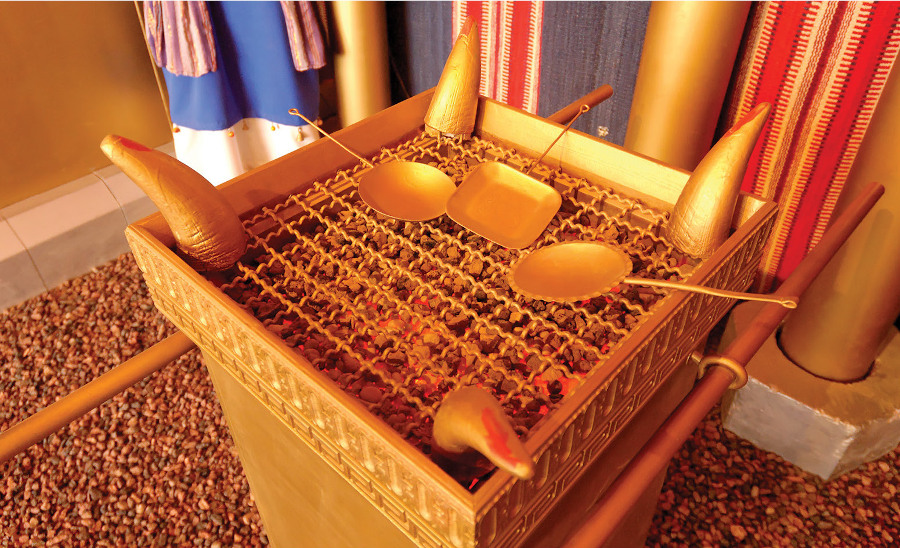
Model of the tabernacle altar. The blood that the priests would spread on the four horns (Lev 9:9) can be seen here.
Todd Bolen/BiblePlaces.com
Return to the main text.
9:11 outside the camp. See note on 8:17.
9:17 morning’s burnt offering. See Ex 29:38–42.
9:21 wave offering. See note on 7:30–32.
9:22 blessed. The Aaronic benediction, a threefold blessing, is given in Nu 6:23–26. Cf. the threefold apostolic benediction in 2Co 13:14.
9:23 glory of the LORD. See v. 6; cf. the display of the Lord’s glory at the erection of the tabernacle (Ex 40:34–35); cf. also God’s acceptance of sacrifices at the dedication of Solomon’s temple (2Ch 7:1).
9:24 Fire came out from the presence of the LORD. See 10:2; 1Ki 18:38.
10:1 censers. Ceremonial vessels containing hot coals and used for burning incense (see 16:12–13; 2Ch 26:19; Rev 8:3–4; see also photo).
10:2 died before the LORD. Aaron’s older sons are mentioned also in Ex 6:23; 24:1,9; 28:1; Nu 3:2–4; 26:60–61; 1Ch 6:3; 24:1–2. They are regularly remembered as having died before the Lord and as having had no sons. Their death was tragic and at first seems harsh, but no more so than that of Ananias and Sapphira (Ac 5:1–11). In both cases a new era was being inaugurated (cf. also the judgment on Achan, Jos 7, and on Uzzah, 2Sa 6:1–7). The new community had to be made aware that it existed for God, not vice versa.
10:3 The quotation reflects the spirit and substance of passages like Ex 14:4; 19:22; 29:1,44; 30:29. be proved holy. Israel was to act so as to publicly display God’s holiness (see 11:44 and note; see also Nu 20:13; Isa 5:16; Eze 20:41; 28:22,25; 36:23; 38:16; 39:27). holy. See Introduction: Theological Themes.
10:4 outside the camp. See note on 8:17.
10:6 not tear your clothes. As God’s representative, the priest must reflect God’s righteous judgment rather than display his own sorrow. See 21:10; see also note on Ge 44:13.
10:7 Do not leave. To join the mourners (21:11–12).
10:10 between the holy and the common. See 11:44 and note. The distinction between what was holy (sacred; see note on Ex 3:5) and what was common (not associated with the sacred) was carefully maintained (Eze 22:26; 42:20; 44:23; 48:14–15).
10:12–15 See 7:28–36; Nu 18:8–20; Dt 18:1–5.
10:18 Since its blood was not taken into the Holy Place, you should have eaten. There were two types of sin offerings: (1) those in which the blood was sprinkled within the tabernacle, and (2) those in which it was splashed only against the altar of burnt offering. Portions of the second type normally should have been eaten (see note on 4:5). But Moses was satisfied when he learned that Aaron had acted sincerely and not in negligence or rebellion (vv. 19–20).
10:19 such things as this have happened to me. Probably referring to the death of his two oldest sons (v. 2), for which he mourned by fasting, which was a private rather than a public act (v. 6).
11:1—15:33 The distinction between clean and unclean (see note on 11:2).
 11:2 the ones you may eat. Ch. 11 is closely paralleled in Dt 14:3–21 but is more extensive. The animals acceptable for human consumption were those that chewed the cud and had a divided hoof (v. 3). Of marine life, only creatures with fins and scales were permissible (v. 9). Birds and insects are also covered in the instructions (vv. 13–23). Some distinction between clean and unclean food was as old as the time of Noah (see Ge 7:2 and note). The main reason for the laws concerning clean and unclean food is the same as for other laws concerning the clean and unclean—to preserve the sanctity of Israel as God’s holy people (see v. 44 and note). Some hold that certain animal life was considered unclean for health considerations, but it is difficult to substantiate this idea. Uncleanness typified sin. For the uncleanness of disease and bodily discharges, see chs. 13–15.
11:6 rabbit. Does not technically chew the cud with regurgitation. The apparent chewing movements of the rabbit caused it to be classified popularly with cud chewers.
11:20 all fours. Although insects have six legs, perhaps people in ancient times did not count as ordinary legs the two large hind legs that many insects used for jumping.
11:36 cistern for collecting water. The use of waterproof plaster for lining cisterns dug in the ground was an important factor in helping the Israelites to settle the dry areas of Canaan after the conquest (cf. 2Ch 26:10). Therefore the cisterns were not porous and remained ceremonially clean.
11:41 ground. Verses 29–30 identify the animals that move about (or swarm) on the ground.
11:44 be holy. Quoted in 1Pe 1:16 (see note there; see also Introduction to Leviticus: Theological Themes). Holiness is the key theme of Leviticus, ringing like a refrain in various forms throughout the book (e.g., v. 45; 19:2; 20:7,26; 21:8,15; 22:9,16,32). The word “holy” appears more often in Leviticus than in any other book of the Bible. Israel was to be totally consecrated to God. Their holiness was to be expressed in every aspect of their life, to the extent that all of life had a certain ceremonial quality. Because of who God is and what he has done (v. 45), his people must dedicate themselves fully to him (cf. Mt 5:48). See Ro 12:1. I am holy. When God’s holiness is spoken of in the Bible, reference is to (1) his incomparably awesome majesty and (2) his absolute moral virtue. Sometimes one of these aspects is foregrounded, sometimes the other, but often both are evoked together (as in Isa 6:3–5).
11:45 brought . . . out of Egypt. A refrain found 8 more times in Leviticus (19:36; 22:33; 23:43; 25:38,42,55; 26:13,45) and nearly 60 times in 18 other books of the OT.
12:2 unclean. The uncleanness came from the bleeding (vv. 4–5,7), not from the birth. A woman’s impurity after childbirth (14 days) was twice as great as that for her period (7 days), But with a male child, she had to participate in his circumcision on the eighth day, and so her impurity was reduced to 7 days. The other differences in the laws in vv. 4–5 do not establish an inherently greater value of male children because the offerings in vv. 6–8 are the same for both genders. monthly period. See 15:19–24.
12:3 See notes on Ge 17:10,12.
12:6 burnt offering. See note on 1:3. sin offering. See notes on 4:3,5.
12:7 The last sentence in this verse is a summary of ch. 12.
12:8 An appendix prescribing alternative sacrifices for people who were poor. See 1:14–17 and note on 1:14; see also 5:7–10; 14:21–22; and especially Lk 2:24 (Mary’s offering for Jesus).
13:1–46 This section deals with preliminary symptoms of skin diseases (vv. 1–8) and then with the symptoms of (1) raw flesh (vv. 9–17), (2) boils (vv. 18–23), (3) burns (vv. 24–28), (4) sores on the head or chin (vv. 29–37), (5) white spots (vv. 38–39) and (6) skin diseases on the head that cause baldness (vv. 40–44).
13:2 defiling skin disease. Occurs often in chs. 13–14; see also 22:4; Nu 5:2. Such diseases show visible defects that could function aptly as a symbol for defilement—as could mold (cf. vv. 47–59). disease. See NIV text note; see also 22:4–8; Nu 5:2–4; Dt 24:8–9. The symptoms described, and the fact that they may rapidly change (vv. 6,26–27,32–37), show that the disease was not necessarily true leprosy (Hansen’s disease). They apply also to a number of other diseases, as well as to rather harmless skin eruptions. The Hebrew word translated “defiling skin disease” can also mean “mold” (v. 47; 14:34; and especially 14:57).
13:3 ceremonially unclean, Not the same as sinful. See article.
13:45–46 The ceremonially unclean were excluded from the camp (the area around the tabernacle and courtyard), where the Israelites lived in tents. Later, no unclean persons were allowed in the temple area, where they could mingle with others. God was present in a special way not only in the tabernacle but also in the camp (Nu 5:3; Dt 23:14). Therefore unclean people were not to be in the camp (see Nu 5:1–4; 12:14–15, Miriam; 31:19–24; see also Lev 10:4–5; Nu 15:35–36; 2Ki 7:3–4; 2Ch 26:21, Uzziah). As a result of their separation from God, they were to exhibit their grief by tearing their clothes, by having unkempt hair and by partially covering their faces (v. 45).
13:47 defiling mold. During Israel’s rainy season (October through March), this is a problem along the coast and by the Sea of Galilee, where it is very humid.
13:54 washed. See vv. 34,55–56,58. The treatment of these disorders commonly included washing.
13:55 not changed. Indicates that the treatment was ineffective.
14:1–32 The ritual after the skin disease had been cured had three parts: (1) ritual for the first week (outside the camp, vv. 1–7), (2) ritual for the second week (inside the camp, vv. 8–20) and (3) special permission for the poor (vv. 21–32).
14:4 hyssop. A plant used in ceremonial cleansing (see note on Ex 12:22).
14:5 killed. Diseases and disorders were a symbol of sin and rendered a person or object ceremonially unclean. The prescribed cleansing included sacrifice as well as washing (see note on 13:54).
14:6 cedar . . . yarn . . . hyssop. Also used for cleansing in vv. 51–52; Nu 19:6 (see note there).
14:7,16,51 Seven times. See note on 4:6.
14:7 clean. Perhaps the yarn and cedar stick were used as well as the hyssop plant to sprinkle the blood for cleansing (see Ps 51:7 and note). Further sacrifices are specified in vv. 10–31. release the live bird. Cf. 16:22; see note on 16:5.
14:8 The Levites were similarly cleansed (see Nu 8:7 and note).
14:10 grain offering. See note on 2:1. log of oil. See second NIV text note on v. 10.
14:12 guilt offering. See 5:14—6:7 and note on 5:15. wave offering. See note on 7:30–32.
14:13 most holy. See note on Ex 3:5.
14:18–21,29,31 atonement. See notes on 16:20–22; 17:11; Ex 25:17; cf. note and NIV text note on Ro 3:25.
14:19 sin offering. See 4:1—5:13 and notes on 4:3,5. burnt offering. See note on 1:3.
14:20 grain offering. See note on 2:1.
14:33–53 There are many similarities between this section and the previous one, particularly in the manner of restoration.
14:45 torn down. A house desecrated by mold or fungus would be a defiled place to live in, so drastic measures had to be taken.
14:54–57 A summary of chs. 13–14.
15:1–33 The chapter deals with (1) male uncleanness caused by bodily discharge (vv. 2–15) or emission of semen (vv. 16–18); (2) female uncleanness caused by her monthly period (vv. 19–24) or lengthy hemorrhaging (vv. 25–30); (3) summary (vv. 31–33).
15:2 bodily discharge. Probably either diarrhea or urethral discharge (various kinds of infections). The contamination of anything under the man (v. 10), whether he sat (vv. 4,6,9) or lay (v. 4) on it, indicates that the bodily discharge had to do with the buttocks or genitals.
15:4 bed. Something like a mat (cf. 2Sa 11:13).
15:13 cleansed. God brought about the healing; the priest could only ascertain that a person was already healed.
15:15 sin offering . . . make atonement. Not necessarily for sin. Such offerings were also necessary for ceremonial cleansing (see chart).
15:16 semen. Normal sexual activity and a woman’s menstruation required no sacrifices but only washing and a minimal period of uncleanness.
15:19 seven days. See 12:2. This regulation is the background of 2Sa 11:4 (Bathsheba; see note there).
15:20 See note on Ge 31:35; see also article.
Included in the OT law are certain purity regulations. These laws focused on representing the distinction between God, as supremely holy, and sinful humanity, as well as to call Israel to a distinctive holiness—to be like their God (Lev 19:2). The specific purpose of these purity laws was to prepare Israel to live in God’s presence, so they were especially a point of focus when approaching and participating at the tabernacle (Lev 15:31) and later the temple.
In the book of Leviticus, an important distinction is made between what and who has been set apart as holy (and so ready for temple use) and what is common. What is common is then further understood as divided between the clean and the unclean. Clean (or pure) is the normal condition of most things and persons, which then can be sanctified for holy purposes as needed. What is unclean is unable to be in contact with what is holy. This is why certain unclean animals, like pigs and rabbits, were forbidden as food for Israel (Lev 11:6–7) and why only clean animals could be used for sacrifices. Unclean animals were permanently unclean and could not be restored to a state of purity.
Alternatively, individual Israelites could and did move between states of cleanness and uncleanness. Normal human activities like contracting a disease, going through childbirth, or having a bodily discharge would render a person unclean for a certain period of time. Depending on the source of contamination, those who came in contact with an unclean person (or something they had contact with) might also become unclean.
To be restored to a state of purity was not particularly difficult and could sometimes be accomplished by ritual washing and/or waiting for the arrival of evening (e.g., Lev 11:24–25; 15:6,16, 21,27). In other cases, there was a longer waiting period (e.g., seven days [Lev 13:4, 4,21,26]), before ceremonial washing, and possibly offerings presented in the tabernacle, would restore the person to a state of ritual purity (e.g., Lev 15:13–15,28–30; cf. Mt 8:4; Lk 2:22–24). The offerings in most cases were the sin offering and the burnt offering (e.g., Lev 15:15). The sin offering might be offered after the commission of an unintentional sin (e.g., 4:27–29), but it was also to be offered for the purposes of purification apart from any specific sin, such as in purification after childbirth (12:6–7; see chart).
The Israelites were commanded to be attentive to purity regulations so that, as a people, they might not endanger themselves, the whole community, or even the land itself (e.g., Nu 19:13).
Go to the Articles Index.
15:24 flow. A husband was prohibited from having sex with his wife during her period (18:19), but this appears to be a case of a woman’s period beginning during intercourse.
15:25 discharge of blood for many days. As, e.g., the woman in Mt 9:20 (see note on Mk 5:25). beyond her period. An unnatural discharge, possibly caused by disease, was treated like a sickness and required an offering upon recovery (vv. 28–30; see vv. 14–15).
15:30 sin offering . . . make atonement. See note on 15:15.
15:31 Addressed to the priests, thus emphasizing the importance of the regulations. Since God dwelt in the tabernacle, any unholiness, symbolized by the discharges of ch. 15, could result in death if the people came into his presence. Sin separates all people from a holy God and results in their death unless atonement is made (see the next chapter).
16:1 sons of Aaron who died. See 10:1–3.
The Day of Atonement was celebrated annually on the tenth day of the month of Tishri (early autumn; see chart). Its purpose was to make atonement for the sins of the priests and of the people of Israel, as well as to purify the Most Holy Place, the tent of meeting, and the altar (Lev 16:33; cf. Heb 9:7). The Israelites were to do no work on the Day of Atonement, as it was “a day of sabbath rest” (Lev 16:31; 23:32). They were also to “deny themselves” (16:29,31; 23:27), an expression interpreted to indicate a requirement of fasting (see note on 16:29,31).
The order of tabernacle (later, temple) procedure for the Day of Atonement was as follows: (1) The high priest went to the basin in the courtyard, removed his regular garments, washed himself and went into the Holy Place to put on the special garments for the Day of Atonement (v. 4). (2) He went out to sacrifice a bull at the altar of burnt offering (see photo) as a sin offering for himself and the other priests (v. 11). (3) He went into the Most Holy Place with some of the bull’s blood, with incense and with coals from the altar of burnt offering (vv. 12–13). The incense was placed on the burning coals, and the smoke of the incense hid the ark from view. (4) He sprinkled some of the bull’s blood on and in front of the atonement cover of the ark (v. 14). (5) He went outside the tabernacle and cast lots for two goats to see which was to be sacrificed and which was to be the scapegoat (vv. 7–8). (6) At the altar of burnt offering the high priest killed the goat for the sin offering for the people, and for a second time he went into the Most Holy Place, this time to sprinkle the goat’s blood in front of and on the atonement cover (vv. 5,9,15–16a). (7) He returned to the Holy Place (called the “tent of meeting” in v. 16) and sprinkled the goat’s blood there (v. 16b). (8) He went outside to the altar of burnt offering and sprinkled the blood of the goat and the bull on it “to consecrate it from the uncleanness of the Israelites” (with “the Israelites” here apparently including both Aaron and his household [v. 11] and all the rest of the people [v. 15]). (9) While in the courtyard, he laid both hands on the second goat, thus symbolizing the transfer of Israel’s sin, and sent it out into the wilderness (vv. 20–22). (10) A man chosen to take the goat away (v. 21), after he had done so, washed himself and his clothes outside the camp (v. 26) before rejoining the people. (11) The high priest entered the Holy Place to remove his special garments (v. 23). (12) He went out to the basin to wash and put on his regular priestly clothes (v. 24). (13) As a final sacrifice he went out to the altar and offered a ram (v. 3) as a burnt offering for himself, and another ram (v. 5) for the people (v. 24). (14) The conclusion of the entire day was the removal of the sacrifices for the sin offerings to a place outside the camp, where they were burned, and there the man who performed this ritual bathed and washed his clothes (vv. 27–28) before rejoining the people.
Go to the Articles Index.
16:2 atonement cover. See Ex 25:17 and note. Blood sprinkled on the lid of the ark made atonement for Israel on the Day of Atonement (vv. 15–17; see article). In the Septuagint (the pre-Christian Greek translation of the OT) the word for “atonement cover” is the same one used of Christ and translated “sacrifice of atonement” in Ro 3:25 (see NIV text note there; see also Heb 9:5).
16:3 bull. For Aaron’s cleansing (vv. 6,11). Before Aaron could minister in the Most Holy Place for the nation, he himself had to be cleansed (Heb 5:1–3); not so Christ, who is our high priest and the one Aaron foreshadows (Heb 7:26–28).
16:5 two male goats for a sin offering. One was the usual sin offering (see notes on 4:3,5) and the other a scapegoat. No single offering could fully typify the atonement of Christ. The one goat was killed, its blood sprinkled in the Most Holy Place and its body burned outside the camp (vv. 15,27), symbolizing the payment of the price of Christ’s atonement. The other goat, sent away alive and bearing the sins of the nation (v. 21), symbolized the removal of sin and its guilt. ram. For the sins of the people; the one in v. 3 was for the sins of the high priest. Both were sacrificed at the end of the ceremony (v. 24).
16:6–10 An outline of vv. 11–22.
16:8 scapegoat. See NIV text note.
16:11 make atonement for himself. See note on v. 3.
16:13 smoke of the incense. Covered the ark so that the high priest would not see the glorious presence of God (v. 2) and thus die. the tablets of the covenant law. See note on Ex 25:22.
16:14 See Ro 3:25 and note. seven times. See note on 4:6.
16:16 tent of meeting. Here and in vv. 17,20,33 the term refers to the Holy Place.
16:20–22 A summary description of substitutionary atonement. The sin of the worshipers was confessed and symbolically transferred to the sacrificial animal, on which hands were laid (see notes on 1:3; Ex 29:10; see also Lev 1:4; 3:8; 4:4; cf. Isa 53:6; Jn 1:29; 1Pe 2:24).
16:24 sanctuary area. Cf. 6:26. burnt offering . . . burnt offering. The two rams mentioned in vv. 3,5.
16:25 fat of the sin offering. See 4:8–10.
16:27 outside the camp. See note on 4:12.
16:29,31 deny yourselves. Or “humble yourselves.” See NIV text note on v. 29. The expression can refer to fasting (Ps 35:13). The Day of Atonement was the only regular fast day stipulated in the OT (see 23:27,29,32 and NIV text note on v. 29), though tradition later added other fast days to the Jewish calendar (see Zec 7:5; 8:19 and note).
16:29 seventh month. Tishri, the seventh month, begins with the Festival of Trumpets (see note on 23:24). The Day of Atonement follows on the 10th day, and on the 15th day the Festival of Tabernacles begins (23:23–36). See also chart.
16:30 clean from all your sins. See notes on Heb 9:12,28.
16:34 once a year. Heb 9:11—10:14 repeatedly contrasts this with Christ’s “once for all” sacrifice.
17:1—26:46 Sometimes called the “Holiness Code,” these chapters deal with regulations for holy living and holy practices in various areas of life (see Introduction: Theological Themes; Outline; see also note on 11:44).
17:4 tabernacle of the LORD. The people, with few exceptions (e.g., Dt 12:15,20–21), were directed to sacrifice only at the central sanctuary (Dt 12:5–6). Sennacherib’s representative referred to Hezekiah’s requiring worship only in Jerusalem (2Ki 18:22). One reason for such a regulation was to keep the Israelites from becoming corrupted by the Canaanites’ pagan worship. cut off from their people. See note on 7:20.
17:5 to the priest, that is, to the LORD. See note on 6:6.
17:7 prostitute themselves. See Ex 34:15 and note.
17:11 the life of a creature is in the blood. See note on Ge 9:4. The blood shed in the sacrifices was sacred. It epitomized the life of the sacrificial victim. Since life was sacred, blood (a symbol of life) had to be treated with respect (Ge 9:5–6). Eating blood was therefore strictly forbidden (7:26–27; Dt 12:16, 23–25; 15:23; 1Sa 14:32–34). blood . . . makes atonement. Practically every sacrifice included the splashing of blood against the altar or the sprinkling of blood within the tabernacle (v. 6; 1:5; 3:2; 4:6,25; 7:2), thus teaching that atonement involves the substitution of life for life. The blood of the OT sacrifice pointed forward to the blood of the Lamb of God, who obtained for his people “eternal redemption” (Heb 9:12). “Without the shedding of blood there is no forgiveness” (Heb 9:22).
17:15 found dead or torn. Such animals would not have had the blood drained from them and therefore would be forbidden.
18:1—20:27 Here God’s people are given instructions concerning interpersonal relations and a morality reflecting God’s holiness. Israel was thereby prepared for a life different from that of the Canaanites, whose lifestyle was deplorably immoral. Ch. 18 marks the boundaries for marriage and sexual relations (but see also v. 21 and note); ch. 19 provides specific moral guidance on a variety of matters, many of which are implicitly covered by the Ten Commandments; and ch. 20 specifies the penalties for violating God’s standard of morality. See chart.
18:2 In chs. 18–26 the phrase “I am the LORD” occurs 47 times. The Lord’s name (i.e., his revealed character as Yahweh, “the LORD”) is the authority that stands behind his instructions. See note on Ex 3:15.
18:3 Six times in this chapter Israel is warned not to follow the example of pagans (here, two times; see also vv. 24,26–27,30).
18:5 live. With God’s full blessing. The law was the way of life for the redeemed (see Dt 6:2; 8:2–3; 30:20 and notes; 32:47; Eze 20:11, 13,21), not a way of salvation for the lost (Ro 10:5; Gal 3:12).
18:6 A summary of the laws against incest (vv. 7–18). Penalties for incestuous relations are given in ch. 20. (Cf. 1Co 5.)
18:7 This prohibition applied also after the father’s death.
18:8 your father’s wife. Other than your mother—assuming there is more than one wife.
18:11 sister. There would be many half sisters in a polygamous society. Tamar claimed that an exception to this prohibition could be made (2Sa 13:12–13; but see note there).
18:14 your aunt. See 20:20. If the father’s brother was alive, the act would be adulterous. If he was dead, one could rationalize such a marriage because the aunt was not a blood relative—but it was still forbidden.
18:15 Cf. the account of Judah and Tamar (Ge 38:18).
18:16 your brother’s wife. The law also applied to a time after divorce or the brother’s death. To marry one’s brother’s widow was not immoral but might damage the brother’s inheritance. The levirate law of Dt 25:5–6 offered an exception that preserved the dead brother’s inheritance and continued his line.
18:17 daughter. Primarily a stepdaughter (granddaughter-in-law is also covered in the verse). The law applied even after the mother’s death.
18:18 Cf. the account of Jacob with Leah and Rachel (Ge 29:23–30).
18:21 Molek. The god of the Ammonites (see 20:2–5; 1Ki 11:5 and note). The detestable practice of sacrificing children to Molek was common in Phoenicia and other surrounding countries. Cf. 2Ki 3:26–27. King Manasseh evidently sacrificed his sons to Molek (2Ch 33:6; see 2Ki 23:10). Jer 32:35 protests the practice. profane the name of your God. Whatever blatantly violates God’s revealed will desecrates his name (see note on Ps 5:11) because it fails to honor his holiness (see note on Lev 11:44).
18:22 have sexual relations with a man. See 20:13; Ro 1:26–27 and note on v. 27.
18:29 detestable. See note on 7:21. cut off from their people. See note on 7:20.
19:1–37 See note on 18:1—20:27.
19:2 Be holy. See note on 11:44.
19:3–4 See 18:30; see also Ex 20:4–6,8–12 and notes; and see chart.
19:5 fellowship offering. See note on 3:1.
19:6 third day. See note on 7:15–18.
19:8 what is holy to the LORD. See note on Ex 3:5. cut off from their people. See note on 7:20.
19:9–10 See 23:22; see also Dt 24:19–21. Ru 2 gives an example of the application of the law of gleaning.
19:11–12 See Ex 20:7,15–16 and notes.
19:13 wages of a hired worker. See Dt 24:14–15; Mt 20:8.
19:17 Do not hate a fellow Israelite. See 1Jn 2:9, 11; 3:15; 4:20.
19:18 love your neighbor as yourself. See v. 34; quoted by Christ (Mt 22:39; Mk 12:31; Lk 10:27), Paul (Ro 13:9; Gal 5:14) and James (2:8). Jesus’ reaction, “Love your enemies” (Mt 5:44; see note there), was in line with true OT teaching (vv. 17,34). “Neighbor” does not merely mean one who lives nearby, but anyone with whom one comes in contact (see Lk 10:25–36 and notes).
19:19 Do not mate . . . plant . . . wear. The distinction God established in the creation order, reflecting the distinction God established between Israel and the surrounding nations.
19:21–22 guilt offering. See 5:14—6:7 and note on 5:15.
19:26 meat with the blood. See note on 17:11. seek omens. See v. 31; Ex 22:18; Dt 18:14; 1Sa 28:9; Isa 47:12–14.
19:27 Do not cut the hair at the sides of your head. Probably to avoid imitation of pagan practices (see v. 28 and note).
19:28 cut your bodies. There was to be no disfiguring of the body, after the manner of the pagans (see note on 21:5). tattoo marks. Likely related to pagan practices or worship.
19:31 mediums . . . spiritists. Practitioners of the occult; consulting a medium was no less a sin than being one (v. 27). See Dt 18:10–11 and note on 18:9; Isa 3:2–3. Only God was to be consulted—through either the priest or a prophet (see Isa 8:19–20 and notes).
19:34 you were foreigners in Egypt. See Dt 5:15.
19:35 dishonest standards. In a culture with no bureau of weights and measures, cheating in business transactions by falsification of standards was common (see Dt 25:13–16; Pr 11:1 and note; 16:11 and note; 20:10,23). The prophets also condemned such sin (Am 8:5; Mic 6:10–11).
20:1–27 In ch. 20 many of the same sins listed in ch. 18 are mentioned again, but this time usually with the death penalty specified. Israel’s God is a jealous God who tolerates no rivals (see note on Ex 20:5). He requires exclusive allegiance (see Ex 20:3 and note). See note on 18:1—20:27.
20:2–5 Molek. See note on 18:21.
20:2 put to death. All OT sins that merit capital punishment are inherently immoral and so remain sinful for all time, even if the societal penalties for such sins change.
20:3 cut him off from his people. See note on 7:20.
20:5 prostituting themselves. See Ex 34:15 and note.
20:6 mediums and spiritists. See note on 19:31.
20:7 be holy. See note on 11:44.
20:8 who makes . . . holy. This phrase and the expression “I am the LORD (your God)” are characteristic of chs. 18–26.
20:9 Cf. the penalty of a rebellious son in Dt 21:20–21.
20:13 detestable . . . death. The penalty for doing things the Lord detested was severe (see note on 7:20).
20:24 flowing with milk and honey. A common phrase in Exodus, Numbers and Deuteronomy (see notes on Ex 3:8; Dt 6:3; see also Jos 5:6; Jer 11:5; 32:22; Eze 20:6,15).
21:1—22:33 Directions for the priests’ conduct, especially about separation from ceremonial uncleanness.
21:1 for any . . . who die. Touching a corpse (Nu 19:11) or entering the home of a person who had died (Nu 19:14) made one unclean. A priest was to contract such uncleanness only at the death of a close relative (vv. 2–3), and the regulations for the high priest denied him even this (vv. 11–12).
21:5 cut their bodies. See 19:27–28. Such lacerations and disfigurement were common among pagans as signs of mourning and to secure the attention of their deity (1Ki 18:28).
21:6 They must be holy to their God. As those especially set apart for service at God’s sanctuary and who represent him in a special way, the priests must be especially careful to retain ceremonial and moral purity (see 11:44; Ex 3:5 and notes). food of their God. See note on 3:11,16.
21:8 I . . . am holy. See note on 11:44.
21:10–15 As the chief representative of the people before God, the high priest was held to an even higher standard of purity than the other priests (see note on v. 6).
21:17 defect. Like the sacrifices that had to be without defect, the priests typified Christ’s perfection (Heb 9:13–14).
21:23 curtain. Between the Holy Place and the Most Holy Place (Ex 26:33).
22:3 cut off from my presence. Excluded from the worshiping community. See note on 7:20.
22:4 See 13:1–46 and note on 13:45–46; 15:1–18 and notes; 21:11.
22:9 die for treating it with contempt. The penalties were far more severe for the priests, who had greater responsibility before God. Cf. Nadab and Abihu (10:1–3) and the faithless priests of Malachi’s day (Mal 1:6—2:9). holy. See note on 11:44.
22:11 may eat his food. Because they are part of the priest’s household.
22:14 make restitution . . . add a fifth. Cf. 5:16 and note on 5:15.
22:16 holy. See note on 11:44.
22:18 burnt offering. See note on 1:3.
22:21 fellowship offering. See note on 3:1.
22:23 You may . . . present. A freewill offering, unlike the offering for fulfilling a vow, was voluntary and so did not require an unblemished animal.
22:30 that same day. The rule applied also to the Passover (Ex 34:25); however, the fellowship offering could be saved and eaten on the following day (7:16).
22:32 holy . . . holy . . . holy. See 11:44; 18:21 and notes.
Old Testament Festivals and Other Sacred Days
Name: Sabbath
Old Testament References: Ex 20:8–11; 31:12–17; Lev 23:3; Dt 5:12–15
Old Testament Time: 7th day
Modern Equivalent: Same
Description: Day of rest; no work
Purpose: Rest for people and animals
New Testament References: Mt 12:1–14; 28:1; Lk 4:16; Jn 5:9–10; Ac 13:42; Col 2:16; Heb 4:1–11
Name: Sabbath Year
Old Testament References: Ex 23:10–11; Lev 25:1–7
Old Testament Time: 7th year
Modern Equivalent: Same
Description: Year of rest; fallow fields
Purpose: Rest for land
Name: Year of Jubilee
Old Testament References: Lev 25:8–55; 27:17–24; Nu 36:4
Old Testament Time: 50th year; Nisan
Modern Equivalent: Same
Description: Canceled debts; liberation of slaves and indentured servants; land returned to original family owners
Purpose: Help for poor; stabilize society
New Testament References: Lk 4:18–19
Name: Passover
Old Testament References: Ex 12:1–14; Lev 23:5; Nu 9:1–14; 28:16; Dt 16:1–3a,4b–7
Old Testament Time: 1st month (Aviv; Nisan) 14
Modern Equivalent: March–April
Description: Slaying and eating a lamb, together with bitter herbs and bread made without yeast, in every household
Purpose: Remember Israel’s deliverance from Egypt
New Testament References: Mt 26:17; Mk 14:12–26; Jn 2:13; 11:55; 1Co 5:7; Heb 11:28
Name: Unleavened Bread
Old Testament References: Ex 12:15–20; 13:3–10; 23:15; 34:18; Lev 23:6–8; Nu 28:17–25; Dt 16:3b, 4a,8
Old Testament Time: 1st month (Aviv) 15–21; Nisan
Modern Equivalent: March–April
Description: Eating bread made without yeast; holding several assemblies; making designated offerings
Purpose: Remember how the Lord brought the Israelites out of Egypt in haste
New Testament References: Mk 14:1; Ac 12:3; 1Co 5:6–8
Name: Firstfruits
Old Testament References: Lev 23:9–14
Old Testament Time: 1st month (Aviv; Nisan) 16
Modern Equivalent: March–April
Description: Presenting a sheaf of the first of the barley harvest as a wave offering; making a burnt offering and a grain offering
Purpose: Recognize the Lord’s bounty in the land
New Testament References: Ro 8:23; 1Co 15:20–23
Name: Weeks (Pentecost) (Harvest)
Old Testament References: Ex 23:16a; 34:22a; Lev 23:15–21; Nu 28:26–31; Dt 16:9–12
Old Testament Time: 3rd month (Sivan) 6;
Modern Equivalent: May–June
Description: A festival of joy; mandatory and voluntary offerings, including the firstfruits of the wheat harvest
Purpose: Show joy and thankfulness for the Lord’s blessing of harvest
New Testament References: Ac 2:1–4; 20:16; 1Co 16:8
Name: Trumpets (later: Rosh Hashanah–New Year’s Day)
Old Testament References: Lev 23:23–25; Nu 29:1–6
Old Testament Time: 7th month (Tishri; Ethanim) 1
Modern Equivalent: September–October
Description: An assembly on a day of rest commemorated with trumpet blasts and sacrifices
Purpose: Present Israel before the Lord for his favor
Name: Day of Atonement (Yom Kippur)
Old Testament References: Lev 16; 23:26–32; Nu 29:7–11
Old Testament Time: 7th month (Tishri; Ethanim) 10
Modern Equivalent: September–October
Description: A day of rest, fasting and sacrifices of atonement for priests and people and atonement for the tabernacle and altar
Purpose: Atone for the sins of priests and people and purify the Most Holy Place
New Testament References: Ro 3:24–26; Heb 9:7; 10:3,19–22
Name: Tabernacles (Booths) (Ingathering)
Old Testament References: Ex 23:16b; 34:22b; Lev 23:33–36a, 39–43; Nu 29:12–34; Dt 16:13–15; Zec 14:16–19
Old Testament Time: 7th month (Tishri; Ethanim) 15–21
Modern Equivalent: September–October
Description: A week of celebration for the harvest; living in booths (temporary shelters) and offering sacrifices
Purpose: Memorialize the journey from Egypt to Canaan; give thanks for the productivity of Canaan
New Testament References: Jn 7:2,37
Name: Sacred Assembly
Old Testament References: Lev 23:36b; Nu 29:35–38
Old Testament Time: 7th month (Tishri; Ethanim) 22
Modern Equivalent: September–October
Description: A day of convocation, rest and offering sacrifices
Purpose: Commemorate the closing of the cycle of festivals
Name: Purim
Old Testament References: Est 9:18–32
Old Testament Time: 12th month (Adar) 14,15
Modern Equivalent: February–March
Description: A day of joy and feasting and giving presents
Purpose: Remind the Israelites of their national deliverance in the time of Esther
On Kislev 25 (mid-December) Hanukkah, the Festival of Dedication or Festival of Lights, commemorated the purification of the temple and altar in the Maccabean period (165/4 bc). This festival is mentioned in Jn 10:22 (see note there).
In addition, New Moon feasts were prescribed (see Nu 28:11–15; 1 Sa 20:5; Isa 1:14 and notes; see also 1Ch 23:31; Ezr 3:5; Ne 10:33; Ps 81:3; Hos 5:7; Am 8:5; Col 2:16).
Go to the Charts Index.
23:2 appointed festivals. See Ex 23:14–17 and notes; see also Ex 34:18–25; Nu 28–29; Dt 16:1–17. The parallel in Numbers (the fullest and closest to Leviticus) specifies in great detail the offerings to be made at each festival. See chart.
23:3 sabbath. See notes on Ex 16:23; 20:9–10. The Sabbath is associated with the annual festivals also in Ex 23:12. Two additional lambs were to be sacrificed as a burnt offering every weekly Sabbath (Nu 28:9–10).
23:5 Passover. See notes on Ex 12:11, 14,21. first month. See note on Ex 12:2. The Israelites had three systems of referring to months. In one, the months were simply numbered (as here and in v. 24). In another, the Canaanite names were used (Aviv, Bul, etc.), of which only four are known. In the third system, the Babylonian names (Nisan, Adar, Tishri, Kislev, etc.) were used—in the exilic and postexilic books only—and are still used today. See chart.
23:6 Festival of Unleavened Bread. See note on Ex 23:15. During the Festival the first sheaf of the barley harvest was brought (vv. 10–11).
23:9–14 Festival of Firstfruits (see notes on Ex 23:19; Nu 15:20; Ne 10:35).
23:10 first grain you harvest. That is, barley (Ru 1:22); wheat harvest followed (Ru 2:23).
23:11 wave the sheaf. See note on 7:30–32.
23:15 seven full weeks. See note on Ex 23:16.
23:16 fifty days. The NT name for the Festival of Weeks was Pentecost (see Ac 2:1 and note; 20:16; 1Co 16:8), meaning “fifty.” new grain. That is, wheat (see note on v. 10).
23:24 first day of the seventh month. Today known as the Jewish New Year (Rosh Hashanah, “the beginning of the year”), but not so called in the Bible (the Hebrew expression is used only in Eze 40:1 in a date formula; see note there). trumpet blasts. Trumpets were blown on the first of every month (see Ps 81:3 and note) and were an important signal of the beginning of the new season, the end of the agricultural year. See note on 16:29; see also charts here and here.
23:27 Day of Atonement. For details, see notes on 16:1–34. Aaron was to enter the Most Holy Place only once a year (16:29–34) on this day. The Hebrew for this phrase is Yom Kippur. The day foreshadowed the atoning work of Christ, our high priest (see Heb 9:7; 13:11–12 and notes). deny yourselves. See note on 16:29,31.
23:34 Festival of Tabernacles. See notes on Ex 23:16; Zec 14:16; Jn 7:37–39. Tabernacles was the last of the three annual pilgrimage festivals (see Ex 23:14–17; Dt 16:16 and notes).
23:37–38 A parenthetical statement because it is a summary of all six festivals. Verse 39 returns to the discussion of the Festival of Tabernacles.
23:42 temporary shelters. The Hebrew for this phrase is sukkot (shelters) and is also translated “tabernacles” (as in v. 34), giving the festival its name. Even today, orthodox Jews construct small shelters (Ne 8:13–17) to remind them of the shelters their ancestors lived in when God brought them out of Egypt at the time of the exodus (v. 43).
24:2–4 See Ex 27:20–21.
24:3 the ark of the covenant law. See note on Ex 25:22. tend the lamps. So that they would burn all night. continually. Every night without interruption, but not throughout the day. See 1Sa 3:3 and note.
24:5 two-tenths of an ephah. See NIV text note. Either the loaves were quite large or a smaller unit of measurement is intended. The Hebrew word ephah is not expressed, but since the ephah was the standard measure of capacity (see table), it is the measure most likely implied here.
24:7 pure incense. Not used as a condiment for the bread but burned either in piles on the table or in small receptacles alongside the stacks of bread. memorial portion. See note on 2:2,9,16.
24:8 This bread. Often called the “bread of the Presence” (see Ex 25:30 and note). It represented a gift from the 12 tribes and signified the fact that God sustained his people. It was eaten by the priests (24:9).
24:9 See 1Sa 21:4–6.
24:10 Egyptian father. The laws, at least in the judicial sphere, applied equally to both the foreigner and the native-born Israelite (v. 22; see Ex 12:49).
24:11 blasphemed. See Ex 20:7 and note. the Name. See v. 16; see also note on Dt 12:5.
24:20 eye for eye, tooth for tooth. See note on Ex 21:23–25. This represents a principle of justice: The penalty is to fit the crime, not exceed it. An actual eye or tooth was not to be required, nor is there evidence that such a penalty was ever exacted. A similar law of “retaliation” is found in the Code of Hammurapi (see chart), which also seems not to have been literally applied. Christ, like the Pharisaic school of Hillel, objected to an extremist use of this judicial principle to excuse private vengeance, such as by the Pharisaic school of Shammai; see Mt 5:38–42.
25:1–7 See Ex 23:10–11. The Israelites did not practice crop rotation, but the fallow year (when the crops were not planted) served somewhat the same purpose. And just as the land was to have a sabbath year, so the servitude of a Hebrew slave was limited to six years, apparently whether or not the year he was freed was a sabbath year (see Ex 21:2 and note). Dt 15:1–11 specifies that debts were also to be canceled in the sabbath year. The care for the poor in the laws of Israel (Ex 23:11) is noteworthy. See 23:7,35; Dt 31:10; Ne 10:31.
25:6 Whatever the land yields. What grows naturally from previous years’ crops.
25:9 Day of Atonement. See notes on 16:1–34; see also 23:27.
25:10 fiftieth year. Possibly a fallow year in addition to the seventh sabbath year, or perhaps the same as the 49th year (counting the first and last years). Jewish sources from the period between the Testaments favor the latter interpretation. proclaim liberty . . . inhabitants. See vv. 39–43,47–55. Cf. Isa 61:1–2; Lk 4:16–21. jubilee. The Hebrew for this word is the same as, and may be related to, one of the Hebrew words for “[ram’s] horn,” “trumpet” (see, e.g., Ex 19:13), though in v. 9 a different Hebrew word for “trumpet” is used. Trumpets were blown at the close of the Day of Atonement to inaugurate the Year of Jubilee. Cf. 23:24.
25:13 return to their own property. See v. 10. The Lord prohibited the accumulation of property to the detriment of the poor. “The land is mine,” said the Lord (v. 23). God’s people are only tenants (1Ch 29:15; Heb 11:13).
25:15 number of years left for harvesting. In a way, the sale of land in Israel was a lease until the Year of Jubilee (27:18,23).
25:24 redemption of the land. That is, the right to repurchase the land by (or for) the original family.
25:25 nearest relative is to come and redeem. See Jer 32:6–15. This is apparently what the nearest relative was to do for Naomi and Ruth (Ru 4:1–4), but he was also obligated to marry the widow and support the family (Dt 25:5–10). Only Boaz was willing to do both (Ru 4:9–10). See note on Ru 2:20.
25:33 towns of the Levites. See Nu 35:1–8; Jos 21:1–42.
25:35–38 See notes on Ex 22:25–27; Ne 5:10; Pr 28:8.
25:36 not take interest. The main idea was that no one should profit in any way from another’s misfortune; rather, the needy should be given assistance.
25:43 fear your God. See note on Ge 20:11.
It is shocking for modern readers to see in Lev 25:44 that God allowed the Israelites to practice slavery. This leads to the question, does God condone the selling of human beings?
There were two main types of slavery in Israel: slavery of fellow Israelites (Lev 25:39–55; Ex 21:2–11; Dt 15:12–18) and of foreigners (Lev 25:44). Slavery associated with fellow Israelites is better referred to as “indentured servitude,” a form of social welfare. If an Israelite was so poor that they risked losing their life, they could “sell” themselves to a fellow Israelite to pay off that debt. Unlike in other cultures, where slaves were viewed as mere property, these Israelite slaves never lost their human identity, and there were strict rules to govern their treatment. They could not be resold and the period of slavery was limited to six years. If the slave was beaten severely, the master would have to set them free. If the slave died, the master would be punished (Ex 21:20–21,26).
The other type of slavery was that of foreigners. In most cases these were probably prisoners of war. This type of slavery is more difficult to justify, since Israelites were allowed to buy male and female slaves from the nations around them and could also pass these slaves on to their children (Lev 25:44–46). At the same time, these slaves were always to be treated as human beings, never as mere property. The rules of Exodus 21 applied to them. If a man married a woman taken as a prisoner of war and later decided to divorce her, he could not sell her as a slave but was to let her go free (Dt 21:14).
It seems clear that the OT laws for slavery do not represent God’s ideal for human relationships; rather, they were a condescension to the reality of poverty and the results of human warfare.
Go to the Articles Index.
25:55 servants. Covenant terminology, similar to “vassals” (see chart).
26:1 See Ex 20:4 and note. sacred stone. See photo.
26:3 obey my commands. Obedience is the key to blessing (Gal 6:7–10; Jas 1:22–25). Compare the blessings promised in vv. 3–13 with those in Dt 28:1–14.
26:4 I will send you rain. One of the blessings for faithful obedience to the Sinaitic covenant (see Dt 28:12; see also Dt 11:14; Isa 30:23; Jer 14:22; Zec 10:1 and notes). On the other hand, one of the curses for covenant disobedience was God’s withholding of rain (v. 19; Dt 28:23–24; see also Dt 11:17; 1Ki 8:35; Isa 5:6; Jer 3:3; 14:4; Zec 14:17–18 and notes).
26:9 fruitful and increase. See note on Ge 1:22; contrast Lev 26:22.
26:12 your God . . . my people. Covenantal terms later made famous by Hosea (1:9–10; 2:23). See Jer 31:33; Zec 8:8 and note; Heb 8:10.
26:14 if you will not listen. The list of curses for covenant disobedience (vv. 14–39) is usually much longer than that of blessings for obedience (as in vv. 3–13; see Dt 28:15—29:28; cf. Dt 28:1–14).
26:16 You will plant seed . . . your enemies will eat it. See note on Hag 1:6.
26:17 See v. 36 and the allusion to this statement in Pr 28:1.
26:18,21,24,28 seven times over. Thoroughly (cf. note on 4:6).
26:19 sky . . . like iron . . . ground . . . like bronze. See note on Dt 28:23.
26:30 high places. See note on 1Sa 9:12.
26:34 Fulfilled during the Babylonian exile (see note on 2Ch 36:20–21).
26:40 confess their sins. See notes on Pr 28:13; 1Jn 1:9.
26:41 uncircumcised hearts. See note on Ge 17:10.
26:44 not reject them. See Jer 31:37; 33:25–26; Ro 11:1–29 and notes; see also note on Ro 9:1—11:36.
26:46 A summary statement concerning chs. 1–26.
27:1–34 This final chapter concerns categories of things promised to the Lord—servants, animals, houses or lands. But provisions were made to give money instead of the item, in which case the adding of a fifth of its value was usually required. Such vows were expressions of special thanksgiving (cf. Hannah, 1Sa 1:28) and were given over and above the expected sacrifices.
27:2 to dedicate a person. Possibly to give a slave to the service of the temple, but more likely to offer oneself or a member of one’s family. Since only Levites were acceptable for most work of this kind, other people gave the monetary equivalent—but see 1Sa 1:11 and note.
27:3–7 The values were related to economic potential, not inherent worth.
27:3,25 according to the sanctuary shekel. See note on Ex 30:13.
27:9 becomes holy. See note on Ex 3:5. An animal given for a sacrifice could not be exchanged for another (v. 10). The people of Malachi’s day chose the poorest animals, after having vowed to offer good ones (see Mal 1:13–14 and notes). If an unclean animal was given, it could be redeemed with the 20 percent penalty (vv. 11–13).
27:28 devotes to the LORD. See NIV text note. Devoting something was far more serious than dedicating it to sacred use. The devoted thing became totally the Lord’s. Achan’s sin was the greater because he stole what had been devoted to the Lord (Jos 7:11). Persons devoted to destruction were usually the captives in the wars of Canaan (cf. 1Sa 15:3,18).
27:29 Saul sinned in this regard when he did not totally destroy the Amalekites (1Sa 15).
27:30 tithe. A tenth (Nu 18:21–29; Dt 12:6–18; 14:22–29; 26:12). From these passages it appears that Israel actually had three tithes: (1) the general tithe (here), paid to the Levites (Nu 18:21), who in turn had to give a tenth of that to the priests (Nu 18:26); (2) the tithe associated with the sacred meal involving offerer and Levite (Dt 14:22–27); and (3) the tithe paid every three years to the poor (Dt 14:28–29). The total adds up to 23 1/3 percent.
27:34 the LORD gave Moses. See 1:1 and note; 7:37–38; 25:1; 26:46.