
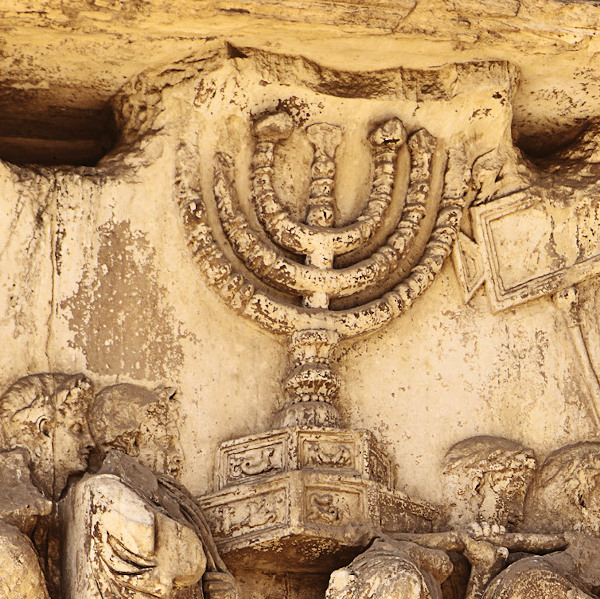
The menorah represents the shape of the tabernacle lampstand and comes from the time of Herod the Great. This detail is from the Arch of Titus in Rome (Ex 25:37).
© Matt Ragen/Shutterstock
Return to the main text.
 25:40 Quoted in Heb 8:5 in order to contrast the “shadow” (the ministry of the tabernacle in the old covenant) with the reality (the ministry of Christ in the new covenant). See also Heb 10:1 and note.
26:1 tabernacle. See note on 25:9; see also model. Its basic structure was to be 15 feet wide by 45 feet long by 15 feet high. Over an inner lining of embroidered linen (vv. 1–6), it was to have a covering woven of goat hair (vv. 7–13) and two additional coverings of leather, one made from ram skins dyed red and one from “another . . . durable leather” (25:5; see NIV text note there; cf. 26:14). Internally, the ceiling was probably flat, but whether the leather coverings had a ridge line with sloping sides (like a tent) is not known. The tabernacle represented God’s royal tent. Its form and adornment (like those of the later temples that replaced it) marked it as a symbolic representation of the created cosmos over which God is sovereign as Creator and Lord. As such, it stood for the center of the cosmos from which the Creator reigns, the place where the heavenly and earthly realms converge. There God “lived” among his people (Immanuel, “God with us”), and his people could come near to him. At this sanctuary Israel lived symbolically at the gate of Paradise—very near though still outside, awaiting the fulfillment of God’s redemptive program (see vv. 31–35; Ge 3:24 and notes; see also Rev 21:1—22:6 and notes). finely twisted linen and blue, purple and scarlet yarn. See note on 25:4. cherubim. Signifying a royal chamber (see 25:18 and note).
26:7 goat hair. See note on 25:4.
26:14 ram skins dyed red . . . other durable leather. See note on 25:5.
26:17 projections. Probably the two pegs at the bottom of each frame that were inserted into its two bases (v. 19).
26:19 forty silver bases. These plus the 40 in v. 21, the 16 in v. 25 and the 4 in v. 32 add up to a grand total of 100, the number of talents of silver obtained from the Israelite community to be used to cast the bases (38:27).
26:23 corners. Or “angles,” perhaps referring to mitered joints at the corners.
26:26 crossbars. To strengthen the frames on the north, south and west sides.
26:29 rings. See note on 25:12.
26:30 plan. See note on 25:40.
26:31–35 A curtain was to divide the tabernacle into two rooms, the Holy Place and the Most Holy Place, with the former twice as large as the latter. The Most Holy Place formed a perfect cube, 15 feet by 15 feet by 15 feet. Enclosed with linen curtains embroidered with cherubim and containing only the ark of the covenant, it represented God’s throne room (see note on v. 1). The Holy Place represented his royal guest chamber where his people symbolically came before him in the bread of the Presence (see note on 25:30), the light from the lampstand (see note on 25:37) and the incense from the altar of incense (see note on 30:1).
26:31 curtain. To separate the Holy Place from the Most Holy Place (v. 33). It was called the “shielding curtain” (39:34; 40:21; Nu 4:5) because it shielded the ark (see 27:21; see also notes on 16:34; 25:22). At the moment when Christ died, the curtain of Herod’s temple was torn, thereby giving the believer direct access to the presence of God (Mk 15:38; Heb 6:19–20; 10:19–22). cherubim. See v. 1 and note. The curtain at the entrance to the Holy Place did not have cherubim (v. 36).
26:37 bronze. Inside the tabernacle, gold was the metal of choice; outside—beginning with the bases of the outer curtain (v. 36)—the metal of choice was bronze. The furnishings close to the place of God’s dwelling were made of, or overlaid with, gold; those farther away (27:2–6; 30:18) were made of, or overlaid with, bronze. The bases that supported the frames of the tabernacle and the four posts holding the dividing curtain were of silver (vv. 19,21,25,32).
27:1 altar. The altar of burnt offering (see model; see also Lev 4:7, 10,18). acacia wood. See note on 25:5.
27:2 horns. Projections on the four corners. They were symbols of help and refuge (1Ki 1:50; 2:28). They also symbolized the atoning power of the altar: Some of the blood was put on the horns of the altar before the rest was poured out at the base (see 29:12; Lev 4:7, 18,25,30,34; 8:15; 9:9; 16:18; see also photos here and here).
27:3 sprinkling bowls. To catch the blood of the animals slain beside the altar and to splash it against it (24:6). meat forks. Three-pronged forks for arranging the sacrifice or removing the priests’ portion from the container in which it was being boiled (1Sa 2:13–14). firepans. Probably for carrying fire from the altar of burnt offering to the altar of incense inside the Holy Place (Lev 10:1; 16:12–13).
27:4 grating. Placed midway between the top and bottom of the boxlike structure. Since the intense heat of the fire built inside the upper half of the altar would have eventually destroyed it, perhaps the hollow altar (v. 8) was designed to be filled with earth when it was in use. ring. See note on 25:12.
27:12–13 west end . . . east end. The courtyard is described as having two equal parts. The Most Holy Place probably occupied the central position in the western half, the altar of burnt offering the central position in the eastern half.
27:13–14 toward the sunrise . . . the entrance. The entrance to the tabernacle courtyard faced east, as did that of Solomon’s temple (Eze 8:16) and of Herod’s temple.
27:18 five cubits. See NIV text note; high enough to block the view of people standing outside the courtyard, thus protecting the sanctity and privacy of the worship taking place inside.
27:20 clear oil of pressed olives. Unripe olives were crushed in a mortar. The pulpy mass was then placed in a cloth basket through the bottom of which the oil dripped, producing a clear fuel that burned with little or no smoke.
27:21 tent of meeting. The tabernacle; it was not a place where God’s people met for collective worship but one where God himself met—by appointment, not by accident—with his people (29:42–43). curtain that shields the ark of the covenant law. See note on 26:31. lamps burning . . . from evening till morning. The lamps were lit in the evening (30:8) and apparently extinguished in the morning (1Sa 3:3).
28:1 Nadab and Abihu. See note on 24:1. serve me as priests. In order “to offer gifts and sacrifices for sins” and “to deal gently with those who are ignorant and are going astray” (Heb 5:1–2). Another important function of the priests was to read the law of Moses to the people, explain its meaning, and remind them of their covenant obligations (Dt 31:9–13; Ne 8:2–3, 7–8,12; Jer 18:18; Mal 2:5–8).
28:2 to give him dignity and honor. The garments were to exalt the office and functions of regular priests (see vv. 4,40), as well as of the high priest.
28:6 ephod. A sleeveless, apron-like vestment worn by the high priest. Sometimes the word refers to an otherwise unidentified object of worship (see, e.g., Jdg 8:27; 18:17; Hos 3:4).
28:8 waistband. Apparently to hold the front and the back of the ephod to the priest’s body.
28:12 Aaron is to bear the names on his shoulders. To symbolize the fact that the high priest represents all Israel when he ministers in the tabernacle (see photo).
28:15 for making decisions. By means of the Urim and Thummim (see note on v. 30).
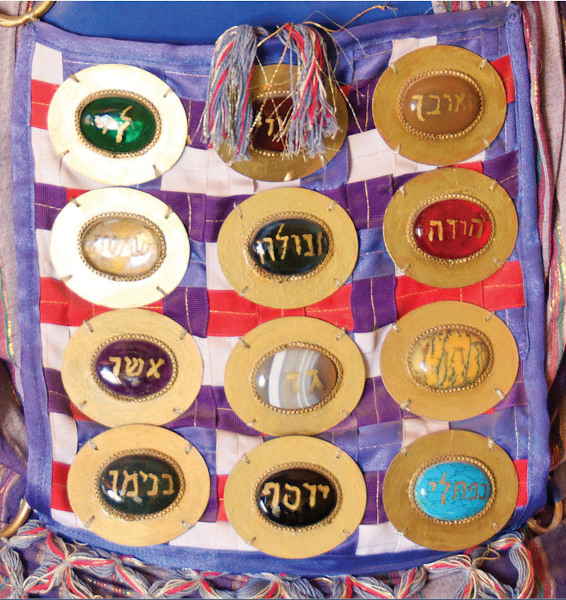
28:29 Aaron . . . will bear the names . . . over his heart. Thus the nation was doubly represented before the Lord (see v. 12 and note).
28:30 the Urim and the Thummim. The Hebrew for this phrase probably means “the curses [traditionally ‘lights’] and the perfections.” The Hebrew word Urim begins with the first letter of the Hebrew alphabet (aleph), and Thummim begins with the last letter (taw; see NIV text note on Ps 119; to see what aleph and taw looked like, they are printed in front of the Aleph and Taw headings above Ps 119:1 and 119:169). They were sacred lots and were often used in times of crisis to determine the will of God (Nu 27:21). It has been suggested that if Urim (“curses”) dominated when the lots were cast the answer was “no,” but if Thummim (“perfections”) dominated it was “yes.” In any event, their “every decision” was “from the LORD” (Pr 16:33; see note there).
28:31 robe. Worn under the ephod.
28:35 sound of the bells. Signaling the beginning and end of the high priest’s solemn ministry in the Holy Place.
28:36 HOLY TO THE LORD See 3:5 and note; 39:30; Zec 14:20 and note.
28:38 bear the guilt. Symbolically.
28:39 tunic. Worn under the robe.
28:40 to give them dignity and honor. See note on v. 2.
28:43 tent of meeting. See note on 27:21.
29:1 consecrate them. See note on 19:10–11. without defect. See note on 12:5.
29:4 tent of meeting. See note on 27:21. wash them with water. Resulting in ceremonial purity (cf. Heb 10:22).
29:7 anoint him. Symbolizing spiritual endowment for serving God (see 28:41; Isa 61:1 and note).
29:10 Bring the bull. As a sin offering (v. 14) to atone for the past sins of Aaron and his sons (see Lev 4:3 and note). lay their hands on its head. As a symbol of (1) the animal’s becoming their substitute and (2) transferring their sins to the sin-bearer (see Lev 16:20–22 and note).
29:12 horns of the altar. See note on 27:2.
29:13 fat. The most select parts of the bull (Lev 3:3–5,16) were burned on the altar as a sacrifice to the Lord.
29:14 flesh . . . hide . . . intestines. Thought of as bearing sin, and thus burned outside the camp (see Heb 13:11–13 and notes).
29:18 burn the entire ram. Symbolizing total dedication (see note on Lev 1:3).
29:20 right ears. Symbolizing sensitivity to God and his word. right hands . . . right feet. Symbolizing a life of service to others on God’s behalf. See notes on Lev 8:14,23.
29:24 wave offering. See note on Lev 7:30–32.
29:28 perpetual share . . . for Aaron and his sons. Parts of certain sacrificial animals were set aside as food for the priests and their families (Lev 10:14).
29:31 a sacred place. Probably the tabernacle courtyard.
29:36 making atonement for it. Because the altar was corrupted by the sins of the people (Lev 16:16; Heb 9:21–22).
29:37 holy . . . holy. Set apart as consecrated to the Lord (see note on 3:5).
29:38–39 Institution of the daily morning and evening offerings—sometimes observed even during days of apostasy (2Ki 16:15).
29:42–43 I will meet. See note on 27:21.
29:43 my glory. Symbolic of God’s presence over the ark of the covenant (see note on 25:10; see also 40:34–35; 1Ki 8:10–13).
29:45–46 dwell among. See note on 25:9.
29:45 I will . . . be their God. Commonly denotes the essence of the divine promise pledged in his covenant with his people (see note on 6:7).
29:46 I am the LORD . . . who brought them out. See note on 20:2.
30:1 incense. See model. Its fragrant smoke symbolized the prayers of God’s people (Ps 141:2; Lk 1:10; Rev 5:8; 8:3–4).
30:4 rings. See note on 25:12.
30:6 curtain that shields the ark of the covenant law. See notes on 25:16,22; 26:31.
30:10 annual atonement. See Lev 16:34 and note. holy to the LORD. See 29:37 and note.
30:12 take a census. Perhaps such censuses were taken on various occasions (and at stated intervals) to enter the Israelites into an official roll for public duties in the Lord’s service (Nu 1:2; 26:2), primarily military (see note on v. 14). pay . . . a ransom for his life. An extension of the principle stated in 13:13,15 (see note on 13:13). Jesus gave “his life as a ransom for many” (see Mt 20:28; Mk 10:45 and notes; cf. 1Ti 2:5–6).
30:13 shekel. A unit of weight, not a coin (see note on Ge 20:16). according to the sanctuary shekel. In keeping with the standard weights used at the tabernacle. They may have differed slightly from those used in the marketplace.
30:14 twenty years old or more. Of military age (Nu 1:3).
30:16 tent of meeting. See note on 27:21. atonement. See note on 25:17.
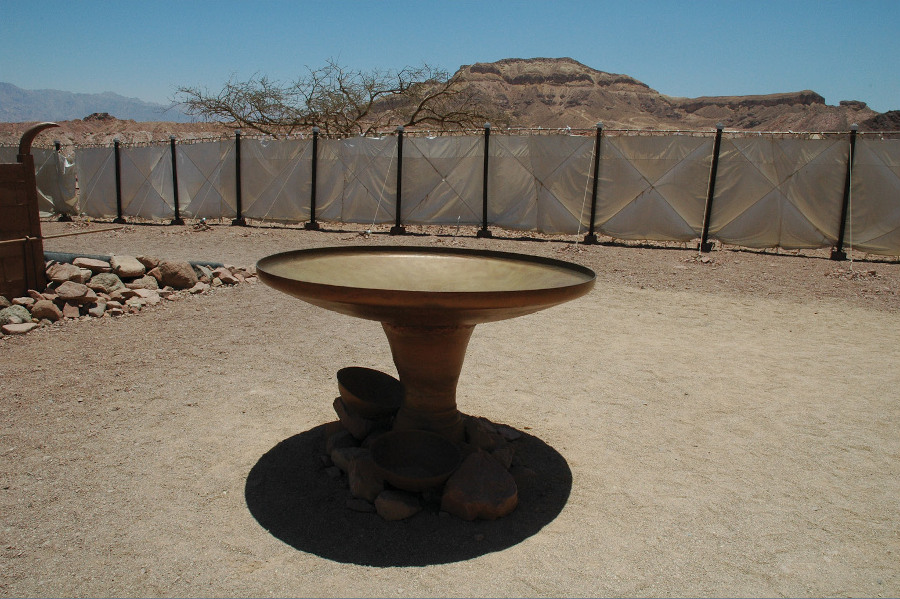
Model of the bronze basin in the tabernacle courtyard
Todd Bolen/BiblePlaces.com
Return to the main text.
30:18 basin. Made from bronze mirrors contributed by Israelite women (38:8). washing. See note on 29:4; see also photo.
30:20 wash . . . not die. Entering into God’s holy presence requires appropriate purification.
30:23–24 myrrh . . . cinnamon . . . calamus . . . cassia. See note on 25:6.
30:29 holy . . . holy. See 29:37 and note.
30:33 cut off from their people. See note on 12:15.
30:34 gum resin, onycha and galbanum. See note on 25:6. frankincense. A resin from the bark of Boswellia carteri, which grows in southern Arabia.
31:2 Bezalel. Means “in the shadow/protection of God.” Hur. See note on 17:10.
31:3 filled him with the Spirit of God. Ability to work skillfully in all kinds of crafts was a spiritual gift, equipping a person for special service to God. wisdom. See Pr 1:2 and note.
31:6 Oholiab. Means “The (divine) father is my tent/tabernacle.” The names of Bezalel (see note on v. 2) and Oholiab were appropriate for the chief craftsmen working on the tabernacle.
31:7 tent of meeting. See note on 27:21.
31:13 observe my Sabbaths. Instructions for building the tabernacle and making the priestly garments are concluded by impressing on the Israelites the importance and necessity of keeping the Sabbath even while carrying out this special task. makes you holy. See 19:6; 29:37 and notes.
31:14 cut off from their people. See note on 12:15.
31:16–17 covenant . . . sign. In their rhythm of work and rest in the service of God, the Israelites were to emulate God’s pattern in creation as an ever-renewed sign of their covenant with God (see note on Ge 9:12).
 31:18 two tablets. In keeping with ancient Near Eastern practice, these were probably duplicates of the covenant document, not two sections of the Ten Commandments. One copy belonged to each party of the covenant. Since Israel’s copy was to be laid up in the presence of God (according to custom), both covenant tablets (God’s and Israel’s) were placed in the ark (see 25:21 and note). covenant law. See notes on 16:34; 25:16. inscribed by the finger of God. Because it was God’s covenant (see 19:5–6 and notes), and the stipulations of the covenant (20:1–17) were his.
32:1 so long. Forty days and forty nights (see 24:18 and note). they. Probably the tribe and clan leaders. gods. See NIV text note. Moses who brought us up out of Egypt. A rebellious contrast to the gracious statement of Israel’s covenant Lord (see 20:2 and note; 29:46).
32:2 gold earrings. Probably part of the plunder brought from Egypt (see 3:21–22 and note on 3:21; 11:2–3; 12:35–36).
32:4 cast in the shape of a calf. Either gold plating over a carved wooden calf (it was later burned, v. 20) or crudely cast in solid gold and then further shaped with a tool, later to be melted down in the fire. The calf was probably similar to representations of the Egyptian bull-god Apis (see note on Jer 46:15; see also notes on Jos 24:14; Jdg 2:13; 1Ki 12:28). Its manufacture was a flagrant violation of the second commandment (20:4–5; see notes there). they. The leaders among the people (see note on v. 1). These are your gods . . . up out of Egypt. A parody of 20:2 (see note on v. 1). Centuries later, King Jeroboam would quote these words when he set up two golden calves in the northern kingdom of Israel (see 1Ki 12:28–29 and notes).
32:5 altar in front of the calf . . . festival to the LORD. Perhaps Aaron sought to redeem the idolatrous situation by invoking the name of Lord.
32:6 they sat down . . . indulge in revelry. A pagan symbol evoked pagan religious practices. Paul quotes this sentence as a vivid example of Israel’s tendency toward idolatry (see 1Co 10:7 and note). The Hebrew verb translated “indulge in revelry” often has sexual connotations (see, e.g., “caressing,” Ge 26:8). Immoral orgies frequently accompanied pagan worship in ancient times.
32:7,9 your people . . . these people. By not calling Israel “my people” (as, e.g., in 3:10), God indicates that he is disowning them for breaking his covenant with them (see note on 17:4).
32:7 corrupt. And, therefore, ripe for destruction (v. 10; Ge 6:11–13).
32:9 stiff-necked. Like unresponsive oxen or horses (see Jer 27:11–12; see also note on Ne 3:5).
32:10 I will make you into a great nation. After Israel—Abraham’s descendants—has been destroyed, God will transfer to Moses the pledge originally given to Abraham (Ge 12:2).
 32:11 your people. Using God’s own words (see v. 7 and note on vv. 7,9), Moses appeals to God’s special relationship to Israel, then to God’s need to vindicate his name in the eyes of the Egyptians (v. 12), and finally to the great patriarchal promises (v. 13).
32:13 Israel. Jacob (see 33:1; see also Ge 32:28).
32:14 the LORD relented. See note on Jer 18:7–10; see also 2Sa 24:16; Ps 106:45; Am 7:1–6 and note on 7:3; cf. Jas 5:16.
32:15 went down the mountain. See note on 24:18. two tablets. See note on 31:18. covenant law. See notes on 16:34; 25:16. inscribed on both sides. See note on 31:18. Elsewhere note is taken of scrolls written on both sides (see Eze 2:10 and note; Zec 5:3; Rev 5:1); in each case what is written pertains to God’s sovereign involvement in human history, especially his coming judgment.
32:16 work of God . . . writing of God. See 31:18.
32:17 Joshua. Perhaps he had accompanied Moses part of the way up the mountain (24:13).
32:19 breaking them to pieces. Thus testifying against Israel that the people had broken the covenant.
32:20 burned it . . . ground it to powder. King Jeroboam’s altar (see note on v. 4) at Bethel received the same treatment (2Ki 23:15).
32:21 great sin. See Ge 20:9 and note.
32:22–24 In his desperation, Aaron blamed the people (cf. Ge 3:12–13 and notes), but the Lord held him accountable. Only through Moses’ intercession was Aaron spared (Dt 9:20).
32:25 were running wild . . . get out of control. The same Hebrew root underlies both phrases and is found also in Pr 29:18 (“cast off restraint”). Anarchy reigns among people who refuse to obey and worship the Lord.
32:26 Whoever is for the LORD, come to me. See Jos 24:15; 1Ki 18:21; Mt 6:24. all. A generalization since Dt 33:9 implies that some of the Levites were also slain. Levites. The descendants of Levi (Ge 29:34) may have originally been regarded as priests (Dt 18:6–8). But at some stage they became subordinate to the priests who were descendants of Aaron, the brother of Moses (38:21; Nu 3:9–10; 1Ch 16:4–6,37–42).
32:27 killing his brother and friend and neighbor. See Mt 10:37; Lk 14:26.
32:28 The Levites did as Moses commanded. Their zeal for the Lord is later matched by Aaron’s grandson Phinehas, resulting in a perpetual covenant of the priesthood (Nu 25:7–13).
32:29 You have been set apart to the LORD today. Because of their zeal for the Lord the Levites were set apart to be caretakers of the tabernacle and aides to the priests (Nu 1:47–53; 3:5–9,12,41,45; 4:2–3).
32:30 make atonement for your sin. By making urgent intercession before God, as the mediator God had appointed between himself and Israel. No sacrifice that Israel or Moses might bring could atone for this sin. But Moses so identified himself with Israel that he made his own death the condition for God’s destruction of the nation (v. 32). Jesus Christ, the great Mediator, offered himself on the cross to make atonement for his people.
32:32 blot me out. Paul made a similar statement (see Ro 9:3 and note). book you have written. See notes on Ps 9:5; 51:1; 69:28.
32:33 Whoever has sinned . . . I will blot out. Moses’ gracious offer is refused; the person who sins is responsible for their own sin (see Dt 24:16; Eze 18:4 and note).
32:34 Now go, lead the people. Thus Moses receives assurance that the Lord will continue his covenant with wayward Israel and fulfill his promise concerning the land. the place I spoke of. Canaan (33:1). my angel. See 23:23; 33:2.
33:2 Canaanites . . . Jebusites. See note on 3:8.
33:3 land flowing with milk and honey. See note on 3:8. I will not go with you. The Lord’s presence, earlier assured to his people (see 23:21 and note), is now temporarily withdrawn because of sin. stiff-necked. See note on 32:9.
33:7 tent of meeting outside the camp. Not the tabernacle (contrast 27:21), which occupied a central location within the Israelite camp, but a temporary structure where the people could consult the Lord until the more durable tabernacle was completed.
33:9 pillar of cloud would come down. Symbolizing God’s communication with Moses “as one speaks to a friend” (v. 11). Later, a similar descent crowned the completion of the tabernacle (see 40:33–34; see also note on 13:21).
33:11 The LORD would speak to Moses face to face. God communicated with him directly—but without visually showing his “face.” As the OT mediator, Moses was unique among the prophets (see Nu 12:6–8; Dt 34:10,12 and notes). Joshua . . . did not leave the tent. Probably his task was to guard the tent against intrusion by others.
33:12 you have not let me know whom you will send with me. See note on v. 3. Moses objects that a mere angel is no substitute for God’s own presence. I know you by name. I have chosen you for my special purpose (see Jer 1:5 and note).
33:13 teach me your ways. A prayer that is answered in 34:6–7.
33:17 because I am pleased with you. How much more does God hear the prayers of his Son Jesus Christ (see Mt 17:5; Heb 3:1–6)!
33:18 show me your glory. All that God has done for Israel through Moses has made him very bold. At his first meeting with God he was “afraid to look at God” in the small display of God’s glory in the burning bush (see 3:6 and note), and he inquired concerning God’s name (3:13). Now he asks to be shown God’s glory unveiled and is told he has asked too much, that he must be content with the fuller proclamation of God’s name (vv. 19,22; 34:5–7).
33:19 goodness. God’s nature and character. name. A further symbol of God’s nature, character and person (see Ps 20:1; Jn 1:12; 17:6 and note). Here his name implies his mercy (grace) and his compassion (as it does also in 34:6). I will have mercy on whom . . . compassion. Paul quotes these words in Ro 9:15 to defend his view of God’s sovereignty.
33:20 no one may see me and live. See note on Ge 16:13; see also Jn 1:18; 6:46; 1Ti 1:17; 1Jn 4:12.
33:22–23 hand . . . back . . . face. God speaks of himself figuratively using human terms (anthropomorphisms), indicating a partial revelation of his glory, which is all that Moses could experience and survive. See 34:5–7 for the fulfillment of his promise.
34:1 two stone tablets . . . I will write on them. See note on 31:18. words. See note on 20:1.
34:6–7 See 33:19 and note. The Lord’s proclamation of the meaning and implications of his name in these verses became a classic exposition that was frequently recalled elsewhere in the OT (Nu 14:18; Ne 9:17; Ps 86:15; 103:8; 145:8; Joel 2:13; Jnh 4:2). See also notes on 3:14–15; 6:2–3.
34:7 thousands. Or “a thousand generations” (20:6). wickedness, rebellion and sin. See Isa 59:12 and note.
34:10 making a covenant. Renewing the covenant he had earlier made (chs. 19–24). Verses 10–26, many of which are quoted almost verbatim from previous sections of Exodus (compare especially vv. 18–26 with 23:14–19), are sometimes referred to as the Ritual Decalogue since they can be convincingly divided into ten sections (see, e.g., the NIV paragraphing of vv. 15–26). wonders. The same word used for the plagues sent on Egypt (3:20). Here it probably refers to the miracles God performed during the wilderness wanderings and the conquest of Canaan (see Ps 9:1 and note).
34:12 not to make a treaty with those who live in the land. Israel is not to make a treaty of peace with any of the people of Canaan to let them live in the land. treaty. The Hebrew for this word is the same as that for “covenant” in v. 10 (see also v. 15).
34:13 Asherah poles. Asherah was the name of the wife of El, the chief Canaanite god. Wooden poles, perhaps carved in her image, were often set up in her honor and placed near other pagan objects of worship (see, e.g., Jdg 6:25).
34:14 whose name is Jealous. See note on 20:5.
34:15 prostitute themselves. A metaphor widely used in the OT to refer to Israel’s unfaithfulness to their covenant Lord, who, according to a related metaphor, had become Israel’s “husband” when he established his special covenant with them (see Isa 54:5–6; Jer 3:14; 31:32; Hos 2:2, 7,16; cf. Jer 2:2; 3:1,20 and note on 3:14; Eze 16:8, 32,45 and note on 16:32; 23:4,37). Such unfaithfulness took various forms, but most commonly outright idolatry (worshiping other gods and looking to them for fertility of wombs, fields and flocks, for healing wounds and diseases, for deliverance or security from enemies—thus treating the false gods as their “lovers”). eat their sacrifices. Partaking of food sacrificed to a pagan deity invites compromise (cf. 1Co 8; 10:18–21). For an example, see Nu 25:1–3.
34:16 lead your sons to do the same. For an example, see 1Ki 11:1–8.
34:17 Do not make any idols. As Aaron had done when he made the golden calf (32:4).
34:18–26 See notes on 23:14–19.
34:21 even during the plowing season and harvest you must rest. Just as they were also to rest while building the tabernacle (see notes on 31:13,16–17).
34:24 no one will covet your land. The Lord promises to protect the Israelite pilgrim’s ownership of his land while he is away attending the three annual festivals that require his presence (see Dt 16:16 and note).
34:27 Write down these words. As he had earlier written down similar words (24:4).
34:28 he wrote. Here the Lord, rather than Moses, is probably the subject (v. 1). the words of the covenant—the Ten Commandments. The two phrases are synonymous (see note on 20:1).
34:29 covenant law. See notes on 16:34; 25:16. was radiant. He who had asked to see God’s glory (see 33:18 and note) now, quite unawares, reflects the divine glory. The Hebrew for “was radiant” is related to the Hebrew noun for “horn.” The meaning of the phrase was therefore misunderstood by the Vulgate (the Latin translation), and thus European medieval art often showed horns sprouting from Moses’ head (see photo).
34:33 he put a veil over his face. The specific reason for the veil is not given. As Paul will interpret it, the purpose of the veil was so that Israel would not see the temporary nature of the radiance, which represented the temporary nature of the Mosaic (Sinaitic) covenant, but would continue to honor Moses as the one who represented God (see 2Co 3:7–18 and notes).
35:1–3 Just as the Israelites had been reminded of the importance of Sabbath observance immediately after the instructions for building the tabernacle and making the priestly garments (see note on 31:13), so now—just before the fulfilling of those instructions—the people are given the same reminder.
35:4—39:43 For the most part repeated from chs. 25–28; 30:1–5; 31:1–11 (see notes on those passages), sometimes verbatim, but with the verbs primarily in the past rather than the future tense and with the topics arranged in a different order. Such repetition highlights the exact obedience to the instructions that had been previously given.
35:5 Everyone who is willing. The voluntary motivation behind the offering of materials and services for the tabernacle is stressed (vv. 21–22,26,29; 36:2–3).
35:21 tent of meeting. See note on 27:21.
36:1–38 See note on 35:4—39:43.
37:1–29 See note on 35:4—39:43.
37:1 Bezalel made the ark. The chief craftsman (see 31:2–3 and notes) was given the honor of making the object that was most sacred (see 25:10 and note) among the furnishings for the tabernacle.
38:1–31 See note on 35:4—39:43.
38:8 bronze . . . mirrors. Mirrored glass was unknown in ancient times, but highly polished bronze gave adequate reflection (cf. 1Co 13:12 and note). tent of meeting. See note on 27:21.
38:25 counted in the census. See 30:11–16. 100 talents and 1,775 shekels. Since there are 3,000 shekels in a talent, 100 talents equals 300,000 shekels, which, when added to the 1,775 shekels, gives a grand total of 301,775—half a shekel for each of the 603,550 men of military age (v. 26).
38:26 603,550 men. See article; see also Nu 1:46 and note.
38:27 one talent for each base. See note on 26:19.
39:1–43 See note on 35:4—39:43.
39:30 sacred emblem. An official designation (not found in 28:36–37) for the plate of the turban. HOLY TO THE LORD See 28:36 and note.
39:32 all the work on the tabernacle . . . was completed. Reminiscent of the concluding words of the creation narrative (Ge 2:1–3). Thus the end of Exodus links with the beginning (see 1:7 and note), marking the complex of events narrated in the book as the beginning of the restoration of the creation order and of the realization of God’s redemptive purposes in history (see also note on 26:1). tabernacle. See models here and here.
39:43 Moses blessed them. For the faithfulness with which the Israelites had donated their gifts, time and talents in building the tabernacle and all its furnishings—faithfulness in service brings divine benediction.
40:2 first day of the first month. The tabernacle was set up almost a year after the institution of the Passover (see v. 17; 12:2,6 and note on 12:2).
40:9–10 holy . . . most holy. See 3:5; 29:37 and notes.
40:16 Moses did . . . just as the LORD commanded. Moses’ obedience to God’s command is a key theme of the final chapter of Exodus (vv. 19,21,23,25,27,29,32). The people provided all the resources and made all the components, but only the Lord’s servant Moses was authorized to set up the tabernacle and prepare it for the Lord’s entry.
40:33 Moses finished the work. See note on 39:32.
40:34 With the glory of the Lord entering the tabernacle (cf. 1Ki 8:10–11 and note on 8:10), the great series of events that began with the birth of Moses and his rescue from the Nile, foreshadowing the deliverance of Israel from Egypt, comes to a grand climax. From now on, the Israelites march through the wilderness, and through history, with the Lord tenting among them and leading them to the land of fulfilled promises.
40:38 See note on 13:21. Exodus begins with the Lord’s apparent absence but ends with his glorious presence.