Study Notes
 1:1 Amos. Apparently a shortened form of a name like Amasiah (2Ch 17:16), meaning “The LORD carries” or “The LORD upholds.” See photo. shepherds. The Hebrew for this word occurs elsewhere in the OT only in reference to the king of Moab (2Ki 3:4, where it is translated “raised sheep”). Cf. 7:14, where a different Hebrew word is used. Amos was not a professional prophet who earned his living from his ministry; he stood outside religious institutions. Tekoa. See Introduction: Author; see also photo. vision he saw. By divine revelation. earthquake. Evidently a major shock, long remembered, and probably the one mentioned in Zec 14:5. Recent geological studies have detected a mammoth seismic event in this area dating to c. 750 bc. Reference to the earthquake suggests that the author viewed it as a kind of divine reinforcement of the words of judgment. Uzziah. See Introduction: Date and Historical Situation; see also note on Isa 6:1. Jeroboam. See Introduction: Date and Historical Situation.
1:2 A thematic verse, ominously announcing the main thrust of Amos’s message. roars. Amos, a shepherd, was sent to Israel to warn them that he had heard a lion roar and that the lion is none other than the Lord himself, who has only wanted to be Israel’s shepherd. For the use of this imagery in other contexts, see Jer 25:30; Joel 3:16. from Zion. The Lord established his earthly throne in Jerusalem, among his special people, and from there he announces his judgments on them, as well as on the other nations. pastures . . . top of Carmel. See 9:3. From the lowest and driest portions of the land to the highest and greenest, the Lord’s judgment will be felt like a severe drought that devastates the whole land.
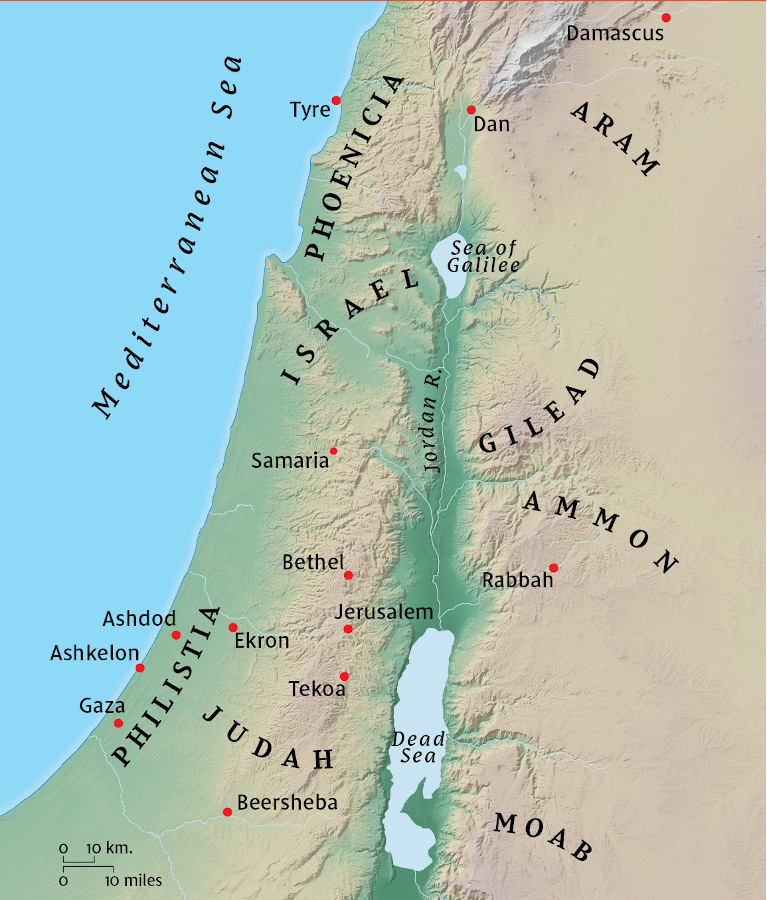
 1:3—2:16 A series of prophecies against the nations; for parallel sections, see Isa 13:1—23:18 and note. After pronouncing judgment on Israel’s neighbors for various atrocities—judgment that Israel would naturally applaud—Amos announces God’s condemnation of his own two kingdoms for despising God’s laws. By listing Israel’s sins under the same form of indictment used against the other nations, the shocking similarities between Israel’s sins and those of their pagan neighbors were emphasized. See map.
1:3 This is what the LORD says. See vv. 6,9,11,13; 2:1,4,6. Amos, the Lord’s spokesperson, uses the messenger formula that identifies the true source of his prophecies. For three sins . . . four. For their many sins, especially the one named; see also vv. 6,9,11,13; 2:1,4,6. For similar numerical expressions, see Job 5:19; Pr 6:16; Mic 5:5 and notes. Damascus. Capital of the Aramean state directly north of Israel (see note on Isa 17:1) and a constant enemy in that day. Their crime was brutality against the conquered people of Gilead, Israel’s territory east of Galilee. not relent. See vv. 6,9,11,13; 2:1,4,6; cf. Isa 9:12, 17,21 and note; Jer 23:20. threshed . . . sledges. Heads of grain were threshed by driving a wooden sledge fitted with sharp teeth over the cut grain (cf. Job 41:30; Isa 28:27; 41:15; Hab 3:12; see 2Ki 13:7 and note on Ru 1:22; see also photos here and here).
1:4 fire . . . that will consume. See vv. 7,10,12,14; 2:2,5; a common description of the threat of divine judgment, usually carried out by a devastating war that resulted in the burning of major cities and fortresses (see Jer 17:27 and note; Hos 8:14). Hazael. King of Damascus (c. 843–796 bc) and founder of a new line of kings (see 2Ki 8:7–15 and note on 8:15). fortresses. See vv. 7,10,12,14; 2:2,5; perhaps referring not only to citadels but also to the fortress-like palatial dwellings of the rich and powerful. Ben-Hadad. Ben-Hadad III (c. 796–770 bc), son of Hazael (see 2Ki 13:3 and note; cf. 2Ki 8:14–15; see also chart).
1:5 Valley of Aven. Possibly the Beqaa Valley between the Lebanon and Anti-Lebanon mountains, but may refer to the river valley in which Damascus is located (see note on 2Ki 5:12), calling it the “valley of wickedness” (see NIV text note). Beth Eden. Probably Damascus, the garden spot of that region. Aram. See note on Dt 26:5. Kir. An unidentified place, possibly in the vicinity of Elam (see 2Ki 16:9 and note), from which the Arameans are said to have come (9:7).
1:6 Gaza. One of the five major Philistine cities (see map); it guarded the entry to Canaan from Egypt. whole communities. See v. 9; not just warriors captured in battle. The reference may be to villages in south Judah on the trade route from Edom to Gaza. to Edom. See v. 9.
1:8 Ashdod . . . Ashkelon . . . Ekron. Three more cities of the Philistine group (see note on v. 6; see also photo). Gath, the fifth (cf. 6:2), may already have been subdued by Uzziah (2Ch 26:6). the last. There would be no remnant. Philistia was finally destroyed by Nebuchadnezzar.
1:9 Tyre. The dominant Phoenician merchant city, allied to Israel by a “treaty of brotherhood” in the days of David (1Ki 5:1), later in the time of Solomon (1Ki 5:12) and later still during the reign of Ahab, whose father-in-law ruled Tyre and Sidon (1Ki 16:30–31). she sold. Her crime was like Philistia’s (v. 6).
1:10 walls. Tyre was an almost impregnable island, boastful of its security (cf. Eze 26:1—28:19).
1:11 Edom. The nation descended from Esau (Ge 36; see Ge 25:23–30; 27:39–40). brother. Israel (see Ob 8–10 and note on Ob 10). Reference may be to a treaty partner (see note on v. 9). Edom’s crime was in violating this relationship by persistent hostility.
1:12 Teman . . . Bozrah. Major cities of Edom, the former thought to be near Petra (see note on Ob 9), the latter now identified with Buseirah, 37 miles to the north. With their destruction, Edom would lose its capacity for continual warfare.
1:13 Ammon. Judgment centered on Rabbah (v. 14; see note on Dt 3:11), modern Amman. Greed for land bred a brutal genocide that would be punished, leaving the state without leaders to continue such practices (see 1Ki 8:12 and note).
1:14–15 Fulfilled by the Assyrian conquest.
1:15 Her king. See NIV text note; see also Jer 49:3 and note on 49:1.
2:1 Moab. Located east of the Dead Sea (see note on Isa 15:1). burned . . . the bones of Edom’s king. Thus depriving the king’s spirit of the rest that was widely believed to result from decent burial.
2:2 Kerioth. Perhaps a plural noun meaning “cities” (see NIV text note) or the name of a major town (Jer 48:24) and shrine of Chemosh, the national god of Moab (1Ki 11:7,33).
2:4–5 The Lord’s indictment of Judah. As a prelude to the judgment against Israel, these verses more generally address disobedience to the law and so prepare for the specific covenant infractions of Israel in 2:6–8.
2:4 Judah. Amos turns from indicting the Gentile nations to the southern kingdom. Now listeners in the northern kingdom of Israel would start to become anxious. rejected the law of the LORD. Judah’s sins differed in kind from those of the other nations. Those nations violated the generally recognized laws of humanity, but Judah disobeyed the revealed law of God.
2:5 fire . . . consume the fortresses. See 1:4 and note. Judah’s punishment is the same as Aram’s (1:4), Philistia’s (1:7), Phoenicia’s (1:10), Edom’s (1:12), Ammon’s (1:14) and Moab’s (2:2)—loss of the defenses and wealth in which they trusted.
2:6 Israel. Finally and climactically, Amos indicts his own audience—the northern kingdom. Israel’s sins revealed the general moral deterioration of the nation. the innocent. Probably those who were not in debt and whom there was no lawful reason to sell (cf. Lev 25:39–43). Alternatively, the “innocent” here may refer to “the poor” (v. 7; cf. 5:12; 8:6), in contrast to the sinfully wicked behavior of the wealthy and powerful (4:1–5; 6:1–7). the needy. God had commanded that they be helped (see Dt 15:7–11 and note on 15:11), but they were instead sold for failure to repay a (perhaps paltry) debt, for which a “pair of sandals” had been given in pledge (8:6).
2:7 trample. See 5:11; 8:4. poor . . . oppressed. To care for them and to protect them from injustice were clearly commanded by Israel’s law (see Ex 23:6–8 and note on Ex 22:21–27); also, throughout the ancient Near East, kings were supposed to defend such people. Father and son use the same girl. Demonstrates the depth of Israel’s moral corruption. For a father and son to have sexual relations with the same girl or woman was strictly forbidden (Lev 18:7–8, 15; 20:11–12). Also the law required that if a man had sexual relations with a young woman (virgin), marriage was obligatory (Ex 22:16; Dt 22:28–29). profane my holy name. Cf. Lev 18:21 and note; 19:12; 20:3; 21:6; 22:2,32; see Jer 34:16; Eze 20:9 and notes; 36:20–23; 39:7.
2:8 beside every altar . . . In the house of their god. Israelites who broke the laws protecting the powerless brazenly used their wrongly gotten gains even in places supposed to be holy. garments taken in pledge. The law prohibited keeping a man’s cloak overnight as security for a debt (see Ex 22:26–27 and note; Dt 24:12–13), or taking a widow’s cloak at all (Dt 24:17). fines. Claimed as restitution for damages suffered. Exorbitant claims or even false charges of damage seem to be suggested.
2:9 I destroyed. Israel not only had known God’s law but had been specially favored by his powerful help. Amorites. Here used for all the inhabitants of Canaan (see notes on Ge 10:16; 15:16; Jdg 6:10). tall . . . strong. Neither the size of Canaan’s people nor their military power (Nu 13:27–33) was able to prevent God’s victory over them (Jos 10:5,12–13). their fruit above and their roots below. Representing total destruction.
2:10 I brought you up. See 3:1; see also Ex 20:2 and note. God’s great blessings to Israel in the past added to their guilt, and now those blessings are recalled as a part of the Lord’s indictment against his people.
2:11 I also raised up prophets . . . and Nazirites. Prophets, as God’s faithful spokespersons (see Dt 18:15–20 and note on 18:15), and Nazirites, as those uniquely dedicated to him (see Nu 6:1–21 and note on 6:2; Jdg 13:5 and note), are singled out as special gifts to his people. These persons who were outside the priesthood were used by God through word and example to call his people to faithfulness.
2:12 But you. Israel showed utter disdain for God’s faithful servants and thus demonstrated its callous insensitivity to God’s working among his people (cf. 7:16).
2:14–16 None who might be expected to stand their ground or escape would be able to save themselves.
2:16 that day. The day God comes in judgment (see 5:18; Joel 1:15 and notes)—as he did through the Assyrian invasion that swept the northern kingdom away.
3:1—5:17 Prophecies that underscore the certainty of God’s judgment on Israel.
3:1 Hear this word. See 4:1; 5:1. The Lord calls his people to account because of their sins.
3:2 You only. Cf. Dt 7:6–9. Israel’s present strength and prosperity gave rise to complacency about their privileged status as the Lord’s chosen people. They are shockingly reminded of the long-forgotten responsibilities their privileges entailed.
3:3–6 With these rhetorical questions (involving comparisons) Amos builds up to the statements of vv. 7–8, to explain why he is speaking such terrifying words. Each picture is of cause and effect, using figures drawn from daily life—and culminating in divine action (v. 6).
3:7 his servants the prophets. See Jer 7:25; Zec 1:6 and notes.
3:8 lion has roared. Echoes 1:2 (see note there). who can but prophesy? Amos must speak because God has spoken.
3:9 The rich and powerful of Philistia and Egypt are summoned to witness the Lord’s indictment against those who store up ill-gotten riches in the fortresses of Samaria (v. 15). fortresses. See note on 1:4. great unrest. The result of a violent, selfish power structure that was heedless of the justice called for in God’s law.
3:10 who store up. Cf. 2:6–8. The prosperity of Israel’s wealthy depended on oppression and robbery. The following verses announce God’s judgment on such greed (cf. Hab 2:6–11).
3:11 enemy. Assyria. plunder your fortresses. Those that Samaria’s wealthy had greedily filled with plunder.
3:12 As a shepherd rescues . . . only two leg bones. To prove to the owner that the sheep had been eaten by a wild animal, not stolen by the shepherd (Ex 22:13). be rescued. Only a remnant of Israel would be rescued. If the NIV text note represents the correct reading of the Hebrew, reference would be to “those who sit” in idle luxury (6:4) “in Samaria on the edge of their beds and in Damascus on their couches.” Since at this time Israel had extended its influence over Damascus, the rich merchants of Samaria may have maintained luxurious houses also in Damascus and enjoyed market privileges in that city (see 1Ki 20:34 and note).
3:13 Hear . . . testify. Addressed to those summoned in v. 9. The rich and powerful of Philistia and Egypt are called upon to hear the Lord’s indictment of the rich and powerful in Samaria and to testify that his indictment is true and that his judgment is warranted. Even these pagans will agree with God’s judgment.
3:14 altars of Bethel. Israel’s sins were rooted in the false shrine built by Jeroboam I at Bethel (1Ki 12:26–33). horns of the altar. Even the last refuge for a condemned person (cf. 1Ki 1:50–53) will afford Israel no protection.
 3:15 winter house . . . summer house. Cf. 6:11; further signs of opulence that would not benefit their owners on the day of God’s judgment—nor would expensive imported decorations, carvings and inlays of ivory (cf. 6:4; see photo). Many examples of such carvings have been found in ruined palaces in Samaria and other cities (see 1Ki 22:39 and note).

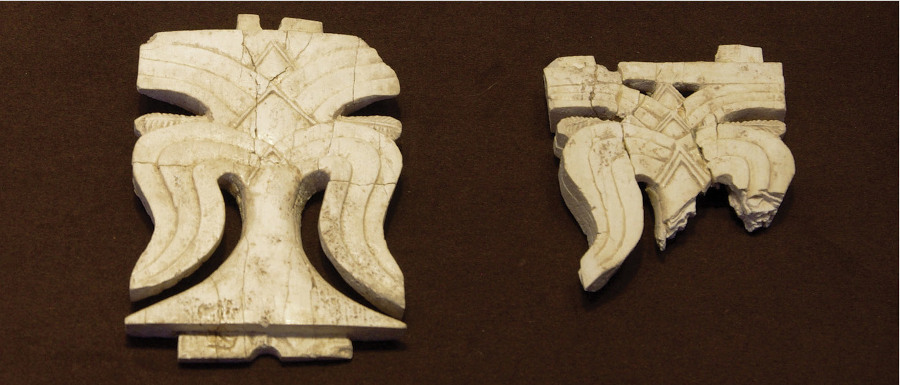
Amos 3:15 likely referred to these examples of carved ivory furniture inlays from Samaria, c. 9th–8th century bc.
A.D. Riddle/BiblePlaces.com
Return to the main text.
4:1 Hear this word. See note on 3:1. cows of Bashan. Upper-class women, directly addressed, are insulted by being compared with the best breed of cattle in ancient Canaan, which were raised (and pampered) in the pastures of northern Transjordan (see Ps 22:12; Eze 39:18 and notes). Mount Samaria. See 6:1 and note.
4:2 The Sovereign LORD has sworn. Stresses the solemnity of the situation and the certainty of the events. by his holiness. Contrasts with Israel’s sin, reminding God’s people of what they could have been (see Ex 19:6 and note) if they had faithfully kept their side of the covenant—as God had his. hooks. According to Assyrian reliefs (pictures engraved on stone), prisoners of war were led away with a rope fastened to a hook that pierced the nose or lower lip (see 2Ki 19:28 and note; 2Ch 33:11; Eze 19:4, 9; Hab 1:15; see photo).
4:3 breaches in the wall. Cf. 2Ki 17:5; Eze 13:5. Harmon. Appears to be a place-name, though it is not otherwise known (see NIV text note).
4:4–5 Spoken in irony to hypocrites.
4:4 Bethel . . . Gilgal. These towns had historical importance as places where God’s help was commemorated (Ge 35:1–15; Jos 4:20–24), and both were popular places of worship in Amos’s day (5:5; see Hos 4:15; 12:4 and notes). sacrifices every morning. See Ex 29:38–41. tithes. Apparently the special tithe that was to be brought “every three years” (Dt 14:28; 26:12). years. See NIV text note. The Hebrew word for “days” sometimes stands for years.
4:5 leavened bread. The burning of leavened bread in the sacrifices was strictly forbidden (Lev 2:11; 6:17). Either Amos rebukes the Israelites for willful transgression of the law, or he speaks of burning in a general way for offering inappropriate gifts to the Lord. Leavened bread could accompany a fellowship offering (Lev 7:13). what you love to do. They loved to boast about their adherence to the law but did not love what was at the heart of the law—goodness, mercy, kindness, justice (see 5:15; Isa 5:7; 61:8; Hos 6:6 and note; Mic 6:8).
4:6–11 In the past, God had used natural disasters to discipline and warn his people, but those lessons were soon forgotten (cf. the covenant curses in Dt 28:22–24, 39–40,42,48,56–57).
4:6 I. These were not simply natural disasters; they were direct acts of God (3:6). yet you have not returned to me. A recurring accusation that runs like a refrain through vv. 8–11.
4:7–8 Lack of rain three months before harvest would prevent full development of the grain.
4:9 blight and mildew. See Hag 2:17 and note. Locusts. See Ex 10:14 and note.
4:10 plagues . . . as . . . Egypt. See Ex 7:14—12:30.
4:11 Sodom and Gomorrah. God’s judgment on those cities (Ge 19:24–25), exemplifying total destruction, eventually became proverbial (see Dt 29:23; Isa 1:9; 13:19; see also Jer 49:18; Zep 2:9 and notes). burning stick snatched from the fire. Saved only by God’s grace (see Zec 3:2 and note).
4:12 prepare to meet your God. Devastated Israel, brought to their knees by the Assyrians, would meet the God they had covenanted with at Sinai and had now so grievously offended.
4:13 See note on 5:8–9. The God of such power and majesty is easily able to execute the judgment announced in v. 12.
5:1 Hear this word. See note on 3:1. this lament. Amos sorrowfully fashioned a lament as if Israel were already dead.
5:2 Virgin Israel. A personification of Israel (see note on 2Ki 19:21). deserted. Left like a dead body on the open field (Jer 8:2; 9:22).
5:3 city . . . town. Communities of varying size would suffer.
5:4 Seek me and live. This gracious invitation is expanded in v. 6, and yet again in v. 14, to heighten the rhetorical effect. If the people of Israel would seek the Lord, they (or at least a “remnant,” v. 15) could yet escape the violent death anticipated in Amos’s lament (see Zep 2:3 and note).
5:5 Bethel . . . Gilgal. See note on 4:4. Beersheba. Located in the south of Judah, it also had evidently become a place of pilgrimage and idolatry (8:14). All shrines where the worship of God was abused would be destroyed.
5:6 The places of idolatry were doomed; yet if Israel turned to God, there was hope for them as a nation. Otherwise they too would be destroyed. Seek . . . live. See v. 4 and note. tribes of Joseph. The northern kingdom of Israel, dominated by the tribe of Ephraim, descendants of Joseph (see v. 15; 6:6; Hos 4:7 and note). Bethel. The main religious center of the northern kingdom (see 3:14; 4:4; 7:13; Hos 12:4 and notes). The god the Israelites worshiped there would be powerless to save the place when the true God brought his judgment.
5:7 those who turn justice into bitterness. They corrupted the procedures and institutions of justice (the courts), making them instruments of injustice (“bitterness”). Turning God’s order upside down is inevitable in a society that ignores his law and despises true religion (see 6:12 and note).
5:8–9 As in 4:13, a brief hymn is inserted (see 9:5–6 and notes). Here Amos highlights the contrast between “those who turn” good into bad (v. 7) and the One “who turns” night into day and governs the order of the universe—and whose power can smash the walls his people hide behind.
5:8 Pleiades. A group of seven stars (part of the constellation Taurus), always mentioned in connection with Orion (see note on Job 9:9). midnight into dawn . . . day into night. The orderly sequence of day and night (Ge 8:22; Jer 31:35). waters of the sea. See 9:6. This phrase might refer to (1) the waters above the atmosphere (see Ge 1:7; see also notes on Ge 1:6; Ps 36:8; 42:7; 104:3); (2) waters evaporated from the sea and condensed as rain; or (3) floodwaters sent in judgment. the LORD is his name. The middle of three occurrences of this refrain (see 4:13, where the refrain is expanded; 9:6).
5:10 Continues the sentence begun in v. 7.
5:11 levy a straw tax on the poor. Echoes the initial indictment against Israel (2:7). though you have built. God would take away their prized possessions acquired through wrongful gain. Their prosperity would be turned to grief (see the covenant curses in Dt 28:30, 38–40).
5:13 the prudent. They know they cannot change the state of affairs, so they become very cautious about what they say. Amos is not suggesting silence or inactivity in the face of injustice (see vv. 14–15).
5:14 Seek good. Cf. “Seek me” (v. 4; see note there; see also Isa 1:16–17 and note on 1:17). that you may live. The purpose is more definitely expressed than in vv. 4,6, and the way to change is explicit. with you. As your security and source of blessing.
5:15 remnant. Implies that a change now would benefit the individual survivors of the disaster, though the nation as a whole would perish. Joseph. See note on v. 6.
5:16–17 A return to the theme of lament with which this section began (vv. 1–2). streets . . . square . . . farmers . . . vineyards. All will be affected by God’s punishment. Even farmers, usually too busy for such things, would join the professional mourners in lament, and mourning would overflow from the cities to the vineyards (see Joel 1:5 and note). When the holy God “will pass through” (as he did in Egypt, Ex 12:12), punishment for the unholy and unjust will be inescapable (cf. Isa 6:5).
5:18 day of the LORD. The time when God will show himself the victor over the world, vindicating his claims to be the Lord over all the earth (see notes on 8:9; Isa 2:11, 17,20; Joel 1:15; see also article). Israel expected to be exalted as his people and longed for that day to come. Amos warned that the day would come, but not as Israel expected—it would be a day of “darkness, not light” (v. 20; see 8:9 and note) for them, because they had not been faithful to God. (Cf. “the day of our Lord Jesus Christ” and variations in 1Co 1:8; 3:12–15; 5:5; 2Co 1:14; Php 1:6, 10; 2:16.) Amos speaks primarily of an imminent and decisive judgment on Israel, not exclusively of the last day.
5:19–20 The two pictures (v. 19) emphasize vividly the inescapability of God’s coming judgment.
5:21–27 Again God directly addresses Israel with the charge of unfaithfulness.
5:21–23 These three verses summarize and reject the current practice of religion in Israel. The institutions were not wrong in themselves; it was the worshipers and the ways they worshiped that were wrong. The people had no basis on which to come to God, because their conduct reflected disobedience to his law (see Isa 1:11–15 and note).
5:24 justice . . . righteousness. Prerequisites for acceptance by God (see Mic 6:8 and note); but these are what Israel had rejected and scorned (cf. vv. 7,10,12b). river . . . never-failing stream. In contrast to stream beds that are dry much of the year (see Jer 15:18 and note). The simile is especially apt: As plant and animal life flourishes where there is water, so human life flourishes where there is justice and righteousness.
5:25 Israel’s right relationship with the Lord was never established primarily by sacrifices. It was above all based on obedience (see 1Sa 15:22 and note; cf. Ro 1:5). forty years in the wilderness. See Nu 14:32–35 and note on 14:34.
5:26 The obscure language of this verse speaks of Israelite idolatry, but whether it was in the wilderness long ago or more recently in the promised land, or both, is not clear. The NIV text note takes two nouns as proper names derived from Akkadian. The Septuagint (the pre-Christian Greek translation of the OT) represents a somewhat different text, which is followed by Ac 7:43.
5:27 This punishment is the final one—exile from the God-given land to remote foreign places in the Assyrian empire.
6:1 in Zion . . . on Mount Samaria. Although Amos spoke primarily to Israel, Judah and Jerusalem (Zion) also deserved his rebuke (cf. 2:4–5), for Israel properly comprised all 12 tribes. Mount Samaria. See 4:1; Israel’s capital city, founded by King Omri. It was located on an easily defended, lofty hill (see 1Ki 16:24 and note). foremost nation. In Israel’s self-complacent eyes in this time of their newly recovered power and prosperity (see Introduction: Date and Historical Situation).
6:2 Perhaps Kalneh and Hamath had fallen in Jeroboam II’s campaign (see 2Ki 14:25,28 and notes), and the wall of Gath had been broken down by Uzziah (2Ch 26:6).
6:3 day of disaster. See note on 5:18.
6:4 lie . . . lounge on your couches. See 3:12 and note. ivory. See 3:15 and note.
6:5 like David. See 1Sa 16:15–23; 2Sa 23:1.
6:6 by the bowlful. To extravagant and intemperate excess. Joseph. See note on 5:6.
6:8 sworn by himself. See notes on Ge 22:16; Heb 6:13. By this oath God declares that the verdict is final. the pride of Jacob. The strongholds in which the people took pride (“his fortresses”; cf. Eze 32:12 and note). fortresses. See note on 1:4.
6:10–11 A fearful scene: Apparently a survivor is cowering inside the house, the relative forbidding him even to pray because God’s wrath had fallen on the city.
6:10 carry the bodies out . . . to burn them. Cremation was not generally practiced, being reserved primarily for serious offenders (see Ge 38:24; Lev 20:14; 21:9; Jos 7:15,25; 1Sa 31:12 and note). Reference may be to burning a memorial fire in honor of the dead (see Jer 34:5 and note) or to the burning of corpses necessitated by a plague.
6:11 great house . . . small house. Perhaps the “summer house” and “winter house” of 3:15, or a rhetorical device to indicate all houses.
6:12 plow the sea with oxen. See NIV text note. Israel’s perversion of justice flies in the face of even common human wisdom about the right order of things. See 5:7 and note.
6:13 Lo Debar . . . Karnaim. See NIV text notes for Amos’s ironic play on the meanings of these place-names. The towns may have been regained from Hazael by Jehoash (2Ki 10:32–33; 13:25) or by Jeroboam II (see 2Ki 14:25 and note), then taken by the Assyrians soon after Amos’s day (2Ki 15:29)—beginning the sequence of events that would lead to the loss of all territory conquered by Jeroboam II.
6:14 nation. Assyria. from Lebo Hamath to the valley of the Arabah. From the Orontes River in north Lebanon to the Dead Sea—thus the whole land (2Ki 14:25).
7:1 showed me. Introduces reports of visions that convey God’s message through things seen, as well as heard (see vv. 4,7; 8:1; Jer 1:11 and note; cf. Am 9:1). locusts. See 4:9; Ex 10:4 and note. king’s share. Apparently the earlier crop, from which the royal taxes were taken. late crops. The growth that came up in the fields after the grains and early hay were harvested. On these the flocks and herds pastured until the summer dry season stopped all growth.
7:2 See v. 5. How . . . survive? Mass starvation would afflict all the people. Jacob. Israel. so small. Powerless to withstand the calamity. Amos makes no appeal to the Lord’s covenant with Israel—perhaps because Israel’s unfaithfulness had removed all right to such an appeal.
7:3 See v. 6. the LORD relented. In response to the prophetic intercession (Ge 20:7), God would not send the locust plague.
7:4 great deep. Probably the Mediterranean Sea. land. Probably referring to the promised land or, more precisely, to everything growing on the land (cf. Joel 1:19).
7:6 See note on v. 3. God would not send fire to destroy the land.
7:7 Israel is compared to a wall built “true to plumb”—what they should have been, after all the Lord had done for them.
7:8–9 In vv. 1–6 God proposed destruction of crops and land but relented at Amos’s prayer. Now the Lord would carry out the judgment of the third vision against sanctuaries and the royal dynasty. Now even Amos’s intercession would not delay God’s judgment (cf. Jer 7:16; 15:1 and notes).
7:8 What do you see . . . ? See note on Jer 1:11. plumb line. A weight at the end of a line used in construction to ensure that buildings were erected at right angles. God’s people had been “built” (v. 7) according to God’s standards. They were expected to be true to those standards, but were completely out of plumb when tested (see 2Ki 21:13 and note). my people. Here, for the first time in the book of Amos, the Lord calls Israel “my people” (see v. 15; 8:2; 9:10,14; see also note on Ex 17:4). spare them no longer. See 8:2; cf. 9:1–4.
7:9 high places . . . sanctuaries . . . house. The centers of religious and political pretension and of self-righteous pride would be wiped out. Isaac. Israel’s (Jacob’s) father, a way of referring to Israel found only in Amos (v. 16). Jeroboam. The prophecies of chs. 1–6 were spoken to the leading people of Israel and Samaria as a whole; here Amos names one man, King Jeroboam II.
7:11 Amaziah’s words summarize Amos’s message (see note on v. 17). Jeroboam. That is, his “house” (v. 9), the king’s name also representing his dynasty. will die. Jeroboam died naturally (2Ki 14:29), but his son and successor Zechariah (2Ki 15:8) was assassinated (2Ki 15:10).
7:12 seer. Amaziah dismissed Amos as a prophet for hire whom he need not take seriously. Go back to . . . Judah . . . and do your prophesying there. Return to your homeland (see Introduction: Author). You have no business or standing among us.
7:13 king’s sanctuary. Amaziah served the king in Samaria, not Israel’s heavenly King; hence he would not allow a prophetic word to be spoken against Jeroboam or his realm at the royal chapel.
7:14 neither a prophet nor the son of a prophet. Amos denied any previous connection with the prophets or their disciples (see note on 1Ki 20:35). No one had hired him to come and announce judgment on Jeroboam and Israel. prophet. See note on Zec 1:1. shepherd. See note on 1:1, but the Hebrew uses a different word here—one not found elsewhere in the OT. The Hebrew for this word is, however, related to a word for “cattle,” suggesting that Amos may also have tended cattle. sycamore-fig trees. They yield fig-like fruit, though smaller than figs and of inferior quality. To ensure good fruit, the gardener had to slit the top of each fig—which may be the procedure referred to by the obscure Hebrew word here rendered “took care of.”
7:15 tending. Or “following,” the Hebrew for which stresses the location of the shepherd rather than his activity. Go. Amos was in Bethel because God had sent him to prophesy there.
7:16 Do not prophesy. Cf. 2:12.
7:17 Amos turned to condemn the priest personally. prostitute. With the exile of Amaziah, the death of his children and the loss of the family estate, Amaziah’s wife would be reduced to prostitution to survive. Your land. Amaziah’s private estate would be “divided up” and given to others. pagan country. Where his ceremonial purity as a priest would be defiled (see NIV text note). And Israel . . . native land. Amos repeats—verbatim in the Hebrew—the last two lines of Amaziah’s earlier summary of Amos’s message (v. 11).
8:1 showed me. See note on 7:1.
8:2 What do you see . . . ? See 7:8 and note. ripe fruit . . . time is ripe. A wordplay in Hebrew; Israel was ready to be plucked. my people. See 7:8 and note. spare them no longer. See 7:8.
8:3 that day. See 5:18 and note. wailing . . . Silence! There would be no thanksgiving songs for this harvest (contrast Lev 23:39–41)—only silence in the face of divine judgment (see note on Hab 2:20).
8:4 Hear this. See 3:1 and note. trample. See 5:11 and note. needy . . . poor. See note on Ex 22:21–27.
8:5 New Moon . . . Sabbath. The rich couldn’t wait to resume their business, with their dishonest practices toward the poor. The official religious festivals, when commerce ceased (see Nu 28:9–15; 2Ki 4:23 and note). skimping on the measure, boosting the price . . . dishonest scales. See Lev 19:35; Pr 11:1 and notes; Hos 12:7.
8:7 The LORD has sworn by himself, the Pride of Jacob. In ironic fashion, Amos echoes the phrase “pride of Jacob” in 6:8, where it refers not to God (as here) but to the fortresses of Israel.
8:8 See 9:5. rise like the Nile. Because of the heavy seasonal rains in Ethiopia, the Nile in Egypt annually rose by as much as 25 feet, flooding the whole valley except for the towns and villages standing above it. Its waters carried a large amount of rich soil, which was deposited on the land—perhaps referred to by the words “stirred up.”
8:9 that day. See 5:18 and note. darken the earth. As elsewhere, the “day of the LORD” is described as one in which the cosmic (world) order is disrupted and light is turned to darkness (see 5:18,20; Isa 13:10; 24:23; 34:4; 50:3; Eze 32:7–8; Joel 2:2, 10,31 and note on 2:2; Mic 3:6; Zep 1:15; Rev 6:12; see also article), as if creation is being undone (see Jer 4:23 and note).
8:10 mourning. Illustrated by King David (2Sa 18:33). wear sackcloth . . . shave your heads. Signs of mourning (see Ge 37:34; Isa 15:2–3 and notes). only son. On whose life the future of the family depended (cf. 2Sa 18:18; Zec 12:10). bitter day. The opposite of the “day of celebration” (Est 9:22).
8:11 days. When God’s judgment begins to take effect. famine of hearing the words of the LORD. In times of great distress Israel turned to the Lord for a prophetic word of hope or guidance (see, e.g., 2Ki 19:1–4, 14–15; 22:13–14; Jer 21:1–2; Eze 14:7), but in the coming judgment the Lord will answer all such appeals with silence—the awful silence of God (see Eze 7:26 and note; 20:1–3; Mic 3:4,7).
8:12 sea to sea . . . north to east. Throughout the land of Israel, from the Mediterranean to the Dead Sea, even to the Transjordan.
8:13 thirst. Both physical and spiritual. Their strength sapped, even the healthiest and most virile would faint and fall useless.
8:14 Those who swear. By the gods of their various religious centers—the false gods in which they trusted rather than in the Lord. Samaria. See note on 6:1. Dan . . . Beersheba. Cities that not only marked the northern and southern limits of Israel (see note on Jdg 20:1) but also were noted as sites where pagan shrines had been built (see 5:5; 1Ki 12:29 and notes).
9:1 I saw the Lord. See note on 7:1. God is now poised on earth. by the altar. God is about to initiate the destruction from the very place from which the people expect to hear a word of peace and blessing. tops of the pillars. God will shatter the temple completely, from the decorated capitals down to the heavy stone “thresholds.” The next lines depict the destruction. Not one . . . will escape. See note on 7:8.
9:2–4 See note on 7:8. These verses emphasize the impossibility of escape from God’s impending judgment. The imaginary extremes to which a person might go may be compared with those in Ps 139:7–12 (see note there). God’s domain includes every place, even the realm of the grave (v. 2).
9:3 top of Carmel. See note on 1:2. serpent. In pagan mythology, the fierce monster of the sea (see Ps 74:13–14 and note). If some of “the people” (v. 1) should seek to escape by hiding in the depths, they could still not evade God, for even there all are subject to him.
9:4 driven . . . by their enemies . . . I will command. Even those dispersed among the nations will not escape God’s judgment. I will keep my eye . . . for harm. Contrast Ps 33:18–19; 34:15.
9:5 The Lord . . . he touches. Introduces a hymnic reminder that Israel’s God is the Creator, Sustainer and Judge of the universe, thus underlining the pronouncements of the previous verses (see 4:13; 5:8–9 and notes). the LORD Almighty. See note on 1Sa 1:3. earth . . . melts. See note on Ps 46:6. rises like the Nile. See 8:8 and note.
9:6 his lofty palace. Contrasts the scale of God with the scale of human beings, whose structures fall at the movement of the earth (v. 5). See Ps 104:3 and note. waters of the sea. See 5:8 and note.
9:7 Cushites. A people who lived south of Egypt (see Jer 13:23 and NIV text note there). Did I not bring Israel up . . . ? See note on Ex 20:2. Israel could not rely on God’s past blessings as an assurance of his future benevolence. Their stubborn rebelliousness robbed the exodus of all special meaning for them; their journey from Egypt is reduced to no more significance than the movements of other peoples. Philistines from Caphtor. See note on Jer 47:4. Kir. See note on 1:5.
9:8 sinful kingdom. Israel, the chosen, whose disobedience was considered by God to be far worse than the sins of other nations (see 1:3—2:16; 3:1–2 and note on 3:2). Yet I will not totally destroy. See note on v. 11.
9:9 sieve. Separates the wheat from small stones and other refuse gathered with it when scooped up from the ground. not a pebble will reach. Only the grain drops through, the refuse being screened out to be discarded.
9:10 All the sinners . . . will die. For their persistent rebellion. my people. See 7:8 and note.
9:11–12 Quoted in Ac 15:16–17 (see note on Ac 15:16).
9:11 The verse is also regarded as Messianic in the Jewish Talmud. I will restore. Raises a hope underlying Amos’s words—one that runs through the whole OT from Ge 3:15 on: God will bring blessing after judgment and will not ultimately reject Israel. shelter. See Isa 1:8; 4:6. While unfaithful Israel sometimes looked to Egypt for protection (see Isa 30:2 and note), faithful Israel always looked to the Lord for shelter (see Ps 91:1; cf. Ps 17:8 and note). They also looked to the Lord’s anointed king from the house of David to provide the shade (protection) in which they would live safely among the nations (see La 4:20; Hos 14:7 and notes). That protective “shelter” had now “fallen,” but it would be restored. as it used to be. In the days of David and Solomon.
9:12 remnant of Edom. Whatever is left of Israel’s bitter enemy (see note on 1:11) after their punishment. all the nations that bear my name. Refers to the extent of the rule of the Lord’s anointed future King, recalling that David had reigned over many nations surrounding Israel. It represents the fulfillment of the Abrahamic and Davidic covenants. The Messiah will reign even over former enemies, of whom Edom is symbolic (see notes on Isa 34:5; Joel 3:19; Ob 8). will do these things. God does what he says.
9:13–15 After all the forecasts of destruction, dearth and death (see, e.g., 5:9,11,27), Amos’s final words picture a glorious Edenic prosperity, when the seasons will run together so that sowing and reaping are without interval, and there will be a continuous supply of fresh produce—a reversal of the conditions portrayed in 4:6–11 (see notes there).
9:14–15 I will bring . . . They will rebuild . . . They will plant . . . I will plant. In the promised land God will make his people productive, fruitful and secure. my people . . . your God. Covenant terminology (see Zec 8:8 and note).
9:14 my people. See note on 7:8; contrast Hos 1:9, but see Hos 2:23. rebuild the ruined cities. See Isa 58:12 and note.
9:15 never again. When Israel is finally and fully restored, they will never again be destroyed. your God. Contrast Hos 1:9, but see Hos 2:23.