Study Notes
1:1–4 Using language similar to classical Greek, Luke begins with a formal preface, common to historical works of that time, in which he states his purpose for writing and identifies the recipient. He acknowledges other reports on the subject, shows the need for this new work and states his method of approach and sources of information.
1:1 things . . . fulfilled among us. Things prophesied in the OT and now fully accomplished.
1:2 handed down. A technical term for passing on information as authoritative tradition (see 1Co 15:3 and note). eyewitnesses and servants of the word. Luke, though not an eyewitness himself, received testimony from those who were eyewitnesses and were dedicated to spreading the gospel. Apostolic preaching, oral traditions and interviews with other individuals associated with Jesus’ ministry were available to him.
1:3 carefully investigated. Luke’s account is characterized by a strong interest in historical accuracy. The account extends back to the very beginning of Jesus’ earthly life. It has an orderly, meaningful (though not necessarily chronological) arrangement. most excellent. Paul used this respectful term for governors Felix (Ac 24:3) and Festus (Ac 26:25). Theophilus. See Introduction: Recipient and Purpose.
1:4 so that you may know. Cf. John’s purpose for writing (Jn 20:31; see note there).
1:5—2:52 Luke compares and contrasts the births of two special children, John the Baptist and Jesus, in highly “Semitic” Greek—after the style of the Septuagint (the pre-Christian Greek translation of the OT; see Introduction: Style). Unlike Matthew, he focuses primarily on the perspective of the two mothers, Elizabeth and Mary. Perhaps some or all of this information had already been written in a source document, the style of which he closely follows, or perhaps he interviewed Mary herself during his time in Israel while Paul was imprisoned there (Ac 22:23—26:32).
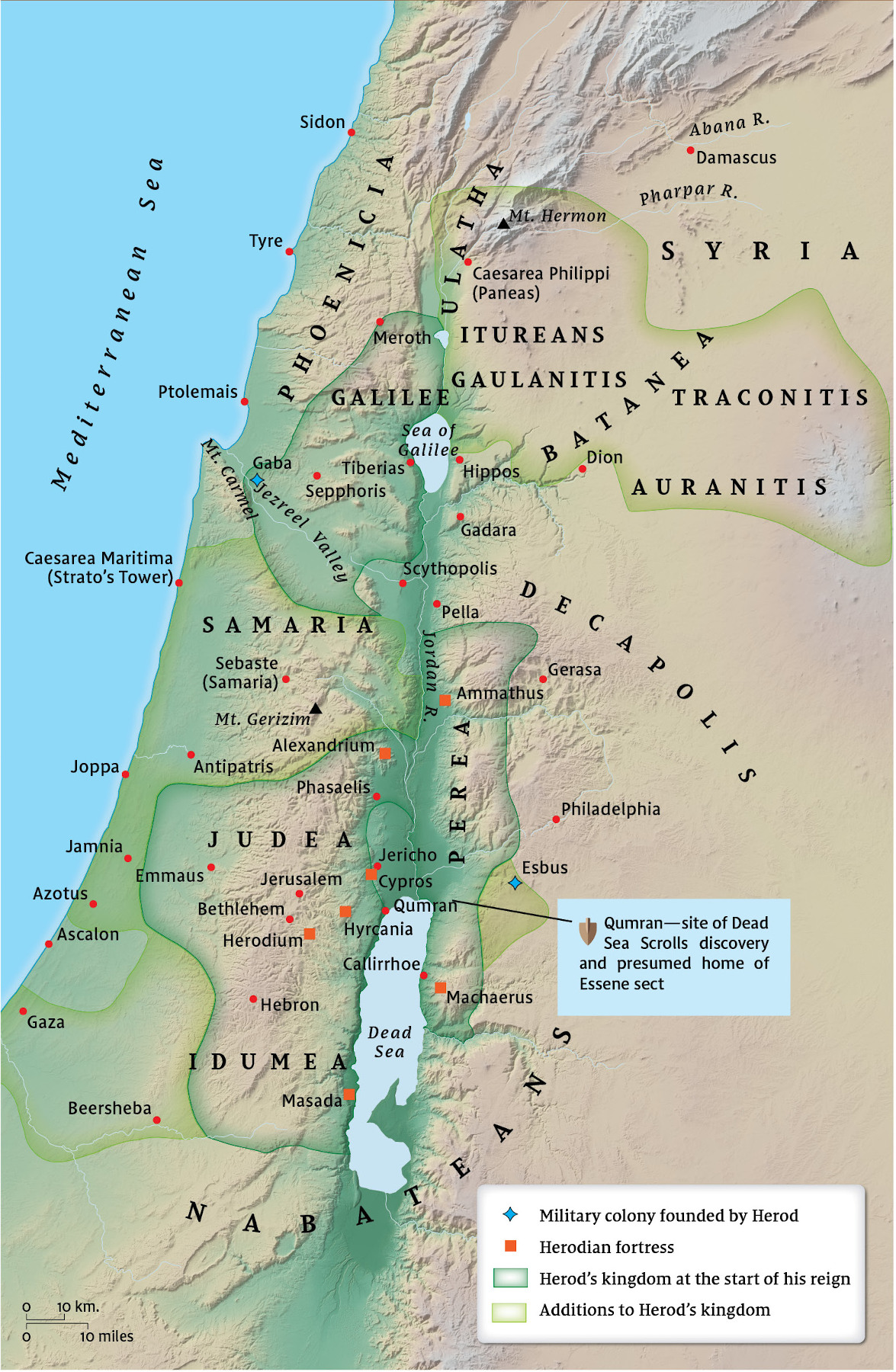
 1:5 Herod king of Judea. Herod the Great reigned 37–4 bc, and his kingdom also included Samaria, Galilee, Perea and Traconitis (see chart; see also note on Mt 2:1). The time referred to here is probably c. 7–6 bc. Zechariah . . . Elizabeth. Both were of priestly descent from the line of Aaron. priestly division of Abijah. From the time of David the priests were organized into 24 divisions, and Abijah was one of the “heads of the priestly families” (Ne 12:12,17; see 1Ch 24:4,10 and notes).
1:6 righteous . . . blamelessly. They were not sinless but were faithful and sincere in keeping God’s commandments. Simeon (2:25) and Joseph (Mt 1:19) are given similar praise.
1:7 childless. See note on v. 25.
1:9 It was one of the priest’s duties to keep the incense burning on the altar in front of the Most Holy Place. He supplied it with fresh incense before the morning sacrifice and again after the evening sacrifice (Ex 30:6–8). Because there were over 10,000 priests in first-century Israel, ordinarily any one of them would have this privilege very infrequently, and sometimes never, since duty assignments were determined by lot. chosen by lot. See notes on Ne 11:1; Pr 16:33; Jnh 1:7; Ac 1:26.
1:11 angel of the Lord. See v. 19; see also Ge 16:7 and note.
1:12 fear. A common reaction to such an event, as with Gideon (Jdg 6:22–23) and Manoah (Jdg 13:22).
 1:13 Do not be afraid. This word of reassurance is given many times in both OT and NT (see, e.g., v. 30; 2:10 and note; 5:10; 8:50; 12:7,32; Ge 15:1; 21:17; 26:24; Dt 1:21 and note; Jos 1:9; 8:1 and note). John. The name (derived from Hebrew) means “The LORD is gracious” or “The LORD shows grace.”
1:14 joy. A keynote of these opening chapters (vv. 44,47, 58; 2:10); this Gospel also closes with an expression of “great joy” (24:52).
1:15 wine or other fermented drink. It appears likely that John was to be subject to the Nazirite vow of abstinence from alcoholic drinks (see Nu 6:2–12 and notes). If so, he was a lifelong Nazirite, as were Samson (Jdg 13:4–7) and Samuel (1Sa 1:11). filled with the Holy Spirit. Consistent with his emphasis in his Gospel and in Acts (see note on 4:1), Luke’s birth narratives stress the activity of the Holy Spirit (vv. 35,41,67; 2:25–27). even before he is born. In the OT the Holy Spirit came upon individuals temporarily for some special task (see, e.g., Jdg 3:10 and note), but John was to be filled with the Spirit his entire life.
1:17 Elijah. John was not Elijah returning in the flesh (see Jn 1:21 and note), but he functioned like that OT preacher of repentance (he came “in the spirit and power of Elijah”) and was therefore a fulfillment of Mal 4:5–6 (see notes on Mal 4:5; Mt 11:14; 17:10). to turn the hearts of the parents to their children. See Mal 4:6 and note. True repentance results in reconciliation with others (see 3:8–9 and note on 3:9). people prepared for the Lord. John helped fulfill Isaiah’s prophecy (see Isa 40:3–5 and notes), as Luke shows in 3:4–6.
1:18 How can I be sure . . . ? Like Abraham (see Ge 15:8 and note), Gideon (see Jdg 6:17 and note) and Hezekiah (2Ki 20:8), Zechariah asked for a sign (cf. 1Co 1:22).
1:19 Gabriel. The name can mean “God is my hero” or “Mighty man of God.” Only two angels are identified by name in Scripture: Gabriel (Da 8:16; 9:21) and Michael (see Da 10:13,21 and note on 10:13; Jude 9; Rev 12:7 and note).
1:20 Zechariah would have known how God intervened with Sarai in very similar circumstances (Ge 17:15–22) and so should have trusted God’s work in the present.
1:21 the people were waiting for Zechariah. They were waiting for him to come out of the Holy Place and pronounce the Aaronic blessing (see Nu 6:24–26 and notes).
1:23 his time of service. Each priest was responsible for a week’s service at the temple once every six months. home. See v. 39.
1:24 remained in seclusion. Perhaps in devotion and gratitude that the Lord had taken away her childlessness.
1:25 The Lord . . . has shown his favor and taken away my disgrace. Not only did lack of children deprive the parents of personal happiness and care in old age, but it was generally considered to indicate divine disfavor and often brought social reproach (see Ge 16:2, Sarai; 25:21, Rebekah; 30:23, Rachel; 1Sa 1:1–18, Hannah; see also Lev 20:20–21; Ps 128:3; Jer 22:30).
1:26–35 This section speaks clearly of the virginal conception of Jesus (vv. 27,34–35; see Mt 1:18–25 and notes). The conception was the work of the Holy Spirit. Jesus, the eternal second person of the Trinity, while remaining God, also “became flesh” (Jn 1:14; see note there). From conception he was fully God and fully man.
1:26 Nazareth. See note on Mt 2:23.
1:27 pledged to be married. See notes on Joel 1:8; Mt 1:18.
1:31 Jesus. See Mt 1:21 and NIV text note for the meaning of this name.
1:32 the Son of the Most High. This title has two senses: (1) the divine Son of God and (2) the Messiah born in time. His Messiahship is clearly referred to in the following context (vv. 32b–33). Most High. A title frequently used of God in both the OT and NT (see vv. 35,76; 6:35; 8:28; Ge 14:19 and note; 2Sa 22:14; Ps 7:10,17). throne. Promised in the OT to the Messiah descended from David (see 2Sa 7:13, 16; Ps 2:6–7; 89:25–27; Isa 9:6–7 and notes). his father David. Mary may have been a descendant of David, as was Joseph (see Mt 1:16 and note); so Jesus could rightly be called a “son” of David.
1:33 forever. See 2Sa 7:16; Ps 45:6 and notes; Rev 11:15. his kingdom will never end. Although Christ’s role as mediator will one day be finished (see 1Co 15:24–28 and notes), the kingdom of the Father and Son, as one, will never end.
1:34 How will this be . . . ? Mary had no precedent of a virginal conception (see v. 20 and note). See v. 45.
1:35 holy one. Jesus never sinned (see 2Co 5:21; Heb 4:15; 7:26 and notes; see also 1Pe 2:22; 1Jn 3:5).
1:36 Elizabeth your relative. It is not known whether she was a cousin, aunt or other relation.
1:44 for joy. In some mysterious way the Holy Spirit produced this remarkable response in the unborn baby (see note on v. 14).
1:46–55 One of four hymns preserved in Lk 1–2 (see vv. 68–79; 2:14; 2:29–32 and notes). This hymn of praise is known as the Magnificat because in the Latin Vulgate translation the opening word is Magnificat, which means “glorifies.” This song is like a psalm and has striking similarities to the song of Hannah (1Sa 2:1–10; see note on 1Sa 2:1). Its main theme is the reversal of the powerful and the lowly in society and among people groups, especially where Israel has been humiliated (for this theme throughout Luke’s Gospel, see 1:68–79; 4:16–21; 6:20–26; 16:19–31).
1:50 those who fear him. Those who revere God and live in harmony with his will (see notes on Ge 20:11; Pr 1:7).
1:51 his arm. A figurative description of God’s powerful acts. God does not have a body; he is spirit (see Jn 4:24 and note).
1:53 hungry. Both physically and spiritually (see Mt 5:6 and note; Jn 6:35). The coming of God’s kingdom will bring changes affecting every area of life.
1:54 remembering to be merciful. The song ends with an assurance that God will be true to his promises to his people (see v. 55; Ge 22:16–18 and notes).
1:56 three months. Mary evidently remained with Elizabeth until John’s birth and then returned to her home in Nazareth (v. 36).
1:57–66 The birth of John the Baptist marks the fulfillment of the prophecy in vv. 5–25.
1:59 name him after his father. An accepted practice in that day, as seen in Josephus (Life, 1).
1:62 they made signs to his father. Apparently assuming that since he was mute he was also deaf. He may well have been both.
1:63 a writing tablet. Probably a small wooden board covered with wax.
1:64 praising God. A common theme in Luke (2:13,20,28; 5:25–26; 7:16; 13:13; 17:15,18; 18:43; 19:37; 23:47; 24:53).
1:67 filled with the Holy Spirit . . . prophesied. Prophecy not only predicts but also proclaims God’s word. Both Zechariah and Elizabeth (vv. 41–45) were enabled by the Holy Spirit to express an inspired proclamation.
1:68–79 This hymn is called the Benedictus (“Praise be to” or “Blessed be”) because the opening word in the Latin Vulgate translation is Benedictus. Its theme is the deliverance of Israel from their enemies through the coming Messiah. Whereas the Magnificat (see note on 1:46–55) is similar to a psalm, the Benedictus is more like a prophecy.
1:68 redeemed them. Not limited to national security (v. 71) but including moral and spiritual salvation (vv. 75,77).
1:69 horn. Indicates strength (see NIV text note), as in the horn of an animal (Dt 33:17; Ps 22:21; Mic 4:13). Jesus, the Messiah from the house of David, has the power to save (see Ps 132:17 and note).
1:73 oath he swore to . . . Abraham. In Ge 22:16–18 (see notes there).
1:74 to rescue us. Including liberation from all kinds of oppression and bondage as well as deliverance from sin.
1:76 called a prophet of the Most High. But Jesus will be called “the Son of the Most High” (see v. 32 and note). prepare the way. See notes on 3:4; Mal 3:1.
1:78 the rising sun. A reference to the coming of the Messiah (see also similar figures in Nu 24:17; Isa 9:2; 60:1; Mal 4:2–5 and notes). Zechariah not only praised his own son, the “prophet of the Most High” (vv. 76–77) but also gave honor to the coming Messiah (vv. 78–79). will come to us. God’s coming (or visitation) occurs at the beginning (v. 68) and end of this hymn and is an important theme in Luke’s Gospel (7:16; 19:44).
1:79 those living in darkness. The lost, separated from God (see Isa 9:1–2; Mt 4:15–16 and notes). peace. See note on 2:14.
1:80 lived in the wilderness. John’s parents, old at his birth, probably died while he was young, and he apparently grew up in the sparsely populated Desert of Judea, which lies between Jerusalem and the Dead Sea. until he appeared publicly. John’s preaching and announcing the coming of the Messiah marked his public appearance. He was about 30 years old when he began his ministry (see note on 3:23).
2:1–7 Jesus’ birth marks the beginning of the fulfillment of the prophecy in 1:26–38.
2:1 Luke takes special interest in relating his narrative to events of world history. Caesar Augustus. The first and (according to many) greatest Roman emperor (27 bc—ad 14). Having replaced the republic with an imperial form of government, he expanded the empire to include the entire Mediterranean world, established the famed Pax Romana (“Roman Peace”) and ushered in the golden age of Roman literature and architecture. Augustus (which means “exalted”) was a title conferred on him by the Roman senate in 27 bc. Nevertheless, the Israelites and other subjugated peoples still languished under the occupation of foreign armies. census. Used for military service and taxation. Jews, however, were exempt from Roman military service. God used the decree of a pagan emperor to fulfill the prophecy of Mic 5:2 (see note there; see also Mt 2:3–6). Roman world. See map.

Main Roman Emperors of the New Testament Period
Name | Date | Events Under Their Reign |
Caesar Augustus or Octavian | 27 bc–ad 14 | The emperor associated with the census at Jesus’ birth (Lk 2:1). Demonstrating extraordinary skills as leader and administrator, Augustus inaugurated the Pax Romana (“Roman Peace”), an unprecedented period of peace and stability throughout the Mediterranean region. The freedom and relative safety of travel afforded by this peace would prove to be major factors for the rapid expansion of Christianity. |
Tiberius | ad 14–37 | Emperor during Jesus’ public ministry (Lk 3:1). It was to him Jesus referred when he said, “Give back to Caesar what is Caesar’s and to God what is God’s” (see Mk 12:17 and note). |
Caligula | ad 37–41 | Provoked a crisis among the Jews by demanding that his image be set up in the Jerusalem temple. Agrippa I eventually convinced Caligula to cancel the order, and the emperor was assassinated before it was carried out. Paul may be alluding to this event as a type of the antichrist when he speaks of the “man of lawlessness” who “sets himself up in God’s temple, proclaiming himself to be God” (2Th 2:3–4). |
Claudius | ad 41–54 | Expelled the Jews from Rome in ad 49, probably because of conflicts with Jewish Christians (Suetonius, Life of Claudius 25.4). Priscilla and Aquila came from Rome to Corinth at this time (Ac 18:2; cf. 11:28). |
Nero | ad 54–68 | The caesar to whom Paul appealed during his trial (Ac 25:10; 28:19). Later, in ad 64, Nero began the first major persecution against Christians, blaming them for a fire he was rumored to have set in Rome (Tacitus, Annals 15.44). Both Paul and Peter were probably martyred under Nero. |
Vespasian | ad 69–79 | Declared emperor while in Israel putting down the Jewish Revolt of ad 66–73. He returned to Rome, leaving his son Titus to complete the destruction of Jerusalem and the temple. |
Domitian | ad 81–96 | The second emperor (after Nero) to persecute the church. This persecution is likely the background to the book of Revelation. |
Adapted from Four Portraits, One Jesus by Mark L. Strauss. Copyright © 2007 by Mark L. Strauss, p. 113. Used by permission of Zondervan.
Go to the Charts Index.
2:2 Quirinius. This official may have been in office for two terms, first 6–4 bc and then ad 6–9. A census is associated with each term. This is the first; Ac 5:37 refers to the second. But see NIV text note.
2:3 own town. Possibly the town of their ancestral origin, but possibly where they had lived before, because they appear to have made plans to move back there (Mt 2:11).
2:4 Nazareth . . . Bethlehem. Bethlehem, the town where David was born (1Sa 17:12; 20:6), was at least a three-day trip from Nazareth. Judea. The Roman designation for the southern part of the Holy Land, earlier included in the kingdom of Judah.
2:5 with Mary. Mary may also have been of the house of David and therefore required to enroll. In Syria, the Roman province in which the Holy Land was located, women 12 years of age and older were required to pay a poll tax and therefore to register. pledged to be married. See Mt 1:18 and note.
2:7 cloths. Strips of cloth were regularly used to wrap a newborn infant. manger. The feeding trough of the animals. This is the only indication that Christ was born in a stable. Very early tradition suggests that it was a cave, perhaps used as a stable. guest room. Traditionally the Greek word (kataluma) was translated “inn,” but respectable travelers normally looked for lodging with friends and relatives, because public hostels were notorious for harboring criminals and prostitutes. In its one other context in which it appears in the Bible (Mk 14:14; Lk 22:11), it clearly means a guest room.
2:8 living out in the fields. Possibly in the spring, when the baby animals were born. The flocks reserved for temple sacrifice were kept in the fields near Bethlehem throughout the year. keeping watch. Against thieves and predatory animals or in case mother animals needed help in delivering their young.
2:9 An angel of the Lord. A designation used throughout the birth narratives (see 1:11 and note; Mt 1:20, 24; 2:13,19). The angel in 1:11 is identified as Gabriel (1:19; see 1:26). Cf. Ge 16:7 and note.
2:10 Do not be afraid. Fear was the common reaction to angelic appearances (see note on 1:13), and encouragement was needed. great joy. See note on 1:14.
2:11 town of David. Bethlehem (v. 4). Savior. Many Jews were looking for a political leader to deliver them from Roman rule. But this announcement concerns the Savior who would above all deliver from sin and death (see Mt 1:21; Jn 4:42 and note). the Messiah. See second NIV text note on Mt 1:1. the Lord. A designation used of God and his “Anointed” (the Messiah) (see Ac 2:36; Php 2:11 and note on 2:9; 1Th 1:1 and note). Together, “a Savior,” “the Messiah,” and “the Lord” combine Luke’s most distinctive title for Jesus (Savior) with his two most characteristic titles.
2:13,20 praising God. See 1:64 and note.
2:14 See note on 1:46–55. This brief hymn is called the Gloria in Excelsis Deo (meaning “glory to God in the highest”), from its first words in the Latin Vulgate translation. The angels recognized the glory and majesty of God by giving praise to him. in the highest heaven. Where God dwells (cf. Mt 6:9). peace to those on whom his favor rests. Peace is not assured to all, but only to those pleasing to God—the objects of his good pleasure (see Luke’s use of the word “pleased” elsewhere: 3:22; 10:21; 12:32). The Roman world was experiencing the Pax Romana (“Roman Peace”), marked by external tranquillity. But the angels proclaimed a deeper, more lasting peace than that—a peace of mind and soul made possible by the Savior (v. 11). Peace with God is received by faith in Christ (see Ro 5:1 and note), and it is on believers that “his favor rests.” The Davidic Messiah was called “Prince of Peace” (Isa 9:6; see note there), and Christ promised peace to his disciples (see Jn 14:27; 16:33; Php 4:7 and notes). But Christ also brought conflict (the “sword”; see Mt 10:34 and note; cf. Lk 12:49), for peace with God involves opposition to Satan and his work (see Jas 4:7 and note).
2:19 treasured up all these things . . . in her heart. Cf. v. 51.
2:21 eighth day. See 1:59; Ge 17:12 and note. circumcise. See Ge 17:10; Jn 7:22 and notes.
2:22 purification. Following the birth of a son, the mother had to wait 40 days before going to the temple to offer a sacrifice for her purification. If she could not afford a lamb and a pigeon (or dove), then two pigeons (or doves) would be acceptable (see Lev 12:2–8 and notes; cf. Lev 5:11). to Jerusalem. The distance from Bethlehem to Jerusalem was only about five miles. present him to the Lord. The firstborn of both people and animals were to be dedicated to the Lord (see v. 23; Ex 13:2–13 and notes). The animals were sacrificed, but the human beings were to serve God throughout their lives. The Levites actually served in the place of all the firstborn males in Israel (Nu 3:11–13; 8:17–18).
The Hymns of Luke’s Birth Narrative
Song* | Verses | Singer | Theme |
The Magnificat | Mary | God’s exaltation of the lowly and humiliation of the mighty | |
The Benedictus | Zechariah | God’s salvation through the Davidic Messiah, prepared for by John the Baptist | |
Gloria in Excelsis Deo | Angelic chorus | Glory to God; peace to the recipients of his grace | |
The Nunc Dimittis | Simeon | God’s salvation as the glory of Israel and a light to the Gentiles |
*Named for the first word(s) in the Latin translation.
Adapted from Four Portraits, One Jesus by Mark L. Strauss. Copyright © 2007 by Mark L. Strauss, p. 265. Used by permission of Zondervan.
Go to the Charts Index.
2:25 the consolation of Israel. The comfort the Messiah would bring to his people at his coming (see vv. 26,38; 23:51; 24:21; Isa 40:1–2 and notes; Mt 5:4). the Holy Spirit was on him. Simeon was given a special insight by the Spirit so that he would recognize the “Messiah” (v. 26; cf. 1:15 and note).
2:28 praised God. See 1:64 and note.
2:29–32 See note on 1:46–55. This hymn of Simeon has been called the Nunc Dimittis (meaning “you may now dismiss”), from its first words in the Latin Vulgate translation. See chart.
2:31 all nations. As a Gentile himself, Luke was careful to emphasize the truth that salvation was offered to Gentiles (v. 32) as well as to Jews.
2:32 light for revelation to the Gentiles. An allusion to Isa 49:6. Paul will cite the same passage in his sermon in Pisidian Antioch in Ac 13:47 as justification for the mission to the Gentiles. light. See 1:78–79; Ps 27:1 and notes.
2:33 child’s father. Luke, aware of the virgin birth of Jesus (1:26–35), is referring to Joseph as Jesus’ legal father (see v. 41; Jn 1:45 and note).
2:34 falling and rising of many in Israel. Christ raises up those who believe in him but is a stumbling block for those who disbelieve (see 20:17–18 and note on 20:18; 1Co 1:23; 1Pe 2:6–8 and notes). sign . . . spoken against. This somewhat enigmatic statement may mean that Jesus, a sign from God (v. 12; 11:30), would precipitate division, opposition and rejection.
2:35 sword will pierce your own soul too. Mary, as well as Jesus, would suffer deep anguish—the first reference in this Gospel to Christ’s suffering and death.
2:36 prophet. Other female prophets were Miriam (Ex 15:20), Deborah (Jdg 4:4), Huldah (2Ki 22:14) and the daughters of Philip (Ac 21:9). Anna. Greek Hanna; same name as OT Hannah (1Sa 1:2), which means “gracious.” Anna praised God for the child Jesus, as Hannah had praised God for the child Samuel (1Sa 2:1–10).
2:37 never left the temple. Herod’s temple was quite large and included rooms for various uses, and Anna may have been allowed to live in one of them. This statement, however, probably means that she spent her waking hours attending and worshiping in the temple.
2:38 Jerusalem. The holy city of God’s chosen people; here it stands for Israel as a whole. See Introduction to Psalms: Theology, 7.
2:39 they returned to Galilee. Luke does not mention the coming of the Magi, the danger from Herod or the flight to and return from Egypt (cf. Mt 2:1–23), but they must have occurred at this point.
2:40 child grew. This continues the parallelism between Jesus and John the Baptist (cf. 1:80; see note on 1:5—2:52). filled with wisdom. See vv. 46–47,52. In Isaiah 11:2, the Messiah is said to be endowed with “the Spirit of wisdom and understanding.”
2:41 Festival of the Passover. Annual attendance at three festivals by all adult males (normally accompanied by their families) was commanded in the law: Passover, Pentecost and Tabernacles (see notes on Ex 23:14–17; Dt 16:16). Distance prevented many from attending all three, but most Jews tried to be at Passover.
2:42 twelve years old. At age 12 boys began preparing to take their places in the religious community the following year.
2:46 the teachers. The rabbis, experts in Judaism.
2:49 in my Father’s house. See NIV text note. Jesus pointed to his personal duty to his Father in heaven. He contrasted his “my Father” with Mary’s “your father” (v. 48). At 12 years of age he was aware of his unique relationship to God, but he was also obedient to his earthly parents (v. 51).
2:52 Luke says of Jesus what is said of Samuel in 1Sa 2:26 (see note there). Jesus grew. Although Jesus was God, there is no indication that he had all knowledge and wisdom from birth. He seems to have matured like any other boy.
3:1–2 Ancient historians frequently dated an event by citing the year in the reign of the ruler at the time the event happened. After these verses, Luke follows Mark’s outline, style and wording more often than not, until the beginning of the travel narrative in 9:51.
 3:1 fifteenth year. Several possible dates could be indicated by this description, but the date ad 25–26 (Tiberius had authority in the provinces beginning in ad 11) best fits the chronology of the life of Christ (see chart). The other rulers named do not help pinpoint the beginning of John’s ministry but only serve to indicate the general historical period (see chart). Pontius Pilate. The Roman governor of Judea from ad 26 to 36, whose official residence was in Caesarea on the Mediterranean coast (see map). (In 1961 archaeologists unearthed a stone step in the Roman amphitheater in Caesarea contemporary with Pilate and bearing a Latin inscription that included these words: “Pontius Pilate, Prefect [Governor] of Judea”; see chart; see also photo; and article.) When he came to Jerusalem, he stayed in the magnificent palace built by Herod the Great, located southwest of the temple area. Mark calls this palace “the Praetorium” (Mk 15:16; see note there), and it was here that the Roman trial of Jesus took place (see note on Mk 14:53—15:15). Cf. article. Herod tetrarch of Galilee. At the death of Herod the Great (4 bc), his sons—Archelaus, Herod Antipas and Herod Philip—were given jurisdiction over his divided kingdom. Herod Antipas became the tetrarch of Galilee and Perea (see note on Mt 14:1; see also chart). tetrarch. Originally the ruler of a fourth part of a region, but a title that came to be used of any minor ruler. Lysanias tetrarch of Abilene. Nothing is known of this Lysanias beyond the fact that his name has been found in certain inscriptions (for Abilene, see map).
Pontius Pilate ruled as prefect (governor) over Judea about ad 26–36. Judea had been ruled by Roman governors under the direct authority of the emperor since ad 6, when the Jewish king Archelaus, son of Herod the Great, had been removed from office because of corruption and abuse of power. Pilate was in power during the time of Jesus’ arrest and trial; this is why Pilate gave the orders for Jesus’ crucifixion.
Pilate is depicted in the Gospels as a weak-willed leader who recognizes Jesus’ innocence and seeks to release him but is persuaded to crucify him under pressure from the religious leaders. Some have argued that this is a very different portrait of Pilate from that found in Jewish writers like Josephus and Philo, who describe him as cruel, violent, politically corrupt and insensitive toward his Jewish subjects. Pilate’s rule began with controversy when he secretly brought Roman standards bearing the image of the emperor—viewed as idols by the Jews—into Jerusalem (Ant. 18.3.1 §§55–59; War 2.9.2–3 §§169–74). Riots also broke out when Pilate used money from the temple treasury to build an aqueduct for Jerusalem. Pilate sent soldiers to surround and attack the protestors, killing many (Ant. 18.3.2 §§60–62; War 2.9.4 §§175–77). Jesus spoke of a similar atrocity committed by Pilate (Lk 13:1).
Though different authors certainly portray Pilate from different perspectives, these can be seen as complementary rather than contradictory. While the Gospel writers may omit references to Pilate’s corruption so as not to antagonize the Roman authorities of their day, both the Gospels and extrabiblical sources portray him as a cynical and self-serving ruler, insensitive toward his Jewish subjects and yet politically pragmatic.
Pilate viewed the religious leaders with contempt but feared their influence in Rome, fearing that a negative report could have him recalled to Rome. This is in fact what eventually happened: After a particularly violent military action against a group of Samaritan protestors, Pilate was recalled to Rome and removed from office (Ant. 18.4.1–2 §§85–89).
Go to the Articles Index.
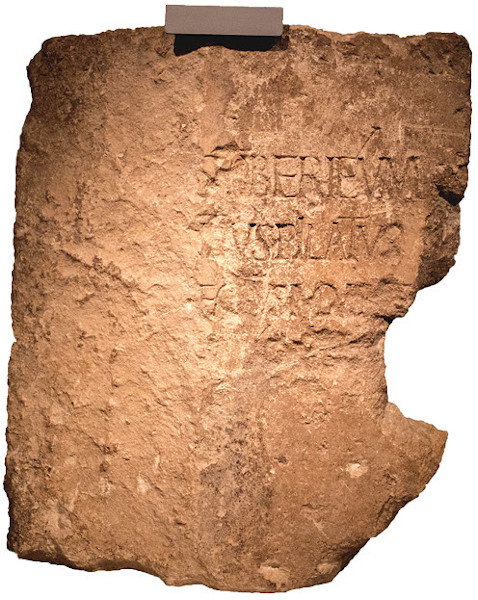
Stone step with a Latin inscription, “Pontius Pilate, Prefect [Governor] of Judea,” discovered in the Roman amphitheater in Caesarea Maritima, dated to the first century ad (see Lk 3:1 and note).
© 2018 by Zondervan
Return to the main text.
3:2 the high-priesthood of Annas and Caiaphas. Annas was high priest from ad 6 until he was deposed by the Roman official Gratus in 15. He was followed by his son Eleazar, his son-in-law Caiaphas and then four more sons. Even though Rome had replaced Annas, the Jews continued to recognize his authority (see Jn 18:13; Ac 4:6 and notes), so Luke included his name as well as that of the Roman appointee, Caiaphas (see photo). word of God. The source of John’s preaching and authority for his baptizing. God’s message came to John as it came to the OT prophets (see Jer 1:2; Hos 1:1; Joel 1:1 and notes; see also Eze 1:3). wilderness. Refers to a desolate, uninhabited area, not necessarily a sandy, waterless place.
3:3 baptism of repentance. See note on Mt 3:11. John’s baptism represented a change of heart, which includes sorrow for sin and a determination to lead a holy life. forgiveness of sins. Christ would deliver the repentant person from sin’s penalty by dying on the cross.
3:4 Prepare the way. Before a king made a journey to a distant country, the roads he would travel were improved (see Isa 40:3 and note). Similarly, preparation for the Messiah was made in a moral and spiritual way by the ministry of John, which focused on repentance and forgiveness of sin and the need for a Savior.
3:6 all people. God’s salvation was to be made known to both Jews and Gentiles—a major theme of Luke’s Gospel (see note on 2:31).
3:7 brood of vipers! See Mt 12:34 and note; 23:33. the coming wrath. Likely a reference to both the destruction of Jerusalem (21:20–23), which occurred in ad 70, and the final judgment (Jn 3:36). But see notes on 1Th 1:10; 5:9.
3:9 ax . . . at the root. A symbolic way of saying that judgment is near for those who give no evidence of repentance. fire. A symbol of divine judgment (see Mt 7:19; 13:42 and note; see also La 1:13 and note).
3:10–14 This section of John the Baptist’s teaching is unique to Luke and reflects Luke’s interest in issues of social justice.
3:11 two shirts. A “shirt” or tunic was something like a long undershirt. Since two such garments were not needed, the second should be given to a person in need of one (see 9:3 and note on Mk 6:9).
3:12 tax collectors. Taxes were collected for the Roman government by Jewish agents, who were especially detested for helping the pagan conqueror and for frequently defrauding their own people (see notes on 19:2,8; Mt 5:46; Mk 2:16).
3:14 soldiers. Limited military forces were allowed for certain Jewish leaders and institutions (such as those of Herod Antipas, the police guard of the temple and escorts for tax collectors). The professions of tax collector and soldier as such were not condemned, but the common unethical practices associated with them were.
3:16 baptize you with the Holy Spirit. Fulfilled at Pentecost (see Ac 1:5; 2:4,38 and notes). and fire. Here fire is associated either with Pentecost (“tongues of fire,” Ac 2:3) or with judgment (v. 17; see La 1:13 and note).
3:17 His winnowing fork. See note on Ru 1:22. The chaff represents the unrepentant and the wheat the righteous (see photos here and here). Many Jews thought that only pagans would be judged and punished when the Messiah came, but John declared that judgment would come to all who did not repent—including Jews.
3:19 rebuked Herod . . . because of his marriage to Herodias. Herod Antipas had married the daughter of Aretas IV of Arabia but divorced her to marry his own niece, Herodias, who was already his brother’s (Herod Philip’s) wife (see Mt 14:3 and note; Mk 6:17).
3:20 locked John up in prison. According to Josephus, John was imprisoned in Machaerus, east of the Dead Sea (Antiquities, 18.5.2; see map). This did not occur until sometime after the beginning of Jesus’ ministry (see Jn 3:22–24), but Luke mentions it here in order to conclude this section on John’s ministry before starting his account of the beginning of Jesus’ ministry (see also Mt 4:12; Mk 1:14). He later briefly alludes to John’s death (9:7–9). Luke further emphasizes this transition from John to Jesus by omitting John’s role in the baptism of Jesus (v. 21).
3:21 baptized. See note on Mt 3:15; see also map and accompanying text, and photo. as he was praying. Only Luke notes Jesus’ praying at the time of his baptism. Jesus in prayer is one of the special themes of Luke (5:16; 6:12; 9:18,28–29; 11:1; 22:32,41; 23:34,46).
3:22 Holy Spirit descended. Luke specifies “in bodily form.” my Son, whom I love. See Ps 2:7 and note on 2:7–9; Isa 42:1; Heb 1:5 and note. Two other times the Gospel writers record the declarations of a voice from heaven referring to Jesus: (1) on the Mount of Transfiguration (9:35) and (2) in the temple courts during Jesus’ final week (Jn 12:28).
3:23–38 There are several differences between Luke’s genealogy and Matthew’s (1:2–16). Matthew begins with Abraham (the father of the Jewish people), while Luke traces the line in the reverse order and goes back to Adam, showing Jesus’ relationship to the whole human race (see note on 2:31). From Abraham to David, the genealogies of Matthew and Luke are almost the same, but from David on they are different. Many interpreters suggest that this is because Matthew traces the legal descent of the house of David, using only heirs to the throne, while Luke traces the direct bloodline of Joseph to David (see Introduction to 1 Chronicles: Genealogies)—perhaps the preferred view. Another common explanation is that Matthew follows the line of Joseph (Jesus’ legal father through Solomon; see Mt 1:6–7, 16), while Luke emphasizes that of Mary (Jesus’ blood relative through Nathan, v. 31). Although tracing a genealogy through the mother’s side was unusual, so was the virgin birth. Luke’s explanation here that Jesus was the son of Joseph, “so it was thought” (v. 23), brings to mind his explicit virgin birth statement (1:34–35) and suggests the importance of the role of Mary in Jesus’ genealogy. Cf. article.
3:23 about thirty years old. Luke, a historian, relates the beginning of Jesus’ public ministry both to world history (vv. 1–2) and to the rest of Jesus’ life. Thirty was the age when a Levite undertook his service (Nu 4:47) and when a man was considered mature. so it was thought. Luke had already affirmed the virgin birth (1:34–35) and here makes clear again that Joseph was not Jesus’ physical father.
Comparing Luke’s and Matthew’s Genealogies
Matthew begins his gospel with a genealogy of 41 names, starting with Abraham and ending with Jesus (Mt 1:2–17). Luke inserts his genealogy after Jesus’ baptism and before his temptation. It contains 57 names and starts with Jesus, going backward all the way to Adam, the first man, and then to God himself (3:23–38).
Matthew and Luke basically follow the names of the people we know from the OT, up until the time of David, while diverging in the names after that until Joseph, Jesus’ adoptive father. Ancient genealogies were often selective, focusing on the most important people; the language of someone being the father or son of another person often meant just that they were an ancestor or descendant. By repeating the reference to the deportation to Babylon (Mt 1:11–12), Matthew creates three series of 14 names, with the 14th name being King David. The Hebrew gematria (the sum of the numbers that each letter in a name stood for) for David is also 14. (Prior to the introduction of vowel points in post-NT times, David would have been spelled DVD, using the fourth, sixth, and fourth letters of the Hebrew alphabet, which add up to 14.) Given the reference to Jesus as son of David in 1:1 and Matthew’s preference for that title throughout his Gospel, it is likely that Matthew crafted Jesus’ genealogy to reflect Jesus’ royal sonship as heir to the Davidic throne.
Luke’s distinctives are harder to account for. He may have used all the names he knew about. Luke’s is the more universal gospel, so taking Jesus all the way back to Adam and then to God fits that characteristic. A number of different solutions have been suggested to account for the differences in the names with Matthew’s genealogy where they run parallel. The most popular has been to suggest that one represents Joseph’s legal line; the other his biological line. At any point where a biological heir died childless, through the Jewish practice of levirate marriage (Dt 25:5–10) the two lines could have diverged. In early church history, Luke was favored as providing the legal (or royal) genealogy; in modern times, the legal genealogy has often been identified with Matthew.
Another common option has been to see Matthew as supplying one of Joseph’s two lines, with Luke giving Mary’s lineage. The second-century Protevangelium of James reflects an early church tradition that Mary’s parents were named Joakim and Anna. A variant form of Joakim is Eliakim (because both Joa from Yah and Eli from El translate Hebrew names for God). An abbreviated form of Eliakim is Eli (or Heli), the person one generation before Joseph and Mary in Lk 3:23. This interpretation would require “so it was thought” in this verse to be Luke’s clue that Jesus was not really descended from Joseph, so that his genealogy must be Mary’s.
No solution is free from problems, but neither is it necessary to conclude that the differences between the genealogies are irreconcilable. Paying attention to the themes and specific interests of both Gospel writers helps us to understand many of the differences.
Go to the Articles Index.
4:1 full of the Holy Spirit. Luke emphasizes the Holy Spirit not only in his Gospel (1:35,41,67; 2:25–27; 3:16,22; 4:14,18; 10:21; 11:13; 12:10,12) but also in Acts, where the Spirit is mentioned 57 times. into the wilderness. The Desert of Judea (see notes on 1:80; Mt 3:1).
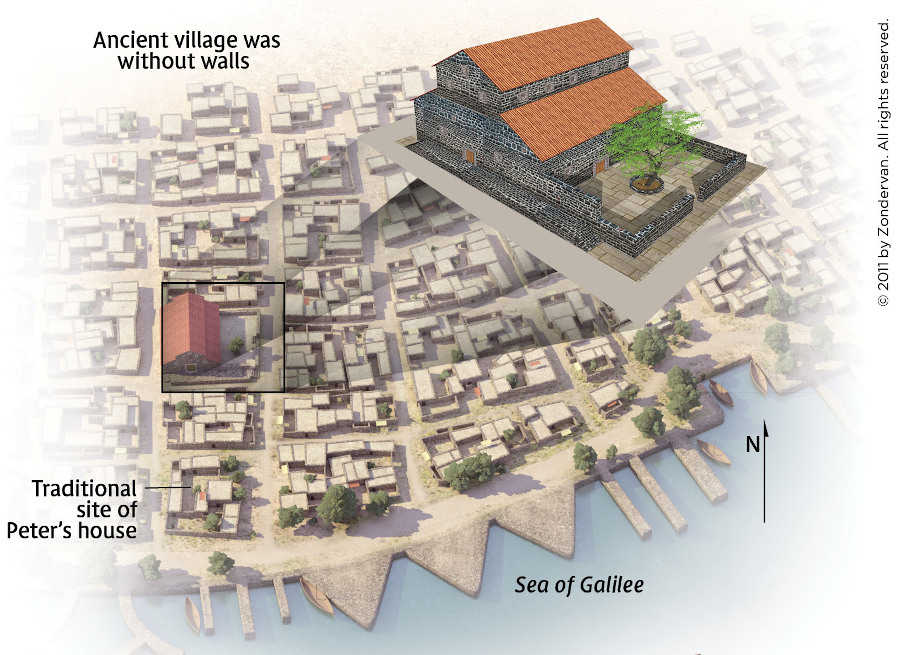
Capernaum was more than a seaside fishing village in the days of Jesus. It was the place that Jesus chose to be the center of his ministry to the entire region of Galilee, and it possessed ideal characteristics as a point of dissemination for the gospel. See photos here and here.
There were good reasons for this. The town itself was named Kephar Nahum, “village of [perhaps the prophet] Nahum,” and was the centerpiece of a densely populated region having a bicultural flavor. On the one hand, there were numerous synagogues in Galilee (in addition to the one in Capernaum), where the ferment of Jewish religious life was profound. On the other hand, there was Hellenism, a pervasive Greek culture already centuries old and potent in its paganism—a lifestyle that influenced manners, dress, architecture and political institutions as well.
Archaeological work at Capernaum has revealed a section of the pavement of a first-century synagogue below the still-existing ruins of the fourth-century one on the site. A private house later made into a church and a place of pilgrimage has yielded some evidence that may link it to the site of Simon Peter’s house (Lk 4:38).
© 2011 by Zondervan. All rights reserved.
Go to the Models Index.
4:2 he was tempted. See notes on Mt 4:1–11; 4:1; Heb 2:18; 4:15. Jesus’ 40 days of temptation in the wilderness parallels Israel’s 40 years of testing in the wilderness. Luke states that Jesus was tempted for the 40 days he was fasting, and the three specific temptations recounted in Matthew and Luke seem to have occurred at the close of this period—when Jesus’ hunger was greatest and his resistance lowest. The sequence of the second and third temptations differs in Matthew and Luke. The climax to each temptation narrative is appropriate to its particular Gospel. Matthew, who emphasizes mountaintop revelations, ends the temptation on a high mountain. Luke, who strongly stresses Jerusalem and the temple (e.g., 1:8; 24:52–53) ends with Jesus on the pinnacle of the temple.
4:3 tell this stone to become bread. The devil always makes his temptations seem attractive.
4:6 their authority . . . has been given to me. Satan is elsewhere called “the prince of this world” (Jn 12:31), “the god of this age” (2Co 4:4) and “the ruler of the kingdom of the air” (Eph 2:2)—but remains under God’s sovereign power and control (cf. notes on 2Sa 24:1; Job 1:12; 2Co 4:4).
4:7 worship me. The devil was tempting Jesus to avoid the sufferings of the cross, which he came specifically to endure (see Mk 10:45 and note). The temptation offered an easy shortcut to world dominion.
4:9 the highest point of the temple. Either the southeast corner of the temple colonnade, from which there was a drop of some 100 feet to the Kidron Valley below, or the pinnacle of the temple proper. temple. See note on Mt 4:5. If you are. See note on Mt 4:3. throw yourself down. Satan was tempting Jesus to test God’s faithfulness and to attract public attention dramatically.
4:10 For it is written. This time Satan also quoted Scripture, though he misused Ps 91:11–12.
4:12 Jesus answered with Scripture, as he had on each of the other two occasions, quoting from Deuteronomy (see NIV text notes here and on vv. 4,8).
4:13 he left him until an opportune time. Satan continued his testing throughout Jesus’ ministry (see Mk 8:33 and note), culminating in the supreme test at Gethsemane.
4:14 in the power of the Spirit. See note on v. 1.
4:15 was teaching in their synagogues. See note on Mk 1:21.
4:16–30 Luke apparently moved the Nazareth sermon forward from a later point in Jesus’ life (Mk 6:1–6) to serve as an introduction and overview of Jesus’ ministry. Notice that Jesus refers to his ministry in Capernaum (v. 23) even though he has not yet gone there according to Luke’s Gospel (v. 31).
4:16 as was his custom. Jesus’ custom of regular worship sets an example for all his followers. to read. Jesus probably read from Isaiah in Hebrew, and then he or someone else paraphrased it in Aramaic, the primary language for Jews in Israel.
4:17 the scroll of the prophet Isaiah. See article and photo. The books of the OT were written on scrolls, kept in a special place in the synagogue and handed to the reader by a special attendant. The passage Jesus read about the Messiah (Isa 61:1–2; see notes there) may have been one he chose to read, or it may have been the assigned passage for the day.
4:18 This verse tells of the Messiah’s ministry of preaching and healing—to meet every human need. he has anointed me. Not with literal oil (Ex 30:22–31), but with the Holy Spirit.
4:19 the year of the Lord’s favor. Not necessarily a calendar year, but the period when salvation would be proclaimed—the Messianic age. But this quotation from Isa 61:1–2 (see note on 61:2) alludes to the Year of Jubilee (Lev 25:8–55), when once every 50 years slaves were freed, debts were canceled and ancestral property was returned to the original family. Isaiah predicted primarily the liberation of Israel from the future Babylonian exile, but Jesus proclaimed liberation from sin and its consequences.
4:20 sat down. It was customary to stand while reading Scripture (v. 16; see Ne 8:3,5 and notes) but to sit while teaching (see 5:3; Mt 5:1 and note; 26:55; Mk 4:1; 9:35; Jn 8:2; Ac 16:13).
4:21 Whatever else Jesus may have said in his sermon, here is the stunning heart of his message. He himself is claiming to be Isaiah’s suffering servant, the Messiah, who would bring the good news of freedom.
4:23 hometown. Nazareth (v. 16). Although Jesus was born in Bethlehem, he was “brought up” in Nazareth, in Galilee (see 1:26; 2:39,51; Mt 2:23 and note). Capernaum. See note on Mt 4:13.
4:26–27 Mention of Jesus’ reference to God’s helping two non-Israelites (see 1Ki 17:7–24; 2Ki 5:1–19a and notes) reflects Luke’s special concern for the Gentiles. Jesus’ point was that when Israel was in rebellion and rejected God’s messengers of redemption (Elijah and Elisha), God caused non-Israelites to receive the covenant blessings that were properly Israel’s. This is what aroused the anger of the crowd.
4:26 Sidon. One of the oldest Phoenician cities, 20 miles north of Tyre (see map). Jesus healed a Gentile woman’s daughter in this region (Mt 15:21–28).
4:28 furious. Because of Jesus’ inclusion of Gentiles as recipients of God’s blessings.
4:30 walked right through the crowd. Luke does not explain whether the escape was miraculous or simply the result of Jesus’ commanding presence. In any case, his time (to die) had not yet come (see Jn 7:30 and note).
4:33 possessed by a demon. To pagans, “demon” meant a supernatural being, whether good or bad, but Luke makes it clear that this was an evil spirit. Such a demon could cause violent action (Lk 8:26–29), bodily disease (13:11,16) and rebellion against God (Rev 16:14).
4:34–35 I know who you are. It was commonly believed in the ancient world that knowing the name of a spiritual power gave one authority over it. Be quiet! See 9:21 and note; Introduction to Mark: Theological Emphases (4).
4:34 Holy One of God. See note on Mk 1:24.
4:36 amazed. See v. 32 and note on Mk 1:22.
4:38 synagogue. See notes on Mt 4:13; Mk 1:21. home of Simon. See model; see also photo. Simon’s mother-in-law. Peter was married (see 1Co 9:5 and note). high fever. All three Synoptics tell of this miracle (Mt 8:14–15; Mk 1:29–31), but only Luke, the doctor, uses the more specific phrase “high fever.”
4:40 At sunset. The Sabbath (v. 31) was over at sundown (about 6:00 PM). According to the tradition of the elders, Jews could not carry a burden or travel more than about two-thirds of a mile on the Sabbath. Only after sundown could they carry the sick to Jesus.
4:41 because they knew he was the Messiah. See note on Mk 1:34.
4:42 solitary place. Mark includes the words “where he prayed” (Mk 1:35).
4:43 kingdom of God. Luke’s first use of this phrase; it occurs over 30 times in his Gospel. The kingdom of God is the rule of God and is both a present reality in the person of Jesus and a future hope. See note on Mt 3:2.
4:44 This summary statement includes not only what has just been described (from v. 14 on) but also what lay ahead in Jesus’ ministry. No express mention is made in the Synoptics of the early Judean ministry recorded in John (2:13—4:3), though it may be reflected in 13:34 (see note there) and Mt 23:37. Judea. Some manuscripts, as well as the parallel accounts (Mt 4:23; Mk 1:39), mention Galilee instead of Judea. In writing to a Gentile (see Introduction: Recipient and Purpose), Luke possibly used “Judea” to refer to the whole land of the Jews (see 23:5 and note; Ac 10:37; 11:1,29; 26:20).
5:1–11 This is the first call of the disciples recorded by Luke. Matthew and Mark describe the call of the four fishermen (Mt 4:18–22; Mk 1:16–20).
5:1 Lake of Gennesaret. Luke is the only one who calls it this. This name appears to be a Greek form of the name “Kinnereth” (see Dt 3:17 and note), which is derived from the Hebrew kinnor (harp), referring to the lake’s harp-like shape (see note on Mk 1:16). The other Gospel writers call it the Sea of Galilee (see Mk 1:16 and note), and John twice calls it the Sea of Tiberias (see Jn 6:1 and note; see also NIV text note on Jn 21:1). See photo.
5:2 washing their nets. After each period of fishing, the nets were washed, stretched and prepared for reuse.
5:3 sat down. The usual position for teaching (see note on 4:20). The boat provided an ideal arrangement, removed from the press of the crowd but near enough for Jesus to be seen and heard.
5:7 their partners. See v. 10.
5:8 Go away from me, Lord. The nearer people come to God, the more they feel their own sinfulness and unworthiness—as did Abraham (see Ge 18:27 and note), Job (see 42:6 and note) and Isaiah (6:5).
5:11 left everything and followed him. Although Luke does not narrate earlier encounters, this was not the first time these men had been with Jesus (see Mk 1:17 and note; Jn 1:40–42; 2:1–2). Their periodic and loose association now became a closely knit fellowship as they followed the Master. The scene may be the same as Mt 4:18–22 and Mk 1:16–20, but the accounts relate events from different hours of the morning.
5:12–16 The healing of the man with leprosy is described in all three of the Synoptic Gospels, but each Gospel writer places it in a different sequence of texts because each is arranging his material topically at numerous points.
5:12 covered with leprosy. See NIV text note; see also note on Lev 13:2. Luke alone notes the extent of his disease.
5:14 Don’t tell anyone. See notes on 4:34–35; 9:21; Mt 8:4; 16:20. but go, show yourself to the priest. By this command Jesus urged the man to keep the law, to provide further proof for the actual healing, to testify to the authorities concerning his ministry, and to supply ritual certification of cleansing so the man could be reinstated into society. a testimony to them. See note on Mk 1:44.
5:17 teaching. In Capernaum (Mk 2:1). Pharisees and teachers of the law. See notes on Mt 2:4; 3:7; Mk 2:16. Opposition was rising in Galilee from these religious leaders. Pharisees. Mentioned here for the first time in Luke (see article and chart). Their name means “separated ones”; they numbered about 6,000 and were spread over the whole of the Holy Land. They were teachers in the synagogues, religious examples in the eyes of the people and self-appointed guardians of the law and its proper observance. They considered the interpretations and regulations handed down by tradition to be as authoritative as Scripture (Mk 7:8–13). Already Jesus had run counter to the Jewish leaders in Jerusalem (Jn 5:16–18). Now they came to a home in Capernaum (Mk 2:1–6) to hear and watch him. teachers of the law. “Scribes,” who studied, interpreted and taught the law (both written and oral); see note on Ezr 7:6. The majority of these teachers belonged to the party of the Pharisees.
5:19 roof. See note on Mk 2:4. tiles. The more common form of roof with which Luke’s audiences would have been familiar. Luke is probably contextualizing the account for his congregations.
5:21 this fellow . . . speaks blasphemy. See note on Mk 2:7. The Pharisees considered blasphemy to be the most serious sin anyone could commit (see note on Mk 14:64).
5:23 Which is easier: to say . . . ? See notes on Mk 2:9–10.
5:24 I want you to know. Jesus’ power to heal was a visible affirmation of his power to forgive sins. Son of Man. See note on Mk 8:31.
5:25 praising God. See v. 26; see also 1:64 and note.
5:27 tax collector. See note on 3:12. Levi. Another name for Matthew (6:15). tax booth. The place where customs were collected (see note on Mk 2:14).
5:28 left everything and followed him. Luke emphasizes the immediate response of these men to Jesus’ call to discipleship (v. 11).
5:29 great banquet. When Levi began to follow Jesus, he did not do it secretly (cf. Jn 19:38 and note).
5:30 Pharisees . . . complained. They probably stood outside and registered their complaints from a distance. eat . . . with tax collectors and sinners. See note on Mk 2:15.
5:31 not the healthy who need a doctor, but the sick. Not to imply that the Pharisees were “the healthy” but that people must recognize themselves as sinners before they can be spiritually healed (see note on Mk 2:17).
5:32 repentance. See 24:47 and note.
5:33 John’s disciples . . . fast and pray. John the Baptist’s ministry was characterized by a sober message and an ascetic lifestyle (1:80). His disciples seemed to be following that pattern. For a contrast between Jesus’ ministry and John the Baptist’s, see 7:24–35; Mt 11:1–19. fast. See notes on 18:12; Mk 2:18. While Jesus rejected fasting for display (cf. Isa 58:3–11), he himself fasted privately and permitted voluntary use of fasting for spiritual benefit (Mt 4:2; 6:16–18).
5:35 See notes on Mk 2:19–20.
5:36 parable. See notes on Mt 13:3; Mk 4:2.
5:38 new wineskins. See note on Mt 9:17.
5:39 The old is better. Jesus was indicating the reluctance of some people to change from their traditional religious ways and follow him.
6:1 going through the grainfields. See note on Mk 2:23.
6:3 what David did. See note on Mk 2:25.
6:4 consecrated bread. See note on Mt 12:4.
6:5 Son of Man. See note on Mk 8:31. Lord of the Sabbath. Jesus has the authority to overrule human regulations concerning the Sabbath, such as those reflecting the interpretations of the Pharisees (see Mt 12:8; Mk 2:27 and note).
6:7 to see if he would heal on the Sabbath. See note on Mk 3:2.
6:8 stand in front of everyone. By healing him as publicly as possible, Jesus directly challenges the hypocrisy of the religious leaders.
6:9 which is lawful on the Sabbath . . . ? Jesus had been enduring questions and attacks from the Pharisees and now took the initiative by putting the questions to everyone in the synagogue (see note on Mk 3:4).
6:10 He looked around at them. Jesus wanted to see whether anyone objected to his question or the implied answer, but no one was bold enough to do so.
6:11 were furious. Because they could not withstand Jesus’ reasoning. Already they were plotting to take his life (Jn 5:18). See note on Mk 3:6.
6:12 Characteristically, Jesus spent the night in prayer before the important work of selecting his 12 apostles.
6:13 he called his disciples. Among those who came to hear Jesus was a group who regularly followed him and were committed to his teachings. Later on, at least 72 people were included in this wider group, since this many disciples were sent out on an evangelistic campaign (10:1,17). Later still, 120 believers waited and worshiped in Jerusalem following the ascension (Ac 1:15). From such disciples Jesus at this time chose 12 to be his apostles, a title meaning “ones sent with a special commission” (see notes on Mk 6:30; 1Co 1:1; Heb 3:1).
6:14–16 Lists of the apostles appear also in Mt 10:2–4; Mk 3:16–19; Ac 1:13. Although the order of the names varies, Peter is always first and Judas Iscariot last.
6:14 Bartholomew. Seems to be (in the Synoptics) the same as Nathanael (in John). Nathanael is associated with Philip in Jn 1:45 as Bartholomew is here.
6:15 Matthew. Another name for Levi (5:27). James son of Alphaeus. Probably the same as James the younger (Mk 15:40). the Zealot. See note on Mt 10:4; see also chart (Zealots).
6:16 Judas son of James. Another name for Thaddaeus (see Mt 10:3; Mk 3:18 and note). Judas Iscariot. Probably the only one from Judea, the rest coming from Galilee (see note on Mk 3:19).
6:17 stood on a level place. Perhaps a plateau, as at the traditional site of the Mount of Beatitudes (see photo), which would satisfy both this context and that in Mt 5:1 (see note on Mt 5:1—7:29). Tyre and Sidon. In Phoenicia (modern Lebanon); see notes on 4:26; 10:14; Mk 7:24,31; see also map.
6:20–49 Luke’s Sermon on the Plateau, apparently parallel to Matthew’s Sermon on the Mount (Mt 5–7). Although this sermon is much shorter than the one in Matthew, they both begin with the Beatitudes and end with the lesson of the builders. Some of Matthew’s sermon is found in other portions of Luke (e.g., 11:2–4; 12:22–31,33–34), suggesting that the material may have been given on various occasions in Jesus’ preaching. Cf. photo and caption. Much of what Luke omits from Mt 5–7 here deals with the relationship between Jesus’ teaching and the law of Moses, a topic of less relevance to his Gentile audience. What he retains often stresses the theme of the “great reversal” of powerful and lowly.
6:20–23 See Mt 5:3–12 and notes. In Matthew’s account Jesus speaks of poverty “in spirit” (Mt 5:3) and hunger “for righteousness” (Mt 5:6). Luke places a greater emphasis on material poverty. Those who are poor tend to look more strongly to God to meet all their needs. This idea is probably present in Matthew as well.
6:21 hunger. See 1:53; Mt 5:6 and notes.
6:24–26 This section is a point-by-point negative counterpart of vv. 20–22 and warns the rich of the dangers of wealth.
6:27 Love your enemies, do good. The heart of Jesus’ teaching is love. While the Golden Rule (v. 31) is sometimes expressed in negative form outside the Bible (see note on Mt 7:12), Jesus not only forbids treating others spitefully but also commands that we love everyone—even our enemies (see Mt 5:44 and note).
6:29 turn to them the other also. Not a call to remain in harm’s way if we can avoid it, but that we are not to have retaliatory attitudes or actions. A slap on the cheek was often an insult from a superior to a subordinate (cf. Ro 12:21).
6:35 Most High. God (see Dt 32:8 and note).
6:36 just as your Father is merciful. See Mt 5:48 and note.
6:37 Do not judge. Jesus did not relieve his followers of the need for discerning right and wrong (cf. vv. 43–45), but he condemned unjust, hypocritical or overly harsh judging of others (see Mt 7:1–6 and notes on Mt 7:1–5). Forgive, and you will be forgiven. See 11:4 and note.
6:38 See 2Co 8:1–5. poured into your lap. Probably refers to the way the outer garment was worn, leaving a fold over the belt that could be used as a large pocket to hold a measure of wheat.
6:40 Not a statement that students can’t outperform their teachers but, in this context, that Jesus’ teachings apply to both teachers and students equally.
6:41 speck . . . plank. Jesus used hyperbole (a figure of speech that overstates for emphasis) to sharpen the contrast and to emphasize how foolish and hypocritical it is for us to criticize someone for a fault while remaining blind to our own considerable faults (see Mt 7:3–4 and note on 7:3).
6:42 hypocrite. See notes on 13:15; Mt 23:23; Ac 5:9.
6:43–45 Cf. Jas 3:11–12 and note.
6:46–49 See Mt 7:24–27 and notes.
6:47,49 hears my words and puts them into practice . . . does not put them into practice. See 8:21; 11:28; Jas 1:22–25 and note on 1:25.
7:1 Capernaum. See note on Mt 4:13.
7:2 centurion’s servant. The centurion was probably a member of Herod Antipas’s forces, which were organized in Roman fashion, ordinarily in companies of men (see note on Mt 8:5). Roman centurions referred to in the NT showed characteristics to be admired (see, e.g., Ac 10:2 and note; 23:17–18; 27:43) even though they were complicit in Israel’s occupation. This centurion showed genuine concern for his slave, and he was admired by the Jews, who spoke favorably of him even though he was a Gentile (vv. 5,9).
7:3 elders of the Jews. Highly respected Jews of the community, though not necessarily rulers of the synagogue. They were willing to come and plead for the centurion. In Matthew’s account (Mt 8:5–13) the centurion speaks with Jesus himself, while in Luke’s account he speaks with Jesus through his friends (see note on Mt 8:5). Matthew often abbreviates in this way.
7:6 I do not deserve to have you come under my roof. See note on Mt 8:8.
7:9 Cf. note on Mt 8:11. he was amazed. The amazement of Jesus is mentioned only twice, here because of belief and at Nazareth because of unbelief (Mk 6:6; see note on Mk 6:5). I have not found such great faith even in Israel. The theme of salvation for the Gentiles is of central importance in Luke and Acts (e.g, 2:32; Ac 13:48; 14:27; 28:28).
7:11 Nain. Mentioned only here. A small village located a few miles south of Nazareth still bears this name. It is generally accepted as the site where this incident took place. See photo and map.
7:12 a widow. Luke contains frequent pairings of accounts that alternately highlight a man and a woman (e.g., 1:5–25, 26–28; 2:25–35,36–38; 4:31–37,38). In this example, the widow’s plight sits alongside the account of a centurion in need of healing for his servant.
7:14 touched the bier. By so doing Jesus risked ritual uncleanness (cf. Nu 19:16). bier. The man was probably carried on a bier in an open coffin, suggested by Jewish custom and the fact that he sat up in response to Jesus’ command. This is one of three instances of Jesus’ raising someone from the dead, the others being Jairus’s daughter (8:40–56) and Lazarus (Jn 11:38–44).
7:15 gave him back to his mother. Cf. 1Ki 17:23; 2Ki 4:36–37.
7:16 praised God. See 1:64 and note. prophet. The account of the raising of the boy closely resembles the miracles of the prophets Elijah and Elisha (see references in note on 7:15). Little wonder the crowd thinks of Jesus as a great prophet.
7:18 John’s disciples. See note on 5:33; see also Mk 2:18. Despite John the Baptist’s imprisonment, his disciples kept in contact with him and continued his ministry.
7:19 should we expect someone else? John had announced the coming of the Messiah, but now he himself had been languishing in prison for months, and the work of Jesus had not brought the results John apparently expected. His disappointment was natural. He wanted reassurance—and perhaps also wanted to urge Jesus to further action.
7:22 report to John what you have seen and heard. In answer, Jesus pointed to his healing and life-restoring miracles. He did not give promises but clearly observable evidence that reflected the predicted ministry of the Messiah. the good news is proclaimed to the poor. In Jesus’ review of his works he used an ascending scale of impressive deeds, ending with the dead raised and the good news preached to the poor. In this way Jesus reminded John that these were the things predicted of the Messianic age (see Isa 29:18–21; 35:5–6 and notes; 61:1; Lk 4:18 and note).
7:23 anyone who does not stumble. Jesus did not want discouragement and doubt to trip up John.
7:24,26 What did you go . . . to see? John was not a weak messenger, swayed by the pressures of human opinion. On the contrary, he was a true prophet.
7:26 more than a prophet. John was the unique prophet sent to prepare the way for the Messiah (v. 27).
7:28 one who is least in the kingdom of God. See note on Mt 11:11.
7:29 tax collectors. See note on Mt 5:46.
7:30 experts in the law. A designation used by Luke (see 10:25,37; 11:45–46,52; 14:3; see also Mt 22:35) for the “scribes” (the teachers of the law), most of whom were Pharisees (see note on 5:17). rejected God’s purpose. Tax collectors had shown their willingness to repent by accepting John’s baptism, whereas the Pharisees showed their rejection of God’s message by refusing to be baptized.
7:32 like children sitting in the marketplace. People had rejected both John and Jesus (for the significance of the analogy, see note on Mt 11:17).
7:34 Son of Man. See note on Mk 8:31. friend of tax collectors and sinners. Jesus ate and talked with people who were on the margins of religious and social life. He even called a tax collector to be an apostle (5:27–32).
7:35 wisdom is proved right by all her children. In the book of Proverbs, Wisdom is personified as a woman who calls people to faithfulness and obedience to God’s commands (Pr 1:20–33; 8:1—9:6). Wisdom’s “children” are those who follow her instruction. In contrast to the rejection by foolish critics, spiritually wise persons could see that the ministries of both John and Jesus were godly, despite their differences. See note on Mt 11:19.
7:36–50 See note on Jn 12:1–11.
7:36 one of the Pharisees. Luke’s Gospel is not as uniformly negative toward the Jewish leaders as the others are (see 11:37; 13:31; 14:1). But even if Simon (v. 40) is well-intentioned, Jesus will have some criticism for him (vv. 44–46).
7:37 A woman . . . who lived a sinful life. She must have heard Jesus preach, and in repentance she determined to lead a new life. She came out of love and gratitude, in the understanding that she had been forgiven. alabaster jar. A long-necked, globular bottle. Alabaster was the most common and suitable material for making jars to contain perfume. perfume. A sweet-scented ointment.
7:38 stood behind him at his feet. Jesus reclined on a couch with his feet extended away from the table, which made it possible for the woman to wipe his feet with her hair while the people were still eating. poured perfume on them. The anointing, perhaps originally intended for Jesus’ head, was instead applied to his feet. A similar act was performed by Mary of Bethany just over a week before the crucifixion (see Jn 12:3 and note).
7:41 five hundred denarii. See NIV text note.
7:44 water for my feet. The minimal gesture of hospitality.
7:47 as her great love has shown. Her love was evidence of her forgiveness, but not the basis for it. Verse 50 clearly states that she was saved by faith. See Eph 2:8 and note.
7:50 Your faith has saved you. Her sins were forgiven and she could experience God’s peace (see 1:79 and note on 2:14).
8:1 kingdom of God. See note on 4:43.
8:2 and also some women. Along with the Twelve, these women were “with him” (Jesus), a designation for discipleship (cf. Mk 3:14 and note). Mary (called Magdalene). Her hometown was Magdala. She is not to be confused with the sinful woman of ch. 7 or Mary of Bethany (Jn 11:1).
8:3 Joanna. Would be an eyewitness of the resurrection (see note on 24:10). Susanna. Nothing more is known of her, but she was presumably somewhat wealthy, like the others. helping to support them. Jesus and his disciples did not provide for themselves by miracles but were supported by the service and means of such grateful people as these women.
8:4 parable. From this point on in Luke’s Gospel Jesus uses parables (see notes on Mt 13:3; Mk 4:2; see also Introduction: Characteristics) more extensively as a means of teaching. They were particularly effective and easy to remember because he used familiar scenes. Although parables clarified Jesus’ teaching, they also included hidden meanings needing further explanation. These hidden meanings challenged the sincerely interested to further inquiry and taught truths that unbelievers would reject (see v. 10 and note). From parables Jesus’ enemies could find no direct statements to use against him. The parable of the sower is one of three parables recorded in each of the Synoptic Gospels (Mt 13:1–23; Mk 4:1–20). The others are those of the mustard seed (13:19; Mt 13:31–32; Mk 4:30–32) and of the vineyard (20:9–19; Mt 21:33–46; Mk 12:1–12).
8:5 sow his seed. In Eastern practice the seed was sometimes sown first and the field plowed afterward. Roads and pathways went directly through many fields, and the traffic made much of the surface too hard for seed to take root. birds. The devil (v. 12).
8:6 on rocky ground. On a thin layer of soil that covered solid rock. Any moisture that fell there soon evaporated, and the germinating seed withered and died (Mt 13:5–6).
8:8 a hundred times more. Luke’s version is more abbreviated than Matthew’s (13:8) and Mark’s (4:8), but the point is the same: The quantity of increase depends on the quality of soil. let them hear. A challenge for listeners to understand the message and appropriate it for themselves.
8:9 His disciples. They included “the Twelve and the others” (Mk 4:10).
8:10 secrets of the kingdom of God. Truths that can be known only by revelation from God (cf. Eph 3:3 and note; 1Pe 1:10–12). See note on Mk 4:11. though seeing, they may not see. This quotation from Isaiah (6:9) does not express a desire that some would not understand but simply states the sad truth that those who are not willing to receive Jesus’ message will find the truth hidden from them. Their ultimate fate is implied in the fuller quotation in Mt 13:14–15 (see note on Mk 4:12).
8:11 the word of God. The message that comes from God.
8:12 may not believe. The devil’s purpose is that people will not hear with understanding and therefore will not appropriate the message and be saved.
8:13 They believe for a while. This kind of belief is superficial and does not save. Farmers don’t care if the plants in their fields grow stems and leaves, but only if they produce a crop or bear fruit. Only these kinds of plants represent genuine disciples. Saving faith perseveres and produces a crop (v. 15).
8:16 lights a lamp. Although Jesus couched much of his message in parables, he intended that the disciples make the truths known as widely as possible (see note on 11:33). see the light. See Mt 5:14–16 and notes.
8:17 This verse explains v. 16. It is the destiny of the truth to be made known (cf. 12:2 and note). The disciples were to begin a proclamation that would become universal.
8:18 consider carefully how you listen. The disciples heard not only for themselves but also for those to whom they would minister (see Mk 4:24; cf. Jas 1:19–22). Truth that is not understood and appropriated will be lost (see 19:26; Php 3:16 and notes), but truth that is used will be multiplied.
8:19 Jesus’ mother and brothers came. See Mk 3:21 and note. Mark provides the motive for this trip: The family thought Jesus was “out of his mind” and wanted to take charge of him (Mk 3:31). John tells us Jesus’ brothers did not believe in him at this time (Jn 7:5; see note on Jn 7:4). Various interpretations concerning their relationship to Jesus arose in the early church: They were sons of Joseph by a previous marriage (according to Epiphanius) or were cousins (according to Jerome). The most natural conclusion (suggested by Helvidius) is that they were the sons of Joseph and Mary, younger half brothers of Jesus. Four of these brothers are named in Mk 6:3, where sisters are also mentioned. Since Joseph is not mentioned here, it is likely that he had died.
8:21 See Jas 1:22; 2:17. Jesus’ reply was not meant to reject his natural family but to emphasize the higher priority of his spiritual relationship to those who believed in him (see 11:28 and note). Of the Gospel writers, only Luke speaks here of “God’s word” as he rounds out a section (vv. 4–21) unified by the theme of hearing God’s word (see vv. 11–13,15).
8:23 squall. See note on Mk 4:37.
8:26 region of the Gerasenes. The Gospels describe the location of this event in two ways: (1) the region of the Gerasenes (see note on Mk 5:1); (2) the region of the Gadarenes (see note on Mt 8:28). Some manuscripts of Matthew, Mark and Luke read “Gergesenes” (see NIV text note here), but this spelling may have been introduced in an attempt to resolve the differences.
8:27 demon-possessed man. See note on 4:33. Matthew (8:28) refers to two demon-possessed men, but Mark (5:2) and Luke probably mention only the one who was prominent and did the talking. tombs. An isolated burial ground avoided by most people (but see note on Mk 5:3).
8:28 Son of the Most High God. Cf. 1:32 and note; 4:34. The title “Most High God” was commonly used by Gentiles (see Ge 14:19 and note; Ac 16:17); its use here perhaps indicates that this man was not a Jew (but see note on Mk 1:24). don’t torture me! See Mk 1:24 and note.
8:30 What is your name? Knowing someone’s name was considered crucial in spiritual warfare for gaining mastery over them (see note on 4:34). Legion. See note on Mk 5:9.
8:31 Abyss. A place of confinement for evil spirits and for Satan (see note on Rev 9:1).
8:32 pigs. Pigs were unclean to Jews, and eating them was forbidden (Lev 11:7–8), but this was the Decapolis, a predominantly Gentile territory. he gave them permission. See note on Mt 8:32.
8:35 sitting at Jesus’ feet. Contrast v. 29. dressed. Contrast v. 27. in his right mind. Contrast vv. 27–29.
8:37 they were overcome with fear. See notes on Mt 8:34; Mk 5:17.
8:39 Return home and tell how much God has done for you. Although the man wanted to follow Jesus, he was directed to make the miracle known in his own native territory. There was no danger here of interference with Jesus’ ministry (see note on Mk 5:19).
8:41 synagogue leader. The leader was responsible for conducting services, selecting participants and maintaining order (see note on Mk 5:22).
8:43 bleeding. Possibly a menstrual disorder that had made her ceremonially unclean (see Lev 15:19–30 and note on 15:25) or a hemorrhage that had never completely healed.
8:45 Who touched me? For the woman’s good and for a testimony to the crowd, Jesus insisted that the miracle be made known.
8:46 power has gone out. See note on Mk 5:30.
8:48 Daughter. In the Gospel accounts this woman is the only individual Jesus addressed with this tender term (cf. 23:28). your faith has healed you. The power that came from Jesus’ body did not magically save or heal the woman; her faith made her whole. Go in peace. Cf. 7:50 and note.
8:50 will be healed. See note on Mk 5:34.
8:52 wailing and mourning. See note on Mk 5:38. not dead but asleep. Jesus meant that she was not permanently dead (see Jn 11:11–14 for a similar statement about Lazarus).
8:56 ordered them not to tell. See notes on Mt 8:4; Mk 5:43. Further publicity at this time concerning a raising from the dead would have been counterproductive to Jesus’ ministry.
9:1 the Twelve. The apostles (see 6:13 and note on Mk 6:30). power and authority. Special power to heal (see 5:17; 8:46; Mk 5:30 and note), authority in teaching and control over evil spirits. demons. Evil spirits (see note on 4:33).
9:3 Take nothing. No excess baggage that would encumber travel, not even the usual provisions. They were to be entirely dependent on the people with whom they were staying (see note on Mk 6:8).
9:4 stay there. They were not to move from house to house, seeking better lodging, but use only one home as headquarters while preaching in a community.
9:5 shake the dust off your feet. A sign of repudiation for their rejection of God’s message and a gesture showing separation from everything associated with the place (see 10:11; see also notes on Mt 10:14; Ac 13:51).
9:7 Herod the tetrarch. See note on Mt 14:1. John had been raised from the dead. See note on Mk 6:16. Luke does not give details about John’s death (Mt 14:1–12; Mk 6:17–29), which occurred about this time, but simply notes that it had taken place (v. 9).
9:8 Elijah had appeared. See notes on 1:17; Mk 9:12.
9:9 he tried to see him. Herod’s desire to see Jesus was not fulfilled until Jesus’ trial (23:8–12).
9:10–17 The feeding of the 5,000 is the only miracle besides Jesus’ resurrection that is reported in all four Gospels (see notes on Mk 6:30–44; Jn 6:1–14,35).
9:10 Bethsaida. See note on Mt 11:21. Jesus must have retired to a remote area with Bethsaida as the nearest town (v. 12). See map.
9:12 Late in the afternoon. After the preaching and healing, the question was raised about food and lodging because they were in an isolated place. Jesus may have introduced the question (Jn 6:5), but the Synoptics indicate that the disciples were also concerned.
9:14 sit down in groups of about fifty. See note on Mk 6:40.
9:17 picked up twelve basketfuls of broken pieces. Demonstrating that everyone had been adequately fed (see note on Mk 6:43). Assuming that Luke is using Mark’s Gospel as a source, he omits a lengthy section of Mark’s narrative (Mk 6:45—8:26), most of which occurs outside of Israel (see Introduction: Outline; see also The Synoptic Gospels). This allows Luke to keep his geographic outline of following Jesus from Galilee, through Samaria and Judea, to Jerusalem (see Introduction: Outline).
9:18 Who do the crowds say I am? The report brought by the disciples was the same as the one that reached Herod (vv. 7–8). This event occurred to the north, outside Herod’s territory, in the vicinity of Caesarea Philippi (see Mt 16:13 and note; see also note on Mk 7:24). It was an apt place for Jesus’ question, since Caesarea Philippi, the ancient city of Paneas (named after the Greek god of the forest, Pan), had recently been renamed in honor of the emperor and Herod Philip to exalt them.
9:20 God’s Messiah. See second NIV text note on Mt 1:1. This predicted Deliverer (the Messiah) had been desired for centuries (see notes on Mt 16:18; Mk 8:29; Jn 4:5).
9:21 warned them not to tell. The people had false notions about the Messiah and needed to be taught further before Jesus identified himself explicitly to the public. He had a crucial schedule to keep and could not be interrupted by premature reactions (see notes on Mt 8:4; 16:20; Mk 1:34).
9:22 Son of Man. See note on Mk 8:31. must suffer. Jesus’ first explicit prediction of his death (for later references, see v. 44; 12:50; 17:25; 18:31–33; cf. 24:7,25–27,44–46 and note on 24:44).
9:23 take up their cross daily. To follow Jesus requires self-denial, complete dedication and willing obedience. Luke emphasizes the continued action of ongoing discipleship; “daily” is not mentioned explicitly in the parallel accounts (Mt 16:24–26; Mk 8:34). Disciples from Galilee knew what the cross meant, for hundreds of people had been executed by this means in their region.
9:24 whoever loses their life for me. A saying of Jesus found in all four Gospels and in two Gospels more than once (14:26–27; 17:33; Mt 10:38–39; 16:24–25; Mk 8:34–35; Jn 12:25 [see note there]). No other saying of Jesus is given such emphasis.
9:26 Whoever is ashamed. See 12:9; see also note on Mk 8:38.
9:27 See note on Mt 16:28. kingdom of God. See note on Mt 3:2.
9:28 About eight days. Frequently used to indicate a week (e.g., Jn 20:26 in the Greek; see note on Mt 17:1). Peter, John and James. These three were also with Jesus at the healing of Jairus’s daughter (8:51) and in his last visit to Gethsemane (Mk 14:33). onto a mountain. Although Mount Tabor is the traditional site of the Mount of Transfiguration (see photo), its distance from Caesarea Philippi (the vicinity of the last scene), its height (about 1,800 feet) and its occupation by a fortress make it unlikely. Mount Hermon fits the context much better by being both closer and higher (over 9,000 feet; Mt 17:1 and Mk 9:2 call it a “high mountain”; see map). Cf. 2Pe 1:16–18 and note on 1:16. pray. Again Luke points out the place of prayer in an important event.
9:30 Moses and Elijah. Moses, the great OT deliverer and lawgiver, and Elijah, the representative of the prophets. They now spoke with Jesus concerning the “exodus” he was about to accomplish, by which he would deliver his people from the bondage of sin and bring to fulfillment the work of both Moses and Elijah (see notes on 1Ki 19:16; Mt 17:3).
9:31 departure. Greek exodos, referring to Jesus’ approaching death, resurrection and ascension. It also links Jesus’ saving death and resurrection with the exodus—God’s saving of his people out of Egypt.
9:32 sleepy. Perhaps the event was at night. saw his glory. See note on Ex 33:18.
9:33 three shelters. Temporary structures to prolong the visit of the three important persons: lawgiver, prophet and Messiah. The idea was not appropriate, however, because Jesus had a work to finish in his few remaining days on earth (see note on Mk 9:5).
9:34–35 cloud. See Mt 17:5 and note.
9:35 whom I have chosen. Or “the Chosen One,” related to a Jewish title found in Dead Sea Scrolls literature and possibly echoing Isa 42:1. See also 23:35. have chosen. Parallel to “love” (Mt 17:5; see Mt 3:17 and note; 2Pe 1:17).
9:39 A spirit seizes him. This evil spirit was causing seizures (Mt 17:15; see note on Mt 4:24) and a speechless condition (Mk 9:17). Evil spirits were responsible for many kinds of affliction (see note on 4:33).
9:44 Another prediction of Jesus’ coming death (see note on v. 22), an indication of how it will be brought about (22:21).
9:46 which . . . would be the greatest. A subject that arose on a number of occasions (see 22:24; see also Mk 10:35–45 and note on Mk 9:34).
9:48 one who is least . . . is the greatest. People become great in God’s sight as they sincerely and unpretentiously look away from self and status to revere him (see Mk 10:43 and note).
9:49–50 Jesus makes clear that there are others besides the Twelve who perform miracles as his followers (see note on Mk 9:38). This sets the stage for the expansion of the gospel to outsiders in the book of Acts (e.g., Samaritans and Gentiles).
9:50 whoever is not against you is for you. Spoken in the context of opposition to the disciples’ work (cf. 11:23, set in a different context; see note there).
9:51 taken up to heaven. See 24:51; Ac 1:9. set out for Jerusalem. Or, more formally, “set his face to go to Jerusalem” (cf. Isa 50:7). Luke emphasizes Jesus’ determination to complete his mission (see note on 13:22). This is not a straight-line journey to Jerusalem but a new emphasis in Jesus’ ministry to reach his Jerusalem goal (see Introduction: Plan). From this time on, he is never said to return to Galilee, and he travels under the constant shadow of the cross. Through 18:14, with only rare exceptions, Luke includes material found elsewhere only in Matthew or entirely unique to Luke himself. The sizable majority of passages are teachings of Jesus, much of the time arranged in topical rather than chronological order (see Introduction: Outline).
9:52 a Samaritan village. Samaritans were particularly hostile to Jews who were on their way to observe religious festivals in Jerusalem. It was at least a three-day journey from Galilee to Jerusalem through Samaria, and Samaritans would often refuse overnight shelter for the pilgrims. Because of this antipathy, Jews traveling between Galilee and Jerusalem frequently went on the east side of the Jordan River.
9:54 call fire down. As Elijah had (2Ki 1:9–16). James and John were known as “sons of thunder” (Mk 3:17; see note there).
9:55 rebuked them. See note on 2Ki 1:10.
9:57–62 The cost of being a true follower of Jesus. Neither hardships (vv. 57–58) nor bereavement (vv. 59–60) nor family ties (v. 61) should keep anyone from following him (v. 62).
9:57 As they were walking. Continuing their journey through Samaria to Jerusalem.
9:59 bury my father. If his father had already died, the man would have been occupied with the burial. But perhaps he wanted to wait until after his father’s death, which might have been years away. Jesus told him that the spiritually dead could bury the physically dead and that the spiritually alive should be busy proclaiming the kingdom of God (see Mt 8:21–22 and note on 8:22).
9:62 looks back. Cf. Jn 6:66; Php 3:13 and notes.
10:1 appointed seventy-two. Recorded only in Luke, though similar instructions were given to the Twelve (Mt 9:37–38; 10:7–16; Mk 6:7–11; cf. Lk 9:3–5). Certain differences in early manuscripts make it unclear as to whether the number was 72 or 70 (see NIV text note). Jesus covered Judea with his message (see note on 9:51) as thoroughly as he had Galilee. The number 72 (or 70) may be meant to signify the Gentile nations, since the table of nations in Ge 10 had 72 names (in the Septuagint, the pre-Christian Greek translation of the OT; 70 in the Hebrew). Just as the first missionary journey of the Twelve signified the mission to Israel, so this mission may signify the mission to the Gentiles. two by two. During his ministry in Galilee, Jesus had also sent out the Twelve two by two (see 9:1–6; Mk 6:7 and notes), a practice continued in the early church (Ac 13:2; 15:27,39–40; 17:14; 19:22).
10:3 lambs among wolves. Cf. Mt 7:15; 10:16; Ac 20:29.
10:4 Do not take a purse or bag or sandals. They were to travel light, without moneybag, luggage or extra sandals (see note on 9:3). do not greet anyone. They were not to stop along the way to visit and exchange customary lengthy greetings. The mission was urgent.
10:7 worker deserves . . . wages. Cf. 1Co 9:3–12 and note on 9:11; 1Ti 5:18 and note. Do not move around. See note on 9:4.
10:9 The kingdom of God has come near. The heart of Jesus’ message (see notes on 4:43; Mt 3:2).
10:11 dust . . . we wipe from. See note on 9:5.
10:12 more bearable . . . for Sodom. Although Sodom was so sinful that God destroyed it (see Ge 18:20 and note; 19:24–28; Jude 7 and note), the people who heard the message of Jesus and his disciples were even more accountable, because they had the gospel of the kingdom preached to them. that day. Judgment day.
10:13 Chorazin . . . Bethsaida. See note on Mt 11:21. sackcloth and ashes. See Mt 11:21; Rev 11:3 and notes.
10:14 Tyre and Sidon. Gentile cities in Phoenicia (see note on 6:17), north of Galilee, which had not had opportunity to witness Jesus’ miracles and hear his preaching as had the people in most of Galilee (see note on v. 12).
10:15 Capernaum. Jesus’ headquarters on the northwest shore of the Sea of Galilee (see Mt 4:13 and note), whose inhabitants had many opportunities to see and hear him. Therefore the condemnation for their rejection was greater.
10:18 Satan fall. Probably not referring to the original rebellion of Satan (traditionally Isa 14:12–15, but see note there). Satan was suffering defeat through the exorcisms performed by Jesus’ disciples. Satan. See notes on Mk 1:13; 1Th 3:5.
10:19 snakes and scorpions . . . power of the enemy. The snakes and scorpions may represent evil spirits; the enemy is Satan himself.
10:20 One’s salvation is more important than power to overcome the evil one or escape his harm. your names are written. Salvation is recorded in heaven (see Ps 69:28 and note; Da 12:1).
10:21–22 See Mt 11:25–27 and notes.
10:23 see what you see. The Messiah and his saving work, for which they longed so much.
10:25 expert in the law stood up to test. A scholar well versed in Scripture asked a common question (18:18; cf. Mt 22:35), either to take issue with Jesus or simply to see what kind of teacher he was. See note on 7:30.
10:27 Love . . . God . . . Love your neighbor. Elsewhere Jesus uses these words in reply to another question (see Mt 22:35–40; Mk 12:28–31 and notes), putting the same two Scriptures together (Dt 6:5; Lev 19:18). Whether a fourfold love (heart, soul, strength and mind, as here and in Mk 12:30) or threefold (Dt 6:5; Mt 22:37; Mk 12:33), the significance is that total devotion is demanded. Love your neighbor. James calls such neighborly love the “royal law” (Jas 2:8; see note there). “Your neighbor” is anyone who needs your help.
10:28 will live. Will have eternal life (v. 25).
10:29 to justify himself. The answer to his first question was obviously one he knew, so to gain credibility he asked for an interpretation. In effect he said, “But the real question is: Who is my neighbor?”
10:30 Jerusalem to Jericho. A distance of 17 miles and a descent from about 2,500 feet above sea level to about 800 feet below sea level. The road ran through rocky, desert country, which provided places for robbers to waylay defenseless travelers.
10:31–33 priest . . . Levite . . . Samaritan. It is significant that the person Jesus commended was not one of Israel’s religious leaders, but a hated foreigner. Jews viewed Samaritans as half-breeds, both physically (see note on Mt 10:5) and spiritually (see notes on Jn 4:20,22). Samaritans and Jews practiced open hostility (see note on 9:52), but Jesus asserted that love knows no national or ethnic boundaries.
10:34 A demonstration of “Love your neighbor” (v. 27). oil and wine. For their healing effects (cf. Isa 1:6 and note; Mk 6:13; Jas 5:14 and note).
10:35 two denarii. Two days’ wages, which would keep the man for up to two months in an inn.
10:36 Which . . . was a neighbor to the man . . . ? Jesus turns the man’s question on its head: Which one proves he is the good neighbor by his actions?
10:38 village. Bethany, about two miles from Jerusalem, was the home of Mary and Martha (Jn 12:1–3; see note on Mt 21:17).
10:39 sat at the Lord’s feet. The posture of a disciple, one learning God’s word from a rabbi. Women in ancient Judaism were usually not permitted this privilege.
10:42 Jesus prioritizes the spiritual over the domestic responsibilities. Too often in church history, God’s people have inverted this priority for women.
11:1 Jesus was praying. Not only on special occasions (e.g., baptism, 3:21 [see note there]; choosing the Twelve, 6:12; Gethsemane, 22:41) but also as a regular practice (5:16; Mt 14:23; Mk 1:35; see Introduction: Characteristics). teach us to pray. The Lord’s model prayer, given here in answer to a request, is similar to Mt 6:9–13, where it is part of the Sermon on the Mount. Six petitions are included in the prayer as given in the Sermon on the Mount by Matthew, whereas five appear in the prayer in Luke, and several of them are shorter than in Matthew. Luke preserves the heart of Jesus’ prayer.
11:4 Forgive us our sins. Mt 6:12 has “debts,” but sins are our spiritual debts. Jesus taught this truth on other occasions as well (see Mt 18:35 and note; Mk 11:25; cf. Eph 4:32 and note).
11:5–13 After his model prayer (vv. 1–4), Jesus now urges boldness in prayer (vv. 5–8) and gives assurance that God answers prayer (vv. 9–13). The argument is from the lesser to the greater (v. 13). See article.
The Parable of the Persistent Traveler
Understanding the culture of the biblical world is always important, but perhaps nowhere as much as with Jesus’ parables. They usually reflect lifelike situations in early first-century Israel, even when certain practices seem strange to us. But at least once in almost every parable, something pushes the bounds of realism and forms a key to the symbolic level of meaning in the story.
The parable of the friend at midnight (Lk 11:5–8) affords an excellent example. Few would have raised eyebrows about a friend arriving at midnight unannounced in a world without modern forms of communication or the ability to estimate the length of travel accurately. During hot times of year, a person might deliberately travel in the cool of the evening. Whether or not the traveler had eaten supper, hospitality dictated that one offer him something to eat at the end of his journey. Poor families may not have had leftovers, but neighbors regularly shared with each other, so the new host’s request even at midnight is not unusual.
Nor is the neighbor’s reluctance to get up. He and his whole family may have slept in one bedroom, a level above the area where the family’s cow, sheep or goat might have spent the night indoors next to a door locked with a heavy metal bolt and padlock. Helping the man asking for bread was no simple task. The three loaves requested were probably fist-sized loaves, so hardly extravagant.
What is striking is that the man will help his neighbor in response to his “shameless audacity” (v. 8). Translations of the Greek anaideia here are often too weak. The word means more than just persistence or boldness but importunity or impudence—chutzpah or moxie. As the NIV text note indicates, some take the term to refer to the sleeping man’s desire not to lose face, though this seems a little less likely grammatically.
Of course, as a parable, Jesus is not talking primarily about getting food from a neighbor for a surprise guest but about the nature of our prayers to God. The logic is that of “how much more”: If a reluctant neighbor can be badgered into helping us, how much more eagerly will God answer prayers for the good of his people? And if it feels we have to ask with shameless audacity, God can handle it. We do not have to approach him in one certain mood, style of speech or form of address.
Go to the Articles Index.
11:13 give the Holy Spirit. Mt 7:11 has “give good gifts.” For Luke, the greatest of these is the Holy Spirit. Luke emphasizes the work of the Spirit, who is one of the greatest of God’s gifts.
11:14 demon that was mute. See note on 4:33. This evil spirit caused muteness. The probable parallel passage in Matthew (12:22–30; see also Mk 3:20–27) indicates that the man was also blind.
11:15 Beelzebul, the prince of demons. Satan (v. 18). See note on Mt 10:25.
11:16 sign from heaven. Jesus had just healed a person who was mute. Here was their sign, and they would not recognize it (see Mk 8:11 and note).
11:17 kingdom divided against itself. If Satan gave power to Jesus, who opposed him in every way, he would be supporting an attack upon himself.
11:19 by whom do your followers . . . ? Jesus did not confirm whether the followers of the Pharisees (Mt 12:24) actually drove out demons (see note on v. 24); but they claimed to drive them out by the power of God, and Jesus claimed the same. So to accuse Jesus of using Satanic power was implicitly to condemn their own followers as well. your judges. They will condemn you for your accusation against them.
11:20 finger of God. See Ex 8:19 and note. the kingdom of God has come. In the sense that the promised kingdom comes with Jesus (see notes on 4:43; 17:21); the powers of evil were being overthrown.
11:22 someone stronger attacks. Jesus was stronger than Beelzebul, and by his exorcism of demons he demonstrated that he had overpowered Satan and disarmed him. It was therefore foolish to suggest that Jesus had cast out demons by Satan’s power.
11:23 The one who does not support Jesus opposes him, making neutrality impossible (see note on Mt 12:30). Even the worker in 9:50, whom the disciples described as “not one of us” (9:49), was apparently a believer, acting in Jesus’ name (see note on Mk 9:38), and Jesus did not condemn him.
11:24 impure spirit comes out. Jesus is perhaps referring to the work of Jewish exorcists, who claimed to cast out demons (cf. v. 19 and note) but who rejected the kingdom of God and whose exorcisms were therefore ineffective. See Mt 12:43–45, where Jesus makes a similar comment about the Jewish nation of that day.
11:25 finds the house swept clean. The place had been cleaned up but left unoccupied. A life reformed but lacking God’s presence and power is open to evil returning.
11:28 Blessed rather. Jesus is not denying the blessedness of Mary. He is stressing that it is even more blessed to be his obedient follower.
11:29 asks for a sign. On several occasions Jewish leaders asked for miraculous signs (see v. 16; Mt 12:38; Mk 8:11 and notes), but Jesus rejected their requests because they had wrong motives. Cf. note on Jn 2:11.
11:30 as Jonah was a sign. Just as Jonah’s preaching was a sign to the Ninevites, so Jesus’ message of the kingdom was a sign to his generation. For a different application of Jonah as a sign, see Mt 12:40 and note.
11:31–32 something greater than Solomon . . . something greater than Jonah. Jesus argued from the lesser to the greater. If the queen of Sheba responded positively to the wisdom of Solomon, and the people of Nineveh to the preaching of Jonah, how much more should the people of Jesus’ day have responded to the ministry of Jesus, who is infinitely greater than Solomon or Jonah!
11:31 The Queen of the South. The queen of Sheba (see 1Ki 10:1–10 and notes).
11:33 may see the light. A lamp is meant to give light to those who are near it (v. 36). Jesus had publicly exhibited the light of the gospel for all to see, but “a wicked generation” (v. 29) requested more spectacular signs. The problem was not with any failure on Jesus’ part in giving light; it was with the faulty vision of his audience.
11:34 lamp of your body. See note on Mt 6:22. your eyes are healthy. Those asking for a sign do not need more light; they need good eyes to allow the light to enter. Cf. Mt 6:22–23 and notes.
11:38 did not first wash. Especially for ceremonial cleansing, not commanded in the law for anyone but priests in their temple service, but added in the tradition of the Pharisees (cf. Mt 15:9 and note on Jn 2:6).
11:39 clean the outside. Engage in ceremonial washings of the body. greed and wickedness. These Pharisees were more concerned about keeping their traditions than about being moral (cf. Mk 7:20 and note).
11:40 make the inside also. Because the inside of a person manifests itself in outward behavior.
11:41 everything will be clean. Giving from the heart makes everything else right. If one gives to the poor, one’s heart is no longer in the grip of “greed and wickedness” (v. 39).
11:42–52 Six woes pronounced by Jesus on the religious leaders (see note on Mt 23:13–32; see also article).
11:42 tenth. A tithe of all agricultural produce was required by OT law (see Dt 14:22–29 and note). rue. Strongly scented herbs with bitter leaves.
11:43 most important seats in the synagogues. See Mk 12:39 and note.
11:44 unmarked graves. The Jews whitewashed their tombs so that no one would accidentally touch them and be defiled (cf. Nu 19:16; Mt 23:27 and note). Just as touching a grave resulted in ceremonial uncleanness, so also being influenced by these misguided religious leaders could lead to moral uncleanness.
11:45 experts in the law. See note on 7:30.
11:46 load people down. By adding rules and regulations to the authentic law of Moses (see note on Mt 15:2) and doing nothing to help others keep them (Mt 23:4), while inventing ways for themselves to circumvent them (cf. Mt 11:28 and note).
11:47 tombs for the prophets. Outwardly these “experts in the law” (v. 46) appeared to honor the prophets in building or rebuilding memorials, but inwardly they rejected the Messiah the prophets announced. They lived in opposition to the teachings of the prophets, just as their ancestors had often done.
11:49 God in his wisdom said. Not a quotation from the OT or any other known book. It may refer to God speaking through Jesus, or it may be referring in quotation form to God’s decision to send prophets and apostles even though he knew they would be rejected.
11:51 blood of Abel . . . Zechariah. See note on Mt 23:35.
11:52 key to knowledge. The very persons who should have opened the people’s minds concerning the law obscured their understanding by faulty interpretation and an erroneous system of theology. They kept themselves and the people in ignorance of the way of salvation, or, as Matthew’s account puts it, they “shut the door of the kingdom of heaven in people’s faces” (Mt 23:13).
11:54 waiting to catch him. The determination of certain religious leaders to trap Jesus is evident throughout Luke (see 6:11 and note; 19:47–48; 20:19–20; 22:2).
12:1 yeast of the Pharisees. Just as yeast permeates a whole lump of dough, so the hypocrisy of the Pharisees could spread. See notes on 13:21; Ex 12:15; Mk 8:15.
12:2 nothing concealed that will not be disclosed. In this context the meaning is that nothing hidden through hypocrisy will fail to be made known (cf. note on 8:17)—if not in this life, then at least on judgment day.
12:3 What is whispered in private will be proclaimed in public.
12:4 after that can do no more. Encouragement in the face of persecution (see Mt 10:28 and note).
12:5 authority to throw you into hell. God alone has this authority. The Greek word for “hell” is ge(h)enna (see note on Mt 5:22), not to be confused with Hades, the general name for the place of the dead, although sometimes also a place of torment. fear him. Respect his authority, stand in awe of his majesty and trust in him. Verses 6–7 give the basis for trust.
12:6 five sparrows sold for two pennies. The Greek for “penny” is assarion; two were worth about an hour’s wage for a laborer. God cares even for little birds, sold cheaply for food.
12:8 acknowledges me. When a person acknowledges that Jesus is the Messiah, the Son of God (see Mt 16:16; 1Jn 2:22 and notes), Jesus acknowledges that the individual is his loyal follower (cf. Mt 7:21).
12:9 will be disowned. See Mk 8:38; 2Ti 2:12 and notes; cf. Mt 7:21; 25:41–46.
12:10 blasphemes against the Holy Spirit. See notes on Mt 12:31; Mk 3:29.
12:12 Holy Spirit will teach you . . . what you should say. See Mt 10:19 and note.
12:13 divide the inheritance. Dt 21:17 (see note there) gave the general rule that an elder son received double a younger one’s portion. Disputes over such matters were normally settled by rabbis. This man’s request of Jesus was selfish and materialistic. There is no indication that the man had been listening seriously to what Jesus had been saying (cf. vv. 1–11). Jesus replied with a parable about the consequences of greed (cf. Col 3:5). Luke emphasizes Jesus’ teaching on riches and poverty, especially in his parables (16:1–9; 16:19–31; 19:11–27).
12:16 parable. See note on 8:4.
12:19 eat . . . be merry. See Isa 22:13 and note.
12:21 rich toward God. Cf. “treasures in heaven” (Mt 6:20; see note there; cf. Lk 12:34). The man is not condemned for his wealth but for having no place for God, which he demonstrates by his complete self-centeredness. In a world teeming with poor people, he would have known from the OT his responsibility to share generously from his abundance (see Dt 15:11 and note).
12:22 do not worry. See v. 29; see also Php 4:6–7 and notes.
12:27 wild flowers. See note on Mt 6:28.
12:31 seek his kingdom. Since v. 32 suggests that Jesus is speaking to believers, who already possess the kingdom, this command probably means that Christians should align themselves with the priorities of the kingdom rather than seeking the material goods of the world (see Mt 6:33, which says, “seek first his kingdom” [emphasis added]).
12:33 Sell your possessions. Jesus does not instruct his disciples to sell all their possessions (see note on Mk 10:21). What is emphasized throughout this Gospel is that wealth is to be generously shared with the poor. give to the poor. The danger of riches and the need for giving are characteristic themes in Luke (see 3:11; 6:30; 11:41 and note; 14:13–14; 16:9 and note; 18:22; 19:8). treasure in heaven. See v. 21 and note.
12:37 dress himself to serve. The master reverses the normal roles and serves the servants (cf. 22:27 and note on 22:26; Mk 10:45; Jn 13:5–14 and notes).
12:38 middle of the night or toward daybreak. That is, “second or third watch.” The second watch was 10:00 PM–2:00 AM, and the third watch was 2:00 AM–sunrise. Night was divided into four watches by the Romans and three by the Jews (see note on Mt 14:25). These were probably the last two of the Jewish watches. The banquet would have begun in the first watch (sunset–10:00 PM).
12:40 Christ’s return is certain, but the time is not known (see Mt 24:36; Mk 13:32 and note).
12:41 Jesus did not intend these warnings of watchfulness just for the Twelve (Mk 13:37). In the following verses he emphasizes the duty of all disciples to fulfill their responsibilities.
12:42 wise manager. An outstanding slave (v. 43) was sometimes left in charge of an estate (see 16:1 and note; see also article).
12:47–48 beaten with many blows . . . beaten with few blows. The grades of punishment that the judge will mete out in proportion to both the privileges each person has enjoyed and one’s response to those privileges (see Ro 2:12–16 and notes).
12:49 fire. Applied figuratively in different ways in the NT (see note on 3:16). Here it is associated with judgment (v. 49; see La 1:13 and note) and division (v. 51). Judgment falls on the wicked, who are separated from the righteous.
12:50 baptism. The suffering that Jesus was to endure on the cross, portrayed as an overwhelming flood (see note on Mk 10:38). until it is completed. The words from the cross would pronounce the completion (23:46; see Jn 19:28,30 and note on 19:30). Jesus wished that the hour of suffering were already past.
12:54–56 Wind from the west was from the Mediterranean Sea; from the south it was from the desert. Although people could use such indicators to forecast the weather, they could not recognize the signs of spiritual crisis, the coming of the Messiah, the threat of his death, the coming confrontation with Rome and the eternal consequences these events would have for their own lives.
12:57 judge for yourselves. The signs of the times called for immediate decision—before judgment came on the Jewish nation.
12:58 be reconciled . . . or. Settle accounts before it is too late.
13:1 Galileans whose blood Pilate had mixed with their sacrifices. Pilate had evidently slaughtered some Galileans, perhaps during an act of protest in the temple. Such an action would be in line with Pilate’s reputation for cruelty.
13:2,4 worse sinners . . . more guilty. In ancient times it was often assumed that a calamity would befall only those who were extremely sinful (see Jn 9:2 and note; see also Job 4:7; 22:5, where Eliphaz falsely accused Job; see note on Job 22:5–11). But Jesus pointed out that all are sinners who must repent or face a fearful end.
13:4 tower in Siloam. The location of this tower is unknown, and this incident is otherwise unreported (cf. note on Jn 9:7).
13:6 fig tree. Probably refers to the Jewish nation (see note on Mk 11:14).
13:7 For three years. A period of ample opportunity.
13:11 crippled by a spirit. Cf. v. 16. Various disorders were caused by evil spirits (see note on 4:33).
13:12 Woman. See NIV text note on Jn 2:4. set free. The spirit had been cast out, and the woman was freed from her physical handicap.
13:13 praised God. See 1:64 and note.
13:14 healed on the Sabbath. A focal point of attack against Jesus was his conduct on the Sabbath (see 6:5; 14:5 and notes; Mt 12:1–8, 11–12; Jn 5:10 and note; see also Ex 20:9–10). synagogue leader. See note on 8:41.
13:15 hypocrites. See note on Mt 6:2. untie your ox. They had more regard for the needs of an animal than for the far greater need of a human being. Jesus called his critics “hypocrites” because they pretended zeal for the law, but their motive was to attack him and his healing.
13:19 mustard seed. See notes on Mt 13:31–32. tree . . . birds. Elsewhere in Scripture, trees are sometimes used to symbolize great political powers (see Eze 17:23; 31:6; Da 4:11 and note). The kingdom will become large and full of people.
13:21 yeast. See note on Mt 13:33. Its permeating quality is emphasized here as it works from the inside to affect all the dough. This parable speaks of the powerful influence of God’s kingdom.
13:22 Jerusalem. Where he would die. Although Jesus was ministering throughout Samaria and Judea, and possibly Perea, his eyes were constantly set on the Holy City and his ultimate destiny.
13:23 only a few . . . saved? Perhaps the questioner had observed that in spite of the very large crowds that came to hear Jesus’ preaching and be healed, there were only a few followers who were loyal. Jesus did not answer directly but warned that many would try to enter after it was too late.
13:24 narrow door. Cf. Mt 7:13–14.
13:27 I don’t know you. See Mt 7:23; 25:12.
13:29 People . . . from east and west and north and south. From all parts of the world (Ps 107:3) and from among all people, including Gentiles. feast in the kingdom of God. See 14:15; Mt 8:11 and notes.
13:31 Herod wants to kill you. See note on Mt 14:1. Jesus may have been in Perea, which was under Herod’s jurisdiction (see note on 3:1). The Pharisees in Luke are not unrelentingly hostile to Jesus (see 7:36 and note).
13:32 fox. Perhaps indicating craftiness, but more likely referring to a worthless or pesky animal. today and tomorrow. In Semitic usage this phrase could refer to an indefinite but limited period of time. reach my goal. Jesus’ life had a predetermined plan that would be carried out, and no harm could come to him until it was time for his purpose to be accomplished (cf. 4:43; 9:22).
13:33 outside Jerusalem. Jesus’ hour had not yet come (see 2:38; Jn 2:4 and note; cf. Jn 8:59; 10:39; 11:54). He would die in Jerusalem as had numerous prophets before him.
13:34 how often I have longed to gather. This lament over Jerusalem may suggest that Jesus was in Jerusalem more often than the Synoptic Gospels indicate (cf. Jn 2:13; 4:45; 5:1; 7:10; 10:22). However, the statement in vv. 34–35 may have been uttered some distance from Jerusalem. According to Mt 23:37–38, the same utterance was spoken on Tuesday of Passion Week. Jesus repeated many of his teachings and sayings.
13:35 house is left . . . desolate. God will abandon his temple and his city (see 21:20,24; Jer 12:7; 22:5 and notes). not see me again until. This might provide hope that the Jewish people would ultimately recognize Jesus’ identity as one sent by God (see Zec 12:10 and note; Rev 1:7; cf. Isa 45:23; Ro 11:25–27; 14:11; Php 2:10–11).
14:1 Of seven recorded miracles on the Sabbath, Luke includes five (4:31,38; 6:6; 13:14; here); the other two are Jn 5:10 (see note there); 9:14. Concerning the vigil of the Pharisees, see note on 13:14. Sabbath meals were prepared the day before.
14:2 abnormal swelling of his body. Perhaps edema, an excessive accumulation of fluid in the tissues and cavities of the body that indicates illness, in which a person remains thirsty no matter how much they drink. The Greek for this word is a medical term found only here in the NT (see Introduction: Author).
14:3 experts in the law. See notes on 5:17; 7:30. By questioning them before the miracle, Jesus made it difficult for them to protest afterward. Is it lawful to heal on the Sabbath? See note on Mk 2:25.
14:5 child. See NIV text note. The reading “donkey” matches well with the “ox that falls into a well.” But in Dt 5:14 the law is specified for both humans and animals; one category opens with “son” and another with “ox.” Jesus’ action was “unlawful” only according to rabbinic interpretations, not according to the Mosaic law itself (cf. note on Mk 2:25).
14:7–24 A collection of parables (vv 7–11,12–14,16–24) about “the great reversal.” Matthew has a parable similar to vv. 16–24 in Mt 22:1–10, but the context and enough of the details are different, suggesting that Jesus reused similar narratives on different occasions.
14:7 places of honor. Maneuvering for better seats may also have caused trouble at the Last Supper (22:24; see also 20:46; Mk 12:39 and note).
14:11 those who humble themselves will be exalted. A basic principle repeated often in the Bible (11:43; 18:14; 20:46; 2Ch 7:14–15; Pr 3:34; 25:6–7; Mt 18:4; 23:12; Jas 4:6, 10; 1Pe 5:5–6).
Meals in the Greco-Roman World
In the Greco-Roman world banquets or dinner parties were not just times of celebration, they were rituals related to social status. One key purpose for such meals was to increase one’s honor and status in the community. A person’s place at the table would be used to indicate one’s status, with positions near the host as the most elite. Different food and wine would even be served to different people, depending on their social status. First century Roman sources even describe guests being placed in different dining rooms in this grading of status. While a few Roman satirists criticize or poke fun at this behavior, it was clearly the order of the day and reflected the values of this honor/shame culture.
It is this kind of behavior that lies behind Jesus’ teaching in Luke 14. He tells his hearers not to take a high place at the table—so they can avoid the humiliation of being asked to move to a lower one (Lk 14:10–11). Similarly, he shockingly tells his hearers to invite the poor and outcasts to their parties, since they cannot reciprocate (14:14–15). This is like our Father in heaven, who loves all people and cares for the most vulnerable members of society—the poor, widows, and the fatherless. We see Jesus living out this lack of concern for maintaining social status as he eats with “tax collectors and sinners” (e.g., Mt 9:9–13; 11:19).
The early church, in particular those located in thoroughly Greek contexts (like Corinth), struggled with this issue. For example, in 1Co 11:17–34, Paul criticizes the rich in the church in Corinth for humiliating the poor by failing to share their fine food with them. For Paul, the unity we share in Christ means all believers are equal in God’s eyes and worthy of equal honor and respect.
Go to the Articles Index.
14:14 resurrection of the righteous. All will be resurrected (see Da 12:2; Jn 5:28–29 and notes; Ac 24:15), but believers will be rewarded eternally while unbelievers will be punished forever. the righteous. Those who have been pronounced so by God on the basis of Christ’s atonement (see Ro 1:17 and note) and who have evidenced their faith by their actions (cf. Mt 25:34–40).
14:15 feast in the kingdom. The great Messianic banquet to come. Association of the future kingdom with a feast was common (see 13:29; Isa 25:6 and note; Mt 8:11 and note; 25:1–10; 26:29 and note; Rev 19:9).
14:16 Jesus replied. Jesus used the man’s remark as the occasion for a parable warning that not everyone would enter the kingdom. great banquet. See chart; see also article.
14:18–20 bought a field . . . bought five yoke of oxen . . . just got married. The initial invitation, like our “save the date,” must have been accepted, but when the final invitation came (by Jewish custom the announcement that came when the feast was ready), other interests took priority. The excuses are exceedingly weak, akin to someone today buying property or a vehicle sight-unseen. A wedding date could have been chosen so as not to conflict with this prior commitment. In each case, the banquet giver is being intentionally snubbed.
14:24 those who were invited. Without explicitly mentioning them, Jesus warned the Jewish religious leaders that those who refused the invitation to his Messianic banquet would not get one taste of it, but others would (see 20:9–19; see also note on Mt 21:41).
14:26 hate father and mother. A vivid hyperbole, meaning that one must love Jesus even more than one’s immediate family (see Mal 1:2–3 for another use of the figure). See Mt 10:37 and note on Mal 1:3.
14:27 carry their cross. See 9:23; Mt 10:38 and notes.
14:28 estimate the cost. Jesus did not want a blind, naive commitment that expected only blessings. As a builder estimates costs or a king evaluates military strength (v. 31), so people must consider what Jesus expects of his followers before they commit their lives to him.
14:33 give up everything you have. The cost, Jesus warned, is complete surrender to him (see Php 3:7–11).