Study Notes
 1:1 Verse 1 could be a title to the whole book, meaning that Mark’s story is about how the gospel began. Or the sentence may continue in v. 2, meaning that the gospel began just as Scripture predicted it would—with the coming of a messenger (John the Baptist). The beginning. Suggests the opening verse of Genesis (see also Jn 1:1). good news. The meaning of “gospel,” from the Old English godspel, “good story” or “good news.” The good news is that God has provided salvation through the life, death and resurrection of Jesus Christ. Jesus. See NIV text note on Mt 1:21. Messiah. See first NIV text note; see also 8:29 and note. the Son of God. This phrase is missing from some of our earliest manuscripts (see NIV text note). But whether or not it was added by a copyist here, the title represents a key theme throughout the rest of Mark’s Gospel. See Introduction: Theological Emphases.
1:2 in Isaiah the prophet. The quotation that immediately follows (see first two poetry lines) comes from Mal 3:1 (see note there) but is followed (v. 3) by one from Isa 40:3 (see note there). Isaiah is likely named as Mark’s way of presenting the story of Jesus under the banner of Isaiah’s description of God’s promised salvation. Or perhaps it was because the book of Isaiah stands at the head of the prophetic canon, the division of the Hebrew Bible known as the Latter Prophets (see Introduction to Isaiah: Position in the Hebrew Bible). In either case, Mark affirms that understanding the ministry of Jesus must begin with the OT. The passages cited speak of the messenger, the wilderness and the Lord, each of which is stressed in vv. 4–8. For another example of a mixed quotation, see Mt 27:9 and note.
1:3 Prepare the way for the Lord. “The Lord” in Isaiah refers to God. By applying the title to Jesus, Mark implicitly affirms his deity.
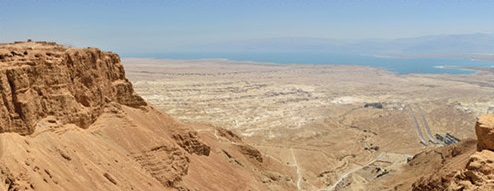
 1:4 John . . . appeared. Mark, like John, has no nativity narrative, but begins with the ministry of John the Baptist. This is also where Peter begins in his proclamation of the gospel in Ac 10:37 (see note there; see also Introduction: Place of Writing). The name John means “The Lord is gracious.” wilderness. The arid region west of the Dead Sea. In Scripture, the wilderness can be a place of testing and/or spiritual retreat and reflection. baptism. John’s practice of baptizing those who came to him in repentance was so characteristic of his ministry that he became known as “the Baptist” or “the Baptizer.” He was preaching repentance-baptism; i.e., baptism that was preceded or accompanied by repentance. The background to John’s baptism is uncertain. It may be related to Jewish ritual baths for purification or to “proselyte” (new convert) baptism. If the latter, it is shocking that John would be treating Israelites like pagans, calling them to repent and once again become the true people of God. repentance. Involves deliberate turning from sin to righteousness, and John’s emphasis on repentance recalls the preaching of the prophets (e.g., Hos 3:4–5). God always grants forgiveness when there is repentance.
1:5 whole . . . all. Hyperbole, indicating the high interest created by John’s preaching. For centuries Israel had no writing prophets. people of Jerusalem. See note on Jn 7:25. Jordan River. The principal river in the Holy Land, beginning in the snows of Mount Hermon and ending in the Dead Sea. Its closest point to Jerusalem is about 20 miles.
1:6 camel’s hair . . . leather belt. Worn by Elijah and other prophets (see 2Ki 1:8 and note; cf. Zec 13:4). locusts and wild honey. Indicates living in simplicity off the land. Locusts were among the clean foods Jews could eat (Lev 11:21–22). See note on Mt 3:4.
1:7 message. Mark’s account of John’s message is brief (cf. Mt 3:7–12; Lk 3:7–17) and focuses on the coming of the powerful One. sandals I am not worthy to . . . untie. See note on Jn 1:27.
1:8 baptize you with the Holy Spirit. Referring to God’s end-time outpouring of the Spirit, promised in Joel 2:8–9 (cf. Isa 32:15; 44:3; Eze 36:26–27; 39:29) and at least partially fulfilled in Ac 2:16–21. See note on Mt 3:11.
1:9 At that time. Jesus began his public ministry c. ad 27 (see chart), when he was approximately 30 years old (Lk 3:23). As far as we know, he had spent most of his previous life in Nazareth. Nazareth. See notes on Mt 2:23; Lk 4:23. baptized by John. For the significance of Jesus’ baptism, which marked the beginning of his Messianic ministry, see Mt 3:15 and note; see also map and accompanying text.
1:10–11 All three persons of the Trinity are involved in Jesus’ baptism: (1) the Father speaks, (2) the Son is baptized and (3) the Holy Spirit descends on the Son (see note on Mt 28:19).
1:10 Spirit descending on him. Mark implies what Luke explicitly indicates: The descent of the Spirit on Jesus is his “anointing” (Messiah = “Anointed One”) and empowerment for ministry (see Lk 4:18 and note). like a dove. Symbolizing the gentleness, purity and guilelessness of the Holy Spirit (see Mt 10:16; Lk 3:22 and note).
1:11 An allusion to Ps 2:7; Isa 42:1 and probably to Ge 22:2 (see note on Mt 3:17). voice. God sometimes spoke directly from heaven (see 9:7; Lk 3:22 and note; Jn 12:28–29; cf. Ex 19:3). You are my Son. In v. 1 Mark proclaims Jesus as the Son of God; here God the Father himself proclaims Jesus as his Son.
1:12 At once. A distinctive characteristic of Mark’s style is his use (some 47 times) of a Greek word that has been variously translated “at once,” “without delay,” “immediately,” “quickly,” “just then” (see, e.g., vv. 18,20,23,28,42–43). wilderness. See map.
1:13 forty. See Mt 4:2 and note. tempted. See notes on Mt 4:1–11. Satan. See Ge 3:1; Job 1:6, 9; Zec 3:1; Rev 2:9–10; 12:9–10 and notes. This first conflict in Mark’s Gospel sets the stage for what will be throughout the book a spiritual war between God and the forces of Satan. wild animals. In Jesus’ day there were many more wild animals—including lions—in Israel than today. Only Mark reports their presence, which likely indicates danger and so highlights that God kept Jesus safe in the wilderness. Another possibility is that the animals are meant to recall the garden of Eden, presenting Jesus as a new Adam. Jesus succeeds where Adam and Eve failed. angels attended him. As they had attended Israel in the wilderness (Ex 23:20, 23; 32:34).
1:14 After John was put in prison. For the reason for John’s imprisonment and his fate, see 6:14–29. See also Mt 4:12; 14:3; Lk 3:20 and notes. good news of God. The good news from, as well as about, God (see 1:1 and note).
1:15 The time has come. Not simply chronological time, but the decisive time for God’s action. With the coming of the kingdom, God was doing something special. kingdom of God. Referring to the sovereign reign of God and the restoration of fallen creation. The kingdom is a present reality in Christ, though its ultimate fulfillment awaits his second coming. See note on Mt 3:2. has come near. The coming of Christ (the King) brings the kingdom near to the people (see Lk 17:21 and note).
1:16 Sea of Galilee. A beautiful lake, almost 700 feet below sea level, 14 miles long and 6 miles wide, fed by the waters of the upper Jordan River (see photo). It was also called the Lake of Gennesaret (Lk 5:1) and the Sea of Tiberias (Jn 6:1; see NIV text note on Jn 21:1). In OT times it was known as the Sea of Kinnereth (see NIV text note on Nu 34:11) because it is shaped like a harp (see note on Dt 3:17). Simon. Probably a contraction of the OT name Simeon (see NIV text note on Ac 15:14). Jesus gave Simon the name Peter (see 3:16; see also Mt 16:18; Jn 1:42 and notes). net. See note on Mt 4:18.
1:17 Come, follow me. The call to discipleship is definite and demands a response of total commitment. Although historically this was probably not Jesus’ first encounter with Simon and Andrew (Jn 1:35–42), Mark wants his readers to see the extraordinary authority of Jesus in calling disciples. He calls, and they immediately respond. send you out to fish for people. As evangelists (Lk 5:10).
1:21 Capernaum. This fishing town on the northwest corner of the Sea of Galilee became Jesus’ base of operations during his Galilean ministry. For more on the town, see Mt 4:13; Lk 10:15 and notes. Sabbath. The seventh day of the week, the day of rest and worship (see 2:27; Ge 2:3; Ex 16:23; Isa 58:13 and notes). synagogue. A very important religious institution among the Jews of that day. Originating during the exile, it provided a place where Jews could study the Scriptures and worship God. A synagogue could be established in any town where there were at least ten married Jewish men. See note on Ac 13:14; see also article and model. began to teach. Jesus, like Paul would later (see Ac 13:14–15 and notes; 14:1; 17:2; 18:4), took advantage of the custom that allowed visiting teachers to participate in the worship service by invitation of the synagogue leaders (see Lk 4:16–17 and notes).
1:22 amazed. Mark frequently reported the amazement that Jesus’ teaching and actions produced (2:12; 5:20,42; 6:2,51; 7:37; 10:26,32; 11:18; 12:17; 15:5). In these instances it was Christ’s inherent authority that amazed. He did not quote human authorities, as did the teachers of the law, because his authority was directly from God (cf. Lk 2:46–48). teachers of the law. Sometimes called “scribes,” these were experts in the law of Moses and its application to everyday life. One became a scribe through mentorship, by becoming the apprentice (disciple) of a senior teacher of the law. See note on Mt 2:4.
1:23 man in their synagogue . . . cried out. It was actually the demon who cried out (see 5:7 and note). possessed by an impure spirit. Demonic possession intended to torment and destroy those who are created in God’s image, but the demon recognized that Jesus was a powerful adversary, capable of destroying the forces of Satan. “Impure” (or “defiling”) indicates that the demon brought a defiling presence—the opposite of holiness—to the man.
1:24 us. Although the man has only one demon, it speaks for the whole demonic realm, which quakes in fear at Jesus’ presence. Holy One of God. A Messianic title affirming that Jesus is set apart for God’s service and perhaps alluding to his divine origin (Lk 1:35; 4:34; Jn 6:69). The title was perhaps used by the demons in accordance with the occult belief that the precise use of a person’s name gave certain control over him (5:7).
1:25 Be quiet! Jesus’ superior power silences the shrieks of the demon-possessed man.
1:27 with authority. Jesus’ authority in how he taught (v. 22) and in what he did (here) impressed the people. Notice that teaching comes first. The miracles are meant to confirm and validate the message.
1:29 home of Simon and Andrew. Jesus and the disciples probably went there for a meal, since the main Sabbath meal was served immediately following the synagogue service (see model and photo).
1:30 Simon’s mother-in-law. 1Co 9:5 speaks of Peter’s being married.
1:32 evening. See Lk 4:40 and note. people brought. They waited until the Sabbath was over (“after sunset”) before carrying anything (Jer 17:21–22).
1:34 not let the demons speak. See Introduction: Theological Emphases. because they knew who he was. Luke says, “because they knew he was the Messiah” (Lk 4:41). Jesus probably wanted first to show by word and deed the kind of Messiah he was (in contrast to popular notions) before he clearly declared himself, and he would not let the demons frustrate this intent.
1:35 Jesus’ highest priority is time in prayer with his Father. In his humanity Jesus lives a life of complete dependence on God.
1:36 companions. Andrew, James and John (vv. 16,19,29), and perhaps also Philip and Nathanael (cf. Jn 1:43–45).
1:38 That is why I have come. Though Jesus is extraordinarily popular in Capernaum, he is not interested in popularity but in finishing the work of God by proclaiming the kingdom of God to all Israel.
1:40 leprosy. See NIV text note and Lev 13–14; see also note on Lev 13:2. Though not every type of “leprosy” was dangerous, all of it caused ceremonial defilement and so separation from family and friends and from the social and religious life of the community. make me clean. “Clean” here means cured of the disease. See notes on Lev 4:12; Mt 8:2.
1:41 Jesus was indignant. Although many manuscripts read “filled with compassion” (see NIV text note), “indignant” is probably the original reading. A later copyist likely tried to soften what seemed to be a very harsh response by Jesus. But Jesus’ indignation is not against the man. It may be against the horrible consequences of the disease, which broke up families and communities. Or perhaps it is against the man’s insinuation that Jesus may not be willing to heal him. touched the man. An act that, according to Mosaic law, brought defilement (see Lev 13, especially vv. 45–46; see also Lev 5:2). Jesus’ compassion for the man superseded ceremonial considerations.
1:44 don’t tell this to anyone. See Introduction: Theological Emphases; see also notes on Mt 8:4; 16:20; Lk 9:21. go, show yourself to the priest. Who would then pronounce him ceremonially clean (see, e.g., Lev 13:6, 13,17,23; see also note on Lk 5:14). testimony to them. The sacrifices were to be evidence to the priests and the people that the cure was real and that Jesus respected the law. The healing was also a testimony to Jesus’ divine power, since Jews believed that only God could cure leprosy (see 2Ki 5:1–14 and notes).
1:45 no longer enter a town openly. Jesus’ growing popularity with the people (v. 28; 3:7–8; Lk 7:17) and the increasing opposition from Jewish leaders (2:6–7,16,24; 3:2,6,22) sometimes made it necessary for him to withdraw from Galilee into surrounding territories.
2:1 home. When in Capernaum Jesus probably made his home at Peter’s house (1:21,29).
2:2 They gathered in . . . large numbers. The same enthusiasm that greeted Jesus earlier (1:32–33,37) was evident at his return.
2:3 paralyzed man. Nothing definite can be said about the nature of the man’s affliction beyond the fact that he could not walk. The determination of the four men to reach Jesus shows their faith in him.
 2:4 made an opening in the roof. A typical house in the Middle East had a flat roof accessible by means of an outside staircase. The roof was often made of a thick layer of clay (packed with a stone roller), supported by mats of branches across wood beams (see photo).
2:5 Jesus saw their faith. Jesus recognized that the bold action of the paralyzed man and his friends gave evidence of faith. Son, your sins are forgiven. Jesus first met the man’s deepest need: forgiveness.
2:7 He’s blaspheming! Who can forgive sins but God alone? Jesus’ claim to be able to forgive sins was taken by the religious leaders as a claim to deity—which they considered to be blasphemous (see note on 14:64).
2:9 Which is easier . . . ? Jesus’ point is probably that it is easier to say, “Your sins are forgiven,” since saying “Get up, take your mat and walk” requires the man to prove it by doing it. On the other hand, forgiveness of sins cannot be proven or disproven.
2:10 But I want you to know. See note on Lk 5:24; spoken to the “teachers of the law” (v. 6). The words “So he said to the man” explain a change in the persons addressed. The purpose of miracles in Mark is to reveal the presence and power of the kingdom of God and to demonstrate Jesus’ divine authority. For the use of miraculous signs in John’s Gospel, see Jn 2:11; 20:30–31 and notes. Son of Man. See note on 8:31.
2:12 This amazed everyone. See note on 1:22.
2:13 lake. The Sea of Galilee (see note on 1:16).
2:14 Levi son of Alphaeus. He is referred to in Matthew’s Gospel as “Matthew” (Mt 9:9 and note; 10:3). His given name was probably Levi (for the possible meaning of the name Levi, see NIV text note on Ge 29:34). tax collector’s booth. Levi was a tax collector (see note on Lk 3:12) under Herod Antipas, tetrarch of Galilee. The tax collector’s booth where Jesus found Levi was probably a toll booth on the major international road that went west from Damascus through Capernaum to the Mediterranean coast and then south to Egypt (see Isa 9:1 and note). Levi got up and followed. See note on Lk 5:28.
2:15 tax collectors. Jewish tax collectors were hated by most Jews as traitors because of their collusion with the Roman authorities and because they were notorious for cheating taxpayers. In the eyes of the Jewish community their disgrace extended to their families. See note on Mt 5:46. sinners. The term could refer to truly evil people, or to those—like Jesus and his disciples—who did not follow the law of Moses as interpreted by the Pharisees. The former is more likely since the disciples and Jesus are not here identified with the sinners. The term was commonly used of tax collectors, adulterers, robbers and the like. were eating. To eat with a person was a sign of friendship and acceptance.
2:16 teachers of the law who were Pharisees. Not all teachers of the law were Pharisees. A teacher of the law (or “scribe”) was a vocation, while Pharisaism was a religio-political party that scribes or others could join. The Pharisees were successors of the Hasidim, pious Jews who joined forces with the Maccabees during the struggle for freedom from Syrian oppression (166–142 bc). They were first called Pharisees during the reign of John Hyrcanus (135–105). Although some, no doubt, were godly, those whom Jesus criticized were hypocritical, envious, ostentatious and formalistic. According to Pharisaism, God’s grace extended only to those who kept his law. See notes on Mt 2:4; 3:7.
2:17 I have not come to call the righteous, but sinners. Those who are self-righteous do not realize their need for salvation, but admitted sinners do.
2:18 John’s disciples. John the Baptist’s disciples may have been fasting because he was in prison (1:14), or this may have been a practice among them as an expression of repentance, intended to hasten the coming of redemption announced by John. disciples of the Pharisees. Pharisees as such did not teach in a formal capacity but they did communicate their views to other Jews, and some were also “scribes” (teachers of the law), who often had disciples. Or perhaps the phrase is used in a nontechnical way to refer to people influenced by the Pharisees. fasting. In the Mosaic law only the fast of the Day of Atonement was required (see Lev 16:29,31 and note; 23:27–32; Nu 29:7). After the Babylonian exile four other yearly fasts were observed by the Jews (see Zec 7:5; 8:19 and notes). In Jesus’ time the Pharisees fasted twice a week (see Lk 18:12 and note).
2:19 How can the guests of the bridegroom fast while he is with them? Jesus compared his disciples with the guests of a bridegroom. A Jewish wedding was a particularly joyous occasion, and the celebration associated with it often lasted a week. It was unthinkable to fast during such festivities, because fasting was associated with sorrow. The arrival of the kingdom of God should be a time of great joy!
2:20 bridegroom will be taken from them. Jesus is the bridegroom who would be taken from them by death, and then fasting would be in order.
2:21–22 unshrunk cloth . . . new wineskins. The two analogies seem to teach that Jesus’ ministry is not just about trying to reform Judaism (putting a new patch on an old garment and new wine in old wineskins); it is about the fulfillment of Judaism through the coming of the kingdom and the arrival of God’s end-time salvation. See note on Mt 9:17.
2:23 pick some heads of grain. The accusation by the religious leaders was that by doing this the disciples were breaking the Sabbath. Picking grain was allowed under the provision of Dt 23:25.
2:24 what is unlawful on the Sabbath. According to Jewish tradition (in the Mishnah, which is much more restrictive than Mosaic law), harvesting (which is what Jesus’ disciples technically were doing) was forbidden on the Sabbath. See Ex 34:21.
2:25 what David did. See 1Sa 21:1–6. One point of connection between the OT incident and the apparent infringement of the Sabbath by the disciples lies in the fact that on both occasions godly men did something considered forbidden. Since, however, it is always “lawful to do good” (Mt 12:12) and to “save life” (Lk 6:9)—even on the Sabbath (3:4; see note there)—both David and the disciples were within the spirit of the law (see 1Sa 21:4 and note; Isa 58:6–7; Lk 13:10–17; 14:1–6). Yet another point may be that Jesus, like David, was “the Lord’s Anointed” and so in a unique position of authority (v. 28).
2:26 In the days of Abiathar the high priest. According to 1Sa 21:1, Ahimelek, Abiathar’s father (1Sa 22:20), was then high priest (see note on 2Sa 8:17). Since Abiathar plays a prominent role in the story and later became the high priest, Mark may mean something like “in the account about Abiathar, who became high priest . . .” house of God. The tabernacle (see 1Sa 1:9 and note; 21:1). consecrated bread. See note on Mt 12:4.
2:27 The Sabbath was made for man, not man for the Sabbath. Jewish tradition had so multiplied the requirements and restrictions for keeping the Sabbath that the burden had become intolerable. Jesus cut across these traditions and emphasized the God-given purpose of the Sabbath—a day intended for the benefit of people (for spiritual, mental and physical restoration; see Ex 20:8–11).
2:28 A remarkable statement of authority, since God alone instituted the Sabbath and so is Lord of it (see note on Lk 6:5).
3:1–6 A demonstration that Jesus is Lord of the Sabbath (2:28).
3:2 Some of them. The Pharisees (v. 6; cf. Lk 6:7). to accuse Jesus. Jesus’ presence demanded a decision about his preaching, his acts and his person. The hostility, first seen in 2:6–7, continues to spread. See note on v. 6. to see if he would heal him on the Sabbath. An indication that the Pharisees believed in Jesus’ power to perform miracles. The question was not “Could he?” but “Would he?” Jewish tradition prescribed that aid could be given the sick on the Sabbath only when the person’s life was threatened, which obviously was not the case here. See notes on 2:25; Lk 13:14.
3:4 to do good or to do evil, to save life or to kill? Jesus asks: Which is better, to preserve life by healing or to destroy life by refusing to heal? The question is ironic since, whereas Jesus was ready to heal, the Pharisees were plotting to put him to death. It is obvious who was guilty of breaking the Sabbath. they remained silent. Their silence indicates Jesus’ rhetorical victory and shows they are in the wrong (12:34).
3:5 He looked around at them. See note on Lk 6:10.
3:6 the Pharisees . . . began to plot. The decision to seek Jesus’ death was not the result of this incident alone but was the response to a series of incidents (2:6–7, 16–17, 24). The plotting of the Pharisees and the Herodians is seen again on Tuesday of Passion Week (see 12:13 and note). Herodians. Evidently influential Jews who favored the Herodian dynasty, meaning they were supporters of Rome, from which the Herods received their authority. These are strange allies since the Pharisees opposed Roman rule while the Herodians supported it. They joined the Pharisees in opposing Jesus because they feared he might have an unsettling political influence on the people. See Mt 22:15–17 and note.
3:8 Impressive evidence of Jesus’ rapidly growing popularity among the people. This geographic list indicates that the crowds came not only from the areas in the vicinity of Capernaum but also from considerable distances. Mark tells of Jesus’ work in all these regions except Idumea (see 1:14, Galilee; 5:1 and 10:1, the region across the Jordan; 7:24,31, Tyre and Sidon; 10:1, Judea; 11:11, Jerusalem). Idumea. The Greek form of Hebrew Edom, but here referring to an area south of Judea, not to earlier Edomite territory. See map.
3:11 impure spirits. See note on 1:23. You are the Son of God. Even the impure spirits recognized and acknowledged who Jesus was (see 1:24 and note; cf. Jas 2:19), but the Jewish leaders and teachers of the law did not.
3:12 not to tell others about him. See Introduction: Emphases. The time for revealing Jesus’ identity had not yet come (see 1:34 and note; see also notes on Mt 8:4; 16:20), and demons were hardly the proper channel for such disclosure.
3:13 mountainside. Probably the hill country of Galilee around the lake. Lk 6:12 adds that he prayed.
3:14–15 to preach and . . . to drive out demons. They are to replicate Jesus’ ministry and so extend his reach.
3:14 He appointed twelve. The number 12 is important, indicating that in some sense Jesus is reconstituting the nation of Israel. See notes on Lk 6:14–16. that they might be with him. The training of the Twelve included not only instruction and practice in various forms of ministry but also—first and foremost—continuous association and intimate fellowship with Jesus himself.
3:16 Simon (to whom he gave the name Peter). See note on 1:16.
3:17 Boanerges. One of many Aramaic words translated by Mark (see Introduction: Recipients). sons of thunder. Probably descriptive of their dispositions (see notes on 10:37; Lk 9:54), but John was later to become the apostle of love.
3:18 Thaddaeus. Apparently the same as “Judas son of James” (Lk 6:16; Ac 1:13). the Zealot. Simon may have been a (former) revolutionary or one zealous for God’s law. See note on Mt 10:4.
3:19 Iscariot. Probably means “the man from Kerioth,” perhaps the town of Kerioth Hezron (Jos 15:25), 12 miles south of Hebron. For Judas’s betrayal of Jesus, see 14:10–11, 43–46.
3:20 house. Perhaps the home of Peter and Andrew (see 1:29; 2:1 and notes; see also model).
3:21 his family . . . went to take charge of him. See note on 6:3. His family may have come to Capernaum from Nazareth, about 30 miles away (see v. 31).
3:22 who came down from Jerusalem. An official delegation sent from the Jerusalem leadership. See 7:1 and note. Beelzebul. See note on Mt 10:25.
3:23 parables. In this context the word is used in the general sense of comparisons or analogies (see note on 4:2).
3:24 kingdom is divided against itself. See note on Lk 11:17.
3:27 In fact. Or “On the other hand.” Jesus’ point is that while Satan would never attack his own kingdom (vv. 24–26), Jesus himself is attacking and defeating it (v. 27). enter a strong man’s house . . . plunder. Jesus was doing this very thing when he freed people from Satan’s control.
3:28 Truly I tell you. A solemn affirmation used by Jesus to strengthen his assertions (see 8:12; 9:1,41; 10:15,29; 11:23; 12:43; 13:30; 14:9,18,25,30; see also note on Jn 1:51).
3:29 whoever blasphemes against the Holy Spirit will never be forgiven. This sin is identified in v. 30 (cf. v. 22)—the teachers of the law attributed Jesus’ healing to Satan’s power rather than to the Holy Spirit (see note on Mt 12:31; see also article).

In Mk 3:29 Jesus says that “whoever blasphemes against the Holy Spirit will never be forgiven; they are guilty of an eternal sin” (cf. Lk 12:10). Matthew’s account adds that even blasphemy against the Son of Man will be forgiven, but not blasphemy against the Holy Spirit (Mt 12:31–32). What is this unforgivable sin and why is it associated with the Holy Spirit (cf. 1Jn 5:16 and note)? Doesn’t the blood of Christ cover every sin?
Mark gives us some help for interpretation by noting that “He said this because they were saying, ‘He has an impure spirit’ ” (3:30). Jesus has been healing the sick and casting out demons in the power the Holy Spirit (Mt 12:28; Lk 11:20). Yet the religious leaders attribute the work of the Spirit to Satan (Mk 3:22; cf. Mt 12:24; Lk 11:15). In other words, they look right into the light and then turn to the darkness. The key to the unpardonable sin, then, seems to lie in the role of the Holy Spirit, which is to reveal God and draw people to the truth. Anyone who rejects the work of the Spirit in their life is essentially rejecting any hope of salvation (Jn 16:8; 1Co 2:14).
The assumption would seem to be that by directly rejecting the Spirit’s work, the religious leaders have reached the point of no return, since the truth will never be clearer than at this point in time. In this way they have committed a sin that will never be forgiven.
Of course, we as humans are not the all-knowing God and so we don’t know when a person has actually reached this point. We therefore keep proclaiming the gospel and calling for repentance, assuming no one is beyond the opportunity for forgiveness. Furthermore, no one in Scripture who wants to repent is told they cannot. Those who genuinely seek repentance show that they cannot have committed any unforgivable sin.
Go to the Articles Index.
3:31 Jesus’ mother and brothers. Jesus had four brothers and at least two sisters. See 6:3 and note on Lk 8:19.
3:35 Whoever does God’s will. Membership in God’s spiritual family, evidenced by obedience to him, is more important than membership in our human families (see 10:30 and note).
4:1 sat in it. Sitting was the usual position for Jewish teachers (see 9:35; see also Mt 5:1; Lk 4:20 and notes).
Jerusalem During the Ministry of Jesus
Herod the Great (reigned 37–4 bc) rebuilt the temple and its surrounding walls and also built a palace, a fortress, a theater and a hippodrome (stadium) for horse and chariot races. He brought the city to the zenith of its architectural beauty and Roman cultural expression. This became Jerusalem in the time of Jesus.
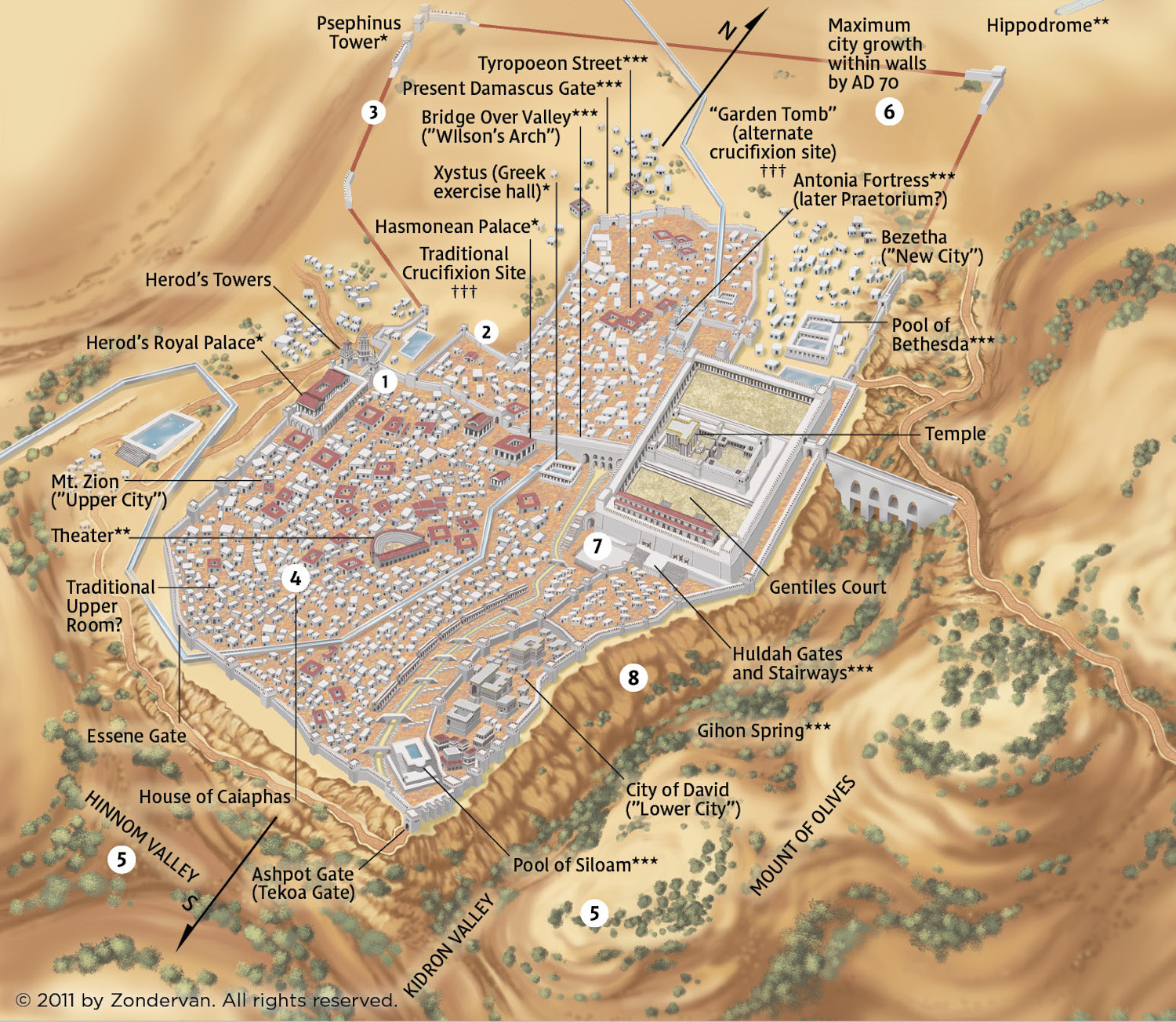
➊ The “FIRST WALL,” so named by Josephus, encircled the city during the Hasmonean period, which began in 167 bc. After the revolt led by Judas Maccabeus in 167, Jerusalem expanded steadily in a period of independence under its own Jewish kings.
➋ The “SECOND WALL” was built by Herod the Great or by earlier Hasmonean kings. Precise location is difficult to determine. This wall was put up around a market area in a valley, protecting it from raiding and looting, but was of questionable military value. At its eastern end, however, Herod built a military barracks (Antonia Fortress).
➌ The “THIRD WALL” (shown with red line) was begun by Herod Agrippa I between ad 41 and 44 to enclose the growing northern suburbs, but the work was apparently stopped. Its construction was resumed, in haste, only after the First Jewish Revolt broke out in ad 66.
➍ House of Caiaphas the high priest,* identified here with today’s Church of St. Peter in Gallicantu.
➎ Deep valleys on the east, south and west permitted urban expansion only to the north.
➏ Maximum city growth within walls by ad 70.
➐ Archaeological excavations have revealed a monumental stairway and the continuation of Tyropoeon Street,*** which lies along the valley called “Valley of the Cheesemongers” by Josephus.
➑ The Siloam aqueduct-tunnel, 1,749’ long, was cut through solid bedrock, was 5’11” high (average) and followed an “S” shaped course made necessary by engineering difficulties. It was dug by order of King Hezekiah and provided water during King Sennacherib’s threat to lay siege to the city in 701 bc (2Ch 32:30). Water flows through it to this very day.
* Location generally known, but style of architecture is unknown; artist’s concept only, and Roman architecture is assumed.
** Location and architecture unknown, but referred to in written history; shown here for illustrative purposes.
*** Ancient feature has remained, or appearance has been determined from evidence.
© 2011 by Zondervan. All rights reserved.
Go to the Maps Index.
4:2 parables. Usually stories out of ordinary life used to illustrate spiritual or moral truth, sometimes in the form of brief similes, comparisons (see note on 3:23), analogies or proverbial sayings. They tended to have a central point, rather than every detail having independent significance (see article). See notes on Mt 13:3; Lk 8:4.
4:3–8 In that day seed was sown by hand—which, by its nature, scattered some seed on unproductive ground (see note on Lk 8:5).
4:3 Listen! This parable begins and ends (v. 9) with a call for careful attention, which suggests that its meaning is not self-evident. sow his seed. See note on Lk 8:5. seed. “The word” (v. 14; see note there).
4:8 multiplying . . . a hundred times. A hundredfold yield was an unusually productive harvest (Ge 26:12–13). Harvest was a common figure for the consummation of God’s kingdom (see Joel 3:13; Rev 14:15 and notes).
4:9 Whoever has ears to hear. A poetic call to hear and respond to Jesus’ message. “Whoever has ears” could mean either everyone or those whom God has given the ability to hear (see v. 11; see also note on Lk 8:8).
4:11 secret of the kingdom of God. In the NT “secret” refers to something once hidden that God has now revealed to his people. The secret is now proclaimed to all, but only those who have faith understand. In this context the secret seems to be that the kingdom of God had drawn near (see v. 26; see also notes on 1:15; Mt 3:2) in the coming of Jesus Christ, the King. It was present, but not yet so obvious that all would recognize it.
4:12 so that. Jesus compares his preaching in parables to the ministry of Isaiah. Ironically, Isaiah’s message was intended in part to further harden the Israelites’ stubborn hearts and so fulfill God’s promised judgment. In the same way, Jesus’ parables blind the eyes of the religious leaders who have already rejected his kingdom message. In that very blindness, they will accomplish God’s purpose of salvation through the death of the Messiah. See Isa 6:8–10 and notes on 6:8–10 and 6:9–10. Isa 6:13 and Ac 6:7 remind us that even those most hardened may later repent.
4:14 the word. The interpretation calls attention to the response to the word of God that Jesus has been preaching. In spite of many obstacles, God’s word will accomplish his purpose (cf. Isa 55:11 and note).
4:17 trouble or persecution. See Introduction: Occasion and Purpose; see also 8:34–38; 10:30 and notes; 13:9–13.
4:19 deceitfulness of wealth. Prosperity tends to give a false sense of self-sufficiency, security and well-being (see 10:17–25 and notes; Dt 8:17–18; 32:15; Ecc 2:4–11; see also Lk 12:12–20; 1Ti 6:9–10; Jas 5:1–6 and notes).
4:20 hundred times. See v. 8 and note.
4:21 Do you bring in a lamp. The lamp could symbolize the gospel message, the kingdom of God, or Jesus himself—the light of the world (see Jn 8:12 and note). In any case, the analogy is that the good news of the kingdom proclaimed by Jesus is not something to be hidden. As a lamp is placed to give, not hide, light, so Jesus, the light of the world (see Jn 8:12 and note), is destined to be revealed. lamp. See Mt 5:15 and note.
4:23 See notes on 4:9, Lk 8:8.
4:25 Those who have begun to understand and appropriate the truth of what Jesus was teaching will be granted fuller understanding in the future, but those who have failed to put it into practice will not benefit from it and will become hardened against it.
4:26–29 Only Mark records this parable. Whereas the parable of the sower stresses the importance of proper soil for the growth of seed and the success of the harvest, here the mysterious power of the seed itself is emphasized. The establishment of the kingdom is ultimately God’s work, not the result of any human effort or plan (cf. Ro 1:16).
4:26 kingdom of God. See note on v. 11.
4:29 he puts the sickle to it, because the harvest has come. A possible allusion to Joel 3:13 (see note there), where harvest is a figure for the consummation of God’s kingdom.
4:30–32 This parable teaches that the kingdom of God seemingly had insignificant beginnings. It was introduced by the despised and rejected Jesus and his 12 unimpressive disciples. But a day will come when its true greatness and power will be seen by the whole world.
4:31 smallest of all seeds. Though not the smallest seed known today, it was the smallest seed known in Israel at the time (see notes on Mt 13:31–32).
4:32 The mustard plant is a large bush that can grow up to ten feet tall. Birds sometimes indicate evil, but here they just illustrate how big the plant (that is, the kingdom) has become.
4:34 He did not say anything to them without using a parable. Jesus used parables to illustrate truths, stimulate thinking and awaken spiritual perception. The people in general were not ready for the full truth of the gospel. When alone with his disciples Jesus taught more specifically, but even they usually needed to have things explained.
4:35–41 This is the first of Jesus’ “nature miracles” in Mark’s Gospel, demonstrating his authority over creation itself (cf. 6:30–51; 8:1–13; 11:12–14, 20–21). Although miracles are hard for some people to accept today, the NT makes it clear that Jesus is Lord not only over his church but also over all creation.
4:35 other side. Jesus left the territory of Galilee to go to the “region of the Gerasenes” (5:1).
4:37 furious squall came up. Situated in a basin surrounded by mountains, the Sea of Galilee is particularly susceptible to sudden, violent storms. Cool air from the Mediterranean is drawn down through the narrow mountain passes and clashes with the hot, humid air lying over the lake (see photo).
4:38 sleeping on a cushion. Mark’s portrait here is characteristic of his emphasis on Jesus’ humanity. His sleep probably indicates both physical exhaustion and his willingness to trust in God.
4:41 Who is this? A sense of mystery and awe permeates Mark’s Gospel, centering on this question. In view of what Jesus had just done, the only answer to this rhetorical question was: He is the very Son of God! God’s presence, as well as his power, was demonstrated (see Ps 65:6–7; 89:9; 107:25–30 and notes; Pr 30:4). Mark indicates his answer to this question in the opening line of his Gospel (1:1). By such miracles Jesus sought to establish and increase the disciples’ faith in his deity.
5:1–43 The stories of the healing of the demon-possessed man, Jairus’s daughter and the woman with the hemorrhage all continue Mark’s theme of Jesus’ extraordinary authority. While Jesus has cast out individual demons, now he casts out a “legion” of demons. While he has healed the sick, now he heals chronic disease and even raises the dead! In addition to authority, all these accounts have to do with ceremonial uncleanness. Jesus brings purity to that which is defiled.
5:1 across the lake. The east side of the lake, a territory largely inhabited by Gentiles, as indicated by the presence of the large herd of pigs—animals Jews considered ceremonially unclean and therefore unfit to eat (see Isa 65:4 and note). region of the Gerasenes. Gerasa, located about 35 miles southeast of the Sea of Galilee (see map), may have had holdings on the eastern shore of the Sea, giving its name to a small village there now known as Khersa. About one mile south is a fairly steep slope within 40 yards of the shore, and about two miles from there are cavern tombs that appear to have been used as dwellings. See note on Lk 8:26.
5:2 a man. Mt 8:28 says there were two demon-possessed men (see note on Lk 8:27). Perhaps Mark (and Luke) focused on the most prominent one or the one who spoke.
5:3 lived in the tombs. It was not unusual for the same cave to provide burial for the dead and shelter for the living. Very poor people often lived in such caves.
5:4 often been chained. Though the villagers no doubt chained him partly for their own protection, this harsh treatment added to his humiliation.
5:5 cry out and cut himself with stones. Every word in the story emphasizes the man’s pathetic condition, as well as the purpose of demonic possession—to torment and destroy the divine likeness in which human beings are created (see Ge 1:26 and note). Everything also speaks of ritual defilement: the demons, the tombs, the pigs.
5:6 fell on his knees. An act of submission rather than worship. The demon showed respect because he recognized that he was confronted by one greatly superior to him.
5:7 What do you want with me . . . ? Similar expressions are found in the OT (e.g., 2Sa 16:10; 19:22), where they mean, “Mind your own business!” The demon was speaking, using the voice of the possessed man (see 1:23 and note). Son of the Most High God. See note on 1:24. In God’s name don’t torture me! To avoid deserved punishment, the demon ironically appeals to God with an oath.
5:9 My name is Legion . . . for we are many. A Roman legion was made up of 6,000 men. Here the term suggests that the man was possessed by numerous demons and perhaps also represents the many powers opposed to Jesus, who embodies the power of God (see 1:23–24 and notes). Some interpreters see in Mark’s reference to Legion an implicit challenge to Roman authority.
5:10 not to send them out of the area. The demons were fearful of being sent into eternal punishment, i.e., “into the Abyss” (Lk 8:31; see note there).
5:11 pigs. For Jews, pigs were unclean animals (Lev 11:7–8), confirming that this is Gentile territory. See note on Lk 8:32.
5:13 gave them permission . . . and were drowned. The implication is that by entering the pigs the demons are seeking to avoid (or at least delay) their judgment, which is to be sent into the abyss (see Lk 8:31 and note). Yet they ironically get what they deserve anyway when the pigs are drowned. See note on Mt 8:32.
5:15 dressed. Luke notes that he wore no clothes (Lk 8:27).
5:16 told about the pigs as well. In addition to the remarkable change in the demon-possessed man, the drowning of the pigs seemed to be a major concern, no doubt because it was so dramatic and brought considerable financial loss to the owners.
5:17 plead with Jesus to leave their region. Fear of further loss (v. 16) may have motivated this response, but also the fact that a powerful force was at work in their midst, one that they could not comprehend or control. Contrast the different responses of the townspeople and of the man who is healed. They beg Jesus to go away, while he begs to go with Jesus as a disciple.
5:19 tell them how much the Lord has done for you. This is in marked contrast to Jesus’ exhortation to silence in the case of the man cleansed of leprosy (1:44; see 1:34; 3:12; Mt 8:4 and notes), perhaps because the healing of the demon-possessed man was in Gentile territory, where there was little danger that Messianic ideas about Jesus might be circulated (see Introduction: Theological Emphases).
5:20 Decapolis. A federation of ten Greek-style cities, most of which were east of the Sea of Galilee. See note on Mt 4:25; see also map. how much Jesus had done for him. See 2Co 5:17 and note. amazed. See 1:22 and note.
5:21–43 Mark sandwiches the healing of the woman in the middle of the account of the raising of Jairus’s daughter (see Introduction: Literary Features). There are striking parallels between the two women. Jairus’s daughter is 12 years old. The woman has been ill 12 years and Jesus calls her “daughter” (only here in the NT). Both are ceremonially unclean: potentially the woman because of her bleeding, the daughter after her death. Both accounts emphasize Jesus’ authority and the power of faith.
5:21 other side of the lake. Jesus returned to the west side of the lake, perhaps to Capernaum.
5:22 synagogue leaders. A leader of the synagogue was a layman whose responsibilities were administrative and included such things as looking after the building and supervising the worship. Though there were exceptions (Ac 13:14–15), most synagogues had only one ruler. Sometimes the title was honorary, with no administrative responsibilities assigned.
5:23 is dying. Matthew tends to abbreviate events and so presents the girl as already dead (see note on Mt 9:18). put your hands on her. See note on Ac 6:6.
5:25 bleeding for twelve years. Possibly a menstrual disorder or a hemorrhage that never completely healed (cf Lev 15:25–33).
The Decapolis and the Lands Beyond the Jordan
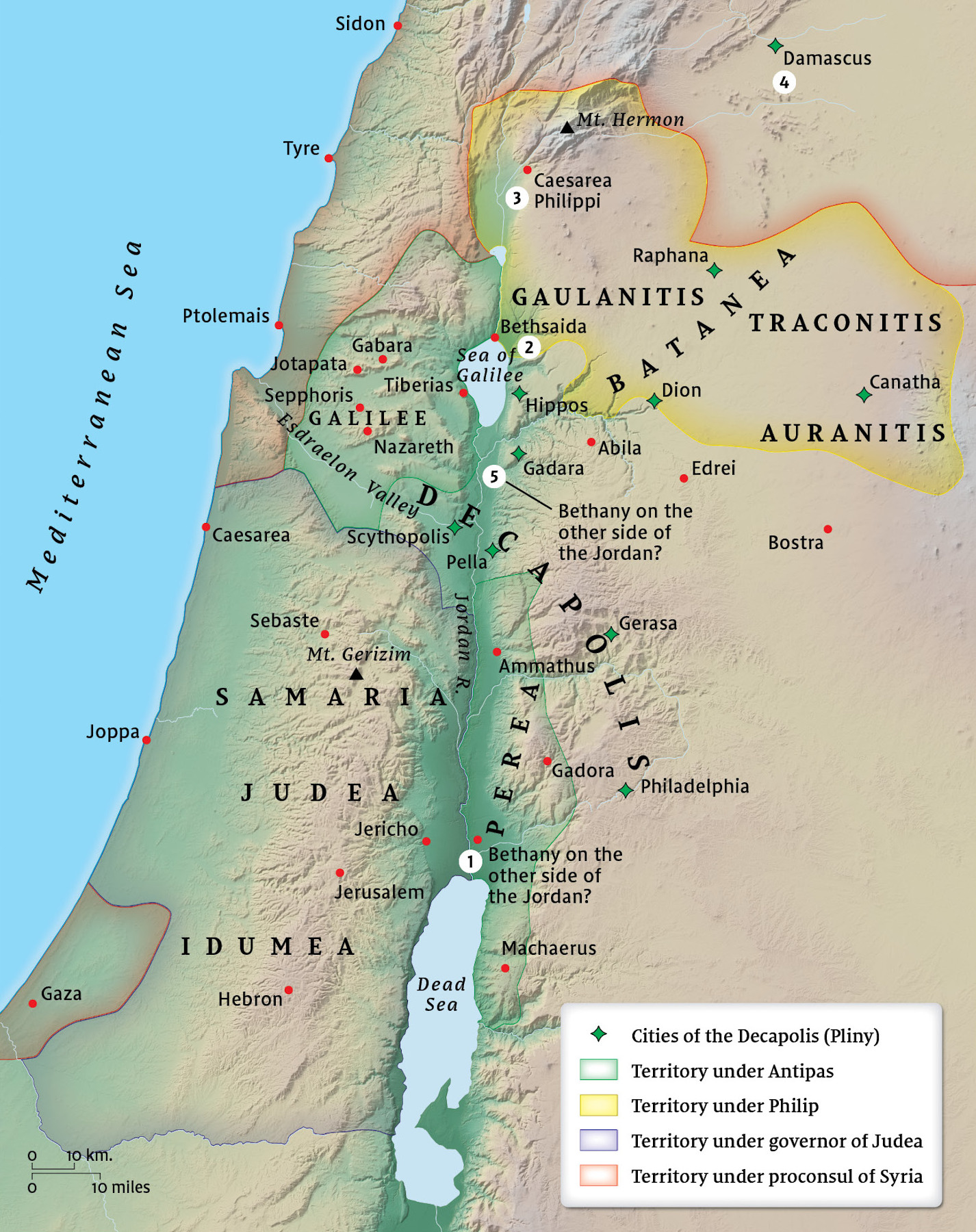
➊ Place east of the Jordan River where John the Baptist was baptizing (Jn 1:28). Here at Bethany on the other side of the Jordan John saw Jesus and called him the “Lamb of God” (Jn 1:29,35).
➋ Philip, Andrew and Peter were from Bethsaida (see Jn 1:44; 12:21 and note on 1:40). Jesus healed a blind man here (Mk 8:22). Feeding of the 5,000 took place near here (Lk 9:10).
➌ Jesus and his disciples withdrew to Caesarea Philippi (Mt 16:13; Mk 8:27), and here Peter confessed that Jesus was the Messiah (Mt 16:15–16).
➍ Paul was converted near Damascus and was brought blinded into the city (Ac 9:3, 8; 22:6,11).
➎ Alternate site for Bethany on the other side of the Jordan, where Jesus may have been baptized.
Go to the Maps Index.
5:26 suffered a great deal under the care of many doctors. The Jewish Talmud preserves a record of medicines and treatments prescribed for illnesses of these sorts. In his parallel account, Luke leaves out the negative statement about physicians (Lk 8:43), perhaps to defend his profession.
5:28 If I just touch his clothes. Although it needed to be bolstered by physical contact, her faith was rewarded (v. 34; cf. Ac 19:12). Instead of the unclean (the woman; see note on v. 25) making another (Jesus) ritually impure through physical contact, with Jesus it was the reverse: The clean (Jesus) made the ritually unclean (the woman) pure.
5:30 power had gone out from him. The woman was healed because God graciously determined to heal her through the power then active in Jesus and in this case because of her faith in him (v. 34).
5:32 kept looking around to see who had done it. Jesus would not allow the woman to recede into the crowd without publicly commending her faith and assuring her that she was permanently healed.
5:34 healed. The Greek for “healed” can also mean “saved.” Here both physical healing (“be freed from your suffering”) and spiritual salvation (“go in peace”) are probably meant. The combination of physical and spiritual healing also occurs in 2:1–12 (see note on 2:9); 3:1–6.
5:37 Peter, James and John. These three disciples had an especially close relationship to Jesus (see note on Ac 3:1).
5:38 people crying and wailing loudly. It was customary for professional mourners to be brought in at the time of death. In this case, however, it is not certain that enough time had elapsed for mourners to have been secured.
5:39 not dead but asleep. See note on Lk 8:52.
5:41 Talitha koum! Mark is the only Gospel writer who here preserves the original Aramaic—one of the languages of the Holy Land in the first century ad and probably the language Jesus and his disciples ordinarily spoke (they may also have spoken Hebrew and Greek).
5:42 astonished. See 1:22 and note.
5:43 not to let anyone know. In the vicinity of Galilee Jesus often cautioned people whom he healed not to spread the story of the miracle. His great popularity with the people, coupled with the growing opposition from the religious leaders, could have precipitated a crisis before Jesus’ ministry was completed (see v. 19 and note; 7:36; 8:26).
6:1 his hometown. Nazareth (see 1:24; Mt 21:11 and notes on Mt 2:23; Lk 4:23).
6:2 teach in the synagogue. See 1:21 and note. amazed. See 1:22 and note.
6:3 carpenter. Matthew reports that Jesus was called “the carpenter’s son” (Mt 13:55); only in Mark is Jesus himself referred to as a carpenter. The Greek word can also apply to a mason, smith or builder in general. The question is derogatory, meaning, “Isn’t he a common worker with his hands like the rest of us?” brother of James, Joseph, Judas and Simon. See note on Lk 8:19. they took offense at him. They saw no reason to believe that he was different from them, much less that he was specially anointed by God.
6:5 He could not do any miracles there. It was not that Jesus did not have power to perform miracles at Nazareth but that he was performing miracles in response to faith. When they responded with unbelief instead of faith (v. 6), Jesus could do nothing for them.
6:6 He was amazed. See note on Lk 7:9. Here Jesus was amazed at the lack of faith by the people of Nazareth; in Lk 7:9 he was amazed at the great faith of the centurion.
6:7 the Twelve. See notes on 3:14; Ac 1:11; 1Co 15:5. two by two. The purpose of going in pairs may have been to bolster credibility by having the testimony of more than one witness (cf. Dt 17:6), as well as to provide mutual support during their training period.
6:8 no bread, no bag, no money in your belts. They were to depend entirely on the hospitality of those to whom they testified (see vv. 10–11; see also notes on Lk 9:3; 10:4).
6:9 not an extra shirt. At night an extra shirt was helpful as a covering to protect from the cold night air, and the implication here is that the disciples were to trust in God to provide lodging each night.
6:10 stay there. If they moved from house to house, the inclination would be to stay at the wealthiest homes, promoting favoritism and resentment (see also note on Lk 9:4).
6:11 shake the dust off your feet. An act of judgment (see notes on Mt 10:14; Lk 9:5).
6:12–13 preached . . . drove out many demons. This mission marks the beginning of the disciples’ own ministry in Jesus’ name (see 3:14–15), and their message was precisely the same as his (1:15).
6:12 repent. See 1:4 and note.
6:13 anointed many sick people with oil. In the ancient world olive oil was widely used as a medicine, and here may also symbolize the Holy Spirit and his healing power (see Jas 5:14 and note).
6:14 King Herod. Herod Antipas, the son of Herod the Great (see note on Mt 14:1). Mark may here have used the title “king” sarcastically (since this Herod was actually a tetrarch; see chart;), or perhaps he simply used Herod’s popular title.
6:15 He is Elijah. There were eschatological expectations in Judaism concerning the return of Elijah, based especially on Mal 3:1; 4:5 (see also note on Mal 4:5).
6:16 John . . . has been raised from the dead! Herod, disturbed by an uneasy conscience and disposed to superstition, feared that John had come back to haunt him.
6:17 John arrested . . . and put in prison. See 1:14 and note. Josephus says that John was imprisoned at Machaerus, a fortress in Perea on the eastern side of the Dead Sea (see map). Herodias. See note on Mt 14:3. Philip’s. See note on Mt 14:3.
6:22 daughter of Herodias. She is not named here, though the Jewish historian Josephus calls her Salome (see note on Mt 14:6).
6:23 up to half my kingdom. A proverbial reference to maximum possible generosity, not to be taken literally (Est 5:3,6). More than that and he would have lost the kingdom. Generosity suited the occasion and would win the approval of the guests.
6:26 greatly distressed. The Greek for this phrase is also used to describe Jesus’ agony in Gethsemane (14:34, “overwhelmed with sorrow”).
6:30–44 The feeding of the 5,000 recalls the miracle of manna in the wilderness during the exodus generation. Mark says the miracle occurred in a “wilderness” (NIV: “solitary”) place (v. 32). The event also points forward to the “Messianic banquet,” the end-times feast symbolizing God’s final salvation (Isa 25:6–9). The account begins with an elaborate introduction (vv. 30–38), is looked back to on two different occasions (v. 52; 8:17–19), and has a sequel in the feeding of the 4,000 (8:1–10).
6:30 apostles. In Mark’s Gospel the word occurs only here and in 3:14 in some manuscripts (see NIV text note there). The apostles were Jesus’ authorized agents or representatives (see Heb 3:1 and note). In the NT the word is sometimes used quite generally (see Jn 13:16, where the Greek apostolos is translated “messenger”). In the technical sense it is used (1) of the Twelve (Lk 6:13)—in which sense it is also applied to Paul (Ro 1:1)—and (2) of a larger group, including Barnabas (Ac 14:14), James the Lord’s brother (Gal 1:19) and probably Andronicus and Junia (Ro 16:7) and Silas (1Th 1:1; 2:7; cf. Ac 17:4). reported to him all they had done and taught. Because he had commissioned them as his representatives.
6:32 went away by themselves in a boat. John reports that they went to the other side of the Sea of Galilee (Jn 6:1). Luke, more specifically, says they went to Bethsaida (Lk 9:10), which locates the feeding of the 5,000 on the northeast shore (see note on 7:24).
6:33 ran on foot . . . and got there ahead of them. Perhaps a strong headwind slowed the boat down so that the people had time to go on foot around the lake and arrive before the boat.
6:37 more than half a year’s wages. See NIV text note. The usual pay for a day’s work was one denarius (see Mt 20:2 and note).
6:38 loaves. Barley loaves. Unlike our modern loaves, these were small and flat. One could easily eat several at a single meal (see note on Jn 6:9).
6:39 green grass. Grass is green around the Sea of Galilee after the late winter or early spring rains.
6:40 groups of hundreds and fifties. Recalls the order of the Mosaic camp in the wilderness (e.g., Ex 18:21).
6:42 all ate and were satisfied. Some attempt to explain away this miracle (e.g., by suggesting that Jesus and his disciples shared their lunch and the crowd followed their good example). This does not fit with the Gospel writers’ focus on Jesus’ miraculous power. If Jesus was, as he claimed to be, the Son of God, the miracle presents no difficulties. God had promised that when the true Shepherd came, the wilderness would become rich pasture where the sheep would be gathered and fed (Eze 34:23–31). Jesus is the Shepherd who provides for all our needs, so that we lack nothing (cf. Ps 23:1).
6:43 twelve basketfuls of broken pieces of bread and fish. The number twelve likely symbolizes the twelve tribes of Israel, drawing another parallel to the miracle of manna in the wilderness (see note on Mt 15:37).
6:44 men. Matthew adds “besides women and children” (Mt 14:21; see note there). five thousand. A number that could easily be calculated because of the division of the crowd into “groups of hundreds and fifties” (v. 40). The size of the crowd is amazing in light of the fact that the neighboring towns of Capernaum and Bethsaida probably had a population of only 2,000 to 3,000 each.
6:46 pray. Mark’s mention of Jesus’ praying is further evidence of a crisis situation. On only three occasions in this Gospel (here; 1:35; 14:32–36) does Jesus withdraw to pray; each time a crisis is involved.
6:48 Shortly before dawn. Or, more formally, “About the fourth watch of the night,” 3:00—6:00 a.m. (see 13:35; Mt 14:25 and notes). walking on the lake. A special display of the majestic presence and power of the transcendent Lord, who rules over the sea (Job 9:8; Ps 89:9; Isa 51:10, 15; Jer 31:35).
6:49 a ghost. Popular Jewish superstition held that the appearance of spirits during the night brought disaster. The disciples’ terror was prompted by what they may have thought was a water spirit.
6:51 amazed. See 1:22 and note.
6:52 they had not understood about the loaves. If they had understood the feeding of the 5,000, they would not have been amazed at Jesus’ walking on the water or his calming the waves. hearts were hardened. They were showing themselves to be similar to Jesus’ opponents, who also exhibited hardness of heart (see 3:5; 8:17–21 and note on 8:16; Ex 4:21 and note).
6:53 Gennesaret. See note on Mt 14:34.
6:55 carried the sick on mats. See 2:3–4.
6:56 touch even the edge of his cloak. See note on 5:28. The word “edge” can also mean “tassels” (Mt 14:36; 23:5), referring to the cords Jewish men wore on their garments in order to literally fulfill Nu 15:37–41 and Dt. 22:12 (see Mt 14:36).
7:1 Pharisees . . . had come from Jerusalem. Another delegation of fact-finding religious leaders from Jerusalem (3:22) sent to investigate the Galilean activities of Jesus (see 2:16; Mt 2:4 and notes).
7:3 ceremonial washing. See note on Jn 2:6. tradition of the elders. The extra-biblical traditions that the teachers of the law developed in order to apply the law correctly. These traditions were considered to be binding by certain Jews (see v. 5 and note on Mt 15:2).
7:4 marketplace. Where Jews would come into contact with Gentiles, or with Jews who did not closely observe the ceremonial law, and thus potentially becoming ceremonially unclean themselves.
7:6 Isaiah . . . prophesied. Isaiah roundly denounced the religious leaders of his day (Isa 29:13), and Jesus quotes him to describe the tradition of the elders as “merely human rules” (v. 7). hypocrites. See Mt 6:2 and note.
7:8 commands of God . . . human traditions. Jesus clearly contrasts the two. God’s commands are found in Scripture and are binding; the traditions of the elders are not in Scripture and therefore not authoritative or binding.
7:10 The fifth commandment is cited in both its positive and negative forms.
7:11 Corban. A Hebrew/Aramaic word meaning “offering” (see note on Lev 1:2). By using this word in a religious vow an irresponsible Jewish son could formally dedicate to God (i.e., to the temple) his earnings that otherwise would have gone for the support of his parents. The money, however, did not necessarily have to go for religious purposes. The Corban formula was here a means of circumventing the clear responsibility of children toward their parents as prescribed in the law. The teachers of the law held that the Corban oath was binding, even when uttered rashly. The practice was one of many that could be used to adhere to the letter of the law while ignoring its spirit. (that is, devoted to God). By explaining this word, Mark reveals that he is addressing Gentile readers, probably Romans primarily (see Introduction: Recipients).
7:13 While Nu 30:1–2 could be used to support the Corban vow (and vows more generally), Jesus highlighted the importance of keeping the command to obey and care for parents over the keeping of a potentially carelessly made oath (see Mt 5:33–37 and note). nullify. Cf. 2Co 4:2 and note.
7:19 (In saying this, Jesus declared all foods clean.) Mark adds this parenthetical comment to help his readers see the profound significance of Jesus’ pronouncement for them (see Ac 10:9–16 and note on 10:14).
7:20 Jesus replaced the normal Pharisaic understandings of defilement with the truth that defilement comes from an impure heart, not the violation of external rules. Fellowship with God is not interrupted by unclean hands or food but by sin (see vv. 21–23 and note on Pr 4:23).
7:24 Tyre. A Gentile city located in Phoenicia (modern Lebanon), which bordered Galilee to the northwest (see map). A journey of about 30 miles from Capernaum would have brought Jesus “to the vicinity of Tyre.” did not want anyone to know. Ever since the feeding of the 5,000 (6:30–44) Jesus and his disciples had been, for the most part, skirting the region of Galilee. His purpose was to avoid the opposition in Galilee, to secure opportunity to teach his disciples privately (9:30–31) and to expand his ministry into Gentile territory. The regions to which he withdrew were (1) the northeast shore of the Sea of Galilee (6:30–53), (2) Phoenicia (7:24–30), (3) the Decapolis (7:31—8:10) and (4) Caesarea Philippi (8:27—9:32).
7:26 Greek. Here probably equivalent to “Gentile.” Syrian Phoenicia. At that time Phoenicia belonged administratively to Syria. Mark possibly used the term to distinguish this woman from the Libyan Phoenicians of North Africa.
7:27 take the children’s bread and toss it to the dogs. The children represent Israel, and the bread is the nation’s salvation. “Dogs” was a derogatory term for Gentiles. Jesus at first appears to rebuff the woman with an insult. But most likely he is provoking her to greater and more persistent faith (see note on Mt 15:26).
7:28 Lord. The only time in Mark’s Gospel that Jesus is addressed as “Lord”—and this by a Syrian Phoenician woman. even the dogs . . . eat the . . . crumbs. The woman shows great insight into the fact that God’s salvation is for the Gentiles as well as the Jews.
7:29 Jesus is so impressed with the reply that he heals the woman’s daughter. Ironically, this is the only time in the Gospels that Jesus concedes to an argument made by another (he always defeats the religious leaders in debate)—and this to a Gentile and a woman! Mark is likely hinting that the gospel will go to the Gentiles.
7:31 left the vicinity of Tyre and went through Sidon, down to the Sea of Galilee. Apparently Jesus went north from Tyre to Sidon (about 25 miles) and then southeast through the territory of Herod Philip to the east side of the Sea of Galilee (see map). The route was circuitous—possibly to avoid entering Galilee, where Herod Antipas was in power (6:14–29). Herod had shown a hostile interest in Jesus (6:14–16). Decapolis. See notes on v. 24; Mt 4:25; see also map.
7:32 could hardly talk. The speech impediment was probably a result of his deafness. place his hand on him. In order to heal him (see 1:41; 5:23; Ac 6:6 and note).
7:33 spit. See 8:23; Jn 9:6 and note. Spittle was often considered to have healing powers in the Greco-Roman world. Why Jesus used it is unclear.
7:34 Ephphatha! An Aramaic word that Mark translates for his Gentile readers (see Introduction: Recipients).
7:35 man’s ears were opened . . . he began to speak plainly. Jesus was doing what God had promised to do when he came to redeem his people (see Isa 35:5–6 and notes).
7:36 not to tell anyone. See 5:19,43; Mt 8:4; 16:20 and notes.
7:37 overwhelmed with amazement. See 1:22 and note.
8:1–10 Although there are striking similarities between this account and 6:34–44, they are two distinct incidents, as indicated by the fact that Jesus himself refers to two feedings (see vv. 18–20). While the first feeding miracle symbolizes Israel’s salvation (see note on 6:43), this one occurs in Gentile territory (the Decapolis; 7:31) and likely symbolizes the salvation of the Gentiles (see note on 6:30–44).
The Territories of Tyre and Sidon
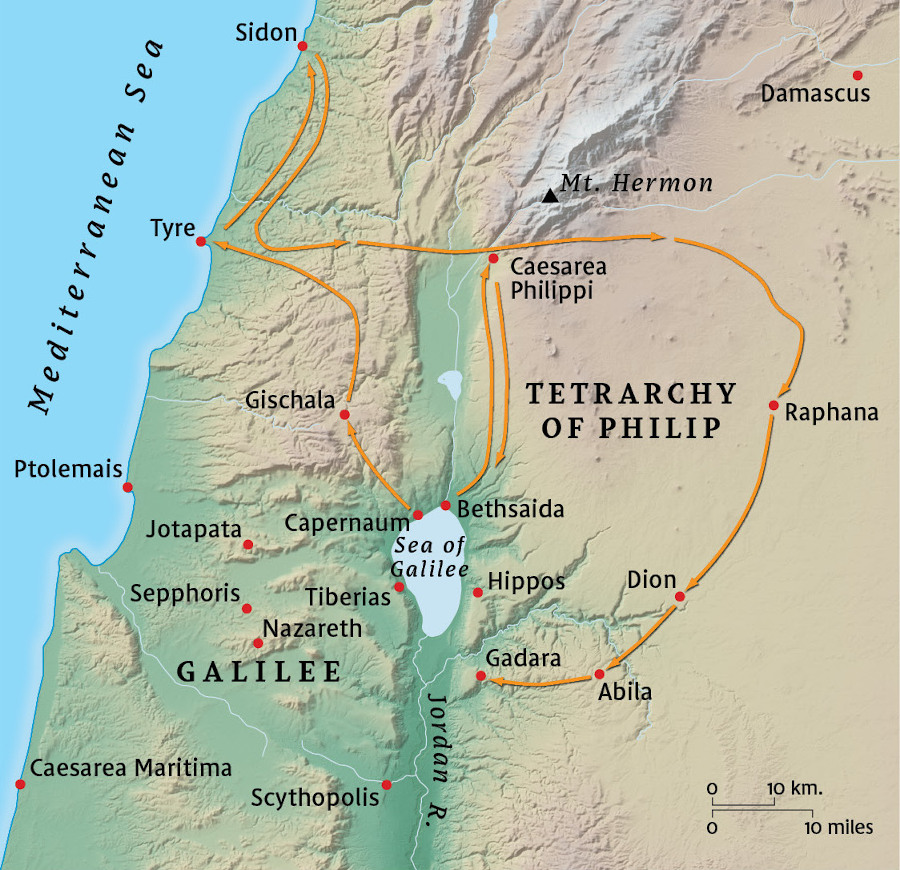
In a unique excursion into pagan and semipagan areas, Jesus visited the districts of Tyre and Sidon and the confederation of free cities called the Decapolis. Even here his fame had spread, and he could not keep his presence secret. The commercially magnificent cities of Tyre and Sidon had been a source of cultural seductiveness and religious heterodoxy since the time of Jezebel. The cities had been heavily influenced by Hellenism; the sophistication of Greek culture was apparent in their coinage and architecture. Each was also a proud, historic center of Canaanite paganism, with tombs of ancient kings and temples to Melqart/Heracles, Astarte and various other deities.
Go to the Maps Index.
8:2 compassion for these people. As Jesus had compassion because the people were “like sheep without a shepherd” (6:34), he now has compassion because they have been so long without food.
8:4 where . . . can anyone get enough bread to feed them? Their question reveals their spiritual dullness—a key theme in Mark’s Gospel (here and 4:13; 5:30–43; 7:18; 8:17–21; 9:32; 10:13–14, 35–40).
8:8 seven basketfuls. See note on Mt 15:37.
8:9 four thousand. See note on 6:44.
8:10 Dalmanutha. Matthew says Jesus “went to the vicinity of Magadan” (Mt 15:39; see note there; see also map). Dalmanutha and Magadan (or Magdala), located on the western shore of the Sea of Galilee, may be names for the same place or for two places located close to each other. A first-century synagogue was discovered in Magdala in 2009 (see photo). Excavations in 2013 may point to a separate village that would have been Dalmanutha.
8:11 Pharisees. See notes on 2:16 and Mt 3:7. sign from heaven. The Pharisees wanted more compelling proof of Jesus’ divine authority than his miracles, but he refused to perform such a sign because the request came from unbelief.
8:12 Truly I tell you. See note on 3:28.
8:13 other side. The eastern shore of the Sea of Galilee.
8:15 yeast. Here, as generally in the NT (Mt 16:6, 11; Lk 12:1; see 1Co 5:6–8; Gal 5:9 and notes, but Mt 13:33 seems to be an exception—see note there), yeast is a symbol of the permeating power of evil or corruption. The metaphor includes the idea of a tiny amount of yeast being able to ferment a large amount of dough. In this context it refers to the evil disposition of both the Pharisees and Herod Antipas (see Lk 23:8 and note). The Pharisees asked Jesus to produce a sign, i.e., a proof of his divine authority (see note on v. 11).
8:16 The disciples were so concerned to find out who was to blame for not bringing more bread that they completely ignored Jesus’ warning about the yeast of the Pharisees and of Herod. Such an understanding heightens Mark’s depiction of the disciples as slow learners.
8:17 hearts hardened. See v. 4; 6:52 and notes. This is a serious danger, since the religious leaders have been said to have stubborn hearts (3:5; cf. 4:11–12).
8:18–20 These verses indicate two feeding narratives (see note on vv. 1–10).
8:22 Bethsaida. See note on Mt 11:21; see also map.
8:23 spit. See 7:33 and note. put his hands on him. See 1:41; Ac 6:6 and note.
8:24 like trees walking around. The man had likely bumped into trees in his blindness; now he dimly sees something like tree trunks moving about. This episode appears just before Peter’s confession and Jesus’ prediction that he will suffer and die (8:29–31). The man’s partial sight may point to the partial insight of the disciples. They recognize that Jesus is the Messiah but cannot yet comprehend his suffering role.
8:25 Once more Jesus put his hands on the man’s eyes. This second laying on of hands is unique in Jesus’ healing ministry. It may symbolize that the disciples’ spiritual sight is gradually increasing. saw everything clearly. Giving sight to the blind was another indication that Jesus was doing what God had promised to do when he came to bring salvation (see 7:35 and note; see also note on Isa 35:5).
8:26 Don’t even go into the village. So as not to broadcast what Jesus had done for him and precipitate a crisis before Jesus had completed his ministry (see 5:19,43; Mt 8:4; 16:20 and notes).
8:27 Caesarea Philippi. See notes on 7:24; Mt 16:13. Who do people say I am? The most important question of the ages: Who is Jesus Christ?
8:29 Messiah. See note on Mt 16:16; a critical climax in Mark’s Gospel as Peter, representing the apostles, recognizes Jesus as the promised Messiah. Yet his conception of the Messiah is about to be radically challenged (see notes on 8:31—10:52; 8:31; 8:32).
8:30 not to tell anyone about him. See v. 26 and note.
8:31—10:52 A new section begins in 8:31. This section contains three cycles of three events (8:31–38; 9:30–37; 10:32–45). In each, (1) Jesus predicts his death; (2) the disciples fail to understand and demonstrate some act of pride; and (3) Jesus teaches about servant leadership. See chart.
8:31 Son of Man. Jesus’ most common title for himself, used 81 times in the Gospels and never used by anyone but Jesus there. Elsewhere it is used by Stephen (Ac 7:56; see note there) and in John’s vision (Rev 1:13). In Da 7:13–14 the Son of Man is pictured as a heavenly figure who in the end times is entrusted by God with authority, glory and sovereign power (see note on Da 7:13). must suffer. As predicted, e.g., in Isa 52:13—53:12 (see note there and note on Lk 24:44; see also Mk 9:9, 12,31; 10:33–34; 14:21,41 and relevant notes). elders. The lay members of the Sanhedrin, the high court of the Jews. chief priests. See note on Mt 2:4. These included the ruling high priest, Caiaphas; the former high priest, Annas; and the high priestly families. teachers of the law. See note on Mt 2:4. Representatives of the three groups mentioned here constituted the Sanhedrin.
8:32 Peter . . . began to rebuke him. Suffering and rejection had no place in Peter’s conception of the Messiah, and he rebuked Jesus for teaching what to him seemed not only inconceivable but also terribly wrong.
8:33 Satan. Peter’s attempt to dissuade Jesus from going to the cross contained the same temptation Satan gave at the outset of Jesus’ ministry in Matthew and Luke—to receive the kingdoms of the earth without following through on God’s plan of salvation (Mt 4:8–10; Lk 4:5–7). So Jesus severely rebuked him.
8:34 deny themselves. Cease to make self the object of one’s life and actions. take up their cross. Lk 9:23 adds “daily.” The picture is of someone, already condemned, required to carry the beam of their own cross to the place of execution (see Jn 19:17 and note). Cross-bearing includes a willingness to suffer and die for the Lord’s sake. follow me. Implying that his own death would be by crucifixion.
8:35 save their life. Physical life may be saved by denying Jesus, but eternal life will be lost. loses their life. Conversely, discipleship may result in the loss of physical life, but that loss is insignificant when compared with gaining eternal life (see note on Lk 9:24).
8:36 whole world. All the things that could possibly be achieved or acquired in this life. their soul. Eternal life (also in v. 37).
8:38 ashamed of me and my words. Contrast Ro 1:16. Those who are more concerned about fitting into and pleasing their own “adulterous and sinful generation” than about following and pleasing Christ will have no part in God’s kingdom. Son of Man. See note on v. 31. when he comes in his Father’s glory. The situation in which Jesus is rejected, humiliated and put to death will be reversed when he returns in glory as the Judge of all people (see 1Th 2:12 and note).
9:1 Truly I tell you. See note on 3:28. not taste death before they see that the kingdom of God has come with power. For the two main interpretations of this verse, see note on Mt 16:28. kingdom of God. See note on Mt 3:2.
9:2 After six days. See note on Mt 17:1. Peter, James and John. See note on 5:37. high mountain. The traditional site is Mount Tabor, though Mount Hermon may be more likely. See note on Lk 9:28. transfigured. A change in appearance revealing Jesus’ true glory (2Pe 1:17). This is the glory he had before coming to earth (Jn 17:5), the glory of his resurrection and exaltation (Lk 24:26), and the glory he will have at his second coming (Mk 8:38; 13:26).
9:4 Elijah and Moses. See notes on Mt 17:3; Lk 9:30.
9:5 Rabbi. Hebrew for “(my) teacher.” three shelters. Peter may be trying to prolong the experience by providing these esteemed guests with a place to stay or a shrine of some sort. But Mark dismisses Peter’s statement as irrelevant and provoked by fear: “He did not know what to say.”
9:7 voice came from the cloud. A cloud is frequently a symbol of God’s presence to protect and guide (see note on Mt 17:5). This is my Son, whom I love. An allusion to Ps 2:7; Isa 42:1. Listen to him! This is probably an allusion to Dt 18:15, where Moses tells the Israelites that God will one day raise up a “prophet like me” and that “You must listen to him.” To listen means to obey. When God is involved, the only true hearing is obedient hearing (see Jas 1:22–25 and note on 1:25).
9:9 not to tell anyone . . . until. See 5:19,43; Mt 8:4; 16:20 and notes. After Jesus’ resurrection the disciples were to tell everyone what they had experienced, for Jesus’ finished work would have demonstrated his true and full character as the Messiah. Son of Man. See note on 8:31.
9:10 what “rising from the dead” meant. As Jews, they were familiar with the doctrine of the resurrection, but that expectation was for all faithful Jews to be resurrected together in the final day. Jesus predicts his own resurrection before the end of time. This would have been baffling to any Jew. Their theology had almost no place for a suffering and dying Messiah.
9:11 Elijah must come first. See note on Mt 17:10.
9:12 Elijah does come first, and restores all things. A reference to the coming of Elijah, or one like him, in preparation for the coming of the Messiah (see note on Mt 17:10). Son of Man. See note on 8:31. must suffer much and be rejected. Just as “Elijah” (John the Baptist; see note on v. 13) has been rejected (see note on Mt 17:12).
9:13 Elijah has come. A reference to John the Baptist (see Lk 1:17 and note). they. Herod and his wife Herodias (see 6:17–29; Mt 14:3 and note). As Elijah was opposed by Ahab and Jezebel, so also John was opposed by a weak ruler and his wicked consort. as it is written about him. What Scripture says about Elijah in his relationship to Ahab and Jezebel (see 1Ki 19:1–10 and note on 19:3). There is no prediction of suffering associated with Elijah’s ministry in the end times. However, what happened to Elijah under the threats of Jezebel foreshadowed what would happen to John the Baptist. The order of events suggested in vv. 11–13 is as follows: (1) Elijah ministered and suffered in the days of wicked Jezebel; (2) Elijah was a type of John the Baptist, who in turn suffered at the hands of Herodias; (3) the Son of Man suffered and was rejected a short time after John was beheaded.
9:14 other disciples. The nine besides Peter, James and John (see v. 2). teachers of the law. See note on Mt 2:4. If the transfiguration took place on Mount Hermon (see v. 2 and note), the presence of the teachers of the law so far north in the Holy Land would indicate their concern in monitoring the activities of Jesus.
9:17–18 See Mt 17:15,18 and notes.
9:18 Demonic possession was responsible for the boy’s condition (vv. 20,25–26).
9:19 unbelieving generation. A reference that includes the disciples, and reveals Jesus’ great disappointment with them (see note on 8:16).
9:22 to kill him. See note on 5:5.
9:23 ‘If you can’? . . . Everything is possible for one who believes. The question was not whether Jesus had the power to heal the boy but whether the father had faith to believe it. A person who truly believes will set no limits on what God can do.
9:24 I do believe; help me overcome my unbelief! Since human faith is never perfect, belief and unbelief are often mixed. This, however, presents no difficulty for God’s power.
9:25 When Jesus saw that a crowd was running to the scene, he rebuked the impure spirit. As much as possible, Jesus wanted to avoid further publicity.
9:29 This kind. Seems to suggest that there are different kinds of demons. only by prayer. The disciples apparently had taken for granted the power given to them or had come to believe that it was inherent in them. Lack of prayer indicated they had forgotten that their power over the demonic spirits came from trusting in Jesus and his power (see 3:15; 6:7,13; see also note on 6:12–13).
9:30 passed through Galilee. Jesus’ public ministry in and around Galilee is coming to an end (see note on 7:24), and he will soon head to Jerusalem to suffer and die (10:32–34). As he had been doing for some time, Jesus continued to focus his teaching ministry on the Twelve (v. 31).
9:31 The second prediction of Jesus’ death (see note on 8:31—10:52). Son of Man. See note on 8:31. This is the second of three cycles, in which (1) Jesus predicts his death; (2) the disciples fail to understand and demonstrate some act of pride or presumption; and (3) Jesus teaches about servant leadership (see note on 8:31—10:52 and chart).
9:32 they did not understand. See v. 10; 8:32–33; Lk 24:44 and notes.
9:33–37 Parallel to 10:35–45 (see note there).
9:33 Capernaum. See Mt 4:13; Lk 10:15 and notes. house. Probably the one belonging to Peter and Andrew (1:29). In Mark’s Gospel, homes are often places of teaching.
9:34 they kept quiet. No doubt due to embarrassment. who was the greatest. Questions of rank and status played an important role in people’s lives at this time, but they had no place in Jesus’ value system (see v. 35; 10:42–44 and note on 10:43).
9:35 See note on Lk 9:48. Sitting down. See 4:1 and note.
9:37 Whoever welcomes one of these little children. Jesus is here challenging first-century ideas of social status, where children had no status and so would be unwelcome in many contexts. The point is that true servant leadership turns social hierarchy on its head, lifting up and serving those of lower status in the eyes of the world.
9:38 not one of us. The man apparently was a believer, but he was not a member of the exclusive company of the Twelve. Nevertheless he acted in Jesus’ name and had done what the disciples, on at least one occasion, had not been able to do (vv. 14,28).
9:39 Do not stop him. Jesus’ view of discipleship was far more inclusive than the narrow view held by the Twelve.
9:40 At first glance, this saying appears to contradict the one in Mt 12:30. There, however, reference is to those who vehemently opposed Jesus, whereas here it is to one who was in sympathy with Jesus and his ministry.
9:41 Truly I tell you. See note on 3:28. gives you a cup of water. God remembers even small acts of kindness extended to believers because they are believers (see note on Lk 9:50). Messiah. See 8:29 and note. not lose their reward. Have God’s approval.
9:42 little ones. Probably referring to the lowly and insignificant followers of Jesus (see Mt 10:42 and note; 18:6,10,14 and note; Lk 17:2). To cause these believers to sin will bring serious judgment. millstone. A heavy stone slab used in grinding grain.
9:43 cut it off. Hyperbole, a figure of speech that exaggerates to make its point, is used here to emphasize the need for drastic action. Often sin can be conquered only by radical “spiritual surgery.” life. Eternal life in the presence of God. hell. See Mt 5:22 and note.
9:47 kingdom of God. See notes on 1:15; Mt 3:2.
9:48 Isa 66:24 (see note there) speaks of the punishment for rebellion against God. As the final word of Isaiah’s message, the passage became familiar as a picture of endless destruction. worms that eat them do not die. Worms were always present in the rubbish dump (see Mt 5:22 and note).
9:49 The saying may mean that everyone who enters hell will suffer its fire, or (if only loosely connected with the preceding) it may mean that every Christian in this life can expect to undergo the fire of suffering and purification.
9:50 Salt is good. The distinctive mark of discipleship typified by salt is allegiance to Jesus and the gospel (see 8:35,38; Mt 5:13 and notes). be at peace with each other. Strife is resolved and peace restored when we recognize in one another a common commitment to Jesus and the gospel.
10:1 region of Judea. The Greek and Roman equivalent to the OT land of Judah, essentially the southern part of the Holy Land (now exclusive of Idumea), which formerly had been the southern kingdom. For Jesus’ ministry in Judea, see note on Lk 9:51. Jordan. See note on 1:5. Jesus’ journey took him south from Capernaum, over the mountains of Samaria into Judea and then east across the Jordan into Perea, where Herod Antipas ruled (see note on Mt 14:1). For Jesus’ ministry in Perea, see note on Lk 13:22.
10:2 Pharisees. See note on 2:16. came and tested him. The question of the Pharisees was hostile. It was for unlawful divorce and remarriage that John the Baptist denounced Herod Antipas and Herodias (6:17–18), and this rebuke cost him imprisonment and then his life. Jesus was now within Herod’s jurisdiction, and the Pharisees may have hoped that Jesus’ reply would cause the tetrarch to seize him as he had John. Is it lawful . . . to divorce his wife? Jews of that day generally agreed that divorce was lawful, the only debated issue being the proper grounds for it (see note on Mt 19:3).
10:5 because your hearts were hard. See 6:52 and note. Divorce was an accommodation to human weakness and was used to bring order in a society that had disregarded God’s will, but it was not the standard God had originally intended, as vv. 6–9 clearly indicate. The purpose of Dt 24:1–4 (see note there) was not to make divorce acceptable but to reduce the hardship of its consequences.
10:6 at the beginning of creation. Jesus goes back to the time before human sin to show God’s original intention. God instituted marriage as a great unifying blessing, bonding the male and female in his creation.
10:8 no longer two, but one flesh. The deduction drawn by Jesus affirms the ideal of the permanence of marriage.
10:9 Therefore what God has joined together. Jesus grounds the sanctity of marriage in the authority of God himself, and his “No” to divorce safeguards against human selfishness, which always threatens to destroy marriage.
10:11 Anyone who divorces his wife. In Jewish practice divorce was effected by the husband himself, not by a judicial authority or court. commits adultery against her. A simple declaration of divorce on the part of a husband could not release him from the divine law of marriage and its moral obligations. This enduring force of the marriage bond was unrecognized in rabbinic courts, where a certificate of divorce explicitly stated the right to remarry (see articles here and here). Cf. Mt 19:3 and note; cf. also Mt 19:9, where an exception is mentioned. 1Co 7:15 contains another exception (see notes on 1Co 7:12,15).
10:12 she commits adultery. In this historical and geographic context, Jesus’ pronouncements confirm the bold denunciation by John the Baptist and equally condemn Herod Antipas and Herodias.
10:14 kingdom of God. See note on Mt 3:2. belongs to such as these. The kingdom of God belongs to those who, like children, are fully dependent on God and prepared to receive the kingdom as a gift of God (see note on v. 15).
10:15 Truly I tell you. See note on 3:28. like a little child. The point of the comparison is the dependent state in which children find themselves. The kingdom of God must be received as a gift; it cannot be achieved by human effort. It can be entered only by those who know they are helpless, without claim or merit (see 9:37; Mt 18:3; Lk 18:17 and notes).
10:16 placed his hands on them and blessed them. See note on Ac 6:6. Jesus visually demonstrated that the blessings of the kingdom are freely given.
10:17 man. Mark simply tells us he was a rich man (v. 22). Lk 18:18 calls him a “ruler,” meaning he was probably a member of an official council or court, and Mt 19:20 says he was “young.” what must I do . . . ? Cf. Ac 16:30–31 and notes. The rich man may have been thinking in terms of earning righteousness to merit eternal life, but Jesus taught that it was a gift to be received (see v. 15 and note). eternal life. See note on Mt 19:16.
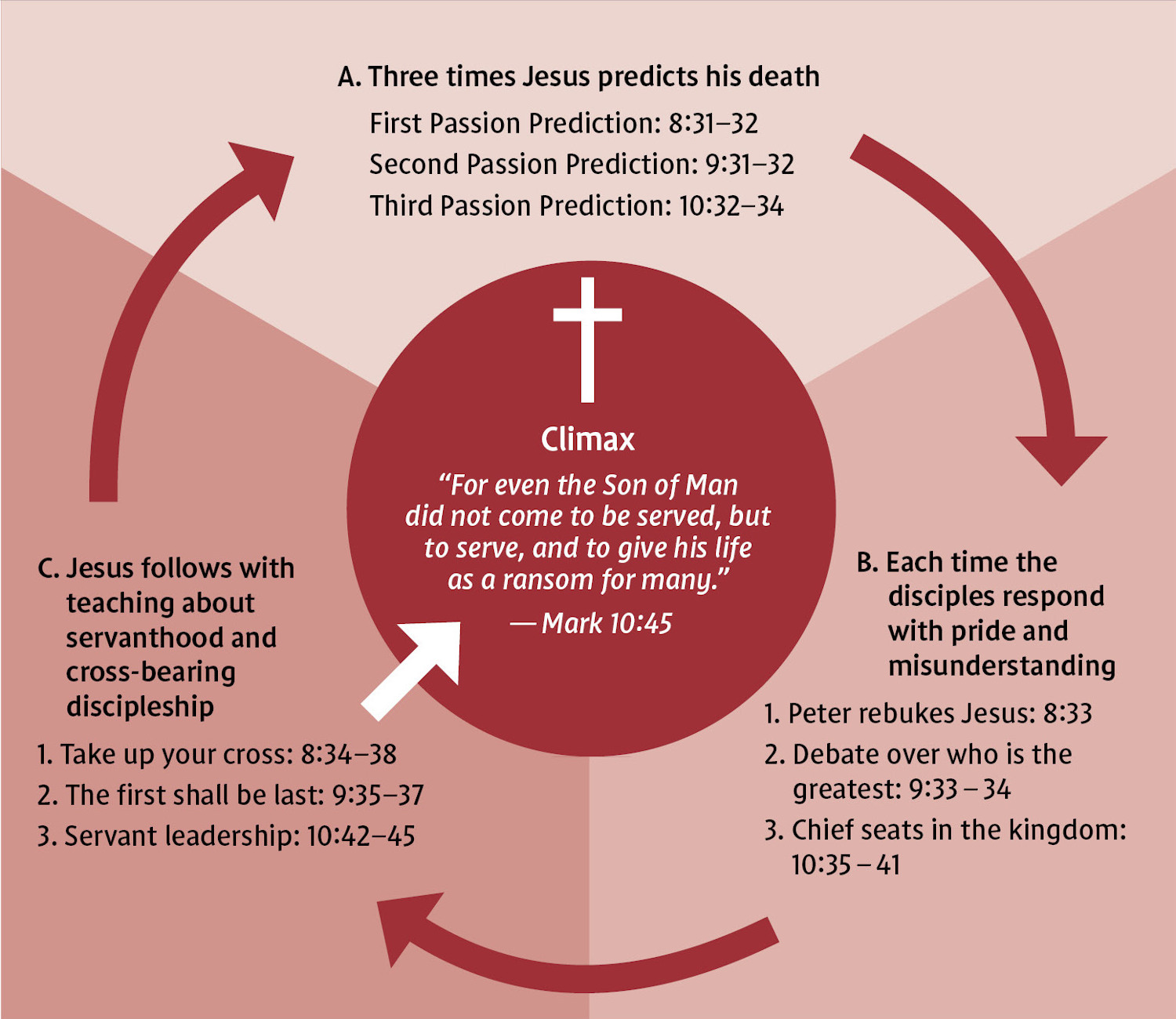
10:18 Why do you call me good? Jesus was not denying his own goodness but was forcing the man to recognize that only God is truly good, so that his only hope was in total reliance on God, who alone can give eternal life. He may also have been encouraging the young man to consider the full identity and nature of the One he was addressing.
10:19 you shall not defraud. The prohibition of fraud may have represented the tenth commandment (against covetousness). If so, Jesus here mentions all six commandments that prohibit wrong actions and attitudes against others (Ex 20:12–17; Dt 5:16–21).
10:20 all these I have kept. The man will be shown to have fallen short of full obedience because he is unable to leave behind his wealth to follow Jesus. since I was a boy. Probably a reference to the age of 13, when a Jewish boy assumed personal responsibility for obeying the commandments and thus became a “son of the commandment(s)” (Aramaic bar mitzvah).
10:21 Jesus . . . loved him. Jesus recognized the man’s earnestness. Jesus’ response was not necessarily intended to shame the man by exposing failure to understand the spiritual depth of the commandments but was an expression of genuine love. One thing you lack . . . Go, sell everything . . . Then come, follow me. See note on 1:17. The young man’s primary problem was his wealth (see v. 22 and note), and therefore Jesus’ prescription was to rid him of it. Lk 19:1–10, 11–27 show other models of stewardship. Jesus’ command to this man applies to those who have the same problem of attachment to their possessions. treasure in heaven. The gift of eternal life, or salvation. This treasure is not to be earned by self-denial or giving of one’s material goods but is to be received by following Jesus. In giving away his wealth, the young man would have removed the obstacle that kept him from trusting in Jesus.
10:22 He went away sad, because he had great wealth. The tragic decision to turn away reflected a greater love for his possessions than for eternal life (see 4:19 and note).
10:25 eye of a needle. The camel was the largest animal found in the Holy Land. The vivid contrast between the largest animal and the smallest opening represents what, humanly speaking, is impossible. There is no legitimate evidence for the oft-repeated suggestion that one of Jerusalem’s gates was called the Needle’s Eye.
10:26 amazed. See 1:22 and note.
10:27 With man this is impossible, but not with God. Salvation is totally the work of God. Every attempt to enter the kingdom on the basis of human achievement or merit is futile. Apart from the grace of God, no one can be saved (cf. Eph 2:8–9; Titus 3:5 and notes).
10:29 Truly I tell you. See note on 3:28. gospel. See 1:1 and note.
10:30 hundred times as much. See 4:8 and note. present age . . . age to come. These two terms take in all of time from the fall of Adam and Eve to the eternal state. The present age is evil (see Gal 1:4 and note), but the coming righteous age will begin with the second advent of Christ and continue forever. homes, brothers . . . fields. Because the church is a family, its possessions are “family resources” to be used for the good of the church and the glory of God. along with persecutions. The life of discipleship is a combination of promise and persecution, blessing and suffering. God takes nothing from a Christian without making multiplied restoration in a new and glorious form. Furthermore, fellowship with other believers develops most deeply in persecution. eternal life. Beyond the conflicts of history is the triumph assured to those who belong to God (see Mt 19:16 and note).
10:31 first will be last. A warning against pride in sacrificial accomplishments such as Peter had manifested (v. 28; see vv. 42–44 and note on v. 43; see also 9:35).
10:32–45 This is the third of three cycles, in which (1) Jesus predicts his death; (2) the disciples fail to understand and demonstrate some act of pride; and (3) Jesus teaches about servant leadership. See note on 8:31—10:52 and diagram.
10:32 on their way up to Jerusalem. See notes on Lk 9:51; 13:22. astonished. See 1:22 and note. Perhaps the disciples’ astonishment was due to the determination with which Jesus proceeded to his goal (see Isa 50:7 and note). those who followed were afraid. Perhaps pilgrims on their way to the Passover in Jerusalem, afraid of the persecution Jesus’ ministry might trigger, or afraid of the Messianic war that would break out if Jesus declares himself to be the Messiah (8:29).
10:33–34 The third prediction of Jesus’ death (see note on 8:31—10:52). Gentiles, who will . . . kill him. The word “crucify” does not occur in any of the passion predictions in Mark’s Gospel, but the statement that Jesus would be handed over to Gentiles to be killed by them suggests crucifixion, since this was the usual means of Roman execution of non-Romans. See note on Lk 24:44.
10:33 Son of Man . . . chief priests . . . teachers of the law. See notes on 8:31; Mt 2:4.
10:35–36 want . . . want. James’s and John’s desire for position and power would be realized only if they willingly submitted to servanthood (see “wants . . . wants” in vv. 43–44).
10:35 James and John, the sons of Zebedee. See 1:19; 3:17.
10:37 at your right and . . . at your left in your glory. Positions of prestige and power. They are not thinking about heavenly glory. They are expecting Jesus to establish an earthly Messianic kingdom in Jerusalem.
10:38 drink the cup I drink. A Jewish expression that meant to share someone’s fate. In the OT the cup of wine was a common metaphor for God’s wrath against human sin and rebellion (see Jer 25:15–16 and notes; 49:12). Accordingly, the cup Jesus had to drink refers to divine punishment for sin that he bore for the redemption of the human race (see v. 45; 14:36 and notes). be baptized with the baptism I am baptized with. The image of baptism is parallel to that of the cup, referring to his suffering and death as a baptism, or a deluge of water that overwhelms (see Lk 12:50 and note; cf. Ro 6:3–4 for the figure).
10:40 is not for me to grant. Jesus would not usurp his Father’s authority.
10:41 the ten. The other disciples. indignant. Because they desired the positions of prestige and power for themselves.
10:43 Not so with you. Jesus overturns the authoritarian leadership model of his world. The life of discipleship is to be characterized by humble and loving service. See diagram.
10:44 wants to be first. See v. 31 and note; 9:35; 3Jn 9 and note.
10:45 A key verse in Mark’s Gospel. Jesus came to this world as a servant—indeed, the Servant—who would suffer and die for our redemption, as Isaiah clearly predicted (Isa 52:13—53:12). Son of Man. See note on 8:31. did not come to be served, but to serve, and to give his life. See note on Jn 13:5. ransom. Means “the price paid for release (from bondage).” Jesus gave his life to release us from bondage to sin and death. for. That is, “in place of,” pointing to Christ’s substitutionary death. many. In contrast to the one life given for our ransom. See note on Mt 20:28.
10:46 Jericho. A very ancient city located five miles west of the Jordan and about 15 miles northeast of Jerusalem. In Jesus’ time OT Jericho was largely abandoned, but a new city, south of the old one, had been built by Herod the Great. blind man. See Lk 18:35 and note. begging. The presence of a blind beggar just outside the city gates, on a road pilgrims followed on the way to Jerusalem, was a common sight in that day.
10:47 Nazareth. See note on Mt 2:23. Son of David. A Messianic title (see Isa 11:1–2; Jer 23:5–6; Eze 34:23–24; Mt 1:1; 9:27 and notes). Verses 47–48 are the only places in Mark where it is used to address Jesus. Its only other occurrence in Mark is in 12:35. The cry of Bartimaeus reminds the reader that Jesus is the Davidic Messiah and so prepares for his royal entrance into Jerusalem (11:1–11) and the “coming kingdom of our father David” (11:10).
10:51 Rabbi. See notes on 11:21; Jn 20:16.
10:52 your faith has healed you. See 5:28 and note.
11:1–11 At this point a new section in the Gospel of Mark begins. Jesus arrives in Jerusalem, and the rest of his ministry takes place within the confines of the Holy City. Jesus’ entry into Jerusalem as King, which inaugurates Passion Week, is a deliberate Messianic action, and the clue to its understanding is found in Zec 9:9 (quoted in Mt 21:5; Jn 12:15). Jesus purposefully offers himself as the Messiah, knowing that this will provoke Jewish leaders to take action against him.
11:1 Bethphage. See note on Mt 21:1 and map. Bethany. A village about two miles east of Jerusalem (see notes on 11:11, Mt 21:17). Mount of Olives. Directly east of Jerusalem, it rises to a height of about 2,700 feet, some 200 feet higher than Mount Zion. Its summit commands a magnificent view of the city, and especially of the temple (now the site of the Dome of the Rock).
11:2 the village ahead. Probably Bethphage. colt. The Greek word can mean the young of any animal, but here it means the colt of a donkey (see Mt 21:2 and note; Jn 12:15). which no one has ever ridden. Unused animals were regarded as especially suitable for religious purposes (Nu 19:2; Dt 21:3; 1Sa 6:7).
11:3 If anyone asks you. The message concerning the colt is not directed specifically to the owner but to anyone who might question the disciples’ action. Lord. See note on Lk 19:31.
11:8 spread their cloaks on the road. See Mt 21:8 and note. branches. The word means “leaves” or “leafy branches,” which were readily available in nearby fields. Only John mentions palm branches (see Jn 12:13 and note), which may have come from Jericho, since they are not native to Jerusalem.
11:9 Hosanna. See NIV text note; see also note on Mt 21:9. Blessed is he who comes. A quotation of Ps 118:26 (see note there), one of the Hallel (“Praise”) Psalms sung at Passover and especially fitting for this occasion.
11:10 the coming kingdom of our father David. The Messianic kingdom promised to David’s son (see 2Sa 7:11–16 and notes).
11:11 temple courts. Refers to the massive platform about 330 by 500 yards upon which the temple building and its porticos and courts stood (see notes on 11:27, Mt 4:5). went out to Bethany. Apparently Jesus spent each night through Thursday of Passion Week in Bethany (see note on Mt 21:17) at the home of his friends Mary, Martha and Lazarus (v. 19; Jn 12:1–3).
11:12 next day. Monday of Passion Week.
Mark’s “Sandwich” Structure (Intercalation)
One of the most interesting literary features of Mark’s Gospel is his frequent use of “sandwiching” or “intercalation.” In this device, one episode begins and is then interrupted by another before finishing. The two events are generally related to the same theme and mutually interpret one another.
One of the most famous examples is Mark’s sandwiching of Jesus’ clearing of the temple in Jerusalem between the account of his cursing of a fig tree and the discovery of the withered tree the next day (11:12–25). The intercalation indicates that both events symbolically represent God’s judgment against Israel for the nation’s spiritual unfruitfulness. In the same way, Mark sandwiches the accusation by the religious leaders that Jesus casts out demons by Beelzebub’s (Satan’s) power between the beginning and end of an account related to criticism from his family (3:20–35). The rejection by his own family symbolically depicts the rejection by the religious leaders and his own people Israel. Similarly, the account of the healing of a woman with a blood disease interrupts the episode of Jesus’ raising of Jairus’ daughter from the dead. Both episodes concern “daughters,” spiritual impurity, twelve years (the length of the woman’s disease; the age of Jairus’s daughter) and most important, both stress the need for faith (5:21–43). For other examples, see 6:7–30; 14:1–11 and 14:53–72.
These Markan sandwiches not only provide drama to the narrative by creating a sense of anticipation, they also carry forward important narrative themes.
Go to the Articles Index.
11:13 not the season for figs. Fig trees around Jerusalem normally begin to get leaves in March or April but do not produce figs until their leaves are all out in June.
11:14 May no one ever eat fruit from you again. The incident was almost certainly a parable of judgment, with the fig tree representing Israel’s leaders, who were failing to produce spiritual fruit by responding in faith to Jesus (cf. Jer 24:1; Hos 9:10 and notes; Na 3:12). The fact that it was not the season for figs (11:13) suggests that Jesus is intentionally making a point, rather than expecting breakfast. The fact that the clearing of the temple (vv. 15–19) is sandwiched between the two parts of the account of the fig tree (vv. 12–14,20–25) may underscore the theme of judgment (see v. 21 and note). The only application Jesus explicitly makes, however, is as an illustration of believing prayer (vv. 21–25). See article.
11:15–19 All three Synoptic writers mention a clearing of the temple at the end of Jesus’ ministry. Only John has one at the beginning. See notes on Mt 21:12–17; Jn 2:14–17.
11:15 temple courts. The court of the Gentiles, the only part of the temple in which Gentiles could worship God and gather for prayer (see v. 17 and note; see also model). buying and selling. Pilgrims coming to the Passover Festival needed animals that met the ritual requirements for sacrifice, and the vendors set up their animal pens and money tables in the court of the Gentiles. tables of the money changers. Pilgrims needed their money changed into a standard currency—the shekel of Tyre—because the annual temple tax had to be paid in that currency. The Mishnah—the tradition of the elders put into writing c. ad 200—also required currency from Tyre for some offerings (see note on Mt 15:2). those selling doves. Doves were required for the purification of women (Lev 12:6; Lk 2:22–24), the cleansing of those with certain skin diseases (Lev 14:22–23), and other purposes (Lev 15:13–14,28–29). They were also the usual offering of the poor (Lev 5:7).
11:16 to carry merchandise through the temple courts. A detail found only in Mark. Apparently the temple area was being used as a shortcut between the city and the Mount of Olives. See note on v. 27.
11:17 house of prayer for all nations. Isa 56:7 assured godly Gentiles that they would be allowed to worship God in the temple. By allowing the court of the Gentiles to become a noisy, crowded marketplace, the Jewish religious leaders were interfering with God’s provision. den of robbers. Not only because they took financial advantage of the people but also because they robbed the temple of its sanctity (see 15:7,27 and notes).
11:18 chief priests . . . teachers of the law. See note on Mt 2:4. began looking for a way to kill him. See note on 3:6. They regarded Jesus as a Messianic claimant, and therefore a dangerous threat to their whole way of life. amazed. See 1:22 and note.
11:19 went out of the city. To Bethany (see note on v. 11).
11:20 In the morning. Tuesday morning of Passion Week. withered from the roots. This detail indicates that the destruction was total (cf. Job 18:16) and that no one in the future would eat fruit from the tree. It served as a vivid warning of the judgment to come in ad 70 (see 13:2; Mt 24:2 and note).
11:21 Rabbi. Hebrew for “(my) teacher.” fig tree you cursed. See note on v. 14. has withered. Likely prophetic of the fate of the Jewish authorities who were now about to reject their Messiah (12:9–12).
11:23 Truly I tell you. See note on 3:28. this mountain . . . into the sea. Perhaps the Mount of Olives, from which the Dead Sea is visible, or possibly Mount Zion, containing the temple (hinting at its destruction [13:2]). Cf. Mt 17:20 and note.
11:25 See Mt 6:14–15; 18:35 and note; cf. Eph 4:32 and note.
11:27 temple courts. Several courts surrounded the main temple buildings, including the court of the women, the court of the men (Israelite) and the court of the Gentiles (see vv. 16–17 and notes). chief priests . . . teachers of the law . . . elders. See notes on 8:31; Mt 2:4.
11:28 authority. The Sanhedrin was asking why Jesus performed what appeared to be an official act if he possessed no official status (see note on Lk 20:2).
11:30 from heaven, or of human origin? “Heaven” was a common Jewish substitute for the divine name to avoid a possible misuse of God’s name (see Ex 20:7 and note; see also Introduction to Matthew: Recipients). Jesus’ question implied that his authority, like that of John’s baptism, came from God.
11:33 Neither will I tell you. From Jesus’ perspective, the leaders’ refusal to answer whether John was a true prophet or not negated their legitimacy as Israel’s spiritual leaders, so he has no reason to answer their question about his authority.
12:1–12 Many of Jesus’ parables are simple, but this parable is rather complex, and the details fit the social situation in Jewish Galilee in the first century. Large estates, owned by absentee landlords, were put in the hands of local peasants who cultivated the land as tenant farmers. Jesus expands on the song of the vineyard in Isa 5:1–7 to portray Israel’s religious leaders as wicked tenant farmers who abuse the owner’s messengers (God’s prophets) and ultimately kill the owner’s son (Jesus). The parable exposed the planned attempt on Jesus’ life, as well as God’s judgment on the planners. See notes on Mt 21:35–37,41.
12:1 them. The representatives of the Sanhedrin mentioned in 11:27 (see note there). parables. See note on 4:2. A man planted a vineyard. The description reflects the language of Isa 5:1–2, where the vineyard clearly symbolizes Israel (see Isa 5:7; see also photo). watchtower. See notes on Mt 21:33; Isa 5:2.
12:2–5 The servants represent the prophets God has sent to Israel. See note on Lk 20:10.
12:6 son, whom he loved. See 9:7 and note.
12:7 inheritance will be ours. How could the tenants think that they could get the vineyard by killing the son? Some interpreters claim that Jewish law provided that property unclaimed by an heir for a time could be taken by its occupants. The tenants perhaps assumed the owner was dead and that, if they killed the son, they could claim the land. Another interpretation is that their actions are in fact irrational, but reflect exactly what the religious leaders did: They killed the Son to try to retain guardianship over Israel.
12:10 cornerstone. See note on Ps 118:22.
12:13–17 This incident probably took place on Tuesday of Passion Week in one of the temple courts (see map).
12:13 they. See note on v. 1. Pharisees. See note on Mt 3:7. Herodians. Supporters of the Herodian dynasty. For their alliance with the Pharisees, see notes on 3:6; Mt 22:15–17. The plan to destroy Jesus, which had originated early in his Galilean ministry, had now matured and was gaining momentum in Jerusalem.
12:14 pay the imperial tax to Caesar. Subject peoples were required to pay a poll tax to the Roman emperor (see NIV text note). The tax was highly unpopular, and some Jews flatly refused to pay it, believing that payment was an admission of Roman right to rule. See note on Mt 22:15–17. This was a trap since to support the tax would antagonize the people, but to oppose it would be viewed by the Romans as insurrection.
12:15 hypocrisy. See 7:6; Mt 5:18–20 and note; 6:2 and note; 23:13–36. denarius. See notes on 6:37; Mt 22:19.
12:17 Give back to Caesar what is Caesar’s. See Mt 22:21 and note. While there are obligations to the state that do not conflict with our obligations to God (see Ro 13:1–7; 1Ti 2:1–3; Titus 3:1–2; 1Pe 2:13–17 and notes), Jesus’ teaching is not meant to suggest a simple division of life between what belongs to Rome and what belongs to God, since in Jewish thinking all things belong to God. That a denarius (v. 15) belonged to Caesar was plainly marked in that on one side it bore a portrait of the emperor and on the other side an inscription that identified him (see photo). to God what is God’s. This is not just a division of responsibilities toward God and Caesar. Humans, who bear the image of God, owe to him their whole lives (see Mt 22:22 and note). amazed. See 1:22 and note.
12:18 Sadducees. A Jewish party that represented mainly the wealthy. Its members resided largely in Jerusalem and made the temple and its administration their primary interest. Though they were small in number, in Jesus’ time they exerted powerful political and religious influence. say there is no resurrection. Their beliefs set them against the Pharisees and common Jewish piety (see notes on Mt 3:7; Lk 20:27; Ac 4:1; see also chart).
12:19 The Sadducees make an argument related to the law of levirate marriage (Dt 25:5–6). See note on Mt 22:24.
12:24 you do not know the Scriptures. Cf. v. 10; 2:25.
12:25 See note on Lk 20:36. In the resurrection there will be a new order of existence brought about by “the power of God” (v. 24; see 1Co 15:42–44 and note). like the angels. The basic characteristics of resurrection life will be fellowship with and service for God (see note on Heb 1:14).
12:26–27 Since God remains the God of the patriarchs, they must still be alive in their relationship to him.
12:26 Book of Moses. The Pentateuch, the first five books of the OT. account of the burning bush. A common way of referring to Ex 3:1–6 (cf. Ro 11:2, where “the passage about Elijah” refers to 1Ki 19:1–18). Chapter and verse numbers were a later addition to the Bible.
12:28 which is the most important? Jewish rabbis counted 613 individual statutes in the law and attempted to differentiate between “heavy” (or “great”) and “light” (or “little”) commands.
12:29–31 Rabbi Hillel, a contemporary of Jesus, also stated that all the commandments are summarized in the call to love.
12:29 This OT citation is the beginning of what came to be known as the Shema (see note on Dt 6:4–9), named after the first word of Dt 6:4 (Hebrew for “Hear”). The Shema became the Jewish confession of faith, which was recited by pious Jews every morning and evening. To this day its recitation begins every synagogue service.
12:30 See notes on Dt 6:5; Mt 22:37; Lk 10:27.
12:31 According to Jesus, the second most important commandment (Lev 19:18) states that love for neighbor is an essential component of love for God (see Jn 13:34; 1Jn 4:19–21 and notes). neighbor. See Lk 10:25–37.
12:32 Well said, teacher. Cf. Lk 20:39 and note.
12:33 more important than. The comparison may have been suggested by the fact that the discussion took place in the temple courtyard (see 11:27 and note). all burnt offerings and sacrifices. See 1Sa 15:22; Isa 1:11–15; Hos 6:6; Mic 6:8 and notes.
12:34 kingdom of God. See note on Mt 3:2.
12:35 Messiah. See 8:29 and note. son of David. See note on 10:47. Most of the people knew that the Messiah was to be from the family of David.
12:36 The Lord said to my Lord. Jesus assumes that David is speaking in the first person in the psalm: “The Lord . . . ” God said to David’s Lord, i.e., David’s superior—ultimately the Messiah (see note on Ps 110:1). The purpose of the quotation was to show that the Messiah was more than a descendant of David—he was David’s Lord (see note on Lk 20:44).
12:38 flowing robes. The teachers of the law wore long robes that were fringed and almost reached to the ground.
12:39 most important seats in the synagogues. A reference to the bench that was in front of the “ark” containing the sacred scrolls. Those who sat there could be seen by all the worshipers in the synagogue.
12:40 devour widows’ houses. Since the teachers of the law were not paid a regular wage, they were dependent on the generosity of patrons for their livelihood. Such a system was open to abuses, and widows, who were often poor, were especially vulnerable to exploitation. for a show make lengthy prayers. See Mt 6:5–7. punished most severely. See note on Lk 20:47.
12:41 temple treasury. Located in the court of the women. Both men and women were allowed in this court, but women could go no farther into the temple precincts. It contained 13 trumpet-shaped receptacles for contributions brought by worshipers (see note on Lk 21:1).
12:42 very small copper coins. The smallest coins then in circulation in Israel. Sometimes called the “widow’s mite”; in Greek the coin is a lepton. Though her offering was meager, the widow brought “all she had” (v. 44; see 2Co 8:12 and note).
12:43 Truly I tell you. See note on 3:28.
13:1–37 Mark’s version of the Olivet discourse (see note on Mt 24:1—25:46). It is the longest connected discourse in Mark’s Gospel. The chapter falls into five sections: (1) Jesus’ prophecy of the destruction of the temple, which gives rise to the disciples’ questions (vv. 1–4); (2) warnings against deceivers, as well as signs of either the temple’s destruction or the end of the age (vv. 5–23); (3) the coming of the Son of Man (vv. 24–27); (4) the lesson of the fig tree (vv. 28–31); and (5) exhortation to watchfulness (vv. 32–37). The greatest challenge is determining when Jesus is speaking about the destruction of Jerusalem and when he is speaking about the second coming.
13:1 massive stones. According to Josephus (Antiquities, 15.11.3), they were white, and some of them were 37 feet long, 12 feet high and 18 feet wide. magnificent buildings. See note on Lk 21:5.
13:3 Mount of Olives. See note on 11:1; see also map. Peter, James, John and Andrew. See 1:16–20; 5:37 and note.
13:4 Jesus’ words led the disciples to think that the destruction of the temple would be one of the events that ushered in the end times (see Mt 24:3 and note). sign. The way by which the disciples might know that the destruction of the temple was about to take place and that the end of the age was approaching.
13:5 Watch out. It is clear from such commands as “Watch out” (see also vv. 35,37) and “You must be on your guard” (v. 9; see also vv. 23,33) that one of the main purposes of the Olivet discourse was to alert the disciples to the danger of deception.
13:6 he. That is, the Messiah.
13:7 but the end is still to come. The events listed in verses 5–13 are characteristic of the present age, not unique signs of the end of the age. See Mt 24:31; Lk 21:8–19 and note on 21:9.
13:8 birth pains. Sufferings that will precede the birth of the new age (see note on Mt 24:8).
13:9 local councils. This could refer to secular councils in Greco-Roman towns or to Jewish councils that met in synagogues. See Mt 10:17 and note. flogged. Infraction of Jewish regulations was punishable by flogging, the maximum penalty being 39 strokes with a whip (see Dt 25:1–3 and note on 25:3). Paul endured this frequently (2Co 11:24; Ac 16:23). synagogues. See note on 1:21.
13:10 gospel. See 1:1 and note. first. Before the end of the age (Mt 24:14).
13:13 stands firm to the end. Such perseverance is a sure indication of salvation (cf. Heb 3:6,14 and notes; 6:11–12; 10:36).
13:14 abomination that causes desolation. The original prediction of this event in Daniel (9:27; 11:31; 12:11) concerned the desecration of the Jerusalem temple by Antiochus Epiphanes in 168 bc. Jesus uses this horrific event in Israel’s past to predict a similar one in the future (see note on Mt 24:15). Whether this was an event that occurred in the first century or is still future is uncertain. standing where it does not belong. Cf. 2Th 2:4 and note. let the reader understand. This may be Mark’s own narrative comment alerting the reader to the imminent fulfillment of this prophecy in the destruction of Jerusalem (but see note on Mt 24:15). flee to the mountains. See note on Mt 24:16.
13:15 housetop. See notes on 2:4; Lk 17:31.
13:16 cloak. See note on Mt 5:40.
13:17 pregnant women and nursing mothers. Representative of anyone forced to flee under especially difficult circumstances.
13:18 winter. The time when heavy rains caused streams to become swollen and impossible to cross, preventing many from reaching a place of refuge.
13:19 days of distress unequaled. The Jewish historian Josephus uses similar language concerning the destruction of Jerusalem. Some believe the reference is to a future period of great distress, others to the destruction of Jerusalem.
13:20 cut short those days. See note on Mt 24:22. elect. People of God.
13:21 Messiah. See 8:29 and note.
13:24–25 Imagery depicting the undoing of creation was commonly used by the OT prophets to describe God’s awful judgment on a fallen world (see Isa 13:10; 24:21–23; 34:4; Eze 32:7; Joel 2:10, 30–31; Am 8:9 and notes).
13:24 in those days. A common OT expression having to do with the Messianic age, the time of Israel’s final redemption (see Jer 3:16, 18; 31:29; 33:15–16; Joel 3:1; Zec 8:23; Heb 9:26 and note). distress. See v. 19 and note on Mt 24:21.
13:26 See Mt 24:30 and note. Son of Man. See note on 8:31. coming in clouds with great power and glory. A reference to Christ’s second coming (see 8:38; Da 7:13, 27; 2Th 1:6–10; Rev 19:11–16 and notes).
13:27 angels. Cf. Rev 14:14–16. gather his elect. In the OT, God is spoken of as gathering his scattered people (Dt 30:3–4; Isa 43:6; Jer 32:37; Eze 34:13; 36:24).
13:28 fig tree. See notes on 11:13; Lk 21:29.
13:29 these things. It is debated whether the signs listed in vv. 5–23 precede the destruction of Jerusalem, the end of the age, or both. it is near. Probably a reference to the kingdom of God (Lk 21:31) coming in the person of King Jesus (see NIV text note).
13:30 Truly I tell you. See note on 3:28. this generation will certainly not pass away until all these things have happened. Likely refers to the events surrounding the destruction of Jerusalem in ad 70, which many of Jesus’ generation witnessed. For other possibilities, see note on Lk 21:32.
13:32 that day. An OT expression (see Isa 2:11, 17,20; Joel 1:15; Am 5:18; Mic 4:6; 1Th 5:2 and notes). no one knows. A specific outline of the future would be a hindrance, not a help, to faith. Certain signs have been given, but not for the purpose of making detailed, sequential predictions (see Ac 1:7; 1Th 5:1 and notes). nor the Son. While on earth, even Jesus lived by faith and in full dependence on the Spirit—as his servants must—and obedience was the hallmark of his ministry (see Heb 10:5–7 and note on 10:5).
13:35 in the evening, or at midnight, or when the rooster crows, or at dawn. The four watches of the night used by the Romans (see note on Mt 14:25).
13:37 Watch! See note on v. 5.
14:1–9 See note on Jn 12:1–11.
14:1 Passover. The festival commemorating the time when the angel of the Lord passed over the homes of the Hebrews rather than killing their firstborn sons as he did in the Egyptian homes (see Ex 12:11 and note). The lambs or kids used in the festival were killed on the 14th of Nisan (March-April), and the meal was eaten the same evening between sundown and midnight. Since the Jewish day began at sundown, the Passover Festival took place on the 15th of Nisan (see note on Jn 2:13). Festival of Unleavened Bread. This festival followed Passover and lasted seven days (see Ex 12:17; 23:15 and notes). chief priests. See note on 8:31. teachers of the law. See note on Mt 2:4.
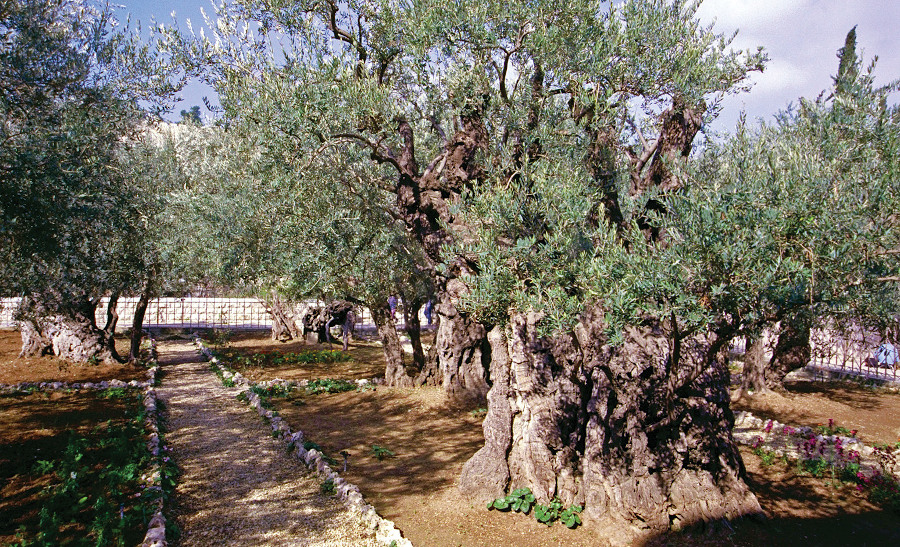
14:2 not during the festival. During Passover and the week-long Festival of Unleavened Bread, the population of Jerusalem increased from about 50,000 to a few hundred thousand. It would have been too risky to apprehend Jesus with so large and excitable a crowd present.
14:3–9 In John’s Gospel this incident is placed before the beginning of Passion Week (see Jn 12:1–11 and note). Matthew and Mark may have placed it here to contrast the hatred of the religious leaders and the betrayal by Judas with the love and devotion of the woman who anointed Jesus. The time reference to “two days before Passover” in Mark (14:1) probably refers to the day of the plot against Jesus (14:1–2) rather than the day of the anointing at Bethany, which John identifies as five days before Passover (Jn 12:1).
14:3 Bethany. See note on Mt 21:17. reclining at the table. The usual posture for eating at a banquet (see note on Jn 13:23). Simon the Leper. He had probably been healed by Jesus (see note on Mt 26:6). woman. We know from Jn 12:3 that she was Mary, the sister of Martha and Lazarus, but Mark chooses to keep her anonymous. alabaster jar. Probably a sealed flask with a long neck that was broken off when the contents were used. nard. A fragrant oil (see notes on SS 1:12; Jn 12:3). poured the perfume on his head. Anointing was a common custom at feasts (see Ps 23:5 and note). The woman’s action expressed her deep devotion to Jesus.
14:4 Some of those present. Mt 26:8 identifies them as the disciples, while Jn 12:4–5 singles out Judas Iscariot.
14:5 given to the poor. It was a Jewish custom to give gifts to the poor on the evening of Passover (Jn 13:29).
14:7 The poor you will always have with you. See Dt 15:11 and note. Jesus’ statement did not express lack of concern for the poor, for their needs lay close to his heart (Mt 6:2–4; Lk 4:18; 6:20; 14:13,21; 18:22; Jn 13:29). In fact, the OT passage he alludes to, Dt 15:11, is a call to care for the poor (see note there). He was simply stating the truth.
14:8 prepare for my burial. It was a normal Jewish custom to anoint a dead body with aromatic oils in preparing it for burial (see 16:1 and note). Jesus seems to anticipate suffering a criminal’s death, for only in that circumstance was there no anointing of the body.
14:9 Truly I tell you. See note on 3:28. gospel. See note on 1:1.
14:10 Judas Iscariot. See note on 3:19. chief priests. See note on 8:31. This was an unexpected opportunity that they seized, even though they had intended not to apprehend Jesus during the festival (see v. 2 and note).
14:11 money. Thirty silver coins, according to Mt 26:15 (see note there).
14:12 first day of the Festival of Unleavened Bread. Here the 14th of Nisan is meant because Passover lambs were killed on that day (Ex 12:6). The entire eight-day celebration was sometimes referred to as the Festival of Unleavened Bread. make preparations. These preparations would have included obtaining food for the meal, such as unleavened bread, wine, bitter herbs and a lamb.
14:13 two of his disciples. Peter and John, according to Lk 22:8 (see note there). man carrying a jar. Unusual, since women normally carried water jars. This could indicate a prearrangement with the owner of the house. See note on Lk 22:10.
14:14 The Teacher asks. See note on Lk 22:11. Where is my guest room . . . ? It was a Jewish custom that anyone in Jerusalem who had a room available would give it upon request to a pilgrim to celebrate the Passover (cf. note on Ac 12:12).
14:16 as Jesus had told them. See note on Lk 22:13.
14:17 evening. Thursday of Passion Week.
14:18 reclining at the table eating. Originally the Passover meal was eaten standing (Ex 12:11), but in Jesus’ time it was customary to eat it while reclining (cf. v. 3 and note). Truly I tell you. See note on 3:28.
14:20 dips bread into the bowl with me. This is probably not meant to be a signal identifying the betrayer, but another way of saying “one who shares closest fellowship with me” (see v. 18). See note on Mt 26:23.
14:21 Son of Man. See note on 8:31. as it is written about him. Jesus may have had the “suffering servant” passage of Isa 52:13—53:12 in mind. See vv. 27,49 and note on Lk 24:44.
14:22 The NT gives four accounts of the Lord’s Supper (here; Mt 26:26–28; Lk 22:19–20; 1Co 11:23–25). Matthew’s account is very much like Mark’s, and Luke’s and Paul’s have similarities. All the accounts include the taking of the bread; the thanksgiving or blessing; the breaking of the bread; the saying, “This is my body”; the taking of the cup; and the explanation of the relation of blood to the covenant. Only Paul and Luke record Jesus’ command to continue to celebrate the Supper. this is my body. The bread represented his body, given for them (see 1Co 11:24 and note).
14:23 had given thanks. The word “Eucharist,” often used to refer to the Lord’s Supper, is derived from the Greek term used here.
14:24 my blood of the covenant. The cup represents the blood of Jesus, which, in turn, represents his poured-out life (i.e., his death). God’s commitments to his people in the new covenant are possible only through Christ’s atoning death (see Ex 24:6, 8; Jer 31:31–34; Lk 22:20; Heb 8:8–12 and notes). for many. See Ro 5:15 and note.