Study Notes
1:1–16 For a comparison of Matthew’s genealogy with Luke’s, see note on Lk 3:23–38. The types of people (including Gentiles) mentioned in this genealogy reveal the broad scope of those who make up the people of God as well as the genealogy of Jesus.
1:1 son of David. A Messianic title (see Introduction: Recipients; Purpose; see also note on 9:27) found several times in this Gospel (in 1:20 it is not a Messianic title). Jesus fulfills the Davidic covenant (see 2Sa 7:5–16 and note on 7:11). son of Abraham. Because Matthew was writing primarily to Jews, it was important to identify Jesus in this way. Jesus fulfills the Abrahamic covenant (see Ge 12:2–3; 15:9–21; 17; 22:15–18; Zec 9:10 and note).
1:3 Tamar. In Matthew’s genealogy five women are named: Tamar (here), Rahab (v. 5), Ruth (v. 5), Bathsheba (not by name but by description—“Solomon, whose mother had been Uriah’s wife,” v. 6) and, of course, Mary (v. 16). All these women were in some sense on the margins of society. At least three of them were Gentiles (Tamar, Rahab and Ruth). Bathsheba was probably an Israelite (1Ch 3:5) but was closely associated with the Hittites because of Uriah, her Hittite husband. By including them (contrary to custom) in his genealogy, Matthew indicates at the very outset of his Gospel that God’s grace is not limited to the people of Israel. Also because all five of these women were associated, rightly or wrongly, with suspicions of sexual impropriety, Matthew is showing that the Messiah’s genealogy is not limited to the upright.
1:4 Amminadab. Father-in-law of Aaron (Ex 6:23).
1:5 Rahab. See notes on v. 3; Heb 11:31; Jas 2:25; see also Jos 2. Since quite a long time had elapsed between Rahab and David and because of Matthew’s desire for systematic organization (see note on v. 17), many of the generations between these two ancestors were assumed, but not listed, by Matthew. Ruth. See note on v. 3.
1:6 Solomon, whose mother. His mother was Bathsheba (see note on v. 3).
1:8 Jehoram the father. Matthew calls Jehoram the father of Uzziah, but from 2Ch 21:4—26:23 it is clear that, again, several generations were assumed (Ahaziah, Joash and Amaziah) and that “father” is used in the sense of “forefather” or “ancestor” (see NIV text notes on 1Ch 1:5,10).
1:11 Josiah the father. Similarly (see note on v. 8), Josiah is called the father of Jeconiah (i.e., Jehoiachin; see NIV text note), whereas he was actually the father of Jehoiakim and the grandfather of Jehoiachin (2Ch 36:1–9). the exile to Babylon. In chs. 1–2 Matthew emphasizes the theme of Israel’s exile and return. In Jesus’ ministry, God’s people experience the restoration that was associated with the return from exile (see 2:18 and note).
1:12 Shealtiel the father. See note on 1Ch 3:19.
1:16 husband of Mary. Matthew does not say that Joseph was the father of Jesus but only that he was the husband of Mary and that Jesus was born of her. In the genealogy and in the birth account (1:18–25), Matthew shows that, although Jesus is not the physical son of Joseph, he is the legal son and therefore a descendant of David (see Lk 2:33; Jn 1:45 and notes). Mary . . . mother of Jesus. See note on v. 3.
1:17 fourteen generations . . . fourteen . . . fourteen. These divisions reflect two characteristics of Matthew’s Gospel: (1) an apparent fondness for numbers and (2) concern for systematic arrangement. The number 14 may have been chosen because it is twice seven (the number of completeness) and/or because it is the numerical value of the name David (see notes on Pr 10:1; Rev 13:17). For the practice of telescoping genealogies to achieve the desired number of names, see Introduction to 1 Chronicles: Genealogies.
1:18—2:23 Matthew frames what he communicates about Jesus’ infancy with five specific OT texts.
1:18 pledged to be married. There were no sexual relations during a Jewish betrothal period, but it was a much more binding relationship than a modern engagement and could be broken only by divorce (v. 19). In Dt 22:24 a betrothed woman is called a “wife,” though the preceding verse speaks of her as being “pledged to be married.” Matthew uses the terms “husband” (v. 19) and “wife” (v. 24) of Joseph and Mary before their marriage was consummated (see note on Joel 1:8). the Holy Spirit. The common NT way of referring to the divine Spirit, who in the OT was almost always called “the Spirit of God” or “the Spirit of the LORD.” See Ps 51:11 and note. Christian reflection on the biblical testimony about the Spirit (see 3:16–17; 28:19; 2Co 13:14 and notes) led to the understanding that he is one of the three persons of the Trinity.
1:19 divorce her quietly. He would sign the necessary legal papers but not have her judged publicly and stoned (Dt 22:23–24).
1:20 in a dream. The phrase occurs five times in the first two chapters of Matthew (here; 2:12,13,19,22) and indicates the means the Lord used for speaking to Joseph. Joseph son of David. See notes on 1:1,16; perhaps a hint that the message of the angel related to the expected Messiah. take Mary home as your wife. They were legally bound to each other but not yet living together as husband and wife. what is conceived in her is from the Holy Spirit. This agrees perfectly with the announcement to Mary (Lk 1:35), except that the latter is more specific (see note on Lk 1:26–35).
1:21 the name Jesus. See NIV text note; the meaning is more specifically explained in the rest of the verse. save. See Lk 2:11 and note.
1:22 fulfill. Twelve times (here; 2:15,23; 3:15; 4:14; 5:17; 8:17; 12:17; 13:14,35; 21:4; 27:9) Matthew uses a fulfillment formula (e.g., “this took place to fulfill . . . ”) when speaking of the OT being fulfilled in the events of Jesus’ life. Some of these are uniquely fulfilled by Jesus, while others are typological, where Jesus is the ultimate fulfillment of an OT type (see note on 2:15).
1:23 See note on Isa 7:14. This is the first of about 50 quotations, many of them Messianic in some sense, that Matthew takes from the OT (see NIV text notes throughout Matthew).
1:24 angel of the Lord. See Lk 2:9 and note.
1:25 he did not consummate their marriage until she gave birth. Both Matthew and Luke (1:26–35) make it clear that Jesus was born of a virgin. Although this doctrine is often questioned, Jesus’ virgin birth is an essential truth of the Christian faith. he gave him the name Jesus. Since it was the father’s prerogative to name children (e.g., Lk 1:60), the emphasis on Joseph naming Jesus at the climactic moment of the birth account highlights the act of adoption by Joseph that makes Jesus his legal son.

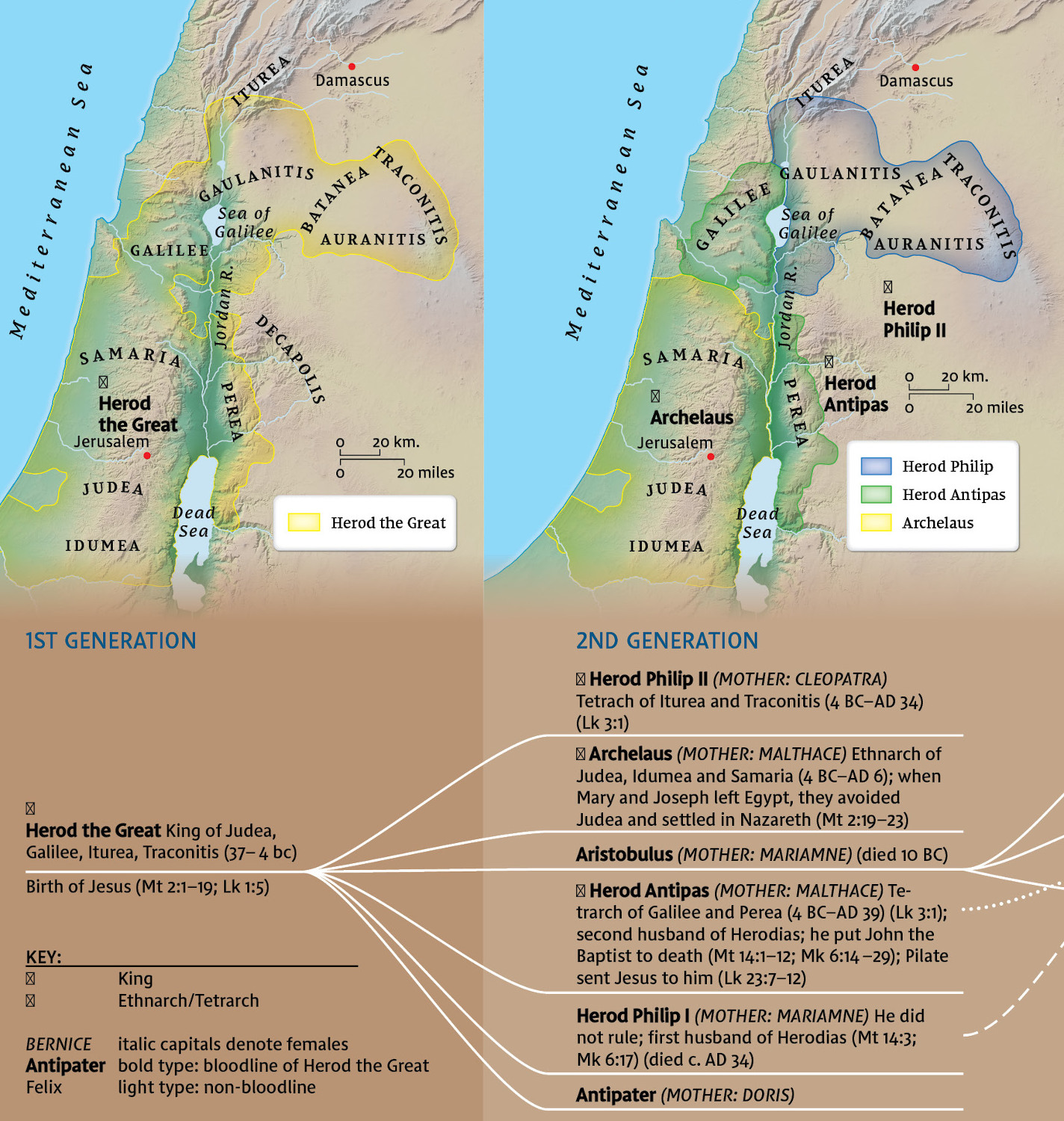
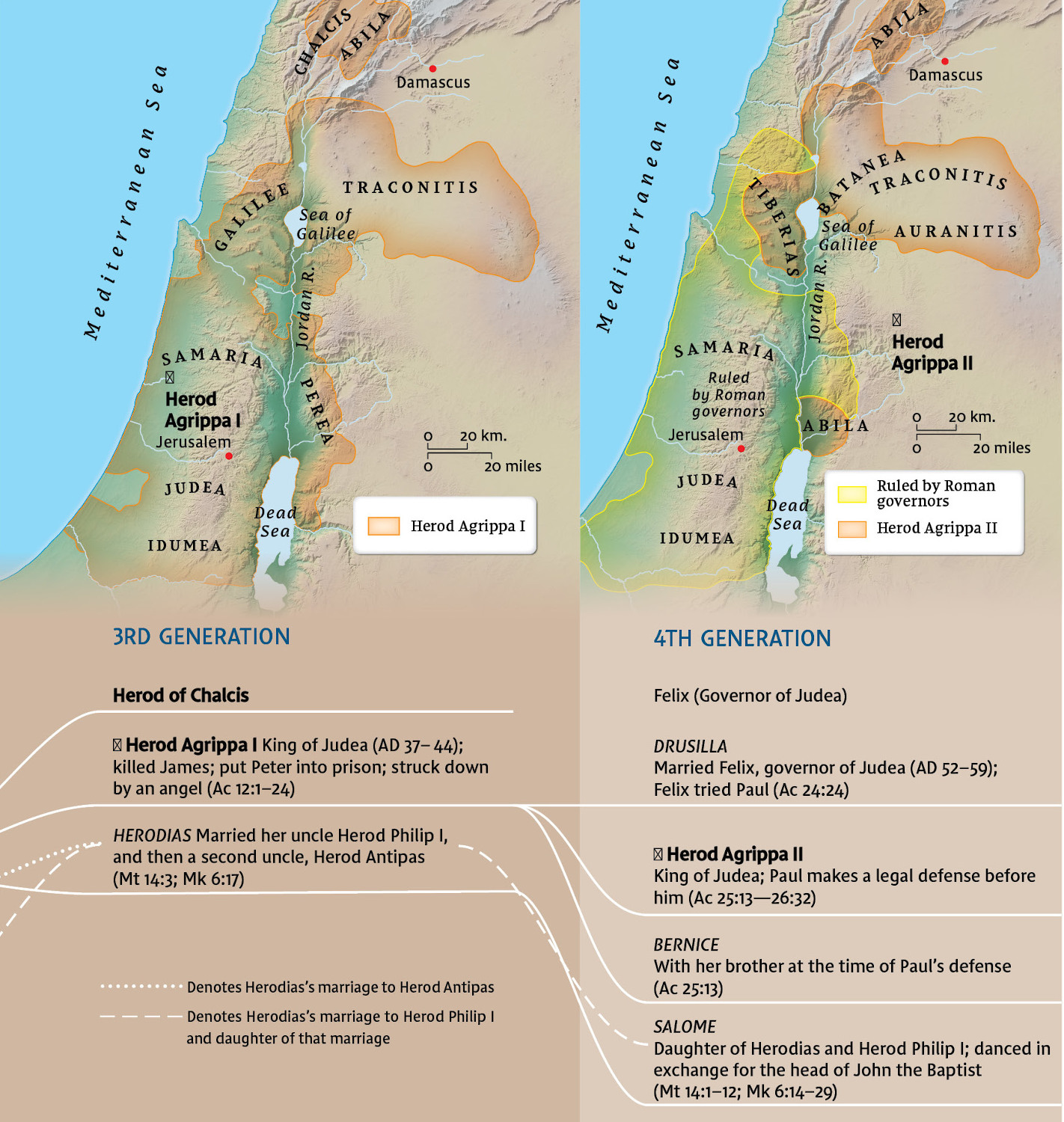
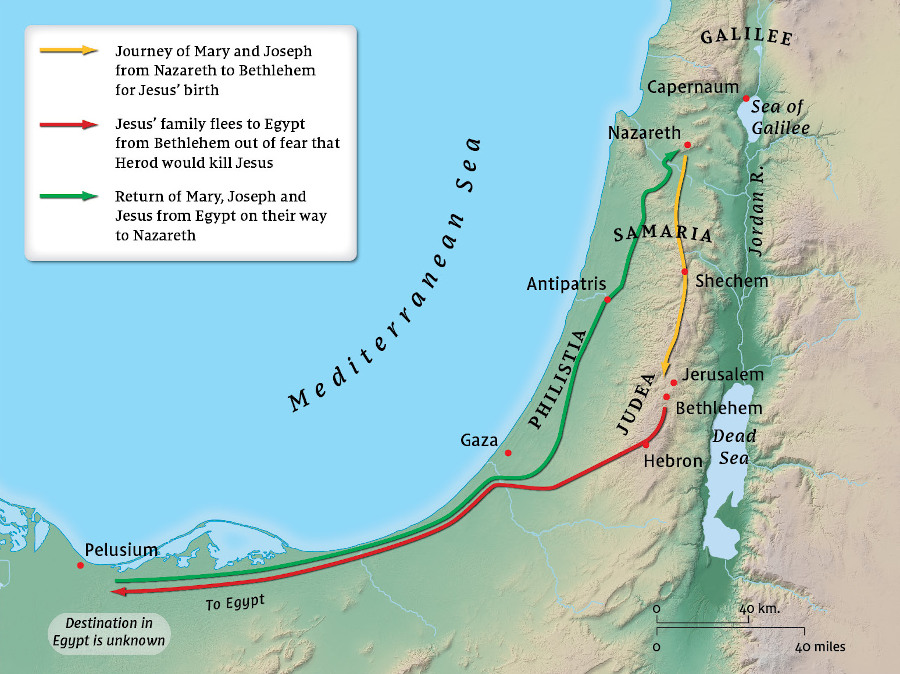
 2:1 Bethlehem in Judea. A village about five miles south of Jerusalem (see photo). Matthew says nothing of the events in Nazareth (cf. Lk 1:26–56). Possibly wanting to emphasize Jesus’ Davidic background, he begins with the events that happened in David’s hometown. It is called “Bethlehem in Judea,” not only to distinguish it from the town of the same name about seven miles northwest of Nazareth, but also to emphasize that Jesus came from the tribe (Judah) and territory that produced the line of Davidic kings. That Jews expected the Messiah to be born in Bethlehem and to be from David’s family is clear from Jn 7:42. King Herod. Herod the Great (37–4 bc), to be distinguished from the other Herods in the Bible (see chart). Herod was a non-Jew, an Idumean, who was appointed king of Judea by the Roman Senate in 40 bc and gained control in 37. He was a ruthless ruler, murdering his wife, three of his sons, his mother-in-law, his brother-in-law, his uncle and many others he suspected of treachery—not to mention the male babies in Bethlehem (v. 16). His reign was also noted for splendor, as seen in the many theaters, amphitheaters, monuments, pagan altars, fortresses and other buildings he erected or refurbished—including the greatest work of all, the rebuilding of the temple in Jerusalem, begun in 19 or 20 bc and finished 68 years after his death (see note on Jn 2:20). Magi. Probably astrologers, perhaps from Persia or southern Arabia or Mesopotamia (“Between the Rivers”), all of which are east of the Holy Land. Jerusalem. Since they were looking for the “king of the Jews” (v. 2), they naturally came to the Jewish capital city (see maps here and here).
 2:2 king of the Jews. Indicates the Magi were Gentiles. Matthew wants to show that people of all nations acknowledged Jesus as “king of the Jews” and came to worship him as Lord (cf. 28:19). star. Probably not an ordinary star, planet or comet, though some interpreters have identified it with the conjunction of Jupiter and Saturn or with other astronomical phenomena (cf. Nu 24:17 and note).
2:4 chief priests. See note on Mk 8:31. These were the ruling priests in charge of worship at the temple in Jerusalem. teachers of the law. Traditionally translated “scribes,” these were Jewish scholars of the day, professionally trained in the teaching and application of OT law (see notes on Mk 2:16; Lk 5:17).
2:11 house. Contrary to tradition, the Magi did not visit Jesus at the manger on the night of his birth. They came some months later and visited him as a “child” in his “house.” the child with his mother Mary. Every time the child Jesus and his mother are mentioned together, he is mentioned first (vv. 11,13–14,20–21). gold . . . frankincense . . . myrrh. Three gifts perhaps gave rise to the legend that there were three Magi. But the Bible nowhere indicates the number of the Magi, and they were almost certainly not kings (see note on v. 1). myrrh. See note on Ge 37:25.
2:13 angel of the Lord. See note on Lk 2:9.
2:15 the death of Herod. In 4 bc. Out of Egypt I called my son. This quotation from Hos 11:1 refers in that context to God’s calling the nation of Israel out of Egypt in the time of Moses. But Matthew, under the inspiration of the Spirit, applies it also to Jesus thus identifying Jesus as the new Israel coming out of Egypt. Matthew sees the history of Israel (God’s “son”) recapitulated in the life of Jesus (God’s unique Son). Just as Israel as an infant nation went down into Egypt, so the child Jesus went there. And as Israel was led by God out of Egypt, so also was Jesus. See article below.

New Testament writers understand Jesus to be the fulfillment of the Jewish story told in the Jewish Scriptures. One way they emphasize Jesus as this fulfillment is by highlighting an OT figure, object, or event, and then connecting it to Jesus.
In this correspondence, the OT “type” is shown to be brought to completion in Jesus (who is sometimes called the “antitype”). For example, Matthew connects Jesus with Israel by citing Hos 11:1, which speaks of God’s son, Israel, coming out of Egypt. Matthew shows that Jesus, like Israel of old, will be delivered from Egypt by God (see Mt 2:15 and note; 2:20–21). Therefore Israel is “a type” of Jesus (with Jesus as the “antitype”).
For another example, consider the temple in John’s Gospel. Jesus fulfills the purposes of the temple (God’s presence with his people; cf. Jn 1:14–18). And according to Jn 2:13–22, Jesus could speak of his body (his self) as the temple (Jn 2:20–21). John also goes on to show how various Jewish festivals are types of Jesus’ person and work. For instance, John understands the Feast of Tabernacles as typological of Jesus’ identity as light and the living water, key elements of this festival (Jn 8:12; 7:37–38; cf. 4:10,14).
Go to the Articles Index.
2:16 kill all the boys . . . two years old and under. The number killed has often been exaggerated as being in the thousands. In so small a village as Bethlehem, however (even with the surrounding area included), the number was probably not large—though the act, of course, was no less brutal.
2:18 Originally referencing mothers in Judah lamenting their sons being exiled to Babylonia (see note on Jer 31:15). The OT contexts of all three citations in Mt 2 so far (2:6,15,18) focus on the promise of return from exile. Matthew seems to be using these quotations to highlight Jesus as fulfillment of Scripture and to signal that Jesus brings about the end of his people’s exile.
2:22 Archelaus. This son of Herod the Great ruled over Judea and Samaria for only ten years (4 bc–ad 6). He was unusually cruel and tyrannical and so was deposed. Judea then became a Roman province, administered by governors appointed by the emperor (see chart). Galilee. The northern part of Israel in Jesus’ day (see maps here and here).
2:23 Nazareth. A rather obscure town, nowhere mentioned in the OT. It was Jesus’ hometown (21:11; 26:71; see Lk 2:39; 4:16–24; Jn 1:45–46). According to Luke (2:4–5), Joseph and Mary had left Nazareth to go to Bethlehem to register for the Roman census. be called a Nazarene. These exact words are not found in the OT and may refer to several OT prefigurations and/or predictions (note the plural “prophets”) that the Messiah would be despised (e.g., Ps 22:6; Isa 53:3), for in Jesus’ day Nazareth was viewed as an unsophisticated, backwater town (Jn 1:45–46). In speaking of Jesus as a “Nazarene,” Matthew, through a wordplay, may be alluding to the “Branch” (Hebrew neṣer) of Isa 11:1, since the word also appears in the Targums (see note on Ne 8:8), rabbinic literature, and the Dead Sea Scrolls (see article) as a Messianic title. In this interpretation, Jesus is the Messianic branch who, ironically, comes from Nazareth.
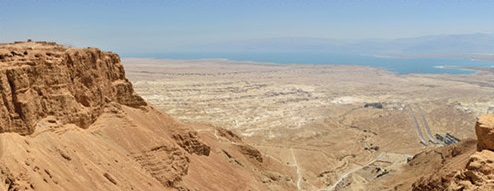
3:1 John the Baptist. The forerunner of Jesus, born c. 7 bc to Zechariah, a priest, and his wife Elizabeth (Lk 1:5–80). wilderness of Judea. An area that stretched some 20 miles from the Jerusalem-Bethlehem plateau down to the Jordan River and the Dead Sea, perhaps the same region where John lived (cf. Lk 1:80). The people of Qumran (often associated with the Dead Sea Scrolls) lived in this area too (see article).
3:2 Repent. Repentance is not merely a change of mind but a radical change in one’s life as a whole that especially involves forsaking sin and turning or returning to God. kingdom of heaven. A phrase found only in Matthew, where it occurs 33 times. See Introduction: Recipients. Mark and Luke refer to “the kingdom of God,” a term Matthew uses only four times (see note on Mk 11:30). The “kingdom of heaven/God” in the preaching of Jesus as recounted in the Gospels is the reign of God that he brings about through Jesus Christ—i.e., the establishment of God’s rule in the hearts and lives of his people, the overcoming of all the forces of evil, the removal from the world of all the consequences of sin—including death and all that diminishes life—and the creation of a new order of righteousness and peace. The idea of God’s kingdom is central to Jesus’ teaching and is mentioned 50 times in Matthew alone. has come near. The presence and the power of God’s reign has already begun to be experienced (4:17; Mk 1:15).
3:3 All four Gospels quote Isa 40:3 (Luke quotes two additional verses) and apply it to John the Baptist. make straight paths for him. Equivalent to “Prepare the way for the Lord” (see note on Lk 3:4). The preparation was thoroughgoing—impacting all areas of life.
3:4 camel’s hair . . . leather belt. Worn by Elijah and other prophets (see 2Ki 1:8; Zec 13:4–6 and notes). locusts and wild honey. People living in the wilderness often ate insects, and locusts were among the clean foods (Lev 11:21–22). John’s simple food, clothing and lifestyle were a visual protest against self-indulgence and injustice (Lk 3:10–14).
3:6 Confessing their sins. See Pr 28:13; 1Jn 1:9 and notes. they were baptized by him. Although writings contemporary with the Gospels provide no exact parallel to Jewish baptism, it is possible that John’s baptizing activity was meant to imitate baptism of new converts to Judaism. If so, then John was inviting his fellow Jews to return to the covenant and to their God. Jordan River. See note on Mk 1:5 and map.
3:7 Pharisees and Sadducees. See article and chart. The Pharisees (see notes on Mk 2:16; Lk 5:17) were a separatistic group focused on the law and its interpretation, who kept both the law of Moses and the unwritten “tradition of the elders” (15:2; later codified in the Mishnah and Talmud). The Sadducees (see notes on Mk 12:18; Lk 20:27; Ac 4:1) were more politically minded and had theological differences with the Pharisees, including denial of the resurrection, angels and spirits (Ac 23:8). baptizing. See note on Mk 1:4. the coming wrath. The arrival of the Messiah will bring repentance (v. 8) or judgment.
3:9 We have Abraham as our father. See Jn 8:39. Salvation does not come as a birthright (even for the Jews) but through faith in Christ (Ro 2:28–29; Gal 3:7, 9,29). children for Abraham. The true people of God are not limited to the physical descendants of Abraham, as Matthew highlights elsewhere (1:3,5,6; 8:5–13; 15:21–28; 28:19–20; cf. Ro 9:6–8 and notes).
3:10 The ax is already at the root of the trees. John preaches that judgment is near. every tree that does not produce good fruit. Cf. Jn 15:2 and note.
3:11 with water for repentance. John’s baptism presupposed repentance; he condemned the Pharisees and Sadducees because they failed to give any evidence of repentance (vv. 7–8). whose sandals I am not worthy to carry. See note on Jn 1:27. carry. Mark (1:7) and Luke (3:16) have “untie” (a different Greek verb), but the Greek here for “carry” can also mean “remove.” baptize you with the Holy Spirit. See Jn 1:33 and note. with the Holy Spirit and fire. Demonstrated in a dramatic way at Pentecost (Ac 1:5, 8; 2:1–13; 11:16), though here “fire” may refer to judgment to come (v. 12). The outpouring of the Holy Spirit on all God’s people was promised in Joel 2:28–29 and was at least partially fulfilled in Ac 2:16–21.
3:12 His winnowing fork. For the process of winnowing, see note on Ru 1:22. Here it is figurative for the separation of the righteous (“wheat”) from the wicked (“chaff”). unquenchable fire. Eschatological judgment (see 25:41 and note; cf. La 1:13 and note). The OT prophets and NT writers sometimes compress the first and second comings of Christ so that they seem to be one event (see, e.g., Isa 61:2 and note).
3:13 Jesus . . . baptized by John. See map and accompanying text.
3:15 Jesus’ baptism marked the beginning of his Messianic ministry. There were several reasons for his baptism: (1) The first, mentioned here, was “to fulfill all righteousness.” His baptism indicated that he was consecrated to God and officially approved by him, as especially shown in the descent of the Holy Spirit (v. 16) and the words of the Father (v. 17; cf. Ps 2:7; Isa 42:1). All God’s righteous requirements for the Messiah were fully met in Jesus. (2) At Jesus’ baptism John publicly announced the arrival of the Messiah and the inception of his ministry (Jn 1:31–34). (3) By his baptism Jesus completely identified himself with humanity’s sin and failure (though he himself needed no repentance or cleansing from sin), becoming our substitute (2Co 5:21). (4) His baptism was an example to his followers.
3:16–17 All three persons of the Trinity are clearly seen here (see 28:19 and note).
3:16 Spirit of God. The Holy Spirit came upon Jesus to equip him (see note on Jdg 3:10) for his work as the divine-human Messiah. like a dove. Either in the form of a dove or in a descent like a dove. See also note on Mk 1:10.
3:17 voice from heaven. The voice (1) authenticated Jesus’ Messianic sonship, echoing Ps 2:7 (“This is my Son”), (2) identified Jesus with the suffering servant of Isa 42:1 (“with him I am well pleased”; cf. Mt 12:18), and perhaps (3) identified Jesus with Abraham’s willingness to offer Isaac as a sacrifice, echoing Ge 22:2 (“whom I love”). This word from the Father must have greatly encouraged Jesus at the very outset of his earthly ministry. my Son. See notes on 14:33; Jn 3:16.
4:1–11 The significance of Jesus’ temptations, especially because they occurred at the outset of his public ministry, seems best understood in terms of the kind of Messiah he was to be. He would not accomplish his mission by using his supernatural power for his own needs (first temptation), by using his power to win a large following by miracles or magic (second temptation) or by compromising with Satan in idolatrous worship (third temptation). Jesus’ temptation was real, not merely symbolic. He was “tempted in every way, just as we are—yet he did not sin” (Heb 4:15; see note there; see also 2Co 5:21; Heb 7:26; 1Pe 2:22 and note; 1Jn 3:5). Although Jesus was the Son of God, he defeated Satan by using a weapon that everyone has at their disposal: “the sword of the Spirit, which is the word of God” (Eph 6:17). He met all three temptations with Scriptural truth (vv. 4,7,10) from Deuteronomy. See articles here and here.
4:1 Jesus . . . tempted by the devil. See article; see also map and accompanying text. by the devil. God surely tests his people, but it is the devil who tempts to evil (see notes on Ge 22:1; Jas 1:13; see also 1Jn 3:8; Rev 2:9–10 and notes; Rev 12:9–10). Like the Hebrew for “Satan,” the Greek for “devil” means “accuser” or “slanderer” or “adversary.” The devil is a personal being, not a mere force or influence. He is the great archenemy of God and the leader of the hosts of darkness.
The Gospels relate that Jesus was tempted as he prepared for his public ministry, yet he did not fall into sin (Mt 4:1–11; Mk 1:12–13; Lk 4:1–13). In these accounts, both Matthew and Luke foster a comparison between Jesus and Israel by highlighting Jesus’ forty days (cf. Israel’s forty years) in the wilderness and with three citations from Dt 6–8 (Israel’s wilderness experience). In this way, they show that Jesus succeeds where Israel failed: Jesus was also tempted to turn away from his God-given mission numerous times, yet he willingly went to the cross (cf. Lk 4:13; Mt 16:22–23; 26:36–46, 53–54; 27:41–43).
But while Christians traditionally agree that Jesus was sinless, they debate whether he could have actually sinned. Some believe that while Jesus experienced temptation, given his divine nature he couldn’t have sinned—just as God is unable to sin (cf. Ja 1:13). This view references Jesus’ choice to align with the divine will rather than following his own will (e.g., Mt 26:39,42) as Jesus acting out of his divine nature and so unable to sin.
Others believe that the analogy between Israel and Jesus shows Jesus as representative humanity and so seems to raise the possibility that he, as fully human, could have sinned (cf. Heb 2:17–18). So Jesus is able to empathize with our weakness because “he has been tempted in every way, just as we are—yet he did not sin” (4:15). If somehow Jesus had not been able to sin (if there were no real possibility), it seems he could not have been described in this way.
Whether Jesus could not have sinned, or could have sinned but did not, the same result is achieved. His perfect obedience means he is able to help us when we are tempted (Heb 2:18) and we are able to approach God with confidence (4:16).
Go to the Articles Index.
This testing or temptation of Jesus has as its primary background Israel’s wilderness experiences in Dt 6–8, from which Jesus quotes in his three responses to the devil’s temptations (see vv. 4,7,10 and NIV text notes). In Deuteronomy, Moses recalls how the Lord led the Israelites in the wilderness for 40 years “to humble and test you in order to know what was in your heart, whether or not you would keep his commands” (Dt 8:2). Here at the beginning of his ministry Jesus is subjected to a similar test and shows himself to be the true Israelite who lives “on every word that comes from the mouth of God” (Dt 8:3; Mt 4:4).
The other two citations from Deuteronomy also highlight a contrast between Israel and Jesus. Whereas Israel failed their wilderness testing by putting God “to the test as [they] did at Massah” (Dt 6:16), Jesus refuses to put God’s promises for protection to the test when tempted to throw himself from the temple heights (Mt 4:5–7). And while Israel’s history demonstrates their propensity to worship and serve other gods besides the Lord, Jesus quotes Dt 6:13 to affirm his commitment to be utterly faithful to the one true God when tempted by the devil to bow down to him (Mt 4:10).
We can learn much from this account of Jesus being tempted. First, although this is the first account of Jesus’ temptation, it is not the last. In Matthew, Jesus is also tempted to relinquish his God-given mission at a number of other points but remains true to God’s calling (16:22–23; 26:36–46; 27:43). Second, because the emphasis in the narrative is on Jesus’ faithfulness in testing in contrast to Israel’s unfaithfulness, Jesus’ identity as representative Israel and so representative humanity is the focus. This means that when Jesus overcomes temptations by clinging to God and God’s word, he provides a powerful example for all believers in their own times of testing. And because Jesus is tempted as Israel was and as believers continue to be, he is able to be our “merciful and faithful high priest” (Heb 2:17; see note there) and thus “able to help those who are being tempted” (Heb 2:18; see also Heb 4:15–16).
Go to the Articles Index.
4:2 forty days and forty nights. The number recalls the experiences of Moses (Ex 24:18; 34:28) and Elijah (1Ki 19:8), as well as the 40 years of Israel’s temptation (testing) in the wilderness (see note on v. 1).
4:3 If you are the Son of God. The devil is tempting him to use his supernatural powers as the Son of God for his own ends. Son of God. See notes on Ps 2:7; 45:6; Jn 3:16. tell these stones to become bread. See note on Lk 4:3.
4:4 Just as God gave the Israelites manna in a supernatural way (see Dt 8:3 and note), so also people today must rely on God for spiritual nourishment. Jesus relied on his Father, not his own power, for provision of food (cf. Jn 4:34 and note; 6:27).
20 bc–ad 70
Begun in 19 or 20 bc, Herod’s new structure towered 15 stories high, following the floor dimensions of the former temples in the Holy Place and the Most Holy Place. The high sanctuary shown here was built on the site of the former temples of Solomon and Zerubbabel.
The outer courts surrounding the temple mount were not completed until ad 64. The entire structure was demolished by the Romans in ad 70.
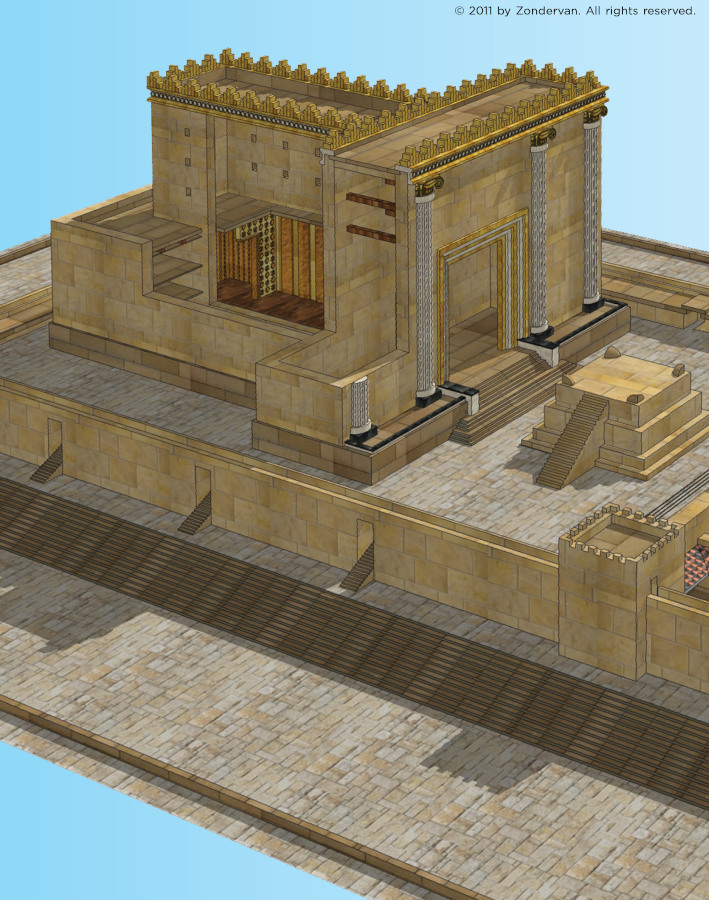
Dimensions of rooms, steps, doorways, cornices and exterior measurements are mentioned in ancient sources (Josephus and the Mishnah) but are subject to interpretation.
© 2011 by Zondervan. All rights reserved.
Go to the Models Index.
Events surrounding Jesus’ baptism reveal the intense religious excitement and social ferment of the early days of John the Baptist’s ministry. Herod had been cruel and power-hungry; Roman military occupation was harsh. Some agitation centered around the change of governors from Gratus to Pilate in ad 26. Most of the people hoped for a religious solution to their intolerable political situation, and when they heard of a new prophet, they flocked out into the desert to hear him. The religious sect (Essenes) from Qumran professed similar doctrines of repentance and baptism. Jesus was baptized at Bethany on the other side of the Jordan (see Jn 1:28; see also photo). John also baptized at “Aenon near Salim” (Jn 3:23).
For Jesus’ temptation, see notes on Mt 4:1–11; Lk 4:1–13; see also article.
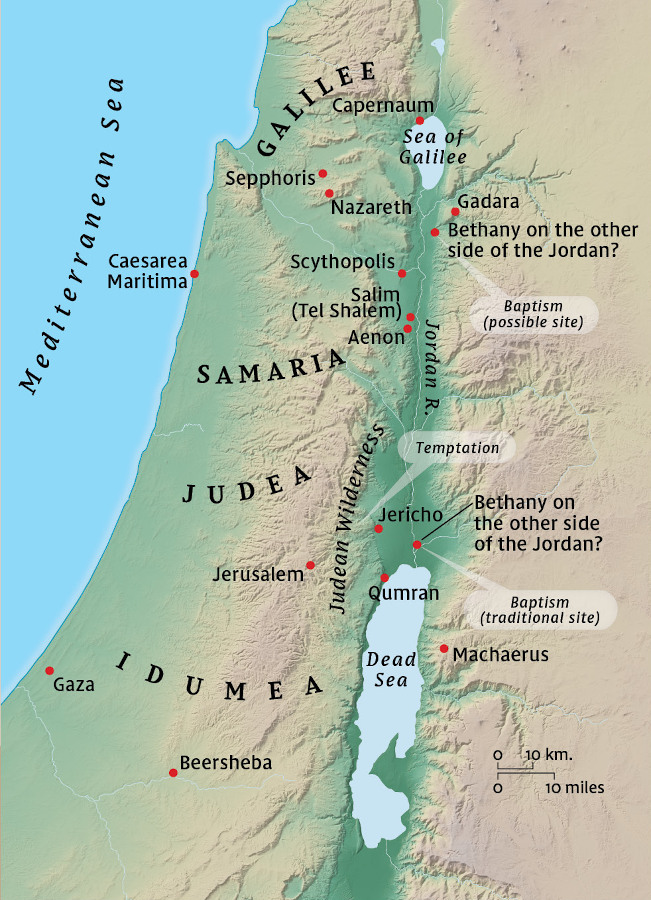
Many interpreters place John’s baptismal ministry at a point on the middle stretch of the Jordan River, where trade routes converge at a natural ford not far from the modern site of Tel Shalem.
Go to the Maps Index.
4:5 See note on Lk 4:2. highest point of the temple. See note on Lk 4:9. temple. The temple, including the entire temple area, had been rebuilt by Herod the Great (see notes on 2:1; Jn 2:20; see also model).
4:6 throw yourself down. See note on Lk 4:9. it is written. See note on Lk 4:10.
4:9 worship me. See note on Lk 4:7.
4:11 the devil left him. See note on Lk 4:13. angels came and attended him. While Jesus rebuffs the devil’s temptation to call for angelic protection (v. 6), in a powerful turn Jesus is cared for by angels after proving faithful in his testing.
4:12 See map. John had been put in prison. See Mk 1:14 and note on Lk 3:20. The reason for John’s imprisonment is given in 14:3–4.
4:13 Capernaum. Although not mentioned in the OT, it was a town of about 2000 people in Jesus’ day (see photo). Peter’s house there became Jesus’ base of operations during his extended ministry in Galilee (Mk 2:1; 9:33). The ruins of a fifth-century basilica now stand over the possible site of Peter’s house, and a fourth-century synagogue is located a short distance from it (see model).
4:15–16 Another Messianic prophecy from Isaiah (9:1–2). Jesus spent most of his public ministry in Galilee, “in the area of Zebulun and Naphtali” (v. 13), which is north and west of the Sea of Galilee (see photos here and here).
4:15 Galilee of the Gentiles. A region that, from the Jewish perspective in Jesus’ day, was “in darkness” and “the land of the shadow of death” (v. 16), probably because it was far removed from the religious influences of Jerusalem and because significant numbers of Gentiles lived there. Matthew may have chosen this text (Isa 9:1–2) because of his interest in the universal appeal of the gospel (see 2:1–12; 13:38; 28:19; see also Introduction: Recipients).
4:17 From that time on Jesus began to. These words indicate an important turning point in Matthew’s narrative and occur twice (see also 16:21). These words seem to mark three main sections of the book (see Introduction: Structure). Repent. See note on Mk 1:4. Jesus began his public ministry with the same message as that of John the Baptist (see 3:2 and note). The people must repent because God’s reign was drawing near in the person and ministry of Jesus Christ. kingdom of heaven. See note on 3:2. has come near. See note on Mk 1:15.
4:18 Sea of Galilee. See notes on 3:2; Mk 1:16. net. A circular casting net used either from a boat or while standing in shallow water.
4:19 send you out to fish for people. Evangelism (“proclaiming the good news of the kingdom,” 4:23) was at the heart of Jesus’ call to his disciples.
4:21 boat. In 1986 the remains of a 2,000-year-old typical fisherman’s boat were found off the northwest shore of the Sea of Galilee. Popularly known as the Jesus Boat, it is now on display in a museum near Magdala (see map). The boat is about 27 feet (8.2m) long, 7.5 feet (2.3m) wide and 4.3 feet (1.3m) high. preparing their nets. Washing, mending and hanging the nets up to dry in preparation for the next day’s work.
4:23 teaching . . . proclaiming . . . healing. Jesus’ threefold ministry. The synagogues (see note on Mk 1:21) provided a place for him to teach on the Sabbath. During the week he preached to larger crowds in the open air. good news. See note on Mk 1:1.
4:24 Syria. The area north of Galilee and between Damascus and the Mediterranean Sea. those having seizures. The Greek word for this expression originally meant “moonstruck” and reflects the ancient superstition that seizures were caused by changes of the moon.
4:25 Large crowds. Jesus’ influence spread quickly over a large geographic area. the Decapolis. A league of free cities (see NIV text note and map) characterized by high Greek culture. All but one, Scythopolis (Beth Shan), were east of the Sea of Galilee and the Jordan River. The league stretched from a point northeast of the Sea of Galilee southward to Philadelphia (modern Amman). followed him. Not all who followed were true disciples; many were curious onlookers, as subsequent events revealed only too clearly.
5:1 mountainside. Perhaps the gently sloping hillside at the northwest corner of the Sea of Galilee, not far from Capernaum (see note on Lk 6:20–49; see also photo). Jesus’ teachings on the kingdom, like the giving of the law (Ex 19:3), were given from a mountain. sat down. It was the custom for Jewish rabbis to be seated while teaching (see Mk 4:1 and note; 9:35; Lk 4:20 and note; 5:3; Jn 8:2). disciples. Learners or followers (of a rabbi). Since at the end of the Sermon the “crowds” expressed amazement at Jesus’ teaching (7:28), “disciples” may here be used in a broader sense than the Twelve. More likely, the Sermon is addressed to the Twelve with the crowds also listening. See article.
The beatitudes are blessings Jesus pronounced on people as the kingdom of God was arriving in his ministry. Kingdom beatitudes occur in Mt 5:3–12 and Lk 6:20–22, though Jesus speaks general blessings on other occasions (e.g., Mt 11:6; Lk 11:28; Jn 20:29). The beatitudes include a sense of reversal of expectation and of circumstance. In all four blessings in Luke and the first four in Matthew, the most unlikely of people are pronounced blessed; e.g., the poor, the hungry, the meek. Yet because they have lived to see the day of God’s benevolent rule being established in this world, Jesus pronounces them blessed. As God comes to reign, he will right all wrongs, and everyone who lives to see and welcome his rule—even and especially the downtrodden—will be blessed.
The second four beatitudes in Mt 5 focus on those who join in God’s great restoration and reversal work of mercy and justice. So Jesus pronounces blessings on those who enact mercy, integrity, peace, and righteousness or justice (Mt 5:7–10). In Matthew, the audience of the Beatitudes centers on Jesus’ disciples (5:1–2,11), though it may not be exclusively so given the use of third person (“they will be . . .”). In Luke, it is clear that the audience is Jesus’ disciples (6:20a,22).
The content of the blessings themselves focuses on the kingdom. The first and eighth beatitudes in Matthew envelop the others with the promise of the kingdom itself (Mt 5:3b,10b), indicating that the kingdom is the focus of all the beatitudes. The first beatitude in Luke also promises the kingdom (Lk 6:20b). The rest of the pronouncements or promises have to do with reversals of expectation: Those who are hungry will be satisfied, those who mourn will be comforted (and laugh), and those who are meek will inherit the whole earth. As God’s reign is established in this world, its effects will be life-changing for those who most need mercy and justice and for all those who share in Jesus’ ministry of the same.
Go to the Articles Index.
5:3 Blessed. The word means more than “happy,” because happiness is an emotion often dependent on outward circumstances. “Blessed” here refers to the ultimate well-being and distinctive joy of those who share in the salvation of the kingdom of God and the reversals of circumstance that it brings, though not necessarily fully realized in this life (see article). See notes on Ps 1:1; Rev 1:3. poor in spirit. In contrast to the proud and self-sufficient. theirs is the kingdom of heaven. The kingdom is not something earned. It is more a gift than a reward.
The Sermon on the Mount is in effect King Jesus’ inaugural address, explaining the countercultural values of God’s kingdom and what Jesus expects of its members. It is the first of five great discourses in Matthew (chs. 5–7; 10; 13; 18; 24–25; see Introduction: Structure). It contains three types of material: (1) beatitudes, i.e., declarations of blessedness (5:1–12); (2) ethical admonitions (5:13–20; 6:1—7:23); and (3) contrasts between Jesus’ ethical teaching and Jewish interpretive traditions (5:21–48). The Sermon ends with a short parable stressing the importance of practicing what has just been taught (7:24–27) and an expression of amazement by the crowds at the authority with which Jesus spoke (7:28–29).
Opinion differs as to whether the Sermon is a summary of what Jesus taught on one occasion or a compilation of teachings presented on numerous occasions. Matthew possibly took a single sermon and expanded it with other relevant teachings of Jesus. While much of Matthew’s Sermon appears in the parallel sermon in Lk 6:17–49, 34 of the verses occur in other contexts in Luke.
The moral and ethical standard called for in the Sermon on the Mount is so high that some have dismissed the Sermon as being completely unrealistic or have projected its fulfillment to the future kingdom. There is no doubt, however, that Jesus (and Matthew) gave the Sermon as a standard for all Christians, realizing that its demands cannot be met in our own power but by Jesus’ power through a Spirit-filled community (1:23; 18:20: 28:19–20). It is also true that Jesus occasionally used hyperbole to make his point (see, e.g., note on 5:29–30).
Go to the Articles Index.
5:4 those who mourn. The arrival of the kingdom will reverse current circumstances so that mourning will turn into rejoicing (Isa 61:2–3).
5:5 meek. This beatitude is taken from Ps 37:11 (see note there) and refers in Matthew to an internal disposition of humility before God, an external reality of low status, or both. the earth. The new promised land (see Rev 21:1; cf. note on Ps 37:9).
5:6 hunger and thirst for righteousness. Have a deep longing for both personal righteousness and justice for the oppressed.
5:8 heart. The center of one’s being, including mind, will and emotions (see note on Ps 4:7).
5:9 peacemakers. Those who promote peace, as far as it depends on them (Ro 12:18). In so doing, they reflect the character of their heavenly Father and so are called “children of God” (Jas 3:17–18).
5:10 Blessed . . . persecuted. Because persecution provides an opportunity for believers to show they belong to the kingdom (see Heb 12:4–11 and notes). persecuted. Living with a commitment to righteousness and justice is often offensive to others (cf. v. 11). theirs is the kingdom of heaven. For the blessings of God’s kingdom, see 3:2 and note.
5:13 salt. Used for flavoring and preserving (cf. Mk 9:50 and note). loses its saltiness. Most of the salt used in Israel came from the Dead Sea and was full of impurities. This caused it to lose some of its flavor.
5:14 light of the world. Although Jesus himself fulfilled the mission of the Lord’s servant to be “a light for the Gentiles” (Isa 42:6; see also Lk 2:32 and notes on Isa 49:6; Lk 2:31), he expected his followers to carry on the work (see vv. 15–16; cf. Jn 8:12; Php 2:15 and notes).
5:15 lamp. In Jesus’ day people used small clay lamps that burned olive oil drawn up by a wick (see note on Ex 25:37; see also photo).
5:16 glorify your Father. Good deeds are not to be done in a public way for one’s own honor (“in front of others, to be seen by them,” 6:1) but for the glory of God (see 1Co 10:31; Php 1:11; 1Pe 2:12 and notes). Father in heaven. A favorite expression used in Matthew, who uses the phrase “Father in heaven” or “heavenly Father” 18 times, Mark and Luke only once each, and John not at all.
5:17 the Law. The first five books of the OT. the Prophets. Not only the Latter Prophets—Isaiah, Jeremiah and Ezekiel, which are called Major Prophets, and the 12 Minor Prophets (lumped together by the Jews as “the Book of the Twelve”)—but also the Former Prophets (Joshua, Judges, Samuel and Kings). Taken together, “the Law” and “the Prophets” designated the entire OT, including the Writings, the third section of the Hebrew Bible. See 13:35, where Matthew introduces a quotation from the Writings (Ps 78:2) with “what was spoken through the prophet.” fulfill. Jesus fulfilled the Law in the sense that he gave it its full meaning. He emphasized the importance of living obediently to it, with attitudes matching actions (5:21–48).
5:18–20 Jesus affirms the importance of keeping the requirements of the law, holding his followers to a righteousness that is greater than that of the Pharisees and teachers of the law (v. 20). According to Matthew, the Pharisees fall short of the authentic obedience that should characterize his own disciples by (1) misprioritizing commands and so neglecting “the more important matters of the law—justice, mercy and faithfulness” (23:23); (2) following the “tradition of the elders” while disobeying OT commands (15:2–3); and (3) not practicing the very things they preach (23:3). In the rest of the chapter, Jesus gives six examples of the higher righteousness he expects of his own followers (vv. 21–48).
5:18 smallest letter. The Greek text has iota, the smallest letter of the Greek alphabet. It is the nearest equivalent to and cognate of Hebrew yodh, the smallest letter of the Hebrew alphabet (Ps 119:73 title). least stroke of a pen. The Greek word for this phrase means “horn” and was used to designate the slight extension of certain letters of the Hebrew alphabet (somewhat like the bottom of a j).
5:20 Pharisees. See note on 3:7. teachers of the law. See note on 2:4. kingdom of heaven. See note on 3:2.
5:21–22 it was said . . . But I tell you. See vv. 27–28, 31–32, 33–34, 38–39, 43–44. Jesus calls for moving beyond merely external obedience to the letter of the Law to keeping the true spirit of the Law, so that attitude and action are united. murder. Several Hebrew and Greek verbs mean “kill.” The ones used here and in Ex 20:13 mean specifically “murder.”
5:22 Raca. May be related to the Aramaic word for “empty” and mean “Empty-head!” court. Possibly the Sanhedrin (see note on Mk 14:55). hell. The Greek word is ge(h)enna, which derives its name from a deep ravine south of Jerusalem, the “Valley of (the Sons of) Hinnom” (Hebrew ge’ hinnom). During the reigns of the wicked Ahaz and Manasseh, human sacrifices to the Ammonite god Molek were offered there. Josiah desecrated the valley because of the pagan worship there (2Ki 23:10; see Jer 7:31–32; 19:6). It was perhaps because of this desecration that the term came to be used for the place of final punishment (see notes on Isa 66:24; Jer 7:31).
5:23–26 Two illustrations of dealing with anger (v. 22) by means of reconciliation, focused on the person who has wronged someone else taking the initiative to reconcile.
5:25 Cf. Lk 12:57–59.
5:26 penny. The smallest Roman copper coin (see note on Lk 12:59).
5:28 looks at a woman lustfully. Not a passing glance but a willful, calculated stare that arouses sexual desire. According to Jesus this is a form of adultery even if it is only “in his heart” (see Job 31:1; 2Pe 2:14 and notes).
5:29–30 Jesus is not teaching self-mutilation, for even a blind person can lust. What he is saying is that his followers should deal as drastically as necessary with sin, a point repeated in 18:8–9 cf. Mk 9:43–48.
5:32 except for sexual immorality. See note on 19:3. Neither Mk 10:11–12 nor Lk 16:18 mentions this exception, but both probably presuppose it.
5:33–37 The OT recognized the useful role of swearing oaths in certain situations (even God swore oaths: see, e.g., Ge 22:16; Jos 5:6; Ps 89:3–4, 35; Isa 45:22; Jer 22:5; Eze 26:7; see also notes on Ge 9:13; 15:17; Dt 6:13; Jer 22:5; Heb 6:13)—common profanity is not in view. Another Jewish first-century source indicates that excessive and elaborate oath-taking was a problem for some (Philo, Decalogue, 92). Jesus urged such honesty and integrity in all human speech that swearing oaths in support of assertions or commitments would not be necessary.
5:39 resist. Here it might mean in a court of law. slaps. More an insult (cf. 26:67) than an act of violence. The point is that it is better to be insulted even twice than to retaliate or take the matter to court.
5:40 shirt . . . coat. The first was an undergarment, the second a loose outer one. Since the outer garment was used to keep a person warm at night, OT law prohibited anyone from taking it even as collateral overnight (Ex 22:26–27; Dt 24:12–13).
5:41 one mile . . . two miles. A reference to a Roman soldier’s prerogative to force a member of a subjugated people to carry his supplies.
5:42 Probably not a general requirement to give to everyone who asks but a reference to the poor (cf. Dt 15:7–11; Ps 112:5,9).
5:43 hate your enemy. Words not found anywhere in the OT. However, hatred for one’s enemies was an accepted part of the Jewish ethic at that time in some circles (cf., e.g., the Dead Sea Scrolls work The Rule of the Community, 1.4,10). See note on Lev 19:18.
5:44 love your enemies. Though this explicit command is not specifically given in the OT, it is exemplified in commands such as that found in Ex 23:4–5 (see note there; cf. 2Ch 28:15). pray. Prayer is one of the practical ways love expresses itself (cf. Job 42:10; Ps 35:13–14 and notes).
5:45 be children of your Father in heaven. That is, be truly like him by loving “your enemies” and praying for “those who persecute you” (v. 44; see v. 48 and note). the evil and the good. God shows his love to people without distinction.
5:46 tax collectors. Local men employed by Roman tax contractors to collect taxes for them. Because they worked for Rome and often demanded unreasonable payments, the tax collectors gained a bad reputation and were generally hated and considered traitors (see notes on Mk 2:14–15; Lk 3:12).
5:48 Be perfect. Or “complete” and “whole” (cf. 19:20–21). Jesus sets up the high ideal of perfect or complete love—including both attitude and action (see vv. 43–47). This is God’s high standard for his people, empowered by the presence of Jesus in their midst (1:23; 18:20; 28:20).
6:1 practice . . . righteousness. This verse introduces the discussion of three acts of righteousness: (1) giving to the poor (vv. 2–4), (2) praying (vv. 5–15) and (3) fasting (vv. 16–18). These are three pillars of Jewish piety. Jesus’ concern here is with the motives that fuel these important acts. reward from your Father. The kingdom itself is the reward in view here (see article).
6:2 when you give. Not “if you give.” Jesus presupposes the disciples’ giving to the poor. announce it with trumpets. Perhaps a reference to the noise made by coins as they were thrown into the trumpet-shaped treasury receptacles (see note on Mk 12:41). Or the phrase may be used figuratively to mean “make a big show of it.” hypocrites. The Greek word refers to a play-actor. Here it is used metaphorically to point to those who fake being pious. their reward in full. The honor they receive from people is all the reward they get.
6:3 do not let your left hand know what your right hand is doing. Not to be taken literally, since this would be impossible, but as a way of emphasizing that one should not call attention to one’s giving. Self-glorification is always a present danger.
6:6 Jesus’ followers are not to make a show of their praying, in contrast to “the hypocrites” (v. 5). This does not mean that all prayer should be private, as the plurals “our” and “us” in vv. 9–13 indicate. room. The Greek word here probably means “storeroom,” because unlike most of the rooms in the house, it had a door that could be shut.
6:7 babbling like pagans. They used long lists of the names of their gods in their prayers, hoping that by constantly repeating them they would call on the name of the god that could help them. Jesus is not necessarily condemning all long prayers. He is teaching against using meaningless verbiage and repetition in prayer that implies that God is slow to hear.
6:9–13 Commonly known as “The Lord’s Prayer.” The prayer nestles at the literary center of the Sermon on the Mount, and the surrounding texts in the Sermon echo the prayer’s concerns. It contains six petitions, three relating more directly to God (vv. 9–10) and three to Jesus’ disciples (vv. 11–13). The order of these petitions is significant and intentional. A similar prayer in Lk 11:2–4 occurs in a different setting.
6:9 hallowed. God is already holy (see Lev 11:44 and note; 1Pe 1:15), so the prayer is not that God be made holy but that he be regarded as holy. By his saving and judging acts in history he proves himself holy (see Lev 10:3; Eze 36:23 and notes). This petition is that he so achieve his saving purposes in the world that his holiness is displayed before the eyes of the world’s people and acknowledged by them—which will happen only as his kingdom fully arrives. name. See notes on Ps 5:11; Eze 20:9.
6:10 your kingdom come. Not in the sense of to “come” into existence—it has already arrived in Jesus’ life and ministry (see 3:2; Lk 17:21 and notes)—but to “come” more and more completely until its full and final consummation. your will be done. Logically follows “your kingdom come.” The NIV line division and punctuation suggest that “on earth as it is in heaven” be read with each of the three preceding petitions.
6:11 That is, meet our needs “each day” (Lk 11:3; see Ex 16:4 and note), although the meaning of the Greek word translated “daily” is uncertain.
6:12 debts. Moral debts, i.e., sins (see note on Lk 11:4).
6:13 lead us not into temptation. That is, do not lead us through trials so deep that they would tempt us to be unfaithful to you. God does not tempt (in the sense of enticing to sin; see Jas 1:13 and note; see also 1Co 10:13 and note). the evil one. Satan (see 13:19 and note), or it could be a reference to “evil” more generally; i.e., evil circumstances (see the first part of the second NIV text note). For the second part of the NIV text note, cf. 1Ch 29:10–11.
6:15 forgive . . . forgive. See Eph 4:32 and note.
6:16 fast. See notes on Mk 2:18; Lk 18:12. Jesus assumes his disciples will fast (using “When” vs. “If;” see note on v. 2); what he condemns is ostentation in fasting. hypocrites. See note on v. 2. their reward in full. See note on v. 2.
6:17 put oil on your head and wash your face. That is, maintain your regular appearance. Jews routinely put ashes on their heads when fasting (Isa 58:5).
6:19–21 The dangers of riches are often mentioned in the NT (e.g., v. 24; 13:22; 19:22; Mk 10:17–30; Lk 12:16–21; 1Ti 6:9–10, 17–19; Heb 13:5; Jas 5:2–3), but nowhere are riches condemned in and of themselves. What Jesus condemns here is greed and the hoarding of material possessions (cf. v. 24).
6:19 moths and vermin. Representative of all agents and processes that destroy worldly possessions. break in and steal. Houses in the Holy Land had walls made of mud bricks and could be broken into easily.
6:20 treasures in heaven. Anything done in this life that has eternal value will be rewarded. Cf. “rich toward God” (Lk 12:21).
6:21 See Lk 12:34. heart. See note on 5:8.
6:22 The eye is the lamp of the body. It lets in light to illumine the body. If your eyes are healthy. If you recognize the folly of storing up wealth (v. 19)—or are generous with your money (see NIV text note). whole body. Entire person.
6:23 your eyes are unhealthy. If you are blind to the deceitfulness of wealth—or are stingy with your money (see NIV text note).
6:25 do not worry. See Php 4:6 and note. worry. Undue anxiety, not a legitimate concern to provide for one’s daily needs (cf. Lk 10:41–42; 2Th 3:6–12).
6:27 add a single hour. See NIV text note. The phrase could also mean “add a single step (cubit) to life’s journey.”
6:30 thrown into the fire. Grass was commonly used to heat clay ovens at that time. you of little faith. Used by Jesus in Matthew to describe disciples (8:26; 14:31; 16:8; 17:20; cf. Lk 12:28).
6:33 The heart of the matter. kingdom. See note on 3:2. his righteousness. The righteous life that God requires, as the content of the Sermon emphasizes (see, e.g., 5:6,10,20; 6:1). Alternatively, it could refer to God’s fulfillment of his promises to bring restoration (and as parallel to “his kingdom”).
6:34 Each day has enough trouble of its own. So live one day at a time.
7:1 The Christian is not to judge hypocritically or self-righteously, as can be seen from the context (v. 5). The same thought is expressed in 13:24–30, where judging people’s eternal destinies is disallowed (cf. Ro 2:1). To obey Christ’s commands in this chapter, we must first evaluate our own lives (7:3–5). Then we can soberly discern a person’s character—whether one is a “dog” (v. 6) or a false prophet (v. 15), or whether one’s life shows fruit (v. 16). Scripture repeatedly exhorts believers to evaluate carefully (Jn 7:24) and choose between good and bad people and things (sexually immoral, 1Co 5:9; those who masquerade as angels of light, 2Co 11:14; dogs, Php 3:2; false prophets, 1Jn 4:1). The Christian is to “test them all” (1Th 5:21). See article below.
It has been suggested that Mt 7:1 has replaced Jn 3:16 as the best-known Bible verse, even by unbelievers, but that few realize its context. The Greek verb behind “judge” here can mean to analyze, discern, render a verdict, condemn or treat overly harshly. Christians regularly have to analyze and discern, determining what is good and evil, right and wrong. Even when that verdict requires the condemnation of some behavior, it should not be rendered too severely.
Jesus’ words here do not mean that we are never to sift the true from the false or the helpful from the destructive. Even as we are to recognize and deal with our own sins and shortcomings, so we must deal with others’, but with a gentle spirit (Mt 7:3–5). After all, it requires judgment as well to recognize who the dogs and pigs are of v. 6 and avoid casting one’s “pearls” (or what is holy) in front of them. But it is not our job to try to eradicate them in this age (Mt 13:24–30); that is God’s role on Judgment Day (Ro 12:19). Only he could ever do it completely fairly.
Go to the Articles Index.
7:3–5 Jesus rebukes hypocritical judging of others without discerning and addressing one’s own sins.
7:3 speck of sawdust . . . plank. An example of hyperbole in the teachings of Jesus (cf. 19:24). Its purpose is to drive home a point (see Lk 6:41 and note).
7:5 hypocrite. See note on 6:2.
7:6 Teaching about the kingdom (the “pearls”) should be given in accordance with the spiritual receptivity of the learners. dogs . . . pigs. Those who have shown themselves to be so hostile to the Christian message that approaching them with it proves counterproductive.
7:7–11 See note on Lk 11:5–13.
7:7 Ask . . . seek . . . knock. Greek present imperatives are used here, indicating continual or repeated asking, seeking and knocking. Persistent prayer is being emphasized (cf. Jas 4:2–3; cf. also Ge 32:26 and note).
7:11 good gifts. See Lk 11:13 and note.
7:12 The so-called Golden Rule is found in negative form in rabbinic Judaism and also in Hinduism, Buddhism and Confucianism. It occurred in various forms in Greek and Roman ethical teaching. Jesus stated it in positive form. in everything. Probably refers to the teaching of the entire Sermon up to this point. sums up. Cf. 22:36–40; Ro 13:8–10 and relevant notes. the Law and the Prophets. See note on 5:17.
7:13–27 These verses present a clear choice for Jesus’ followers by offering the example of two ways (vv. 13–14), two trees and two fruits (vv. 15–23), and two foundations (vv. 24–27).
7:13 narrow gate. The gate that leads into the kingdom of heaven is synonymous with “life” (v. 14). destruction. Separation from God in hell.
7:15 false prophets. People who have not been sent by God but who claim that they have (see 24:24; Jer 23:16 and note).
7:19 See Jn 15:6 and note; cf. Mt 3:10.
7:21 Lord. Here means more than merely “sir” or “master” since Jesus is the one who makes the final decision about a person’s eternal destiny. kingdom of heaven. See note on 3:2. does the will of my Father. The deciding factor as to who enters the kingdom (see 25:31–46; also Mk 3:35 and note).
7:22 that day. The day of judgment (cf. Mal 3:17–18). prophesy. In the Bible this verb primarily means to give a message from God, not necessarily to predict. demons. See note on Mk 1:23.
7:24–27 This parable ends the Sermon on the Mount and also the parallel sermon in Luke (6:47–49).
7:24 rock. Within the parable, refers to a firm foundation. The Bible often speaks metaphorically of God or Christ as a “rock” (see Ge 49:24; Ps 18:2; 1Co 10:4 and notes).
7:25 rain came down. Israel is known for its torrential rains that often cause disastrous floods.
7:28 were amazed. A common reaction by Jesus’ listeners to his teaching—both its presentation and its authority (see note on Mk 1:22).
7:29 authority. The teachers of the law quoted other rabbis to support their own teaching (see note on 2:4), but Jesus spoke with divine authority (see 28:18; cf. Jn 7:46).
8:1 mountainside. See 5:1 and note.
Matthew’s Fulfillment Quotations
Ten Fulfillment Statements | |
Jesus’ virgin birth fulfills Isaiah 7:14. | |
The escape to and return from Egypt fulfills Hosea 11:1. | |
The murder of the male infants of Bethlehem fulfills Jeremiah 31:15. | |
Jesus’ childhood in Nazareth fulfills an unknown prophecy.* | |
Jesus establishes his ministry in Galilee, fulfilling Isaiah 9:2. | |
Jesus heals disease, fulfilling Isaiah 53:4. | |
Jesus fulfills the role of the Servant of Isaiah 42:2. | |
Jesus speaks in parables, fulfilling Psalm 78:2; 2 Chronicles 29:30. | |
Jesus enters Jerusalem as the humble king of Zechariah 9:9. | |
Jesus is betrayed for 30 pieces of silver, fulfilling Zechariah 11:12–13. | |
Other Fulfillment Citations | |
Jesus’ Bethlehem birth fulfills Micah 5:2. | |
John the Baptist fulfills Isaiah 40:3. | |
Jesus fulfills the Law and the Prophets. | |
The division of families fulfills Micah 7:6. | |
Jesus performs Messianic signs, fulfilling Isaiah 35:5; 61:1, etc. | |
John the Baptist fulfills Malachi 3:1. | |
Parables conceal the truth from the hard-hearted (Isa 6:9). | |
Israel’s disobedience fulfills Isaiah 29:13. | |
Praise from the lips of children is predicted in Psalm 8:2. | |
The rejected stone becomes the cornerstone (Ps 118:22). | |
The shepherd is struck down and the sheep scattered (Zec 13:7). | |
*“He would be called a Nazarene” may be a reference to the “Branch” (neṣer) of Isaiah 11:1, or a general statement of the humble origins of the Messiah.
Adapted from Four Portraits, One Jesus by Mark L. Strauss. Copyright © 2007 by Mark L. Strauss, p. 218. Used by permission of Zondervan.
Go to the Charts Index.
8:2 leprosy. See NIV text note; see also note on Lev 13:2. Lord. See note on 7:21. make me clean. Leprosy made a person ceremonially unclean (Lev 13:3, 8,11,20) and socially an outcast (Lev 13:45–46).
8:3 touched the man. See note on Mk 1:41.
8:4 don’t tell anyone. Jesus did not wish to stir up the popular, but mistaken, expectations that a wonder-working Messiah would soon arise as king of the Jews to deliver them from the Roman yoke. For similar instructions, see 9:30; 12:16; 16:20 and note; 17:9. See also Introduction to Mark: Emphases (item 4). show yourself to the priest. See note on Lk 5:14. a testimony to them. See note on Mk 1:44. them. The priests and the people.
8:5–13 Although the incident in Jn 4:46–54 is similar, it probably is a separate episode in the life of Jesus.
8:5 Capernaum. See note on 4:13. centurion. A Roman military officer in charge of about 100 soldiers. In Luke’s account (Lk 7:1–5) Jewish elders and friends of the centurion came to Jesus on his behalf, but Matthew does not mention these intermediaries.
8:7 Shall I come and heal him? The Greek line can be rendered as either a statement or a question. The Greek grammar suggests a question with its unusual emphasis on “I.” If so, Jesus questions departing from his God-given ministry to the “lost sheep of Israel” (15:24; cf. 10:6), similar to his initial hesitance to heal the daughter of a Canaanite woman (15:21–28).
8:8 I do not deserve to have you come under my roof. In Greek the words “I do not deserve” are the same as those used by John the Baptist in 3:11 (“I am not worthy”). The entire statement reveals how highly the centurion regarded Jesus. He may also be aware that a Jew would be reluctant to enter a Gentile’s home (v. 6).
8:10 he was amazed. See note on Lk 7:9. In his incarnate state Jesus experienced human emotions. such great faith. See note on Lk 7:9.
8:11 The universality of the gospel is one of Matthew’s themes (see Introduction: Recipients). feast . . . in the kingdom of heaven. The eschatological Messianic banquet that symbolizes the blessings of an intimate relationship with God (see Isa 25:6; Lk 14:15; Rev 19:9 and notes).
8:12 subjects of the kingdom. Jews who thought their Judaism was an inherited passport for entrance into the kingdom (see 3:9–10 and note on 3:9). outside, into the darkness. Hell. weeping and gnashing of teeth. A phrase used only in Matthew’s Gospel (here; 13:42,50; 22:13; 24:51; 25:30)—though an almost identical phrase occurs in Lk 13:28—to describe the horrible suffering (the sorrow and anger of regret) experienced in hell.
8:14 Peter’s mother-in-law. See notes on Mk 1:30; Lk 4:38.
8:15 wait on him. On Jesus. Mk 1:31 and Lk 4:39 have “them.” Matthew focuses on serving Jesus specifically, possibly to emphasize service as a discipleship trait (as in 25:44; 27:55; cf. 20:28).
8:16 evening. See Lk 4:40 and note. demon-possessed. See notes on Mk 1:23; Lk 4:33.
8:17 In applying Isa 53:4 to Jesus, Matthew shows Jesus to be the servant of the Lord (see note on 12:18). bore. Bore the burden of. The diseases were not transferred to Jesus in the sense of making him ill.
8:18 the other side. The east side.
8:19 teacher of the law. See note on 2:4.
8:20 Son of Man. See note on Mk 8:31.
8:21 bury my father. See note on Lk 9:59.
8:22 let the dead bury their own dead. Let the spiritually dead bury the physically dead. The time of Jesus’ ministry was short and demanded full attention and commitment. This statement stresses the radical demands of Jesus’ discipleship, since Jews placed great importance on the duty of children to bury their parents.
8:23–27 This passage emphasizes Jesus’ power over creation, and more specifically over the sea, a symbol of chaos (see note on Mk 4:35–41).
8:24 furious storm. See note on Mk 4:37. But Jesus was sleeping. See note on Mk 4:38.
8:26 little faith. See 6:30 and note.
8:27 What kind of man is this? See note on Mk 4:41.
8:28 region of the Gadarenes. The region around the city of Gadara, six miles southeast of the Sea of Galilee (but see NIV text note). Mark and Luke identify the region by the capital city Gerasa, located about 35 miles southeast of the Sea (see note on Lk 8:26). two. Mk 5:2 and Lk 8:27 (see note there) mention only one demon-possessed man. demon-possessed. See notes on Mk 1:23; Lk 4:33.
8:29 Son of God. The same title applied to Jesus by the devil at 4:3–6. appointed time. The time of their judgment (see notes on Mk 5:10; Lk 8:31).
8:30 herd of pigs. Many Gentiles lived in Galilee. Normally Jews did not raise pigs, since they were considered the most ceremonially unclean of all animals (cf. Lev 11:7).
8:32 Though Jesus seemingly consented to the demons’ request, the pigs carried the demons into the depths of the sea—perhaps symbolic of divine judgment. Luke’s account refers to the “Abyss” (see Lk 8:31 and note; see also Rev 9:1 and note).
8:34 pleaded with him to leave. They were probably more concerned about their financial loss than about the deliverance of the miserable demon-possessed men (see note on Mk 5:17).
9:1 crossed over. The northern end of the Sea of Galilee. his own town. Capernaum (see note on 4:13).
9:2 their faith. The faith of the men who carried him as well as the faith of the paralyzed man. your sins are forgiven. Since sin and illness were often connected in the ancient world, Jesus might be addressing (though not affirming; see Jn 9:1–3) what many in his audience assumed was the core issue (sin) for the man’s illness.
9:3 blaspheming. Here the term includes usurping God’s prerogative to forgive sins (see notes on Mk 2:7; Lk 5:21).
9:5–6 See notes on Mk 2:9–10; 14:64.
9:6 Son of Man. See note on Mk 8:31.
9:8 praised God, who had given such authority to man. By emphasizing Jesus’ humanity in this final verse of the passage (already having emphasized Jesus’ divine prerogative to forgive in 9:2), Matthew shows that Jesus represents restored humanity.
9:9 Matthew. Mark and Luke call this disciple Levi in the parallel accounts (but see also Mk 3:18; Lk 6:15; Ac 1:13). Jews often had more than one name to distinguish them, especially if one of the names was very common, as Levi was. tax collector’s booth. See note on Mk 2:14. got up and followed him. See note on Lk 5:28; see also photo and caption.
9:10 tax collectors. See notes on 5:46; Mk 2:16. sinners. See note on Mk 2:15.
9:11 Pharisees. See note on Mk 2:16.
9:12 not the healthy who need a doctor, but the sick. A common proverb (see note on Lk 5:31).
9:13 I desire mercy, not sacrifice. Jesus cites Hos 6:6 here and at 12:7 to elevate mercy as a central value of the kingdom (see note on 12:7; see also 23:23 and note). I have not come to call the righteous, but sinners. See note on Mk 2:17.
9:14–15 See notes on Mk 2:18–20; Lk 5:33.
9:17 new wineskins. In ancient times goatskins were used to hold wine (see Jos 9:4 and note). As the fresh grape juice fermented, the wine would expand, and the new wineskin would stretch. But a used skin, already stretched, would break (see note on Job 32:19; see also photo). Jesus brings a newness that cannot be confined within the old forms.
9:18 synagogue leader. His name was Jairus (see notes on Mk 5:22; Lk 8:41). has just died. Mk 5:23 has “is dying,” but Matthew omits reference to the later messengers (Mk 5:35) and condenses (see notes on 21:12–17; 21:18–22) by presenting at the outset what was actually true before Jesus reached the house.
9:20 subject to bleeding for twelve years. Possibly a menstrual disorder or a hemorrhage that never completely healed (see notes on Mk 5:25; Lk 8:43).
9:21 See notes on Mk 5:28; Lk 8:45.
9:22 daughter. See note on Lk 8:48. healed. See note on Mk 5:34.
9:23 noisy crowd. May have included mourners hired to wail and lament (see Jer 9:20; Mk 5:38 and notes). people playing pipes. Musicians hired to play in mourning ceremonies.
9:24 not dead but asleep. See note on Lk 8:52.
9:25 took the girl by the hand. Touching a dead body ordinarily resulted in ceremonial uncleanness (see Lev 11:31; 21:1,11 and note on 21:1; 22:4; Nu 19:14 and note), but Jesus’ action brought life, not ritual defilement.
9:27 blind men. Isaiah predicted the healing of the blind in the Messianic age (Isa 35:5; see also Mt 11:4–5). Son of David. A popular Jewish title for the coming Messiah and a favorite title for Jesus in Matthew (e.g., 12:23; 20:30; 21:9; 22:41–45; see note on 1:1).
9:29 According to your faith. That is, “Because you have faith,” not “In proportion to your faith.” Jesus did not provide healing according to the amount of faith the blind men had (see 17:20 and note). Cf. 8:13; Mk 9:23 and note; 11:23; Jn 11:40.
9:30 For Jesus’ warnings against spreading news about him, see notes on 8:4; 16:20.
9:32 could not talk. Isaiah also (see note on v. 27) predicted that people who were mute would be able to speak in the Messianic age (Isa 35:6).
9:33 amazed. See 8:27; 13:54; 15:31; 21:20; 22:22; cf. Mk 1:22 and note.
9:34 prince of demons. See note on 10:25.
9:35 synagogues. See note on Mk 1:21. good news. See note on Mk 1:1.
9:36 compassion. Jesus’ compassion for people is often noted in the Gospels (14:14; 15:22; 20:34; Mk 1:41; 6:34; 8:2). like sheep without a shepherd. An indictment of the Jewish leadership of Jesus’ day (see Eze 34:5; Zec 10:2; 13:7 and notes; see also Mk 6:34).
10:2–4 See notes on Lk 6:14–16.
10:2 apostles. The twelve disciples Jesus chose to be his closest followers (see note on Mk 6:30).
10:3 Thaddaeus. Also called Judas (not Iscariot [Jn 14:22]); see Mk 3:18; Lk 6:16; Ac 1:13 and note.
10:4 the Zealot. Either a description of Simon’s religious zeal or a reference to his political involvement in revolutionary activity against Roman rule (referred to by Josephus as the party of the Zealots; see chart).
10:5 Do not go. The good news about the kingdom was to be proclaimed first to the Jewish people only, though Jesus himself in Matthew makes exceptions when he sees Gentiles of exceptional faith (8:10; 15:28). After his death and resurrection, Jesus commanded the message to be taken to all nations (28:19; cf. 21:43). Samaritans. The Jews considered them a mixed race resulting from the intermarriage of Israelites left behind when the people of the northern kingdom were exiled and Gentiles who were brought into the land by the Assyrians (2Ki 17:24). Bitter hostility existed between Jews and Samaritans in Jesus’ day (see Jn 4:9 and note).
10:7 kingdom of heaven. See note on 3:2.
10:8 leprosy. See NIV text note and note on Lev 13:2.
10:9–10 See notes on Mk 6:8–9.
10:10 worker is worth his keep. Cf. 1Co 9:4–14; 1Ti 5:17–18 and note on 5:18.
10:11 stay at their house. See note on Lk 9:4.
10:12 your greeting. The Jewish greeting was shalom, “peace” (Lk 10:5; see article).
10:13 If the home is deserving. That is, “If the head of the house loves peace” (Lk 10:6). let your peace return to you. Either (1) retract your blessing or (2) leave the house.
10:14 shake the dust off your feet. A symbolic act practiced by Jews when they left a ceremonially unclean Gentile area. Here it represented an act of solemn warning to those who rejected God’s message (see notes on Lk 9:5; Ac 13:51; cf. Ac 18:6).
10:15 Truly I tell you. See note on Mk 3:28. Sodom and Gomorrah. See Ge 19:23–29; Lk 10:12 and note.
10:16 Cf. 7:15; cf. also Paul’s statement in Ro 16:19: “I want you to be wise about what is good, and innocent about what is evil.”
10:17 local councils. The lower courts, connected with local synagogues, that tried less serious cases and flogged those found guilty. synagogues. See notes on Mk 1:21; Lk 21:12.
10:18 Anticipates the mission to the Gentiles. Matthew’s Gospel emphasizes the universality of the gospel (see note on 8:11; see also Introduction: Recipients).
10:19 do not worry about what to say. Namely, to defend yourselves (Lk 21:14–15). you will be given what to say. “Words and wisdom” that cannot be resisted (Lk 21:15; see note there).
10:20 the Spirit of your Father. Refers to the Holy Spirit and occurs only here in the Bible (cf. “the Spirit of Jesus” in Ac 16:6–7). See Mk 13:11; Lk 12:11–12; cf. Lk 21:14–15.
10:21 The allusion is to Mic 7:6, which is quoted in vv. 35–36.
10:22 hated by everyone. Hyperbole. the one who stands firm to the end will be saved. See note on Mk 13:13.
10:23 Some take Jesus’ saying here as a reference to his second coming at the end of the age (24:30), understanding “going through the towns of Israel” to refer to the completion of the mission to the Jewish people. Others understand it to refer to his coming in judgment when Jerusalem and the temple were destroyed in ad 70. the Son of Man comes. The first of a number of Matthew’s allusions to Da 7:13–14, signaling the vindication of Jesus as God’s chosen one. Matthew alludes to Daniel to show that Jesus is vindicated at his resurrection (16:28; 26:64), at the fall of the temple as Jesus predicted (24:30), and at his second coming (24:36–37).
10:25 Beelzebul. The prince of demons (12:24); the Greek form of the Hebrew name Baal-Zebul (“Exalted Baal” or “Baal the Prince”). Baal-Zebub (“lord of flies”) is a parody on and mockery of the actual epithet, Baal-Zebul (see note on Jdg 10:6). The name came to be used of Satan.
10:26–33 See Lk 12:2–9 and notes.
10:26 them. The persecutors (vv. 21–25).
10:28 cannot kill the soul. See Lk 12:4 and note. soul. The true self (see note on Ps 6:3). Body and soul are closely related in this life but are separated at death and then reunited at the resurrection (cf. 2Co 5:1–10 and notes; Php 1:23–24). the One. God. He alone determines the final destiny of us all. destroy both soul and body in hell. See Lk 12:5 and note. hell. See note on 5:22.
10:29 two sparrows sold for a penny. Cf. Lk 12:6 and note.
10:31 worth more than many sparrows. See 6:26.
10:32–33 See Lk 12:8–9 and notes.
10:34–36 Allegiance to Jesus as Messiah and Lord will even divide families, which in the ancient world usually shared the same loyalties. Family loyalty is not greater than loyalty to Jesus. When Jesus promises to provide peace (Jn 14:27), he means peace with God and with fellow believers. Yet the inevitable result of Christ’s coming is conflict—between Christ and the antichrist, between light and darkness, between Christ’s followers and unbelievers. This conflict can occur even between members of the same family (vv. 35–36; Mk 10:29–30; cf. 2Co 6:14–17 and notes).
10:38 take up their cross. The first mention of the cross in Matthew’s Gospel. The cross was an instrument of death (execution by Rome) and here symbolizes the necessity of total commitment—even to the point of death—on the part of Jesus’ disciples (see note on Mk 8:34).
10:40–42 During times of persecution, hospitality was especially important and could be dangerous. So Jesus indicates that those who provide it and show kindness to God’s people will receive a reward.
10:41 a prophet’s reward . . . a righteous person’s reward. For Matthew, reward usually refers to receiving the kingdom itself (see 6:4,6,18 and article).
10:42 cup of cold water. See note on Mk 9:41. little ones. Those of lower status than more esteemed disciples, such as prophets and righteous persons (vv. 40–41). Care for “little ones” concludes this list for hospitality as a surprising note about Jesus’ care for those usually deemed least important (see 18:6–14 and note on 18:6,10,14).
11:1 This verse transitions from the second of Jesus’ discourses in Matthew by means of the formula, “After Jesus had finished [instructing his twelve disciples]” (see Introduction: Structure). Galilee. See note on 2:22.
11:2 John. The Baptist (see note on 3:1). in prison. See note on Lk 7:19. the deeds of the Messiah. An inclusio (a framing device) with wisdom’s “deeds” in v. 19 (see note there).
11:3 the one who is to come. The Messiah. expect someone else. While languishing in prison, John began to wonder about the nature of Jesus’ mission. John’s own ministry focused on coming judgment, so he might not have understood Jesus’ teaching and healing ministry to be the works of the Messiah (see note on Lk 7:19). This leads into Jesus’ declaration of what his Messianic deeds actually look like (Mt 11:4–5).
11:4 report to John what you hear and see. See note on Lk 7:22.
11:5 leprosy. See NIV text note; see also note on Lev 13:2. the good news is proclaimed to the poor. See note on Lk 7:22.
11:6 anyone who does not stumble. An encouragement to see the true Messiah in Jesus’ healings and his preaching to the poor. See note on Lk 7:23.
11:7–10 See Lk 7:24–28 and notes.
11:11 greater than he. John belonged to the age of the old covenant, which was preparatory to Christ and the arrival of God’s kingdom. The least NT believer has a higher privilege in Christ as a part of his bride the church (Eph 5:25–27,32) than John the Baptist, who was only a friend of the bridegroom (Jn 3:29). Another view, however, stresses the expression “whoever is least,” holding that the key to its meaning is found in 18:4—“whoever takes the lowly position of this child.” Such a person, though “least,” is regarded by God as even greater than John the Baptist.
11:12 From the days of John the Baptist. From the beginning of Jesus’ ministry. kingdom of heaven. See note on 3:2. subjected to violence. The persecution of the people of the kingdom, including John and Jesus. (But see NIV text note for the positive view of the kingdom’s forward movement.)
11:13 the Prophets and the Law. The entire OT prophesied the coming of the kingdom. John represented the end of the old covenant era.
11:14 he is the Elijah who was to come. A reference to Mal 4:5 (see note there), which prophesied the reappearance of Elijah before the day of the Lord. Some of the people remembered the prophecy and asked John the Baptist, “Are you Elijah?” He answered, “I am not” (Jn 1:21). John was not literally the reincarnation of Elijah, but he did fulfill the function and role of the prophet (see Mt 17:10–13 and note on Lk 1:17).
11:16 like children sitting in the marketplaces. See note on Lk 7:32.
11:17 played the pipe. As at a wedding. sang a dirge. As at a funeral. The latter symbolized the ministry of John, the former that of Jesus. The people of Jesus’ “generation” (v. 16) were like children who refused to respond positively on either occasion. Another interpretation understands this parable to refer to the people’s dissatisfaction with both John’s behavior and Jesus’ behavior (they didn’t “dance to their tune”).
11:19 Son of Man. See note on Mk 8:31. friend of tax collectors and sinners. See 9:9–13 and note on Lk 7:34. wisdom is proved right by her deeds. The lasting works of both Jesus and John will vindicate their ministries (see note on Lk 7:35). Given the repetition of “deeds” at the beginning and conclusion of this passage (vv. 2,19), Matthew seems to be identifying Jesus’ deeds with wisdom’s deeds, thereby showing Jesus to be the full expression of wisdom.
11:20 repent. See note on 3:2.
11:21 Chorazin. Mentioned in the Bible only twice (here and in Lk 10:13), it was near the Sea of Galilee, probably about two miles north of Capernaum. Bethsaida. On the northeast shore of the Sea of Galilee. Philip the tetrarch rebuilt Bethsaida and named it “Julias,” after Julia, daughter of Caesar Augustus. Tyre and Sidon. Cities on the Phoenician coast north of the Holy Land (see note on Mk 7:31). sackcloth. Here a sign of repentance (see note on Ge 37:34). Cf. Rev 6:12. ashes. Also a sign of repentance.
11:23 Capernaum. See note on Lk 10:15. Sodom. See notes on 10:15; Ge 13:10; Lk 10:12.
11:25 Lord of heaven and earth. A title for God emphasizing his sovereignty and found only three times in the Bible (here; Lk 10:21; Ac 17:24). these things. Either the significance of Jesus’ miracles (vv. 20–24) or of his entire mission. wise. According to the standards of this age (see 1Co 1:26–29; cf. 1Co 3:18 and note). little children. The disciples or, more generally, the humble followers of Jesus.
11:26 what you were pleased to do. Since God is “Lord of heaven and earth” (v. 25), he sovereignly reveals and conceals. The motifs of hiddenness and revelation begin in this passage and will be highlighted in the parables of the kingdom (ch. 13).
11:27 All things. The full revelation of God (v. 25). No one knows the Son. Total knowledge of the Son belongs only to the Father. Believers can “know” the Son for salvation (1Jn 5:20) and in a deep and satisfying way, but not completely (see Jn 10:14 and note; cf. Php 3:7–11 and notes). except . . . those to whom the Son chooses to reveal him. The revelation of the Father through the Son, seen here, is a central theme of John’s Gospel (see Jn 1:18 and note).
11:28–30 Jesus’ words echo the language used by wisdom in the OT and in other Jewish literature to invite discipleship and obedience that give life (cf. Pr 8; Sirach 24:19; 51:26–27; Wisdom 6).
11:28 weary and burdened. Probably a reference to the “heavy . . . loads” the Pharisees placed “on other people’s shoulders” by insisting on behavior that they themselves didn’t practice (23:4; see note on Lk 11:46).
11:29 yoke. Cf. v. 30 and note; see note on Eze 34:27. The yoke speaks of submission. find rest for your souls. See Jer 6:16 and note.
11:30 my burden is light. Cf. Ps 55:22; 1Jn 5:3 and notes.
12:1 grainfields. Of wheat or barley, the latter eaten by poorer people. pick some heads of grain. See note on Mk 2:23.
12:2 Pharisees. See note on 3:7. what is unlawful on the Sabbath. See note on Mk 2:24.
12:3 what David did. See note on Mk 2:25.
12:4 consecrated bread. Each Sabbath, 12 fresh loaves of bread were to be set on a table in the Holy Place (Ex 25:30; Lev 24:5–9). The old loaves were eaten by the priests.
12:5 desecrate the Sabbath. By doing required work associated with the sacrifices (see Nu 28:9; cf. Jn 7:22–23 and note on 7:22).
12:7 I desire mercy, not sacrifice. While both are found in the Jewish law, Jesus prioritizes mercy over sacrifice by citing Hos 6:6 (see 9:13; 23:23 and notes). you would not have condemned the innocent. A clear claim that Jesus’ interpretation of the OT law is the correct one, exonerating him and his disciples from the charge of breaking the law.
12:8 the Son of Man is Lord of the Sabbath. See note on Lk 6:5.
12:9 synagogue. See note on Mk 1:21.
12:10 heal on the Sabbath. The rabbis prohibited healing on the Sabbath, unless it was feared the victim would die before the next day. Obviously the man with the shriveled hand was in no danger of this.
12:11–12 Jesus contrasts the worth of an animal with that of a human being (cf. Lk 13:15–16; 14:5 and notes).
12:12 lawful to do good on the Sabbath. See Mk 3:4; Lk 6:9 and notes.
12:13 “Stretch out your hand.” So he stretched it out. The fact that the man stretched out his shriveled hand shows there is a connection in this instance between faith and Jesus’ healing power.
12:14 The Pharisees evidence more concern for adherence to their understanding of the law than for human compassion (see notes on Mk 3:6; Lk 6:11).
12:16 not to tell others about him. See note on 8:4.
12:18–21 Another fulfillment passage (see note on 1:22; see also chart). This one is from Isaiah’s first servant song (see Isa 42:1–4 and note) and is the longest OT quotation in Matthew’s Gospel. It summarizes the quiet and merciful ministry of the Lord’s servant, who will bring justice and hope to the nations.
12:18 my servant. Jesus is called God’s servant only here and in Ac 3:13,26 (see note on 3:13); 4:27,30. chosen. See Lk 9:35 and note. the one I love, in whom I delight. See note on 3:17. put my Spirit on him. See Isa 11:2; 61:1 and notes.
12:20 Jesus mends broken lives (see v. 15; Isa 42:3 and note; Jn 4:4–42; 8:3–11).
12:22 demon-possessed. See notes on Mk 1:23; Lk 4:33.
12:23 Son of David. See note on 9:27.
12:24 Beelzebul . . . prince of demons. See 10:25; Lk 11:19 and notes.
12:25 kingdom divided against itself. See note on Lk 11:17.
12:28 kingdom of God. See note on 3:2. has come upon you. See note on Mk 1:15.
12:30 There can be no double-mindedness in our relationship to Jesus (see note on Lk 11:23; cf. Ps 119:113; Mk 9:40; Lk 9:50 and note; Jas 1:8; 4:8).
12:31 blasphemy against the Spirit will not be forgiven. The context (vv. 24,28,32) suggests that the unpardonable sin was attributing to Satan Christ’s authenticating miracles done in the power of the Holy Spirit (see note on Mk 3:29) and never repenting of that attitude. In other words, the only unpardonable sin is a persistent refusal to acknowledge the presence of God in Christ.
12:32 Son of Man. See note on Mk 8:31. this age . . . the age to come. See Eph 1:21 and note.
12:33 See 3:16; cf. Jas 3:11–12.
12:34 brood of vipers. In the NT an expression used only by John the Baptist (3:7; Lk 3:7) and Jesus (here; 23:33). In this context it refers to the Pharisees (v. 24). the mouth speaks what the heart is full of. See 15:18–19; Pr 4:23 and note. heart. See note on Ps 4:7.
12:36 day of judgment. At Christ’s second coming; sometimes referred to as “that day” (7:22; 2Ti 1:12,18), “the day of slaughter” (Jas 5:5; see note there). empty word. Words are incredibly powerful, so words spoken without thought or care can be terribly destructive (Jas 3:1–12).
12:38 sign. The Pharisees wanted to see a spectacular miracle, preferably in the sky (Lk 11:16), as the sign that Jesus was the Messiah. Instead, he cites them a “sign” from history. See note on Lk 11:29.
12:39 adulterous. Referring to spiritual, not physical, adultery, in the sense that their generation had become unfaithful to its spiritual husband (God; see note on Ex 34:15). sign of the prophet Jonah. See note on Lk 11:30.
12:40 three days and three nights. Including at least part of the first day and part of the third day, a common Jewish reckoning of time. See note on Lk 24:46. This is the first hint Jesus gives of his coming death. Jesus points to Jonah’s three days and three nights in the “huge fish” as a sign of his death and resurrection “on the third day” (Mt 16:21). huge fish. The Greek word does not mean “whale” but rather “sea creature,” i.e., a “huge fish” (see note on Jnh 1:17). Son of Man. See note on Mk 8:31.
12:41–42 something greater than Jonah . . . something greater than Solomon. See note on Lk 11:31–32.
12:42 Queen of the South. In 1Ki 10:1 she is called the queen of Sheba, a country in southwest Arabia now called Yemen.
12:43–45 See notes on Lk 11:24–25.
12:46 mother and brothers. See note on Lk 8:19.
12:50 whoever does the will of my Father. Spiritual family ties are more important than biological ones (see notes on Mk 3:35; Lk 8:21).
13:1 went out of the house. See “went into the house” (v. 36). These two phrases determine the setting of Jesus’ teaching in vv. 1–35 and reflect the themes of outsiders and insiders in relation to receiving and understanding kingdom knowledge (see the “secrets of the kingdom” language in v. 11; see also Mk 4:11). the lake. The Sea of Galilee (see note on Mk 1:16).
13:2 sat in it. See note on Mk 4:1.
13:3–9 See vv. 18–23 for the interpretation of this first parable.
13:3 parables. The word “parable” comes from the Greek parabole, which means a comparison or an illustration. Its most common use in the NT is for the illustrative stories that Jesus drew from nature and human life. The Synoptic Gospels contain about 40 of these stories. John’s Gospel contains no parables but uses other figures of speech (see notes on Mk 4:2; Lk 8:4; see also chart and article). to sow his seed. See note on Lk 8:5. According to Mk 4:14; Lk 8:11 (see notes there), the seed is the word of God.
Common-sense wisdom suggests that Jesus used illustrative stories to make his message clearer. It is one thing to announce that God welcomes repentant sinners no matter how far from him they have run, but it is quite something else to hear the story of the lost son (Lk 15:11–32) and relate directly to the characters it depicts. Yet when the disciples asked Jesus why he spoke in parables, he did not say that they were given to reveal the nature of God’s kingdom but to conceal it (Mk 4:11–12; cf. Mt 13:13 and Lk 8:10). What could he possibly have meant?
Mark 12:12 concludes the parable of the wicked tenants with Jesus’ opponents plotting to kill him because they recognized he told the parable against them. They understood his cognitive meaning all too well; Jesus was claiming that they were the farmers who mistreated their landlord’s servants and who would execute his son (vv. 1–9). The kind of understanding these Jewish leaders lacked was volitional—the willingness to act properly based on their knowledge and follow Jesus as his disciples. The same is true in Mk 4. When Jesus said he taught in parables so that some people would not truly see or understand, it was after the parable of the sower (vv. 3–9), which contains four different kinds of responses to Jesus’ teaching. Some reject but others accept the word.
If Jesus’ parables both reveal and conceal, it is because they create a polarized response. They lure people into a seemingly innocuous story only for them to discover they are trapped in it; they have to admit that they are like one of the characters in the story. If they are not prepared to respond in discipleship, they do not remain in a neutral position but find themselves moving even further away from Jesus. One shouldn’t read vv. 11–12, however, as suggesting that this movement away from Jesus is irreversible. These verses quote Isa 6:9–10, a section of prophecy that concludes with hope for a righteous remnant in the land (v. 13). So, too, Ac 6:7 discloses many of the Jewish priests, who had been at the heart of the opposition to Jesus, becoming believers. Repenting is always possible in this life for those who genuinely want to do so.
Go to the Articles Index.
13:4 birds. Satan, “the evil one” (v. 19).
13:5 rocky places. Not ground covered with small stones, but shallow soil on top of solid rock. See note on Lk 8:6.
13:8 a hundred. See notes on Mk 4:8; Lk 8:8.
13:9 let them hear. See note on Lk 8:8.
13:11 secrets of the kingdom of heaven. Refers to something previously hidden but now revealed to God’s people. In this chapter, only the “disciples” hear the explanations of the parables (cf. v. 10). See notes on Mk 4:11; Lk 8:10. given to you . . . not to them. Accessed by the faith of Christ’s disciples and therefore inaccessible and inscrutable to those lacking faith.
13:13–14 Jesus speaks in parables because of the spiritual dullness of the people (see note on Lk 8:4).
13:13 Though seeing, they do not see. See notes on Mk 4:12; Lk 8:10.
13:14–15 See Isa 6:9–10 and notes.
13:18 what the parable of the sower means. Jesus seldom interpreted his parables to this extent, but here he does.
13:19 message. Cf. Luke’s “word of God” (8:11). evil one. Satan (the devil; see Mk 4:15; Lk 8:12 and note).
13:21 Cf. 24:10–12; see note on Lk 8:13.
13:22 the worries of this life and the deceitfulness of wealth. Lk 8:14 adds life’s “pleasures” to these two phrases. deceitfulness of wealth. See note on Mk 4:19.
13:23 understands. Cf. the Isaiah quotation in vv. 14–15. Matthew uses this word six times in this chapter (here and in vv. 13,14,15,19,51). hundred . . . times. See note on Lk 8:8.
13:24–30 See vv. 36–43 for the interpretation.
13:24 The kingdom of heaven is like. This phrase introduces six of the seven parables in this chapter (all but the parable of the sower). Jesus compares the kingdom to the entire story that he narrates, not just to the character mentioned first.
13:25 weeds. Probably darnel, which looks very much like wheat while it is young, but can later be distinguished. This parable does not refer to unbelievers in the professing church. The field is the world (v. 38). Thus in this world the people of the kingdom live side by side with the people of the evil one.
13:28–30 The parable of the weeds emphasizes that we are not to try to make a separation between believers and unbelievers in the present. That is entirely the Lord’s business (vv. 41–42; see 7:1 and note).
13:30 harvest. The final judgment (see notes on Joel 3:13; Mk 4:29; Rev 14:15).
13:31–32 Although the kingdom will seem to have an insignificant beginning, it will eventually spread throughout the world (see note on Mk 4:30–34).
13:32 the smallest . . . the largest. The mustard seed is not the smallest seed known today, but it was the smallest seed used by farmers and gardeners there and at that time, and under favorable conditions the plant could reach about ten feet in height. a tree . . . its branches. Likely an allusion to Eze 17:23 and perhaps Da 4:21, suggesting that the kingdom of heaven will expand to the entire world and that people from all nations will find rest in it (cf. Da 2:35, 44–45; 7:27; Rev 11:15).
13:33 In the Bible, yeast usually symbolizes that which is evil or unclean (see note on Mk 8:15). Here, however, it is a symbol of growth. As yeast permeates a batch of dough, so the kingdom of heaven, often having a hidden quality in the present, will expand throughout the whole world. See note on Lk 13:21.
13:35 spoken through the prophet. The quotation is from Ps 78 (see note on 78:2), a psalm ascribed to Asaph, who according to 2Ch 29:30 was a “seer” (prophet). I will utter things hidden. Emphasizing the theme of the kingdom’s previous hiddenness and subsequent revelation as in vv. 31–33,44.
13:37,41 Son of Man. See note on Mk 8:31.
13:42 blazing furnace. Often mentioned in connection with the final judgment in apocalyptic literature (Rev 19:20; 20:14). weeping and gnashing of teeth. Occurs six times in Matthew’s Gospel (here; v. 50; 8:12; 22:13; 24:51; 25:30) and nowhere else in the NT (but see note on 8:12).
13:43 the righteous will shine like the sun. See Da 12:3. let them hear. See note on Lk 8:8.
13:44–46 These two parables teach the same truth: The kingdom, though its true worth is hidden at present, is of such great value that one should be willing to give up all one has in order to gain it. Jesus did not imply that one can purchase the kingdom with money or good deeds.
13:44 treasure hidden in a field. In ancient times it was common to hide treasure in the ground since there were no banks—though there were “bankers” (25:27; see note there).
13:47–51 The parable of the net teaches the same general lesson as the parable of the weeds (see vv. 28–30 and note): There will be a final separation of the righteous and the wicked.
13:51 Yes. Probably an overstatement by the disciples, especially in view of Jesus’ words in 15:16.
13:53 Formula that concludes a teaching section and introduces a narrative section (cf. 7:28–29; Introduction: Structure).
13:54 his hometown. Nazareth (see note on 2:23). teaching the people in their synagogue. See note on Mk 1:21. synagogue. See note on Mk 1:21. amazed. See note on 7:28.
13:55–56 The fact that all of Jesus’ family members are mentioned here except the father may indicate that Joseph was no longer alive at the time of this incident.
13:55 carpenter’s son. See note on Mk 6:3. brothers. Sons born to Joseph and Mary after the virgin birth of Jesus (see note on Lk 8:19). James. See Introduction to James: Author. Judas. See Introduction to Jude: Author.
13:58 lack of faith. The close relationship between faith and miracles is stressed in Matthew’s Gospel (cf. 8:10,13; 9:2,22,28–29). But elsewhere we are reminded that miracles may occur to instill faith and are not dependent on faith already existing (cf. Jn 2:1–11; 4:43–54).
14:1 tetrarch. The ruler of a fourth part of a region. “Herod the tetrarch” (Herod Antipas) was one of several sons of Herod the Great. When Herod the Great died, his kingdom was divided among three of his sons (see chart; see also map). Herod Antipas ruled over Galilee and Perea (4 bc–ad 39). Matthew correctly refers to him as tetrarch here, as Luke regularly does (Lk 3:19; 9:7; Ac 13:1). But in v. 9 Matthew calls him “king”—as Mk 6:14 also does—because that was his popular title among the Galileans, as well as in Rome.
14:2 John . . . risen from the dead. See note on Mk 6:16.
14:3 Herod had arrested John. See note on Mk 6:17. Herodias. A granddaughter of Herod the Great (see chart). First she married her uncle, Herod Philip (Herod the Great also had another son named Philip), who lived in Rome. While a guest in their home, Herod Antipas persuaded Herodias to leave her husband for him. Marriage to one’s brother’s wife while the brother was still living was forbidden by the Mosaic law (Lev 18:16). Philip’s. The son of Herod the Great and Mariamne, the daughter of Simon the high priest, and thus a half brother of Herod Antipas, born to Malthace (see chart;).
14:6 daughter of Herodias. Salome, according to Josephus. She later married her granduncle, the other Philip (son of Herod the Great), who ruled the northern territories (Lk 3:1). In light of the typical debauchery of an event like this in the Herodian court, her dance may have been provocative, and the performance pleased both Herod and his guests.
14:9 because of his oaths and his dinner guests. Herod’s pride and fear of losing face before his guests prevented him from refusing to do what he had promised.
14:10 The Jewish historian Josephus also refers to Herod’s arrest and execution of John the Baptist (Antiquities, 18.5.2).
14:13–21 See 15:37; Mk 6:32–44; Lk 9:10–17; Jn 6:1–13 and notes.
14:13 what had happened. Probably refers to vv. 1–2, namely, Herod’s response to reports about Jesus. withdrew . . . to a solitary place. To avoid the threat of Herod and the pressing of the crowds. Jesus’ time had not yet come (see Jn 2:4 and note; cf. Jn 6:15).
14:14 compassion. See note on 9:36.
14:20 twelve basketfuls. See notes on 15:37; Jn 6:13. The 12 baskets were possibly the lunch baskets of the 12 apostles. The 12 baskets of leftovers may also suggest a sufficient abundance to feed all 12 tribes of Israel (cf. note on Ex 25:30).
14:21 besides women and children. Matthew alone notes this, emphasizing the size of the crowd.
14:23 pray. Matthew speaks of Jesus praying only here and in Gethsemane (cf. 26:36–46).
14:24 considerable distance from land. See Jn 6:19 and note.
14:25 Shortly before dawn. Or, more formally, “During the fourth watch of the night,” 3:00—6:00 a.m. According to Roman reckoning the night was divided into four watches: (1) 6:00—9:00 p.m., (2) 9:00–midnight, (3) midnight–3:00 a.m. and (4) 3:00—6:00 a.m. (see note on Mk 13:35). The Jews had only three watches during the night: (1) sunset–10:00 p.m., (2) 10:00 p.m.–2:00 a.m. and (3) 2:00 a.m.–sunrise (see Jdg 7:19 and note; 1Sa 11:11). walking on the lake. See note on Mk 6:48. lake. The Sea of Galilee (see note on Mk 1:16).
14:26 ghost. See note on Mk 6:49.
14:27 It is I. Or “I am,” possibly an allusion to the divine I AM (cf. Ex 3:14; Isa 43:10; 51:12; Jn 8:58 and note; see also article).
14:31 You of little faith. See notes on 6:30; Mk 9:24. why did you doubt? See Jas 1:5–8.
14:33 Son of God. This is the first time the disciples use the full title in addressing Jesus (cf. 3:17, where God called him “my Son”; see also Jn 3:16 and note).
14:34 Gennesaret. Either the narrow plain (about four miles long and less than two miles wide) on the west side of the Sea of Galilee near the north end (north of Magdala), or a town in the plain. The plain was considered a garden spot, fertile and well watered.
14:36 just touch the edge of his cloak. See note on Mk 5:28. The Greek word for “edge” indicates the cloak’s tassels, prescribed in the law to be worn by Jewish men (Nu 15:38; also Mt 9:20).
15:2 tradition of the elders. After the Babylonian exile, the Jewish rabbis began to make meticulous rules and regulations governing the daily life of the people. These were interpretations and applications of the law of Moses, handed down from generation to generation. In Jesus’ day this “tradition of the elders” was in oral form. It was not until c. ad 200 that it was put into writing in the Mishnah (see note on Ne 10:34). wash. See note on Mk 7:3.
15:5–6 See notes on Mk 7:11,13.
15:7–20 See Mk 7:6–23 and notes.
15:7 hypocrites. See note on 6:2.
15:8–9 See Isa 29:13 and note.
15:13 Every plant that my heavenly Father has not planted. Probably refers to various Pharisees and teachers of the law who were in Jesus’ audience (vv. 1,12).
15:15 parable. See note on 13:3. The parable Peter refers to is found in v. 11.
15:20 eating with unwashed hands does not defile. Jesus, by his “parable” (v. 15) about what is clean and unclean, answers the Pharisees’ initial question (v. 1).
15:21 Tyre. See note on Mk 7:24. Sidon. About 25 miles north of Tyre.
15:22 Canaanite. A term found many times in the OT but only here in the NT. In NT times there was no country known as Canaan, but Matthew likely uses this archaic designation to evoke the past enmity between Israel and the people of Canaan. This heightens the impact of Jesus’ healing. Mark says the woman was “a Greek, born in Syrian Phoenicia” (7:26; see note there). Son of David. See note on 9:27; shows that this pagan woman had some recognition of Jesus’ Messianic claims. demon-possessed. See Mk 1:23; Lk 4:33 and notes.
15:24 I was sent only to the lost sheep of Israel. Specifying the scope of Jesus’ earthly ministry (cf. 10:5), which makes more pronounced his healing of Gentiles who exhibit exceptional faith (e.g., here and in 8:5–13). What seems like a deliberate insult may have been intended to draw out the woman’s faith and show Jesus’ disciples that she should not be sent away as inferior or unworthy of God’s blessing.
15:26 children’s. “The lost sheep of Israel” (v. 24). bread. God’s covenanted blessings. dogs. An insult referring to Gentiles. Jesus’ point was that the gospel was to be given first to Jews. The woman understood Jesus’ implication and was willing to settle for “crumbs” (v. 27). Jesus rewarded her “great faith” (v. 28).
15:28 Jesus was pleased with the woman’s reply (v. 27). It revealed not only her wit but also her faith and humility. Woman. See NIV text note on Jn 2:4.
15:29 there. The “region of Tyre and Sidon” (v. 21; see note on Mk 7:31).
15:31 amazed. Cf. Mk 1:22 and note.
15:32–39 See notes on Mk 8:1–10.
15:32 compassion. See note on 9:36.
15:36 when he had given thanks. The Jewish practice at meals (1Ti 4:3–5).
15:37 The feeding of the 5,000 is recorded in all four Gospels, but the feeding of the 4,000 is only in Matthew and Mark. The seven baskets mentioned here were probably larger than those mentioned in the feeding of the 5,000 and may represent the number of completeness, signifying the gospel going out into all the world.
15:39 Magadan. Also called Magdala, the home of Mary Magdalene. In 2009 the remains of a 2,000-year-old synagogue were discovered in Magdala. Mk 8:10 has “Dalmanutha” (see note there; see also photo; and map).
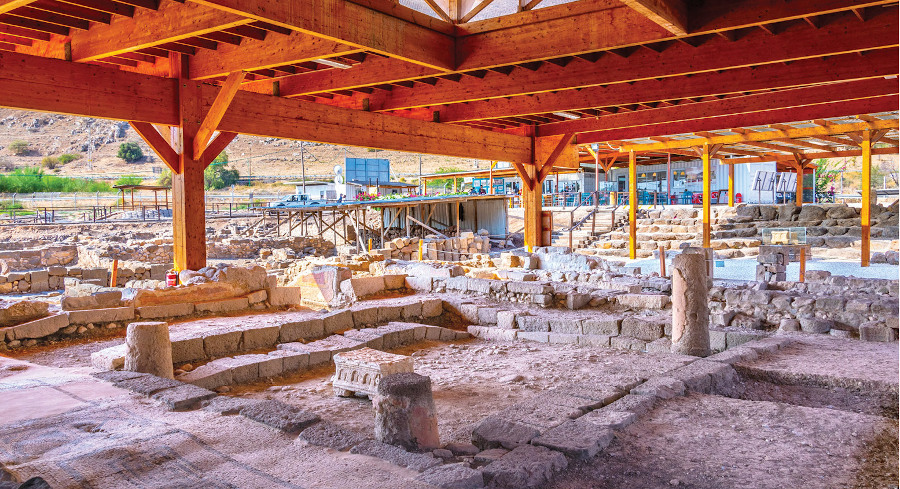
First-century synagogue at Magdala, which is likely the site of Magadan (Mt 15:39).
trabantos/Shutterstock
Return to the main text.
16:1 Pharisees and Sadducees. See note on 3:7. Normally these two groups were opponents, but they had a common enemy in Jesus. sign from heaven. See note on Mk 8:11.
16:4 sign of Jonah. See 12:39–40 and note on Lk 11:30.
16:6 yeast of the Pharisees and Sadducees. See v. 12; see also note on Mk 8:15.
16:7 because we didn’t bring any bread. Apparently the disciples took Jesus’ statement about “yeast” (v. 6) to somehow relate to their being short of bread. Perhaps they assumed they would be required to bake bread when they arrived at the other side of the lake and thought they were being warned by Jesus not to use any yeast provided by the spiritually contaminated religious leaders.
16:8 little faith. See 14:31 and note on 6:30. Here the disciples’ “little faith” is closely connected to their misunderstanding of Jesus’ teachings (vv. 8–10).
16:12 Matthew often explains the meaning of Jesus’ words (cf. 17:13).
16:13 Caesarea Philippi. To be distinguished from the magnificent city of Caesarea, which Herod the Great had built on the Mediterranean coast. Caesarea Philippi, rebuilt by Herod’s son Philip (who named it after Tiberius Caesar and himself), was north of the Sea of Galilee near one of the three sources of the Jordan River. Originally it was called Paneas (the ancient name survives today as Banias) in honor of the Greek god Pan, whose shrine was located there. The region was especially pagan. Who do people say the Son of Man is? See note on Lk 9:18. Son of Man. See note on Mk 8:31.
16:14 John the Baptist. See Mk 6:16 and note. Elijah. See Mk 6:15 and note.
16:16 Peter answered. As spokesperson for the Twelve. Messiah. See second NIV text note on 1:1; see also note on Jn 1:25. The Hebrew word for Messiah (“anointed one”) can be used of anyone who was anointed with the holy oil, such as the priests and kings of Israel (e.g., Ex 29:7, 21; 1Sa 10:1, 6; 16:13; 2Sa 1:14,16). The word carries the idea of being chosen by God, consecrated to his service, and endowed with his power to accomplish the assigned task. Toward the end of the OT period the word assumed a special meaning. It denoted the ideal king anointed and empowered by God to rescue his people from their enemies and establish his righteous kingdom (Da 9:25–26). The ideas that clustered around the title Messiah tended to be political and national in nature. Probably for that reason Jesus seldom used the term. When he did accept it as applied to himself, he did so with reservations (Mt 16:21; cf. Mk 8:27–30; 14:61–63).
16:17 Simon son of Jonah. In Jn 1:42 Jesus identifies Peter as “Simon son of John.” Probably Simon Peter was the son of Johanan (the Hebrew form of the name), and Jonah is an Aramaic abbreviation of Johanan, while John is from the Greek form of the name. flesh and blood. See notes on 1Co 15:50; Gal 1:16.
16:18 Peter . . . rock . . . church. In the Greek “Peter” is petros (“rock” or “stone”), and “rock” is petra (“rock” or “bedrock”). The rock on which the church is built is (1) Peter’s confession of faith in Jesus as the Messiah (v. 16) or (2) Peter himself, understood in terms of his role on the day of Pentecost (Ac 2), the Cornelius incident (Ac 10) and his leadership among the apostles. Eph 2:20 indicates that the church is “built on the foundation of the apostles and prophets” (see note on Jn 1:42). church. In the Gospels this word is used only by Matthew (here and twice in 18:17). In the Septuagint (the pre-Christian Greek translation of the OT) it is used for the congregation of Israel. In Greek circles of Jesus’ day it indicated the assembly of free, voting citizens in a city (cf. Ac 19:32, 39,41). Hades. The place of departed spirits, generally equivalent to the Hebrew Sheol (see note on Ge 37:35). The “gates of Hades” (see note on Job 17:16) here may refer to the powers of death (i.e., all forces opposed to Christ and his kingdom), which will not prove victorious over Christ’s church. See article.
When Jesus says to Peter, “you are Peter (Greek: petros), and on this rock (Greek: petra) I will build my church,” what does he mean? This statement has been interpreted in quite a variety of ways in the history of the church, especially given the potential ambiguity of the wordplay used. What forms the church’s foundation (“this rock”) according to Jesus’ words?
A common Protestant view is that the rock stands as an analogy for (or a “type” of) Peter’s faith. Given that Peter has, just before this affirmation, confessed by faith that Jesus is the Messiah (16:16), this view has contextual support. Similarly, the Eastern view sees “this rock” expressly as the confession of Jesus as the Messiah, which provides the bedrock for the church’s faithful teaching. In both views, Peter’s faith or confession is to be emulated by other disciples of Jesus.
Another line of interpretation understands Jesus himself to be the rock on which the church is built, taking the content of the confession of Jesus as the Messiah to be the referent of “this rock.” This was, for example, Augustine’s view.
Those who understand Peter to be “this rock” emphasize that the wordplay itself points clearly in this direction. The two terms, petros (Peter’s name) and petra (a feminine noun, meaning rock), are to mutually inform each other. And if the saying was originally in Aramaic (Jesus’ mother-tongue), the same term—kepha—would have likely been used in both cases (in other words, the slight distinction in Greek is not significant). Furthermore, the immediate context fits this view, since Peter is given very high authority (the “keys of the kingdom”; v. 19) in the following sentence.
This last view can be divided into two distinct interpretive camps. The Catholic view sees Peter as the foundation of the church, which provides apostolic continuity and papal succession from the time of the NT until today. This viewpoint, however, only became official Roman Catholic doctrine after the time of the Reformation with its Protestant critique of the papacy. The other camp understands Peter to be the clearest referent in context (given the wordplay), though not as a unique basis for the church but as a model and representative for the other disciples and for future believers. This view has support from later in Matthew’s Gospel, since the authority promised to Peter in 16:19 as a part of this saying of Jesus (to bind and loose) is given to all the disciples by Jesus in 18:19. This interpretation may also find some additional support in the statement in Eph 2:20 that the church is “built on the foundation of the apostles and prophets, with Christ Jesus himself as the chief cornerstone.”
Go to the Articles Index.
16:19 keys. Perhaps Peter used these “keys” on the day of Pentecost (Ac 2) when he announced that the door of the kingdom was unlocked to Jews and converts to Judaism and later when he acknowledged that it was also opened to Gentiles (Ac 10; cf. Isa 22:22; Rev 3:7 and notes). bind . . . loose. Not authority to determine, but to announce, guilt or innocence (see 18:18 and context; cf. Jn 20:23 and note; Ac 5:3,9). As these were terms used in Jewish discussions of the law, it may be that the church is being given authority to determine the application of laws.
16:20 not to tell. Because of the false concepts of the Jews, who looked for a primarily national and political Messiah, Jesus didn’t want to precipitate a revolution against Rome (see notes on 8:4; Lk 9:21).
16:21 began. The beginning of a new emphasis in Jesus’ ministry. Instead of teaching the crowds in parables, he concentrated on preparing the disciples for his coming suffering and death. must go . . . suffer . . . be killed . . . be raised. See 17:12,22–23; 20:17–19 and parallels in the other Gospels. This assertion by Jesus was contrary to Jewish expectations (see Jn 12:34 and note). It was, nevertheless, in accordance with the OT (see 26:24,31,54; Mk 14:21, 27,49; Lk 18:31–33; 22:37; 24:25–27,44–46 and note on 24:44).
16:22 Peter . . . began to rebuke him. See note on Mk 8:32.
16:23 Satan. A loanword from Hebrew, meaning “adversary” or “accuser” (see NIV text note on Job 1:6; see also notes on Mk 8:33; Rev 2:9). stumbling block. The “rock” (see NIV text note on v. 18) became a “stumbling block.”
16:24 See note on Mk 8:34. take up their cross. See note on 10:38 (Lk 9:23 adds “daily”; see also note there).
16:25 save their life. See note on Mk 8:35. whoever loses their life. See note on Lk 9:24.
16:26 whole world. See note on Mk 8:36. soul. See note on 10:28.
16:27 Son of Man. See note on Mk 8:31. is going to come. The second coming of Christ. in his Father’s glory. See note on Mk 8:38; cf. Jn 17:1–5. according to what they have done. See Ps 62:12 and note; see also notes on Ro 2:1–16; 2:6–8.
16:28 There are two main interpretations of this verse: (1) It is a prediction of the transfiguration, which happened a week later (17:1) and which demonstrated that Jesus will return “in his Father’s glory” (16:27). (2) It refers to the Son of Man’s authority and kingly reign in his postresurrection church. Some of his disciples will witness—even participate in—this as described in the book of Acts. The context seems to favor the first view, though given that the transfiguration is a foreshadowing of the resurrection, both horizons might be in view. See note on 2Pe 1:16. Son of Man coming in his kingdom. An allusion to Da 7:13–14 (see note on 10:23).
17:1–9 The transfiguration was: (1) a revelation of the glory of the Son of God, a glory hidden now but to be fully revealed when he returns (2Th 1:10); (2) a confirmation of Peter’s confession (16:13–20); and (3) a beneficial experience for the disciples, who were discouraged after having been reminded so recently of Jesus’ impending suffering and death (16:21). See notes on Mk 9:2–7; Lk 9:28–35.
17:1 six days. Mark also says “six days” (Mk 9:2), counting just the days between Peter’s confession and the transfiguration, whereas Luke, counting all the days involved, says, “About eight days” (Lk 9:28). Peter, James and John. See 26:37; Mk 5:37 and note. high mountain. See note on Lk 9:28. by themselves. Luke adds “to pray” (Lk 9:28).
17:2 he was transfigured. His appearance changed. The three disciples saw Jesus in his glorified state (Jn 17:5; 2Pe 1:17).
17:3 Moses and Elijah. Moses the lawgiver appears as the representative of the old covenant and the promise of salvation, which was soon to be fulfilled in the death of Jesus. Elijah the prophet appears as the appointed restorer of all things (Mal 4:5–6; Mk 9:11–13). Lk 9:31 says that they talked about Christ’s death. See note on Lk 9:30.
17:4 three shelters. See notes on Mk 9:5; Lk 9:33.
17:5 bright cloud. Signifying the presence of God (see Ex 13:21; 19:16 and notes; 24:15–16; 34:5; 40:34–38; see also note on Mk 9:7). them. Jesus, Moses and Elijah. This is my Son, whom I love; with him I am well pleased. The same words spoken from heaven at Jesus’ baptism, which allude to Isa 42:1 and Ps 2:7 (see 3:17 and note). No mere man, but the very Son of God, was transfigured. Listen to him! See note on Mk 9:7.
17:6 terrified. Also with a sense of awe at the presence and majesty of God—a frequent response to theophanies (divine manifestations) in the Bible.