76:8 From heaven. Though God is present in Zion (v. 2), he sovereignly rules from heaven.
76:10 wrath. See note on 2:5. brings you praise. When his judgments bring deliverance, those rescued praise him. If the alternative translation in the NIV text note is taken, “the wrath of mankind brings you praise” would mean that when people rise up against God’s kingdom he crushes them in wrath, to his own praise as Victor and Deliverer. And “the remainder of wrath” would indicate that particular judgments do not exhaust his wrath; a remainder is left to deal with other hostile powers.
 76:11–12 Let Israel acknowledge God’s help with grateful vows; let the nations acknowledge his sovereign rule with tribute.
76:11 Make vows . . . fulfill. See note on 50:14.
76:12 spirit of rulers. Their bold rebelliousness.
Ps 77 Comforting reflections in a time of great distress. For the relationship of this psalm to Ps 74, see introduction to Ps 73–78. The interplay of verb forms in vv. 1–6 makes it uncertain whether the psalm is a lament in the face of a current threat (in which case the verbs of these verses would have to be rendered in the present tense) or the recollection of a past experience (as the NIV understands it). The “distress” (v. 2) appears to be personal rather than national. Comparison of vv. 16–19 with Hab 3:8–10 suggests, but does not prove, a time late in the monarchy. The poetic development advances from anguished bewilderment (vv. 1–9) to comforting recollection (vv. 10–20). A striking and dramatic feature is the insertion of a four-verse stanza (vv. 16–19) between the third and fourth verses of another four-verse stanza (vv. 13–15,20).
77 title For the director of music. See note on Ps 4 title. Jeduthun. See note on Ps 39 title. Asaph. See note on Ps 73 title.
77:1–9 Anguished perplexity over God’s apparent inaction, when he seemingly fails to respond to unceasing and urgent prayers.
77:3–6 Remembrance of God’s past mercies intensifies the present perplexity (as also in 22:1–11). God’s failure to act now is so troubling that the psalmist cannot sleep (cf. 3:5; 4:8) and words fail (but see vv. 10–20).
77:3 For Selah, see NIV text note and note on 3:2.
77:7–9 Though words fail (v. 4), troubled thoughts will not go away.
77:8 unfailing love. See article.
77:10–20 Reassuring recollection of God’s mighty acts in behalf of Israel in the exodus.
77:10–12 Faith’s decision to look beyond the present troubles—and God’s bewildering inactivity—to draw hope anew from God’s saving acts of old.
77:10 Most High. See note on Ge 14:19.
77:11,14 miracles. See note on 9:1 (“wonderful deeds”).
77:13–20 God’s mighty acts in the exodus recalled.
77:13 Appears to echo Ex 15:11. are holy. Or “are seen in the sanctuary” (cf. 63:2).
77:15 redeemed. Here, as often, a synonym for “delivered” (see note on 71:23). Joseph. OT authors sometimes refer to the northern kingdom as “Joseph” (or “Ephraim,” Joseph’s son) in distinction from the southern kingdom of Judah (78:67; 2Sa 19:20; 1Ki 11:28; Eze 37:16, 19; Am 5:6, 15; 6:6; Zec 10:6). However, here and elsewhere (80:1; 81:5; Ob 18) Joseph—the one elevated to the position of firstborn (see Ge 48:5 and note; Jos 16:1–4; 1Ch 5:2; Eze 47:13)—represents the whole of his generation and thus also all the descendants of Jacob.
77:16–19 A poetically heightened description of the majesty of God displayed when he opened a way through the Red Sea (74:13–15). Verses 16,19 speak expressly of that event; the intervening verses (vv. 17–18) evoke the majesty of God displayed in the thunderstorm and earthquake. Ex 14:19 speaks only of God’s cloud, not of a thunderstorm or earthquake, but the Hebrew poets often associated either or both with the Lord’s coming to effect redemption or judgment—no doubt because these were the two most fearsome displays of power known to them (18:12–14; 68:8; Jdg 5:4–5; Hab 3:6,10). For Christians, the display of God’s power in behalf of his people now includes the resurrection of Jesus Christ from the dead (see Mt 28:2; cf. Eph 1:18–23 and note on 1:19).
77:17 arrows. Lightning bolts (see note on Ge 9:13).
77:20 Completes the thought of v. 15 (see introduction). led your people. Through the Desert of Sinai. like a flock. See 23:1; 74:1 and notes.
Ps 78 A salvation-history psalm, warning Israel not to repeat their sins of the past but to remember God’s saving acts and marvelously persistent grace and, remembering, to keep faith with him and his covenant. Here, as elsewhere (pervasively in the OT), trust in and loyalty to God on the part of God’s people are covenant matters. They do not spring from abstract principles (such as the formal structure of the God-human relationship) or from general human consciousness (such as feelings of dependence on “God” or a sense of awe in the presence of the “holy”), but they result from remembering God’s mighty saving acts. Correspondingly, unfaithfulness is the more blameworthy because it contemptuously disregards all God’s wonderful acts in his people’s behalf (Ps 105–106).
The psalm is composed of 77 (Hebrew) lines (72 numbered verses) and seven stanzas—with an 11-line introduction. After the introduction, the structure of the stanzas is symmetrical: 8 lines, 16 lines, 9 lines, 16 lines, 9 lines, 8 lines. The two sequences of 16 lines–9 lines constitute a thematic cycle, while the two 8-line stanzas frame the double cycle and underscore the contrast between the sin of Israel (“Ephraim,” vv. 9–16) and the unending mercy of God to his people—mercy that is evidenced in his victory over his enemies and his election of Zion (in Judah) and David (vv. 65–72). For this psalm’s relationship to Ps 73 in the arrangement of the Psalter, see introduction to Ps 73–78.
78 title maskil. See note on Ps 32 title. Asaph. See note on Ps 73 title.
78:1–8 Our children must hear what our fathers have told us, so that they may be faithful to the Lord.
78:1–2 This introduction is written in the style of a wisdom writer (see article; see also Ps 49:1–4).
78:2 parable . . . hidden things. While both terms had specialized uses, they apparently also became conventionalized more generally for instruction in a wide variety of forms (see note on 49:14). Mt 13:35 refers to this verse as a prophecy of Jesus’ parabolic teaching. Matthew apparently perceived in this psalm a recitation of God’s mighty acts that required spiritual discernment to understand their full meaning, just as Jesus’ parables did.
78:4–5 The Lord’s saving acts and his covenant statutes—both must be taught, and in relationship, for together they remain the focal point for faith and obedience down through the generations (vv. 7–8).
78:4 not hide them. See Job 15:18.
78:5 teach their children. See, e.g., Ex 10:2; 12:26–27; 13:8,14; Dt 4:9; 6:7,20–21.
78:8 stubborn and rebellious. Like a rebellious son (Dt 9:6–7, 24; 31:27). generation. Reference here is to a people with certain shared characteristics (24:6; Dt 32:5,20), thus not limited to the exodus generation (vv. 9–11,56–64). hearts. See note on 4:7.
 78:9–16 The northern kingdom has violated God’s covenant, not remembering his saving acts (a message emphasized by the prophets Amos and Hosea). Israel’s history with God has been a long series of rebellions on their part (vv. 9–16,32–39,56–64), beginning already in the wilderness (vv. 17–31,40–55).
78:9 men of Ephraim. The northern kingdom, dominated by the tribe of Ephraim (see introduction). turned back. Neither the tribe of Ephraim nor the northern kingdom had a reputation for cowardice or ineffectiveness in battle (see, e.g., Dt 33:17). So this verse is best understood as a metaphor for Israel’s betrayal of God’s covenant (v. 10), related to the figure of the “faulty bow” (v. 57).
78:12–16 A summary reference to the plagues in Egypt and to the water miracles at the Red Sea and in the wilderness. In the two cycles that follow (vv. 17–39,40–64), further elaboration intensifies the indictment.
78:12 See Ex 7–12. Zoan. A city in the northeast part of the Nile delta (see v. 43; see also Nu 13:22 and note).
78:13 See Ex 14:1—15:21.
78:15–16 See v. 20; Ex 17:6; Nu 20:8,10–11.
78:17–31 Israel’s rebelliousness in the wilderness; God’s marvelous provision of food—and his anger.
78:17 continued. Although no sin in the wilderness has yet been mentioned, the poet probably expected his readers to recall (in conjunction with the miraculous provisions of water just mentioned) how the people grumbled at Marah because of lack of water (Ex 15:24). Most High. See vv. 35,56; see also note on Ge 14:19.
78:18 See Ex 16:2–3. put God to the test. See vv. 41,56; see also note on Ex 17:2.
78:20 bread . . . meat. The poet is probably combining and compressing two episodes (Ex 16:2–3; Nu 11:4).
78:21 wrath. See vv. 31,49–50,58–59,62; see also note on 2:5.
78:23 opened the doors of the heavens. For this imagery, see Ge 7:11; 2Ki 7:2; Mal 3:10.
78:25 bread of angels. So called because it came down from heaven. angels. Or “mighty ones.” The Hebrew word is used only here of the angels, but reference is clearly to heavenly beings (103:20).
78:26–28 See Ex 16:13; Nu 11:31.
78:26 east wind . . . south wind. Since the quail were migrating from Egypt at this time, the south wind may have carried them north and the east wind may have diverted them to the wilderness area occupied by the Israelites (the book of Numbers does not provide wind directions).
78:27 like dust . . . like sand. Similes for a huge number (see note on Ge 13:16).
78:32–39 Rebelliousness, which became Israel’s way of life, showed itself early in the wilderness wandering (vv. 17–31) and continued throughout that journey.
78:32 did not believe. That God could give them victory over the Canaanites (Nu 14:11).
78:33 The exodus generation was condemned to die in the wilderness (see Nu 14:22–23,28–35; cf. note on Heb 3:16–19).
78:34–37 A cycle repeated frequently during the period of the judges (see note on Jdg 2:6—3:6).
78:35 Rock. See note on 18:2. Redeemer. Deliverer (see note on 71:23).
78:37 hearts. See note on 4:7.
78:38 See Ex 32:14; Nu 14:20. forgave. See note on 65:3.
78:39 See 103:14; see also 39:5; 62:9; 144:4 and notes.
78:40–64 The second cycle (the first is vv. 17–39).
78:40–55 Israel’s rebelliousness began in the wilderness; they did not remember how they had been delivered from oppression by God’s plagues upon Egypt (v. 12). Yet he brought his people through the sea and the wilderness and established them in the promised land.
78:41 Holy One of Israel. See 71:22; 89:18; see also 2Ki 19:22 and note.
78:44–51 The plagues upon Egypt (Ex 7–12): The sequence in Exodus is followed only in the first and last; the third, fifth, sixth and ninth plagues are not mentioned.
78:47 sycamore-figs. See note on Am 7:14.
78:49 destroying angels. The poet personifies God’s wrath, indignation and hostility as agents of his anger.
78:51 tents. Dwellings. Ham. For the association of Ham with Egypt, see 105:23,27; 106:21–22; Ge 10:6 and note.
78:52 like a flock. See 77:20 and note.
78:53 sea. Red Sea (see Ex 15:1–21 and notes).
78:54 holy land. See note on Zec 2:12.
78:55 Summarizes the story told in Joshua.
78:56–64 Rebelliousness continued to be Israel’s way of life in the promised land (a recurring theme of Judges; see also 1Sa 2:12—7:2), so God rejected Israel (v. 59; see Jer 7:15).
78:57 faulty bow. See note on v. 9.
78:58 high places. See note on 1Sa 9:12. jealousy. God’s intense reaction to disloyalty to him (see note on Ex 20:5).
78:59 rejected Israel completely. Abandoned the people to their enemies. The psalmist does not speak of a permanent casting off of Israel, not even of the ten northern tribes (cf. note on Ro 9:1—11:36).
78:60 Shiloh. The center of worship since the time of Joshua (Jos 18:1, 8; 21:1–2; Jdg 18:31; 1Sa 1:3; Jer 7:12), it was located in Ephraim between Bethel and Shechem (see Jdg 21:19; see also map). Apparently it was destroyed by the Philistines when they captured the ark or shortly afterward (see note on Jer 7:12).
78:61 his might . . . his splendor. The ark is here so called because it was the sign of God’s kingship in Israel and the focal point for the display of his power and glory (26:8; 63:2; 1Sa 4:3,21–22).
78:62,71 his inheritance. See Dt 9:29.
78:63 Fire. Often associated with the sword (vv. 62,64) as the two primary instruments of destruction in ancient warfare. no wedding songs. So great was the catastrophe that both the wedding songs of the brides and the wailing of the widows (v. 64) were silenced in the land.
78:64 priests were put to the sword. See 1Sa 4:11.
78:65–72 The Lord’s election of Judah (instead of Ephraim) as the leading tribe in Israel (anticipated in Jacob’s deathbed blessing of his sons, Ge 49:8–12), of Mount Zion (instead of Shiloh) as the place of his sanctuary (royal seat) and of David as his regent to shepherd his people.
78:65 awoke as from sleep. Poetic hyperbole to highlight the contrast between God’s action in behalf of his people in the days of David and the preceding time of Israel’s troubles (see note on 7:6).
78:66–72 The saving events noted have two focal points: (1) God’s decisive victory over his enemies (thus securing his realm) and the establishment of Zion as his royal city, and (2) the appointment of David to be the shepherd of his people.
78:67 tents of Joseph. A figure for the tribe of Ephraim (for the figurative use of “tents,” see v. 51; see also 69:25; 83:6; 84:10; 120:5; Ge 9:27; Dt 33:18; 1Ki 12:16; Job 8:22; 12:6; Hab 3:7; Mal 2:12).
78:68,70 he chose . . . Mount Zion . . . He chose David. See Ps 132.
78:69 heights . . . earth. The verse is subject to two interpretations: (1) The Lord built his sanctuary as impregnable as a mountain fortress and as enduring and immovable as the age-old earth, or (2) the Lord built his sanctuary as secure and enduring as the heavens and the earth (see note on 24:2) and there manifests himself as the Lord of glory (24:7–10; 26:8; 63:2; 96:6), even as he does in the creation (19:1; 29:9; 97:6).
78:70–71 See 1Sa 16:11–13; 2Sa 7:8.
78:70 his servant. Here an official title marking David as a member of God’s royal administration (see notes on Ex 14:31; Ps 18 title; Isa 41:8–9; 42:1). For David as God’s “servant,” see also 89:3,20,39; 132:10.
78:71 shepherd. See v. 72; see also note on 23:1.
78:72 Israel under the care of the Lord’s royal shepherd from the house of David was for the prophets the hope of God’s people (see Eze 34:23; 37:24; Mic 5:4—fulfilled in Jesus Christ, Mt 2:6; Jn 10:11; Rev 7:17). shepherded. See note on 23:1.
Ps 79–83 A group of five psalms at the center of Book III that are framed by two anguished laments of the community when the nation has been invaded by powerful enemies (for the different events alluded to, see introductions to Ps 79; 83). In the center of this group (Ps 81)—thus also at the center of Book III—stands an urgent admonition to wayward Israel, reminding God’s people that only if they are faithful to the Lord, who brought them out of Egypt, will he preserve them or rescue them from the ravaging of their enemies. Bracketing this center on one side is a communal lament to God asking him to “restore” his “flock” and revive his once thriving “vine” that has been decimated by enemies (Ps 80) and on the other a prayer that the God who judges all kings and possesses all nations will arouse himself to “judge the earth” (Ps 82).
Ps 79 Israel’s lament to God asking for forgiveness and help and for his judgment on the nations that have so cruelly destroyed them, showing utter contempt for both the Lord and his people. For the relationship of this psalm to Ps 80–83 in the arrangement of the Psalter, see introduction to Ps 79–83. Like Ps 74, with which it has many thematic links, Ps 79 dates from the time of the exile. The poignancy of its appeal is heightened by its juxtaposition to Ps 77 (recalling God’s saving acts under Moses) and Ps 78 (recalling God’s saving acts under David), two psalms with which it is significantly linked by the shepherd-sheep figure and other thematic elements. Israel acknowledges that the Lord has used the nations to punish them for their sins, so they plead for pardon. But they know too that the nations have acted out of their hostility to and disdain for God and his people; that warrants Israel’s plea for God’s judgment on the nations (Isa 10:5–11; 47:6–7). Daniel’s prayer (Da 9:4–19) contains much that is similar to the elements of penitence in this psalm.
79 title Asaph. See note on Ps 73 title.
79:1–4 What the nations have done: They have attacked God’s own special domain, violated his temple, destroyed his royal city, slaughtered his people, degraded them in death (by withholding burial—see note on 53:5—and leaving their bodies as carrion for birds and beasts) and reduced them to the scorn of the world.
79:1 your inheritance. Cf. 78:62,71. Here reference is to Israel’s homeland as the Lord’s domain (see note on 2:8; cf. 114:2 and note). holy temple. See note on 78:69. rubble. See photo.

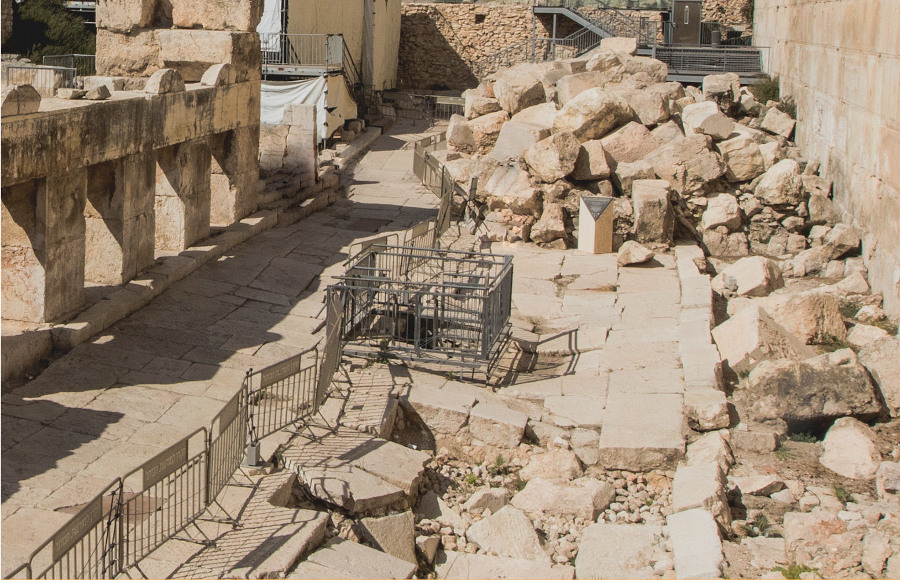
Ancient street in Jerusalem that used to run under Robinson’s Arch. The rubble in the background is from the desctruction of Jerusalem in ad 70 by the Romans. “O God, the nations have invaded your inheritance; they have defiled your holy temple, they have reduced Jerusalem to rubble” (Ps 79:1).
© 2018 by Zondervan
Return to the main text.
79:2 your servants. Though banished from the Lord’s land for sins that cannot be denied, the exiles plead their special covenant relationship with God (see “your own people,” here, and “your people, the sheep of your pasture,” v. 13). your own people. See note on 4:3.
79:3 poured out blood . . . all around Jerusalem. Cf. 2Ki 21:16.
79:5–8 A prayer for God to relent and deal with the nations who do not acknowledge him.
79:5 How long . . . ? See note on 6:3. angry. See v. 6 (“wrath”); see also note on 2:5. jealousy. See note on 78:58. burn like fire. See Dt 4:24; 6:15; Zep 1:18; 3:8.
79:6–7 See Jer 10:25 and note. Perhaps the psalmist is quoting Jeremiah here.
79:6 Pour out your wrath. As they “poured out” (v. 3) the blood of your people. The exiles plead with God to redress the wrongs committed against them (see note on 5:10).
79:7 devoured. Like wild beasts (see 44:11; 74:19 and note on 7:2). Jacob. A synonym for Israel (Ge 32:28).
79:8 sins of past generations. Israel suffered exile because of the accumulated sins of the nation (2Ki 17:7–23; 23:26–27; 24:3–4; Da 9:4–14), of which they did not repent until the judgment of God had fallen on her. The exiles here pray that God will take notice of their penitence and not continue to hold the sins of past generations against his now repentant people. mercy. Here personified as God’s agent sent to bring relief (see notes on 23:6; 43:3).
79:9–11 A prayer for God to help and forgive his people and to redress the violent acts of the enemies.
79:9 for the glory of your name. As the desolation of God’s people brings reproach to God (v. 10), so their salvation and prosperity bring him glory (see note on 23:3). forgive. See note on 65:3.
79:10 Where is their God? See note on 3:2. avenge. Redress the wrongs (Dt 32:35,43).
79:11 prisoners . . . those condemned to die. The exiles, as imperial captives in Babylonia (102:20)—not actually in prisons, but under threat of death if they should seek to return to their homeland.
79:12–13 Concluding prayer and vow to praise God.
79:12 Pay back into the laps. See note on Jer 32:18. seven times. In full measure; the number seven symbolized completeness. contempt . . . at you. The enemies’ violent action against Israel was above all a high-handed reviling of God (vv. 1,10; 2Ki 19:10–12, 22–23; Isa 52:5).
79:13 sheep of your pasture. See 23:2; 74:1 and notes; see also 77:20; 78:72; 80:1. will praise you forever. See note on 7:17. from generation to generation. See 78:4.
 Ps 80 Israel’s lament to God asking for restoration when they had been ravaged by a foreign power. For the relationship of this psalm to the others in its group, see introduction to Ps 79–83. It seems likely that “Ephraim, Benjamin and Manasseh” (v. 2) here represent the northern kingdom. Recent archaeological surveys of the Holy Land have shown that Jerusalem and the surrounding countryside experienced a dramatic increase in population at this time, no doubt the result of a massive influx of displaced persons from the north fleeing the Assyrian threat. This could account for the presence of “Ephraim, Benjamin and Manasseh” at the Jerusalem sanctuary, and for a national prayer for restoration with special focus on these tribes (see notes below). The prayer has five stanzas of four (Hebrew) lines each. A recurring petition climaxes the first, second and last (for other refrains, see introduction to Ps 42–43), with a progressing urgency of appeal: “God” (v. 3); “God Almighty” (v. 7); “LORD God Almighty” (v. 19).
80 title For the director of music. See note on Ps 4 title. To the tune of. See note on Ps 9 title. Lilies. See note on Ps 45 title. Asaph. See note on Ps 73 title.
80:1–3 An appeal for God to arouse himself and go before his people again with all his glory and might as he did of old in the wilderness.
80:1 See the shepherd-flock motif in 74:1; 77:20; 78:52,71–72; 79:13; see also 23:1–2 and notes. Joseph. See note on 77:15. enthroned between the cherubim. See note on Ex 25:18. shine forth. Let your glory be seen again, as in the wilderness journey (Ex 24:16–17; 40:34–35), but now especially through your new saving act (102:15–16; Ex 14:4, 17–18; Nu 14:22; Isa 40:5; 44:23; 60:1–2).
80:2 before Ephraim, Benjamin and Manasseh. March against the nations as you marched in the midst of your army from Sinai into the promised land (in that march the ark of the covenant advanced in front of the troops of these three tribes; see Nu 10:21–24; see also introduction to Ps 68). Awaken. See note on 7:6.
80:3 make your face shine. See vv. 7,19; an echo of the priestly benediction (see Nu 6:25; see also notes on 4:6; 13:1).
80:4–7 A lament over the Lord’s severe punishment of his people.
80:4 How long . . . ? See note on 6:3. LORD . . . Almighty. See vv. 7,14,19; see also note on 1Sa 1:3. anger. See note on 2:5.
80:5 God has now given them tears to eat and tears to drink rather than “the bread of angels” and water from the rock (78:20,25).
80:8–16 This use of the vine-vineyard metaphor (here to describe Israel’s changed condition) is found also in the Prophets (see Isa 3:14; 5:1–7; 27:2; Jer 2:21; 12:10; Eze 17:6–8; 19:10–14; Hos 10:1; 14:7; Mic 7:1; see also Ge 49:22; Mt 20:1–16; Mk 12:1–9; Lk 20:9–16; Jn 15:1–5; cf. photos, here and here).
80:8–11 Israel was once God’s flourishing, transplanted vine.
80:8 transplanted . . . from Egypt. See 78:52. drove out the nations and planted. See 44:2.
80:9 cleared the ground. See Isa 5:2.
80:11 Sea . . . River. See NIV text notes; see also Ex 23:31 and note.
80:12–15 A prayer for God to renew his care for his ravaged vine.
80:12 Why . . . ? Israel’s anguished perplexity over God’s apparent abandonment (see note on 6:3). broken down its walls. Taken away its defenses.
80:14 Watch over. See Ex 3:16. But the Hebrew for this phrase may have the sense here that it has in Ru 1:6: “Come to the aid of.”
80:15 son. Israel (Ex 4:22–23; Hos 11:1). But “son” may sometimes be used also to refer to a vine branch (see NIV text note; see also note on Ge 49:22). That may be the case here, thus yielding the conventional pair “root and branch,” a figure for the whole vine (see Job 18:16; 29:19; Eze 17:7; Mal 4:1; see also Isa 5:24; 27:6; 37:31; Eze 17:9; 31:7; Hos 9:16; Am 2:9; Ro 11:16).
80:16–19 Concluding prayer for restoration.
80:16 rebuke. See 9:5 and note on 76:6.
80:17 Let your hand rest on. Show your favor to (Ezr 7:6, 9,28; 8:18,22,31; Ne 2:8,18). your right hand. Reference may be to the Davidic king as the Lord’s anointed, seated in the place of honor in God’s presence (110:1) and the one in whom the hope of the nation rested (2:7–9; 72:8–11; 89:21–25).
80:18 A vow to be loyal to God and to trust in him alone. It occurs in a place where it would be more common to find a vow to praise God (see note on 7:17).
Ps 81 A festival hymn. It was probably composed for use at both the New Year festival (the first day of the month, “New Moon”) and the beginning of Tabernacles (the 15th day of the month, full moon); see notes below. As memorials of God’s saving acts, Israel’s annual religious festivals called the nation to celebration, remembrance and recommitment (see Ps 95; see also chart). For the significant placement of this psalm within Book III of the Psalter, see introduction to Ps 73–78 and introduction to Ps 79–83. The psalm falls into two main parts (vv. 1–5, 6–16).
81 title For the director of music. See note on Ps 4 title. According to. See note on Ps 6 title. gittith. See note on Ps 8 title. Asaph. See note on Ps 73 title.
81:1–5 A summons to celebrate the appointed sacred festival.
81:1 Jacob. A synonym for Israel (Ge 32:28).
81:2 timbrel. See note on Jer 31:4. harp and lyre. See note on 57:8.
81:3 ram’s horn. The ram’s horn trumpet (Ex 19:13). our festival. Probably the Festival of Tabernacles (see Ex 23:16; Zec 14:16 and notes), often called simply “the festival” (see, e.g., 1Ki 8:2,65).
81:4–5 decree . . . ordinance . . . statute. See the passages referred to in note on v. 3.
81:5 When God went out against Egypt. Some believe this indicates that the festival referred to is Passover and Unleavened Bread (Ex 12:14,42). More likely it serves as a reference to the whole exodus period, while highlighting especially God’s triumph over Egypt by which he had set his people free (vv. 6–7). Joseph. See note on 77:15. heard an unknown voice. The “voice” is the thunder of God’s judgment against Egypt (v. 7), which the Levitical author then proceeds to interpret as to its present reference for the celebrating congregation (vv. 6–16).
81:6–10 God heard and delivered and now summons his people to loyalty.
81:6 burden . . . basket. The forced labor to which the Israelites were subjected in Egypt (Ex 1:11–14).
81:7 you called and I rescued. See Ex 3:7–10. out of a thundercloud. See 106:9; Ex 14:21, 24; 15:8,10; see also note on 76:6. I tested you. See Ex 17:1–7. For Selah, see NIV text note and note on 3:2.
81:8–10 God heard his people in their distress (vv. 6–7); now they must listen to him.
81:9–10 See Ex 19:4–5; 20:2–4; Dt 4:15–20.
81:10 Open wide your mouth. Trust in the Lord alone for all of life’s needs. I will fill it. See v. 16; as he did in the wilderness (see 78:23–29; see also 37:3–4; Dt 11:13–15; 28:1–4).
81:11–16 Israel has not listened—if only God’s people would! See Eze 18:23, 32; 33:11.
81:11 See 78:10,17,32,40,56; Dt 9:7, 24; Jer 7:24–26.
81:12 It is God who circumcises the heart (see Dt 30:6; see also 1Ki 8:58; Jer 31:33; Eze 11:19; 36:26). Thus for God to abandon his people to their sins is the most fearful of punishments (see 78:29; Isa 6:9–10; 29:10; 63:17; cf. Ro 1:24, 26,28).
81:13–16 See the promised covenant blessings outlined in Ex 23:22–27; Lev 26:3–13; Dt 7:12–26; 28:1–14.
81:13 my ways. See 25:4 and note.
81:16 honey from the rock. See note on Dt 32:13.
Ps 82 A word of judgment on unjust rulers and judges. The author of this psalm evokes a vision of God presiding over his heavenly court—analogous to the experiences of the prophets (see 1Ki 22:19–22; Isa 6:1–7; Jer 23:18,22; see also Job 15:8). As the Great King (see introduction to Ps 47) and the Judge of all the earth (94:2; Ge 18:25; 1Sa 2:10) who “loves justice” (99:4) and judges the nations in righteousness (9:8; 96:13; 98:9), he is seen calling to account those responsible for defending the weak and oppressed on earth. These rulers and judges here are confronted by their King and Judge (Ps 58). Structurally, the words of the Levite (vv. 1,6) frame the words of God. At the very center (see note on v. 5) stands the most devastating judgment of all. For this psalm’s placement in Book III of the Psalter, see introduction to Ps 79–83.
82 title See note on Ps 73 title.
82:1 great assembly. The assembly in the great Hall of Justice (cf. 1Ki 7:7) in heaven (89:5; 1Ki 22:19; Job 1:6; 2:1; Isa 6:1–4). As if in a vision, the psalmist sees the rulers and judges gathered before the Great King to give account of their administration of justice. gods. See v. 6. In the language of the OT—and in accordance with the conceptual world of the ancient Near East—rulers and judges, as deputies of the heavenly King, could be given the honorific title “god” (see note on 45:6; see also NIV text notes on Ex 21:6; 22:8) or be called “son of God” (see 2:7 and note).
82:2 For Selah, see NIV text note and note on 3:2.
82:3–4 In the OT a first-order task of kings and judges was to protect the powerless against all who would exploit or oppress them (72:2,4,12–14; Pr 31:8–9; Isa 11:4; Jer 22:3,16).
82:5 The ‘gods’ know . . . nothing. The center of the poem (see note on 6:6). They ought to have shared in the wisdom of God (1Ki 3:9; Pr 8:14–16; Isa 11:2), but they are utterly devoid of true understanding of moral issues or of the moral order that God’s rule sustains (Isa 44:18; Jer 3:15; 9:24). foundations . . . are shaken. When such people are the wardens of justice, the whole world order crumbles (see 11:3; 75:3 and notes).
82:6 Quoted in part in Jn 10:34 (see note there). I said. Those who rule (or judge) do so by God’s appointment (2:7; Isa 44:28) and thus are his representatives—whether they acknowledge him or not (Ex 9:16; Jer 27:6; Da 2:21; 4:17,32; 5:18; Jn 19:11; Ro 13:1). “gods” . . . sons of. See note on v. 1. Most High. See note on Ge 14:19.
82:7 However exalted their position, these corrupt “gods” will be brought low by the same judgment as other human beings. fall. See note on 13:4.
82:8 Having seen the prospect in store, the psalmist prays for God’s judgment to hasten and for the perfect reign of God to come quickly to the whole world. Rise up. See note on 3:7. inheritance. Domain (see note on 79:1).
Ps 83 Israel’s lament asking God to crush his enemies when the whole world—or so it seemed—was arrayed against his people. For this psalm’s relationship to those around it, see introduction to Ps 79–83. The occasion may have been that reported in 2Ch 20, when Moab, Ammon, Edom and their allies were invading Judah. In any event, the psalm must date from sometime after the reign of Solomon and before the great thrust of Assyria in the time of King Menahem (2Ki 15:19). Each of the two main divisions (vv. 1–8, 9–18) consists of two four-verse stanzas, with the latter division being extended by a two-verse stanza that brings the prayer to its climactic conclusion.
83 title song. See note on Ps 30 title. Asaph. See note on Ps 73 title.
83:1–4 An appeal to God to act in the face of Israel’s imminent danger.
83:1 do not remain silent. Do not remain inactive (35:22; 109:1).
83:2 growl. In Hebrew the same verb as for “are in uproar” in 46:6 and for “snarling” in 59:6,14.
83:4 they say. See note on 3:2. let us destroy them. Israel’s very existence is at stake (v. 12).
83:5–8 The array of nations allied against Israel—threat from every quarter.
83:6 Hagrites. Either Ishmaelites (descendants of Hagar) or a group mentioned in Assyrian inscriptions as an Aramean confederacy (1Ch 5:10, 18–22; 27:31).
83:7 Byblos. See 1Ki 5:18; Eze 27:9; an important Phoenician city. Amalek. See note on Ge 14:7.
83:8 Assyria. Since it is mentioned only as an ally of Moab and Ammon (the descendants of Lot; see note on Ge 19:36–38), Assyria, though distantly active in the region, must not yet have become a major threat in its own right. For Selah, see NIV text note and note on 3:2.
83:9–12 A plea for God to destroy his enemies as he did of old in the time of the judges. Those who hurl themselves against the kingdom of God to destroy it from the earth—so that the godless powers are left to shape the destiny of the world as they will—must be crushed if God’s kingdom of righteousness and peace is to come and be at rest (see note on 5:10).
83:9 as you did to Midian. In Gideon’s great victory (Jdg 7). as you did to Sisera and Jabin. In Barak’s defeat of the Canaanite coalition (Jdg 4).
83:10 Endor. See Jos 17:11 and note; northeast of where the main battle was fought—apparently where much of the fleeing army was overtaken and decimated.
83:11 Oreb and Zeeb . . . Zebah and Zalmunna. Leaders of the Midianite host destroyed by Gideon (Jdg 7:25—8:21).
83:13–16 The plea renewed, with vivid imagery of fleeing armies and of God’s fearsome power.
83:15 Imagery of the heavenly Warrior attacking his enemies out of the thunderstorm (18:7–15; 68:33; 77:17–18; Ex 15:7–10; Jos 10:11; Jdg 5:4, 20–21; 1Sa 2:10; 7:10; Isa 29:5–6; 33:3). For the storm cloud as God’s chariot, see 68:4 and note.
83:16 will seek. See note on v. 18. name. See note on 5:11.
83:17–18 The prayer’s climactic conclusion.
83:18 The ultimate goal of God’s warfare is not merely the security of Israel and the destruction of Israel’s (and God’s) enemies but the worldwide acknowledgment of the true God and of his rule, even to the point of seeking him as his people do (see v. 16; see also 40:9; 47:9; 58:11; 59:13 and notes). Most High. See note on Ge 14:19.
Ps 84–89 The first of the six psalms that make up the final group of Book III (see introduction to Ps 73–78) expresses yearning for fellowship with God, who dwells in his temple in Zion and from whom alone come security and blessing. References to God as “LORD Almighty” and a prayer for “our shield,” the Lord’s “anointed,” form distinctive links with the final psalm of the group (for the former, see 84:1,3,8,12 and 89:8; for the latter, see 84:9 and 89:18,38,51). The five psalms thus introduced are four cries out of distress arranged around a central song (Ps 87) that celebrates God’s special love for Zion and the care he has for all its citizens. Of these four, the first (Ps 85) and the last (Ps 89) are communal prayers, and the remaining two (Ps 86; 88) are prayers of individuals. They all make much of God’s “love and faithfulness” (85:7,10–11; 86:5,13,15; 88:11; 89:1–2,5,8,14,24, 28,33,49) and his “saving” help (85:4,7,9; 86:2,16; 88:1; 89:26). And three of them share another key concept, “righteousness” (85:10–11,13; 88:12; 89:14). The final two laments (Ps 88; 89) both end unrelieved by the usual expression of confidence that God will hear and act (see note on 3:8).
Ps 84 A lament of longing for the house of the Lord. The author (presumably a Levite who normally functioned in the temple service), now barred from access to God’s house (perhaps when Sennacherib was ravaging Judah; see 2Ki 18:13–16), gives voice to his longing for the sweet nearness to God in his temple that he had known in the past. Reference to God and his temple and to the blessedness (vv. 4–5,12) of those having free access to both dominates the prayer and highlights its central themes. For its placement in the arrangement of the Psalter, see introduction to Ps 84–89. Whatever its origin, the psalm now voices the devotion to and reliance on God that motivate the remaining prayers of the group it introduces.
The psalm has three main divisions and a conclusion (v. 12). In the Hebrew text, a six-line unit (vv. 1–4) precedes and another six-line unit (vv. 8–11) follows a three-line reflection (vv. 5–7) on the blessedness of those free to make pilgrimage to Zion. Each of these six-line divisions contains three references to the “LORD,” while the seventh reference (symbolizing completeness or perfection) appears in the conclusion.
84 title For the director of music. See note on Ps 4 title. According to. See note on Ps 6 title. gittith. See note on Ps 8 title. Of the Sons of Korah. See note on Ps 42 title.
84:1–4 A lament of deep longing for the house of the Lord.
84:1 lovely. The traditional rendering of the Hebrew here; could also be translated “beloved” or “loved.” LORD Almighty. See vv. 3,8,12; see also note on 1Sa 1:3.
84:2 My soul yearns. I yearn (see note on 6:3). courts. Of the temple (v. 10; 2Ki 21:5; 23:11–12). my heart . . . flesh. My whole being (73:26). living God. See Dt 5:26.
84:3 The psalmist envies the small birds that have such unhindered access to the temple and the altar. They are able even to build their nests for their young there—the place where Israel was to have communion with God.
84:4–5,12 Blessed. See note on 1:1.
84:4 who dwell in your house. See note on 15:1. For Selah, see NIV text note and note on 3:2.
84:5–7 The joyful blessedness of those who are free to make pilgrimage to Zion—them too the psalmist envies.
84:5 those whose strength is in you. Those who have come to know the Lord as their deliverer and the sustainer of their lives. whose hearts are set on pilgrimage. Joyful anticipation of the pilgrimages the Israelites took to observe the religious festivals at Jerusalem (Zion, v. 7).
84:6 As they pass. On their way to the temple. Baka. Means either “weeping” or “balsam trees” (common in arid valleys). place of springs. The joyful expectations of the pilgrims transform the difficult ways into places of refreshment. autumn rains. See note on Jas 5:7. Reference to these rains suggests that the psalmist had in mind especially the pilgrimage to observe the Festival of Tabernacles (see chart). pools. The Hebrew for this word may refer to “blessings” or to “pools” (see NIV text note); it is likely that both are intended. By God’s benevolent care over his pilgrims, the vale of weeping (or balsam trees), already transformed by the glad hearts of the expectant wayfarers, is turned into a valley of praise (2Ch 20:26).
84:7 from strength to strength. God provides for them throughout the journey, whatever the hardships (Isa 40:31). Zion. See 9:11 and note.
84:8–11 A prayer for the king, and its motivation: Only as God blesses the king in Jerusalem will the psalmist once more realize his great desire to return to his accustomed service in the temple (see introduction).
84:8 Jacob. A synonym for Israel (Ge 32:28).
84:9 our shield. The king in Jerusalem (see NIV text note; see also note on 3:3). anointed one. God’s earthly regent over his people (from David’s line—perhaps Hezekiah [see introduction to this psalm]); see note on 2:2.
84:10 doorkeeper. Perhaps the psalmist’s normal (and humble) service at the temple (2Ki 22:4). dwell in the tents of the wicked. Share in the life of those who do not honor the God of Zion. Perhaps reference is to the peoples imported by Sargon II (2Ki 17:24–33), among whom the psalmist was forced at the time to live.
84:11 sun. The glorious source of the light of life (see note on 27:1). shield. See note on 3:3. blameless. See 15:2; Ge 17:1 and notes.
84:12 The sum of it all (40:4).
Ps 85 A communal lament to God asking for the renewal of his mercies to his people at a time when they are once more suffering distress. Verse 12 suggests that a drought has ravaged the land and may reflect the drought with which the Lord chastened his people in the time of Haggai (Hag 1:5–11). For this lament’s placement in the Psalter and its relationship to the psalms of its group, see introduction to Ps 84–89. Christian liturgical usage has often employed this psalm in the Christmas season. The psalm has two main divisions of seven (Hebrew) lines each: (1) the plea to God (vv. 1–7); (2) a reassuring word (vv. 8–13). Each division contains a three-line stanza followed by a four-line stanza, with the corresponding stanzas of the second half answering to those of the first: Verses 1–3 speak of mercies granted, while vv. 8–9 speak of mercies soon to come; vv. 4–7 voice the plea, and vv. 10–13 offer the blessed reassurance that the plea will be heard.
85 title For the director of music. See note on Ps 4 title. Of the Sons of Korah. See note on Ps 42 title.
85:1–7 The plea for the renewal of God’s favor.
85:1–3 Israel begins this prayer by appealing to the Lord’s past mercies, recalling how he has forgiven and restored his people before (perhaps a reference to the restoration from exile).
85:1 restored the fortunes of Jacob. Or “brought Jacob back from exile” (see Jer 29:14 and NIV text note there). Jacob. A synonym for Israel (Ge 32:28).
85:2 For Selah, see NIV text note and note on 3:2.
85:3 wrath . . . anger. See v. 5; see also note on 2:5.
85:4–7 The plea acknowledges that the present troubles are indicative of God’s displeasure. No confession of sin is expressed, but in the light of v. 3 (and possibly v. 8; see below) it is probably implicit.
85:7 unfailing love. See v. 10; see also article.
85:8–13 God’s reassuring answer to the plea, conveyed through a priest or Levite, perhaps one of the Korahites (see note on 12:5–6; see also 2Ch 20:14).
85:8–9 The assurance that God will again bless his people.
85:8 I will listen. The speaker awaits the word from the Lord. promises peace. The word from the Lord perhaps takes the form of the priestly benediction (Nu 6:22–26). faithful servants. See note on 4:3. but let them not turn to folly. And so provoke God’s displeasure again. But it is also possible to translate the clause: “and to those who turn from folly.” folly. See NIV text note on 14:1.
85:9 glory. Wherever God’s saving power is displayed his glory is revealed (see 57:5 and note; 72:18–19; Ex 14:4, 17–18; Nu 14:22; Isa 6:3 and note; 40:5 and note; 44:23; 66:19; Eze 39:21).
85:10–13 God’s sure mercies to his people spring from his covenant love, to which in his faithfulness and righteousness he remains true, and that assures his people’s welfare (peace). Cf. 40:9–10.
85:10 Love and faithfulness . . . righteousness and peace. These expressions of God’s favor toward his people are here personified (see note on 23:6), and the vivid portrayal of their meeting and embracing offers one of the most beautiful images in all Scripture of God’s gracious dealings with his covenant people. righteousness. See vv. 11,13; see also note on 4:1. peace. See notes on Nu 6:26; Eze 34:25; Lk 2:14; Ro 1:7.
85:11 Faithfulness springs forth. As new growth springs from the earth to bless all living things with plenty. righteousness looks down. It shines down benevolently. (With “disaster” as subject, the Hebrew for “looks down” indicates the opposite effect: Jer 6:1, “looms.”) From heaven and from earth God’s covenant blessings will abound till Israel’s cup overflows.
85:12 what is good. See 4:6 and note. will yield its harvest. See 67:6 and note.
85:13 Righteousness goes before. As in v. 10, again the psalmist uses personification. Acting either as herald or guide, righteousness leads the way and marks the course for God’s engagement in his people’s behalf—and righteousness is God’s perfect faithfulness to all his covenant commitments (see note on 4:1).
Ps 86 The lament of an individual requesting God’s help when attacked by enemies, whose fierce onslaughts betray their disdain for the Lord. Whether or not David was the author (see Introduction: Authorship and Titles [or Superscriptions]), the psalmist’s identification of himself as God’s “servant” (v. 2) suggests his royal status and thus his special relationship with the Lord (see 2Sa 7:5,8 and note on Ps 18 title). For the placement of this psalm in the arrangement of the Psalter, see introduction to Ps 84–89.
This carefully designed lament is composed of five stanzas, having a symmetrical verse pattern (four, three, three, three, four). The author identifies himself as the Lord’s servant in the first and last stanzas, which also contain the plea for God’s mercy and deliverance from the enemy threat. The second stanza (vv. 5–7) adds a profession of assurance; the fourth stanza (vv. 11–13) adds a vow to praise God. These are linked by references to God’s “love” (see article) in vv. 5,13. The center stanza (vv. 8–10) hails the Lord as the incomparable, the only God, whom all the nations will someday worship. Verse 9 is the center verse (see note on 6:6).
86 title prayer. See note on Ps 17 title. of David. This is the only psalm in Book III (Ps 73–89) that is ascribed to David. Perhaps its placement among the Korahite psalms is in part because those who arranged the Psalter perceived a thematic link between v. 9 and 87:4.
86:1–4 Initial plea for God to have mercy and protect the life of his servant.
86:1 poor and needy. See 35:10; see also 34:6 and note.
86:2 faithful to you. The Hebrew for this phrase is ḥasid (see note on 4:3). your servant. See vv. 4,16; see also introduction. You are my God. Not that David has chosen him, but that he has chosen David to be his servant (1Sa 13:14; 15:28; 16:12; 2Sa 7:8). David’s faithfulness to God and God’s commitment to him are deliberately juxtaposed.
86:5–7 In his need David prays to the Lord because he is confident that, out of his kindness and love, God answers prayer.
86:5 love. See vv. 13,15; see also article.
86:7 I call . . . you answer. See note on 118:5.
86:8–10 At the center of his lament David gives expression to his fundamental belief (see also 115:3–7; 135:13–17 and relevant notes) and makes clear why he appeals to Yahweh in the surrounding stanzas.
86:9 All the nations. See note on 46:10. This is the center verse of the psalm (see note on 6:6) and contains the psalm’s most exalted confession of faith concerning God’s sovereign and universal rule. they will bring glory. As David vows to do (v. 12). your name. See vv. 11–12; see also note on 5:11.
86:10 marvelous deeds. See note on 9:1.
86:11–13 A prayer for godliness and a vow to praise God.
86:11 Teach me . . . give me. What would be the benefit if God were to save him from his enemies but abandon him to his own waywardness? David’s dependence on God is complete, and so is his devotion to God—save me from the enemy outside but also from my frailty within (see 25:5; 51:7,10 and notes). Only one who is thus devoted to God may expect God’s help and will truly fulfill the vow (v. 12). undivided heart. See Eze 11:19 and note; see also 1Ch 12:33; 1Co 7:35. heart. See note on 4:7.
86:12 Vow to praise God (see note on 7:17).
86:13 David anticipates the answer to his prayer (see note on 3:8). depths. See note on 30:1.
86:14–17 Conclusion: the lament renewed.
86:14 ruthless. The Hebrew for this word suggests also ferocity. they have no regard for you. In their arrogance they dismiss the heavenly Warrior, who is David’s defender (see note on 10:11; see also Jer 20:11).
86:15 Echoes v. 5, but is even more similar to Ex 34:6 (see note on Ex 34:6–7).
86:16 show your strength. Exert your power in my behalf. I serve you just as my mother did. See 116:16.
86:17 goodness. Covenanted favors (see 27:13 and note). may see it. May see that you stand with me and help me (see 31:19 and note).
Ps 87 A hymn celebrating Zion (Jerusalem) as the “city of God” (v. 3), the special object of his love and the royal city of his kingdom (see introductions to Ps 46; 48; 76). According to the ancient and consistent interpretation of Jewish and Christian interpreters alike, this psalm stands alone in the Psalter in that it foresees the ingathering of the nations into Zion as fellow citizens with Israel in the kingdom of God (but see 47:9 and note)—after the manner of such prophetic visions as Isa 2:2–4; 19:19–25; 25:6; 45:14,22–24; 56:6–8; 60:3; 66:23; Da 7:14; Mic 4:1–3; Zec 8:23; 14:16. So interpreted, this psalm stands in sharpest possible contrast to the other Zion songs of the Psalter (Ps 46; 48; 76; 125; 129; 137). The key to its main thrust lies in v. 4. Placed at the center of four laments arising from deep crises—two of individuals (Ps 86; 88) and two of the community (Ps 85; 89)—it offers reassurance that God will surely answer such prayers for help (see introduction to Ps 84–89).
87 title Of the Sons of Korah. See note on Ps 42 title. song. See note on Ps 30 title.
87:1 He has founded his city. The Lord himself has laid the foundations of Zion (Isa 14:32) and of the temple as his royal house. mountain. The Hebrew for this word is plural, emphasizing the majesty of the holy mountain on which God’s throne has been set (see 48:2; 121:1 and notes).
87:2 loves . . . more than. As the city of his founding, his chosen seat of rule over his people, Zion is the Lord’s most cherished city, even among the towns of Israel (see 9:11 and note; 78:68; 132:13–14). Jacob. A synonym for Israel (Ge 32:28).
87:3 For Selah, see NIV text note and note on 3:2.
87:4 I will record . . . ‘This one was born in Zion.’ God will list them in his royal register (see notes on 9:5; 51:1; 69:28) as those who are native (born) citizens of his royal city, having all the privileges and enjoying all the benefits and security of such citizenship. Rahab. A reference to Egypt (see NIV text note; see also Isa 30:7 and note; 51:9), perhaps portrayed as the mythical monster of the deep (see 89:10; see also notes on 32:6; Job 9:13). The nations listed are representative of all Gentile peoples. As usually interpreted, the psalm here foresees a widespread conversion to the Lord from the peoples who from time immemorial had been hostile to him and to his kingdom (see Isa 19:21; 26:18 and note). But see third NIV text note. Philistia too. See Zec 9:7 and note.
87:5 This one and that one. Wherever they may be dispersed among the nations. Most High. See note on Ge 14:19.
87:7 All my fountains. All that refreshes them is found in the city of God, a possible allusion to God’s “river of delights” (36:8) “whose streams make glad the city of God” (46:4); see notes on those passages. Alternatively, “fountains” may be a metaphor for sources; the sense of the line would then be: We all spring from you. my. Communal use of the singular pronoun (see note on Ps 30 title).
Ps 88 A cry out of the depths, the lament of one on the edge of death, whose whole life has been lived, as it were, in the near vicinity of the grave (see also Ps 90). So troubled have been his years that he seems to have known only the back of God’s hand (God’s “wrath,” v. 7), and even those nearest him have withdrawn themselves as from one with a defiling skin disease (v. 8). No expressions of hopeful expectation (as in most laments of the Psalter; but see Ps 44; 89) burst from these lips; the last word speaks of darkness as “my closest friend.” And yet the lament begins, “LORD, you are the God who saves me.” The psalm recalls the fact that although sometimes godly persons live lives of unremitting trouble (73:14), they can still grasp the hope that God is Savior (see also Ps 87 and introduction to Ps 84–89). Many early church leaders interpreted this psalm as a lament of the suffering Christ (as they did Ps 22); for that reason it became part of the Good Friday liturgy.
Structurally, the psalm ends (vv. 13–18) as it began (vv. 1–5), each section with two Hebrew poetic lines of petition (vv. 1–2, 13–14) followed by four lines describing the psalmist’s distress (vv. 3–5,15–18). Between the beginning and the end are two stanzas of four lines each (vv. 6–9a,9b–12). In the first of these the psalmist expresses his recognition that what has happened to him is God’s doing. In the second he appeals to God to consider the consequences if he does not deliver the petitioner from death.
88 title The psalm bears a double title, perhaps representing two different traditions. song. See note on Ps 30 title. of the Sons of Korah. See note on Ps 42 title. For the director of music. See note on Ps 4 title. According to. See note on Ps 6 title. maskil. See note on Ps 32 title. Heman. See note on Ps 39 title. Ezrahite. The reference appears to be to Zerah, one of Judah’s sons, who is recorded as having a Heman and an Ethan (see Ps 89 title) among his sons (1Ch 2:6). If so, the title here represents a confusion in the tradition, arising from the similarity between these two Judahite names and those of two famous Korahite choir leaders, Heman and Ethan (Jeduthun; see note on Ps 39 title).
88:1–2 Opening appeal to the Lord as “the God who saves me.”
88:3–5 Living on the brink of death. Whether the psalmist lies mortally ill or experiences some analogous trouble or peril cannot be known.
88:4 pit. See 28:1; 30:3,9; 143:7.
88:5 remember no more. From the perspective of this life, death cuts off from God’s care; there is no remembering by God of the needy sufferer to rescue and restore (25:7; 74:2; 106:4). In his dark mood the author portrays his situation in bleakest colors (see note on 6:5; cf. Job’s experiences).
88:6–9a You, God, have done this! The psalmist knows no reason for it (see v. 14; cf. Ps 44), but he knows God’s hand is in it (Ru 1:20–21; Am 3:6). That his Savior-God shows him the face of wrath deepens his anguish and helplessness. But he does not try to resolve the dark enigma; he simply pleads his case—and it is to his Savior-God that he can appeal (v. 1).
88:6 lowest pit . . . darkest depths. See note on 30:1.
88:7 wrath. See v. 16; see also note on 2:5. all your waves. See note on 32:6. For Selah, see NIV text note and note on 3:2.
88:8 my closest friends. See v. 18 and note on 31:11–12.
88:9 eyes are dim. See note on 6:7.
88:9b–12 Appeal to God to help before the psalmist sinks into “the land of oblivion” (see note on v. 5).
88:10,12 wonders. God’s saving acts in behalf of his people (see note on 9:1).
88:10 rise up. In the realm of the dead (not in the resurrection); see Isa 14:9. praise you. See 6:5; 30:9; 115:17 and notes.
88:12 righteous deeds. See 71:24 and note.
88:13–14 Concluding plea—with echoes of the initial petition in vv. 1–2.
88:13 in the morning. See 101:8 and note.
88:14 Why . . . ? See note on 6:3. hide your face. See note on 13:1.
88:15–18 The psalmist has been no stranger to trouble; all his life he has suffered the terrors of God (cf. Ps 90).
88:17 like a flood. See v. 7; see also note on 32:6.
Ps 89 A lament that mourns the downfall of the Davidic dynasty and pleads for its restoration. The bitter shock of that event (reflected in the sudden transition at v. 38) is almost unbearable—that God, the faithful and almighty One, has abandoned his anointed and made him the mockery of the nations, in seeming violation of his firm covenant with David—and it evokes from the psalmist a lament that borders on reproach. The event was probably the destruction of Jerusalem by Nebuchadnezzar in 586 bc (vv. 38–45).
As with Ps 44 (see introduction to that psalm), a massive foundation is laid for the prayer with which the psalm concludes. An introduction (vv. 1–4) sings of God’s love and faithfulness (vv. 1–2) and his covenant with David (vv. 3–4). These two themes are then jubilantly expanded in order: vv. 5–18, God’s love and faithfulness; vv. 19–37, his covenant with David. Suddenly jubilation turns to lament, and the psalmist recounts in detail how God has rejected his anointed (vv. 38–45). Thus he comes to his plea, impatient and urgent, that God will remember once more his covenant with David (vv. 46–51). (Verse 52 concludes not the psalm but Book III of the Psalter.)
89 title maskil. See note on Ps 32 title. Ethan. Jeduthun (see note on Ps 39 title). The author was probably a Levite (perhaps a descendant of Jeduthun) who voiced this agonizing lament as spokesman for the nation. Ezrahite. See note on Ps 88 title.
89:1–2 God’s love and faithfulness celebrated.
89:1 love. See vv. 2,14,24,28,33,49; see also article. It is God’s love and faithfulness that appear to have failed in his rejection (vv. 38–45) of the Davidic king. The author repeats each of these words precisely seven times, the number of completeness (in v. 14 the Hebrew uses a different—but related—word for “faithfulness”).
89:2 in heaven itself. God’s love and faithfulness have been made sure in the highest seat of power and authority (vv. 5–8).
89:3–4 God’s covenant with David celebrated (2Sa 7:8–16).
89:3 servant. See vv. 20,39,50; here an official title (see note on 78:70).
89:4 For Selah, see NIV text note and note on 3:2.
89:5–8 The Lord’s faithfulness and awesome power set him apart among all the powers in the heavenly realm, and they acknowledge him with praise and reverence.
89:5 The heavens. All beings belonging to the divine realm in the heavens. wonders. God’s mighty acts in creation and redemption (see note on 9:1). assembly of the holy ones. The divine council in heaven (see v. 7; see also note on 82:1).
89:6 heavenly beings. Or “sons of god(s)” (see 29:1 and note).
89:8 LORD . . . Almighty. See note on 1Sa 1:3. your faithfulness surrounds you. It also surrounds this stanza (v. 5).
89:9–13 The Lord’s power as Creator—and creation’s joy in him.
89:9–10 Poetic imagery borrowed from ancient Near Eastern myths of creation, here celebrating God’s sovereign power over the primeval chaotic waters so that the creation order could be established (see Ge 1:6–10; see also notes on 65:6–7; 74:13–14).
89:10 Rahab. Mythical monster of the deep (see notes on 32:6; 87:4), probably another name for Leviathan (74:14; 104:26). The last half of this verse is probably echoed in Lk 1:51.
89:12 The parallelism indicates that the reference is to Mount Hermon (see note on Dt 3:8) in the north and Mount Tabor (see note on Jdg 4:6) in the south. sing for joy. See note on 65:13. name. See vv. 16,24; see also note on 5:11.
89:14–18 The Lord’s righteousness and faithfulness in his rule in behalf of his people—and their joy in him.
89:14 Righteousness and justice are the foundation stones of God’s throne (see 97:2 and note; cf. Pr 16:12; 25:5; 29:14). Love and faithfulness are personified as throne attendants that herald his royal movements (see note on 23:6). Righteousness. See v. 16; see also note on 4:1.
89:17 horn. King (see NIV text note; see also v. 18).
89:18 Holy One of Israel. See 71:22; 78:41; 2Ki 19:22 and note.
89:19–29 The Lord’s election of David to be his regent over his people, and his everlasting covenant with him. The thought is developed by couplets: (1) introduction (v. 19); (2) I have anointed David as my servant and will sustain him (vv. 20–21); (3) I will crush all his foes (vv. 22–23); (4) I will extend his realm (vv. 24–25); (5) I will make him first among the kings (vv. 26–27); (6) I will cause his dynasty to endure forever (vv. 28–29)—a promise fulfilled in the eternal reign of Jesus Christ (Jn 12:34).
89:19 vision. Reference is to the revelation to Samuel (1Sa 16:12) and/or to Nathan (2Sa 7:4–16). faithful people. See note on 4:3.
89:25 sea . . . rivers. David’s rule will reach from the Mediterranean Sea to the Euphrates River (see 72:8; 80:11 and note on Ex 23:31). But the author uses imagery that underscores the fact that, as his royal “son” (v. 26) and regent, David’s rule will be a reflection of God’s (see vv. 9–10 and notes; also compare v. 23 with v. 10).
89:27 firstborn. The royal son of highest privilege and position in the kingdom of God (2:7–12; 45:6–9; 72:8–11; 110), thus “the most exalted of the kings of the earth” (Rev 1:5). So the words may speak of universal rule—ultimately fulfilled in Christ.
89:29 as long as the heavens endure. See vv. 36–37.
89:30–37 The Lord’s covenant with David and his dynasty (see note on 2Sa 7:1–29; see also chart) was everlasting (vv. 28–29) and unconditional—though if any of his royal descendants is unfaithful he will individually suffer God’s discipline (to the detriment of the entire nation).
89:38–45 God’s present rejection of David’s son, and all its fearful consequences—the undoing of all that had been promised and assured by covenant (see especially vv. 19–29). To fully appreciate the poignancy of this lament, cf. Ps 18.
89:46–51 An appeal—in spite of all—to God’s faithfulness to his covenant with David. In this dark hour, that remains the psalmist’s hope.
89:46 How long . . . ? See note on 6:3. wrath. See note on 2:5.
89:47 how fleeting is my life. See 37:20; 39:4–6 and notes. The shortness of human life adds urgency to the plea. futility. Because humans have limited powers and are subject to death, they are dependent on God’s involvement in the world (see 60:11; 90:5–6 and note; 108:12; 127:1–2; see also Job 7:1–3; Ecc 1:2 and note).
89:49 former great love. The love referred to in v. 1.
89:52 A brief doxology with which the final editors concluded Book III of the Psalter (see note on 41:13).
Ps 90–100 A series of 11 psalms arranged within the frame “you have been our dwelling place throughout all generations” (90:1) and “his faithfulness continues through all generations” (100:5)—a series that begins with lament and ends with praise. The first two of these psalms (90–91) are thematically connected (point and counterpoint); the next three (92–94) form a trilogy that serves as a transition to the final thematic cluster (95–99). At the very middle, Ps 95 anticipates the four following psalms and adds a warning for the celebrants of Yahweh’s reign that echoes the warning of Moses in Dt 6:13–18. Evidently the editors of the Psalter intended readers of this group of psalms to hear echoes of the voice of Moses as interceder (Ps 90) and as admonisher (95:8–11), through which ministries (shared also by Aaron and Samuel) Israel had been blessed under the reign of the Great King, Yahweh (99:6–8).
Ps 90 A lament to the everlasting God asking for compassion on his servants, who through the ages have known him to be their safe haven (v. 1; see also 91:9) but who also painfully experience his wrath because of their sin and his sentence of death that cuts short their lives—a plea that through this long night of his displeasure God will teach them true wisdom (see v. 12 and note) and, in the morning after, bless them in equal measure with expressions of his love so that joy may yet fill their days and the days of their children and their daily labors may be blessed. This psalm has many links with Ps 39.
So that the melancholy depiction of the human state found here might not stand alone, the editors of the Psalter have followed it immediately with a psalm that speaks in counterpoint of the happy condition of those who dwell “in the shelter of the Most High” (91:1) and “make the Most High [their] dwelling” (91:9; see also 92:13). To isolate Ps 90 from this context is to distort its intended function in the Psalter collection. See also Ps 103.
Two stanzas descriptive of the human condition under God’s aggrieved anger (vv. 3–6,7–10) are framed by two couplets (vv. 1–2,11–12) that, by their implicit contrasts, highlight the major polarities over which the intervening stanzas brood: (1) The Lord, who has ever been our “dwelling place” (v. 1), has shown us the power of his wrath (v. 7). (2) God is the Everlasting One (v. 2), while we must come to terms with the small number of our days (v. 12). These reflections lead to the prayer with which the psalm concludes (vv. 13–17).
90 title A prayer. See note on Ps 17 title. Moses. Tradition has assigned this psalm to Moses—perhaps because (1) it shares some language with Dt 32–33; (2) as an intercessory prayer it fits well on the lips of Moses, the great interceder for Israel (see Ex 32:11–13; 34:9; Nu 14:13–19; Dt 9:25–29; Ps 106:23; Jer 15:1; see also Ps 99:6); and (3) elsewhere only Moses asks God directly to “relent” from his anger toward Israel (v. 13; see Ex 32:12). man of God. A phrase normally applied in the OT to prophets (see note on 1Sa 2:27), including Moses (see, e.g., Jos 14:6).
90:1 dwelling place. See 91:9. The Hebrew for this phrase is translated “refuge” in 71:3. Here and in 91:9 it has the connotation of “home” or “safe haven.”
90:3–6 Human beings live under God’s sentence of death—“Dust . . . to dust” (Ge 3:19).
90:4–5 A . . . Yet. Though for God 1,000 years are like a mere watch in the night (three–four hours), he cuts human life short like new grass that shows itself at dawn’s light but is withered away by the hot Canaanite sun before evening falls.
90:4 A thousand years . . . are like a day. Cf. 2Pe 3:8 and note. watch in the night. See note on Jdg 7:19.
90:5–6 The shortness of human life frequently occupied the thoughts of biblical writers (37:2,20,36; 39:5,11; 62:9; 78:39; 89:47; 102:3,11; 103:15–16; 109:23; 144:4; Job 8:9; 14:1–2; Ecc 6:12; Isa 40:6–8; Jas 1:10–11; 1Pe 1:24–25).
90:7–10 Even life’s short span is filled with trouble, as God ferrets out every sin and makes the sinner feel his righteous anger.
90:7 anger . . . indignation. See vv. 9,11; see also note on 2:5.
90:8 light of your presence. The holy light of God that illumines the hidden corners of the heart and exposes its dark secrets.
90:10 if our strength endures. If God gives us the strength to live that long. the best of them. Reference is either to the best of the days or to what people prize most in their years—these are all soured by trouble and sorrow (or disappointment).
90:11–12 If only we knew . . . Teach us. No one can measure the extent of God’s anger. But everyone ought to know the measure of their (few) days or they will play the arrogant fool, with no thought of their mortality or of their accountability to God (see Ps 10; 30:6; 49; 73:4–12; see also Dt 8).
90:11 fear that is your due. See note on 15:4.
90:12 gain a heart of wisdom. God’s discipline humbles arrogant sinners and teaches them true wisdom (see 94:12; Pr 3:1–12; Heb 12:7–11; cf. Ps 92:6–7; 94:8–10).
90:13–17 Prayer for God to be compassionate and restore the joys of life. The good hope with which such a prayer may be uttered comes to expression in Ps 91; 92; see also 94:12–14.
90:13 Relent. Or “Turn” (cf. v. 3). How long . . . ? See note on 6:3.
90:14 in the morning. Let there be for us a dawning of your love to relieve this long, dark night of your anger (see introduction to Ps 57). The final answer to this prayer comes with the resurrection (Ro 5:2–5; 8:18; 2Co 4:16–18). unfailing love. See article.
90:16 deeds. For a fuller description of such deeds, see the whole of Ps 111. to their children. As to past generations (v. 1).
90:17 favor. See NIV text note; see also 27:4 and note. establish. As you only have been our security in the world (v. 1), so also make our labors to be effective and enduring—though we are so transient.
Ps 91 A glowing testimony to the security of those who trust in God—set beside Ps 90 as a counterpoint to the dismal depiction of the human condition found there (see introduction to that psalm). It was probably written by one of the temple personnel (a priest or Levite) as a word of assurance to godly worshipers. Because the “you” of vv. 3–13 applies to any who “make the Most High your dwelling” (v. 9; see 90:1), the devil applied vv. 11–12 to Jesus (Mt 4:6; Lk 4:10–11).
Structurally, the psalm is divided into two halves of eight verses each, with the opening couplet of the second half (vv. 9–10) echoing the theme of vv. 1–2. In the first half, the godly are assured of security from four threats (vv. 5–6)—though thousands fall (v. 7). In the second half, they are assured of triumphing over four menacing beasts (v. 13). The message of vv. 14–16 offers climactic assurance.
91:1 shelter. The temple (as in 27:5; 31:20; see also 23:6; 27:4), where the godly find safety under the protective wings of the Lord (v. 4; 61:4). Most High. See v. 9; see also note on Ge 14:19. shadow. See note on 17:8. Almighty. See NIV text note; see also note on Ge 17:1.
91:3 fowler’s snare. Metaphor for danger from human enemies (see 124:7; see also note on 9:15). See photo. pestilence. Danger to life from disease. These two threats are further elaborated in vv. 5–6.
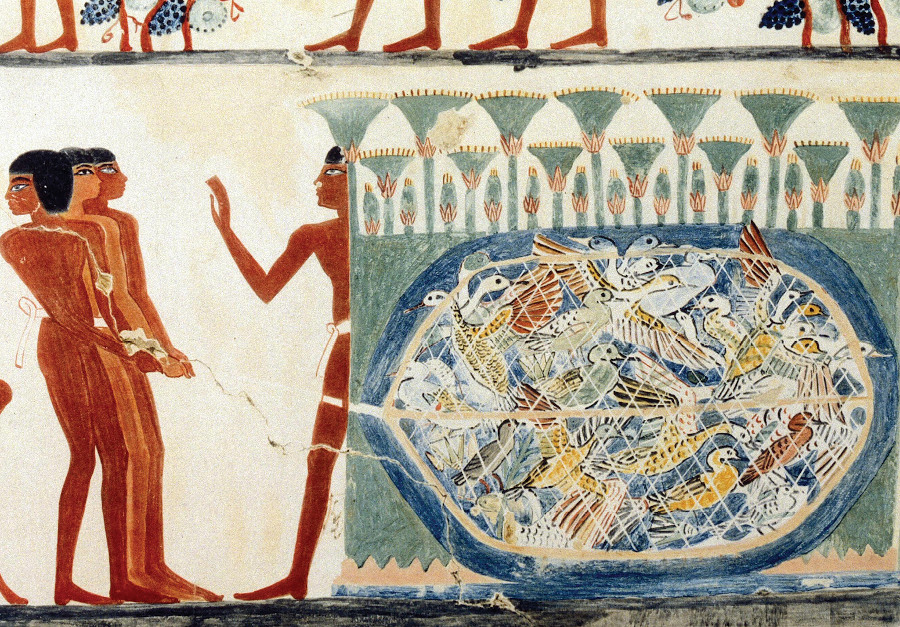
Egyptian men hunting and capturing birds with a net (Thebes, 1420–1411 bc). The psalmist declares that God will protect his people from their enemies: “Surely he will save you from the fowler’s snare” (Ps 91:3).
Z. Radovan/www.BibleLandPictures.com
Return to the main text.
91:4 with his feathers . . . wings. See note on 17:8; cf. Mt 23:37; Lk 13:34.
91:5 terror. As in 64:1 (“threat”), reference is to attack by enemies; thus it is paired with “arrow.” These two references to threats from war are arrayed alongside “pestilence” and “plague” (v. 6), two references to mortal diseases that often reached epidemic proportions. night . . . day. At whatever time of day or night the threat may come, you will be kept safe—the time references are not specific to their respective phrases (see also v. 6).
91:7 ten thousand. Hebrew poetic convention called for 10,000 following 1,000 in parallel construction (see notes on 90:10; 1Sa 18:7; Am 1:3).
91:9 dwelling. See 90:1 and note.
91:11–12 Quoted but misapplied by Satan in Mt 4:6; Lk 4:10–11.
91:11 his angels. See note on 34:7.
91:12 against a stone. On the stony trails of Canaan (Pr 3:23).
91:13 lion . . . cobra . . . great lion . . . serpent. These double references to lions and to poisonous snakes balance the double references of vv. 5–6 and complete the illustrative roster of mortal threats (Am 5:19).
91:14–16 Employing the form of a prophetic message, the author (see introduction) supports his testimony by assuring the godly that it is confirmed by all the promises of God to those who truly love and trust him.
91:14 protect him. See 59:1. acknowledges my name. See 9:10 (“know your name”) and note. my name. See note on 5:11.
91:15 He will call . . . I will answer. See note on 118:5.
91:16 With long life. The climactic counterpoint to Ps 90.
Ps 92 A hymn celebrating the righteous rule of God. Its testimony to the prosperity of the righteous, “planted in the house of the LORD” (v. 13), links it thematically with Ps 91 (see introduction to that psalm), while its joy over God’s righteous reign relates it to the cluster of psalms that follow (Ps 93–100; see especially Ps 94). There are, in fact, reasons to believe that the editors of the Psalter brought together Ps 92–94 as a trilogy that serves as a bridge between Ps 90–91 and 95–99 (see introductions to Ps 93; 94). Notably, God’s name Yahweh (“LORD”) occurs seven times in this psalm. Verses 10–11 suggest that the author may have been one of Israel’s kings.
Following the introduction on praise (vv. 1–3), vv. 4–5 offer the motivation for the praise (“me,” “I”), which is picked up again in vv. 10–11 (“my,” “me,” “My,” “my,” “my,” “my”). Verses 6–9 expound the folly and destiny of evildoers, while vv. 12–15 expound the prosperity of the righteous. Notice also the link between v. 7 and v. 13. The NIV text offers a different analysis of the psalm’s structure.
92 title A song. See note on Ps 30 title. For the Sabbath day. In the postexilic liturgy of the temple, this psalm came to be sung at the time of the morning sacrifice on the Sabbath. (The rest of the weekly schedule was: first day, Ps 24; second day, Ps 48; third day, Ps 82; fourth day, Ps 94; fifth day, Ps 81; sixth day, Ps 93.)
92:1–3 Hymnic introduction.
92:1 LORD . . . Most High. That is, “LORD Most High” (see 7:17; see also note on 3:7). name. See note on 5:11. Most High. A link with Ps 91 (see vv. 1,9 of that psalm). For the title, see note on Ge 14:19.
92:2 love. See article. morning . . . night. Continuously.
92:3 lyre . . . harp. See note on 57:8. harp. See note on Ge 31:27.
92:4–5 Joy over God’s saving acts (vv. 10–11).
92:5 your thoughts. As shown by your deeds.
92:6–9 The fatal folly of evildoers (contrast vv. 12–15).
92:6 Senseless . . . fools. See NIV text note on 14:1; see also 49:10—and note especially 94:8–11. They do not know that the Lord rules righteously. They see the wicked flourishing but do not see the Lord or foresee the end he has appointed for them. The author thus characterizes his “wicked foes” (v. 11), whom the Lord has routed.
92:7 A condensed statement of what is expounded more fully in Ps 73 (see also 37:2; 62:9; 90:5–6 and notes).
92:8 forever exalted. God’s eternal exaltation assures the destruction of his enemies.
92:9 enemies. Here the evildoers, referred to also in v. 7.
92:10–11 Joy over God’s favors (vv. 4–5): God has made him triumphant (89:24) and anointed him with “the oil of joy” (45:7; see also 23:5) by giving him victory over all his enemies.
92:12–15 The secure prosperity of the righteous (contrast vv. 6–9).
92:13 planted in the house of the LORD. Though the wicked may “spring up like grass,” their end is sure (v. 7). But the righteous are planted in a secure place (Ps 91) and so retain the vigor of youth into old age, rejoicing in God’s just discrimination (v. 15). courts. Of the temple (84:2,10; 2Ki 21:5; 23:11–12).
92:15 upright . . . Rock . . . no wickedness in him. See Dt 32:4 and note.
Ps 93 A hymn to the eternal, universal and invincible reign of the Lord, a theme it shares with Ps 47; 95–99. Together these hymns offer a majestic confession of faith in and hope for the kingdom of God on earth. They may all have been composed by temple personnel and spoken by them in the liturgy. Ps 93 celebrates Yahweh’s secure cosmic rule that grounds his righteous and effective rule over human affairs—which is the joy (Ps 92) and the hope (Ps 94) of those who rely on him for protection against the assaults of the godless fools who live by violence. Structurally, the psalm has two short stanzas (vv. 1–2,3–4) and a conclusion (v. 5).
93:1–2 The Lord’s reign, by which the creation order has been and will be secure throughout the ages, is from eternity (Ge 1:1). Though Israel as a nation has come late on the scene, their God has been King since before the creation of the world.
93:1 The LORD reigns. The ultimate truth, and first article, in Israel’s creed (see 96:10; 97:1; 99:1; see also Zec 14:9 and note, as well as Introduction to Psalms: Theology).
93:3–4 Both at and since his founding of the world, the Lord has shown himself to be mightier than all the forces of disorder that threaten his kingdom.
93:3 seas. Reference is to the primeval chaotic waters, tamed and assigned a place by the Lord’s creative word (33:7; 104:7–9; Ge 1:6–10; Job 38:8–11). Implicitly they symbolize all that opposes the coming of the Lord’s kingdom (see 65:6–7; 74:13–14 and notes).
93:4 The thunder of the chaotic waters is no match for the thunder of the Lord’s ordering word (104:7).
93:5 statutes. He whose indisputable rule has made the world secure has given his people life directives that are stable and reliable (19:7)—and that they must honor (95:8–11). your house. His earthly temple—but also the heavenly. for endless days. Qualifies both clauses.
Ps 94 An appeal to the Lord, as “Judge of the earth” (v. 2), to redress the wrongs perpetrated against the weak by arrogant and wicked persons who occupy seats of power. The psalm has links with Ps 92 (see introductions to Ps 92; 93) but is the voice of the oppressed within Israel, seeking redress at God’s throne for injustices done to them by the “fools” smugly established in the power structures of the nation. Thus it is unique within the Ps 90–100 group of psalms and stands here as representative of the many cries of the oppressed found in Books I–III of the Psalter. Following a three-verse introduction, the thought advances regularly in five stanzas of four verses each, with the main thematic shift coming at v. 12.
94:1–3 Initial appeal to God, the Judge.
94:1 avenges. Redresses wrongs (see note on 5:10; see also Dt 32:35,41 and note on 32:35). To avenge is the function of a king in his role as chief executive of the realm. Thus a direct conceptual link with Ps 47; 93; 95–99 is established at the outset. shine forth. Cf. notes on 50:2; 80:1.
94:2 the proud. See vv. 4–7 for a description of them.
94:3 How long . . . ? See note on 6:3.
94:4–7 Indictment of the wicked.
94:4 arrogant words . . . boasting. For similar expressions of the arrogance of the wicked, see 10:2–11 and notes.
94:5 your people . . . your inheritance. Those among them who are vulnerable (v. 6).
94:7 They say. See note on 3:2. Jacob. A synonym for Israel (Ge 32:28).
94:8–11 Warning to the wicked—those “senseless . . . fools” (see 92:6–9; see also NIV text note on 14:1).
94:10 disciplines. Keeps them in line by means of punishment (Lev 26:18; Jer 31:18). teaches. Gives human beings some knowledge of the creation order (Isa 28:26).
94:11 The LORD knows. Contrary to their foolish supposition (v. 7).
94:12–15 Here the focus shifts from the arrogance and folly of the wicked to the happy state of those who count themselves among the Lord’s people and who live under his discipline and rely on his royal protection.
94:12 Blessed. See note on 1:1. discipline . . . teach. See v. 10 and note. Here the author speaks of God’s correcting and teaching his people in the ways of his law.
94:14 people . . . inheritance. See v. 5. The Lord will not abandon the powerless among his people to the injustice of their oppressors. Paul may be echoing this verse in Ro 11:1–2.
94:15 However this difficult verse is to be translated, the author appears to say that God’s righteous rule will restore justice for those who have been wrongfully treated while being themselves innocent—described as “the upright in heart” (v. 21).
94:16–19 The Lord is the only sure court of appeal.
94:17 silence of death. See note on 30:1. Without God’s help the wicked would have silenced the psalmist in the grave, but now it is the wicked for whom the pit will be dug (v. 13).
94:18 When I said. When feeling about to be overwhelmed by the wicked (see note on 38:16). love. See article.
94:20–23 Confidence that the Lord’s justice will prevail. Cf. notes on 89:14; Zec 8:16.
94:20 corrupt throne. A seat of authority that works mischief. The author speaks of injustice at the center of power (cf. notes on Ne 5:6; Zec 8:16).
94:21 righteous. Here referring to those who have not wronged anyone—i.e., “the innocent” (see note on v. 15). For the basic concept, see note on 1:5.
Ps 95 A hymn calling for worship of the Lord, spoken by a priest or Levite to the assembled Israelites at the temple. (See introduction to Ps 93.) Placed at the center of its group (Ps 90–100) and at the beginning of a series of psalms celebrating the universal reign of Israel’s God (Ps 95–99), Ps 95 contains a sharp reminder that Israel’s sense of security under Yahweh’s rule—from which spring both their lament (as in Ps 90; 94) and their praise (as in Ps 91–93; 95–100)—is warranted only if Israel proves to be Yahweh’s loyal and obedient servant. Its function in context is similar to that of Ps 81 (see introduction to Ps 79–83).
The psalm is composed of two parts: (1) a call to praise the Lord of all the earth (vv. 1–5); (2) a call to acknowledge by submissive attitude and obedient heart the Lord’s kingship over his people (vv. 6–11). Each part also has two subdivisions, the latter of which forms the climax. Cf. the structure of Ps 96.
95:1–2 The call to praise God.
95:1 Rock of our salvation. See note on 18:2.
95:3–5 Why Israel is to praise the Lord—because he is above all gods, and there is no corner of the universe that is not in his hand. The ancient pagan world had different gods for different peoples, different geographic areas, different cosmic regions (heaven, earth, netherworld) and different aspects of life (e.g., war, fertility, crafts).
95:4–5 depths . . . mountain peaks . . . sea . . . dry land. All the world—the extremes and all that lies between and all that is in them.
95:6–11 The exhortation to submit to the Lord with obedient hearts—a bent knee is not enough. For a NT reflection on these verses in the light of the advent of Christ, see Heb 3:7—4:13.
95:6–7 The call to confess submission to the Lord by kneeling before him.
95:6 our Maker. Both as Creator of all things (Ge 1) and as Israel’s Redeemer, he has made them what they are: the people of the Lord in the earth (Isa 45:9–13; 51:12–16).
95:7 people of his pasture. See 100:3; Jer 23:1; Eze 34:17–23. Since kings were commonly called the shepherds of their people (see notes on 23:1; 74:1), their realms could be referred to as their pastures (23:2; Jer 25:36; 49:20; 50:45). if only you would hear his voice. In the liturgy of the religious festival, possibly in some such manner as Ps 50 and/or 78. The concern expressed in what follows echoes that of Moses in Dt 6:16–19.
95:8 Meribah . . . Massah. See NIV text notes. The leader of the liturgy reminds Israel of times of their rebellion in the wilderness (Ex 17:7; Nu 20:13).
95:9 me. Official representatives of the Lord, when speaking for him, could shift to first person (see 50:5,7–15; see also note on Ge 16:7). had seen what I did. In Egypt and at the Red Sea—and his provision of food in the wilderness (see Ex 16; see also Nu 14:11).
95:10 forty years. The climax of Israel’s rebellion came when God’s people faithlessly refused to undertake the conquest of Canaan and considered returning to Egypt (Nu 14:1–4). It was then that God condemned them to a 40-year stay in the wilderness (Nu 14:34). angry. See note on 2:5. that generation. The (adult) Israelites who came out of Egypt and covenanted with God at Sinai (Nu 32:13). They are a people . . . my ways. A restatement of the Lord’s word in Nu 14:11. hearts. See note on 4:7. my ways. See 25:4 and note.
95:11 on oath. See Nu 14:28; Dt 1:34–35. never enter my rest. The language of Nu 14:30 is “not one of you will enter the land,” but since the promised land was also called the place where God will give his people “rest” (Jos 1:13,15; see Ex 33:14; Dt 12:10; 25:19), the two statements are equivalent. Cf. note on Heb 3:16–19. rest. A rich concept indicating the Israelites’ possession of a place with God in the earth where they are secure from all external threats and internal calamities (see Dt 3:20; 1Ki 5:4 and notes).
Ps 96 A hymn calling for all nations to praise the Lord as the only God and to proclaim the glory of his reign throughout the world—an OT anticipation of the world mission of the NT people of God (Mt 28:16–20). (See introductions to Ps 93; 95.) This psalm appears in slightly altered form in 1Ch 16:23–33. Here in the Psalter it is paired with Ps 98, with which it shares much in form, language and theme (compare especially their opening and closing stanzas). Each of these in turn is followed by a hymn that celebrates Yahweh’s reign (cf. 97:1; 99:1) and its special benefits for Israel (cf. 97:8–12; 99:4–9). This arrangement suggests that Ps 97 has been linked with 96 and Ps 99 with 98 to form a pair of thematic couplets—introduced by Ps 95.
The psalm is composed of two parts: (1) The first begins with a threefold call to all nations to “sing to the LORD” in praise of his “name” (vv. 1–6); (2) the second begins with a threefold call to all nations to “ascribe to the LORD glory . . . the glory due his name” (vv. 7–13). Each part has two subdivisions, the last of which forms the climax to the whole psalm. Cf. the structure of Ps 95.
96:1–3 The call to all the earth to sing the praise of the Lord among the nations. Triple repetition for emphasis (“Sing . . . sing . . . Sing”) was a common feature in OT liturgical calls to worship (see vv. 7–9 and note; see also 103:20–22; 118:2–4; 135:1; 136:1–3; cf. Isa 6:3 and note).
96:1 new song. See note on 33:3. all the earth. See v. 9; or “all the land,” in which case the call is addressed to all Israel. However, the worldwide perspective of this psalm (see especially v. 7) suggests that here the psalmist has in view broader horizons (see 97:1; 100:1 and note; 117:1; see also note on 9:1).
96:2 name. See v. 8; see also note on 5:11. proclaim his salvation. Proclaim as good news (see 40:9 and note) the Lord’s saving acts in Israel’s behalf (see 3:8; see also 85:9).
96:3 glory. See note on 85:9. marvelous deeds. See note on 71:16–17.
96:4–6 Why “all the earth” (v. 1) is to praise the Lord: He alone is God (Ps 115).
96:4 feared. See note on 15:4.
96:5 made the heavens. As the Maker of the heavenly realm, in pagan eyes the abode of the gods, the Lord is greater than all the gods (97:7).
96:6 Splendor and majesty . . . strength and glory. Two pairs of divine attributes personified as throne attendants whose presence before the Lord heralds the exalted nature of the one, universal King. For similar personifications, see 23:6 and note. glory. The Hebrew for this word here connotes radiant beauty.
96:7–9 The call to all nations to worship the Lord (see 29:1–2 and note). The two half-sentences of 29:2 have been expanded in this psalm.
96:8 courts. Of the temple (84:2,10; 2Ki 21:5; 23:11–12).
96:9 splendor of his holiness. See note on 29:2. tremble. In reverent awe, equivalent to “fear” (v. 4).
96:10–13 The call to all nations to proclaim among the nations the righteous reign of the Lord.
96:10 The LORD reigns. See 93:1 and note. The world . . . with equity. In OT perspective, the world order is one, embracing both its physical and moral aspects because both have been established by God as aspects of his one kingdom and both are upheld by his one rule. Therefore God’s rule over creation and over human affairs (also his acts of creation and redemption) is often spoken of in one breath, and righteousness, faithfulness and love are equally ascribable to both. And since the creation order can still testify to God’s goodness (Ge 1), it often serves in OT poetry (as it does here) as a manifest assurance that God’s rule over human affairs will also be “with equity,” “in righteousness” and “in . . . faithfulness” (vv. 10,13; see 9:7–8; 11:3; 33:4–11; 36:5–9; 57:10; 58:11; 65:6–7; 71:19; 74:13–14,16–17; 75:2; 82:5; 93:3–4; 98:9; 99:4; 119:89–91 and notes). will judge. See v. 13 and note.
96:11–12 Because God’s kingdom is one (see v. 10 and note), all his creatures will rejoice when God’s rule over humankind brings righteousness to full expression in his cosmic kingdom (see note on 65:13; see also 97:7–9). For the present state of the creation as it awaits the fullness of redemption, see Ro 8:21–22 and notes.
96:13 comes . . . comes . . . will judge. Because God reigns over all things and is the Lord of history, Israel lived in hope (as the prophets announced) of the coming of God—his future acts by which he would decisively deal with all wickedness and establish his righteousness in the earth. righteousness. See note on 4:1.
Ps 97 A hymn of joyful celebration of the Lord’s righteous reign over all the earth (see introductions to Ps 93; 95), with special attention to the benefits of the Lord’s reign enjoyed by Israel (see introduction to Ps 96). The psalm’s two main divisions (vv. 1–6,8–12—closely balanced, having 42 and 43 Hebrew words, respectively) are joined by a centered verse (v. 7; see note on 6:6) that serves as a counterpoint to the main theme. The opening verses of the two main divisions are thematically linked: v. 1, “be glad . . . rejoice”; v. 8, “rejoices . . . are glad”—in reverse order, a frequent stylistic device in OT poetry. The first major division is framed by references to “the earth” (v. 1) and “the heavens” (v. 6), the second by references to “Zion . . . the villages of Judah” (v. 8) and the “righteous” (v. 12).
97:1–6 A testimony to the nations—that they too have seen God’s majesty displayed (vv. 2–6) and ought to rejoice with Israel that the Lord reigns supreme.
97:1 The LORD reigns. See 93:1 and note. earth. See 96:1; 99:1; 117:1; see also note on 9:1. distant shores. Even distant lands reached by the far-ranging ships that sail the seas (1Ki 9:26–28; 10:22; Isa 60:9; Jnh 1:3).
97:2–6 The Lord’s majestic glory revealed in the sky’s awesome displays, especially in the thunderstorm (see 18:7–15 and note; see also introduction to Ps 29).
97:2 Clouds and thick darkness. The dark storm clouds that hide the sun and cast a veil across the sky are dramatic visual reminders that the fierce heat and brilliance (also metaphors) of God’s naked glory must be veiled from creaturely eyes (Ex 19:9; 1Ki 8:12). Thus also a curtain closed off the Most Holy Place in the tabernacle and temple (Ex 26:33; 2Ch 3:14), veiling it in darkness. righteousness. See v. 6; see also note on 4:1. foundation of his throne. God rules by his power (66:7), but his reign is founded on righteousness and justice, which also the heavens proclaim (see v. 6 and note). That a throne was established by righteousness and justice was proverbial in Israel (see Pr 16:32; 25:5; 29:14; cf. Ps 9:7–8; 103:6,19 and notes).
97:3 Fire. Manifested in the storm cloud’s lightning bolts (v. 4), fire often signified God’s judicial wrath (see, e.g., 21:9; 50:3; 83:14; Dt 4:24; 9:3; 32:22; 1Ki 19:12; Isa 10:17; 30:27,30; see also note on La 1:13).
97:4 earth. Here the land realm (the continents) personified.
97:6 proclaim his righteousness. The stable order of the heavens’ vast array “speaks” (19:1–4); it declares that God’s reign similarly upholds the moral order (see note on 96:10). all peoples see. Verses 2–6 have spoken of general revelation (cf. 19:1–6).
97:7 The center verse (see note on 6:6) and counterpoint of the psalm: joy to all who acknowledge the Lord; shame and disgrace to those who trust in false gods. worship him. With biting irony the psalm calls on all the gods that people foolishly worship as if they were real to bow in worship before the Lord (see v. 9; see also 29:1 and note).
97:8–12 A declaration of Zion’s joy that the Lord reigns (vv. 8–9), and a reminder that only those who hate evil have real cause to rejoice in his righteous rule (vv. 10–12).
97:8 Zion hears. That “the LORD reigns” (v. 1) in “righteousness” (v. 6). judgments. The executive and judicial acts of the Lord who reigns (v. 1) over all human affairs (105:7; Isa 26:9), especially his saving acts in Israel’s behalf (48:11; 105:5; Dt 33:21).
97:9 Most High. See note on Ge 14:19.
97:10 faithful ones. See note on 4:3.
97:11 Light. See 27:1 and note; see also 36:9. righteous. See v. 12; see also note on 1:5. heart. See note on 4:7.
Ps 98 A hymn calling for joyful celebration of the Lord’s righteous reign (see introductions to Ps 93; 95). Its beginning and end echo Ps 96, with which it has been paired (see introduction to Ps 96). The three stanzas progressively extend the call to ever wider circles: (1) the worshiping congregation at the temple (vv. 1–3); (2) all the peoples of the earth (vv. 4–6); (3) the whole creation (vv. 7–9). The first stanza recalls God’s revelation of his righteousness (v. 2) in the past; the last stanza speaks confidently of his coming rule “in righteousness” (v. 9); the middle stanza is enclosed by the jubilant cry “Shout for joy” (vv. 4,6).
98:1–3 The call to celebrate in song God’s saving acts in behalf of his people.
98:1 new song. See note on 33:3. marvelous things. See note on 9:1 (“wonderful deeds”).
98:2 made . . . known . . . revealed . . . to the nations. God’s saving acts in behalf of his people are also his self-revelation to the nations; in this sense God is his own evangelist (see 77:14 and note on 46:10; see also Isa 52:10). salvation . . . righteousness. God’s saving acts reveal his righteousness (see notes on 4:1; 71:24).
98:4–6 The call to all the earth to join in the celebration.
98:4 See 100:1. all the earth. The peoples of the earth (see 96:1 and note; see also 99:1).
98:5 harp. See note on Ge 31:27.
98:6 trumpets. The special long, straight trumpets of the sanctuary (referred to only here in Psalms; see notes on Nu 10:2–3,10). ram’s horn. The more common trumpet (referred to also in 47:5; 81:3; 150:3; see note on Joel 2:1).
98:7–9 The call to the whole creation to celebrate (see note on 96:11–12).
98:7 sea . . . world. The two great regions of creaturely life.
98:8 rivers . . . mountains. From the rivers to the mountains, let every feature of the whole earth clap and sing (see note on 65:13).
98:9 comes to judge. See 96:13 and note. Israel in faith lived between the past (vv. 1–3) and the future righteous (saving) acts of God. righteousness . . . equity. See 96:10 and note.
Ps 99 A hymn celebrating the Lord as the great and holy King in Zion—with special emphasis on the benefits of the Lord’s reign for Israel, a feature it shares with Ps 97 (see introduction to Ps 96). In developing his theme, the poet makes striking use of the symbolic significance (completeness) of the number seven: Seven times he speaks of the “LORD,” and seven times he refers to him by means of independent personal pronouns (Hebrew). (See introduction to Ps 93.)
The form is symmetrical, with four stanzas of three Hebrew poetic lines each and two main divisions (marked by a refrain) that are closely balanced, having 42 and 41 Hebrew words, respectively—a formal feature it shares with Ps 97 (see introduction to that psalm). The lesser refrain, “he is holy” (vv. 3,5, and expanded in v. 9), probably reflects a traditional, threefold liturgical rubric (see Isa 6:3; Rev 4:8; see also Ps 96:1–3,7–9 and notes for further evidence of a liturgical penchant for triple repetition). The second half of the psalm develops the theme introduced in the second stanza.
99:1–3 The God enthroned in Zion is ruler over all the nations—let them acknowledge him.
99:1 The LORD reigns. See 93:1 and note. tremble . . . shake. In reverent awe before God. cherubim. See 80:1; see also notes on Ex 25:18; Eze 1:5 and photo below.
An ivory plaque from Megiddo (13th–12th century bc) depicts a ruler on his cherub-flanked throne with his attendants inspecting prisoners. Psalm 99:1 describes the Lord as “enthroned between the cherubim.” Verse five also says we are to “Exalt the LORD our God and worship at his footstool”—a footstool can also be seen on the ivory plaque.
Z. Radovan/www.BibleLandPictures.com
Return to the main text.
99:3 Let them praise. As the Great King, he ought to be shown the fear (v. 1) and honor that are his due. name. See v. 6; see also note on 5:11. holy. See vv. 5,9; see also Introduction to Leviticus: Theological Themes and note on Lev 11:44.
99:4–5 The Lord has shown the quality of his rule by what he has done for Israel.
99:4 is mighty . . . loves justice. Two chief characteristics of God’s reign. established equity. That is, created conditions in the world that embody equity—especially for Israel (see 96:10 and note). Jacob. A synonym for Israel (Ge 32:28). just and right. Justice and righteousness, as in 97:2 (cf. 119:121; Eze 18:5 and notes). Though even the heavens proclaim God’s righteousness (see 97:6 and note), it is in the whole complex of his saving acts in and for Israel that the righteousness of God’s reign is especially disclosed (see 98:2 and note).
99:5 See also v. 9. For other refrains in the Psalms, see introduction to Ps 42–43. footstool. God’s royal footstool (2Ch 9:18), here a metaphor linking the heavenly throne with the earthly; when God sits on his heavenly throne, his earthly throne is his footstool (here “his holy mountain,” v. 9; see 132:7; 1Ch 28:2; La 2:1; see also photo).
99:6–7 In Israel the Lord provided priestly intermediaries, who (1) were appointed to intercede with him on behalf of his faltering people (v. 6), and (2) were given knowledge of his will so they could instruct Israel (v. 7).
99:6 Moses . . . Aaron . . . Samuel. These three no doubt serve here as representatives of all those the Lord used as intermediaries with his people in times of great crises. priests . . . who called on his name. The priestly function of intercession is highlighted (see Ex 17:11 and note; 32:11–13,31–32; Nu 14:13–19; 21:7; 1Sa 7:5, 8–9; 12:19,23; Jer 15:1). they called . . . he answered. See note on 118:5. answered them. See v. 8; see also the Lord’s responses to the intercessions referred to in note on vv. 6–7.
99:7 spoke to them from the pillar of cloud. Though reference may be to all Israel (“them”), more likely the hymn recalls God’s speaking with Moses (Ex 33:9) and Aaron (Nu 12:5–6). But that special mode of revelation in the wilderness may also be generalized here to include God’s revelations to Samuel, who was called to his prophetic ministry at the sanctuary, “where the ark of God was” (1Sa 3:3; see also 1Sa 12:23). they kept. However imperfectly, it was in Israel that God’s righteous statutes and decrees were kept because only in Israel had they been made known (147:19–20; Dt 4:5–8).
99:8–9 The justice and righteousness of God’s rule in Israel (v. 4) have been especially shown in the manner in which he has dealt with the nation’s sins (see Ex 34:6–7; see also note on 4:1).
99:9 holy mountain. See v. 5 and note. the LORD our God is holy. Climactic expansion of the secondary refrain.
Ps 100 A hymn calling for praise to the Lord. This psalm closes the series that begins with Ps 90. It has special affinity with 95:1–2,6–7; see also Ps 117. (See introduction to Ps 93.) The second main division (vv. 4–5) parallels the structure of the first (vv. 1–3), namely, a call to praise followed by a declaration of why the Lord is worthy of praise.
100 title grateful praise. See v. 4; see also note on 75:1. Perhaps it indicates that the psalm was to accompany a thank offering (see note on 7:17; see also Lev 7:12).
100:1 all the earth. Though vv. 3,5 clearly speak of God’s special relationship with Israel, the call to worship goes out to the whole world, which ought to acknowledge the Lord because of what he has done for his people (see also Ps 98–99; 117).
100:3 Know. Acknowledge. made us. See 95:6 and note. sheep of his pasture. See 95:7 and note; see also note on 23:1.
100:4 his gates. The gates of the temple (see 24:7 and note). courts. Of the temple (see 84:2,10; 2Ki 21:5; 23:11–12).
100:5 the LORD is good. See 73:1; 1Ch 16:34 and notes. love. See article.
Ps 101–110 A collection of ten psalms located between two other groups (see introductions to Ps 90–100; 111–119) and framed by two psalms that pertain to the king (the first the king’s vow to pattern his reign after God’s righteous rule; the last God’s commitment to maintain the king—his anointed—and give him victories over all his enemies). This little psalter-within-the-Psalter is concentrically arranged. Inside the frame, Ps 102 and 109 are laments of individuals in times of intense distress; Ps 103 and 108 praise the Lord for his “great . . . love” that reaches to the heavens (103:11; 108:4); Ps 104 and 107 are complements, with 104 celebrating God’s many wise and benevolent acts in creation and 107 celebrating God’s “wonderful deeds” (vv. 8,15,21,24,31) for people through his lordship over creation. The remaining two are also complements, with Ps 105 reciting the history of Israel’s redemption and 106 reciting the same history as a history of Israel’s rebellion. This little psalter includes most of the forms and themes found in the rest of the Psalter. Its outer frame is devoted to royal psalms and its center pair to recitals of Israel’s history with God. Meanwhile, its themes range from creation and God’s eternal enthronement to the covenant with Abraham, Isaac and Jacob, Israel’s exodus from Egypt and entrance into Canaan, their exile and restoration, and finally the ultimate triumph of the Lord’s anointed. The traditional division between Books IV and V at Ps 107 was probably done by a later compiler, breaking up the collection consisting of Ps 101–110.
Ps 101 A king’s pledge to reign righteously (2Ki 23:3), after the pattern of God’s rule. For its relationship to Ps 110, see introduction to Ps 101–110. If authored by David (see title), it may have been composed before the ark of God was successfully brought into Jerusalem (see note on v. 2a; see also 2Sa 6). Only Christ, the great Son of David, has perfectly fulfilled these commitments.
Composed of seven couplets (the number of completeness), the psalm begins with a twofold introduction (vv. 1–3a; see notes below), followed by a five-stanza (vv. 3b–8) elaboration of the theme of the second stanza. Of these five stanzas, the middle one (v. 6) speaks of the king’s commitment to the “faithful” and “blameless,” while the other four (vv. 3b–4,5,7,8) declare his repudiation of all the “faithless” and “wicked” in the land. (For the parallel relationship of stanzas six and seven with three and four, see notes below.) The middle stanza is linked with stanzas one and two also by the catchword “blameless.” (For centering in the Psalms, see note on 6:6.) The whole psalm is framed by references to the “LORD” in the first and last stanzas (vv. 1,8). The second stanza from the end echoes two phrases found in the second stanza from the beginning (“of/in my house” [vv. 2,7] and “in my presence” [v. 7]—in Hebrew the same as for “look with approval” [v. 3]), thus forming an inner frame. For other doublets, see notes below.
101:1–2a Celebration of the pattern of God’s reign, which the king makes the model for his own.
101:1 love and justice. Two of the chief qualities of God’s rule (see 6:4; 99:4 and notes). For this particular combination, see Hos 12:6; Mic 6:8; cf. Zec 7:9.
101:2a blameless. See vv. 2b,6; see also note on Ge 17:1. when . . . ? Perhaps expressive of David’s yearning for the presence of the ark of the Lord in his royal city as the sign of God’s readiness to be with him and sustain him in his pledge to reign as he ought (see 2Sa 6 and note on 6:2). For later kings it would be a plea for divine enablement relative to the pledge given in vv. 1–2 (cf. Ps 72; 1Ki 3:7–9).